FINANCIAL PROFITABILITY ANALYSIS OF TOBACCO CULTIVATION IN SOME SELECTED
AREAS OF LALMONIRHAT DISTRICT
ASHEK MD. ASIF
DEPARTMENT OF AGRICULTURAL ECONOMICS SHER-E-BANGLA AGRICULTURAL UNIVERSITY
SHER-E-BANGLA NAGAR, DHAKA -1207
DECEMBER, 2018
FINANCIAL ANALYSIS OF TOBACCO CULTIVATION IN SOME SELECTED AREAS OF LALMONIRHAT DISTRICT
BY
ASHEK MD. ASIF
REGISTRATION NO. 10-04204A Thesis
submitted to the Faculty of Agribusiness Management, Sher-e-Bangla Agricultural University, Dhaka
in partial fulfillment of the requirements for the degree of
MASTER OF SCIENCE (MS) IN
AGRICULTURAL ECONOMICS
SEMESTER: JULY-DECEMBER, 2018Approved by:
Dr. Bazlul Ameen Ahmad Mustafi
Former Director, BRRI Joydebpur, Gazipur
Supervisor
Dr. Fauzia Yasmin
Director
Technology Transfer and Monitoring Unit, BARC
Co-supervisor
Prof. Gazi M. A. Jalil Chairman
Examination Committee
Department of Agricultural Economics Sher-e-Bangla Agricultural University
CERTIFICATE
This is to certify that the thesis entitled, “
Financial analysis of tobacco cultivation in some selected areas of Lalmonirhat district
” submitted to the Faculty of Agribusiness Management, Sher-e-Bangla Agricultural University, Dhaka, in partial fulfillment of the requirements for the degree of MASTER OF SCIENCE (MS) in AGRICULTURAL ECONOMICS, embodies the result of a piece of bonafide research work carried out by Ashek Md.Asif, Registration No. 10-04204 under my supervision and guidance. No part of the thesis has been submitted for any other degree or diploma.
I further certify that such help or source of information, as has been availed of during the course of this investigation has duly been acknowledged.
Dated: December, 2018
Place: Dhaka, Bangladesh
Dr. Bazlul Ameen Ahmad Mustafi Former Director,BRRI Joydebpur, Gazipur Emai:[email protected] Mobile: +8801712105868
Dr,Bazlul Ameen Ahmad Mustafi Former Director, BRRI
Joydebpur, Gazipur SUPERVISOR
DEDICATED TO
MY BELOVED PARENTS
i ABSTRACT
The study was undertaken with the objective of determining the profitability level of tobacco cultivation in the Lamonirhat district of Bangladesh. To collect information, 67 tobacco growings fermers some selected on the basis of random sampling technique for this study. Tabular technique as used for the presentation of findings. 67 which were randomly selected from namely village Bairaty, Char-Bairaty, Kashiram,Parulia and Gorol in Kaliganj. The study revealed that per hectare gross return of Tobacco Cultivation were Tk. 230217.27 of per hectar cost of cultivation Tk. 19732.09 and Net return were Tk.50485.18 respectively. The Benefit-cost ratio of the study was found 1.28. Several problems were Identified to the cultivation of Tobacco, but higher prices of fertilizer cost are the major problems. In this areas needs the alloction of the government to solve these problems. Among the suggestion, they told that HYV and drought-tolerant variety would be good for them.
ii
ACKNOWLEDGEMENT
At First the author would like to thank almighty Allah, the most merciful and compassionate, the most gracious and beneficent to whom every praise is due and for leading the author to this level and enabling to complete this research work and to his prophet Mohammad (SM) who is forever a torch of knowledge and guidance for humanity as a whole with whose delighting the present and endeavor beautiful.
The author Expressing indebtedness, deepest sense of gratitude sincere appreciation and profound regards to my honorable supervisor professor Bazlul Ameen Ahmad Mustafi ,Former Director, BRRI. Joydebpur, Gazipur, for his scholastic guidance, cordial support, valuable instructions, suggestions and constant encouragement throughout the research work.
The author especially grateful to his respected co-supervisor, Dr. Fauzia Yasmin, Director, Technology Transfer and Monitoring Unit, Bangladesh Agricultural Research Council (BARC), Dhaka, for her proper guidance, inspiring co-operation and encouragement during the research work and preparation of the thesis.
The author expresses his sincere respect and heartfelt gratitude to his honorable Associate Professor Dr. Md. Mizanul Haque, deparmentt of Development & Proverty Studies, for his constructive and necessary help.
The author expresses his profound respect and gratitude to his elder brothers Nasim and Shabuj and sisters Lipy and Popy for their constant inspiration, encouragement, and affection to complete his study.
The author wishes to express cordial thanks to all of his friends and brothers especially Saikot, Mannan Munna, Tofayel Ahmed Linkon, Mahabubur Rahman Rony and Kazi Faysal Ahmed for their heartfelt co-operation throughout the study.
iii
TABLES OF CONTENTS
CHAPTER TITLE PAGE
NO.
ABSTRACT i
ACKNOWLEDGEMENT ii
TABLE OF CONTENTS iii
LIST OF TABLES iv
LIST OF FIGURES vii
LIST OF APPENDIX vii
LIST OF ACRONYMS viii
CHAPTER I INTRODUCTION
1.1 Background of the study 1
1.2 Importance of tobacco in the economy of Bangladesh 2 1.3 Contribution of tobacco to the total production of Bangladesh
3
1.4 Impacts of tobacco cultivation 4
1.6 Justification of the study 5
1.7 Objectives of the study 5
1.8 Organization of the study 6
CHAPTER II REVIEW OF LITERATURE 7
CHAPTER III METHODOLOGY
3.1 Introduction 15
3.2 Selection of study region 15
3.3 Sample size 16
3.4 Period of study 17
3.5 Preparation of survey schedule 17
3.6 Collection of data 17
3.7 Accuracy of the data 17
3.8 Processing of data 18
iv
TABLES OF CONTENTS (CONT’D.)
3.9 Analytical technique 18
3.9.1 Gross margin 18
3.9.2 Net return 19
3.9.4 BCR (Benefit cost ratio) 19
CHAPTER IV DESCRIPTION OF THE STUDY AREA
4.1 Location 20
4.2 Population 21
4.3 Education 22
CHAPTER V RESULTS AND DISCUSSION
5.1 Socio-economic profile of tobacco farmers 23
5.1.1 Age 23
5.1.2 Educations 24
5.1.3 Family size 25
5.1.4 Farm size 25
5.1.5 Farming experience 26
5.1.6 Occupation status 26
5.1.7 Annual family income 28
5.1.8Annual family expenditure 28
5.2 To assess the profitability level of tobacco cultivation.
29
5.2.1 Inputs use and costs for tobacco production 29
5.2.1.1 Human labor cost: 29
5.2.1.2 Cost of animal labor and power tiller 29
5.2.1.3 Seedling cost: 29
5.2.1.4 Cost of fertilizer: 29
5.2.1.5 Cost of irrigation: 29
v
TABLES OF CONTENTS (CONT’D)
5.2.1.6 Cost of pesticides: 29
5.2.1.7 Curing cost 29
5.2.1.8 Interest on operating capital 30
5.2.1.9 Land use cost 30
5.2.2 Estimation average yields and gross return 30
5.2.3 Benefit cost ratio (BCR) 30
5.3 To identify the constraints of tobacco cultivation 31 5.4 Probable suggestion to overcome those constraints 32
CHAPTER VI SUMMARY, CONCLUSION AND RECOMMENDATIONS
6.1 Summary 34
6.2 Conclusion 36
6.3 Key findings 36
6.4 Recommendations 37
REFERENCES 39
APPENDIX 41
vi
LIST OF TABLES
SL. No. Title Page
01
Table 1.1 Area and production of tobacco in Bangladesh
3
02 Table 4.1 Population of Lalmonirhat 21
03 Table 4.2 Educational status of Lalmonirhat 22 04 Table 5.1 Age distribution of the members of sample farm
families
24
05 Table 5.2 Educational status of tobacco farmers 24 06 Table 5.3 Family size and gender distribution of tobacco
farmers
25
07 Table 5.4 Farm size of the tobacco farmers 25
08 Table 5.5 Farming experience of the tobacco farmers 26 09 Table 5.6 Occupational status of the household heads of the
sample farmers
27
10 Table 5.7 Annual family income of the tobacco farmers 28 11 Table 5.8 Annual family expenditure of the tobacco farmers 28 12 Table 5.9 Per hectare costs, returns, and other parameters
for tobacco producing farmers
31
13 Table 5.10 Problems and constraints 32
14 Table 5.11 Suggestion to the problems 33
vii
LIST OF FIGURES
SL. No. Title Page
01 Figure 1.1 Tobacco cultivation in Bangladesh 4
02 Figure 4.1 Geo cod of Lalmonirhat 20
03 Figure 5.1 Age distribution of the growers 23
04 Figure 5.2 Occupations of the farmer 27
05 Figure 5.3 Total cost, gross return and net return of tobacco 30
LIST OF APPENDICES
Appendix A Interview schedule 41
viii
ACRONYMS AND ABBREVIATIONS
BBS Bangladesh Bureau of Statistics
BER Bangladesh economic review
BCR Benefit-cost ratio
GOB Government of Bangladesh
0C Degree celsius
e.g. Exempil gratia (for example)
et.al. Et alia (and others)
etc. Et cetera (and others and so forth)
GDP Gross domestic product
GM Gross margin
GR Gross return
HSC Higher secondary certificate
SSC Secondary school certificate
Ha Hectare
HYV High yielding varieties
Kg Kilogram
Km2 Kilometer square
Ln Natural logarithm
M.T Metric ton
MFC Marginal factor cost
MVP Marginal variable cost
M0P Murate of Potas
MT Metric ton
TSP Triple super phosphate
TVC Total variable cost
TC Total cost
MU Marginal utility
RTS Returns to Scale
PPP Purchasing power parity
Agri. Agriculture
Econ. Economics
Mgt. Management
1
CHAPTER I INTRODUCTION
1.1 Background of the study
Bangladesh is mainly an agricultural country. Agriculture is here the single largest producing sector of the economy and covers approximately 12.68% (2019-2020) to the total Gross Domestic Product (GDP) of the country. This sector also accommodates around 40.6% (in 2016-17) of labor force. GDP growth rate of Bangladesh mainly depends on the performance of the agriculture sector. Due to natural calamities like flood cyclone, drought, loss of production in both food and cash crops are almost a regular phenomenon. Yet in recent years, there has been a substantial increase in food grain production. Agricultural holding in Bangladesh is generally small but use of modern machinery and equipment is gradually increasing.
Rice, jute, sugarcane, potato, pulses, wheat, tea and tobacco are the principal crops of Bangladesh. Crop diversification program, credit supply, extension work, research and input distribution policies pursued by the government are yielding positive results. The country is now on the threshold of attaining self-sufficiency in food grain production (BBS, 2018).
Tobacco has been introduced since mid-sixties of the last century into the fields where food crops were grown, and more widely after liberation in 1971 by the British American Tobacco Company in Teesta silt in Rangpur area. Although Bangladesh Agricultural Research Institute (BARI) has conducted research and development activities of tobacco and abandoned in 1995, tobacco production has mainly been pushed by big multinational companies such as British American Tobacco Company through contract growers. Bangladesh is one of the largest tobacco consuming countries in the world. Employment in tobacco farming accounts for less than 0.5% of agricultural employment in Bangladesh. Tobacco is grown throughout the country, with the largest tobacco growing areas including Rangpur, Kushtia, and Chittagong Hill. After many years as a net importer of tobacco leaf, acreage and yields rose beginning 1999, and Bangladesh has become a net exporter in recent years, exporting about one-third of the tobacco grown (Barakat A. et al., 2012).
2
1.2 Importance of tobacco in the economy of Bangladesh
At present it is claimed that Bangladesh produces international standard Flue Cured Virginia (FCV) and the demand for Bangladesh tobacco is growing in the global market. This is perhaps due to restrictions in other countries on tobacco cultivation.
Obviously, this is not good news for food production. The production of Virginia variety of tobacco during 2008-9 was 22,277 metric tons, while the other varieties, such as Jati were 8,437 metric tons and Motihari was 9,270 metric tons three varieties of tobacco -- Jati, Motihari and Virginia -- are grown in different districts of Bangladesh. Jati and Motihari are mostly grown in Rangpur and Bandarban, while Virginia is mostly grown in Kushtia, Rangpur, Jessore and Dhaka. Other varieties such as Burley are also grown in limited quantities. In terms of land area covered by all three kinds of tobacco, Rangpur still remains highest with 40345 acres during 2008-09 followed by Kushtia 22241 and Bandarban 4678 acres of land. Besides tobacco is extending to Jessore, Jhenaidah, Nilphamari, Lalmonirhat and even in Manikganj and Tangail. Among the three varieties, Virginia is the most „popular‟
variety for the companies. British American Tobacco (BAT) Company has introduced the Flue cured Virginia in 1967 on an experimental basis and by 1976 it started producing it commercially. Until 1971 Bangladesh had to import 95% of the total FCV consumed here. 4. The later two varieties are used for producing bidi - the local and cheaper version of cigarette. In the 2005-06 financial year, Bangladesh exported tobacco worth 95 crore 85 lakh 35 thousand (over 958 million) taka. This is not a big amount for an export commodity. Till 2007-08 the import of unmanufactured tobacco (Raw) was 1125 million Taka Tobacco in the Research areas, more than what was exported. In comparison, the export of vegetables during 2008-9 was 8,945 million Taka according to Foreign Trade Section of BBS as recorded in the Statistical Yearbook of Bangladesh 2009 (Farida, 2011).
3
1.3 Contribution of tobacco to the total production of Bangladesh
Tobacco cultivation is gradually increasing day by day. In 2000-01 year total tobaccos cultivable lands were 74 acreage and gross production of tobacco whole over the Bangladesh were 37 metric tons. In 2017-18 this acreages of tobacco cultivation increased by 105 where production were 89 metric tons. This occurs probably due to the farmers getting high yield with a satisfactory price comparing to other crops like potato or maize. It also may occur due to easy accessibility of tobacco cultivable accessories with loan facilities which are provided by the tobacco related goods manufacturing companies and factories before the season of tobacco cultivation .This facilities accelerate the capability among the farmers about tobacco cultivation with a secured tobacco selling market.
Table 1.1: Area and production of tobacco in Bangladesh
Year Tobacco
Acreage „000‟
Production
„000‟ M. Ton
2000-01 74 37
2001-02 75 38
2002-03 76 37
2003-04 75 39
2004-05 74 40
2005-06 78 43
2006-07 76 39
2007-08 76 40
2008-09 77 40
2009-10 94 54
2010-11 121 79
2011-12 126 85
2012-13 124 181
2013-14 124 85
2014-15 127 94
2015-16 115 88
2016-17 115 88
2017-18 105 89
Source: BBS, 2018
4 1.4 Impacts of tobacco cultivation:
Tobacco smoking and other forms of tobacco use impose a large and growing public health burden globally and in Bangladesh. Globally, tobacco use currently causes 5.4 million premature deaths each year, and current trends predict that one billion people will die from tobacco use in the 21st century (WHO, 2018). Smoke-free policies are limited to health care and educational facilities and do not cover bars, restaurants, government buildings, transport, indoor workplaces and other indoor public places.
Tobacco advertising is banned on television and radio, in local magazines and newspapers, and on billboards, but is allowed at the point of sale. Tobacco company sponsorship of tournaments is banned, but promotional discounts and distribution of free samples are allowed. Health warnings are required on cigarette and bidi packages, but do not include graphic images, and no warnings are required on smokeless tobacco products. Tobacco excise taxes have increased over time, but tobacco products have become more affordable over time and significant tax increases have not been adopted to curb tobacco use. Currently, tobacco use causes nearly six million deaths per year worldwide more than one in ten adult deaths.
About 70% of current tobacco-attributable deaths occur in low and middle-income
countries (Jha P. et al., 1999).
Figure 1.1 Tobacco Cultivation in Bangladesh
5 1.5 Justification of the study
Agriculture is the salvation of Bangladesh. The most important livelihood of the people of Bangladesh is associated with Agriculture. Farmers of this country at the outset produce crops what satisfies family life wants then they exemplify interest on production of cash crop such as cotton, jute, tea, tobacco, coffee, and so on are mostly expected in dealing demand of home market and sell abroad in foreign currency in support of developing countries. Tobacco has a substantial implication in nationalized economy. Small hard work has been completed to study the economics of the tobacco production. By the way cost of production and profitability determination should be premeditated. This study will be intended at determining causes of variation and aspect of success among farms growing tobacco; it is indispensable both for the farmers and planners to carry out a program considered for eliciting agricultural production. Updating knowledge on profitability of Tobacco is one rationalization of this study. It is essential to evaluate substitute profitability of this investment in terms of land and other resources keen to tobacco farming. This research possibly will endow with a number of detailed benefits to the individual farmers for efficient operation and management of the farm and also to the research personnel for supplementary studies of elated natural history and to the planners and policy makers who provide the farmers centrally for Marco- level strategy assessment.
1.6 Objectives of the study The objectives of the study were:
To describe the socio-economic profile of tobacco cultivation;
To assess the profitability level of tobacco cultivation;
To identify the problems of tobacco cultivation, and
To suggest to overcome those problems.
6 1.7 Organization of the study
The study has been organized into these below chapters. Following the introducing chapter 1,, In a review of literature in presented in chapter 2, and the Methodology of the study is described chapter 3,, In chapter 4 description of the study area is explained,, In chapter 5 result and discussion are presented,, Finally summary, conclusion and policy recommendation are explains of the study chapter 6.
7
CHAPTER II
REVIEW OF THE LITERATURE
Tobacco has been introduced since mid-sixties of the last century into the fields where food crops were grown, and more widely after liberation in 1971 by the British American Tobacco Company in Teesta silt in Rangpur area. Bangladesh is one of the largest tobacco consuming countries in the world. Employment in tobacco farming accounts for less than 0.5% of agricultural employment in Bangladesh.
Tobacco is grown throughout the country, with the largest tobacco growing areas including Rangpur, Kushtia, and Chittagong Hill. The purpose of this paper is to reveal some basic social and econmical characteristics of tobacco growers. This paper investigates the impact of tobacco cultivation on environment and health. This paper also identifies the factors which are responsible for the profits of tobacco cultivation.
The paper finds that tobacco cultivation has some negative effects on environment and health though it has some short term positive effects such as more profit. The paper also shows that the profits depends on so many factors some of them are cost on seed, fertilizer and other pesticides, labor, irrigation, production, price, etc. Tobacco has been introduced since mid-sixties of the last century into the fields where food crops were grown, and more widely after liberation in 1971 by the British American Tobacco Company in Teesta silt in Rangpur area. Bangladesh is one of the largest tobacco consuming countries in the world. Employment in tobacco farming accounts for less than 0.5% of agricultural employment in Bangladesh.
Tobacco is grown throughout the country, with the largest tobacco growing areas including Rangpur, Kushtia, and Chittagong Hill. The purpose of this paper is to reveal some basic social and economical characteristics of tobacco growers. This paper investigates the impact of tobacco cultivation on environment and health. This paper also identifies the factors which are responsible for the profits of tobacco cultivation. The paper finds that tobacco cultivation has some negative effects on environment and health though it has some short term positive effects such as more profit. The paper also shows that the profits depends on so many factors some of them are cost on seed, fertilizer and other pesticides, labor, irrigation, production, price, etc.
Tobacco has been introduced since mid sixties of the last century into the fields where
8
food crops were grown, and more widely after liberation in 1971 by the British American Tobacco Company in Teesta silt in Rangpur area. Bangladesh is one of the largest tobacco consuming countries in the world. Tobacco has been introduced since mid sixties of the last century into the fields where food crops were grown, and more widely after liberation in 1971 by the British American Tobacco Company in Teesta silt in Rangpur area. Bangladesh is one of the largest tobacco consuming countries in the world. In 2003 Mpyazzem and Mahbubur stated Employment in tobacco farming accounts for less than 0.5% of agricultural employment in Bangladesh. Tobacco is grown throughout the country, with the largest tobacco growing areas including Rangpur, Kushtia, and Chittagong Hill. The purpose of this paper is to reveal some basic social and economical characteristics of tobacco growers. This paper investigates the impact of tobacco cultivation on environment and health. This paper also identifies the factors which are responsible for the profits of tobacco cultivation. The paper finds that tobacco cultivation has some negative effects on environment and health though it has some short term positive effects such as more profit. The paper also shows that the profits depends on so many factors some of them are cost on seed, fertilizer and other pesticides, labor, irrigation, production, price, etc.
According to the official Agricultural Statistics three varieties of tobacco--Jati, Motihari and Virginia-- are grown in different districts of Bangladesh. Jati and Motihari are mostly grown in Rangpur and Bandarban, while Virginia is mostly grown in Kushtia, Rangpur, Jessore and Dhaka. Other varieties such as Burley are also grown in limited quantities. In terms of land area covered by all three kinds of tobacco, Rangpur still remains highest with 40345 acres during 2008-09 followed by Kushtia 22241 and Bandarban 4678 acres of land. Besides tobacco is extending to Jessore, Jhenaidah, Nilphamari, Lalmonirhat and even in Manikganj and Tangail.
Among the three varieties, Virginia is the most „popular‟ variety for the companies.
British American Tobacco (BAT) Company has introduced the Flue cured Virginia in 1967 on an experimental basis and by 1976 it started producing it commercially. Until 1971 Bangladesh had to import 95% of the total FCV consumed here. At present it is claimed that Bangladesh produces international standard Flue Cured Virginia (FCV) and the demand for Bangladesh tobacco is growing in the global market. This is perhaps due to restrictions in other countries on tobacco cultivation. Obviously, this is not good news for food production. The production of Virginia variety of tobacco
9
during 2008-9 was 22,277 metric tons, while the other varieties, such as Jati were 8,437 metric tons and Motihari was 9,270 metric tons (Bangladesh Bureau of Statistics, 2010).The later two varieties are used for producing bidi - the local and cheaper version of cigarette. In the 2005-06 financial year, Bangladesh exported tobacco worth 95 crore 85 lakh 35 thousand (over 958 million) taka (Rahman, 2010).
This is not a big amount for an export commodity. Till 2007-08 the import of unmanufactured tobacco (Raw) was 1125 million Taka (Bangladesh Bureau of Statistics, 2009).
Initially the grower of tobacco get some cash income but gradually have been incurring loss in terms of soil fertility, plant genetic resources, livestock and poultry and human health. According to UBINIG research, there are several reasons including cash earning, perceived high profit, guarantee of inputs and market and also the involvement of farmers through company card plays a coercive role for continuing tobacco cultivation. At the same time, lack of support for food production by the agriculture department discourages farmers to remain in food production. Tobacco companies can easily take advantage of the situation. Therefore, it is not true that the tobacco companies have involved the farmers in tobacco production only by motivation. The attractions that draw farmers to tobacco production are lump-sum cash income at a time, input and credit advance from the companies and ensured market through procurement of tobacco leaves by the companies. The most important effort of the companies is to bring the farmers into the company card system which entices the farmer for short or long time with tobacco production. Akhter (2011) stated that once a farmer is enrolled in the company card system it is very difficult to get out of tobacco production. The legal basis of the company card system is vague and deserves separate investigation that was not within the scope of the study.
Export of tobacco leaves from Bangladesh is a relatively new phenomenon, but it is becoming an expanding agricultural export. Starting from a very low or non-existent base, at more than $80 million, raw tobacco export is the most important agricultural export after jute in terms of value 1. Past government efforts in the form of increased export incentives and active participation of the tobacco industry with access to foreign markets have contributed to the gradual growth of this sector in recent years.
However, the sector has not been without controversy. Since 2008, Government has reversed its policy towards tobacco by withdrawing the cash incentives provided to
10
exporters and imposing duty on export of tobacco leaf (Policy Research Institute, 2016).
Around 95 percent respondents reveal that tobacco cultivation is more profitable than cultivation other crops. This is a great threat to other crop production and continuing this one creates food crisis in our country in long run. By tobacco cultivation the tobacco growers get more money at a time from the company related to tobacco cultivation. It is observe that 92 percent of the respondent says that they are inspired to tobacco cultivation by any company situated in Kushtia. Tobacco cultivation requires large investments of cash causes farmers to borrow from moneylenders with high interest, leads to chronic indebtness. About 62 percent of the respondent says that they get loan for tobacco cultivation from a company. Moyazzem and Mahabubur (2013) investigate that the major companies involved in tobacco leaf production as well as cigarette and bidi production in Kushtia areas are British American Tobacco (BAT) Company, Akij Tobacco, Abul Khair, Dhaka Tobacco, Nasir Tobacco. Though farmers face some problem to tobacco cultivation but it is more profitable. This sort term profit continues the tobacco cultivation though the long term effect is negative.
The profits depends on so many factors some of them are cost on seed, fertilizer and other pesticides, labor, irrigation, etc.
The increase in the number of farmers and the area under tobacco cultivation is also attributable to the increase in tobacco price received by farmers. The average price received by farmers in nominal terms has increased by approximately 87% in the period between 2001 and 2011. However, after accounting for inflation and converting the average price per Kg in real terms (Base Year 2010), we observe a persistent decline in the average price received in the period 2001-07. Following the spike in tobacco price in 2009, the real average price received by farmers increased sharply. Since there has been an increase in production of tobacco from 2001 due to both increased productivity and acreage, real income from tobacco farming has been increasing over the last decade. A dip in price in 2010 corroborates the idea of export duty imposition, inventory correction and an increase in competition which caused the average price to fall, which is very similar in nature to other crops/cash crops (Policy Research Institute, 2016).
11
A staggering 50 thousand hectares of land in the district has been brought under tobacco cultivation against last year‟s 25 thousand hectares, said sources of agriculture department, tobacco companies and farmers. Farming of the harmful item sees an alarming rise in a number of villages in five upazilas under Lalmonirhat district as tobacco companies conduct successful door to door campaign to motivate farmers for the purpose. Azizar Rahman, 60, of Baninagar village of Kaliganj upazila for the first time cultivated tobacco on his three acres of land that was earlier used to produce paddy. Like Azizar, around two thousand farmers in the district have got their names listed as new tobacco growers with hope to get high profit.
Most of the farmers do not know the harmful effect of tobacco cultivation on the soil but agriculture officials hardly come to make farmers aware about it, said farmers of Kaliganj upazila. Tobacco growers cultivate the item from late November to middle December and harvest it in the last week of February to first week of March. They get 45 to 70 maunds of yield from each hectare of land and one maund (40 kg) tobacco is sold for Tk 3,000 to Tk 4,000. Six tobacco companies work in the field level in Lalmonirhat district round the year and they often make advance payment for the cultivation, farmers said. Dilip (2015) expressed deep concern over large-scale tobacco cultivation on paddy lands, Abdul Mazid, deputy director in Lalmonirhat DAE, said his department always conducts campaigns to build up awareness among the farmers but they forget the matter later due to temptation of high profit.
Overall tobacco production in Bangladesh has increased in recent years. However, Bangladesh is not one of the key players in the tobacco cultivation industry as of now.
Tobacco crop of Bangladesh contributes just over 0.74% of the global production.
Moreover, compared with the production levels of regional counterparts such as China, India and Pakistan, Bangladesh can be considered as a marginal player.
Bangladesh has an export led growth strategy. In the past, in order to diversify exports, the Government of Bangladesh (GOB) encouraged the tobacco industry to identify and look into growing and exporting high quality tobacco to countries like USA, Indonesia, Malaysia, and the EU countries. In line with this strategy, the GOB declared a 10% cash incentive on tobacco export since 2003. The main idea behind this move was to make the price of Bangladeshi produce more competitive relative to other countries in the region. As a result of the move undertaken by the government in 2003, according to industry sources, tobacco companies reacted by releasing
12
resources amounting to roughly US$50 million to enhance quality, increase productivity and improve facilities. All these efforts have been successful in establishing Bangladesh in the world market. Currently, Bangladesh exports tobacco to over 20 countries including the EU and the USA. Furthermore, since Bangladesh is one of the Least Developing Countries (LDCs), it enjoys duty free exports to a number of countries (Policy Research Institute, 2016).
In Bangladesh overall, from 1990 to 2003, there was a gradual decline in tobacco cultivation. Despite the overall decline, there are indications of increases in production in various local areas. For example, in 1995–96, Bandarban, a hilly district in southwest Bangladesh, had about 300 acres of land under tobacco cultivation. By 2002– 03, this figure had risen to 1810 acres – an increase of 600%. During the same period, another district of Bangladesh, Kushtia, saw an increase in tobacco acreage from about 13 200 acres to more than 20 000 acres. Nahar and Efroymson (2007) stated in the northern district of Rangpur, about 48 000 acres of land is devoted to tobacco farming.
Mahmud (1999) conducted a socioeconomic study on tobacco production in some selected areas of Rangpur district where he found that tobacco growing was a profitable business, but the Virginia variety was more profitable than the Matihari.
Likewise many researchers, Hassan et al.(2015), Moazzem et al.(2013), Sarkar and Farida (2013), found the tobacco farming as a profitable than other Findings in the table indicates that output of the double-log regression gave the better result than that of linear regression model in terms coefficient of determination and number of significant parameters. Here, the coefficient of determination R2 = 0.76 suggests that 76 percent variation in dependent variable tobacco yield has been explained by the independent variables. Out of the eight regressors, six namely fertilizer, labor, support from the company, land quality, seed, and pesticides are statically significant, while the rest two (irrigation, ethics) are not statistically significant at various level of significance (α=1%, 5% & 10%). With regards to the effect of individual variables, it is found out that fertilizer is significant at 1% level with positive impact; labor and support from company are significant at 5% level with positive impact on tobacco yield. In the same way, pesticides, land quality, and seeds have positive effect on tobacco yield at 10% level of significance.
13
Bangladesh is mainly an agricultural country. Agriculture is the major stay of the economy of Bangladesh. Agriculture is the crucial way of life of Bangladesh.
Agriculture bears an anticipative contribution to the Gross Domestic Product (GDP) of the country prior to a greater extent than 50% of GDP. At present greater portion of Bangladesh's GDP comes from the service sector. Notwithstanding this, two-thirds of the country's population is engrossed in agricultural practices. A variety of crops are cultivated in this country which categorized into two-food crops and cash crops.
Tobacco is being dealt as leading cash crop in the world in addition to Bangladesh.
This study was carried on to bringing close together the cost of production and profitability of Tobacco producers at Rangpur district. Data was gathered from 65 farmers using simple random sampling method. The Tobacco farmers demonstrated individual differences of opinion in their socioeconomic characteristics and unconditional majority of them belonged to young age category (20-35 years) having medium family size, illiterate, medium farm size (0.34-1.0 acre) , (1-10 years) farming experience. The largest part of the Farmers used Virginia variety of Tobacco and sells their amount produced at home. Farmers who put up for sale Tobacco in the market were further profitable than others. The study further more denominates that the large farmers were almost profitable likened to others. Main difficulty confronted by the Tobacco farmers were lower price of Tobacco during harvesting period, price fluctuation , shortage of capital, lack of good quality seed, poor storage facility, higher price of inputs and lack of marketing facility etc. Appropriate measures should be necessitated by Government to figure out this problem. The findings of the study will add fundamental economic data on the production practices of Tobacco. Hassan et al., in 2018 stated it will be supportive to the planners and policy makers in formulating micro or macro level policy for the improvement of Tobacco production in the country.
Approximately 87.0% of the respondents were contract farmers with different tobacco companies. Almost 83.3% of the farmers had intentions to continue tobacco farming.
Rahman et al. (2019) applied Binary logistic regression which results suggest that company‟s incentives to farmers, farmers‟ profitability,a guaranteed market for the tobacco crop and economic viability were the variables most affecting the decision to cultivate tobacco.
14
Hasan (2018) stated that tobacco is socially undesirable as it hurts health and reduces food production. Many stakeholders including WHO and governments are taking initiatives to reduce its cultivation. Bangladesh is an agro-based country where agriculture confronts so many challenges. Despite some anti-tobacco campaigns, tobacco is being cultivated for few decades in some selective regions of Bangladesh.
Though there is a skipping trend in tobacco cultivation, new farmers are also entering into this cultivation as well. Some tobacco processing companies (TPCs) are also located at selective tobacco cultivating regions.
15
CHAPTER III METHODOLOGY
3.1 Introduction
Appropriate methodology is very much important for a good research. The steps of a survey are prominently determined by the natures, aims, and objectives of the study.
Normally it relies on the availability of essential resources, materials and time.
Various methods are there in collecting data for farm management research. In this study, “survey method” was employed mainly due to two reasons:
Surveys enable quick investigations of large number of cases and
Survey results have wider applicability.
The vital disadvantage of the survey method is that the investigator has to rely upon the past memory of the farmers experience and sometimes it occurs that they cannot able to understand the question related to the cultivation. To solve this problem, repeated visits were made to collect data in the study area and in the case of any omission or contradiction the farmers were revisited to obtain the missing and correct information whether required. The steps of the survey for this study involved the following steps.
3.2 Selection of the study region
Selection of the study region is an important phase for the farm management research.
“The area in which a farm business survey is to be carried out depends on the particular purposes of the survey and the possible co-operation from the farmers”
(Yang, 1965).
A preliminary survey in Kaligon Upazila of Lalmonirhat district was conducted to achieve the objectives of the study. On the basis of preliminary information Bairaty, char_-Bairaty,Kashiram,Gorol and Parulia villages were selected purposively because a large number of farmer produces a various types of in these villages.
The other reasons for selecting the study region were as follows:
i. The area represents the same agro-ecological characteristics and it locates beside the Tista river basin which land is highly illegible for cultivation.
16
ii. These were typical growing villages with representative soil conditions and patterns
iii. Easy accessibilities of cultivation accessories and a comparative quite good communication system existed in the selected villages
iv. Responses of the respondents were quite expected to be high since the researcher was inhabitant of that area and familiar and experienced with the local dialect, living sustainability, beliefs and other socioeconomic characteristics of the area
v. It is expected on the basis of the formation of the respondents that no socio- economic study of this type was conducted previously in this area.
3.3 Sample size
The survey will be designed quantitative information on the farm status of individual of growers. The researcher will conduct the study simple random sampling of those farmers; it will collect 67 farmers information. Here, the 67 farmers are considered:
( )
Where
n = desire sample size
z = standard normal deviate usually set at 1.645 which corresponds to the 90%
confidence level.
p = It is assumed proportion in the target population estimated to have particular characteristics = 0.50
and also (1-p) =0.50
d = It is the degree of accuracy desired in the estimated proportion.
= 0.1
Now, ( ) ( ) ( ) ( )
=67.35 ≈ 67
17 3.4 Period of study
Since farming is seasonal one, a farm business survey should cover a whole crop year in order to have a complete sequence of crops. The researcher must determine to what extent the information for a particular year represents normal or average conditions, particularly for crop yields, annual production and price level. Tobacco cultivation begins at October-November and ends in mid-February-march. The data collection period, therefore, pertained this period of 2018. Besides these, secondary data were collected from different published and un-published sources to fulfill of the objectives of the study.
3.5 Preparation of survey schedule
A set of comprehensive survey schedule was set to collect necessary information from the farmers in such a way that all the factors in the production of Tobacco could be included in conformity with the objectives of the study. As the survey mainly depends on the preparation of the survey schedule, it was, therefore, pretested to verify the relevancy of the question and nature of response of the respondents. The necessary adjustments were made and a final survey schedule was developed.
3.6 Collection of data
Obviously, both technical and socioeconomic data are needed in the relevant research.
The data were collected by interviewing the selected respondents. It was very difficult to collect accurate data since farmers did not keep any written records of their farm activities. To overcome this problem, all possible efforts were made by the researcher to ensure the collection of reasonably accurate information from the field. At first, the objectives of the present study were explained to the farmers and were requested to provide correct information so far as they could remember.
3.7 Accuracy of the data
Adequate measures were taken during the period of data collection to minimize the possible errors.
The measures taken were:
Built-in-check in the interview schedule
Field checking and independent re-interviewing of the respondents.
18
In case of any inconsistency and lapse, the neighboring farmers were asked for necessary verification and data were checked and corrected through repeated visits. In order to ensure consistency and reliability of the parameters being generated out of the data, follow up visits were also made to the field to obtain supplementary data.
Data were collected at farmer‟s house as well as in the field.
3.8 Processing of data
The collected data were manually edited and coded. Then all the collected data were summarized and scrutinized carefully. Data were processed to transfer to master sheets to facilitating tabulation in order to meet the objectives of the study. Moreover, data entry was made in computer and analyses were done using the concerned software Microsoft Excel and Statistical Package for Social Science (SPSS). It may be noted here that data were collected initially in local units. After necessary checking it was converted into standard international units such as hectare, metric ton, etc.
3.9 Analytical technique
To meet particular research objectives, several analytical methods were employed in the present study. Tabular method was used for a substantial part of data analysis.
This technique is intensively used for its inherent quality of purporting the true picture of the farm economy in the simplest form. Percentage and arithmetic mean or average were employed to analyze data and to describe socioeconomic characteristics of Tobacco growers, input use, costs and returns of Tobacco production and to calculate undiscounted Benefit Cost Ratio (BCR).
3.9.1 Gross margin
Gross margin has given an estimate of the difference between total revenue and variable cost.
That is, GM = TR-VC Where,
GM = Gross margin TR = Total return
19 VC = Variable cost
Gross margin is widely used in short run analysis and farm planning. This analysis is easily understandable for its simplicity. Per hectare total return was calculated by multiplying per hectare total amount of product by annual average farm gate price.
3.9.2 Net return
Net return analysis considered fixed cost; cost of land rent, interest on operating capital, etc. So per hectare net return was determined by subtracting per hectare total cost (variable cost and fixed cost) of production from per hectare total return. To determine the net returns of Tobacco production the following equation was used in the present study: 𝜋=𝑃𝑟𝑄𝑟+𝑃𝑏𝑄𝑏−Σ(𝑃𝑥𝑖.𝑋𝑖)−𝑇𝐹𝐶 𝑖=1
Where,
Π = Net return (Tk./ha)
Pr = Per unit price of the product (Tk./kg) Qr = Quantity of the product (kg/ha) Pb = Per unit price of by-products (Tk./kg) Qb = Quantity of by-products (kg/ha)
Pxi = Per unit price of the ith (Variable) inputs (Tk. /kg) Xi = Quantity of the ith inputs (kg/ha)
i = 1,2, 3……… n (number of inputs) TFC = Total fixed cost
3.9.3 BCR (Benefit Cost Ratio)
BCR is the ratio of the present worth of benefit and presents worth of cost. It indicates the benefit of per-unit cost at present worth for the production. BCR was calculated by using the following formula-
BCR =
20
CHAPTER IV
DEMOGRAPHY OF THE STUDY AREA
4.1 Location
Lalmonirhat District area 1241.46 sq km, located in between 25°46' and 26°33' north latitudes and in between 89°01' and 89'36' east longitudes. It is bounded by west Bengal state of India on the north, Rangpur district on the south, Kurigram district and West Bengal of India on the east, Nilphamary and Rangpur districts on the west.
Lalmonirhat may be called a district of enclaves; it had 33 enclaves. The two biggest enclaves of the district were Dahagram and Angarpota which are connected with the main land by Tin Bigha Corridor (Banglapedia, 2015).
Source: Adapted from Banglapedia Figure: 4.1 Geo cod of Lalmonirhat
21 4.2 Population
Population Total 1109343; male 566344, female 542999; Muslim 941186, Hindu 166720, Buddhist 661, Christian 59 and others 719 (Banglapedia, 2015).
The larger areaed upazila of Lalmonirhat district is Hatibandha and the smaller upazila is Aditmari where larger populated upazila is Hatibandha and smaller populated upazila is Patgram. Density of population in per square kilometer higher in lalmonirhat sadar upazila and lower in Hatibandha upazila.In Lalmonirhat sadar upazila literacy rate is higer valued 45.5% and lower in Hatibandha upazila valued 39.3% and second lower rate is in the Aditmari upazila.
Table 4.1 Population of Lalmonirhat Name of Upazila Area
(sq km)
Population Density (per sq km)
Literacy rate (%)
Aditmari 195.03 203742 1045 39.8
Kaliganj 236.96 216868 915 41.1
Patgram 261.51 193185 739 44.7
Lalmonirhat Sadar 259.54 289272 1114 45.5
Hatibandha 288.42 206276 715 39.3
Source: BBS, 2018
22 4.3 Education
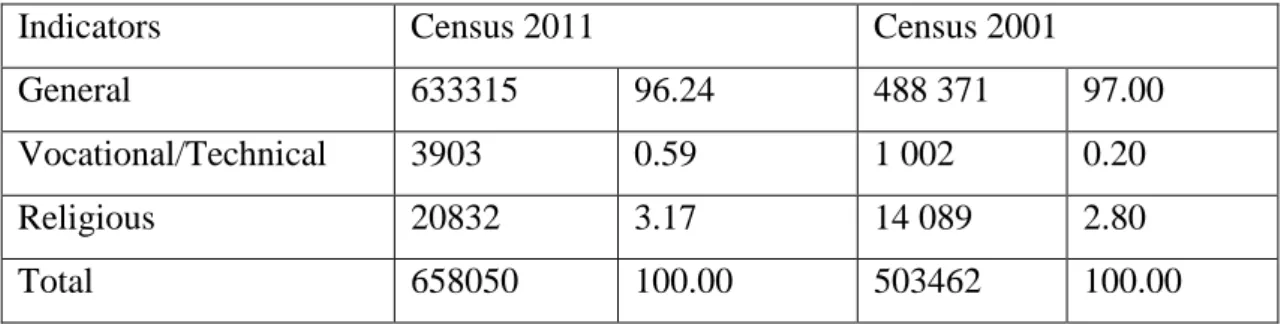
From the chart the educational status shows that general educations are taken by maximum people. This table shows that about 96.24 % are taking general education.
A few percentile about .59% are taking vocational education and 3.17 % peoples are taking religious education according to census 2011.
Table 4.2: Educational status of Lalmonirhat
Indicators Census 2011 Census 2001
General 633315 96.24 488 371 97.00
Vocational/Technical 3903 0.59 1 002 0.20
Religious 20832 3.17 14 089 2.80
Total 658050 100.00 503462 100.00
Source: Adapted from BBS, 2011
23
CHAPTER V
RESULTS AND DISCUSSION
5.1 Socio-economic profile of tobacco farmers
The socioeconomic background of the sample farmers particularly the family size and composition, literacy level, occupation, land ownership pattern and its distribution etc. are discussed in this section. These characteristics of the farmers often affect their production decision.
5.1.1 Age
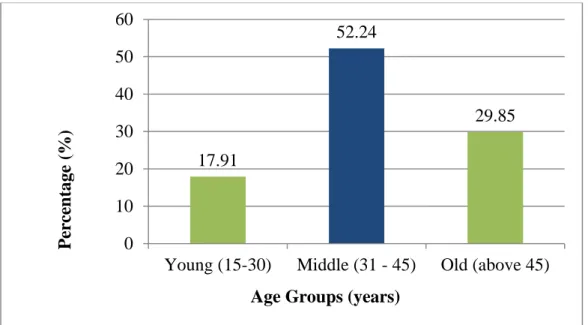
In this study Tobacco farmers were classified into three age groups i.e. young age (16 to 30 years old), middle age (31-45 years old) and old age (above 45 years old). Table 4.1 indicates that in the case of tobacco producing household 17.91 percent member‟s belonged to young age group, 52.24 percent members belonged to middle age group and 29.85 percent members belonged to old age group. It is evident from the Table 5.1 that the age of 31-45 was the highest which was working age for tobacco production.
Figure 5.1 Age distribution of the growers 17.91
52.24
29.85
0 10 20 30 40 50 60
Young (15-30) Middle (31 - 45) Old (above 45)
Percentage (%)
Age Groups (years)
24
Table 5.1 Age distribution of the members of sample farm families Age Groups
(years)
Tobacco farmers N=67
Number Percentage (%)
Young (15-30) 12 17.91
Middle (31 - 45) 35 52.24
Old (above 45) 20 29.85
Total 67 100
Source: Field survey, 2018 5.1.2 Education
Education was considered as the key factor for transforming technology. An educated farmer is inclined to take the new technology and motivated towards progress. The present study has been categorized the respondent family into six categories on the basis of educational qualification.
Table 5.2 Educational status of tobacco farmers Level of literacy Tobacco farmers
Numbers Percentage (%)
Illiterate 20 29.85
Primary (I-V) 16 23.88
High School (VI-IX) 15 22.39
Secondary School Certificate 9 13.43
Higher Secondary Certificate 5 7.46
Graduate & above 2 2.98
Total 67 100
Source: Field survey, 2018
Table 5.2 showed that in the case of tobacco farmers 29.85, 23.88, 22.39, 13.43, 7.46, 2.98 percent were illiterate, primary, high school, secondary school, higher secondary
& graduate respectively. It‟s also show that illiterate people were higher percentage in tobacco production.
25 5.1.3 Family size
The sample of 67 household in the study area comprised a total population of319, among them 192 were male and 127 were female in case of tobacco farmers. The average family size of tobacco producing farmer was 4.76 shown in table 5.3.
Table 5.3: Family size and gender distribution of tobacco farmers
Farmers
Family type Total family member
Total Family member
(No)
Average family size Nuclear Joint Male Female
Tobacco farmers 28 39 192 127 319 4.76
Source: Field survey, 2018 5.1.4 Farm size
Farm size is measured by the entire land area operated by the operator. It is computed by adding the area of land owned and the rented in from others and subtracting the area rented to others. It includes both homestead area and the area used for woods, pasture and crops. In the present study, the size of farm has been defined as the Cultivated land = (Own + Rented in + Mortgaged in - Rented out- Mortgaged out) during the year of investigation.
Table 5.4: Farm size of the tobacco farmers Categories of farmers Tobacco farmers
Number Percent (%)
Small farmers (0.2-1.0 ha) 17 25.37
Medium farmers (1.01-2.0 ha)
43 64.18
Large farmers (above 2.0 ha)
7 10.45
Total 67 100
Source: Field survey, 2018
Table 5.4, shows the land use pattern of tobacco farmers. Table 4.4, also shows different categories of farmers according to their land size as small, medium and large farmers. Among the respondents, 25.37 percent tobacco farmers were in small
26
category, 64.18 percent were in medium category and 10.45 percent were in large category. From the Table 4.4, it was evident that most of farmers were medium size farmers.
5.1.5 Farming experience
The sample farmers were found to be experienced in tobacco cultivation which was measured by year of experience. According to experience, farmers were categorized in three levels as low, medium and high.
Table 5.5: Farming experience of the tobacco farmers
Category Tobacco farmers
Numbers Percent (%)
Low (<13 years) 9 13.43
Medium (14-26 years) 30 44.78
High (>26 years) 28 41.79
Total 67 100
Source: Field survey, 2018
Tables 5.5 showed that in case of tobacco producing farmers 44.78 percent (highest) were in medium experienced category and almost same farmers (41.79%) were in high experienced category and only 13.43 percentage farmers were in low experienced category.
5.1.6 Occupation status
The sample farmers were found to be engaged in various types of occupations Agriculture was the main occupation for tobacco producers.
27 Figure 5.2 Occupations of the Farmers
Table 5.6: Occupational status of the household heads of the sample farmers Occupation Tobacco farmers
Numbers Percent (%)
Agriculture 47 70.15
Business 15 22.39
Service 5 7.46
Total 67 100
Source: Field survey, 2018
Table 5.6 showed that in case of tobacco producing farmers 70.15 percent were engaged in agriculture, 22.39 percent in business and 7.46 percent in service.
5.1.7 Annual family income
Cash return from different sectors such as crops, livestock, fisheries, business etc. is considered as family income.
70.15
22.39
7.46 0
10 20 30 40 50 60 70 80
Agriculture Business Service
Percent (%)
Occupation
28
Table 5.7: Annual family income of the tobacco farmers Category Basis of categorization
(Tk. 000‟)
Tobacco farmers
Numbers Percent (%)
Low < 100 15 22.39
Medium 100 – 200 45 67.16
High > 200 7 10.45
Total 67 100
Source: Field survey, 2018
According to table 5.7 the annual family income for tobacco farmers were categorized into three groups as low, medium and high. In terms of tobacco farmers, the highest farmers (67.16 percent) were in medium income category where 10.45 percent farmers were in high income category.
5.1.8 Annual family expenditure
According to table 4.8 the annual family expenditure for tobacco farmers were categorized into three groups as low medium and high. In terms of tobacco farmers, the highest farmers (52.24 percent) were in low income expenditure category where 41.79 percent farmers were in medium and 5.97 were in high expenditure category.
Table 5.8: Annual family expenditure of the tobacco farmers Category Basis of categorization
(Tk. 000‟)
Tobacco farmers
Numbers Percent (%)
Low < 100 35 52.24
Medium 100 – 200 28 41.79
High > 200 4 5.97
Total 67 100
Source: Field survey, 2018
5.2 To assess the profitability level of tobacco cultivation.
Profitability mainly depends on the cost involved in Tobacco cultivation and return from Tobacco and its by-product.
29
5.2.1 Inputs use and costs for tobacco production
There were several factors were used in tobacco cultivation.
5.2.1.1 Human labor cost
Human labor Cost was 86605.72 taka per hector which is the 48.18% of total costs of Tobacco cultivation. Among the human labors step by step male and female labors were taken.
5.2.1.2 Cost of animal labor and power tiller
Cost of animal labors and power tillers were 9500.18 taka per hector which was the 5.28% of the total of production costs.
5.2.1.3 Seedling cost
Seedling cost was 18286.21 taka for one hector Tobacco cultivable land which is 10.17% of total production cost.
5.2.1.4 Cost of fertilizer
Four types of fertilizers were applied to Tobacco field. Manure was costs 10055.42 taka which is 5.59 % of total production costs. TSP was required 14296.19 taka per hector which was 7.95 % of total production costs. Urea was required 6341.16 taka per hector @ 16 taka per kg which was 3.52 % of total production cost. MoP were required 1481.85 taka per hector @ 16 taka per kg which was 0.82% of total Tobacco production costs.
5.2.1.5 Cost of irrigation
6795.66 taka was required to provide irrigation in one hectare of Tobacco cultivable land which was 3.78% of total production costs of Tobacco cultivation.
5.2.1.6 Cost of pesticides
1653.46 taka was required for one hector of land to cultivate Tobacco which was 0.92
% of total production costs.
30 5.2.1.7 Curing cost
Curing cost (storing and drying) for one hector of last was 2550.6 taka which was 1.42% of total production costs.
Figure 5.3: Total cost, gross return and net return of tobacco 5.2.1.8 Interest on operating capital
Interest on operating capital @ of 10% for 6 months was 8665.64 taka was required for one hector of Tobacco cultivable land which was 4.82 % of total production costs.
5.2.1.9 Land use cost
13500 taka were required for one hector of Tobacco cultivable land which was 7.51 % of total production costs.
5.2.2 Estimation average yields and gross return
Estimation of Average Yields and Gross Return for one hector of Tobacco cultivation is 230217.27 taka.
5.2.3 Benefit Cost Ratio (BCR)
Benefit–Cost ratio of Tobacco cultivation is BCR =
BCR = = 1.2808913
230217.27
179732.09
50485.18
0 50000 100000 150000 200000 250000
Tk/ha
Cost & Return
31
Table 5.9 Per hectare costs, returns, and other parameters for tobacco producing farmers
Particulars Quantity Rate
(Tk./unit) Cost (Tk./ha)
% of Total Cost
Seedling (thousand/ha) 18286.21 10.17
Animal Labor /Power Tiller cost (Tk./ha)
9500.18
5.28 Human labor cost (No. of Man-
days/ha)
86605.72
48.18
Urea(Kg/ha) 16 6341.16 3.52
TSP (Kg/ha) 21 14296.19 7.95
MoP (Kg/ha) 16 1481.85 0.82
Manure (Kg/ha) 10055.42 5.59
Cost of irrigation (Tk./ha) 6795.66 3.78
Cost of Pesticides (Tk./ha) 1653.46 0.92
Curing Cost 2550.6 1.42
A. Total Variable Cost (TVC) 157566.45 87.66 Interest on operating capital @ of
10% for 6 months
8665.64
4.82
Rental value of land 13500 7.51
B. Fixed Cost (FC) 22165.64 12.33
C. Total Cost (A+B) 179732.09 100
Main product value 2861.48 226056.92
By-product value 4160.35
D. Gross Return (Tk./ha) i. e.
(GR)
230217.27 Total variable cost (Tk./ha) i. e.
(TVC)
157566.45
Total cost (Tk./ha) i.e. (FC+TVC) 179732.09
E. Gross Margin (Tk./ha) i.e. (D- A)
72650.82 F.Net Return (Tk./ha) i.e. (D-C) 50485.18 G. Benefit-Cost ratio i.e. (D/C) 1.2808913
Source: Authorization, 2018
5.3 To identify the constraints of tobacco cultivation
a) Natural disaster: Among the 67 respondent 60 respondents depict that they face the problem of natural disaster. When the leaf of Tobacco is being grown up then thunder with little with medium iced pieces fall into that Tobacco leaf which crack the leaves. Besides this strong wind sometimes destroy the Tobacco plants.
32
b) Credit facilities: Among the respondents 52% respondents said that they did not get the credit facilities for their Tobacco cultivation. Credit facilities helps them cultivating Tobacco with proper fertilizer & irrigation application.
c) Attacked by insect and pest: Among the Tobacco cultivators a large amount of respondents 83% replies that planting after 30 to 40 days it attacks by insects and pests. Locally this termed as “Kaduya”.
d) High price of fertilizer: Among the respondents 94% respondents said that Tobacco cultivation is a fertilizer based crop. TSP the high priced fertilizer is required in a larger amount in Tobacco cultivation, which increases their production cost of Tobacco cultivation.
e) Seedling scarcity: About 74% respondents assert that there is a problem for Tobacco cultivation is the getting availability of seedling. If early winter comes it‟s very hard for the farmers to produce seed from seed bed. In that time scarcity of seedling reaches in the apex with the higher prices.
Table 5.10 Problems and constraints
Source: Field servey,2018
5.4 Probable suggestion to overcome those constraints
a) High yield and drought tolerant variety : Among the respondents 97% make solution of the above problem of natural disaster is to invent high yielding and drought tolerant variety
b) Supplementary irrigation: Among the respondents 92.54% said that major problems for Tobacco cultivation in north bangle specially on Tista river basin is the irrigation They also said that if supplementary irrigation facilities are provided to the Tobacco farmers yield will be increased by 1 to 1.5 times . Problems and constraints No. of Respondent Percentage of Respondent
Natural disaster 60 89.55
Credit facilities 35 52.24
Attacked by insect and pest 56 83.58
High price of fertilizer 63 94.03
Seedling scarcity 50 74.63
33
c) Available credit facilities: Among the respondents 76.12% said that if credit facilities are given to the Tobacco farmers they will be able to apply more fertilizers specially Cow dung and TSP which is a must to increase the productivity of Tobacco. Sometimes credit facilities ensure the market in where they can sell their produced Tobacco.
d) Regular contact of extension agent: Among the respondent 58.21% complain that in their long time experience of Tobacco cultivation it was rare to have the facilities of extension agents Sometimes Tobacco is infected by
“KADUYA” disease and most of the cultivators don‟t know which Pesticides and insecticides to be applied. If regular contact of extension agent will be available it is expected that yield will be increased.
Table 5.11 Suggestion to the problems
Suggestion to the problems No. of Respondent Percentage of Respondent High yield and drought tolerant
variety 65 97.01
Supplementary irrigation 62 92.54
Available credit facilities 51 76.12
Regular contact of extension agent 39 58.21 Source: Field survey, 2018