GROWTH, SEED YIELD AND QUALITY OF CHILLI AS INFLUENCED BY FERTILIZER MANAGEMENT AND
SPACING
MD. MEHEDI HASSAN
INSTITUTE OF SEED TECHNOLOGY
SHER-E-BANGLA AGRICULTURAL UNIVERSITY DHAKA-1207
JUNE, 2020
GROWTH, SEED YIELD AND QUALITY OF CHILLI AS INFLUENCED BY FERTILIZER MANAGEMENT AND
SPACING
By
MD. MEHEDI HASSAN REGISTRATION NO. 13-05342
A Thesis
submitted to the Institute of Seed Technology, Sher-e-Bangla Agricultural University, Dhaka-1207
in partial fulfillment of the requirements for the degree of
MASTER OF SCIENCE IN
SEED TECHNOLOGY
SEMESTER: JANUARY-JUNE, 2020
Approved by:
Prof. Dr. Jasim Uddain Prof. Dr. Tahmina Mostarin Supervisor
Co-Supervisor
Examination Committee Prof. Dr. Md. Ismail Hossain Chairman
Sher-e-Bangla Agricultural University
Sher-e-Bangla Nagar, Dhaka-1207Phone: 9134789
CERTIFICATE
This is to certify that the thesis entitled “GROWTH, SEED YIELD AND QUALITY OF CHILLI AS INFLUENCED BY FERTILIZER MANAGEMENT AND SPACING” submitted to the Institute of Seed Technology, Sher-e-Bangla Agricultural University, Dhaka, in partial fulfillment of the requirements for the degree of MASTER OF SCIENCE (M.S.) in SEED TECHNOLOGY, embodies the results of a piece of bona fide research work carried out by MD. MEHEDI HASSAN, Registration. No. 13-05342 under my supervision and guidance. No part of this thesis has been submitted for any other degree or diploma.
I further certify that such help or source of information as has been availed of during the course of this investigation has duly been acknowledged.
Dated: Prof. Dr. Jasim Uddain
Dhaka, Bangladesh Supervisor
DEPARTMENT OF HORTICULTURE
i
ACKNOWLEDGEMENTS
All praise is bestowed upon the Almighty Allah, who is the Supreme Creator, and bestowed His gracious blessing upon the Author to complete this study and to entrust him to the successful completion his thesis towards achieving the Master of Science degree.
It is a great pleasure for the author to express his deep gratitude to his respected parents, who have had a great deal of hardship inspiring him to pursue his studies and thus to receive proper education. It is another way to express his deepest sense of gratitude to them for their constant prayer and support to reach this landmark.
The author is very glad to convey his sincere appreciation and profound gratitude to his respected supervisor Prof. Dr. Jasim Uddain, department of Horticulture, Sher-e-Bangla Agricultural University, Dhaka not only during the preparation of the thesis but also during the entire period of the work, for his dynamic guidance, constant encouragement, constructive criticism and valuable suggestions.
It is a great privilege for the author to express his deep sense of gratitude and sincere respect to the research co-supervisor, Prof. Dr. Tahmina Mostarin, department of Horticulture, Sher-e- Bangla Agricultural University, Dhaka for her adept guidance, supervision, kind cooperation, and valuable suggestions in preparation of the thesis.
Technology, Sher-e-Bangla Agricultural University, Dhaka along with all the teachers and staff members of the Institute of Seed Technology, Sher-e-Bangla Agricultural University for their co-operation during the period of the study.
The author wishes to extend his special thanks to his classmates, friends, relatives for their help as well as heartiest co-operation and encouragement.
May Allah bless and protect them all.
The Author
The author is highly grateful to Prof. Dr. Md. Ismail Hossain, Director, Institute of Seed
ii
GROWTH, SEED YIELD AND QUALITY OF CHILLI AS INFLUENCED BY FERTILIZER MANAGEMENT AND SPACING
ABSTRACT
An experiment was conducted at the central farm of Sher-e-Bangla Agricultural University, Sher-e-Bangla Nagar, Dhaka-1207 during the period from October 2018 to April 2019 to determine the growth, seed yield and quality of chilli as influenced by fertilizer management and spacing. The experiment consisted of two factors Factor A: Different fertilizer management such as F0: Control, F1: Vermicompost (15 t ha-1), F2: 110 kg ha-1 N, 170 kg ha-1, 100 kg ha-1 K and F3:
½ Vermicompost + ½ N110P170K100 kg ha-1; Factor B: Different types of plant spacing such as S1: 60 cm × 30 cm, S2: 60 cm × 45 cm and S3: 60 cm × 60 cm.
The experiment was laid out in Randomized Complete Block Design (RCBD) with three replications. Data on different growth and yield contributing characters were recorded. Results indicated that fertilizer management and spacing had a significant influence on most of the growth, seed yield and quality components of chilli. Under this investigation, it was revealed that plant height, number of branches per plant, number of leaves per plant, fruit length, the weight of dry fruits, number of dry fruits per plant, yield per plant dry fruits, number of seeds per fruit, thousand seed weight, germination percentage, root length, shoot length and seedling length were found to be maximum from F3S3 treatment combination and minimum from F0S1 treatment combination. Yield of dry fruits (3.06 t) and seed (353.35 kg) per hectare were found to be maximum from F3S2. By contrastminimum dry fruits (0.92 t) and seed yield (143.68 kg) were given from F0S3 and F0S1. Considering the yield of dry fruits and seed per hectare, F3 (½ Vermicompost + ½ N110P170K100 kg ha-1) along with S2 (60 cm × 45 cm) could be the best production package for the production of chilli.
iii
LIST OF CONTENTS
CHAPTER TITLE PAGE
ACKNOWLEDGEMENT i
ABSTRACT ii
LIST OF CONTENTS iii
LIST OF TABLES vi
LIST OF FIGURES viii
LIST OF APPENDICES ix
LIST OF ACRONYMS x
I INTRODUCTION 1
II REVIEW OF LITERATURE 4
III MATERIALS AND METHODS 24
3.1 Location of the experimental field 24
3.2 Agro-ecological region 24
3.3 Climate of the experimental area 24
3.4 Soil characteristics 25
3.5 Plant materials used 25
3.6 Raising the seedlings 25
3.7 Treatments of the experiment 26
3.8 Layout and design of the experiment 26
3.9 Cultivation procedure 26
3.9.1 Land preparation 26
3.9.2 Application of fertilizers 27
3.9.3 Transplanting the seedlings 27
3.9.4 Gap filling 27
3.9.5 Intercultural operations 27
3.9.6 Control of pest and disease 28
3.9.7 Harvesting 28
iv
LIST OF CONTENTS (cont’d)
CHAPTER TITLE PAGE
3.10 Data collection 28
3.10.1 Plant height 28
3.10.2 Number of branches per plant 28
3.10.3 Number of leaves per plant 29
3.10.4 Length of fruit 29
3.10.5 Weight of dry fruits 29
3.10.6 Number of dry fruits per plant 29
3.10.7 Yield per plant dry fruits 29
3.10.8 Yield per plot dry fruits 29
3.10.9 Yield per hectare dry fruits 29
3.10.10 Number of seeds per fruit 30
3.10.11 Weight of 1000 seeds 30
3.10.12 Seed yield per plant 30
3.10.13 Seed yield per plot 30
3.10.14 Seed yield per hectare 30
3.10.15 Germination percentage 30
3.10.16 Root length (cm) plant-1 31
3.10.17 Shoot length (cm) plant-1 31
3.10.18 Seedling length (cm) 31
3.11 Statistical analysis 31
IV RESULTS AND DISCUSSION 32
4.1 Plant height 32
4.2 Number of branches per plant 35
4.3 Number of leaves per plant 37
v
LIST OF CONTENTS (cont’d)
CHAPTER TITLE PAGE
4.4 Fruit length 41
4.6 Weight of dry fruits 41
4.8 Number of dry fruits per plant 44
4.10 Yield per plant dry fruits 45
4.12 Yield per plot dry fruits 46
4.14 Yield per hectare dry fruits 47
4.15 Number of seeds per fruit 50
4.16 1000 seed weight 51
4.17 Seed yield per plant 54
4.18 Seed yield per plot 55
4.19 Seed yield per hectare 57
4.20 Germination percentage 59
4.21 Root length 60
4.22 Shoot length 61
4.23 Seedling length 62
V SUMMARY AND CONCLUSION 64
REFERENCES 69
APPENDICES 77
vi
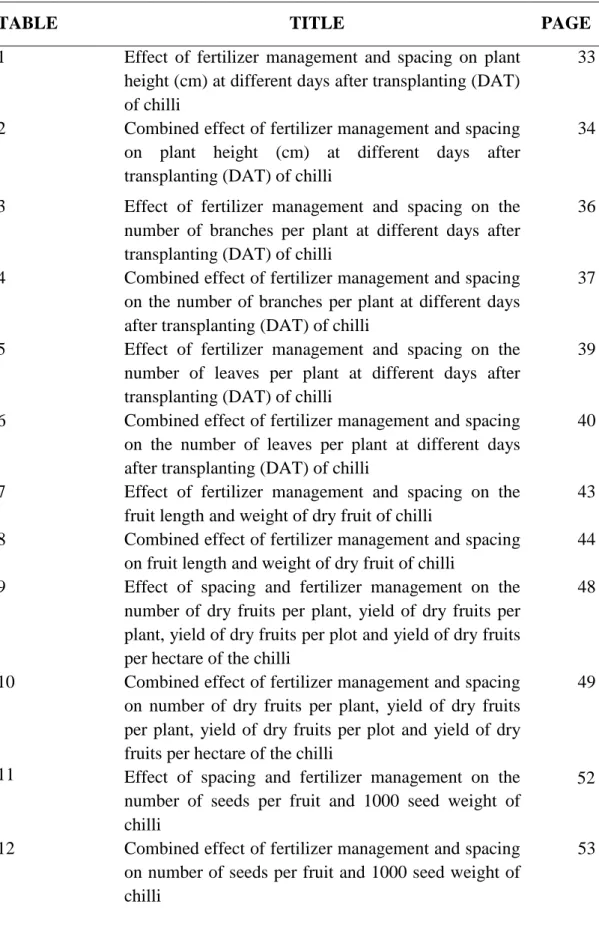
LIST OF TABLES
TABLE TITLE PAGE
1 Effect of fertilizer management and spacing on plant height (cm) at different days after transplanting (DAT) of chilli
33
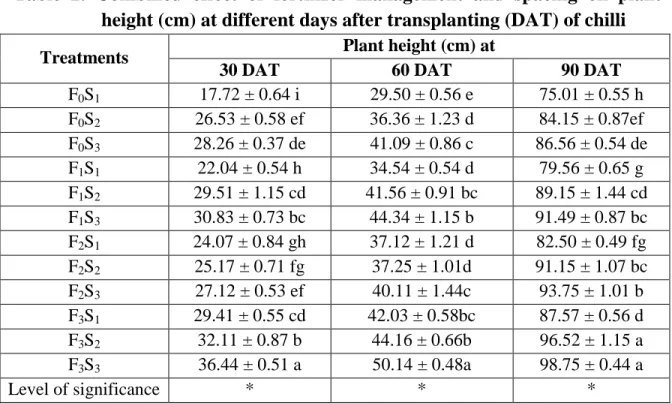
2 Combined effect of fertilizer management and spacing on plant height (cm) at different days after transplanting (DAT) of chilli
34
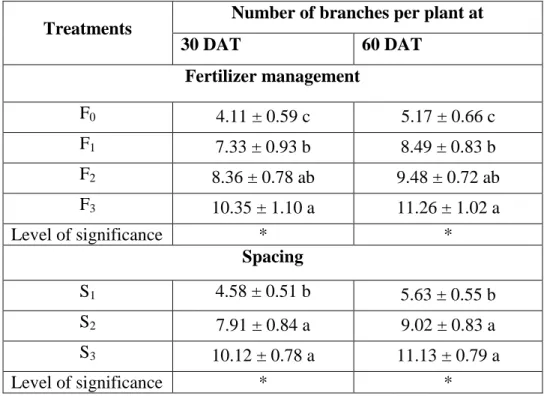
3 Effect of fertilizer management and spacing on the number of branches per plant at different days after transplanting (DAT) of chilli
36
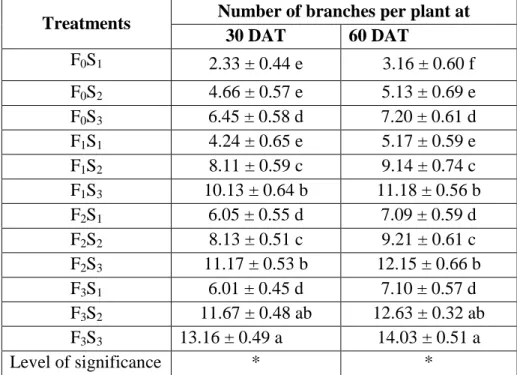
4 Combined effect of fertilizer management and spacing on the number of branches per plant at different days after transplanting (DAT) of chilli
37
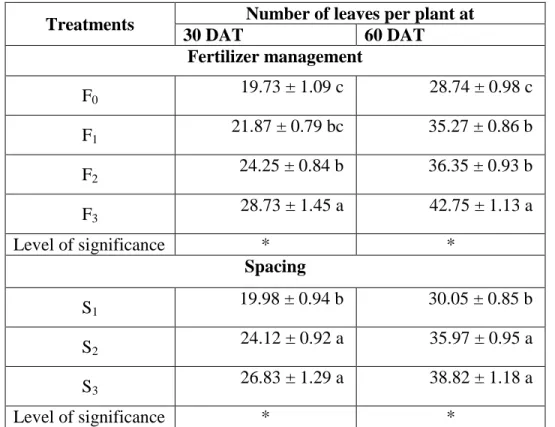
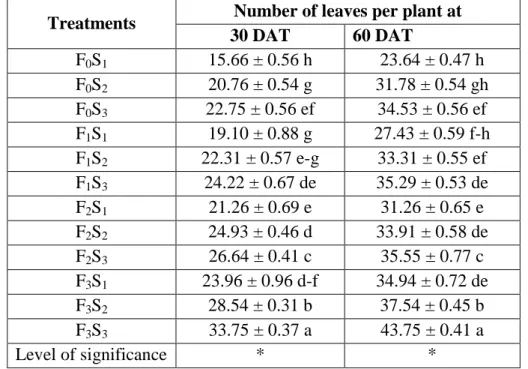
5 Effect of fertilizer management and spacing on the number of leaves per plant at different days after transplanting (DAT) of chilli
39
6 Combined effect of fertilizer management and spacing on the number of leaves per plant at different days after transplanting (DAT) of chilli
40
7 Effect of fertilizer management and spacing on the fruit length and weight of dry fruit of chilli
43 8 Combined effect of fertilizer management and spacing
on fruit length and weight of dry fruit of chilli
44 9 Effect of spacing and fertilizer management on the
number of dry fruits per plant, yield of dry fruits per plant, yield of dry fruits per plot and yield of dry fruits per hectare of the chilli
48
10
11
Combined effect of fertilizer management and spacing on number of dry fruits per plant, yield of dry fruits per plant, yield of dry fruits per plot and yield of dry fruits per hectare of the chilli
Effect of spacing and fertilizer management on the number of seeds per fruit and 1000 seed weight of chilli
49
52
12 Combined effect of fertilizer management and spacing on number of seeds per fruit and 1000 seed weight of chilli
53
vii
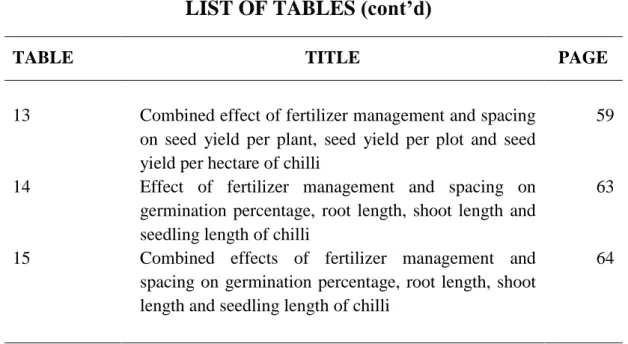
LIST OF TABLES (cont’d)
TABLE TITLE PAGE
13
14
15
Combined effect of fertilizer management and spacing on seed yield per plant, seed yield per plot and seed yield per hectare of chilli
Effect of fertilizer management and spacing on germination percentage, root length, shoot length and seedling length of chilli
Combined effects of fertilizer management and spacing on germination percentage, root length, shoot length and seedling length of chilli
59
63
64
viii
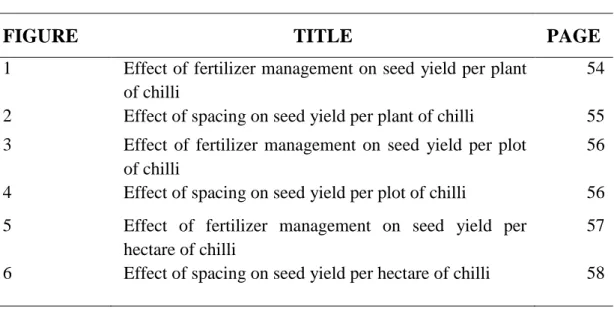
LIST OF FIGURES
FIGURE TITLE PAGE
1 Effect of fertilizer management on seed yield per plant of chilli
54 2 Effect of spacing on seed yield per plant of chilli 55 3 Effect of fertilizer management on seed yield per plot
of chilli
56 4 Effect of spacing on seed yield per plot of chilli 56 5 Effect of fertilizer management on seed yield per
hectare of chilli
57 6 Effect of spacing on seed yield per hectare of chilli 58
ix
LIST OF APPENDICES
APPENDIX TITLE PAGE
1 Map showing the experimental sites under study 77
2 Characteristics of soil of experimental site is analyzed by Soil Resources Development Institute (SRDI), Khamarbari, Farmgate, Dhaka
78
3 Monthly records of air temperature, relative humidity, rainfall and sunshine hours during the period from October 2018 to April 2019
79
4 Analysis of variance (mean square) of plant height at different days after transplanting (DAT)
79 5 Analysis of variance (mean square) of number of
branch per plant and number of leaves per plant at different days after transplanting (DAT)
80
6 Analysis of variance (mean square) of number of length of fruit, weight of dry fruit and number of dry fruits per plant
80
7 Analysis of variance (mean square) of yield per plant dry fruits, yield per plot dry fruits and yield per hectare dry fruits of chilli
81
8 Analysis of variance (mean square) of number of seeds per fruit, 1000 seed weight and seed yield per plant of chilli
81
9 Analysis of variance (mean square) of seed yield per plot, seed yield per hectare and germination percentage of chilli
82
10 Analysis of variance (mean square) of root length shoot length and seedling length of chilli
82
x
LIST OF ACRONYMS
AEZ Agro-Ecological Zone
Anon. Anonymous
BARC Bangladesh Agricultural Research Council BARI Bangladesh Agricultural Research Institute
BAU Bangladesh Agricultural University
BBS Bangladesh Bureau of Statistics
BRRI Bangladesh Rice Research Institute
CV % Percent Coefficient of Variance
cv. Cultivar (s)
DAT Days After Transplanting
eds. Editors
et al. et alibi (And others)
etc. et cetera (and other similar things)
FAO Food and Agricultural Organization
i.e. id est (that is)
LSD Least Significant Difference
MoP Muriate of Potash
TSP Triple Super Phosphate
1
CHAPTER I INTRODUCTION
Chilli (Capsicum frutescens L.) is an important spice belongs to the genus Capsicum of the family of Solanaceae. Chilli is cultivated as an annual crop in worldwide. Chilli is a native crop of central America and the West Indies (Pruthi, 1993). But the discovery of America and the West Indies, chilli spread rapidly throughout the Tropical countries in the world (Pruthi, 1993). The major chilli growing countries are India, Mexico, Japan, Ethiopia, Thailand, Turkey, Indonesia, China and Pakistan. Chilli is an unavoidable spice because of its pungency, spicy taste and its appealing colour add to the curry. In Bangladesh, chilli is one of the most important spices and cash crop which widely grown in almost all areas and seasons (Asaduzzaman et al., 2010).
Chilli is an excellent source of high nutritive value with 1.29 mg/100 g protein, 11 mg/100 g calcium, 870 I.U vitamins-A, 175 mg ascorbic acid, 0.06 mg thiamine, 0.03 mg riboflavin, 0.55 niacin per 100 g edible fruit and 321mg per 100 g of vitamin C (Agarwal et al., 2007). Sometimes chilli referred to as capsule of vitamin C because of the richest source of vitamin C (Durust et al., 1997).
Chilli occupies 1.01 lakh hectares of land and the production of chilli is about 1.41 lakh metric tons during the year of 2017-18 (BBS, 2019 and FAO, 2018).
But about 60% of yields could be lost due to improper time of weeding and management (BBS, 2012). In Bangladesh, the harvest price of chilli is about Tk. 133530/M. Ton (BBS, 2018). With the increase of population, the demand for crop has been increasing day by day and the traditional varieties could not fulfill the demand due to their inherent low yield potential. The main reasons for low yield are lacking high yielding varieties and use of an appropriate dose of fertilizer. Nutrient supply is an important aspect of the improved technologies developed and whose widespread adoption continues to ensure higher fruit yields, better quality and yield stability (Khan et al., 2010). The
2
high quality of seed in terms of viability and vigour are the essential factors, which determine the seedling development in nursery and plant establishment in the field to get a higher yield with the high-quality seed (Kodalli, 2006).
Production of high-quality seed is possible only by adopting scientific, cultural and improved agronomic management practices. Among several agronomic and management practices, the mother plant nutrition plays an important role in increasing the production of quality seed (Kulkarni et al., 2002).
Fertilizers contain various macro and micronutrients that are being used in vegetables. The key functions of micronutrients are to favour the photosynthesis and the synthesis of chlorophyll in green plants (Naz et al., 2012). Fertilizers offer the best means of increasing yield, quality and maintaining soil fertility. Three major nutrients viz., nitrogen (N), phosphorous (P) in general and potassium (K) in particular are essential for increasing yield and quality of chillies (Irutharayaraj and Kulandaivelu, 1973). Fertilizer application is widely used to achieve optimum plant growth and more yield from the unit area with increased input use efficiency (Senger and Kothari, 2008).
A high input of chemical fertilizer leading to a qualitative deterioration of soil as well as agricultural yield. However, a growing awareness of the adverse impacts of inorganic fertilizers on crop production as well as increasing environmental and ecological concerns have stimulated greater interest in the utilization of organic amendments for crop production (Ullah et al., 2008).
Organic manures act not only as a source of nutrients and organic matter but also increase microbial diversity and activity in the soil, which influences soil structure and nutrients turnover, in addition to improvement in other physical and biological properties of the soil (Albiach et al., 2000). Thus organic manures are environmentally benign and help in maintaining soil fertility as well as agricultural productivity (Khanam et al., 2009).
3
Among various organic products, vermicompost has been recognized as a potential soil amendment. Vermicompost is a product of non-thermophilic biodegradation of organic material by the combined action of earthworms and associated microbes. It is a highly fertile, finely divided peat-like material with high porosity, aeration, water holding capacity and low C: N ratios. So, vermicompost is very essential for the growth and yield of chilli and other winter vegetables (Goutam et al., 2011 and Ushakumari et al., 2006).
Optimum plant spacing ensures proper growth and development of plant resulting maximum yield of the crop and economic use of land. The yield of chilli has been reported to be dependent on the number of plants accommodated per unit area of land (Duimovik et al., 2009). Plant height, number of branches/plant, number of leaves/plant, Stem girth, flower initiation, number of fruits/plant, fruit weight were significantly influenced by plant spacing (Islam et al., 2011 and Maya et al., 1997). The increase in plant yield with higher plant spacing results in the increase of numbers of fruit per ha in chilli (Nasto et al., 2009 and Cavero et al., 2001).
From the above-mentioned facts, this study was undertaken by the following objectives:
1. To find out the suitable fertilizer on growth, seed yield and quality of chilli.
2. To identify the optimum plant spacing on growth, seed yield and quality of chilli.
3. To determine the combined effect of fertilizer and suitable spacing on growth, seed yield and quality of chilli.
4
CHAPTER II
REVIEW OF LITERATURE
An attempt was made in this section to collect and study relevant information available in the country and abroad regarding the growth, seed yield and quality of chilli influenced by spacing and fertilizer management to gather knowledge helpful in conducting the present research work.
Ali et al. (2011) conducted an experiment to investigate the effect of Panchagavya and Sanjibani, liquid organic manure on the yield of green gram, Vigna radiata, chilli, Capsicum frutescens (Chili) and mustard, Brassica campestris. Their influence was compared by evaluating the yield contributing attributes like plant height, primary branch/plant, secondary branch/plant, number of seed/fruit, fruit length, the weight of 100 seed, yield/plant, yield m-2. From the results of the experiment showed that the Sanjibani and Panchagavya treated crops were higher than the control. Liquid manure specifically Sanjibani used in this experiment was pre-analyzed to evaluate the variation in microbial population between two Sanjibani samples prepared by using raw materials (Cow dung and Cow urine) obtained from two different sources of cow breed (i.e., Native breed and Jersey breed) and the best source of the breed can be recommended for the further research work. Meanwhile, the effect of organic farming practice in soil-health was also evaluated by analyzing the basic parameters of soil in the field. The result shows increased microbial population, oxidisable organic carbon, nitrogen, phosphate, potash. The pH and E.C were observed to be close to neutral.
Kattimani and Shashidhara (2006) carried out a field experiment during Kharif 2002, in Dharwad, Karnataka, India, to evaluate the response of chilli genotypes to integrated nutrient management (INM). Results from the experiment showed that, among the genotypes, Vietnam-2 produced significantly higher yield (932 kg ha-1) contrast with Byadagi dabbi and Byadagi kaddi. The result of the experiment
5
stated that the values of growth and yield contributing characters were also significantly higher in Vietnam-2. Application of FYM at 10 t ha-1 along with 100% recommended dose of fertilizer (RDF) observed in higher fruit yield (919 kg ha-1) compared to RDF alone. Similarly, application of FYM at 10 t ha-1 with 100% RDF increased oleoresin content and yield by 17.5 and 16.0%, respectively, over 100% RDF alone. Application of FYM at 10 t ha-1 along with 100% RDF enhanced the uptake of nutrients like N, P, K, Ca, S and Fe by 14.1, 44.9, 37.4, 15.5, 20.3 and 26.7%, respectively, over RDF alone in Vietnam-2. A similar result was also observed in other genotypes. The maximum net returns (Rs. 28522 ha-1) was obtained with the application of FYM at 10 t ha-1 + 100% RDF followed by FYM at 5 t ha-1 + chilli stalk at 5 t ha-1 + 100% RDF + secondary and micronutrient + biofertilizer (Rs. 25638 ha-1) in Vietnam-2 contrasted to Byadagi kaddi and Byadagi dabbi.
Biswas et al. (2017) were conducted an experiment at the field laboratory of Horticulture Department, Sylhet Agricultural University during the winter season from October 2013 to March 2014 with a view to evaluate fruit and seed production potentiality of tomato genotypes. Eight tomato genotypes namely C- 11, C-21, C-41, C-51, C-71, FP-5, WP-10 and HT-025 were used for this study.
The experiment was laid out in a Randomized Complete Block (RCB) Design with three replications. A remarkable variation was observed among the tomato genotypes at the seedling stage of hypocotyls color, stem length, root length and number of leaves at 1st inflorescences of seedlings etc. The genotype C-41 produced the highest number of fruits (48.00 plant-1) but its corresponding individual fruit weight was the lowest (34.33 g). The lowest number of fruits plant-
1 was harvested from the line WP-10 (22.33 plant-1), and it had the highest individual fruit weight (66.67 g). Significant variation was observed in weight of fruit plant-1. The highest fruit yield plant-1 was recorded from the genotype HT- 025 (2.02 kg plant-1) and the lowest was recorded from the line FP-5 (1.17 kgplant-
6
1). Corresponding hectare-1 fruit yield was the highest in HT-025 (68.68 tones) followed by the line C11 (68.0 tones). The highest number of seeds fruit-1 was counted from the genotype C-51 (85.42) very closely followed by C-11 (81.67).
The genotype C-41 produced the lowest number of seeds (49.28 fruit-1) identical to that of C-21 (51.72). The genotype HT-025 had the highest 1000-seed weight (2.90 g) which was identical to that of C-41 (2.80 g). The lowest 1000-seed weight was recorded from WP-10 (2.20 g). Seed yield plant-1 was varied from 3.64 g to 9.41 g. Among the genotypes, C-11 produced the maximum amount of seeds (319.94 kg ha-1) and lowest seed production recorded from WP-10 (123.76 kg ha-
1).
A field experiment was conducted by Hangarge et al. (2004) during the Kharif and rabi seasons of 1996-97 to evaluate the influence of vermicompost and other organics on the fertility and productivity of soil (Vertisol) under chilli-spinach cropping system. The application of vermicompost at 5 t ha-1 + organic booster at 1 litre m-2 and soil conditioner (Tera care) at 2.5 t ha-1 + organic booster at 1 litre m-2 enhanced the availability of N, P, K and organic C content in the soil. There did not have any significant impact on recommended rates of NPK and organic sources each alone. The interaction effect of organic + organic sources resulted to be better than either organic alone or the interaction of organic + inorganic fertilizer.
A field experiment was conducted by Hanifah et al. (2016) to compare two different cultivation systems, conventional and fertigation on plant growth, fruit yield and physical fruit qualities of two commercial varieties (151 and 461) and two local varieties (MC11 and Kulai) of chili and seed yield among local varieties.
In conventional system, plants were grown in peat soil area with two times of fertilizer applications, basal and top dressing following recommended dose (18 g N, 3 g P and 15 g K/plant in total). In fertigation system, fertilizer was supplied with irrigation water. Dependent variables on plant growth were taken at the first
7
harvest meanwhile data on fruit quality and seed yield were taken at the second harvest. Stem height was taken weekly from 1 to 10 weeks after transplant.
Results showed that cultivation system does not have significant effect on fruit yield all varieties but type of variety does (P<0.001). Type of variety also had significant effect on stem height, number of fruit per kilogram and all fruit physical qualities at P<0.0001. Type of cultivation system had significant effect on number of fruit per kilogram at P<0.0001 and fruit length at P<0.001. Among all varieties tested, variety of 461 abled to produce highest fruit yield and all physical fruit qualities especially when grown conventionally in peat soil. Therefore, it is recommended to use variety of 461 and growing conventionally in peat soil area for high fresh fruit production. Seed yield of MC11 was recorded the highest when grown under conventional system while vice versa for Kulai. Therefore, for high production of MC11 seeds, it is recommended to grow the plants under conventional system, however, fertigation system for Kulai. This study also would like to suggest repeating this study with a modification on fertilizer rate of fertigation system.
Maheswari et al. (2004) were carried out a study to assess the effects of foliar organic fertilizers on sandy loam soil (amino acid at 0.5 and 0.75%; humic acid at 0.1 and 0.2%; and vermiwash at 1:3 and 1:5 at vermiwash and water ratios) on the quality and economic considerations of chilli (C. annuum). The recommended fertilizer dose was applied as basal and top dressing (complete dose; N: P: K at 160:60:30 kg ha-1), and as basal application alone (80:60:30 kg ha-1). The highest ascorbic acid content (175.23 mg/100 g) was recorded in the treatment combination of vermiwash at 1:5 and basal and top fertilizer dressing. Capsaicin content and seed number were maximum (0.49%) with 0.75% amino acid + complete fertilizer dose. The amino acid at 0.75% + complete fertilizer dose produced the best returns.
8
Malawadi et al. (2004) was carried out a field experiment conducted in Dharwad, Karnataka, India, chilli (Capsicum annuum), planted on 19th July 2001, was subjected to the following treatments: NPK alone; NPK+farmyard manure (FYM);
NPK+Fe; NPK+S; NPK+Ca; NPK+S+Fe; NPK+Ca+Fe; NPK+Ca+S; and NPK+Ca+S+Fe. N, P and K (100:50:50 kg ha-1) were applied in the form of urea, diammonium phosphate and muriate of potash, respectively. Half of the recommended NPK was applied at transplanting, and the other half was applied after 6 weeks. FYM at 10 t ha-1, Ca at 30 kg ha-1 (calcium carbonate) and S at 60 kg ha-1 (elemental sulfur) were applied 10 days before transplanting. Fe at 12 kg ha-1 (iron chloride) was applied at 6 weeks after transplanting. NPK+FYM produced the maximum fruit yield (844.39 kg ha-1), followed by NPK+S+Fe, NPK+Ca+S and NPK+Ca+Fe (843.36, 841.20 and 840.42 kg ha-1, respectively), compared to NPK alone (695 kg ha-1). NPK+FYM also produced the maximum fruit weight hill-1 (86.60 g) and 100 fruit weight (200.50 g), while NPK alone produced the maximum value for the weight of discolored fruits (112.00 kg ha-1).
No significant variation was observed in these parameters among different treatments. NPK+Ca+Fe produced the maximum oleoresin yield (109.41 kg ha-1), followed by NPK+Ca+S+Fe and NPK+S+Fe (108.08 and 107.08 kg ha-1, respectively). The maximum ascorbic acid content was observed for NPK+Ca+S+Fe (81.67 mg/100 g), followed by NPK+Ca+S and NPK+S (79.83 and 78.73 mg/100 g, respectively) compared with NPK alone (59.50 mg/100 g).
Increased N, P, K, Ca, S and Fe uptake was achieved with the application of FYM or interactions of secondary and micronutrients along with NPK.
A pot culture experiment was conducted by Yadav and Vijayakumari (2004) at Avinashilingam University, Coimbatore, Tamil Nadu, India, to evaluate the effect of vermicomposted vegetable waste, alone and in combination with different organic manures and chemical fertilizer, on the biochemical characters of chilli (Capsicum annuum). From the results of the pot, the experiment showed that the
9
reducing sugar, free amino acid and phenol contents were higher in the vermicompost treatment on 30 (70.27, 7.98, 14.62 mg/g), 60 (95.51, 17.66, 22.32 mg/g) and 90 days after sowing (33.67, 3.17, 11.85 mg/g). The protein content was higher in vermicompost treatment on 60 and 90 days after sowing (113.37 and 79.69 mg/g, respectively), whereas it was higher in vermicompost + farmyard manure (FYM) treatment on 30 (35.73 mg/g) days after sowing. The carbohydrate content was higher in vermicompost + FYM treatment on 30 and 90 (4.67 and 6.46 mg/g, respectively) days after sowing, while on 60 days after sowing; it was higher in the vermicompost treatment (15.34 m/g). Chlorophyll a (0.23 mg/g), chlorophyll b (0.38 mg/g) and total chlorophyll (0.62 mg/g) were higher in vermicompost + neem cake treatment on 30 days after sowing. On 60 days after sowing, higher chlorophyll b (2.61 mg/g) and total chlorophyll (3.62 mg/g) contents were observed in the treatment containing vermicompost alone. On 90 days after sowing, chlorophyll a (1.01 mg/g) and total chlorophyll (1.92 mg/g) content were higher in vermicompost alone, and chlorophyll b (1.07 mg/g) in the vermicompost + FYM treatment.
An experiment was conducted by Idan (2016) to investigate the effect of potassium on the yield of pepper (Capsicum annuum L.) cv. charisma under protected cultivation. There were 4 treatments used viz. T1 (0), T2 (10), T3 (15), T4 (20) kg potassium sulfate (K2SO4) per poly house (504 m2). The maximum number of fruits (22.10), the weight of fruit (184.10 g), yield per plant (4.07 kg) and total yield per poly house (3.25 tones) was achieved in T4 treatment.
An experiment was carried out by Khan et al. (2014) to study the influence of nitrogen and potassium levels on chillies (Capsicum annuum L.). In this experimentation, different levels of nitrogen (0, 60, 120 and 180 kg ha-1) and potassium (0, 30, 40 and 50 kg ha-1) were assessed. The highest number of fruits plant-1 (47.7), length of fruit (5.76 cm), seeds fruit-1 (109) and yield (7.10 tons ha-1) were observed with 50 kg K ha-1 which was statistically similar with 40 kg K ha-1
10
except for the length of fruit. Application of 180 kg N with 40 kg K2O ha-1 is recommended for better growth and yield of chillies.
Bhuvaneswari et al. (2013) were conducted an experiment to evaluate the effects of nitrogen and potassium on the growth and yield of capsicum. In this experiment, 4 levels of N (0, 25, 50 and 75 kg ha-1 were designated as treatment N0 , N1, N2, and N3, respectively) and 3 levels of K (0, 30 and 60 kg ha-1 designated as K0, K1 and K2, respectively). Results from the experiment showed that Plant height at first flowering and branches number at first harvest increased significantly increasing levels of K up to the treatment K1 (30 kg K ha-1), whereas plant height and branches number at final harvest and number of fruits yield plant-1 enhanced significantly up to the treatment K2 (60 kg K ha-1). Considering the interaction effect of nitrogen and potassium, the highest plant height at final harvest were achieved from N3K2 (75 kg N + 60 kg K ha-1). The maximum number of fruits plant-1 was also observed in the treatment combination N3K2 (75 kg N + 60 kg K ha-1).
El-Tohamy et al. (2006) was carried out an experiment to improve the productivity of chilli plants grown under unheated greenhouse conditions by foliar application of nutrients. Application of different nutrient treatments including two levels of each of superphosphate, calcium chloride and potassium chloride were applied while control plants were not treated. The results showed that all fertilization treatments significantly influenced chilli growth attributes (plant height, number of branches plant-1, number of leaves plant-1 and fresh weight of plants) and yield compared to control plants, especially at the higher levels. The results remarked that additional foliar application of nutrients, especially by phosphorus, calcium and potassium, can enhance growth and yield of chilli plants grown under sandy soil conditions during the winter season.
11
Shivaprasad et al. (2009) was carried out a field experiment to assess the effects of secondary and micronutrients on yield and quality of chilli cv. Bydagi. The Recommended doses of inorganic NPK Fertilizers (RDF) at 100:50:50 kg ha-1 was applied along with various doses of secondary and micronutrients (Ca at 25 and 50, S at 25 and 50, Fe at 10 and 20 kg ha-1). The results of the experiment reported that RDF+Ca+S+Fe at 50+50+20 kg ha-1 observed significantly higher chilli yield (1189 kg ha-1) compared to the rest of the treatments, except for RDF+Ca+S at 50+50 kg ha-1 (1119 kg ha-1) and RDF+Ca+S+Fe at 25+25+10 kg ha-1 (1176 kg ha-1). From the pooled results of the experiment also showed that, significantly higher benefit: cost ratio (2.56) was achieved with RDF+Ca+S+Fe at 25+25+10 kg ha-1 compared to the rest of the treatments. However, it was statistically similar with RDF+Ca+S+Fe at 50+50+20 kg ha-1 and RDF+Ca+S at 50+50 kg ha-1 (2.45 and 2.29, respectively).
Bahuguna et al. (2016) were conducted a field experiment to evaluate the effects of optimum levels of fertilizer on growth and yield components of capsicum (C.
annuum L.). The experimental treatments consisted of 4 levels of nitrogen (0, 40, 80 & 120 kg ha-1), 3 levels of phosphorus (0, 40 & 70 kg ha-1), 3 levels of potash (0, 30 & 60 kg ha-1) and one level of vermicompost (200 q ha-1) along with control on sweet pepper in randomized block design with three replications. Results revealed that plant height at harvest, the number of fruits plant-1, fruits maturity and fruits yield increased significantly with T20 treatment (nitrogen, phosphorus, potash and vermicompost 120:40:60:20000 kg ha-1). However, fruits length, fruits width and fruits weight increased significantly with increasing T10 treatment (nitrogen, phosphorus and potash 120:40:60 kg ha-1) level.
A field experiment was carried out by Roy et al. (2011) to evaluate the effects of nitrogen and phosphorus on the fruit size and yield of Capsicum (C. annuum L.) In the experimentation, the treatments were comprised of 4 levels of N (0, 50, 100 &
150 kg ha-1) and 3 levels of P (0, 30 & 60 kg ha-1). Length of fruit, breadth of fruit
12
and number of fruits plant-1 increased significantly with increasing nitrogen doses up to 100 kg N ha-1. Along with, the average weight of fruit content increased significantly up to 150 kg N ha-1. On the other hand, the average weight of fruit and yield increased significantly with the increasing levels of P up to the treatment 30 kg P ha-1, whereas the length of fruit and number fruits plant-1 was increased significantly up to the 60 kg P ha-1. Considering the interaction effect of nitrogen and phosphorus, the maximum significant length of capsicum, breadth of capsicum, number of fruits plant-1 and, average weight of fruit, as well as yield, were observed in the treatment combination of 150 kg N and 30 kg P ha-1.
In a field experiment, Hasan et al. (1993) revealed that Green pepper (Capsicum annuum L. cv. Lady Bell) was grown for 7 weeks and transplanted into the field.
Treatments of the experiment comprised of the following rates of N: 112, 224, 336 and 448 kg ha-1. Results showed that, as N rates increased, plants exhibited poor early growth and produced lower early and total fruit yields. But doubling the N rate from 112 to 224 kg ha-1 resulted in a 21 per cent increase in flowerbeds, but the percentage of fruit set decreased as N rates increased. Results of the experiment revealed that fruit set correlated negatively with total leaf N and positively with plant weight, suggesting that a high leaf N content and a lower plant weight were detrimental to fruit set and yield of green pepper.
In a preliminary experiment, Aldana (2005) evaluate the effects of P and K fertilization on chilli growth and fruit quality. In the experimentation, 4 levels of P (0.25, 1.0, 1.75, and 2.5 mM) and 4 levels of K (0.75, 1.75, 2.75, and 3.75 mM) were assessed in hydroponic culture with a factor randomized design. Results from the experiment showed that the dry root weights of plants grown with the highest K rate (K4) were significantly higher than the lowest k rate (K1). Phosphorus and potassium rates significantly influenced plant growth, increasing plant height, weight, stem diameter, leaf area and dry weights of plant sections with increasing rates in the nutrient solution. For the fruit quality experiment, all plants were
13
grown until the flowering stage with the same nutrient solution (2 mM P; and 3.75 mM K). Increasing P and K rates significantly affected plant yield and some fruit quality variables. Results were similar for most of the variables but recommended that the 0.25 mM concentration for both P and K was insufficient for pepper production. Concentrations higher than 1.25 mM and close to 2.5 mM are the most appropriate for hydroponic pepper production.
Lal et al. (2014) were conducted an experiment during Kharif 2012 to find out optimum planting density and training system for seed production of bell pepper, Capsicum annuum L under protected conditions using cultivar Solan Bharpur. The treatment combinations comprised of three planting densities (S) viz S1 (45× 15 cm), S2 (45 × 30 cm) and S3 (45 × 45 cm) and four training levels (T) viz T1 (single shoot), T2 (two shoots), T3 (three shoots) and T4 (four shoots). The observations were recorded in the field on plant height (cm), days to ripe fruit harvest, ripe fruit weight (g), number of ripe fruits/plant, ripe fruit yield/plant (kg), number of seeds/fruit, per cent seed recovery, seed yield/plant (g), seed yield/m2 (g) and seed yield/ha (kg). Analysis of variance showed that the combination S2T2 (plants spaced at 45 × 30 cm and trained to two shoots) was found superior over all other treatments in terms of economic characters such as total fruit yield/plant and seed yield (per plant, per m2 and per hectare).
Aminifard et al. (2012) was conducted an experiment to find out the response of paprika pepper (Capsicum annuum L.) to nitrogen (N) fertilizer under field conditions. Nitrogen was supplied in four levels (0, 50, 100 and 150 kg ha-1). The results revealed that plant height, lateral stem length and leaf chlorophyll content were affected by N fertilizer. Data revealed that fertilization with 50 kg N ha-1 resulted in the best yield and quality components at the ripening stage. Thus, these results noted that fertilization with 50 kg N ha-1 had a strong influence on vegetative and reproductive growth of paprika pepper under field conditions.
14
Murugan (2001) did an experiment and found that nitrogen and phosphorus application increased the ascorbic acid content and capsaicin content in green, ripe and dry chilli. Under this observation, he found that there was no significant effect on sources of the ascorbic acid content. The maximum ascorbic acid content was observed in green fruit which decreased gradually with the maturity of the fruit, observing the lowest value in a dry pod, while capsaicin content was lowest in green fruit and maximum in a dry pod.
Khan et al. (2014) revealed that the influence of different levels of nitrogen (0, 60, 120 and 180 kg ha-1) and potassium (0, 30, 40 and 50 kg ha-1) on all growth and yield parameters. Nitrogen application at the rate of 180 kg ha-1 significantly influenced on plant height (68.3 cm), number of leaves plant-1 (294), number of branches plant-1 (18.3), stem thickness (2.43 cm), number of fruits plant-1 (59.4), fruit length (6.83 cm), number of seeds fruit-1 (152) and yield (8.80 tons ha-1). The maximum fruits number plant-1 (47.7), fruit length (5.76 cm), number of seeds fruit-1 (109), chlorophyll content (78.02) and higher yield (7.10 tons ha-1) were observed with 50 kg K ha-1 which was statistically similar with 40 kg K ha-1 except for fruit length. Application of 180-40 kg N-K2O is recommended for better growth and yield of chillies under the agro-climatic conditions of Dargai, Malakand, Pakistan.
An experiment was conducted by Subhasmita et al. (2004) to evaluate the effects of vermicompost based on karanj, niger, mahua, Indian mustard, groundnut or neem oilseed cake, and NPK (120:80:60 kg/ha) as control, on leaf damage by L.
trifolii and on the yield of chilli cv. Suryamukhi. Results showed that leaf damage varied from 20.0 to 53.3%, whereas fruit yield per plant ranged from 9.7 to 21.3%.
The vermicompost based on mahua oilseed cake resulted in the lowest percentage of leaf damage (16.7%), whereas the vermicompost based on groundnut oilseed cake recorded the highest fruit yield (21.3 g per plant).
15
Patil and Biradar (2001) conducted a field experiment in Dharwad, Karnataka, India, during Kharif 1997 on Vertisols to determine the nutrient uptake by chilli cv. Byadgi Kaddi as influenced by plant population and nutrient levels. The treatments consisted of 5 plant populations, i.e. 37037, 55555, 74074, 111111, and 148148 plants/ha, and 4 nutrient levels, i.e. 100% recommended dose of fertilizer (RDF, 150:75:75 NPK kg/ha) + farmyard manure (FYM) at 10 tonnes/ha, 100%
RDF + FYM + vermicompost (VC) at 2.5 tonnes/ha, 150% RDF + FYM + VC, 200% RDF + FYM + VC. The dry chilli yield and total uptake of nutrient by plant varied significantly with respect to plant population and nutrient levels. A wider spaced plant population of 55555 plants/ha recorded significantly higher dry chilli yield (20.71 q/ha), followed by 37037 plants/ha (18.68 q/ha) and further decreased with the increase in plant population. Similarly, higher total N uptake (129.6 kg/ha) was recorded at a wider spacing of 37037 plants/ha and decreased with the increasing plant population. The trend was similar to P and K uptake. The yield of chilli also increased significantly with the increase in nutrient supply. The highest fruit yield (19.12 q/ha) was recorded with the application of 200% RDF + FYM + VC. Similarly, N, P and K uptake increased with the increase in nutrient levels.
An experiment was conducted by Naeem et al. (2002) to find out the effect of different levels of nitrogen (0, 30, 60, 90 kg ha-1) and phosphorus (0, 30, 60 kg ha-
1) with a constant dose of potash (30 kg ha-1) on the growth and yield of chilli cultivar Sanam. Results showed that minimum days to flowering (42 days) and days to flowering (54 days) were observed in plots fertilized with (30-60-30 kg NPK ha-1) and (30-30-30 kg NPK ha-1), respectively. Maximum brunches number plant-1 (10.00), plant height (98.27 cm), fruits number plant-1 (51.73) and total yield (7679.66 kg ha-1) was obtained in plots fertilized with 90-60-30 kg NPK ha-1. However, maximum fruits number was obtained at the fertilized level of 60-30-30 kg NPK ha-1. It is recommended that chilli cv. Sanam should be fertilized with 90- 60-30 kg NPK ha-1.
16
Barik et al. (2017) experimented to examine the effect of planting time and spacing days to flowering, fruit maturity, net assimilation rate and plant growth efficiency of king chilli (Capsicum chinense) under poly-house condition. Under this experiment, 4 planting times viz. November 30th, December 19th, January 7th and January 26th were considered as factor A and 3 spacings viz. 60 × 60 cm, 60 × 45 cm and 45 × 45 cm were considered as factor B. The outcomes of the experiment showed that days to first flowering, 50% flowering and 80% fruiting significantly varied with the variation of planting time, but not with spacing. But minimum days for first flowering (84.93 days), 50% flowering (92.47 days) and 80% fruiting (126.06 days) were observed by January 7th planting with a spacing of 45 × 45 cm. On the other hand, maximum net assimilation rate (NAR) of 0.03858 gm-2/day and 0.09871 gm-2/day during 60-90 DAP AND 90-120 DAP respectively. Highest plant growth efficiency (PGE) (44.61%) was achieved by November 30th planting with a spacing of 60 × 60 cm during 60-90 DAP, followed by planting time December 19th with a spacing of 60 × 45 cm (82.42%) during 90- 120 DAP.
Alam et al. (2011) were experimented to investigate yield and yield contributing attributes of sweet pepper as influenced by plant spacing and sowing time at the Olericulture field of Horticulture Research Centre of BARI, Joydebpur, Gazipur during September 2006 to April 2007. The results of the experiment showed that majority of the yield and yield contributing attributes significantly varied with the variation of spacing and sowing time. The number of branches plant-1, fruits number plant-1, fruit length, individual fruit weight and yield plant-1 were observed significantly increased with the increasing plant spacing but other parameters were observed to be significantly increased with the decreasing plant spacing. The interaction effect of sowing date and plant spacing also had a significant influence on different growth and yield contributing parameters and yield. The highest yield
17
(19.36 t ha-1) of fruit was recorded from the earlier sowing (1 October) with the closest spacing (50 × 30 cm).
An experiment was conducted by Kumar and Rana (2018) to observe optimum crop geometry and nitrogen level in bell pepper with three levels of nitrogen (N1- 100, N2-125 and N3-150 kg N ha-1) and two of spacing (S1-45 × 45 cm and S2-60 × 45 cm). Results of the experiment showed that a higher number of branches plant-1 was achieved from 60 × 45 cm (S2). Wider spacing of 60 × 45 cm (S2), the crop took 3 and 4 days more to flowering and fruiting. Length of fruit (4.67 cm), fruit width (4.50 cm), fruits plant-1 (8.51), weight of fruit (28.21 g) and fruit weight plant-1 (212.77g) were maximum at 60 × 45 cm (S2) spacing. But the total yield was noteworthy maximum at a closer spacing of 45 × 45 cm (S1) during 2012 only. Net returns were Indian Net Rupees (INR) 4487 more with 60 × 45 cm (S2) crop geometry compared to 45 × 45 cm (S1). B: C was also higher under wider spacing 60 × 45 cm (S2) than closer spacing 45 × 45 cm (S1). Level of nitrogen increasing from recommended to 150% of recommended significantly influenced the number of days taken to 50% flowering and fruiting. Length of fruit (4.63 cm), fruit width (4.62 cm), fruits number plant-1 (9.05), the weight of fruit (28.71g) and fruit weight plant-1 (215.53 g) were maximum at 150% of recommended N (N3) followed by 125% N (N2). The net returns increased by 31,154 INR and 14,889 INR with the application of 150 (N3) and 125% N (N2), respectively over present recommended N application (N1-100 kg N, 60 kg each of P2O5 and K2O). From the results stated that B: C also increased with the increase in N dose.
A field experiment was carried out at the Horticultural farm of the Bangladesh Agricultural Research Institute (BARI), Joydebpur, Gazipur, during September 2006 to April 2007 to investigate growth and yield of sweet pepper as influenced by spacing. There were three levels of spacing viz. 50×50 cm, 50×40 cm, 50×30 cm. The experiment was laid out in a Randomized Complete Block Design (RCBD) with three replications. Data were recorded on various parameters and
18
subjected to statistical analysis. The plant spacing had significant variation in almost all the growth and yield contributing characters except pericarp thickness.
Branches number plant-1, leaves number plant-1, stem girth, fruits number plant-1, days to the first harvest, fruit length, individual fruit weight, yield per plant were found to be significantly increased with the increasing of plant spacing but plant height at different stages, fruits number plot-1, days to 50% flowering, fruit breadth, yield plot-1 and yield ha-1 were marked to be significantly increased with the decreasing plant spacing. Considering the yield of fruits ha-1, cost of production and net return, 50×30cm spacing appeared to be recommendable for the cultivation of sweet pepper (BARI, 2011).
An experiment was conducted by Pundir and Porwal (1999) to investigate the effect of spacing and fertilizers on growth, yield and physical fruit quality of chilli (Capsicum annum) cultivars. The cultivar Local Desi produced significantly higher plant height, dry weight plant-1, weight and volume fruit-1. However, cultivar NP 46 produced the maximum number of fruits plant-1, fruit yield plant-1 and fruit yield ha-1. Application of 100 kg N in combination with 25 kg P and 50 kg K ha-1 produced the highest fruits plant-1. Maximum plant height, fresh weight and dry weight plant-1, fruits number and yield of fruits plant-1 were observed in the widest spacing (55 cm x 55 cm); closest spacing (25 cm x 25 cm) produced highest fruit yield ha-1. The quality of fruits was influenced by spacings. The combined effect of spacing, fertilizers and cultivars were non-significant to affect growth, yield and fruit quality attributes.
Sharma and Kumar (2017) were conducted a field study to evaluate the effect of spacing and growing conditions on Chilli during 2011-12 and 2012-13 to evaluate growth and yield of Chilli as influenced by growing conditions and spacing. In this experiment, there were two different growing conditions viz. low tunnel and open field conditions and three levels of spacing viz. 60×30cm, 60×45 cm, 60×60 cm.
Two years average data marked that maximum yield was achieved when Chilli
19
was grown under low tunnel as compared to open field condition. The yield increases to an extent of 38% in addition to better fruit quality was achieved under a low tunnel. The plant spacing had significantly influenced almost all the growth and yield components when variation in different spacing. The number of branches plant-1, the number of fruits plant-1 and yield plant-1 was increased with the increasing of plant spacing but plant height was observed to be significantly increased with the decreasing plant spacing.
Bhuvaneswari et al. (2014) were carried out a study to examine the response of Bell peppers (Capsicum annuum L.) to plant density and nitrogen fertilizer under field conditions. Plant density at four levels (20×50 cm, 30×50 cm, 20×100 cm and 30×100 cm) and nitrogen treatments at four levels (0, 50, 100 and 150 kg N ha-1) were used as factor A and factor B. Plant height, the number of lateral stems, leaf chlorophyll content and yield were evaluated at immature and mature stages.
The outcomes of the results showed that vegetative growth attributes (plant height, the number of lateral stem and dry matter of leaf) and reproductive factors (volume of fruit and weight of fruit) declined with increasing plant density, but total yield (kg ha-1) increased with increasing plant density. The highest and lowest total yields were achieved by plant density 20×50 cm and 30×100 cm respectively.
Nitrogen fertilizer was significantly influenced by plant height, the number of lateral stem and leaf chlorophyll content. It was found that fertilization with 150 kg N ha-1 resulted to the highest volume of fruit and plant yield. There were significant variations between the volume of fruit and weight of fruit by the combination of plant density and nitrogen treatments.
Thakur et al. (2018) was carried out an experiment to evaluate the effect of plant spacing on growth, flowering, fruiting and yield of Capsicum (Capsicum annuum L.) hybrid buffalo under naturally ventilated polyhouse during September 2016 to February 2017 at Hi-Tech Horticulture, Dr. R. P. C. A. U Pusa, Samastipur, Bihar.
Under this experimentation, there were 3 levels of spacing 45 cm × 30 cm (4.4
20
plants/m2), 45 cm × 45 cm (2.94 plants/m2) and 45 cm × 60 cm (2.22 plants/m2) and 3 levels of numbers of shoots plant-1 viz. 2 shoots, 3 shoots and 4 shoots. The experiment was laid out in a factorial randomized block design with three replications. Among the different spacing level, the spacing S1 (45 cm × 30 cm) marked maximum plant height (137.46 cm), yield (82.13 t ha-1) and spacing S1 (45 cm × 30 cm) indicated the early flower initiation as well as 50% flowering (52.24 days). Maximum number of leaves (122.29), leaf area (97.24 dm2), number of branches (9.39), number of flower plant-1 (10.74), number of days for fruit set (66.20), least number of days to the first harvest (89.06 days), fruit weight (185.31g), number of fruit plant-1 (18.48), yield plant-1 (3.38 kg.) was observed under S3(45 cm × 60 cm). But higher B: C ratio (5.60) was found under S2 rest of treatments.
Bai and Sudha (2015) were conducted an experiment to evaluate the optimum spacing requirement of chilli grown inside the greenhouse. Under this experimentation, three levels of spacing viz., 45 × 45 cm, 50 × 50 cm and 55 × 55 cm were used as treatments in the greenhouse condition and it was contrasted with chilli grown under open field condition with a spacing of 45 × 45 cm. Results showed that chilli performed better under greenhouse condition than under open condition during the rainy season. From the result showed that Spacing had a significant influence on the growth and yield of chilli under greenhouse condition.
The spacing of 50 × 50 cm observed the highest yield followed by 55 × 55 cm.
An experiment was carried out by Fatemi et al. (2012) to evaluate the response of sweet pepper (Capsicum annuum L.) to plant density under field conditions. There were four levels of plant density viz. (20 × 50 cm, 30 × 50 cm, 20 × 100 cm and 30
× 100 cm). The results indicated that vegetative growth attributes (plant height, the number of lateral stem and dry matter of leaf) and reproductive characters (volume of fruit, the weight of fruit and plant yield) declined with increasing plant density
21
but total yield increased with increasing plant density. The highest and lowest total yields were achieved by plant density 20 × 50 cm and 30 ×100 cm, respectively.
A field experiment was conducted by Islam et al. (2011) to evaluate growth and yield of sweet pepper as influenced by spacing. Three levels of spacing viz. 50×50 cm, 50×40 cm and 50×30 cm were used as treatments. The plant spacing had significantly influenced in almost all the growth and yield contributing characters except pericarp thickness. Number of branches plant-1, number of leaves plant-1, stem girth, number of fruits plant-1, days to the first harvest, length of fruit, individual fruit weight, yield plant-1 were remarked to be significantly influenced with the increasing of plant spacing but plant height at different stages, number of fruits plot-1, days to 50 per cent flowering, fruit breadth, yield plot-1 and yield ha-1 were recorded to be significantly increased with the decreasing plant spacing.
Considering the yield of fruits ha-1, cost of production and net return, 50×30 cm spacing recommended for the cultivation of sweet pepper.
Aminifard et al. (2010) was carried out an experiment to evaluate the effects of different plant densities (20 × 50 cm, 30 × 50 cm, 20 × 100 cm and 30 × 100 cm) on plant growth attributes and fruit yield of paprika pepper (Capsicum annuum L.) in the open field. Plant height, leaf chlorophyll content, flower number, yield, numbers of fruit and seed, 1000 seed weight and vitamin C were recorded at the immature and mature stage. The results showed that vegetative growth attributes viz. plant height, lateral stem length and leaf chlorophyll content decreased as plant density increased. The maximum lateral stem number and leaf number were achieved in plant density 30 × 100 cm. Plant density influenced the flowering factors viz. node number to first flower, days to first flowering and flower number.
Results showed that the days to first flowering increased as plant density increased. It was found that volume of fruit, fruit average weight, plant yield and seed number decreased with increasing plant density but total yield ha-1 increased with increasing plant density. The maximum and minimum of yield ha-1 were
22
achieved by 20 × 50 cm and 30 × 100 cm spacing, respectively. Also, plant density significantly influenced the vitamin C content. The highest and lowest vitamin C content was achieved in 30 × 100 cm and 30 × 50 cm spacing, respectively.
An experiment was carried out with three plant densities (30,000; 42,000, and 78,000 plants ha-1) with an in-row spacing of 0.45, 0.30 or 0.15 m between plants in rows 0.8 m apart. The 42,000 plants ha-1 density produced suitable vegetative growth, best yield and did not have any significant negative influences on bell pepper quality (Khasmakhi et al., 2009).
Lee et al. (2006) were carried out an experiment to investigate the effects of planting distance (in-row spacings of 30, 45, 60 and 70 cm) on jalapeno pepper (Capsicum annuum cv. Sierra fuego) and the effects of plant types (erect, semispreading and spreading). They revealed that there were no significant variation in fruit characteristics such as length of fruit, width of fruit and sugar contents. The number of fruits and yield plant-1 increased with increase in row spacings but the total yield per unit area was maximum at the lowest in-row spacing of 30 cm regardless of plant type.
A field experiment was carried out by Faiza et al. (2002) to evaluate the effects of different plant spacing (25, 30, 35, 40 and 45 cm) on the growth and yield of sweet pepper cv. Yellow Wonder. Plant spacing significantly influenced plant height (41.00 cm), branches number (7.78) and fruits number (18.61) at 45 cm spacing, while lowest values of these parameters were observed when plants were spaced at 25 cm. Highest (25.98 t ha-1) and lowest (20.17 t ha-1) yield were achieved in plants spaced 35 and 45 cm apart, respectively. The results stated that better performance in growth and yield were achieved when plants were spaced at 35 cm.