Page | i
Internship Report On
Service Strategy of Standard Bank
Submitted by:
Solil Acharjoya Suvro ID NO: BBA1903018121
Program: BBA Major: Marketing Semester: Spring-2022 Sonargaon University (SU)
Submitted to:
Department of Business Administration Sonargaon University (SU)
Submitted for the partial fulfillment of the degree of Bachelor of Business Administration
Sonargaon University (SU)
Dhaka - 1215
Submission Date: 12th May, 2022
Page | ii
Internship Report On
Service Strategy of Standard Bank
Submitted by:
Solil Acharjoya Suvro ID NO: BBA1903018121
Program: BBA Major: Marketing Semester: Spring-2022 Sonargaon University (SU)
Submitted by:
Sharmila Sikder Lecturer
Department of Business Administration Sonargaon University
Submitted for the partial fulfillment of the degree of Bachelor of Business Administration
Sonargaon University (SU)
Submission Date: 12th Ma
Page | iii
Letter of Transmittal
Date: 12th May, 2022 Sharmila Sikder
Department of Business Administration Sonargaon University
Subject: Submission of Internship Report on Service Strategy of Standard Bank Limited.
Dear Madam,
This is my pleasure to submit my internship report on Service Strategy of Standard Bank Limited which I was assigned to complete. It was a great chance for met acquire experience and knowledge with respect to practical orientation with Standard Bank Limited.
This report contains the Service Strategy of Standard Bank Limited, Jhenaidah Branch where I worked as an intern for three months. These three months internship program in this bank was pretty a good journey for me. I consider that this internship program has enriched my knowledge, skills and ability which will help me to do better in my future career a lot.
Moreover, I have tried my level best to prepare this report to be as much informative and relevant as possible.
To make this report more valuable I have reviewed some books, journals, articles and annual reports of Standard Bank Limited
Yours Sincerely --- Solil Acharjoya Suvro ID NO: 1903018121
Department of Business Administration Sonargaon University
Page | iv
Declaration of student
This is to notify that the internship report on ‘‘Service strategy of Standard Bank Limited’’, has been prepared as a part of my internship formalities. It is an obligatory part for my BBA program to submit an internship report. Moreover, I was inspired and instructed by my supervisor Sharmila Sikder, Lecturer, Faculty of Business, Sonargaon University. I am further declaring that I did not submit this report anywhere for awarding any degree, diploma or certificate.
……….
Solil Acharjoya Suvro ID- BBA1903018121 Marketing (Major)
Department of Business Administration Sonargaon University (SU)
Page | v
Letter of Authorization
Certified that this internship report titled on “Service Strategy of Standard Bank Limited” is a bonafide work of Solil Acharjoya Suvro, who carried out the research under my supervision.
Certified further that to the best of my knowledge the work reported herein does not form part of any other report or dissertation on the basis of which a degree or award was conferred on an earlier occasion on this or any other candidate.
--- Sharmila Sikder Lecturer
Department of Business Administration Sonargaon University (SU)
Page | vi
Acknowledgement
In the beginning I would like to convey my sincere appreciation to the Almighty God for giving me the strength and ability to finish the task.
I want to thank my academic supervisor Sharmila Sikder, Lecturer of Department of Business Administration, SONARGAON University, for providing me all the necessary helps for completion of this report. I want to give the greatest thanks to Sir for guiding me as an advisor to start and complete this report successfully.
The internship opportunity I had with Standard Bank Limited was a great chance for learning and professional development. I consider myself as a very lucky individual as I was provided with an opportunity to be a part of it. I am also grateful for having a chance to meet so many wonderful people and professionals who led me through this internship period. I would like to thank Mr. Rahim Khan, Vice President and Manager of Standard Bank Ltd. Jhenaidah Branch and my organizational supervisor Ms. Nahid Farzana, Assistant Vice President and Second Man of the Jhenaidah Branch to help me with all their capabilities and affections.
I would like to express my deep sense of thankfulness to Ms. Shaon Sharmin, Executive Officer, Foreign Exchange Department, Jhenaidah Branch, for her enormous help and endless support throughout the internship period. I would also like to thank Mr. Andalib Hossain Joy, Senior Officer, Credit and Finance Department and Ms. Kabita Barai, Assistant Officer, General Banking Department for guiding me.
And last but not the least; thanks to all the personnel working at Standard Bank Limited, Jhenaidah Branch.
Page | vii
Executive Summary
This Internship report is aimed at providing different areas of service of Standard Bank Limited. The report has been divided into eight parts. The first chapter is the Introduction;
Second chapter is the literature review; Third chapter contains the history of banking industry; Fourth chapter gives an overview of Standard Bank, vision, features and managerial hierarchy; ; Fifth chapter is the product and services part which consists a brief explanation of the Service Strategy which followed at Jhenaidah branch and a short overview of banking services, Chapter Six is focused on the critical observation findings based on my observation during internship period, Lastly, Chapter Seven is the recommendations and conclusion part.
As a mandatory requirement to complete Bachelors of Business Administration (BBA) program at SONARGAON University, this report has been written. Throughout my overall study I have mainly tried to critically review the Service Strategy of Standard Bank Limited (Jhenaidah Branch).
Page | viii
Table of Content
Chapter Particulars Page No.
Cover Page Inner cover page Letter of Transmittal Declaration of Student Letter of Authorization
Acknowledgement Executive Summary
Table of Content
I II III IV V VI VII VIII
Chapter 1 Introduction
Background Of The Report Origin of the report Objective of the study Methodology of the Report
Scope of the report Limitation of the Report
2-3 2 2 2 3 3 3
Chapter 2 Literature Review 5-9
Chapter 3 History of Bank Industry & Banking Sector Overview in Bangladesh
Financial System in Bangladesh
Short History of Financial System and Banking in Bangladesh
Banking Sector in Bangladesh
11-15 11 11 12-15
Page | ix
Chapter 4 Overview of The Standard Bank Limited Historical Background of Standard Bank Mission, Vision, Objectives, Core Values
Business Objective Features of SBL
Managerial Hierarchy of Standard Bank Limited Existing levels of Management at Standard Bank
17-23 17 18-19
20 21 22 23 Chapter 5 Service Strategy Of Standard Bank Ltd.
Departments of SBL Customer Benefit Current Deposit Account
Current Account Fixed Deposit Receipt
Deposit Schemes Loan Schemes
Debit /Atm and Visa Credit Card Merchant Banking Wing
Islamic Banking Retail Banking
Correspondent Banking Division Credit And Advance Department Foreign Exchange Department
Foreign Remittance Section Pay Order
Information Technology Department
25-38 25 26 26 27-28
29 30-31
31 32 32 33 34 35 35 36 37 38 38
Page | x
Chapter 6 Critical Observation And Findings
Lack of Dynamic and Prompt Customer Service Shortage of availability of Machineries
Shortage of Manpower
Unsatisfactory software performance Customer Complains
40-41 40 40 40 41 41 Chapter 7 Recommendations And Conclusion
Renovation of Customer Service:
Ensure Proper Division of Labor and Man Power:
Ensure Availability of Machineries:
Ensure Employee Satisfaction:
Ensure Proper Promotional Activities:
Conclusion
34-35 43 43 43 43 44 45
Bibliography 46
References
References of Books and Policies
47 47
Appendix 48-52
Page | xi
Page | 1
CHAPTER- 01
INTRODUCTION
Page | 2
Background of the report
:As a student of Bachelor of Business Administration I was sent to Standard Bank limited to conduct a practical orientation for fulfilling the requirement of 12 weeks internship.
The main purpose of the program is to expose the students to real world situation. The goal of this analysis is to apply classroom learning in practice.
During the three months of my internship at Standard Bank Limited I was placed in the Jhenaidah Branch under Mr. Rahim Khan, Vice President and Manager. I enjoyed the working environment of this office. The work experience gave me a good idea of the overall banking system of Bangladesh and taught me professionalism at work place.
Origin Of the Report:
This report is the result of three months long internship program conducted at Standard Bank Limited. Internship is the best learning process to know about the organization and cope up the environment in such a way like professional employees. The experience that I got by working as an intern will help me in future.
Objective Of the Report:
Main objective of the report is to fulfill the requirement of BBA program. The objective of this report is to gather practical knowledge and experience about the Standard Bank Limited and its operations in different fields and its customer satisfaction level.
More Specific Objectives:
• To find out the position of Standard Bank Limited in the banking industry.
• To find out how its present strategy is working.
• To analyze the bank‟s performance in some key areas.
• To find out existing problems of the bank.
Page | 3
Methodology Of the Report
The report is descriptive in nature. The information was collected from both primary and secondary sources of data. The study requires various types of information of present policies, procedures and methods of Banking Service Operation.
Primary data sources
• Practical desk work
• Face to face conversation with the respective officers and clients Secondary data sources
• Website of Standard Bank Limited • Annual Report of the Standard Bank Ltd • Various publications on banking operation
Scope of the report
This report covers Standard bank's Products and Services, Organizational Overview, Management and Organizational Structural functions performed by EBL. It also covers overview of the general banking division, processes and other functions.
Limitation of the report
This report might be limited with some constraints. Details of many aspects of the services of Standard Bank Limited have been skipped in this report due to various constraints, including time and space. Moreover, one of the main barriers in writing this report was the confidentiality of data. Beside this there are some limitations, such as- • Due to time limitation many of the aspects could not be discussed in the present report.
Learning all the functions within just 3 months is really tough.
• The bankers are very busy with their job which lead little time to consult with
• In many cases, up to date information was not published
• Non-availability of reference books is another limitation
Page | 4
CHAPTER-02
LITERATURE REVIEW
Page | 5
Literature Review
In banking sector there are different customer perceptions about service quality. Based on the customer perceptions about service quality, customer chose different banks. Standard Bank one of the customer oriented leading bank. Basic objective of this report is to know the customer perceptions about service quality of Standard Bank ltd. Also find out to highlight different banking activities of Standard Bank Ltd. and to analyze the service quality performance of the bank according to varies activities.
“The bank is one of the financial institutions. But it differs from other firm because the bank collects money from customer as a deposit and gives money to customer as a loan.
So the bank acts as financial intermediaries between the depositors and borrowers.
Deposits are liabilities to the bank. Deposit must be maintained by the bank to maximize the profit”. (Shelagh Heffernan 2005). “The bank maintains financial statement such as balance sheet and profit and loss account to measure their financial performance. Main source of bank is a customer deposit. Deposits are reported on the balance sheet as a liability. These deposits are used by the bank for investment. This is assets for the bank.
The bank capital arises from different between the total liability and total asset. On the other hand bank increasing their fund by issuing bonds and equity”. (Barbara Casu 2006)
To find relevant literature that focuses on smart services, a systematic search was performed. To ensure a structured and broad overview, the approach by Webster and Watson (2002) was chosen as the underlying methodology. According to Vom Brocke et al. (2009), validity and reliability are essential components of a rigorous literature search. In general, validity is defined as the degree of accuracy, and, for a literature review, the validity is regarded as the degree to which all publications
Page | 6
relevant to a topic are discovered (Vom Brocke et al. 2009). For this study, the validity of the literature search was considered by examining the selected
databases, the predefined search terms, the performance of forward and backward searches, and the use of the TSISQ (Koukal et al. 2014). The TSISQ uses the concept of latent semantic indexing and is an extension of conventional term-matching
methods.
Reliability is generally understood to be the formal precision of a scientific
study. In the case of a literature search, reliability is the replicability of the search process; thus, it is necessary to comprehensively document the search process (Vom Brocke et al. 2009).
Inclusion and exclusion criteria were defined to identify the most relevant articles.
Publications that were non-academic articles or not peer-reviewed were filtered out. However, to be sure of achieving a broad literature review, the search was not limited to high-ranking journals and conferences.
According to Webster and
Watson (2002), a topic-centric view of the literature is much more valuable than a view limited to a few top journals. Articles that were not written in English were excluded, which is why only English search terms were used to identify relevant literature. It was assumed that potentially relevant articles in the field of smart services would be in English because most researchers write in English, aiming to address a broad target group.
To avoid regional overrepresentation of research in
the formal analysis, articles in other languages were excluded. This choice also helped avoid regional bias based on differences in research topics. After
implementing the named inclusion and exclusion criteria, 10,012 potentially relevant
Page | 7
hits remained. In this literature review smart services are viewed from an ISR perspective. Articles in different disciplines such as history or art were excluded.
This criterion was applied by using the filters whenever possible while searching the different databases and disciplines. A publication by Bianchi (2015), which includes a discussion of the roles of risks and trust in art exchanges, is an example of an article that was not from the ISR field and thus excluded. Additionally, articles that only used the terms smart/digital/electronic service, without subsequently
focusing on these topics, were not considered.
One example is a technical analysis
and presentation of strategies for network scenarios (Sohn and Gwak 2016).
Most of the articles were found using second and third search terms; that is, they contained the terms “digital” or “electronic”, but not “smart”. The definition of smart services presented earlier was used to determine whether an article was using the terms “digital service” or “electronic service” as a synonym for smart services.
Implementing this criterion led to a large reduction in potentially relevant articles, because most of the articles that used the second and third search terms did not consider “smart” services in accordance with the definition presented in this article.
Appendix Table 4 shows the number of hits and their reduction for each search term in the different databases. If it was not possible to decide whether the terms used in an article complied with the definition of smart services considered in this article, the full text was examined. An article by Mecella and Pernici (2001) is an example of a hit using the search term “electronic service” that was eventually excluded. They define electronic services as open, developed for interaction in an organization and between organizations and as easily composable. Using this definition, electronic services are not necessarily based on context information or
Page | 8
data analytics.
Following the search described above, both a backward and a forward search were conducted (Webster and Watson 2002). For the backward search step, the citations of the articles were screened manually for additional relevant literature. Google Scholar was used for the forward search to find articles that cited the identified literature, resulting in seven additional articles. Finally, the literature tool TSISQ (Koukal et al. 2014) was used to enhance keyword-based search via latent semantic indexing. The tool compares unstructured texts and identifies semantically similar texts in a database. The database contains IS literature from the “AIS basket of eight” and other IS conferences and led to the identification of two further articles.
In total, 109 articles were considered in the literature review. Figure 2 illustrates the literature search process.
In the second phase of the literature review an analysis of the identified articles was conducted, involving the following steps: identifying relevant aspects and issues, categorizing them and discussing the highlights and results. First, a formal
exploration of the 109 articles was conducted. The years of publication were examined to identify a possible trend. The identified industries used as context were also determined. Next, the articles were analyzed thematically. The smart service lifecycle explained in section two was used to identify the phases covered by each article. During analysis, it was found that considering the service lifecycle is helpful for organizing the relevant publications. Associating research with a specific lifecycle phase enabled us to draw more concrete conclusions and to better
understand the opportunities and challenges. For each article in the literature
review, it was determined which phases of the smart service lifecycle were covered.
The service lifecycle is also relevant in practice.
Page | 9
Niemann et al. (2009) indicated that
a given topic must be examined at multiple points in the smart service process. All existing publications focus on specific lifecycle phases but do not consider the entire lifecycle. The considered topics were also analyzed. In the different phases it is focused on different topics. As not all articles identified can form part of the findings section, publications are selected that, in total, represent the diversity of research results.
Page | 10
CHAPTER-03
HISTORY OF BANK INDUSTRY AND BANKING SECTOR OVERVIEW IN
BANGLADESH
Page | 11
Financial System in Bangladesh:
The financial system of Bangladesh consists of three sectors. They are-
• Formal sector
• Semi-formal sector
• Informal sector
The sectors have been categorized in accordance with their degree of regulation. The formal sector includes all regulated institutions like banks, non-bank financial institutions (FIs), insurance companies, capital market intermediaries like brokerage houses, merchant banks etc; micro finance institutions (MFIs) . The semi formal sector includes those institutions which are regulated otherwise but do not fall under the jurisdiction of Central Bank, Insurance Authority, Securities and Exchange Commission or any other enacted financial regulator. This sector is mainly represented by specialized financial institutions like House Building Finance Corporation (HBFC), Palli Karma Sahayak Foundation (PKSF), Samabay Bank, Grameen Bank etc, Non-governmental organizations (NGOs) and discrete government programs. The informal sector includes private intermediaries which are completely unregulated. (Source: WIKIPEDIA)
Short History of Financial System and Banking in Bangladesh:
The banking system at independence (1971) consisted of two branch offices of the former state bank of Pakistan and 17 large commercial banks, two of which were controlled by Bangladeshi interests and there by foreigners other than west Pakistanis. There were 14 smaller commercial banks. Virtually all banking services were concentrated in urban areas. The newly independent government immediately designated the Dhaka branch of the state bank of Pakistan as the central bank and renamed it Bangladesh Bank. The bank was responsible for regulating currency, controlling credit and monetary policy, and
Page | 12
administering exchange control and the foreign exchange reserves. The Bangladesh government initially nationalized the entire domestic banking system and produced to recognize and rename the various banks. Foreign-owned banks were permitted to continue doing business in Bangladesh. The insurance business was also nationalized and became a source of potential investment funds. Cooperative credit systems and postal savings offices handle service to small individual and rural accounts. The new banking system succeeded in establishing reasonably efficient procedures for managing credit and foreign exchange. The primary function of the credit system throughout the 1970s was to finance trade and public sector, which together absorbed 75% of total advances. The government’s encouragement during the late 1970s and early 1980s of agricultural and private industry brought changes in lending strategies. Managed by the Bangladesh Krishi Bank, a specialized agricultural banking institution, lending to farmers and fishermen dramatically expanded. The number of rural bank branches doubled between 1977 and 1985, to more than 3.330. Denationalization and private industrial growth led the Bangladesh Bank and the World Bank to focus their lending on the emerging private sector. (Source: Bangladesh Bank)
Banking Sector in Bangladesh:
• Bangladesh Bank (BB): Bangladesh Bank has been working as the central bank since the country’s independence. Its prime jobs include issuing of currency; maintain foreign exchange reserve and providing transaction facilities of all public monetary matters.
Bangladesh Bank is also responsible for planning the government’s monetary policy and implementing thereby. Bangladesh Bank, which is the designated central monetary authority of the People’s Republic of Bangladesh, has a governing body comprising of nine members with the Governor as its chief. Apart from the head office in Dhaka, it has nine ten branches, of which two in Dhaka and one each in Chittagong, Rajshahi, Khulna, Bogra, Sylhet, Rangpur, Barishal and Mymensingh. (Source: Bangladesh Bank)
Page | 13
• Commercial Bank: After the independence, banking industry in bangladesh started its journey with 6 nationalized commercial banks, 2 state owned specialized banks and 3 foreign banks. In 1980s banking industry achieve significant expansion with the entrance of private banks. Now banks in Bangladesh are primarily of two types:
• Scheduled Banks: The banks which get license to operate under Bank Company Act, 1991 (Amended up to 2013) are termed as scheduled banks.
• Non-Scheduled Banks: The banks which are established for special and definite objective and operate under the acts that are enacted for meeting up those objectives, are termed as Non-Scheduled banks. These banks cannot perform all functions of scheduled banks.
There are 56 scheduled banks in Bangladesh who operate under full control and supervision of Bangladesh Bank which is empowered to do so through Bangladesh Bank order, 1972 and Bank Company Act, 1991. Scheduled banks are classified into following types.
• Stated Owned Commercial Banks: There are 6 stated owned commercial banks which are fully or majorly owned by the government of Bangladesh. Among these six banks, two banks named Pubali and Uttara were shifted to private sector in 1985. So, there are four stated owned commercial banks in Bangladesh such as Sonali Bank, Rupali Bank, Janata Bank and Agrani Bank. All of these four banks were listed as public limited company.
• Specialized Banks: Two specialized banks are now operating which were established for specific objectives like agricultural or industrial development. These banks are fully or majorly owned by the Government of Bangladesh. For example, Bangladesh Krishi bank and Bangladesh Development Bank Limited.
Page | 14
• Private Commercial Banks:
There are 39 private commercial banks which are majorly owned by the private entities. These banks can be categorized into two groups;conventional banks which perform the banking functions in conventional fashion i.e.
interest based operations. There are 31 conventional private commercial banks in Bangladesh. The others are IslamiShariah based banks which execute banking activities according to IslamiShariah based principle i.e. profit-loss sharing mode. There are 8 IslamiShariah based banks.
• Foreign Commercial Banks:
9 foreign banks are operating in Bangladesh as the branches of the banks which are incorporated in abroad.There are now four non-scheduled banks in Bangladesh which are- Ansar VDP Unnayan Bank, Karmashangosthan Bank, ProbashiKollyan Bank, Jubilee Bank.Non bank financial institutions are those types of financial institutions which are regulated under Financial Institution Act, 1993 and controlled by Bangladesh Bank.
Activities of Commercial Banks:
Bangladesh Bank Order 1972 and the Banking Companies Act 1991 mainly guide the commercial banks in Bangladesh. Commercial Banks in Bangladesh are not allowed to do business other than just banking. Normal activities include borrowing, raising or taking up of money, lending or advancing of money with or without security. They are also authorized to issue letters of credit, trade in precious commodities and buying and selling of foreign goods excluding foreign bank notes. They are also authorized to trade in bills of exchange, promissory notes, coupons, drafts, debentures, certificates and other instruments approved by Bangladesh Bank (BB).Banking companies are required to provide safe vaults and are authorized to collect money and securities. All banks operating in Bangladesh with different paid-up capital and reserves having a minimum of an aggregate value of Tk 5 million and conducting their affairs to the satisfaction of Bangladesh Bank have been declared as scheduled banks in terms of section 37(2) of Bangladesh Bank Order 1972.
Page | 15
Now in terms of section 13 of bank company act, 1991, the minimum aggregate capital is tk 200 million. Current Status of Banking Industry: The banking industry of Bangladesh at present is in the growth stage. Almost every year new private banks are coming up, new branches are coming within 2 to 3 months, and new customers are coming to open an account in different banks.
Page | 16
CHAPTER-04
OVERVIEW OF THE STANDARD
BANK LIMITED
Page | 17
Historical Background of Standard Bank Limited:
Standard Bank Limited is a scheduled Bank under private sector established under the ambit of bank Company Act, 1991 and incorporated as a Public Limited Company under Companies Act, 1994. The Bank started commercial banking operations effective from June 06, 1999. During this short span of time the Bank had been successful to position itself as a progressive and dynamic financial institution in the country. The Bank had been widely acclaimed by the business community, from small entrepreneur to large traders and industrial conglomerates, including the top rated corporate borrowers for forward-looking business outlook and innovative financing solutions. Thus within this very short period of time it has been able to create an image for itself and has earned significant reputation in the country‟s banking sector as setting a new standard in banking. Presently it has eighty seven with two Islami window branches in operation.
The emergence of Standard Bank Limited at the junction of liberation of global economic activities, after the WTO has been an important event in the financial sector of Bangladesh. The experience of the prosperous economies of Asian countries and in particular of South Asia has been the driving force and the strategies behind operational policy option of the Bank. The Company Philosophy – “Setting a New Standard in Banking” has been preciously the essence of the legend of bank‟s success.
Standard Bank Limited has been licensed by the Government of Bangladesh as a Scheduled Bank in the private sector in pursuance of the policy of liberalization of banking and financial services and facilities in Bangladesh. In view of the above, the Bank within a period of 16 years of its operation achieved a remarkable success and met up capital adequacy requirement of Bangladesh Bank.
Page | 18
Mission, Vision, Objectives & Core Values
➢ Vision
To be a modern Bank having the objective of building a sound national economy and to contribute significantly to the Public Exchequer.
➢ Mission
To be the best public commercial bank in Bangladesh in terms of efficiency, capital adequacy, asset quality, sound management and profitability having a strong liquidity.
➢ Long-term objective:
To be the market leader both in terms of deposits and good loans among private commercial banks by 2025.
➢ Short-term objective
To increase current market shares at least 5% by 2020.
To increase it‟s number of branches to 100 by 2021.
➢ Goals
Become the most profitable bank.
Provides highest level of satisfaction to customers.
Enhance the value of shareholders investments and optimize return on their investment.
➢ Strategic Intent
Bring out new financial products and to ensure that customers receive a consistent standard quality of service.
Page | 19
➢ Business Strategies
Achieve business vision through quality and customer acceptance by providing financial services.
Maintain highest ethical standards in every aspect.
Customer focus – a perspective of quality throughout:
-The entire organization each department and bank.
- All processes, systems and services.
Compliance – with regulatory requirements.
Added value – through continuous improvements to benefit customers and the bank.
➢ Core Values
Core values of SBL are-
• Our Shareholders: By ensuring fair return on their investment through generating stable profit.
• Our customer: To become most caring bank by providing the most courteous and efficient service in every area of our business.
• Our employee: By promoting the well being of the members of the staff
• Community: Assuring our socially responsible corporate entity in a tangible manner through close adherence to national policies and objectives.
Page | 20
Business Objective
The motto of the Standard Bank Limited is to explore new innovative banking in an automated and computerized environment. It aims at providing one stop service and prepares itself to face the new challenges of globalization and 21st century. One of the main objectives of the bank is to be a provider of high quality products and services at a competitive price. The bank also caters to the needs of its corporate clients and provides a comprehensive range of financial services to national and multinational companies. The dimension of responsible corporate behavior of the Bank is the maintenance of ethical standard in its functioning. Some of the objectives are as follows:
• To become one of the best financial institutions in Bangladesh economy participating in the most significant segments of business market that we serve
• To top the list in respect of cost efficiency of all the commercial Banks
• To be a dynamic leader in the financial market in innovating new products as to the needs of the society
• To undertake, carry on, transact and conduct the businesses of banking in Bangladesh.
• To receive, borrow or raise money on deposit, loan or otherwise upon such terms as the Company may approve and to give guarantees and indemnities in respect of any debt and contract
• To advance, deposit or lend money to or with such persons or bodies, corporate, unincorporated, statutory, Government or its agencies on such terms as the Company approves
• To act as agent for the sale and purchase of any stocks, shares or securities or for any other monetary or mercantile transaction
Page | 21
Features of SBL
a) It has been performing conventional commercial banking activity.
b) It is the pioneer in introducing and launching different customer friendly deposit schemes to tap the savings of the people for channelizing the same to the productive sectors of the economy.
c) For uplifting the standard of living of the employee of the Bank, it has introduced Consumer Credit Schemes by providing financial assistance in the form of loan to the employee for procuring household durables, which have had encouraging responses.
d) The Bank is committed to continuous research and development so as to keep pace with modern banking.
e) The operations of the Bank are fully computerized so as to ensure quick, prompt flawless and services to the customers
Page | 22
Managerial Hierarchy of Standard Bank Limited
Chairman
Board of Directors Managing Director
Deputy Managing Director
Senior Executive Vice President
Executive Vice President Senior vice President Vice President
Senior Assistant Vice President Assistant Vice President
Senior Principal Officer Principal Officer
Executive Officer Senior Officer Officer
Assistant Officer
Trainee Assistant Officer
Page | 23 MANAGER
2ND MAN
GENERAL
BANKING CREDIT FOREIGN
EXCHANGE
ASSISTANT OFFICER (GB-
01)
CASH OFFICER
(01)
SENIOR OFFICER
(02)
SENIOR EXECUTIVE OFFICER (01)
ASSISTANT OFFICER (CASH- 03)
EXECUTIVE OFFICER (03)
Existing levels of Management at Standard Bank Limited (Jhenaidah Branch)
Fig: Organogram of SBL (Jhenaidah Branch)
Page | 24
CHAPTER-05
SERVICE STRATEGY OF STANDARD
BANK LTD.
Page | 25
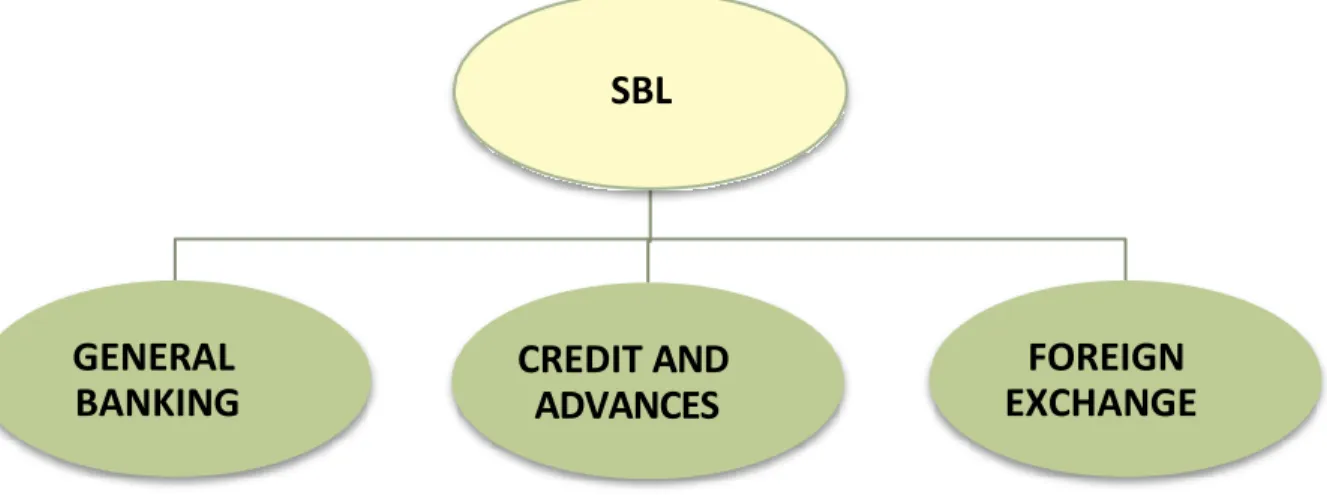
SBL
GENERAL BANKING
CREDIT AND ADVANCES
FOREIGN EXCHANGE
The banking system of Standard Bank Limited (Jhenaidah Branch) is divided into three major divisions. These divisions are –
• General Banking
• Credit and Advance Department
• Foreign Exchange Department
Fig 1: Different Departments of SBL
This deposit is primarily for small-scale savers. There are certain limitations in Savings Account, i.e., customer can draw only twice a week, if they want to get interest on the deposited money. If a customer draws more than twice in a week he will not receive any interest for that month. Heavy withdrawals are permitted only against prior notice. Some Important Points are as follows-
• Minimum opening deposit of Tk.5000/= is required;
• Below 1.00 lac interest rate is 6%, Tk. 1.00 lac to 5.00 lac interest rate is 8%, above 5.00 lac interest rate is 8.50%.
• Minimum Tk. 1000/= balance must always maintain all the time;
• Withdrawal amount should not be more than 1/4th of the total balance at a time and limit twice in a month.
Page | 26
Customer Benefit
• Cheque Book facility.
• Opportunity to apply for safe deposit locker.
• Utility payment service.
• Collect foreign remittance.
• Transfer of fund from one branch to another branch
• Online banking service.
CURRENT DEPOSIT ACCOUNT
Standard Bank facilitates customers with different types of current account. There are current accounts for individuals, proprietorship firms; partnership firms, Joint Stock Company, school, college, association, trust and N.G.O. Account opening form for these categories are different.
Some terms and documents may differ but the overall process of account opening is similar to that of the saving account. Here I like to state what kinds of information to be furnished in the form and which documents customer should provide.
Current Account (individual): Branches use the forms distributed by the SBL head office for opening a current personal/ individual account.
Current Account (Proprietorship): To open a proprietorship current account photocopy of trade license, attached by the concerned officer, is required along with the procedure mentioned for individual current account. A customer should meet the following requirements to see an account has been opened in his/ her name:
• Name of the applicant
• Profession or business of applicant
Page | 27
• Address of the applicant
• Photographs of the applicant
• Introduced by an account holder of the branch
• Signature on the application form
• Signature on the specimen signature card
• Verification of details and signatures by authorized officer.
Current Account (Partnership):
Opening procedure of a partnership current account is almost same as the opening of individual current account but some additional documents are required which are as follows:• Partnership deed
• Letter of partnership
• Trade license
Current Account (Joint Stock Company):
All the formalities of individual current account opening should be met for the opening of Joint Stock Company; additionally following documents also should be submitted to the bank. These documents are:
• Registration certificate from Register of joint stock companies
• Certificate incorporation
• Memorandum of association
• Articles of association
• Annual audit report
• Copy of board Resolution containing
Page | 28
• Name of the persons authorized to operate the bank account on behalf of the company.
• Name of the persons authorized to deal documents with the bank.
SBL current account meets the needs of individual and commercial customers through its schedule benefit.
• Minimum balance: Tk 5000/-
• Interest rate : Nil Customer Benefit:
• Cheque book facility
• Opportunity to apply for safe deposit locker facility
• Collect foreign remittance in both T.C. and Draft.
• Transfer of fund from one branch to another by
• Telegraphic Transfer
• Demand Draft
• Mail Transfer
• Collection of cheque through clearing house
• Online banking service.
Page | 29
Fixed Deposit Receipt
Fixed Deposit is the amount deposited by the customer for a fixed period of time. It offers comparatively higher rate of interest.
• Procedure of FDR Account
• Bank provides the interested customer a Fixed Deposit form.
• Customers fill the form, which contains name of the customer, amount of money, duration, rate of interest etc.
• After filling the form customer pay the money by cash or cheque.
• After receiving the form from the customer the respected officer look for the cash seal or transfer seal. If any of these are present and the form is properly signed the officer provides a specimen signature card to the customer.
• Customer signs thrice on the specimen signature card along with his or her full name.
• At the same time respected officer issue a fixed deposit receipt on the specific FDR block.
Features
• Interest is compounded once a quarter
• Loan may be allowed up to 80% of the deposited amount under lien.
• Excise duty and source tax etc. are deductible from the depositor profit.
Time Duration
Interest Rate (%) 1 month 5%
3 month 7.25%
6 month 7.25%
1 year 7%
2 year 6%
Page | 30
DEPOSIT SCHEMES
Under deposit scheme, the Standard Bank Ltd (SBL) offers different types of products (scheme) to help the fixed income people to save money and meet any future financial obligations. The schemes offer a large amount of money after a certain period of time if the account holders deposit a specific amount on monthly basis.
SBL Regular Deposit Program (SRDP):
It’s called DPS also, customers deposit small amount of money monthly and receives a bigger amount at the time of withdrawal after maturity. Very popular type of account gives greater opportunity of choice as it starts from taka 300. Highest tenure is 10 years.
The given table shows the tenure and amount of taka at maturity-
Installment/Years 300 500 1000 2000 2500 5000 10000 3 Years 11,833 19,722 39,436 78,860 98,800 197,175 394,350 5 Years 20,953 34,913 69,787 139,571 174,492 348,991 698,117 7 Years 29,527 49,212 98,424 196,848 246,060 492,121 984,242 10 Years 48,847 81,446 162,805 325,655 407,310 815,201 1,631,135
The schemes are
I.Three stage savings scheme 1. Monthly benefit scheme III. Juniors savers scheme
1. Lakhpati scheme
2. Pension Savings Scheme (PSS)
Page | 31
3. Education Savings Scheme (ESS) VII. Marriage Savings Scheme (MSS)
VIII. Savers Benefit Deposit Scheme (SBDS) Deposit products
1. Al-Wadiah current account 2. Mudaraba savings account
3. Mudaraba special notice deposit account.
4. foreign currency account 5. NFCD account
6. RFCD Account
7. Mudaraba term deposit receipt Account 8. Mudaraba monthly savings scheme 9. Mudaraba hajj saving scheme.
Investment Products 1. Bai- Murabaha 2. Bai-Salam 3. Bai-Muajjal
LOAN SCHEMES
The loan portfolio of the Bank is well diversified and covers funding to a wide spectrum of business and industries including readymade garments, textile, edible oil, ship scrapping, steel & engineering, chemical, pharmaceuticals, cement, construction, health- care, real-estate and loans under consumer‟s credit schemes allowed to the middle-class people of the country for acquiring various household items.
Page | 32
DEBIT /ATM AND VISA CREDIT CARD
SBL decided to bring more diversification in its array of products and services. This was necessitated to cater to the emerging needs of the market.
Debit/ ATM card and VISA credit card are two such products, the bank could hardly afford not to have them and offer to its customers. In the last quarter of the year under review, the board of directors decided to have its own network of ATMs in strategic locations preferably in branch premises. To do this the bank further agreed to join and share existing network of ATMs currently available in the country. Dutch Bangla Bank Ltd (DBBL) and Q-cash are such two networks which have the largest footprint in Bangladesh. Accordingly SBL has entered into agreement with these networks to give maximum coverage to our ATM cardholders in addition to banks own network.
The bank has also engaged IT Consultants Limited (ITCL) as a third party processor for visa card management. Most of the preparatory works has been done and waiting for visa certification to launch Standard Bank Visa credit card at the earliest.
MERCHANT BANKING WING
In order to broaden the base of service SBL obtained a full-fledged merchant banking license from the Securities and Exchange Commission (SEC) on 06 April 2009. A dedicated wing named, Merchant Banking Wing (MBW) was established for this purpose. After completion of all formalities including staffing, infrastructural facilities, renovation etc .MBW of the bank started operation from august 2009.
The bank has initiated steps to expand the activities of merchant banking operations as below:
Page | 33
• Merchant Banking subsidiary company: The formation of a Merchant banking subsidiary named SBL capital Management Limited is underway. It is expected that this subsidiary will commence operation from june2013.
• Opening of new branches: SBL has plans to open a few branches of merchant banking subsidiary at different areas if Dhaka city phase by phase during June 2014.
• Introduction of new products: SBL is also working to launch a few new products under the merchant regulation.
ISLAMIC BANKING
There are two Islamic banking windows of Standard bank ltd. Those are:
• Topkhana road branch, Dhaka.
• Agrabad branch, chittagong.
Accordingly SBL has opened 2 Islamic banking wings in two divisions during the year 2009. They are following and maintaining properly the guidelines for islami banking issued by Bangladesh Bank. In this regard SBL has installed separate high profile islami banking software which is known as “HIKMA” software.
This “HIKMA” software is completely separate from the conventional software where method of profit calculation is as per Bangladesh Bank guidelines and as per Islamic Banking
SBL is offering the following deposit and investment products to the clients under islami banking:
Page | 34
RETAIL BANKING
According to the statistics and market research paper available, the consumer lending market in Bangladesh has a size of BDT 2600 billion whereas loan outstanding of September 30, 2013 as per schedule bank statistics of Bangladesh bank is around BDT 52 billion. This indicates that only 32% of the market has been utilized by the financial institutions. So the remaining 68% of the market holds tune potential for the loan giving institutions. To exploit the rapidly increasing opportunities in the fast expanding SME sector through maximizing effectiveness of our product development, distribution & sales strategies of Standard bank Ltd. has established a retail banking division in 2012 with the launching of consumer financing & small enterprise financing. The division has introduced the following asset products on consumer financing:
• Salary loan scheme
• Car /auto vehicles loan
• House renovation loan
• Self-employed professional loan.
The division has always been discovering the potential of retail & consumer finance in Bangladesh, understanding the current market condition and examining the latest development within the retail banking , mastering new & successful ways to reduce or mitigate the risk of retail & and small financing book. The account number will also be written on every leaf of the cheque-book. Two officers initialize the account number and leaf numbers. The issuing officer will also check register book and initializes it also.
Then the cheque-book is delivered to the party after taking the signature on the register book.
Page | 35
CORRESPODENT BANKING DIVISION
The main aim of Standard bank limited is to increase its foreign exchange business and in this connection they are doing international banking with all major banks of the world. At present they are maintaining correspondent banking relationship with 23 major banks of the world. These are:
The Hong Kong and Shanghai banking corporation (HSBC), Citibank N.A., Standard chartered bank(SCB), American Express bank ltd., Mashreq bank PSC.,Wcchovia bank, The bank of Tokyo-Mitsubishi ltd.,Union De Banques, Et ArabesFrancaises, Danske bank ltd, A/S Commerz bank, Dresdner bank, Bank Islam Malaysia, Berhad, Nepal Bangladesh bank ltd., NIB bank ltd., Arab Bangladesh bank ltd., AB international finance limited, Bhutan national bank, UTI bank ltd., The bank of Nova Scotia and ICICI bank limited , Habib bank, Ag Zurich, Nordea bank and Samen bank.
CREDIT AND ADVANCE DEPARTMENT
Bank’s basic work is to create a channel through depositing money from the surplus unit and provide funding to borrowers. Thus the necessity of credit department in bank occurs. The credit department is a very important department of a bank. The money mobilized from ultimate surplus units are allocated through this department to the ultimate deficit unit (borrower). The success of this department keeps a great influence over the profit of a bank. Failure of this department may lead the bank to huge losses or even to bankruptcy. Standard Bank’s credit department also tries to do their job perfectly.
Credit and Advance department has four sections they are- Loan, Statement, Recovery &
Bank Guarantee.
Page | 36
FOREIGN EXCHANGE DEPARTMENT
Foreign exchange operation of the bank played a significant role in the overall business of the bank. The Bank is contributing in the country‟s national economy after successfully handling foreign transactions offering a broad spectrum of trade finance product through its 17 A.D branches. During the year 2013 the bank has contributed in the country‟s national economy after successfully handling of foreign exchange transactions VIZ. import, export and remittance. In 2013 volume of import has significantly increased from Tk. 48499.70 million to Tk. 51036.10 million, which was 11.59% higher than last year, the volume of export business has tremendously increased from Tk. 42520.80 million to Tk. 42574.50 million which was 4.74% higher than last year and foreign remittance business also remarkably increased from 703.45 million to Tk. 989.83 million which was 32.33% higher than last year.
Import Section:
This section deals with the import of foreign commodities into Bangladesh. To import, a person should be competent to be an importer. Import starts with the opening of an L/C till the payments are made to the foreign exporters. The import section is divided into two divisions. One division looks after Sight L/C and another one looks after Back to Back L/C. The Basic difference between these two types of L/C is that, sight L/C requires at sight payment for the imported items, the buyer should pay within three days of documents arrival. And on the other hand, the issuance period for Back to Back credit can range from two months to even a year depending on the L/C terms.
Export Section:
All Export departments of Standard Bank's branches are equipped with facilities that would help an exporter ship their good beyond the nation's boundary, thus earning foreign currency for the country. And majority of such customers for Standard Bank Ltd are involved in the Ready Made Garment sector with only a few exporting other different
Page | 37
commodities. Bangladesh exports most of its readymade garments products to U.S.A and European Community (EC) countries. Bangladesh exports about 40% of its readymade garments products to U.S.A.
FOREIGN REMITTANCE SECTION
Remittance means transmission of money from one place to another. There are different modules of remittance. They are as follow:
TT-Telegraphic Transfer DD-Demand Draft
PO-Pay Order
TT-Telegraphic Transfer:
TT is the quickest method of transferring funds from one place to another. The remitting branch sends a telegraphic/ telephonic/ Fax message to the branch at the other end, to pay a certain sum of money to a named payee.
DD-Demand Draft:
It is an instrument containing an unconditional order of one bank office to pay certain amount of money to the named person or order the amount therein on demand. DD is very much popular instrument for remitting money from one corner of money to another.
Commission for DD is 15% of the principle amount.
Page | 38
PO-Pay Order
It is process of money transfer from payer to payee within a certain clearing area through banking channel. A person can purchase payment order in different models such as Pay Order by cash, Pay Order by cheque.
Foreign remittance can be stated as the purchase and sale of freely convertible foreign currency as admissible under Exchange Control Regulations of the country. Inward remittance is the purchase and outward remittance is the sale of foreign currency.
INFORMATION TECHNOLOGY DEPARTMENT
STANDARD BANK is committed to deliver efficient, prompt and personalized service to their distinguish customers who are their first priority and driving forces.
They want to provide them quality services through the integration of the latest state of the art technology.
IT division has been COM powered with more manpower to drive the bank technologically. They have started ON-LINE banking services for their all branches including Principal branch, Dhanmondi branch, Gulshan branch, Agrabad branch, Khatunganj branch, Jubilee road branch, and Topkhana and Khulna branch where clients can deposit or withdraw their money.
Communication backbone of their bank has been connected through VAST, FIBEROPTIC or RADIO LINK by using CISCO ROUTERS. More branches are being brought under the network of ON-LINE banking.
Page | 39
CHAPTER 6
CRITICAL OBSERVATION AND
FINDINGS
Page | 40
SBL is one of the potential banks in the banking sector. The Jhenaidah branch of SBL is a small branch. It was a wonderful experience working at Standard Bank Limited. The employees of the bank were very helpful and nice to me. In spite it was not an easy job to find so many things during the very short period of practical orientation program. Now, I would like to present my observations and give, my opinion to improve the banking service and make their customer more satisfied.
• Lack of Dynamic and Prompt Customer Service:
Since a number of new banks are coming to existence with their extended customer service pattern in a completely competitive manner. Customer services must be made dynamic and prompt. Now a day, people have very little time to waste but want fastest and unique services in short time. Moreover they seek the bank which will provide more facilities and attractive offer compare to other bank. Therefore SBL should think sincerely about the renovation of their customer service and facilities which will be more attractive and innovative rather than traditional one.
• Shortage of Availability of Machineries:
There are shortages of photocopy machines at Jhenaidah branch of SBL therefore at the time of opening account if the customers want to photocopy a document they have to go outside which makes the procedure of opening account lengthy. If one printer stops working load shifts to another printer as the branch consists only two.
• Shortage of Manpower:
For shortage of manpower extra burden falls over a person and it decreases their level of performance and hampers the discipline of working environment. The customers have to wait for sometimes to get their desired service which is a contrary to premium banking.
Page | 41
• Unsatisfactory Software Performance:
SBL uses software named Steller for performing banking activities, but it is often hanged and delays to perform work in time.
• Customer Complains:
Customers are not satisfied with facility of utility bills payment offered by Standard Bank Ltd. They often complain about the short bill collection time and unavailability of the bank’s ATM booth.
Page | 42
CHAPTER-7
RECOMMENDATIONS AND
CONCLUSION
Page | 43
• Renovation of Customer Service:
SBL should make its service prompt so that people need not give more time in the banking activities and fell easy to perform all respective activities. Moreover they have to come up with new facilities and offer which will attract more client and help to ensure their premium as well as loyal customer forever. Therefore they have to ensure-
The working process faster with better computers and operating systems.
Individual attention can be given to customers in order to understand the customers need and better satisfy them.
More ATM booth in merchant location.
More Gifts, Discounts as well as differentiated interest rates on several loan and deposit schemes for the Premium Customers.
• Ensure Proper Division of Labor and Man Power:
The human resource departments of SBL have to ensure proper division of labor in desk for handling the rush of customer in an efficient way. Moreover by increasing the numbers of personnel they can try to maintain their premium banking objective.
• Ensure Availability of Machineries:
Every department should ensure the availability and proper maintenance of necessary machines like photocopy and printing machines.
• Ensure Employee Satisfaction:
Management of the bank has to provide time to time recognition to their employees.
Moreover short probationary period and on time promotion will motivate the employee to perform well in their day to day activities.
Page | 44
• Ensure Proper Promotional Activities:
The Bank must prepare an organized set of plan regarding its advertising and promotional activities which should include billboards, internet advertising and sponsorship. The sales team and officers should provide periodic training on interacting and dealing with different classes of potential and existing custom.
Page | 45
Conclusion
The importance of sustaining and improving bank performance is increasing day by day.
Particularly in an environment which is characterized by rapidly flourishing technology and its growing application to banking, tremendous competition, product development, shift in marketing strategy, deregulation & globalization on the one hand, and escalation in the number of bank failures accompanied by mergers and mega mergers on the contrary. In order to keep abreast with the prevailing market scenario Standard Bank limited has already strengthen its position in the industry. The Bank has grown well in its 14th year of business, expanded its coverage of financial products and customer segments and enhanced its service capabilities across multiple channels. The result achieved by the Bank reflects that it claimed to even higher operational height despite stiff competition.
To be a leading private sector bank, Standard Bank Ltd. has to apply some new dimensions in its customer satisfaction level & its products and services. Otherwise, it would be quite hard for them to keep their business position in competitive market industry. Because of without pure satisfaction from the customers no one can last longer in the market. Existing customers hope better future of Standard Bank Limited by providing best services.
Page | 46
Bibliography
● Lovelock, C. and Wirtz, J., 2004. Services marketing. Upper Saddle River, N.J.:
Pearson/Prentice Hall.
● Palmer, A., 2014. Principles of services marketing. 7th ed. London: McGraw-Hill
● Zeithaml, V., Bitner, M. and Gremler, D., 2010. Services Marketing Strategy. Wiley International of Marketing, 1, pp.208-218
● Bates, K., Bates, H. and Johnston, R., 2003. Linking service to profit: the business case for service excellence. Int J of Service Industry Mgmt, 14(2), pp.173-183.
● Grönroos, C., 1984. A Service Quality Model and its Marketing Implications.
European Journal of Marketing, 18(4), pp.36-44
● Kasper, H., Helsdingen, P. and Vries, W., 1999. Services marketing management.
Chichester: Wiley
● Smallbusiness.wa.gov.au. 2015. Marketing - People Strategy. [online] Available at: [Accessed 31 October 2015]
● Strydom, J., 2004. Introduction to Services marketing. 3rd ed. Cape Town: Juta Academic
● Zeithaml, V., Parasuraman, A. and Berry, L., 1990. Delivering quality service. New York: Free Press
Page | 47
REFERENCES
Standard Bank Limited [Online]. Available From http://www.standardbankbd.com/
References of Books and Policies
:
1. Operation Management, William J.Stevenson (8th Edition).
2. Annual Report, The Standard Bank Limited, 2021.
3. Bangladesh Electronic Funds Transfer Network (BEFTN) Operation Rules, Bangladesh Bank, August 2010.