USE OF COMMUNICATION SOURCES IN RECEIVING AGRICULTURAL INFORMATION BY THE
RURAL WOMEN
Si r-a-Bamgll AqrCUUL'IlI University
Lib2arl
4•
BY
2c C$dd I...
KAMRUZZAMAN Registration No. 04-1 225
A
Thesis
Submitted to the Faculty of Agriculture, Sher-e-Bangla Agricultural University,
Dhaka,in partial fulfillment of the requirements
for the degree of MASTER OF SCIENCE
IN
AGRICULTURAL EXTENSION
Approved by:
ki 6L , 16111~
Prof. Md.
Shadat Uila Prof. Mohammad Hossain RhuiyanSupervisor Co-supervisor
(Prof. Dr. Md. Sekender
All)CERTIFICATE
This is to certify that the thesis entitled, "Use of Communication Sources in Receiving Agricultural Information by the Rural Women" submitted to the Faculty of Agriculture, Sher-e- l3angla Agricultural tiniversity.
Dhaka in partial fulfillment of the requirements for the degree of MASTER OF SCIENCE IN AGRICULTURAL EXTENSION embodies the result of a piece of bona tide research work carried out by KAMRUZZAMAN, Registration No. 04-01 225 under my supervision and guidance. No part of the thesis has been submitted for any other degree or diploma.
I further certify that any help or source of information, received during the course of this investigation has been duly acknowledgement.
Dated:
Dhaka, Bangladesh. (Prof. Md. Shadat Ulla)
Supervisor
"k6iA A5fiUL)i1'
ficXOWTJEJDgcESWEJVT
All pratces are due to the 'Almighty Allah, Who enabled the author to pursue for the successful completion of this research work
The author expresses his sincere gratitude and thanks to his Supervisor, Md. Shadat U/la, Professor, Department of Agricultural Extension and Information System, Sher-e- Bang/a Agricultural University, Dhaka for his scholastic guidance and constcnu' encouragement during the entire period of the research work and in the preparation of the manuscript writing.
The author a/co expresses his gratefulness and best regards to respected Co-Supervisor Prof. Mohammad Hossain Uhulyan, Department of Agricultural Extension and Information System, Slier-c-Bang/a Agricultural (/niversitv. Dhaka for his advice, valuable suggestion, constructive c,;! icisin, special lie/p and co-operation during the tenurc 0/ this research work, as well as preparing of this thesis and providing all the neccsswy facilities during entire period of this pro grainnie.
The author expresses his gratitude and indebtedness to all the honorable course teachers of Dej't. of Agricultural Extension and Information System, Sher-e-/Jangla Agricultural university for their kind help and co-operation in various stages towards completion of this research work.
Finally, the author is deeply indebted to her belovedfather, mother, brothers, friends and other well wishers for their constant inspiration and moral support which can never be forgotten.
'Thtftutfior
CONTENTS
LIST OF CONTENTS ABSTRACT
CHAPTER I INTRODUCTION 1.1 General Background 1.2 Statement of the Problem 1.3 Objectives of the study 1.4 Scope of the Study 1.5 Limitations of the Study 1.6 Significance of the Study 1.7 Hypothesis
1.8 Assumptions
1.9 Deliiiitions of Terms
ChAPTER 2 RWVIEW OF LITERATURE
General Review on use of communication sources b' the rural women in a2ricuhIuraI activitics
Review of Past Studies Concerning Relationship of Selected Characteristics of the Rural Women with their use of Communication sources
2.3 Conceptual Model of the Study
r
c:l-IAPlER titleft
-
ACKNOWLEDGEMENT4
5 6 7 7 8-11 12-21 12-14
14-20
20-2 Cl IAPTER 3 METHODOLOGY
3.1 The Locale of the studs
3.2 Populations and Sampling Design
3.3 Preparation of Data (lathering Instrument 3.4 Collcction of Data
22-34 I 2
22 25 26
3.5 Processing of Data 26
7
3.6 Variables of the Study 27
3.6.1 Independent Variable 27
3.6.2 Dependent Variable 27
3.7 Measurement of Variables 28
3.7.1 Measurement ol' independent variables 28-31 3.7.2 Measurement of dependent variable 3 1-33
3.8 Analysis olData 33
3.9 Statistical Analysis 3-I
RESULT AND DISCUSSION
-
35-49 CHAPTER 44.1 Selected characteristics of the rural women 35
I 4.1.1 Age 37
4.1.2 Level of education 37
4.1.3 Family Size 38
4.1.4 Annual ftniily income 38
4.1.5 Farm size 39
A I A i1 mr cnent in norriiItnriI wnrk 39
4.1.7 Organizational participation I 40
4.1.8 Agricultural knowledgc 40
4.2 Use of communication sources of rural women 41-42 reaardirm aaricultural activities
Relationship between individual characteristics 42
N Il
of the rural women and their use of communication sources4.3.1 Relationship between age of the rural women 43 and their use of communication sources in
agricultural activities
I
4.3.2 Relationship between level of education of 44 the rural women and their use of
communication sources in agricultural activities
Cl-IA PIERS
4.3.3 Relationship between family size of the rural 45 7 women and their use of communication I
sources in agricultural activities
4.3.4 Relationship between annual thmilv income 45 of the rural women and their use of
communication sources in agricultural activities
4.3.5 Relationship between farm size of the rural - 46 women and their use of communication
sources in agricultural activities
4.3.6 Relationship between times spent in 46 agricultural work by the rural women and
their use of communication sources
r
4.3.7 Relationship between organizational 47 participation of the rural women and theiruse of communication sources
4.3.8 Relationship between agricultural knowledge 48 of the rural women and their use of
communication sources
4.4 Rank order of different technology used by the 48-49 rural omen regarding agricultural activities
SUMMARY. CONCULATION AND 50-59
RECOMMENDATION
5.1 Swnmaty - 50
5.1 .1 Introduction 50
5.1.2 Methodology 51
5.1.3 Findings SI
5.1.3.1 Selected characteristics of the rural women 51-53
5.1.3.2 Use of communication sources of the rural 53 - women regarding agricultural activities
5.1.3.3 Relationship of the selected characteristics 54-55 of the rural women with their use of
communication sources
5.1.3.4 Rank order according to CSUI 55
5.2 Conclusions - I 56-57
5.3 Recommendation
5.3.1 Recommendation for policy implication 1 58 5.3.2 Recommendation for further study 59
REFERENCES 6064
LIST OF TABLES
flible
- TitleNo.
3.1 Distribution of population sample and reserve list of the rural women in two selected villages of Surjyamani union under Patuakhali district
4.1 Characteristics profiles of the rural women.
4.2 Number & percentage distribution of rural women according to their use of communication sources.
4.3 Relationship between eight characteristics of the rural women and the use of communication sources regarding agricultural activities.
44 i Rank order of different technology used by the rural women regarding agricultural activities.
Page No.
25
36
41
43
49
LIST OF FIGURES
Fig Title
No.
1 2.1 Simple Conceptual framework of the study.
3.1
I
A Map Patuakhali District Sowing Bauphal Upazila.3.2
I
A map of Rauphal upazila showing Surjyamani UnionPage No.
21 23 24
LIST OF APPENDICES
'LihraryJ
-,Appendix No.
Title
_________
Page -
No.
An English version of Interview schedule 65-69 An Bangla version of Interview schedule 70-73
Correlation Matrix 74
ABSTRACT
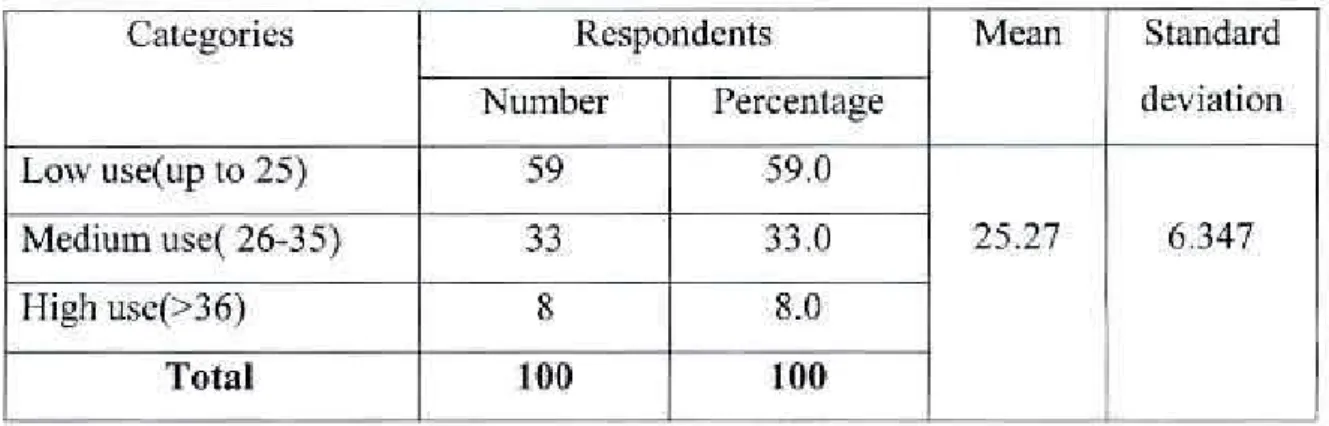
The purpose of the study was to have an understanding on the communication sources of the rural women regarding agricultural activities, the locus of the study was the involvement of rural women in agricultural activities in Sur;vamani union tinder Rauphal upazila of Patuakhali district. Attempts were also made to detenninc and describe the selected characteristics of the rural women and to determine the relationship of the selected characteristics of the rural women with their use of communication sources. Data were collected from a random sample of IOU rural women of two selected village, namely Ramnagar and Nurainpur of Patuakhali district. Data revealed that more than half (59%) ol the respondent had low use of communication sources in their agricultural activities as compare to 33% having medium and only 8% use of high communication sources. The characteristics such as age and time spent in agricultural work had no relationship with their use of communication sources. The other characteristics such as level of education, family size. annual litwily income. ttrm size, organizational participatioi't and agricultural knowledge of the rural women had signi ñcant positive relationship with their use of communication sources in agricultural activities. Utilization of ten technologies by the rural women, the communication sources score ranged from 12 to 45 against the possible score C) to IOU to utilize these technology for their agricultural activity. It indicates very poor use of' communication sources by the rural women in the study area.
[3 ibrarC'!ur thHiersity CHAPTER 1
C '
INTRODUCTION l.lcencral
BackgroundBangladesh is an agro-based over-populated country. Development of socio- economic condition of Bangladesh fully depends upon the development of the village. Women in rural Bangladesh are major but largely unrecognized contributors to agricultural and economic productivity. Half of these human resources consist of women and the majority of them live in rural areas.
It is estimated that women are almost half of the total population of the world. In Bangladesh. 49.06 % of the populations are women of which 72.6% live in the rural area (BBS, 2011). Vertical increases may be possible through more intensive production and more involvement of women in production. activities.
About 70% population of this country directly or indirectly live on agriculture(BBS. 2011). But agriculture in Bangladesh remains to be almost traditional and the technologies which are being developed did not reach the bonatied users more effectively for their applications.
Womens involvement in rural development. more particularly in agricultural development in Bangladesh. is the most important strategy designed to improve the social and economic life of spceiIic group of Ilirming community.
Undoubtedly. the improvement provides various benefits of development to the target groups who seek a livelihood in rural areas. The basic aim of the government of Bangladesh (GOB) is to raise lärm productivity and family income for socio economic welfare of the society for which it is intended to.
Women of these landless thmilies cultivated different kinds of' ve2etables. fruits and earn money more than medium and large flimily (1 lalim. 1991 ). This income may meet it part of house hold expenditure for an average of 5.5 member family, size (Anonymous. 1991). Women are the majority, of the world's agricultural
producers. playing important roles in agriculture sector and as well as iii Lisheries.
livestock management. Rural women play a key role in agricultural sector production by working with full passion in production of crops right from the soil preparation till post han'est and food security activities (Habib, 1996: ESCAP.
1996; Ahmed & Hussain. 2004).
Women contribute significantly in agricultural production but it has hardly been recognized. Because of the existence of a traditional society. male generally dominates in development activities in Bangladesh. The situation now seems to be changing considerably due to the introduction of new technologies in agriculture and rural life. In the economic development of Bangladesh the role of women cannot he over looked. Traditionally the women and their activities were conlined in the homestead area (Baum, 1982). Akhter (1990) reported that women contribute to litmily income through homestead gardening activities such as fruit and vegetable gardening, poultnr rearing, goat rearing etc. This income may meet a part of their household expenditure. The women are also involved with homestead agricultural production activities such as cultivation ol' vegetables! fruits.
timber etc. and rearing of smallanimals (goat, sheep) and poultry birds to supply goods and increase family income (Akther. 1990), Halim (1982) reported that the women are potential producer a] the homestead agricultural products. But due to lack of knowledge. utilization of' proper technology and proper communication sources the production remains below the expected level.
Although rural women are heavily engaged in agricultural activities but in the past very few organized efforts have been made to find out the comparative effectiveness of different communication media in disseminating homestead gardening in!brmation to the rural women.
From the above discussion, we can say that women can play an important role to
from economic and nutritional point of View. The researcher becomes keenly interested to conduct an investigation on involvement of rural wonieti in homestead vegetable cultivation.
1.2 Statement of the Problem
Women may be the key operators of the homestead production and are also actively involved in the field of agriculture. Women can contribute in both homestead gardening and field cropping. It is expected that the participation of women in development process could attribute significantly in h balanced socio economic growth and development of the country. So it is essential to provide adequate knowledge and training in order to provide them to perform their job in a better way in the various field of development activities especially increasing agricultural production. Very l•v researchers have as tiir been conducted on the use of communication sources the rural women in Bangladesh. But there are urgent needs to identify the information sources used by the rural women regarding agricultural purpose. Ilence, the present study mainly deals with the communication sources of rural women for finding the answers to the following question;
(I) what were the information sources being used by the W01flC11
regarding agriculture?
(ii) What was 'the extent of use communication sources of the rural voiiien!
(Ill) \qich of the characteristics of the rural women were related with their communication sources regarding agriculture!
(IV) What were the weightage of the communication media used by the rural women regarding agriculture?
For getting answer of the above questions the researcher selected the following objectives of the study.
1.3
Objectives of the studyThe following specific objectives of the study were being formulated in order to give proper direction of the study.
I. To determine and describe the use of communication sources by the rural women in receiving agriculture inibnuation.
2. To determine and describe some selected characteristics of the rural women The characteristics are-
I. Age
11. Level of education Ill. Family size
Annual income of Family Farm size
Time spent in agricultural work Organizational participation Agricultural knowledge
3. To explore the relationship bctwccn selected characteristics of the rural women and their use of communication sources.
1.4 Scope of the Study
Finding of the study will be particularly applicable in a selected area of Surjyamani under lauphal upazila under Patuakhali District. However, the findings may also have application for other areas of Bangladesh where the physical. socio-econornie and cultural conditions do not differ much from those of study area. Thus. the findings will be helpful to the researcher, planners, policy makers and extension workers for promoting rural development also help to dcvelopmcnl of SOCiO economic condition of the rural women.
1.5 Limitations of the Study
The present study was conducted to have an understanding about communication sources of the rural women regarding agricultural activity. But considering the time, money and necessary resources available, the study was conducted with the folloving liniitations:
The study was confined to only one union.
The respondents ['or data collection were kept limited within the women of the rural families.
Characteristics of rural women were many and varied but in the present study.
only eight characteristics were selected for investigation.
There are many communication sources from where rural women can receive information for their agricultural activities. But only few communication sources were selected for this study.
1.6 Significance of the Study
Now a day various government and non-government organizations are taking programs for increasing agricultural production. it is very much important to improve production technology of agriculture otherwise not possible to fulfill our food demand in our increasing population. Rural women play a vital role in agricultural production. Homcstcad gardening. poultry rearing, working in the crop field etc. agricultural activities are participating in rural women. So it is too much important to know new technologies, modern varieties, modern cultivation process etc. by rural women.
Surjoinoni union is one of the most important unions in Patuakhali district. Most of the people are literate but most of the people who doing agricultural work are not literate also they are backward in agricultural activities. They are not aware of modern agriculture. Women of this union participate in agricultural activity. They are engaged with their agricultural production activities for a long period of time in day.Thcir participation and income generation activities improve the condition of their family.
But this may be due to the thel that they are not using the modem technologies.
as they do not know about them or not motivated to use them commercially.
Rural women usually perform agricultural activities with their indigenous knowledge. The change agent could motivate the women to change their present practices.
For better control over their activities and understanding, and to bring a dcsired change, the rural women should have exposure with different communication sources to get agricultural infonnation and technologies. As a result the time and scope will hilly be utilizcd and the production will be the satisfactory. ThereFore this study would be very usellil to policy planners in order to develop an extension
1.7 Hypothesis
To test relationship between the rural women involve in use of conhciltlnicatioil sources in receiving agricultural information and their selected ehunicleristics. it null hypothesis was developed.
The null hypothesis of the study was "there is no relationship between selected each of the characteristics of the rural women and their involvement in use of communication sources in receiving agricultural information."
1.8 Assumptions
An assumption is the supposition that an apparent fict or principal is true in the light of available evidence (Gode, 1945). The researcher had the following assumptions were made in conducting the study:
I. The respondents included in the sample were capable of furnishing proper responses to the questions included in the interview schedule.
The researcher personally collected data was well adjusted himself to the social environment of' the study area. I-fence the data collected from the respondents were free from any biasness and with no hesitation.
The responses furnished by the respondents were valid and reliable.
Views and opinions furnished by the rural women were the representative views and opinions of all the rural women of the study area.
1.9 Definitions of Terms
Some significant terms used in the study have been defined as fbllows:
Agriculture
Agriculture is the science, art or practice of cultivating the soil. producing crops.
and raising livestock and in varying degrees the preparation and marketing of the resulting products.
Communication
Communication is a process of purposeful and mutual transmission or exchange of information in order to affect the desired change of behavior.
Rural women
It refers to the women living in villages and is engaged in gardening directly or indirectly.
Communication source
Communication source refer to the sources of information through which various information are diflitsed to the rural women or farmers.
AQricultural Information
Agricultural information refers to information need for the farmer relevant to agricultural work/activity.
Age of a rural woman was defined as the period of time in years from her birth to the time of interview.
Education
Education refers to the development of desirable knowledge, skill and attitude in the individual through reading. writing and other related activities. It was measured in terms of actual grades or class passed by a respondent.
Family size
Family size of a rural woman was defined as the number of individuals who live in the same residence and eat together. 'l'his includes the respondent hersell her husband, children and other permanent dependents if any.
Farm size
Farm size refers to the cultivated area either owned by a farmer or benefit derived from the land as horga or lease system. Farm size was measured in terms of heetares.
Time Spent in Uardenmg
It refers to the number of hours of a day her or her thmilv members kept she or they involved in homestead gardening activities.
Agricultural knowted9c
It is the extent of basic understanding of a rural woman in different aspects of agriculture subject matters i.e. vegetable, fruit plants, varieties, production.
plant protection etc. It also inctudes the basic understanding of the use of different agriculture inputs and practices.
Annual family income
Income that comes by the family member annually is called annual family income. It's conic by agricultural production. poultry rearing, fish culture.
services etc. It was measured in taka.
Organizational participation
Organizational participation of a rural woman refers to her participation in various social organizations as ordinary member. executive committee member and executive officer.
lnterated pest rnanacment
The attempt to prevent pathogens insects and weeds from causing economic crop losses by using it variety of management methods that are cost effective and cause the least damage to the environment.
Crop rotation
Crop rotation is it process of growing different crops in regular recurrent succession on it piece of land for specific period of time.
Inte&rated Crop Management (1CM)
1CM is a system of crop production which conserves and enhances natural resources while producing Ibod on all economically viable and sustainable foundation. It is based on it good understanding of tile interactions between biology, environment and land management systems.
1CM is particularly appropriate for small !iinuers because it aims to minimize dependence on purchased inputs and to make the fullest possible use of indigenous technical knowledge and land use practices.
Intercultural operation
The operation which are taken at different crop growth stages of crops after seed sowing or planting of seedlings till before harvesting are known as intercultural operations or after cares.
rk
(11ih
r;i ry)Hi&J-vielding varieties
(l-IYVs) are any of a group of genetically enhanced eultivars of crops such as rice.
maiz.e and wheat that have an increased growth rate. an increased percentage of usable plant parts or an increased resistance against crop diseases. Those crops funned the basis for the Revolution. In general, they require a higher level of agricultural care, such as intensive disease control, higher fertilizer levels and controlled water supply. While those crops have enabled the multiplication of agricultural production, their increased demands of fertilizers, pesticides and water control have drawn criticism from environmcntalists. Another name is high- response variety, as the high yield requires high input.
Guti urea
Urea briquette. popularly known as 'guti urea', is produced from traditional urea fertilizer using locally made machines. While traditional urea fertilizer is used thrice for a crop, (luti urea is used only once.
Organic farming
Vegetable and livestock production using natural sources of nutrients (such as compost, crop residues. and manure) and natural methods of crop and wccd control. instead of using synthetic or inorganic agrochcmicals. Also called low input farming.
Post harvest technology
Post-harvest technology invo$vcs all treatments or processes that occur from time of harvesting until the foodstuff reaches the final consumer.
Efficient techniques 11w harvesting, conveying/transportation, handling, storage.
processing/preservation, packaging. etc are components of the post-harvest chain.
CHAPTER 2
REVIEW OF LITERATURE
'flie present study is concerned with the involvement of rural woiiien in USC
of
communication sources for agricultural activities. This chapter deals with the review of past studies and findings related to the present study. This chapter is divided into three sections. First section deals with the findings on use of communication sources by the rural women in agricultural activities in general and the second section is devoted to a discussion on the findings of studies exploring relationship between the selected characteristics of the respondents and their use of communication sources. The third section deals with the conceptual model of the study.
LI General Review on use of communication sources by the niral women in agricultural
Flahi (1977) recommended that personal contact was an excellent medium for channeling inlbrmation to rural communities where the mass media could not penetrate because ol' educational tinder development.
Hooda (1987) observed that with regard to the utilization of' source of communication radio was found to be the most impersonal source of intormation. In case of personal source. friends and relatives were the most utilized source of in lbrmation followed by progressive farmers.
Parveen (1993) revealed that individual contact of women in modern village was positively significant with attitude towards homestead agricultural production and it was significant in ease of traditional village.
Wahvuni (1990) found that women's communication network and perceptions of themselves as individuals significantly affected women's rolcs in small hold farming systems.
Miah and Rolls (1990) in their study have identified some of the reasons enhances the flow of agricultural infhrmation among the flirmers in Bangladesh.
They observed that the social, political and economic factors of the Ilirming community play an important role in the flow of extension messages among the farmer.
Bhuiyan (1988) observed that when single communication media was considered irrespective of categories it was found that the highest proportion of citations in all stages of adoption process was neighbors. friends and relatives.
Gura (1986) suggested that rural women need to he recognized as it group with specific extension and training needs, group approaches. compared to methods of extension that are general to individuals, lie said that group approach of women rather than individual approach might help to reduce the social and cultural restrictions. The female agricultural extension worker would be helpful to reach rural women.
Orojobi (1980) found in a study that the private sources of agricultural information of Nigerian l'armcrs were friends, other t'anners. local leaders.
traditional meetings. extension agents. radio, demonstrations. television.
agricultural shows and printed materials.
Akanda (1994) in his study found that highest proportion of' the rural women had participation in vegetable cultivation while only 0.5 percent of them had high participation in the cultivation of fruit trees.
Islam and karim (1994) observed in a village of Jossore district. liangladesh that women participate in vegetable production 20-80% while men by 20-50% in various farm group.
Thapa et al. (1996) suggested that both hired labor and off- farin income substitute for women's labor in agriculture. \Vomen who have more young children are more likely to be involved in agriculture eonverscl.
Patil et al. (1984) found in a study that contact farmers received iniormation on improved agricultural technology from neighbor flirniers (59.13%). progressive farmers (56.12%), village extension worker (91.84%), agricultural officer (3 1.63%). group discussion (16.33%). demonstration (14.28%), radio (88.77%) and news paper (60.20%).
Auragozeb (2002) studied on adoption of integrated homestead fanning technologies by the rural women in RDRS. He found that the highest proportion (7 l%) of' rural women had high 21% medium and 8% had low integrated homestead farming technology.
2.2 Review of Past Studies Concerning Relationship of Selected Characteristics of the Rural Women with their use of Communication sources
Eight characteristics of the rural women were selectcd as indepcndcnt variables of the study. The researcher has studied the relationship of each of the selected characteristics with their use of communication sources. However, succinct reviews of I iterature on the relationship of each independent variable with use of communication sources are presented in this section.
Age
Kandani and Sahale (1983) observed in a study that age of Ihe farmers had statistically significant association with the extent of use of communication media.
Ahmed (1977) in his study found that age of the farmers had no significant influence on the use of information sources in the adoption of improved lärm practices.
Rahman (1974) concluded in his study that the age had no significant influence on the use of information sources.
Haque (1972) observed in a study that statistically there was no relationship between age and use of information sources.
Latif (1974) observed that there was no relationship between age of the farmers and their communication exposure.
Aurangozch (2002) found that age of the rural women had significant negative relationship with their adoption of integrated homestead Rirming technologies.
Islam (2002) in his study found that age of the rural women had no significant relationship with their involvcnicnt in income generating activities.
Salahuddin (2003) in his study found that the age of the rural women had significant negative relationship with their involvement in homestead vegetable production.
'I
Level of education
Kasheni and Juries (1988) found in their study that education of small lanners had significant positive correlation with their contact with information sources.
Dcvi (1995) found that education of women had a significant positive impact on labor force participation.
Bhuiyan (1988) concluded in his study that education and the use of communication media in the adoption of farm practices were positively correlated.
In Dhande (1982) observed that the education of the respondent was positively and significantly related to information sources utilization score.
Ahnied (1977) in his study showed that education of thrmers has a significant relationship with information sources in the adoption of plant protection measures.
Latif(1974) found in his study that there was no relationship between education of rural women and their communication exposure.
Rahman (1996) observed that level of education of the women had positive relationship with their participation in rural development activities.
Chovdhuri (2000) in his study found that education of the rural omcn had significant positive relationship with their opinion for participation.
Islam (2002) in his study found that education of the women had significant positive relationship with their involvement in income generating activities and decision making in household and health care.
Family size
Rao (1994) reported that rural women's participation in agriculture was positive correlation with the size of their family.
Latif (1974) observed that there was no relationship between family size of the farmers and their communication exposure in receiving agricultural information.
Ahmeds (1977) study showed that family size had significant influence on the use of infonnation sources in the adoption of plant protection measures.
Islam (2002). in his study found that family size of the rural women had non- significant relationship with their involvement in income generating activities.
Kadam and Sabale (1983) found in a study that size of family of the farmcrs had on association with the extent of use of communication media.
Nahar (2000) reported that there was no relationship between family size and participation of women in homestead vegetable cultivation, poultry. fanning and goat rearing but she found a significant positive relationship between family size and participation in post-han'est practices.
Annual income of family
Ahsan (2002) Ibund that animal income of rural women had no significant relationship with their involvement in homestead vegetable production.
Nahar (2000) in her study found that üimily income had negative relationship with their participation in homestead vegetable cultivation, post harvest practices.
poultry rearing and goat rearing.
Akhter (1989) opined that on an average the income from homestead varied from 5 to 13.14 thousand taka in a year.
Akanda (1994) observed in his study that family income had significant positive relationship with their participation in the cultivation of fruit trees and non-farm household activity but not with homestead vegetable cultivation.
Farm size
Latif (1974) found in his study that there was a positive relationship between farm size and communication exposure of the rural women.
Ahmed (1977) showed in a study that farm size had significant influence on the use of information sources in the adoption of plant protection measures.
Ualim (1991) in his evaluation report on farming system Research activities of homestead component mentioned that women of small farm family spent more time in agricultural activities as compared to medium and large thrm liimily in Kazirshimla side (upland), whereas in Naogaon site (low lying area), women of medium farm family spent more time in agricultural activities.
Rahman (1974) concluded in his study that a positive correlation was found between the farm size of the farmers and their use of communication sources.
Basak (1997) observed that homestead size of the rural women under BRAG had a significant relationship with their impact of participation in BRAG rural development activities.
Time spent in agricultural work
No literature was found as the relationship between times spent in agricultural work and use of communication sources.
Organizational participation
Latif(1974) concluded that the organizational participation of the rural women had a significant positive relationship with the use of communication media.
Roy (1981) in his study indicated that organizational participation ol small income farmers had significant positive effect on their communication behavior receiving information on the use of balanced doses of fertilizer.
Rahman (1974) in his study revealed that organizational participation had significant positive relationship with the use of communication sources by the Jute seed growers.
Bhuyari (1988) indicated in his study that the relationship between organization participation and the use of communication media was not significant. l)hande (1982) observed that organization participation of the respondents was positively and significantly related to information source utilization score.
Agricultural knowledge
Kashem and ilalim (1991) showed that the use of communication media in adoption of modern rice technologies had significant positive correlation with agricultural knowledge.
Akhter (2000) in his study Ibund that agricultural knowledge of the women had significant positive relationship with their participation in decision working role in the family with regard to development activities.
Kashem and Jones (1988) found in their study agricultural knowledge of the rural women rendered signification positive correlation with their contact with information sources.
Parveen (1995) in her study observed that the level of existing knowledge of farm women on the use of modern technologies revealed that 58% of moderate knowledge. 35% had high while 7% oi'fiirin women possessed poor knowledge.
2.3 Conceptual Model of the Study
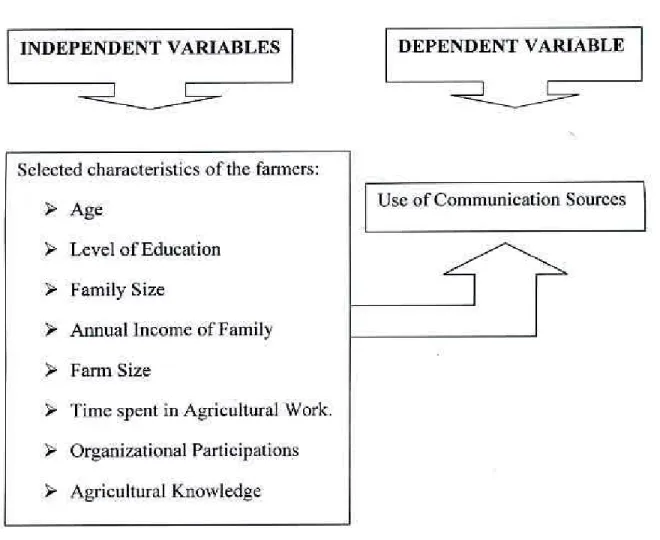
In the light of review of literature, it is conceived that communication sources of the rural women regarding agricultural information is greatly motivated and influenced by some of the characteristics. In scientific research, selection and measurement of variables constitute an important task. The hypothesis of a research while constituted properly contains at least two important elements i.e "a dependent variable" and "an independent variables." A dependent variable is that Iltetor which appears, disappears or varies as the researcher introduces, removes or varies the independent variable (Townsend. 1953). An independent variable is that factor which is manipulated by the researcher in his attempt to ascertain its relationships to an observed phenomenon. A simple conceptual framework for the study is made on the basis of review of literature which is shown below:
INDEPENDENT VARIABLES DEPENDENT VARIABLE
I _
Selected characteristics of the farmers:
>Age
> Level of Education
> Family Size
> Annual Income of Family
> Farm Size
Use of Communication Sources
Time spent in Agricultural Work.
> Organizational Participations
> Agricultural Knowledge
Figure 1: Simple Conceptual framework of the study
CHAPTER 3
METHODOLOGY
Methodology is very important in scientilic research. Importance of methods and procedures in conducting any research can hardly be over emphasized. A researcher should he carniful in formulating methods and procedures in conducting research.
The researcher has the great responsibility to clearly describe what shorts of research design, methods and procedures: Thus, methods and procedures
followed in conducting this study are discussed in this chapter.
3.1 The Locale of the study
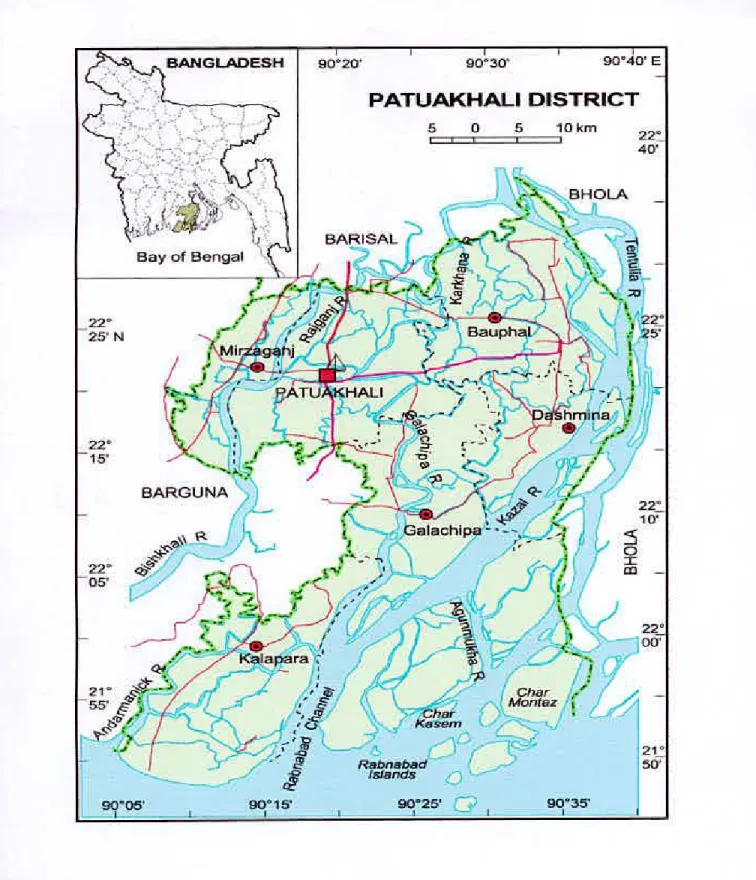
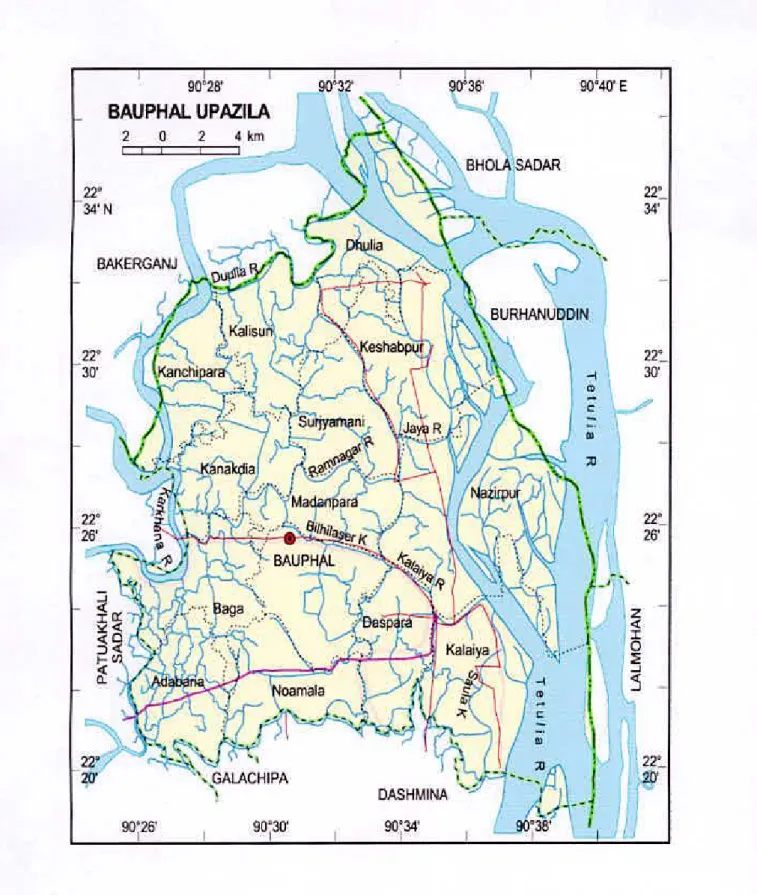
The study was conducted at the Surjyaniani union of Bauphal upazilla under Pamakhali district. There were I 1(elcven) villages in suijyamani union. Out of eleven villages two villages were selected purposively. The selected villages were Ramnagar and Nurainpur. Considering time, money and resources of the researcher, the study was kept confined to theses villages.
3.2 Populations and Sampling Design
The numbers of villages of Surjyamani union were eleven and total numbers of family head male and female were 10047. Among them 5083 were male and 4964 were female. It was difficult to conduct on all the female of 11 villages within a short period of time. So out of II villages two villages were selected purposively and the rural women of these two selected villages constituted the population of the study. The numbers of farm family of these two selected (Ramnagar and Nurainpur) villages were 315 and 180 respectively. l'hus a total of 495 rural women constituted the population of the study. Out of 495 rural women around 20% were selected randomly as
BANGLADESH
I
90°20 goao 0°4o ElPATUAKHALI DISTRICT
f J5 0 5 10km 22°
40
- BHOLA
1çC
BARISAL Bay of Bengal
"
22° / /- . '22
25 N -.:
,5
';.•. BauphaL- ) 25'(\MiagahJ I
?ATU $HALI
) - J
hmina -,
22° • / g
15
BARGUNA
7
10,Galachipa ---
- I 0
22° t
05' -,
--
22°
T/ J. 00,
7lCalapara: - -
.. - I
- I.
21 Char /
55' Char Montaz1
Kasem
21°
- Rabriabad 50'
islands
9005' 90°15' 90°25' 90°35'
I I I I I I I I
Fig 3.1 A Map Patuakhali District Sowing Bauphal Upazila.
90632 90036 90040 E
BHOLA SADAR
2201 34,
3ç
1
. ... BURHANUDDIN 90°26'BAUPHAL UPAZILA
2 0 2 4km
I I I I I
220 34'N
BAKERGANJ N
22°
30' (Kangparac Th
".
.•---
Kanakd rl
22°
26'
..
_ .t_. • I,...
Lc, .:- •
a •.::a9
:< ,'
<0 '
a. NDamala
220 - I
2(Y ,GALACHIPA
/ 'F4aZIIP&J.
7,;-' •5
.*-*
37\ (
._._J
KaIaIYa1!
°--:ff2}---:
IZ.-n DASHMINA
1' --'--S 90°34' 90'38'
1
IYNthiyamT"Mada41ar
'7
BAUPHALN
22 30'
22°
26'
20'
Figure 3.2 A map of Bauphal upazila showing Surjyamani Union
The researcher first prepared the list of rural women of these two villages with the help of union council. local leaders and aged persons of respective villages.
A number of 100 sample housewives were selected randomly from the two selected villages as shown on the Table 3.1.
A reserve list of 10 housewives (10% sample) was prepared for use in case of unavailability of the respondents of the sample of any reason.
Table 3.1 Distribution of population sample and reserve list of the rural women in two selected villages of Surjyamani union tinder Patuakhali district
Union Villages No. of Rural No. of rural No. of rural -
women women women
(population) included as included as sample reserve list
Ramnagar 315 58 6
Surjyamani
180 42 4
- Nurainpur
Total 495 100 10
3.3 Preparation of Data Gathering Instrument
Keeping the objectives of the study in view, an interview schedule was prepared for collection of data. The questions and statements contained in the schedule were
00 simple. direct and easily understandable to the rural women. The schedule
00
contained close and open form of questions. Scales were constructed for measuring some variables. Numerical data were ohtained in the case of age, level of education, family size, annual family income, farm size, time spent in agricultural work, organizational participation, agricultural knowledge. use of eomniunication sources of the rural women.
The schedule was prepared in Bengali for clarity of understanding on the part of respondents. The drati interview schedule was pre-tested by administering the same on 10 homestead rural women of the study area of Surjyamani union in actual licld situation beibre linalizing the same for collection of data. Necessar) alternations, modifications and adjustment were made in the schedule on the basis of the experience of the pie-test. A copy of the English version of the interview schedule appears at Appendix- A.
3.4 Collection of Data
l'he researcher himself collected data. A house-to-house survey was conducted by the researcher to collect data. All possible efforts were made to explain the purpose of the study to the respondents in order to get valid and relevant information from them.
For data collection, interviews were conducted with the respondents at their homes during their leisure period. While starting interview with any respondent the researcher established appropriate rapport so that she did not feel hesitance to furnish proper responses to the questions, statements in the schedule. In some cases the researcher failed to meet with respondents at their homes for interviews. However this problem was resolved by repeating the visit.
The total collection process of data took 30 days from I March to 30h March 2012.
3.5 Processing of Data
Data obtained from the respondents were coded, compiled, tabulated and analyzed in accordance with the objectives of' the study. Qualitative data were converted to quantitative data by means of suitable scoring to facilitate analysis and interpretation.
3.6 Variables of the Study
Independent and dependent variables of the study are presented below:
3.6.1 Independent Variable
The selected individual characteristics of the rural women were considered as independent variables, which were as Ibilows:
Age
Level of education Family size
Annual income of family Farm size
Time spent in agricultural work Organizational participation Agricultural knowledge
3.6.2 Dependent Variable
The dependent variable of the study was:
Communication sources of the rural women regarding agricultural activity were the dependent variable of the study. Various communication sources were used by the rural women regarding information on agriculture.
3.7 Measurement of Variables
In order to conduct this study in accordance with the objectives it was necessary to measure the variables. The procedure for measuring the variables is described below:
3.7.1 Measurement of independent variables
Eight characteristics of rural women as mentioned above were the independent variables of this study. The measurement procedures of these selected characteristics are described below:
3.7.1.1 Age
Age of a rural woman referred to the period of time from her birth to the time of interview and it was measured in terms of complete actual years. A score of one was assigned for each year of age.
3.7.1.2 Level of Education
Education of a respondent was measured on the basis of her number of years of schooling in educational institutions, if a respondent had the education equal to the level of class jive (5). her education score was taken as 5. If a respondent passed the final examination of S.S.C. her education score was taken as 10. Ii a respondent could sign her name only then the education score of the respondent was taken as 0.5. If a respondent did not know how to read and write, her education score was taken as zero (0).
3.7.1.3 Family size
Family size of the rural women was determined by the total number ol' male and female members in her family including herself, adult, adolescence, infant and
family size of a respondent. For example. if a respondent has S members in her family, then her family size was 5.
3.7.1.4 Annual family income
It was the total income earned by respondent and other members of her family from various sources such as agriculture, business and others. Family income was measured in 'thousand' taka per year.
3.7.1.5 Land possession
Farm size was estimated in terms of full benefit the respondent get from the land she operated thrrning operation. The Land possession of a respondent was measured in hectares by using the following fonnula:
Land possessiona+b+'/2(c+d)+e+1+g Where,
a = I lomestead
h = Own land under own cultivation c = Land given to others on borga d = Land taken from others on borga e a Land taken from others on lease
f= Own pond g fellow land
3.7.1.6 Time spent in agricultural work
l'ime spent in agricultural work of a respondent was measured by (lie number ol hours in a day she had kept herself involved in performing agricultural activities
3.7.1.7 Organizational participation
It was measured by computing an organizational participation score oii the I)asiS of a respondent's nature of participation in different selected organizations. The scale for computing organizational participation for a particular organization shown below:
Organizational participation score = P X D. Where, P = Participation score
D = Duration (year)
Participation score was assigned as:
Score - Position hold
0 No participation
General member
2 Executive member
Executive officer
L
The duration score was assigned as year.
Finally organizational participation score was measured by summing up all the score for participating in all the organizations.
3.7.1.8 Agricultural knowledge
it refers to the possession of knowledge by a respondent on different aspects of
15 different questions related to homestead gardening. Two (2) score was assigned for each question. The total assigned score for all the questions was 30. A respondent answering a question correctly obtained lull score, while for wrong answer. she obtained zero score. Partial score was given for partial correct answer. Thus the agricultural knowledge score of a respondent could range from 0 10 30. where 0 indicated very low knowledge and 30 indicated
\'ery high knowledge.
3.7.2 Measurement of dependent variable
Use of communication sources of the rural women was the dependent variable of the study. The use of communication sources of the rural women regarding agricultural activities was ascertained.
it was calculated on the basis of number of contact made by a rural woman with their use of communication sources regarding iii formation for performing selected agricultural technology. There were ten (10) technologies and different types of communication channel were used to adopt these technologies by the rural women.
Weightage were assigned to each of the items according to their logical frequencies of contact to each communication channel to compute the communication sources score of the rural women as following manner:
SI No. Communication Nature of visit Weightage channel
>7-8 times/year 4
1. AEO 5-6 times/year 3
4-3 times/year 2
1-2 times/year
Not at all U
>3 times/month 4
2. SAAO 3 times/month 3
2 times/month 2
Once per month
Not at all 0
>3 times/month 4
3. Ngo Worker 3 times/month 3
2 times/month 2
Once per year I
Not at all 0
>5 times/month 4
4. Ncighbor/fricnds &
4-5 times/month 3
2-3 limes/month 2
Television Once per month - -
Not atall 0
- >4 Limes/year -I
5.
Aaricultural fair 3-4 times/year 32 times/year 2
Once per 3year
Not at all 0
>4 times/month 4
6. Group discussion 3-4 times/month 3
2 timeshnontlt 2
Once per year
Not at all 0
>5 Limes/month
7. Ideal farmer 4 UITICS!fllUil th 3
2-3 times/year 2
Once per year
Not at all 0
>3 titi;csntt'ritl
I
Agricultural meeting 1-3 times/month 2 times/year once per year Not at all
1-2 times/year I iimes/2 year
Method demonstration
F Once per 3 year Not at all
There were 10 technologies and for each of the technologies the respondents were asked to indicate that extent of contact against 4 (four) communication media the weightage for each medium could range from 0 to 4. Thus the total communication media score of a respondent could range from 0 to 160: 0 indicated no use of communication media and 160 indicated very high use of communication media.
3.8 Analysis of Data
After completion of data collection the responses were coded, tabulated and analyzed according to the objectives of the study. Local units were converted into standard units. The responses to the questions in interview schedules were transferred to a master sheet to facilitate tabulation. Necessary tabulation and cross tabulation were also computed.
)
0 4
.3 1
0
3.9 Statistical Analysis
After data collcction. these were compiled, tabulated and analyzed statistically in accordancc with the objectives of the study- The statistical measures such as range. mean. standard deviation, number and percentage distribution and rank order were used for describing both the independent and dependent variables. 'Fables were also used in presenting data for clarity of understanding. To find out the relationship between selected characteristics of rural women and their use of communication sources Pearson's Product Moment Co-efficient of Correlation was used. Five percent (0.05) level of probability was used as the basis for determining statistical significance.
CHAPTER 4
RESULT AND DISCUSSION
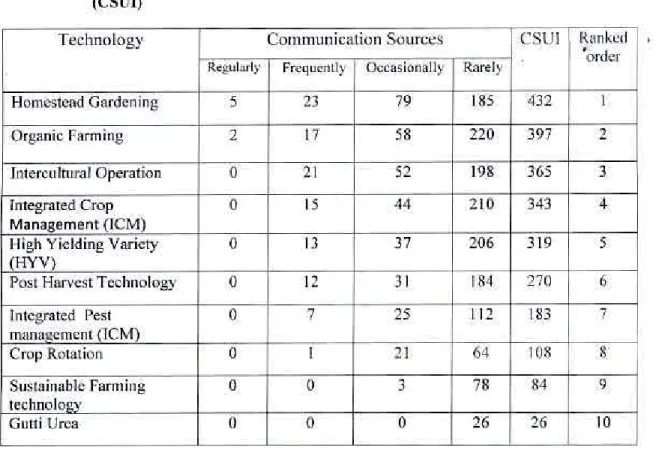
Purpose of this chapter, is to describe the findings o! the present study. In accordance with the objectives of the study. the findings are presented in four sections. In the first section. the selected characteristics of the rural women have been discussed. The second section deals with the communication sources oF the rural women regarding agricultural activities. The third one describes with the relationship between individual characteristics of the rural women with their communication sources regarding agricultural activities. The last section deals with the rank order of use of different communication sources regarding agricultural activities.
4.1 Selected characteristics of the rural women
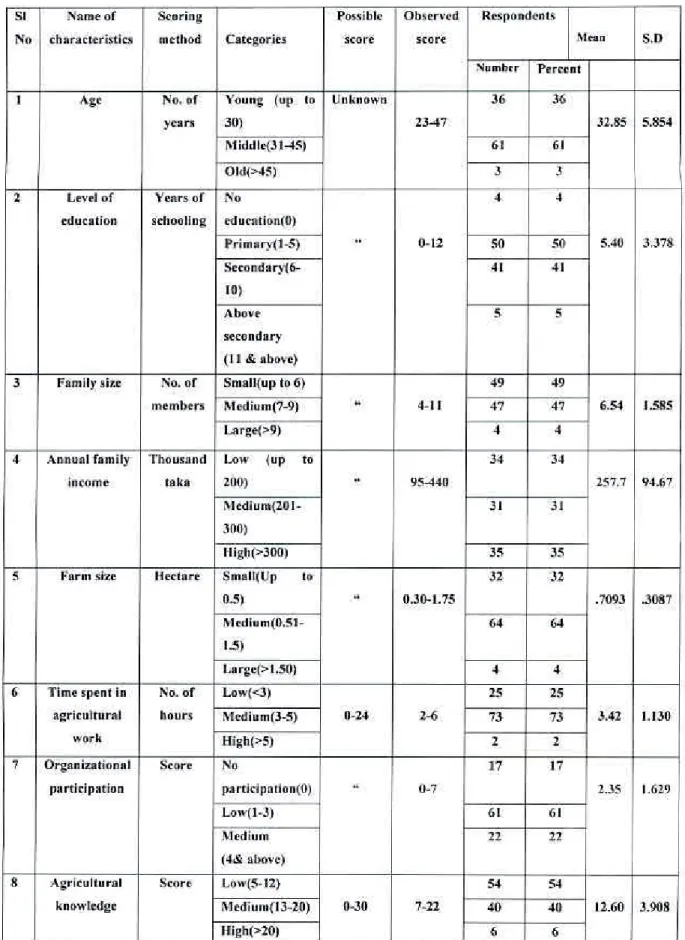
This section deals with the classification of the rural women according to their various characteristics. \Vomen may play an important role in the agricultural production. By the characteristics, behavior of an individual can he largclv determined. Eight individual characteristics of the rural women selected which formed the independent variables. There characteristics of' the rural women have described in this section. Characteristics profiles of the rural women may he seen at a glance (Table 4.1)
Table 4.1 Characteristics profiles of the rural women
SI Name of Scoring Possible Observed Respondents
No characteristics method Categories score score Mean S.D
Number Percent
Age No. of Young (up to Unknown - - 36 36
years 30) 2347 32.85 5.854
Midclle(3145) 61 61
No -
3 4
3 4 2 Level of Years of
education schooling education(0)
0-12 5.40 3.378
Primary(1-5) 50 50
Sccondary(6- 41 41
10)
5 5 -
Above secondary (II & above)
3 Family sin No. of Small(up to 6) 49 49
members
1MIiun1(7_9) 4-1I 47 47 6.54 1.585
Large(>9) 4 4
4 Annual family Thousand Low (up to 34 34
income taka 200) 95440 257.7 94.67
Medium(201- 31 31
300) I
lligh(>300) 35 35
5 Farm size Ilectare Small(Up to 32 32
0.5) 0.30-1.75 .7093 .3087
64
Mediuni(0.51- 64
1.5)
Large(>I.50) 4 4
6 Time spent in No. of - Low(<3) 25 25
agricultural hours Medium(3-5) 0-24 24 73J73 3.42 1.130
work tligh(>5) 2 2
7 Organizational Score No 1 17 Il
participation participalior(0) 0-7 2.35 1.629
Low(I-3) 61 61
Medium 22 22
(4& above)
-- 54 54
8 Agricultural Score l.ow(5-12)
knowledge 030 7.22
- 12.60 3.908
Mediuun(13-20)
6 6
I-ligh(>20)
4.1.1 Age
Age of the rural women ranged from 23 to 47 years. the average being 32.85 years and the standard deviation was 5.854. On the basis of their age, the rural women were classified into three categories: "young" (up to 30), "middle aged (31-45) and "old" (>45).The distribution of the rural women according to their age is shown in table 4.1.
Data contained in the table 4.1 indicates that, the highest proportion of the rural women (61 percent) felt in the "middle age" category. while 36 percent ol' them are "young age" category and only 3 percent in the "old" category.
The findings indicate that a large portion (97 percent) of the rural women were young and middle aged and may use more communication sources for their agricultural activities than the old aged rural women.
4.1.2 Level of education
The education of the rural women was measured by the level of their education i.e. to the grade (class) passed by them in the educational inslitulions. Education score range from 0 to 12. The average being 5.40 and standard deviation was 3.378. On the basis of their educational scores, the rural women were elassilied into four categories, namely "no education" (0). "primary" (1-5). "secondary" (6- 10) and "above secondary" (11 or above). The distribution of the rural women according to their education is shown in table 4.1.
The majority (50 percent) of the rural women had primary level of education while 4 percent no education, 41 percent secondary education and only 5 percent above secondary level ol'education. Rural women need to have some education in order to use various communication sources properly. It is shown that 96 percent of the rural women had education of various degrees from primary to above
secondary level. It is observed that about only (4 percent) of rural women had no education. For that reason the women having no education may stiller to use the communication sources. As a result they could not receive the usellil and important agncultural information.
4.1.3 Family Size
The family size of rural women ranged from 4 to II members. The average was 6.54 with a standard deviation of 1.585. On the basis of their family size the rural women were classified into the following three categories: "small family"(up to 6). "medium family" (7-9) and "large family" (8 or above). Table 4.1 contains the distribution of the rural women according to their family size.
Data presented in Table 4.1 shows that highest propitiation (49 percent) of the rural women had small families compared to 47 percent having medium Iirniilies and 4 percent had large families. The findings indicate that majority (96 percent) of the rural women had small to medium families and likely to maintain better contact with various communication sources for obtaining infonnation.
4.1.4 Annual family income
The observed family annual income of the rcspondcnt of rural women range from 95 to 440 thousand 1k, the average being Tk 257.71 thousand and standard deviation of 94.673. On the basis of their annual faniilv income the rural women classified into three categories: low" (up to 200), medium" (20 1-300) and
"high" (>300) thousand. Table 4.1 contains the distribution of the rural women according to their annual family income.
Data furnished in table 4.1 revealed that the highest proportion (35 percent) of the rural women had high annual family income. From the table we sec that law (34
above findings there is needed to take all possible attempts by extension agencies to increase more income.
4.1.5 Farm size
Farm size of the rural women of the study area ranged from 0.30 to 1.75 liectares with the average of 0.7093 and standard deviation of 0.30874. l)cpending of the farm size the respondents were classified into three categories; "small" (up to 0.5).
"medium" (0.5-1.5) and "large" (>1.50). Table 4.1 contains the distribution of the rural women according to their farm size.
Data fi.irnished in table 4.1 indicate that the highest propitiation (64 percent) of the respondents rural women belonged to the medium farm category compared to 32 percent having small farm size and only 4 percent large farm size. Thus most (96 percent) of the respondents women were in small to medium farm category. It indicates that majority of the ütmilies possessing small amount of land. Farmers are becoming landless for various rcasons of which fragmentation of land due to inheritance is the most important one. Women of small and medium farm are more active in the agricultural work. So, an appropriate program is needed depending on the farm size to increase skill of rural women in different productive activities and to improve life style.
4.1.6 Time spent in agricultural work /1 /
/1
Time spent in gardening by the rural women in the sttidy area ranged from 2 to 6 hours per day with an average of 3.42 and the standard deviation was 1.130.
Based on the score obtained, the rural women were grouped into three categories and those are "low" (<3). "medium" (3-5) and "h