Md. Kamrul Hasan Reza
Department of Physics
Khulna University of Engineering & Technology Khulna-9203, Bangladesh
Tel.: +880-41-769468~75 Ext. 587(O), 588 (R)
e-mail: [email protected], [email protected] Website : www.kuet.ac.bd/phy/reza/
Instagram: mkhreza1@ Md. Kamrul Hasan Reza
Twitter: mkhreza1@ Md. Kamrul Hasan Reza www.youtube.com/c/MdKamrulHasanReza
Welcome to my Class (trial-II)
Physics Ph 1101
11:40 AM July 22, 2020
COVID-19 Precautions
Don’t be afraid
Be aware of the pandemic
Use appropriate outfits if you compelled to go out
Try to maintain proper diet
Do not forget to exercise (at least one hour) regularly
Try to follow the guidelines of WHO and Bangladesh Government
Try to stay at home
Applications of First Law of Thermodynamics
Specific Heat of a Gas (T and V Independent)
If V and T are chosen as the independent variables
U = f (V, T) ….(1)
Differentiating eq. (1)
….(2)
If an amount of heat δH is supplied to a thermodynamical system, say an ideal gas and if the volume increases by dV at a Constant pressure P,
Then according to the first law of thermodynamics δH = dU + δW
Here δW = P . dV
∴ δH = dU + PdV
Substituting the value of dU from eq. (2)
….(3)
Dividing both sides of eq. (3) by dT
….(4) If the gas is heated at constant volume
….(5) When the gas is heated at constant pressure
∴ From eq. (4)
….(6)
From Joule's experiment, for an ideal gas on opening the stop- cock, no work was done and no heat transfer took place.
So, δH = 0 = dU + 0. Therefore, dU = 0. Even though the volume changed while the temperature is constant, there is no change in internal energy.
References:
Heat and Thermodynamics – Brij Lal & N. Subrahmanyam and materials from internet resources
From the ideal gas equation PV = RT
….(7)
….(8) Here CP, CV and R are expressed in the same units.
From eq. (3)
….(9) For a process at constant temperature
dT = 0
….(10)
This equation represents the amount of heat energy supplied to a system in an isothermal reversible process and is equal to the sum of the work done by the system and the increase in its internal energy.
For a reversible adiabatic process δH = 0
Therefore from eq. (9)
Dividing throughout by dV
….(11)
….(12) The isobaric volume coefficient of expansion
….(13)
….(14)
From eq. (12) and (14)
….(15)
This expression holds good for an adiabatic reversible Process.
Slopes of Adiabatics and Isothermals
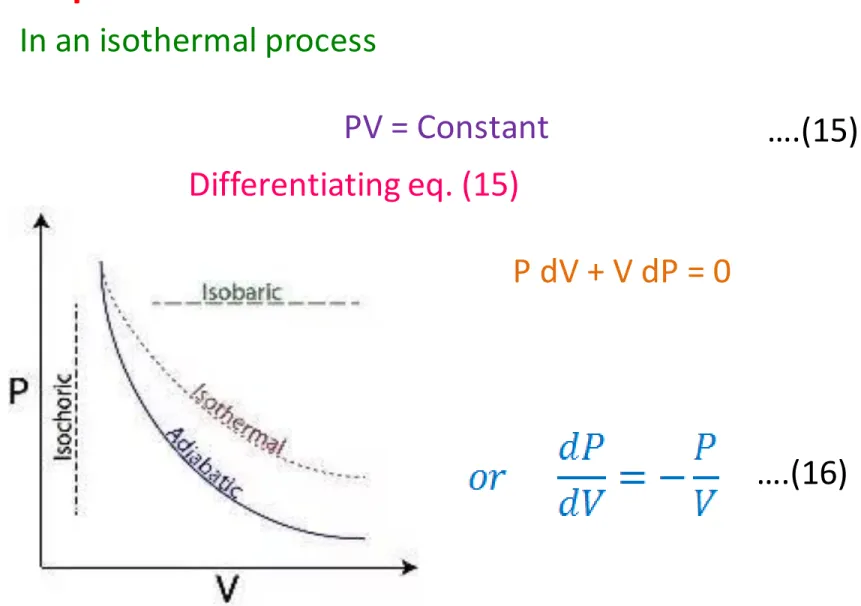
In an isothermal process
PV = Constant Differentiating eq. (15)
P dV + V dP = 0
….(15)
….(16)
Fig. 1: P-V diagram to show the slopes of adiabats and isotherms
In an adiabatic process
P Vϒ = Constant ….(17)
Differentiating eq. (17)
P ϒ Vϒ-1 dV + V dP = 0
….(18)
Therefore, the slope of an adiabatic is ϒ times the slope of the isothermal.
Work Done During an Isothermal Process
….(19)
Considering one gram molecule of the gas P V = R T
Fig. 2: P-V diagram of an isotherm
….(20)
Also P1 V1 = P2 V2
….(21)
Here, the change in the internal energy of the system is zero (temperature constant). So the heat transferred is equal to the work done
Work Done During an Adiabatic Process
….(22)
Fig. 3: P-V diagram of an adiabat
During an adiabatic process P Vϒ = Constant = K
….(23)
Since A and B lie on the same adiabatic
Taking TA and TB as the temperatures at the points A and B respectively and considering one gram molecule of the gas
P1V1 = R T1
and P2 V2 = R T2 Substituting these values in eq. (24)
….(24)
….(25)
Here, heat transferred is zero because the system is thermally insulated from the surroundings. The decrease in the internal energy of the system (due to fall in temperature) is equal to the work done by the system and vice versa.
Relation Between Adiabatic and Isothermal Elasticities
During an isothermal process
PV = Constant Differentiating eq.(26)
P dV + V dP = 0
….(26)
….(27)
Isothermal Elasticity
From the definition of elasticity of a gas
….(28) From eq. (27) and (28)
….(29)
Adiabatic Elasticity
During an adiabatic process
PVϒ = Constant ….(30)
Differentiating eq. (30)
P ϒ Vϒ-1 dV + Vϒ dP = 0
….(31)
From the definition of elasticity of a gas
….(32) From eq. (31) and (32)
Eadi = ϒP ….(33)
Comparing eqs. (29) and (33)
….(34)
Thus, the adiabatic elasticity of a gas is ϒ times the isothermal elasticity
Irreversible Process
The thermodynamical state of a system can be defined with the help of the thermodynamical coordinates of the system.
The state of a system can be changed by altering the thermodynamical coordinates. Changing from one state to the other by changing the thermodynamical coordinates is called a process.
Consider two states of a system ie., state A and state B.
Change of state from A to B or vice versa is a process and the direction of the process will depend upon a new thermodynamical coordinate called entropy.
Consider the following processes :
Let two blocks A and B at different temperatures T1 and T2 (T1>T2) be kept in contact but the system as a whole is insulated from the surroundings. Conduction of heat takes place between the blocks, the temperature of A falls and the temperature of B rises and thermodynamical equilibrium will be reached.
Consider two flasks A and B connected by a glass tube provided with a stop cock. Let A contain air at high pressure and B is evacuated. The system is isolated from the surroundings. If the stop cock is opened, air rushes from A to B, the pressure in A decreases and the volume of air increases.
processes in which the entropy of an isolated system decreases do not take place or for all processes taking place in an isolated system the entropy of the system should increase or remain constant
Reversible Process
A reversible processes is one in which an infinitesimally small change in the external conditions will result in all the changes taking place in the direct process but exactly repeated in the reverse order and in the opposite sense.
Second Lew of Thermodynamics
Kelvin-Planck statement of the second law is as follows:
It is impossible to get a continuous supply of work from a body (or engine) which can transfer heat with a single heat reservoir.
According to Kelvin, it is impossible to get a continuous supply of work from a body, by cooling it to a temperature lower than that of its surroundings.
According to Clausius, it is impossible to make heat flow from a body at a lower temperature to a body at a higher temperature without doing external work on the working substance.