We would also like to thank the program staff of Advocating for Social Change and Challenging the Limits of Poverty Reduction: Targeting the Ultra Poor (CFPR-TUP) for all kinds of cooperation, and we would especially like to show our appreciation to the field staff. Social protection is one of the key strategies to combat long-term and intergenerational poverty in Bangladesh. Social protection is one of the key strategies to combat persistent and intergenerational poverty in Bangladesh.
Advocacy is BRAC's latest tool to address critical issues of ultra-poor households' accessibility to various public services. BRAC Advocacy for Social Change launched a new project called Advocacy for Access Promotion of the Ultra Poor (APUP), which has already been translated into action in Naogaon. Health, Education, Livestock and SSNP) and improving regular attendance at primary school education for ultra-poor children. The purpose of this project is to mobilize relevant stakeholders to improve the regular attendance of primary school education of the ultra-poor children and increase the accessibility of the ultra-poor to public services.
Project implementation strategy
health, education, livestock and SSNPs) and increased regular attendance of the ultra-poor children in primary school. This is a pragmatic effort to reduce the ultra-poor dropout from schools and to facilitate their access to various services.
Expected outcomes of the project
Objectives and analytical framework
Objectives of the study
Conceptual framework: exclusion from protection
The implementation of the concept began after the Social Summit of 1994 focusing on issues of poverty, inequality and social justice in the context of developing countries. She argues that the added analytical value of the concept lies in the integration of insights from different paradigms of disadvantage. The extreme poor are not "just like" the rest of the poor, only poorer or poorer for longer, but they are also disadvantaged by aspects of "who they are" and "where they are" that distinguish them from the rest of the poor.
Social exclusion should be seen as an institutionalized form of inequality, the inability of a society to provide all sections of the population with the economic resources and social recognition they need to participate fully in the collective life of the community. The analysis of social exclusion is thus concerned with institutional rules, relationships and processes through which resources are distributed and value assigned in a society, with a particular emphasis on the mechanisms through which 'access' and recognition are granted or denied. Babajanian and Hagen-Zanker (2012) argue that the concept of social exclusion is a useful lens for examining and analyzing the performance of social protection interventions.
Methodology
- Sampling technique and sample size .1 Quantitative
- Data collection and quality control measures
- Data management and analysis
- The limitations of the study
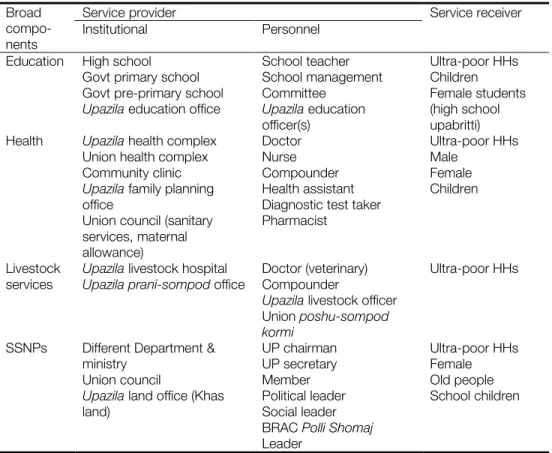
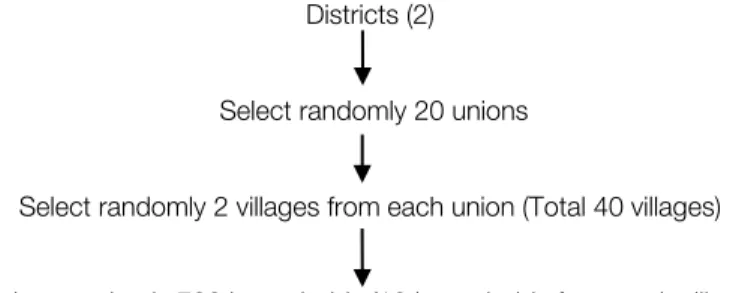
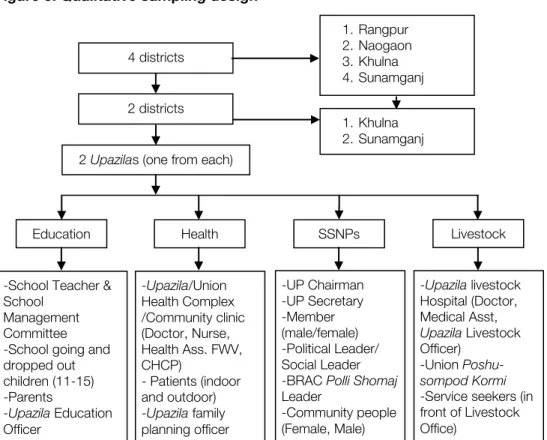
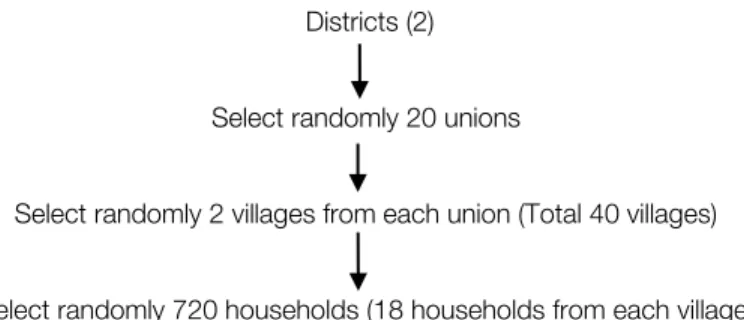
After identifying relevant stakeholders (Appendix Table A 1) related to each of four services, a representative sample was selected in each service area (education/health/livestock/SSNP). The distinctive characteristics (Appendix Table A 2) of each area of intervention, based on socioeconomic, cultural, vulnerability, ethnographic and geographical diversity are properly analyzed, and to capture the multidimensional varieties, two upazilas are selected. In this research, for the sake of generating qualitative data and information, different individuals and groups from each component of the study were selected for in-depth interviewing, group discussion and case studies for each of the sample areas that were intervened. A five-day in-house training for the details of the questionnaire along with field testing was provided to the research assistants to ensure efficient, unbiased and professional capture of primary data from the respondents.
A semi-structured questionnaire was used to collect information from the respondents to achieve the objective of the study. To maintain overall data quality, research assistants were strictly instructed to survey no more than four households per day, and all completed questionnaires were checked daily. However, as non-TUP households were not surveyed, some of the dimensions and extent of social exclusion outcomes may remain underexplored.
Demographic characteristics
- Characteristics of household members
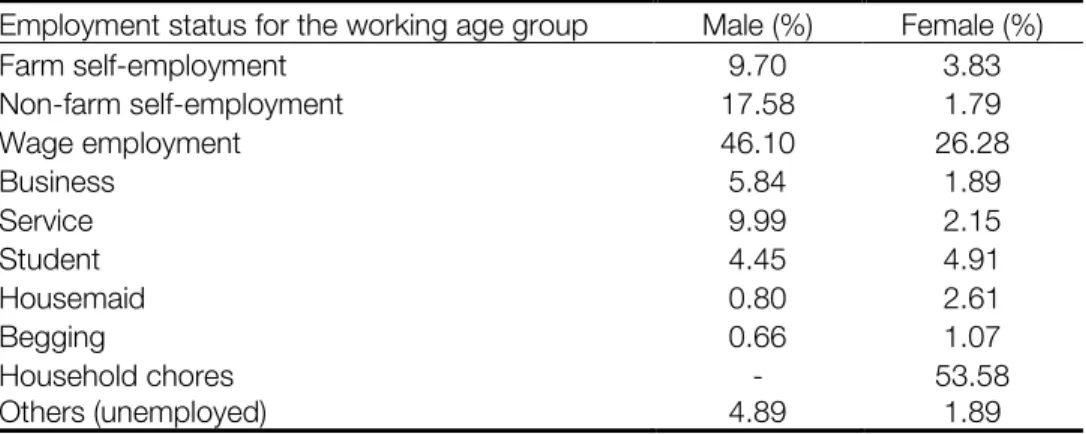
- Primary occupation of the working aged male and female members To get a quick understanding of the status of the ultra poor households, it is worth to
- Self-perceived food security and economic condition
- Physical structure of the households
- Households’ access to basic facilities and practices
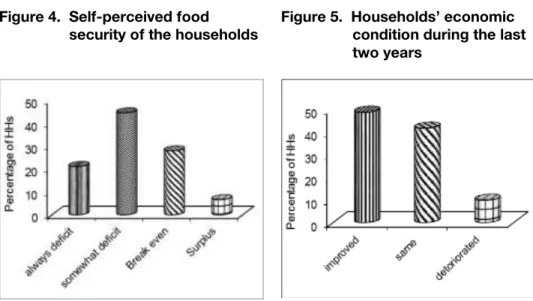
In order to understand the food security status of ultra-poor households, respondents were asked to rate their households by identifying these households in a given category taking into account all sources of income and items of expenditure during the last year of the study. About 21% of households estimated that they faced high food shortage and 44% of households faced moderate or occasional food deficit (Fig. 4). Summarizing the first two categories, it can be said that about 65% of the ultra-poor families faced food deficits of varying proportions.
In addition, regarding household financial condition, 48% of respondents reported that their household financial condition has improved during the last two years prior to the survey, while about 10%. The survey also seeks to observe the physical structure of the households' main house and the materials used in the walls and roof (Appendix Table A 5). Results show that almost 71% households have built the wall of their main house from semi-durable materials like wood, bamboo, jute stick, mud etc.
Only about 2% of households have the wall of the main building made of brick and cement. In the case of the roof, 88% of households built the roof of the main building with tin-coated iron sheets, while about 12% of households made the kacha roof (inferior and cheap materials such as straw, mud, etc.) made of straw, soft plastic. etc. The study makes explicit that about 97% of ultra-poor households drink spring water, while 73% of households in the same category use spring water for cooking (Appendix Table A 6).
Data shows that only 16% of households have access to electricity and 4% can afford to use solar panels as an energy source.
Results and discussion
- Education
- Health service
- Social Safety Net Programmes (SSNPs)
- Livestock
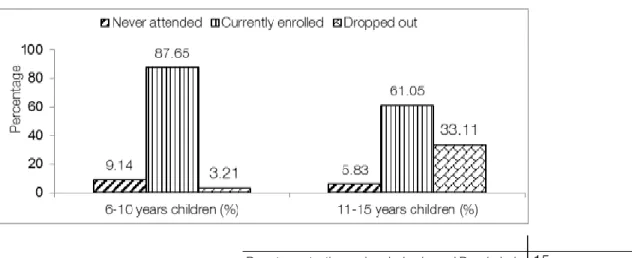
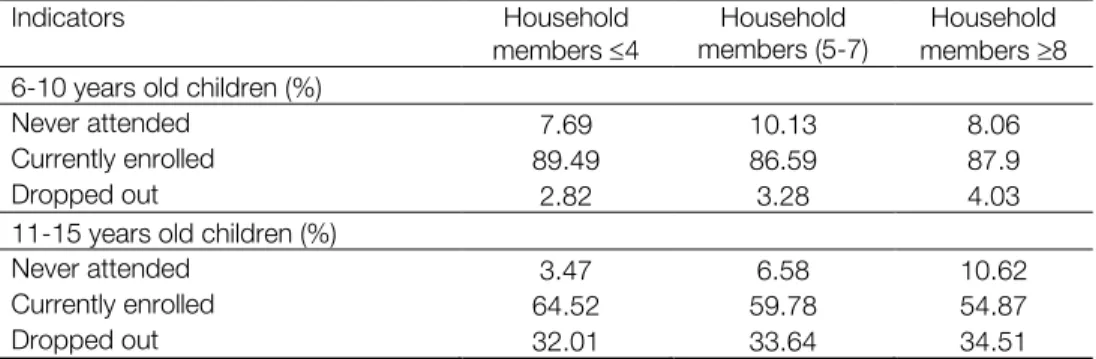
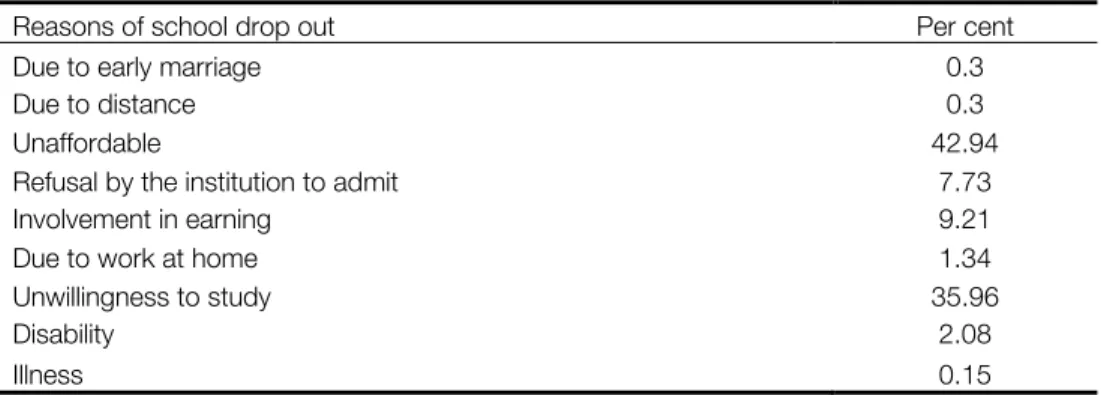
There are three stages of exclusion of ultra-poor children from mainstream formal education. Irregularities at school: Quantitative results show that 43% of students in the ultra-poor households were absent at least one day a week before the survey. It is difficult for the ultra-poor children to buy or arrange food during tiffin hours.
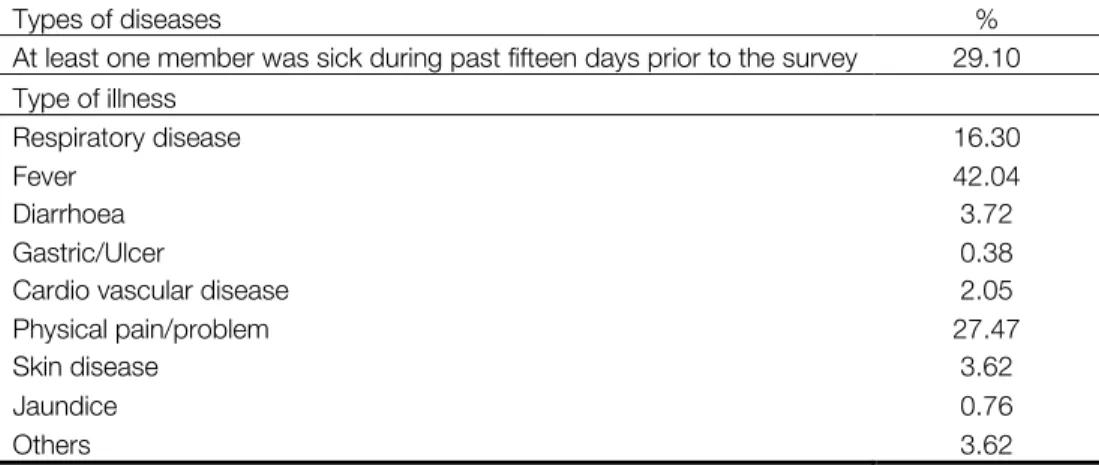
But this requires long-term education, which may not be possible for the ultra-poor. Quantitative findings show that approximately 29% of ultra-poor households had at least one member fall ill in the last 15 days prior to the survey (Table 5). The majority of ultra-poor patients (more than 80%) visit a non-physician in case of health problems (Figure 7).
A significant percentage of the ultra-poor households (11%) do not or cannot use treatment during illness. About 32% of the ultra-poor people expect better health services from the providers, while 24% feel that they do not need to spend extra money. Institutional versus community treatment: From quantitative findings, it was observed that most of the ultra poor seek treatment from non-medical practitioners.
However, most of the ultra-poor seem to be largely unaware of a range of other benefits and their eligibility criteria. Quantitative findings highlight that about 76% of ultra-poor families have received SSNP in the last year (Table 8), while 77% of them have received VGD/VGF services and a very small portion have received widows (9%) and old age (11%) allowances. However, very few of the ultra poor strongly agreed or disagreed on this issue, only 38%.
A higher percentage of ultra-poor households reported that they were informed about the SSNPs through the chairperson/member (58%) or teacher (33%) (Appendix Table A 9). Here, a range of factors have been identified that prevent the ultra-poor from seeking institutional services. Furthermore, almost 46% of the ultra-poor (Appendix Table A 10) reported that they perceive differences in the provision of veterinary services between the rich and the poor.

Conclusion and recommendations
- Recommendations on education National level
- Recommendations on health
- Recommendations on social safety nets
- Recommendations on livestock
Among the comments on the social safety net, it was noted that approximately 60% of ultra-poor households received SSNP in the past year; on the contrary, 80% received VGD/VGF services, and a very small proportion received widow's and old-age benefits. The findings further show that a significant proportion of the ultra-poor received services with the help of a local UP president/member or school teacher. Although very few of the ultra-poor strongly agree or disagree on this question, only 38% agree that beneficiaries are properly selected.
Usually, the poor who do not have solid forms of social capital or connectedness are not aware of the eligibility criteria. It was found that about half of the surveyed ultra-poor households seek treatment for their livestock from village veterinarians and local medicine sellers. A significant proportion of ultra-poor families do not go to the state veterinary hospital or doctor because of the distance and possible cost, even if this is necessary.
In addition, some people complain that most medications have to be sourced from outside. Remarkably, some ultra-poor claim that they do not go to an animal hospital even if necessary because the service providers neglect the ultra-poor and behave poorly. The shortage of female doctors and male nurses is one of the reasons why people are unwilling to seek treatment in hospitals; A long-term policy is needed for an increasing number of male nurses and female doctors.
Training for local government representatives (training related to the issues of eligibility criteria and distribution mechanism) should be provided as many of them are not aware of the eligibility criteria and other issues of social safety net. It would be better if the name of the various safety net services along with selection criteria are displayed at the public places like at markets, mosques/temples and at the UP office. BRAC Polli Shomaj can play an important role at the grassroots level of the society to empower the poor community through different types of awareness activities.
Rights based awareness campaign can be extended to the ultra poor community so that they do not hesitate to seek the benefits. Decentralization of livestock service from upazila level to at least union level will facilitate service as distance is one of the exclusive instruments to seek service from public livestock centres. Eg. the state's lending for livestock breeding is hardly known by the ultra-poor.