PRIVATE APARTMENT HOUSING FOR MIDDLE INCOME PEOPLE:
A STUDY ON AFFORDABILITY
srt*T"1
"f
f,~«:' ~
P' .,~~~$8~~
'X~ *
'!il~..y."",,~~"@,/
•••..~ "f'.
'I'itG;f\ ~i'
By , ,
MOUSHUMI ZAHUR
A Thesis
Submitted to the Department of Urban and Regional Planning in partial fulfillment for the degree of
Master orUrhan and Regional Planning
"
.'" -
____ •• _ ._ r
1IIIIIIIIRlllilliillllllii 'I
#10598e#
'--
-.
--~-.,. -
.,~-,~",,
• DEPARTMENT OF URBAN AND REGIONAL PLANNING
BANGLADESH UNIVERSITY OF ENGINEERING AND TECHNOLOGY
I
March, 2008THESIS ACCEPTANCE FORM
Private Apartment Housing for Middle Income People:
A Study on Affordability
By
MOUSHUMI ZAHUR
Thesis Approved as to Style and Content by
,
I~
_1JH-
Dr. Isbrat hlam (Supen'isor) Assistant ProfessorDepartment ofUchan and Regional Planning, BUET
Dr. Roxana Hafiz Professor &Head
Department of Urban and Regional Planning, BUET
f,\9.}.J4Ail",,", ,,~~
A.S.M. Mll.hbnb-Un-Nabi Professor
Department of Urban and Regional Planning, BUET
~\""~
Dr. Numl Islam Nazem Professor
Department of Geography and Environment University of Dhaka
Chairperson
Member
Member
Member
-
Candidate's Declaration
I hereby declare that this thesis has been prepared in partial fulfillment of the requirc\1lcnts [or the D;egree of Master of Urban and Regional Planning at the Bangladesh University of Engineering and Technology Dhaka and has not been submitted anywhere else for any other degree.
-~
Mousbumi Zahur Student No. 040315012 URI', BUET, Dhaka.Acknowledgement
I woold like 10 express my deepest gn,(ilooc to Almighty Allah for his blessings 10 gmm me the opportunity.
1 am graleful to a number of individual~ who have eontribuloo in many ways towards Ihe complelion of Ihis thesis. First I would like to express my profound gratitude and acknowledgement 10 my supervisor, Dr. hint 1,lam, Assi,tant Professor, Department of Urban and Regional Planning, for her constant guidance, continual encouragement and patience since the inception of lhc sllldy. Thanks for intensive discussion and coru;lruclive commcm~ Ihrougholll lhe thesis with kind oo-operation.
Special thanks life owed 10 Dr. Roxana Hafi", Professor and Head of lhe Department of Urban and Regional Planning, BUBT, Dhaka for the encouragemenl she has extended during this research.
Special thanks go 10 those people who actively participated in the successli.d completion of this study through their time and labor.
My gratitude al~o goes 10 all oIh= teachers the URP department for their suggestions and helpful support during the course of my study. I also Ihankful for co-operation and assistance extended by Ihe staff of Department ofURl', BUET, Dhaka. I am also thankful 10 my external Dr. Nurul Islam Nazem, Professor, Department of Geography and Environment, Dhaka University.
Moreover, lhanks 10 all government and non-government agencies, and professiorJUls for their kind support and co-operation which make possible 10 eomplete Ihe study successfully.
Finally J would J like 10 thank my family for Iheir uncondilional support and love throughout my life lhal encourages me to go forward Special thanks to my friends and colleagues for their inspiration, co-operalion and support to those whom I did nol mention here.
Moushurni Zahur MMrch, 2008
Abstract
Housing problem in the urban areas of Bangladesh is a common problem like most of developing countries of the world. Dhaka has more population than it can accommodate the housing situation. Rapid urbanization and poor economy followed by inequitable distribution resources have created serious housing problems. Dhaka is experiencing rapid population growth. The availability of facilities compared to other urban centers made Dhaka very attractive to all people. Investments made in housing are also highly profitable in Dhaka compared 10 any other cities and toWllS of Bangladesh. But it does not cope with rapidly increasing population and resources to provide(herequired essential services amI facilities. As a result serious problem have emerged over the years regarding housing provision and other related services for the city dwellers particularly fur middle-income people.
Due to the enormous population growth in Dhaka in the past decades, it is almost 'impossiblc on the part of the government to ensure honsing fur all. As public sector failed to ensure their right, people themselves have taken initiative to ensure their fundamental need of shelter. The Formal Private Sector Housing that constitutes Real Estate developers has evolved to quench the ever-increlll'ing thirst of people fur shelter.
In order to meet the ever-increasing demand for residential accommodation in the limited land of Dhaka the construction of apartment buildings was a natural and viable solution with natural consequences. In our country, real estate business started in Dhaka in late seventies. In 2006 there are about 250 companies engaged in this business in Dhaka and Chittagong also. From the early 1980s the business has started to flourish and in 1990s it reached its highest point. Towards the end of year 2000 there was slight downfall in real estate sectot. Now in 2005 this sector is again showing growth. At the beginning most of the developers aimed to cater the upper income group oflbe socicty. But recently the private bousing eompanies also started to construct apartment fur the middle-income people who are the largest segment of population (about 50 percent) of Dhaka city.
The major focuses of this research arc: (i) to investigate the issues related with housing standard expected by the middle-income group. (ii) to study the affordability ofthc middle-income group to meet the bousing cost. About ISO-questionnairesurvey have been conducted in four different middle-income arellSof Dhaka to collect socio- economic and demographic data. The developers were also inlerviewed to understand their perspective on middle-income group and their housing demand. Present cost of per sq. feet space, amount of booking and down payment money is not affordable by the middle class people of Dhaka city. The loan scheme and installment procedure also do not appropriate for the targe! group. The study also shown some measures by which cxisting housing market can fulfill the expectation of the middle class people.
ii
•
Table of Contents
Acknowledgement
Abstract
TablcofCouh:1I1 List of Tables LislofFigures List of Maps
List of Abbreviations Chapter 1: IntroductioD
1.1 IntroduL1ion
1.2 Presentslate ortlle Problem t.J Objectives of (he research 1.4 MetllOdology
1.4.1 Identification ofthe target group 1.4.2 Selection ofSludy area
1.4.3 Collcctionofinfonnation 1.4,4 Data Analysis
1.5 Limitationsofilie research 1.6 Organization of the thesis
Chapter 2: Housing Provision in Dhaka City 2.1 Introduction
2.2 The Concept or Housing
2.3 Land and Housing Sector in Dhaka 2.4 Housing Affordability
25 Cost of Land and ApartmentIiousing
2.6 Supplyof Available Building Materials and Labor
2.7 Finance ofCrcdit Available to Prospective House Builders &Buyers 2.7.1 Loans from Commercial Hanks
2.7.L1 Loans from Nationali,,-<,d Banks 2.7.1.2 Loans from the Private Sectors Danks 2.7.1.3 Finance Scheme for Government Employee 2.7.1.4 I louse Building Finance Corporation
2.7.1.5 DELTA BRAC Housing Finance Corporation
iii
Ii iii_v ,i_vii
viii
1-12
,
1,
Ii Ii 7 7 10 10 11 13-37 11
13 17 19 21 24
"
n
'"
'"
29
30 31
2.7.1.6IndustrialDevelopmentLeasingCompanyof BangladeshLimited(lDLe)]3
2.7.1.7MIDASFINANCINGLTD 34
2.7.1.8 GovernmentLoanSchemefor MiddleClassPeople 35
2.8 The GapBetweenSupplyand AffordabililylDemand 36
2.9 Concluswn 36
Chapter 3: Present Role of Public lind Private Sedor in Providing Affordable
Housing 38-47
3.1 Introduction 38
3.2 Performanceofthe HousingInstitutionsfor MiddleIncomeGroup 38
3.3 Roleof Publie Organizatiol15 39
3.4 1be NGOsand Co-operativeSocieties 41
3.5 PrivateDcvelopersof DhakaCity 42
3.6 The RealEstaleand HousingAssociationof Bangladesh 43
3.6.1 ReulEstateSectorat a Glancc 45
3.7 Conclusion 47
Cbapter 4: Middle Income House Buyers in Dhaka City 48-64
4.1 Introduction 48
4.2 A SurveyProfileof the Upper-middleIncomeGroup 49
4.2.1 Socio-eeonomieinformationofthe Group 49
4.2.2 Income,Expenditureand Earningmemberof the Group 50
4.2.3 Rentof the presenthouse 51
4.2.4 Reasonto buy an apartmentand locationchoice 52
4.2.5 PreferredDwellingUnitsize 53
4.2.6 Affordablecost (persq. feet)for upper-middleincomepeople 54 4.3 A SurveyProfileofthe Middle-middleIncomeGroup 55
4.3.1 Socio-eeonomicinformationof the Group 55
4.3,2 Income,Expenditureand Earningmemberof the Group 56
4.3.3 Rentof the presenthouse 57
4.3.4 Reason10buy an apartmentand locationehoice 58
4.3.5 PreferredSizeofDwelJingUnit 60
4.3.6 AtTordablecost(per sq. feel)for middle-middleincomepeople 61 4.4 Comparisonof preferredlocation,sizeand atfurdablecost (per sq. feet)of two
groupsofmiddJeclasspeople 62
4.5 Conclusion 63
Chapter 5: Alfordability and Preference of Middle-Income Pcople and the
Existing Housing MllI'ket 65-81
5.1 Introduction 65
5.2 Housing Standard and Facilities of Apartment Preferred by the Middle Income
and Provision ofFaeiJitics 66
5.3 Affordability of Middle Income Group 68
5.3.1 AfTordabilityofTurget Population in case of lola! price oftbe Apartment 68 5.3.2 AfTordabilityofTarge! Population in case of Booking&Down payment 69
5.4 Installment ofloan
n
5.5 Preference of Finance Organizations by the Target Group 75
5.6 Housing and Floor prefcrcnce 76
5.7 A short description of some Real Estate Companies bas been given below (included form field survey of this researcb) 79
5.8 Conclusion 81
Chapter 6: Recommendations and Co"e1usions 6.1 Introduction
6.2 Summary and Findings 6.3 Recommcndations 6.4 Conclusion
Reference Appendix
82-89 82 82 86 88
,0-"
97-104
List of Tables
1.1 Sample Si7-e chosen from four areas of Dhaka city 10 2.1 Increase of Land Value in Differenl Locations of Dhaka city 22
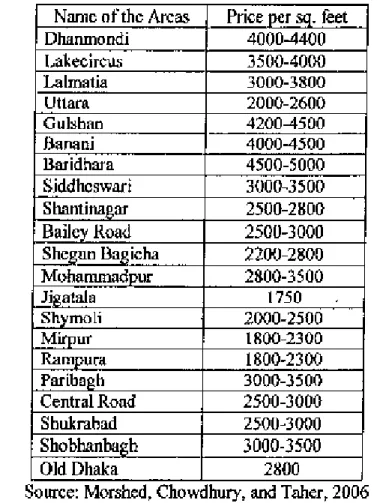
2.2 Apartment price (per sq. feet) of dlfli:retlt areas of Dhaka city 23 2.3 Land price ofsomc adjacent areas of Dhaka city 24
2.4 Price of Building Materials 25
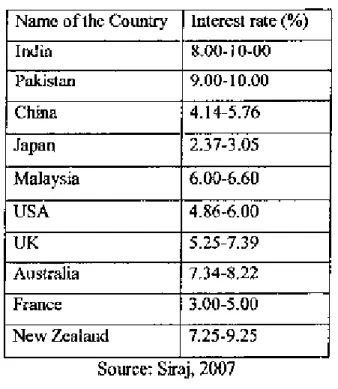
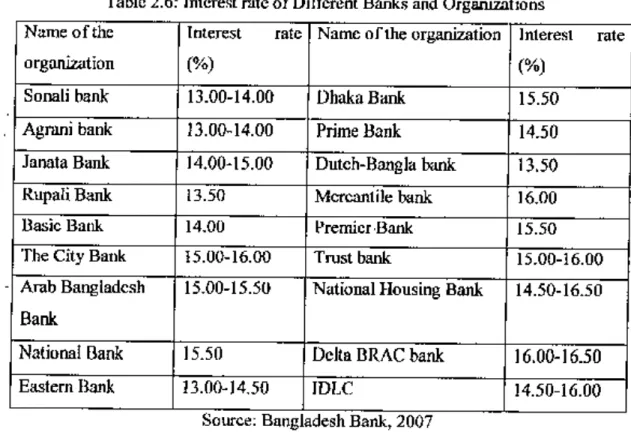
2.5 Annual interest rate of housing loan of some countries 26 2.6 Interest rate ofDifIerent Banks and Organi7..ations 27
4.1 Income Range of the Middle Income Group 48
4.2 Income of the Family of upper-middle income people 50 4.3 Expenditure uflhe Family of uppee-middle income people 51 4.4 Relation ofincomc ofthc family and rent of the present house of upper-
middle income people 51
4.5 Most preferred area ofuppcr-middle income people to buy an apartment52 4.6 Factors influencing choosing the location of apartment of upper-middle
income people 53
4.7 Space desire by the upper-middle class people 54
4,8 Relation of Income and desired space by the upper-middle income people54 4.9 Affordable cost (per sq. feet) of upper-middle income people 55 4.10 Relation of income and A/fordable cost (per sq. feet) of upper-middle
income people 55
4.11 Occupations of Household Head of middle-middle income people 56 4.12 Relation oflncome and Rent ofthe present house of middle-middle income
people 58
4.13 Area prefer most to buy an apartment of middle-middle income people 59 4.14 Faclor5 innuencing choosing the location of apartment of middle-middle
income people 60
4,15 Space dcsire by the middle-middle c1as5people 60
4.16 Relation oflncomc and Desired sJXleeofthe middle-middle class people61 4.17 Relation of income of the family and affordable cost ofpcr sq. feet space of
middle-middle income people 62
~i
4.18 Preferred locations of two groups to buy.an apartment 62 4.19 Space oftbe flat prelcrrcd by two groups of middle-income people 63 4.20 Affordable cost ofpcr sq. reet oflluddle-income people 63
5.1 Facilities preferred by upper-middle income people 67 5.2 Facilities preferred by middle-middle income people 67 5.3 Affurdability of the target group people to buy a flat 69 5.4 Amount of money able to pay for booking an apartment 70
5.5 Way to arrange dovm payment money 71
5.6 SOlln'e of instaUment money 73
5.7 Amount of install men I money able to pay per month 74 5.8 Relation of rent ofthc present house and Affordability to pay installment
money (per month) of upper-middle income people 74 5.9 Relation of rent oftbe present house and affordability to pay installment
money (per month) of middle- middle income people 75
5.10 Preferred organizations to take loan 76
5.11 Housing Type Preference by the target group 77
5.12 Floor preferences by the target group 77
, 5.13 Bask information of some Real Estate Companies 79
•
;
"
VII ~
List of Figures
3.1 Apartment Delivery in Lls122 Years by REHAB members 45 3.2 HousingProjects Distributedbasedon StoreyHeight 46
3.3 ProjectDistributlonsby Land Area 46
4.1 OccupationsofHousehoJd Head of upper-middle income people 50 , 4.2 Educalion level ofHou>.ehold Head ofmiddle-middJc income people 56 4.3 Income ofthc family of middle-middle income people 57 4.4 Expenditureoithe fumily of middle-middleincomepeople 57
4,5 Rent oflhe presenthouse ofmiddle-middJeinoomepeople 58 4.6 Affordable cost of per sq. fcct space of middle-middle income people 61 5.1 AffordabilityRegardingPaymentfor Car ParkingSpace 68
5.2 Means to Manage Booking Money 71
5.3 Amount of Money AbJc 10 Pay for Down Payment 72
5.4 Preferred Width of Access Road 78
VIH
List of Maps
1.1 Location ofstudy areas in Dhaka city 8
OJT WASA HSD
lOED
NGO PWD RAJUK UDD REHAIl ADB GOB HBFC DBH C&D CDA KDA RDA BBS
BUET
CMB CBO
eus
DCC
DoE
DPHE GOB LGED
List of Abbreviations
Dhaka Improvement Trust Water &Sewerage Authority Housing &Settlement Directorate
Loeal Government Engineering Department Non-Government Organizations
Public Works Department Rajdhani Unnayan Katripakhya Urban Development Directorate
Real estate and IlolL,ing Associalion of Bangladesh Asian Development Bank
Government of Bangladesh
House Building Finance Corporation DELTA BRAe Housing
Communication and Building lfilpartment Chillagong Development Authority lUmina Development Authority Rajshahi Development Authority Bangladesh Bureau of Statistics
Bangladesh University of Engineering and Technology Civil Aviation Authority of Bangladesh
Community based Organization Centcr for Urban Studies Dhaka City Corporation Department of Environment
Department of Public Health and Engineering Government of Bangladesh
I..oeal Government Engineering Department
,
Chapter 1
Introduction
..
Chapter I: Introduction
1.1 Introduction
Housing is not merely a shdtcr, but a complex package of goods and services from which each family makes a social and economic contribution to the community in which they live. Housing not only provide shelter for a family but also serves as a center of its total residential environment. The nature and value of housing determined by the services it offers. 1hcse services are varied and include neighbourhood amenities, acceSSof educalion, health !'lcilities lind security. Housing makes up fur 15% 1020% of total expenditure and for low-income families anywhere between 5% to more than 40%. A major share of housing in Bangladesh is supplied through the informal sector, while public sector provides only7<'10 urlhe lotal housing (laban, 2002).
Bangladesh is one uflhe least urbanized countries ofthe world. Less than a quarter of its population live in 522 urban centers. Since the independence in 1971, its urban populatioD has increased significantly; the population growth of Dhaka stands at 56.5% in the last de<;ade,which is very high. During the last decade an additional population of 3,868,077 was added to the Dhaka city. (BBS, 2001). According to an Asian Development Bank Study, the population of Dhaka city estimated in 1995 was 7.8 millions, ranked as 14'h populous city in Asia. But now the mega city i~stretching over an area of 1528 sq. km., with a population of 10.7 millions which is expected to rise to 25 million in 2025 which will rank 4'1> in Asia. Rapid increase of urban population, in the large towns and cities ha~ greatly increased the Deed for housing, employment and ineome generation, transportation and provision of basic requirements. Rapid urbanization characterized by growth oflarge cities and towns is
IIcommon phenomenon in the developing countries at a rate much fuster than those of developed world. In Bangladesh, the urban population grew from 6 millions in 1974 to 28.6 millions in 2001 and the urbanization rate is 23.39%. (B.B.S, 2001).
Urbanization is an outcome of both population growth and rural-urban migration. As urbanization increases, more and more people arc becoming city dwellers. Bangladesh
Chapter-l: !Il/rotiudion
is not any exception to that picture. In Bangladesh the prohlem of urbanization is further aggravated by limited land supply in urban areas, lower land utilization and lack ofpropcr planning and land use policy. As globalization increases, the process of urbanization increases. In Bangladesh, the rate of urbanization is very high further aggravated by high population growth rate and rapid rural-urban migration. The current trend of urban growth in this country is about 5-6% per annum. This will change and increase demand for habitat in Bangladesh. At present 28% population of Bangladcsh live in urban areas, which will be 34% in 2025.
The land - man ratio in Bangladesh is lowest and is shrinking in an alarming rate. The rapid growth of urban population in our country is concentrated in the major cities and towns, especially in Dhaka. Capital city Dhaka alone has the highest concentration with almost 37.40% of the total urban population and 8.6% of the national (BBS, 2001). The crisis is more ilCutein Dhaka for many reasons. Dhaka continues to hold all major activities and facilities and there has becn no serious attempt 10
decentrali7..ation.The availability of facilities like better education and improved and modcrn hcahh care compared to their availability in other urban centers hnve made Dhaka attractive to all people. The prospect of increasing income also makes Dhaka more attractive to all sections of people. Huge population in the city is creating demand on housing becalL'ICit is one of tbe basic needs of the human being. So investment made in housing are also higWy profitable in Dhaka compared to any other cities and tOWJL~of Bangladesh.
The housing shortage was estimated in 1991 to be about 3.10 million lilits, eomposed of 2.15 million units in rural areas and 0.95 million units in urban areas. The annual population growth rate of the city is 4.34% and the household size is 4.8 (B.O.S, 2001). So il is generating the demand for 50,000 new houses annually. But the average rate of production is only 20,000 units per year (Seraj &Afrin, 2003). As a result, housing related problems are aggravating every year. Distnbution of housing facilities for Dhaka city dwellers exhibits high levels of disparity and segmentation. In Dhaka, 80 percent of the residential land have been occupied hy only 30 percent of urban people, and remaining 20 percent area provide shelter to the residual70percent
2
•
Chuptu-J: lnl,,,ducti,,n
of the city dwellers comprised of middle and lower income people (Nabi & et aL, 2003). 111such a backdrop, Dhaka has been selected as the study area of this research.
1.2 Pl"e.'lentstate oftbe Problem
Housing is indeed a global problem. In many cities of developing countries, up to half of the urban populution live in slums and ~qualters (Mathur, 1993). The ever- increasing urban population is creating an increasing dellllllJd for sheller. The right of shelter is a fundamental right, which is ensurcd by both UN declaration and the constitution of Bangladesh. At present the hOllsing condition of urban area in Bangladesh, in general, is quile unimpressive. In all metro]X>litan cities, there is acute
shortage of housing supply and the backlog is continual1y on the increase. Inadequate supply of dwelling UJlits for middle and low-income people and high rental value arc among the most severe challenges afflicting urhan living in Dhaka. Dhaka, the capital of Bangladesh, is facing more acute hOllsing problem than any other cities of the country. On the other hand land price of Dhaka city is so high that it is very costly for middle-income people to build their own bome in the capital city. To satisfY the housing need of this huge explosive population and high land price, Dhaka has attempted to expand vertically. Being a government ofa poor developing country, it is almost impossible on the part ofthc government to ensure housing for all As public sector Jailed to ensure their right, people have taken their own initiatives to ensure their fundamental need of shelter. Private sector and real estate companies both are working together to reduce the ever-increasing thirst ofpcople for sheller.
Housing problem nol only exisls for the low-income group, the middle-income group 31so faces the severity of the situation. Different government or public sector agencies engaged in solving the enormous hOllsing problem of the country. All government effurts hnve been grossly inadequate compared to the requirement, which make any attempl, by planners, designers ur policy makers redundant. Due to a great inere-<lsein the number of population of Dhaka, the pressure on land for residential use has been very high. Most oftbe increase in populalion is due to a steady now of rural migrants.
During 1961-1974 the urban population of Bangladesh increased by 138% while rate •••
of housing increased by 129"/". During 1980-2000 the housing deficit was projected
3
•
Chaple,-I: 1""00=(;0"
10be5million unils with an annual requirement of 165,000 ncw housing units (Jahan, 2002). In all metropolitan cities, there is acute shortage of housing supply and the backlog is continually on the inereasc. Inadequate supply of dwelling units for middle-income pcople and high rental value arc among the most severe challenges afflicting urban living in Dhaka. At present in our eOWltrythe annual requirement of shelter varies from 3 Iakh to 5.5 Iakh units. Bangladesh will need to construct approximately 4 million new houses annually to meet the future demand of the next 20 years (Seraj&Afrin,2003).
There remains a large gap between the demand for the new supply and the rale of production. The situation is more aggravated by high land cost and scarcity of resources, particularly land, low level of allordability of the majority of the population. This resulled in unhygienic living in the service less slums and squatter settlements by a third of the population (Rahman, 1990). "cople from all socio- economic background in Dhaka facing housing problem though the nature and intensity of the problem are different. The urban destitute needs rehabilitation, tk slum dwellers need slum uPb>rading,low income families arc in necd oflow cost nats or plots and the middle and upper income tamilies are complaining that the cost of decent plot or a flat is going beyond their means. The solution of these groups is also different and mainly lies in the hand of the policy makers and the government.
Planners and decision makers have tried to evolve different strategies to solve housing problem, but even the cheapest formally designcd housing remain beyond the affordability of over 80% of households in Bangladesh (Jahan, 2002). There are millinns of families who will nevcr know the comforts of their own homes or have access to such basic necessities (sueh as safe drinking water, sanitary toilets, electricity, garbage disposal etc).
In the early eighties, private sector came forward to address the housing issue with its limited strength (Khan & et ai., 2(04). In addition to land development projects, privale developers also introduced the concept of apartment construction. Soon the apartment projects become popular among the high-income residents of the city, who are the primary target group of those projects. But nowaday the private hoUSing
4
Chapter-l: lfl/rodudion
companies also started to construct apartment for the middle-income people who are the largest segment ofpopolation (50 percent) of Dhaka city (Islam, 2004). Apartment bnildings are constructed both in inner city areas as well as in outer, especially in the planned residential areas of Dhaka. Shortage of build ahle land and high land price has made it almost impossible for most of the urban population to own a piece of land for constructing a detached/semi-detached houses. In this scenario, people are forced to purchase flats in an errort to find and abode of their own in the rapidly increasing capital city-Dhaka.
Being motivated by the market demand, more than two hundred Real Estate Developers has engaged themselves in building apartment houses. But still the pros and cons of apartment houses are unknown to general people, buyers, developers, and construction firms. Very few efforts have been undertaken to understand the functionality of this type of houses, realize their economic and social behaviour, determine current market price or rent strocl<Jre. Statistics related to the factors affecting the choice, development, growth arc virtually non-existent. Therefore this research is designed to study the financial affordability of middle class people, which means ability and willingness to pay and to determine the loeational preference, actual need of facilities that middle class people prefer if they want to buy an apartment.
1.3 Objectivesof Ihem1carch
The purpose of this research is to study the affordability and demund!need of middle class people in terms of location, space wquircments and services. Following are the objectives for the research:
).> To determine IDeational preference and housing standards of apartment fur
middle income people.
» '
To investigate the existing institutional support for housing fInance and assess the aftordability of target populatioll in terms of mode of paymetlt such as amount of down payment and installments ofloarIS.).;- To compare varim.l..~issues of existing supply in market of apartment with the aspiration of middle class people.
5
Chopl~r.l: Introduction
J.4 Methodology
Methodology deS<-'l"ibesthe procedures to be followed for collection and llI1ll1ysisof the information and data confurmation with research. Scientific propositions must be supported by logically acceptable evidence weighted carefully and tested by the necessary and probable inference. "Private Apartment Housing lor Middle Income People; A Study on Affordability" has bccn selected as the present research topic.
After" long and critical obliervation of ditfcrcnt problcms of Dhaka city, one of thc prime issues i.e. private apartment housing development and the affordllbility of the middle income group have been selected as thc present research topic. Following rcsearch steps were applied to attain the objectives of this research mentioned in section 1.3.
1.4.1 Identification of the target group:
Aecordill&to the income of the households, 50 percent people of DhaJrn belong 10 middle class. Again middle class is divided ioto three sub groups: upper-middle, middle-middle: and lower-middle income group (Islam, 1996 & 2004). In this research target JXlpulationwill be !he uppcr-middle and middle-middle income tenant group living various localities of Dhaka city. Among these population only those households has been surveyed who has a plan to buy an apartment in the next 5 years.
The following chart explained two sub gronps (target population) of the middle-class elaboratcly.
<,
Chapt~r-l, Introduction
olland
,"
"'"
Middle -dass people
50% of the total population of Dhaka city
Upper-middle class Middle-middle class
10% of total nuddle class population and 40% of total mIddle class populati 10% oftolal populatIOnof Dhaka city 10% oftotai population of Dhaka Monthly Income 25000-50000 taka Monthly income: 10000-25000
1.4.2 Selection of Study area:
Dhaka, the capital of Bangladesh, is one of the oldest urban agglomerations in the region, which came into promises from 1608 when it was made a provincial capital.
According to the national statistics the average population of the urban areas of the Bangladesh helongs to lower and lower-middle income groups, where as the majority oftbe popolation of the Dhaka city belongs to the middle-income group (BSS, t 997).
So primarily four middle class areas of Dhaka City Rampura, Bashabo, Syamoli and Eskaton Garden area (Map 1.1) have been selected for its easy accessibility, Except the lm.t one, the rest three are predominantly middle class areas with respe<..t to dwelling unit (Nabi & ct, aI., 2(03), Eskaton garden area occupied by government officials and in respect of income the area is also recognized as middle class areas.
1.4.3 CoUection ofinformation
Questionnaire survey, reconnaissance survey, literature survey, documents and information collection were the prime means of data and information collection For the purpose of the present study the required information has been collected from
• Secondary source
• Primary source
7
., - - --
ChDj1fn-l; lnfrtJdtld/tln---
Map: 1.1 Location of Study Areas in Dhaka City
••••
- ~---,
- -
"
•
• ~_'
• DIofold' ••
• TIwlo" ••
. _- ---
_n •• _
-- -- ft,,,,, ••,••
. '-
... -
8
•
, • , .~
•
u
•
"
•
r
•
Chllpl~T.l: ln1roducflon
Sccundary source
Secondary data includes the information that a researcher collects from different sources other than any kind of ficld surveys. These sources include any previous research paper, thesis paper, seminar presentation, eensus report, newspaper report etc. 1bese reports and papers assist to evaluate the present situation of the study area with its previous onc. Secondary data may also include any government circulation or press nole or any kind of regulalion regarding a system. Secondary dala and information has been collected from different books, different thesis papers, magazine, ward office, RAJUK, loternet and REI-IABoffice.
Primary Source
Primary data has been collected through direct random questionnaire survey of the middle class people in the selected study areas. The survey was conducted by using pre-designed questionnaire (Sec appendix 1& 2). For this purpose random questionnaire survey have been conducted on 180 households. 180 samples have been drawn from two categories of middle--incomepopulation according to the following proportion: 65% from middle-middle and 35% from upper-middle class. The following chart explained the number of questionnaire surveyed from three sub groups of the middle-class elaborately.
Middle .dass people (Total 180 questionnaire survey)
Upper-middledllS'l Middle-middleclass
35% oftolal middle class population 65%of total middleclass population
(60 samples) (120 samples)
9
•
Chapter_I: Introduction
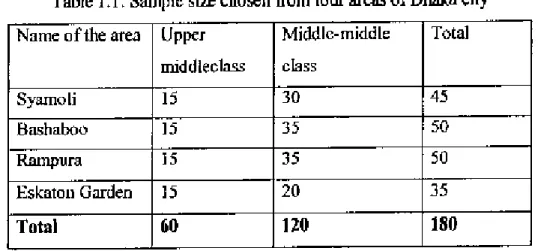
Again 180 samples divided into four parts aceordiog to the study areas. The below table 1.1 shows information about the random survey from the four selected areas.
Table 1.1: Sample size chosen from four areas of Dhaka city Name of the area Upper Middle-middle Total
middleclass class
Syamoli 15 30 45
Bashaboo 15 35 50
Romp,m 15 35 50
Eskatoll Garden 15 20 35
Total 60 120 180
At prescnt almost 260 private developers companies are engaged in construction of private apartment in Dhaka city. Primary data bas been also collected through questionnaire survey of almost 10% (20 developers) of total developers who are involved with the apartment building business. Some important information arc ,collected by informal inlerviews of different organizations that arc also related with apartment building and purchasing activities. [ntcrviews with the developers are conducted to obtain valuable information regarding lhe socio-economic and environmental aspect.
1.4.4 Data Analysis
The data obtained through questionnaire survey and interview has been analyzed, classified and tabulated as per items after careful checking. Collected data are analyzed and presented through SI'SS and Ms, Exed.
1.5 Limitations of the reseoITh
The major aim of the study is to find oul the fmancial nlfurdability of middle elass people and willingness to pay if they want to buy an apartment. Like other researches, this study also has few obvious con:.tmints and limitations, which could not be totally overcome but tried to mitigate as fur as possible with utmost sincerity. The study faces problems to collect different information due to coordination gap between
10
Chapter-I: Introductian
ciilrerenl development agencies unci financial institutions. No authentic information was available about the middle-income group. The information also missing due to insufficient books and publication:;.
1.6 Organization ofthe thCl'lis
In chapter 1, the concepts of housing, background and present state of the problem have been discussed. The research objectives WId methodology have been also ,discussed in the same chapter. lhis chapter also states how the thesis has been
organized.
In chapter 2, Housing Provision in Dh!!ka City has been discussed. Due to huge increase in the population of Dhaka, the pressure on land for residential use has been very high. Tl1cvalue of land in Dhako City, mainly in the central area increased in u higher rate, People's affurdability, supply of land, fmancial support from different organizations to buy an apartment also slated in this chapter. loan procedure of different banks, organizations (including government, semi government and private) are also discussed in this chapter.
In chapter 3, present role of government institutions in ptoviding affordable housing have been disellssed. Land is usually developed through government agencies and private developers in the different areas of the city. In the capital city Dhaka, RAJUK is mainly responsible for land and housing development But PWD, UDD, HSD and some other organizations arc also responsible for the development of land and housing in the city. So their performance for low and middle-income people also discussed in this chapter. It has been tried to describe the emergence of developers who have attempted to solve the housing problem by building apartments. Their origin and development, their role in solving the housing ptoblems have also been discussed. This chapter also includes the discussion about real estate sector and REHAB (Real Estate and Housing Association of Bangladesh),
In chapter 4, Middle Income House buyers in Dhaka City and their socio-economic background have been diseussed by considering the primary data, which have been collected from the field. The chapter includes the information about the education, occupation, income, and expenditure of the respondents. It also tried to describe the
II
Chaple,.l: Int,odadion
present house rent, reason to buy an apartment, expected dwelling unit size and their cost.
Chapter 5 discu"sed the Ilffordability of middle-income people and the existing ,housing market. Housing standard and facilities of apartment CJl.pectedby the target group, procedure of purchasing the fiat (booking and down payment system), installment fueilities offered by the developers to repay the loan, amount of loan and how they can repay the loan are also included in this chapter.
In the concluding Chapter 6 the summary, findings, recommendations and conclusions of the research have been included.
12
~..,....
_. - ..••.
Chapter 2
Housing Provision in Dhaka City
Chapter 2:Housing Provision in Dhaka City
Chapter 2
Housing ProviliioD io Dhaka City
2.1 Introduction
Rapid growth of urban population associated with very limited cconomtc opportunities, high cost of land, accelerating price of building materials create huge housing shorttalls in the urban areas of Bangladesh. Housing problem in the urban areas of Bangladesh is a common phenomenon like most developing countries of the ,world. Dhaka has more population than it can accommodate with its prevailing supply of housing. The Government's achievement in the housing sector in Dhaka is very insignificant, compared to massive needs and demands. Housing and Scttlement Directorate is the principal public sector agency engaged in solving the enonnou.~
housing problem of the country, particularly for the low and middle-income group.
Since its creation RAJUK played a key role in the housing sector of Dhaka city. Due to the enormous population growth in Dhaka in the past decadcs, it is almost impossible on the part of the governmcnt to ensure housing for all As public sector failed to ensure their right, people themselves have taken initiative to ensure their fundamental need of shelter. But the constructions of houses are also related with supply of land, supply of available building rnaterials and financial support from the respective organizations.
This chapter tries to explain mainly land and housing sector of Dhaka city, cost of land and apartment, financial snpport from different organizations to buy an apartment in the city. Loan procedure of different banks, organizations (ineluding government, semi government and private) also discussed in this chapter.
2.2 The Concept of Housing
Housing Is onc of the three primary needs and is equally important as food and clothing. It provides shelter, safety and 11sen&:ofbclongingness to the owner. It also provides privacy, promotes health and comfort and provides a basis for employment and income generation. It is eonsideredlll5 an integral part of overall improvement of human settlement and economic development. As a focus of economic activity, as a symbol of achievement and social acceptance and as clement of urban and regional
13
-!
Chap/a 2:nOIL,ing Pnwi<ion in Dhaka City
growth and income distribution - housing fuHiIIa social tlC{:dand satisfies criteria lor urban and regional investment.
Housing includes &-pace10relax, for sleeping, for cooking and bathing. But "housing"
does not simply mcan the physical structure only. It includes along with the physical structure used as shelter its environs llnd the ~erviccs, fucilitics and equipment needed for the physical and mental health and social well being of the family and the individual. It also includes residential environment and neighbourhood.
Housing addresses basic human needs. Al its most c1cmcnlallcvel, it acts as shelter, offering protection against excessive cold and heat, rain, high winds, and other intemperate weather situation threatening people's well-being. By the same token, dampness, lead paint, vermin, overcrowding, and other substandard conditions undermine resident's physical and mental health. Housing also protects people against the risk of victimization by street crime,
Housing fulfills other important functions as well. At the household level, it provides a physical enclosure for domestic behaviors place of relative privacy for daily activities, where people can cook, eat, sociali7-eand rest away from the public realm and a place where, in many cultures, they are oorn and die. It is also a setting, rcmoved Itom external scrutiny, where child beating and spousal abuse ollen go undetected. At the same time, through its location, housing forms the basis for activities in the community and larger outsidc world, such as interactions with neighbours, work, school and shopping centers.
For most residents, however, housing is more than just a structure of "bricks-and- mortar". Usually, it is a place tbat peoplc want to makc into a home. a place to which they tend to hold emotional attachmcnts resulting from its assoeiation with accumulated life experience. Psychologically and socially significant aspects of housing are also evidenl in people's desire to personalize the interior and exterior space. People attempt to express their individual or group identity through housing.
Research has found, for example, that the design of housing may reflect the
14
l 1
,j
j
,
1
j
Chapter 2:Housing Provision in Dhllka Chy
occupational values oflhe residents, with self.made businessmen choosing somewhat ostentatious display homes and service professional opting for more inward-looking designs. Furthermore, form an economic perspective; housing represents the largest fmllJlcialinvestment most households will make during their lifetimes. Housing cost burdens for those with low incomes often leave insufficient resources for other necessities, such as food, clothing, medical care, and transportation.
In a wider community context, the design and location of housing can denote a household's affiliation with a particular cultural or religious group, serving to reinforce the social bonds among its membet"sor making possible the carrying out of certain ritual activities. On the other hand, these same housing characteristics also reflect segregation from other population groups and can reinforce unequal aecess to day care, education, jobs, and life chances generally. In this sense, housing is inextricably connected to questions of redistribute justice and, thereby, to political and economic processes in the widcr community and society at large.
Housing should include
• Health and physical security aspects such as space utilization, lighting, ventilation, toilet lacililies, -rood processing and basic health services within the neighborhood.
• Privacy
• Provision for social interaction and co-ordination of shared activities.
• Optimization of available social services.
• Efficient inlegration with other land lL~esthrough communication facilities.
• lmpruvcmcnt of urban form and community development through equity and efficiency.
"Housing" has been defincd in 1961 by WHO: 'Residential environment, neighbourhood, nllcro-district or the physical structure that environs of that structure, including all necessary services, facilities, equipmcnts and t1evices rn:cd.edfor the physical and mental health and social well-being of the family and the individual'.
15
•
Chapter 2:Housing Provision in Dhaka City
An Ad Hoc group convened in 1962 by the Secretary Gencral at the request of the Economic and the Social Council stated that "Housing is not 'shelter' or 'household facilities' alone, but comprises a number of fueilities, services and utilities which link the individual and his family to the community, and the community to the region in which it grows and progresses" (UN, 1976).
In 1970 another Ad Hoc Expert group of social programming of housing in urban areas concluded that "In the fulfillment of social needs, housing plays ooth a direct and indirect role, and both role arc decisive. In its direct role housing serves as the area where the individual becomes capable of experiencing community and privacy, social well-being, sbelter and protection against hostile physical forces and disturbances. In its indireet role housing serves as the area where pl~s for social intercourse, education, recreation, sports, social welfare and health protecting services, shopping and transportation" (UN, 1976). Interregional Seminar on the Social Aspects of Housing, held in 1975, dcfmed that "The concept of housing is more than merely a physical shell. Housing encompasses all the ancillary services and community facilities, which are necessary to human well.being. Therefore, community facilities, social amenities and services form an integral part of the housing concept and should receive equal or greater attention than thc housing unit itself' (UN, 1976).
Nehru (1977) defined house as; 'The house is nOI merely a place to take shelter from tbe rain or the cold, or the sun. It is, or should be an enlargement of one's personality, and ifhuman welfare is our objective, this is bound up with house' (Sadollah, 1991).
In the word of Grimes (1980) "Housing not only provides shelter for a family but also serves as a center ofils total residential environment As a focus of economic activity, as a symbol of achievement and social acceptance, and as an element of urban growth and income distribution, housing fulfills a social need and satisfies criteria for remunerative urban investment".
16
••
-""•
Chapter 1:Housing Provi.ion in Dhaka City
All human activities arc aimed al improving the quality of life, which as reflectcd in housing, is considered to be thc function ofthrcc major components (a) Individual and the family, (b) The neighborhood, (c) The production environmcnt (Islam, 1981).
Man-made physical cnvironment has to play Ihe role of fulfillment, wholly or partially of human needs biological and socio- cultural, irrespective of formal recognition 10these needs.
According to Mahmudul Hasan (1999) hnusing meant not only a mere timn of shelter bul also it includes those qualities of comfort, conveniences and amenities, which are essential for a fumily as a centcr nftota! tesidential environment.
Sharma and Mallick (2005) define that Housing is a built form accommodating domestic activities of men, with due consideration of external environment ennducive to such living. All these three requiremenlS like infrastructure, Utilities arc essential requirements of housing.
2.3 Land and Housing Sector in Dbaka
Initially people constructed their houses in the same concept in which those were constructed in the rural areas. But gradually this type of construction was regulated , and shaped by a number oHactors, such as (i) unavailability ofland, (ii) introduction of better quality of building materials, (iii) improved system of supply of utilities, (iv) improved construction technology, etc. Even though living in such houses WlLS different from that in the rural houses, people had to accept it becausc of economic rcasons and that the urban arca~ were more atltaetive in points of recreation. Another significant change came when new technology and material rendered multi-story houses possible.
Before t 757 lhere were no urban arcUs in thc geographical region now under Bangladesh. Some business COlllcrs,called "mokam's" und the seats of feudal lords (Zamindars, Nawabs etc) showed some character of urban area in point of density of population, infrastructure and utilities etc. In 1957, eame the colonial rule of the British empire and with it came development in the £Ormof road network, water
17
••
Chapl~r 2,Hau .•ing Provisi,m i" Dhaka City
ways, rail ways, post ami telegraph in communication, business and industry, etc, under the new system of administration. Towns and cities expanded quickly and become thc center of new administration. As such people started to be attracted towards urban living due to a number of reasons including the following:
),> To serve under the government
.••. To take advantage of business lIod industrial activities
):> To take advantage of education and training fucilitics
.••. To earn a livelihood by working for others, etc .
. Availability of urban land for development and other facHities Is in a critical situation in Baugladesh. The high price of the laud in the urban areas is indicative of that situation. The urbanIzation due to popuLo-dianincrease and migration from rural areas are the main instigators towards the rising demand for urban land in Bangladesh.
These new comers are absorbed into the fabric of the life immediately after the independence, cities specially capital Dhaka became attractive and focus point of economic, political and social activities. These crowding and increasing people push demand for urban land. The glaring house shortage and degraded living envirornnent in the most of the urban areas of Bangladesh can be described to excessive consumption, waste ofscllCce reWufCCSand concentration of wealth in the hands of a fcw. All these factors along with OdlCfsocial and economic forces pushed the demand for the urhan land 10 a critical stage. The high land price in urban areas is indicative of imbalance betwcen the supply and dcmand for urban land. Dhaka displays gross inequalities ill housmg opportunities, where the rich enjoymg spacious accommodation with all utility services of high standards, while the low income groups languish in unbearable hovels. 'Nhat shall be the form of housing and living accommodation in 2025? It will d"]lcnd on socio-political ideologies of the government of the future.
The housing situation is made all the more complicated by high cost of and scarcity in the supply of land for housing and the very low Jevel of affordabiJity of the majority of tile city residents. Moreover, house construction for an individual landowner is not profitable till now. to this situation, high-risc residential buildings are seen as
18
Chupter 2:Housing Pruvis;on in Dhuka City
solutions or as compromises between high cost of land and constmction cost of housing Moreover, investment made in housing is also highly profitable in Dhaka compared to any other cities and towns of Bangladesh, Those who had plots in a desirable location tooked towards high-rise residential devetopments as means to acquire still more profit.
The present attitude of the government or the privale formal sector can never solve the housing problem for all income groups. Rural or urban the affluent and the poor must be housed and provided with well managed municipal services---water, sanitation, waste removal, transport, etc- to protect their health and to maximize the contributions that they can make to the nation's economic growth. In the case of the poor and in the setting of urbanization, the need for housing will be monumental.
A study (GOB-ADS, 1996) estimates that 299 million urban households, 61.3 percent of the total, or 13.5 million out of 22 million city dwellers, live below the absolute poverty line ofTk. 3500 per month, These 3 million households (assuming a household size of 4.3) demand affordable low-income housing in the informal sector.
The remaining 1,8 million households find their shelter in the formal housing sector.
By the year 2020, it is estimated that urban population will be 60 million which will be composed of 16-20 million urban households (assuming household size shrinks to 3.25 in the year 2015).
It is estimated that 75 percent of urban families live in substandard housing. This amounts to approximately 4 million families, which will grow to 9 million in 25 years ifnolhing is done to address the urban housing problem. Special effort will be needed to develop specialized housing finance institutions to meet the housing credit need of lower and middle-income households,
2.4 HousingAffordability
Affordability can be generally defined as whether tenants are able, willing and to do pay for their accommodation, In a generaltenn affordability for something is defined as the ability and willingness to pay for that (Reid, 1962, Needleman, 1965). The
19 •
Chapwr 2:Ht)"~lng Provisit)n in Dhaka City
definition involves the cost ofhoosing, quality of housing, household income and non housing necessities nfter paying the rent. In other words it is a law of consumption, which relates household expenditure to household income.
Among various concepts of affordability, several conventional approaches deserve much attention. Engel (1977) proposed his law of consumption: ''The poorer a family, the grater the proportion of total that must he devoted to the provision of food~.
Hulehanski (1995) took the rent-to-income in his discussion: "A household is said to have IIhousing affordnbilily problem .... When it pays more than a certain percentage ofns income to obtain adequate and appropriate housing".
On the other hand Grigsby and Rosenburg (1975) focused on residential income;
"Affordability should be defined in tenns of the adequacy for other household needs of income remaining after deducting household costs". Bramley (1990) followed the same approach: " .... That household should not be able to occupy housing thaI meets well-established DOrmsof adequacy at a net rent which leaves them enough income to live on without falling below some poverty standard". Maclennan and Williams (1990) defmed alfordability more generally as: "Affordabillty is concerned with securing some given standard of housing at a price or at a rent which does not impose, in the eyes of some third party (usually government) an unreasonable burden on household income".
Afiordability is defined as the "xtent ofa household's ability and willingness to spend regularly a reasonable portion of income as rent or cost repayment in order to sustain an accommooation. Income is the most important determinant of the housing options.
They set limit what the people can afford. According to U.N nonn a family generally should not purchase a dwelling cost is more than 2.5 times its annual income. A family saves 10% of his monthly income and after 25 years of his service, able to Fay 2.5 times of annual income. In the case of rental affurdabjJity, a family able to pay maximum 25% of his monthly income. Affurdability filr housing means the housing that the people can affurd 10 buy, operate and maintain within their range of income
20 ••
ChapteT 1:llou.oing Provuion in Dhaku CUy
•
and other properties. In order to make an affordable housing program accessible to the target group; the allocated cost musl be affordable to them.
. Definition of affurdability provided by Keare and Jimenez (1983) includes the income, housing expenditure and the propensity to consume housing. Nevertheless, the interpretation aod measurement oftllese variables still are not without difficulties.
The final element of the atTordabilily relationship is the proportion of income the households are wHling to spend on housing. ModitieatiotlS were made to the assumption of a percentage of income deemed 10 be affordable by noting essential expenditure on other basic items.
The final element of the affordability relationship is the proportion of income the households are willing to spend on housing. Thcse assumptions were derived more from a sense of social conscience than :fromobservation of what actually happened.
England and Alnwiek (1982) measured housing affordability by rccognizing that food is the first priority and major oe<;asionof spending to most lower income fnmilics.
Finally affordability was based on the study groups' willingness to pay, which in somc instances would be compared to the actual cost including the recurring and finance costs, not the income. Aftordability for apartment houses in the relation of a buyer's available resources to the housing cost in the market. So affordability means the capacity or ability of IIperson or a group to have the specific facilities or to buy, operate and maintain some thing that is important for their livelihood.
2.5 Cost orLand and Apartment Housing
Land is the primary consideration for any sort of housing project especially in Dhaka.
In Dhaka land price is very high, and high price of land C<l!\ only be afforded by the high-income people and to some extent the upper.middle income people. But the land with in the city is completely inaccessible to the middle-middle and lower-middle income house buyers or builders. These problems become very acute due to land 'speculation and inappropriate land taxation policy. Rich people buy vacant land with in the city and keep that land fur making profit in the future, which creates artificial scarcity of land. This scarcity causes the uneven growth of urban land price. As a result urban land become totally inaccessible to the middle and lower income people.
21