Faculty of Engineering
Department of Textile Engineering Project (Thesis) on
EFFECTS OF TIME ON THE BIO-SCOURING
& BLEACHING PROCESS OF COTTON KNITTED FABRICS
Course code: TE-4214 Course title: Project (Thesis)
Submitted by:
MD.Touhid Alam ID: 173-23-5174 MD.Naimul Islam ID:173-23-5186
Supervised by:
Tanvir Ahmed Chowdhury Assistant professor
Daffodil International University
A thesis submitted in partial fulfillment of the requirements for the degree of Bachelor of Science in Textile Engineering
Advance in Wet Processing Technology
Summer - 2020
“©Daffodil International University” 1
“©Daffodil International University” i
DECLARATION
I hereby declare that this project report has been done by me under the supervision of Tanvir Ahmed Chowdhury, Assistant professor, Department of Textile Engineering, Faculty of Engineering, Daffodil International University. I also declare that, neither this project nor any part of this project has been submitted elsewhere for award of any degree or diploma.
Md.Touhid Alam ID:173-23-5174 Department of TE
Daffodil International University
Md.Naimul Islam
ID: 173-23-5186 Department of TE
Daffodil International University
“©Daffodil International University” ii
LETTER OF APPROVAL
This project report prepared by Md.Naimul Islam (ID:173-23-5186) and Md:Touhid Alam (ID:173-23-5174), is approved in Partial Fulfillment of the Requirement for the Degree of BACHELOR OF SCIENCE IN TEXTILE ENGINEERING. The said student has completed his project work under my supervision. During the research period I found him sincere, hardworking and enthusiastic.
TANVIR AHMED CHOWDHURY ASSISTANT PROFESSOR
DEPARTMENT OF TEXTILE ENGINEERING FACULTY OF ENGINEERING
DAFFODIL INTERNATIONAL UNIVERSITY
“©Daffodil International University” iii
ACKNOWLEDGEMENT
Firstly, we express our gratefulness to almighty Allah for his divine blessing makes us possible to complete this project successfully.
I am grateful to my supervisor Tanvir Ahmed Chowdhury, Assistant Professor, Department of Textile Engineering, Faculty of Engineering, Daffodil international University. Deep knowledge and keen interests of our supervisor in the field of textile dyeing and finishing influenced us to carry out the project work. His endless patience, scholarly guidance, continual encouragement, energetic supervision, constructive criticism, valuable advice, reading many inferior drafts and correcting these at all stages have made it possible to complete this project.
We would like to express our thanks to Mr. Md. Mominur Rahman, Assistant Professor & Head (In-Charge), Department of Textile Engineering, Faculty of Engineering, Daffodil international University for his kind help to finish our project report. We would like to express our thanks to Prof. Dr. Md. Zulhash Uddin, Dean, BUTex and Prof. Dr. S.M. Mahbub Ul Haque Majumder for providing us necessary information to complete the report on time.
We would like to deliver thanks to our entire course mates in Daffodil International University, who took part in the discussion while completing the course work.
Finally, we would like to express a sense of gratitude to our beloved parents and friends for their mental support, strength and assistance throughout writing the project report.
“©Daffodil International University” iv
DEDICATION
We dedicate this project report to my beloved teacher and my parents.
“©Daffodil International University” v
ABSTRACT
This study pretends to assess the eco-friendly Bio-scouring and bleaching process on cotton knitted fabrics. Living organisms and their components are being used to remove natural and added impurities from cotton fabric in Enzymatic scouring or Bio-scouring application.
This project is mainly focused on, effects of different periods of time (30mins, 45mins and 60mins) on the Bio Scouring and bleaching process of cotton knitted fabrics and aim of the work was to measure fabric characteristics (CPI, WPI, SL, GSM), absorbency test (Immersion test, Drop test, Wicking test) as well as PH test. For doing the project we took three types of fabric like Single Jersey, (1*1) Rib and Plain Interlock. We studied the Bio- scouring & bleaching process of cotton by using pectinase enzymes. Here for doing Bio- scouring& bleaching we changed the time (30 mins, 45 mins, 60 mins). We took pectinase, emulsion and wetting agent. After we had done the process, we tested the fabric like absorbency test, wicking test and drop test. Stitch length, WPI, CPI, GSM and weight loss of fabric test also. After done the research we found that Single Jersey, (1*1) Rib and Plain Interlock were showing higher% of change in CPI, WPI, SL, GSM, Weight Loss and good Absorbency in 60mins of Bio-scouring and bleaching process.
“©Daffodil International University” vi
LIST OF CONTENTS
Contents Page No. Declaration ... iLetter of Approval ... ii
Acknowledgement ... iii
Dedication ... iv
Abstract ... v
List of Contents………...……… vi .. vi
List of Figures ... ix
List of Tables ... x
Chapter-1: Introduction 1.1Introduction………....………...………....…………2
1.2 Objective…….………...………3
Chapter-2: Literature Review 2.1 Introduction of cotton………...……… 5
2.1.1 Properties of cotton………5
2.1.2 Properties of cotton products………6
2.1.3 Properties of cotton fiber………..………..….7
“©Daffodil International University” vii
2.1.4 Long staple cotton………..….………..7
2.1.5 Chemistry of cotton ……….………...……… 8
2.1.6 Chemical composition of cotton ………...……… 8
2.2 Knitting ………...…… 10
2.1.2 Basic structure in weft knitting ………….…...…....………… 11
2.3 Scouring ………...……… 11
2.3.1 Scouring of cotton ………...………....………...……… 12
2.4 Enzymes ………...……… 13
2.4.1 Advantages of using enzymes in textiles ………..……… 14
2.5 Enzymes scouring (Bio-scouring) ………...…… 15
2.5.1 Bio-scouring of cotton fabric ………...…… 16
2.5.2 Bio-scouring system and advantages of bio-scouring …...…. 17
2.6 Difference between Conventional and Bio-scouring process ...18
2.7 Estimation of scouring effect ... 29
2.7.1 Absorbency test ………...……… 21
2.7.2 Determination of weight loss% ... 21
Chapter-3: Methodology 3.1 Materials ………..………,,,,,,,,,,,,,,,,,,…… 22
3.2 Methods ………..……… 23
3.2.1 Method of Bio-scouring …….……….……… 23
3.2.2 Bio-scouring process ……… 24
3.3 Method of evaluation ………..……… 25
3.3.1 Determination of fabric weight loss% ……….……… 25
3.3.2 Test of WPI ……….……… 26
“©Daffodil International University” viii
3.3.3 Test of CPI ……….……… 26
3.3.4 Test of GSM ………..…..……… 26
3.3.5 Test of SL ……….….………… 27
3.4 Absorbency test .………..………… 28
3.4.1 Immersion test ………..…….……… 28
3.4.2 Drop test ………..……….…… 28
3.4.3 Wicking test ……….……….……… 29
SAMPLE ATTACHMENT ………..………. 30-34 Chapter-4: Discussion of Results 4.1 Change in WPI of fabric after Bio-scouring & bleaching process …….…… 36
4.2 Change in CPI of fabric after Bio-scouring & bleaching process ………..… 37
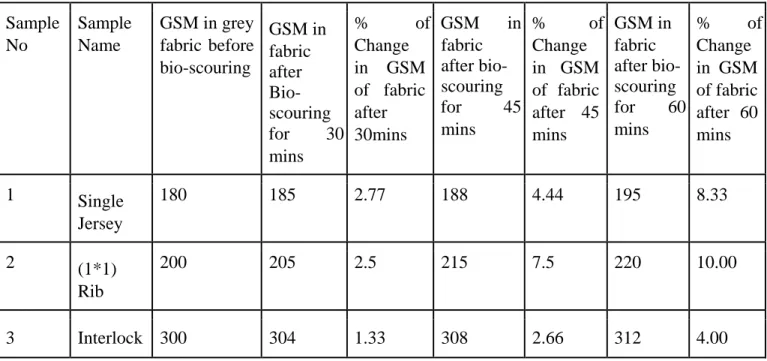
4.3 Change in GSM of fabric after Bio-scouring & bleaching process …...…… 38
4.4 Change in SL of fabric after Bio-scouring & bleaching process ... 39
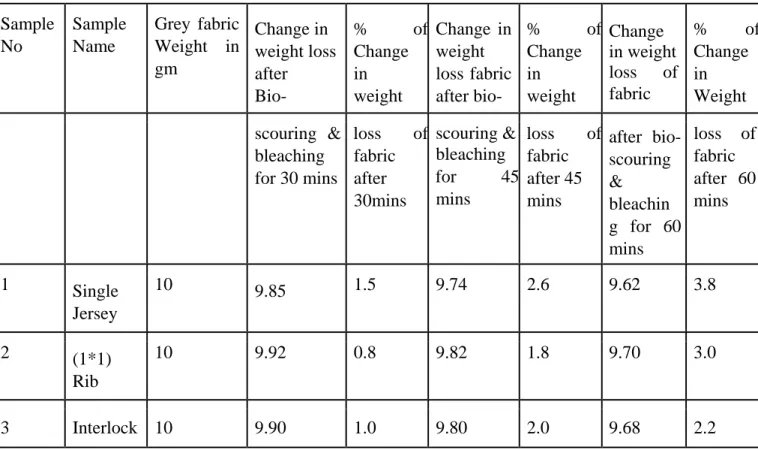
4.5 Change in Weight loss% of fabric after Bio-scouring & bleaching process .. 41
4.6 Change in Immersion time of fabric after Bio-scouring& bleaching process .42 4.7 Change in Wicking Length of fabric after Bio-scouring& bleaching process.43 4.8 Change Drop test time of fabric after Bio-scouring & bleaching process ... 44
Chapter-5:
Conclusion………...………...45-47
Appendices………….………..………..……..48-51
“©Daffodil International University” ix
Reference……….………...……….. 52
LIST OF FIGURES
Figure No. Title of the Figure Page No.
Figure 2.1.5 Structure of Cotton Cellulose 8
Figure 3.2.2 Process Curve for Bio-scouring and bleaching 26
Figure 4.1
Line diagram represents% of change in WPI of fabrics under different stages of time
36
Figure 4.2
Line diagram represents% of change in CPI of fabrics under different stages of time
37
Figure 4.3
Line diagram represents% of change in GSM of fabrics under different stages of time
38
Figure 4.4
Line diagram represents% of change in SL of fabrics under different stages of time
40
Figure 4.5
Line diagram represents% of change in weight Loss of fabrics under different stages of time
41
“©Daffodil International University” x
Figure 4.6 Column Diagram represents immersion time under different stage of time 42 Figure 4.7 Column Diagram represents wicking length under different stage of time 43 Figure 4.8 Column Diagram represents drop test time under different stage of time 44
LIST OF TABLES
Table No Title of the Table Page No Table 2.1 Chemical composition of cotton ………..………..…….9Table 3.1 Sample specification ……….………..………..…….………23
Table 3.2 Types of chemicals used in the investigation……… 23
Table 3.3 Bio scouring & bleaching recipe ……….….….,,…..24
Table 3.4 Apparatus used in the experiment ……….…………..……….….24
Table A1 Change in WPI of fabric after bio-scouring & bleaching process …...…….…48
Table A2 Change in CPI of fabric after bio-scouring & bleaching process ………....….48
Table A3 Change in GSM of fabric after bio-scouring & bleaching process………...….49
Table A4 Change in SL of fabric after bio-scouring & bleaching & bleaching process...49
Table A5 Change in Weight loss% of fabric after bio-scouring & bleaching process….49 Table A6 Change in Immersion time after bio-scouring & bleaching process ………....50
Table A7 Change in Wicking Length after bio-scouring & bleaching process…..……...51
“©Daffodil International University” xi
Table A8 Change in Drop test time after bio-scouring & bleaching process………51
“©Daffodil International University” 1
Cotton yarn or fabric, before dyeing or printing it passes through number of process in textile processing. Scouring is a very important process. Non-cellulose elements are completely or incompletely removed by this process. For doing scouring fabrics get high and even wet ability. In this process highly alkaline chemicals as like as caustic soda are used. Which is not only removing the non-cellulose from the cotton, but also the cellulose governance to risk chemical result in high COD (Chemical Oxygen Demand) BOD (Biochemical Oxygen Demand) and TDS in the waste water. So, it is not friendly for environment. In this era, consumers are conscious about the clothes they buy are of highquality material and are well made. Additionally they are concerned about the clothes
CHAPTER - 1
INTRODUCTION
“©Daffodil International University” 2
in which excessive number of chemicals are used. They are aware of the environmental friendly process of the manufacturing clothes. The most efficient way to reduce impurities (natural/additive) from the clothes are enzymatic scouring or Bio-scouring. Pectinase is used in Bio-scouring & bleaching process as a chemical. In this process living organisms and their components are used to remove the impurities. So Bioscouring will have a large impact in future in many industrial sectors as it an eco-friendly process. Bio-scouring &
bleaching process is an inexpensive process than the other scouring processes because of the use of the low temperature, little energy and less water. The pectinase breakdown the formation of the epidermis, hydrolyzing the pectin and killing the links with wax and protein and remaining the fiber structure. Even when fabric remain 30% of the remaining pectins after a residence stage, a wash at 80 ⁰C-90 ⁰C eliminates the solubilized waxes. In Bio-scouring process, here need less amount of dyes, chemicals and water so after treatment when we release the waste water in the environment it will more friendly for environment then conventional scouring process.
Bleaching is that method by that natural color of the cotton cloth area unit destroyed. in order that cloth is going to be additional bright & light-weight coefficient are going to be additional before one. conjointly permeability is augmented as a result of hydroxide is employed to extend the hydrogen ion concentration worth and that takes away oil, fat wax etc.
1.1 Objective of the study
The broad objective of the research is to established a basic structure for effects of time on the bio-scouring process of cotton knitted fabrics.
The specific objectives of this research are mainly –
■ To know about enzyme which is mainly used in Bio-scouring process and also about a modern technology which is used in the scouring process.
■ To assess the Bio-scouring effect with various test as like drop test, Immersion test wicking test.
■ To assess the SL (Stich Length), GSM (Gram Per Square Meter), CPI (Course Per
■ Inch) and WPI (Wales Per Inch) of fabric before and after Bio-scouring process.
■ To know the weight loss percentage of the fabric by measuring the weight before and after the Bio-scouring process.
■ To know the effect of fabric before and after the Bio-scouring process.
■ To know regarding the estimation of bleaching results
“©Daffodil International University” 3
“©Daffodil International University” 4
2.1 Introduction of Cotton
Cotton is a cellulosic natural fiber.. it's one in all the oldest fibers during this world that is most usable for numerous purposes and acquainted to kith and kin. With polyose noncellulosic material like sugars, starch, macromolecule and a few inorganic matters are gifts in cotton fiber. while not this matters polymer additionally found within the cotton fiber that may be an advanced chemical compound. It works as a security sale that is kept around on the material.
C
HAPTER-2LITERATURE REVIEW
“©Daffodil International University” 5
Cotton nowadays is the most used textile fiber within the world. Its current market share is 56% for all fibers used for attire and residential furnishings and sold within the U.S.
Another contribution is attributed to nonwoven textiles and private care things. The earliest proof of victimization cotton is from India and therefore the date assigned to the current material is 3000 B.C. there have been additional excavations of cotton materials of comparable age in Southern America. Cotton cultivation initially unfolds from India to Egypt, China, and therefore the South Pacific.
Cotton may be a soft, staple fiber that grows during a type referred to as a boll round the seeds of the cotton, a woody plant native to tropical and subtropical regions round the world, as well as solid ground, India, and Africa. The fiber most frequently is spun into yarn or thread and accustomed to create a soft, breathable textile, that is that the most generally used natural-fiber textile in articles of clothing nowadays. The nation name derives from the Arabic (al) qutn, which began to be used circa 1400.
Each cotton fiber consists of homocentric layers. The cuticle layer on the fiber itself is dissociable from the fiber and consists of wax and cellulose materials.
2.1.1 Properties of Cotton
Cotton could be a soft fiber that grows round the seeds of the cotton. Cotton fiber grows within the seed pod or boll of the cotton. every fiber could be a single elongated cell that's flat twisted and ribbon-like with a good inner hollow (lumen).
90% cellulose, 6% wetness and also the remainder fats and impurities.
The outer surface is roofed with a protecting wax-like coating which provides fiber AN adhesive quality.
Cotton could be a fiber that's full-grown in countries around the world. It's a crop that needs adequate wetness and warmth to mature and turn out quality fibers. Cotton growing tends to be in hotter climates. Cotton 6 june 1944 true trade goods within the world markets and provide and demand really have an effect on costs of raw cotton.
Cotton fibers square measure chiefly created from polysaccharide. cellulose doesn't kind unless temperatures square measure over seventy °F (21 °C). The cotton fibers square measure connected to the seeds within the boll of the plant. Their square measures
“©Daffodil International University” 6
sometimes six or seven seeds in a very boll and up to twenty,000 fibers connected to every seed. The length of those fibers (also referred to as staples) is the main crucial thing about the standard of the cotton. In general, the longer the staple grows the upper the standard of the cotton. Staple lengths square measure divided into short, medium, and long (and additional long, in some cases):
Short staple cotton is between 3/8” to 15/16” (.95cm to 2.4cm) long Medium staple cotton is between 1” to 1-1/8” (2.54cm to 2.86cm) long
Long staple cotton is between 1-3/16” to 2-1/2” (3cm to six.35cm) long
2.1.2 Properties of Cotton Products
■ Comfortable – there are not any surface characteristics of cotton that create it irritating to human skin. Cotton feels sensible against skin; it's a soft hand.
■ Hydrophilic – cotton incorporates a natural affinity for water – it attracts wet removed from your body.
■ Moisture passes freely through cotton – aiding in evaporation and cooling
■ Good Heat conduction – Cotton permits heat to dissipate creating it an exquisite fiber to keep up a snug sleeping temperature.
■ Strong and abrasion resistance
■ The unfavorable attributes of cotton embrace its lack of resiliency (cotton tends to wrinkle) and its
■ lack of luster (colors area unit typically dull)
2.1.3 Properties of Cotton Fiber
■ It has 8% moisture regain
■ The cellulose is organized in an exceedingly approach that offers cotton distinctive properties of strength, durability, and absorbency.
■ It is contemporary, crisp, comfy, absorbent, flexible, has no pilling issues and has sensible resistance to alkalis
■ It has poor wrinkle resistance, shrinkage, poor acid resistance, less abrasion resistance, prone to harm by moths and mildew, wants many maintenance and stains area unit troublesome to get rid of
■ Its fiber length ranges from ½ inches to 2inches
■ It has a 10%increase in strength once wet.
■ It has a flat twisted tube form
“©Daffodil International University” 7
2.1.4 Long Staple Cotton
In general, long staple cotton required|is required to spin the yarns needed within the weaving of the finer down proof cotton fabrics.
Long staple cotton is considered to be finer quality as a result of they will be spun into finer yarns and people finer yarns is woven into softer, smoother, stronger, and additional lustrous materials. Long staple cotton makes stronger yarns, particularly in fine yarns, as there are fewer fibers in an exceedingly given length of yarn and therefore the longer fibers offer additional points of contact between the fibers after they are twisted along within the spinning method.
Common areas that grow long staple cotton within the world would be Egypt, Sudan, the u.s. (Pima cotton fully grown within the west and southwest are long staple cotton), and Western China. The 2 most generally famous long cottons ar egyptian cotton and Pima cotton. Pima cotton is fully grown principally within the u. s., however additionally in South American nations, Israel, and Australia.
The fibers are sent to a manufacturing plant. carding machines flip the fibers into cotton yarn. The yarns are woven into material that's comfy and simple to clean however will wrinkle simply. Cotton fabric can shrink concerning third-dimensional once washed unless pre-treated to resist shrinking.
Cotton is prized for its comfort, easy care, and affordability and is right for covering, bedding, towels, and furnishings.
2.1.5 Chemistry of Cotton
Cotton is Associate in Nursing insoluble substance. In some specific solvent it'll be soluble.
In cotton fiber cellulose percentage is higher than different fiber. It's one quite vegetable fiber. in the main cotton fiber composed from saccharide that holds a series of aldohexose monomers.
that cotton we have a tendency to get from nature it's extremely crystalline then different fiber and rigid molecular structure. Main building block of cotton cellulose chain ar ar, 4D.
Free rotation of the anhydro glucose-pyranose C-O-C link is stopped by steric result. as a result of the gift of hydroxyl group teams and therefore the} chain conformation there also several bonds manufactured. Some bonds increase the rigid by increasing the rigidity of the structure of cotton fiber.Figer:2.1.5
“©Daffodil International University” 8
2.1.6 Chemical Structure of Cotton
Cotton could be a natural cellulose. because it includes a common component of a vegetable cell.
Proteins, oil and wax, pectose and pectins, mineral matters and natural coloring matters area unit the contents of fibre. Cotton fiber conjointly contains impurities. the share of impurities depends on the kind of cotton and fiber maturity. Immature cotton produces additional impurities than mature cotton fiber. For a dry cotton fiber, the approximate formation is shown in 2.1.
Table 2.1 Chemical components of cotton
Chemical Formation (%)
Cellulose 88.0-97.0
Protein 1.0-2.0
Oil and wax 0.4-1.5
Pectins 0.4-1.5
Minerals 0.7-1.6
Others 0.5-8.0
a) Cellulose
In cotton, most quantities of elements we tend to get polysaccharide. Naturally polysaccharide consists of an aldohexose molecule that is ready in lipide technique. The mass is a pair of million more or less of the polysaccharide gift in cotton.
“©Daffodil International University” 9
b) Protein
Cotton may be a macromolecule fiber. as was a common macromolecule made from polypeptides and amino acids. Those are chiefly gifts in voltaic cell walls and lumen of cloth. The assorted quantity between cell membrane and lumen is 1-2%.
c) Oil and Wax
Oil and wax are primarily hydrophobic substances. It works as a protecting coating on the fiber surface. they're from a high mass of glycerides and carboxylic acid. Waxes are going to be melted in numerous amounts. The approximate worth is sixty eight sixty eight sixty eight. once treatment (scouring) wax faraway from fiber. Waste wax accustomed manufactures soap throughout treatment in alkaline resolution.
d) Pectin
About 0.4-1.5% pectins gift in cotton fiber. In the main these square measure from metallic elements, Mg and iron pectates with some free acid and methyl radical pectate. It’s metallic element and Mg salt don't seem to be soluble in water and {also the} free acid also however in alkali hydroxides or soda they'll be regenerated into soluble products. So, throughout alkali boiling or scouring these is aloof from the cotton fiber or materials.
e) Minerals
About 0.7-1.6% minerals gift in cotton fibers. These minerals are far from cotton as ash once burnt. Minerals matter other than cotton fiber as an outer surface. Minerals contain chlorides, carbonates and sulphates of potassium, metal and metallic elements. Minerals square measure removed or scale back from cotton fiber by boiling.
2.2 Knitting
Knitting is a method of producing knit fabric. On different hands it's a method of knit material construction by forming loops into yarn. producing material yarn perhaps single yarn or set or cluster of yarn. In another word knitting is methodology by manipulating yarn to provide Textile. Knitting turns out multiple loops of yarn, that is named sew. sewing is
“©Daffodil International University” 10
completed in an exceedingly line. sew creates a line in warp and conjointly in thread direction. Loops area unit created by victimization needle. Fineness of the material given by the quantity of stitch/needles per in. in an exceedingly machine. If the gauge variety is higher per in. then the material is finer and if the gauge variety is a smaller amount high per in. then the materials are going to be less fine. the dimensions of the loop of the yarn verify after all and wales. material length determines the quantity of courses in material and breadth material determines the quantity of wales within the fabric.
Figure: 2.2 Knitting Structure
Basically there are 2 styles of knitting:
1.Warp Knitting 2.Weft knitting
• Warp knitting: it's a fabric producing method by manufacturing loops warp wise.
During this method loops square measure created 2 or sets of yarn. Here loops square measure shaped vertically. typically warp knit is completed in flat or open form.
• Weft knitting: it's a fabric producing method by manufacturing loops yarn wise.
During this method loops square measure created with one yarn. These loops square measure shaped horizontally. Typically yarn knit is completed in a cannula kind.
“©Daffodil International University” 11
2.2.1 Basis Structure in Knitting
1.Single Jersey:
Single jersey fabric could be a weft knit. Here one set of needles is used. From structural read front facet and back facet of single jersey fabric square measure are totally different.
2.Rib Fabric:
In rib fabric manufacture, every course has one face loop and one back loop. during this fabric front and back both side squares measure the same. 3.Interlock: though interlock springs from 1*1 rib structure, the fabric properties aren't the same.
3.Interlock:
Although interlock springs from 1*1 rib structure, the material properties aren't the same.
2.3 Scouring and Bleaching
Scouring and bleaching is a process by victimisation to get rid of natural and extra impurities from the cotton fabric. The natural impurities are oil, waxes, fat etc. And extra impurities are gear oil, grease etc. Dirt and dust conjointly take away by scouring method.Bleaching is H2O2: it's the whitener. It accustomed turned out permanent white on cloth.
Scouring is going to be a continuous or discontinuous system. For scouring impurities off from the material in addition because it will increase the permeability of the material.
When scouring methods in run we should always be concerned regarding temperature, interval, pH, liquor magnitude relation, cloth shorts etc. Complete Scouring useful for consequent method. On the other hand, incomplete scouring originates dangerously and has an effect on the next method like colouring and printing because of poor affinity of dyes of the fabric.
Types of Scouring Processes are:
a) conventional Scouring method. (Scouring by chemicals means) and b) Bio-Scouring or enzymatic Scouring method.
Conventional Scouring Process:
It is a conventional method to get rid of impurities from the material. During this method a high quantity of water is needed and time additionally. So, this method value is beyond
“©Daffodil International University” 12
the Bio-scouring method. Here I would like a high quantity of water and dyes and chemicals additionally. therefore wastewater quantity additionally beyond different scouring methods. As here the number of waste water is higher that the rate of contamination is additionally high. Over all this can be a pricey method however the value of the machineries is affordable.
Bio-Scouring or enzymatic Scouring method:
This can be associated with an updated scouring process to get rid of the impurities from the material. Here would like less water and time than a different scouring method. This method is cheaper typical|the traditional|the standard} scouring method however machineries value is beyond conventional method.
2.3.1 Scouring of Cotton
At extreme temperature, the cotton polysaccharide material is treated with an answer containing alkali, soda ash and hydroxide, associate degree anionic and/or nonionic detergent a wetting agent a complexing and sequestering (which is employed for the removal of metal ions) and polyacrylates or polyphosphonates (as special wetter free dispersing agent) within the scouring method. nowadays the scouring is finished largely within the colouring machines. Scouring is finished as a locality of combined or single operation like scouring and bleaching. Conventionally the scouring operation was an exhausted kier machine that the method was referred to as kier boiling.
i. saponification of fats into water soluble soap and water mixable glycerin underneath alkaline condition.
ii. hydrolysis of proteins into water soluble degradation merchandise. iii. Dissolution of amino compounds.
iv. Solubilizing of pectose and pectins by changing into soluble salts.
v. Dissolution and extraction of mineral matter.
vi. Emulsification and solubilization of natural oils and waxes.
vii. Removal and dispersion of dirt particles and kitty by the action of alkali and detergent.
“©Daffodil International University” 13
The material once scouring is additional absorbent, free from natural impurities and coloring matter. This treatment is often administered on filaments, yarns and materials.
2.4 Enzymes
Enzymes are macromolecule catalysts that accelerate the speed of chemical reactions. From macromolecules all enzymes are created by having 3 dimensional specific form. completely different For various} enzymes the shapes are different. The enzymes that are used for one reaction that aren't used for any reactions i.e. enzyme quickens the breakdown of starch into the sugar malt sugar. enzymes speed up the breakdown of peroxide. The rationale for this is often that the substrate fits into a special region of the catalyst referred to as the situation.
Once within the situation the catalyst will enzyme the reaction.
thanks to the benefits of catalyst being non-toxic, perishable and environmentally friendly the uses of catalyst in textile processes has gained multiplied. In textile wet processes like desizing, scouring, bleaching, colouring and finishing catalyst are often safely used whereas ancient chemicals will cause several issues as well as pollution of effluents once disposed into the surroundings. Advances in catalyst technology use within the textile business have created it attainable to explore the potential of single catalysts or enzyme mixtures for specific applications. for material preparation and finishing hydrolases (e.g. amylases, cellulose, pectinases, proteases) are utilized.
catalysts are massive high-molecular weight macromolecule structures with extremely specific active sites among the molecules that perform the chemical change reaction.
exchange enzymes with easier compounds that mimic the behavior of those biocatalysts might considerably increase the reaction rate, facilitate the protein method and reduce prices.
Enzymes will work gas pressure and in gentle conditions with relevancy temperature and acidity (pH). Most enzymes perform optimally at a temperature of 30⁰C-70⁰C and at pH values that are close to the neutral purpose (pH 7). catalyst processes are doubtless energy saving and save finance in special instrumentation proof against heat, pressure or corrosion.
2.4.1 Advantages of Using Enzymes in The Textile
Usage of enzymes has the subsequent benefits within the textile industry:-
the enzymatic method is surroundings friendly.
➢ it's going to improve the merchandise quality.
“©Daffodil International University” 14
➢ Speed up the chemical action.
➢ it's a non-toxic method.
➢ Less water is needed.
➢ Less energy is needed.
➢ Less time is needed.
a) Environment Friendly
For the textile processes several poisonous dangerous chemicals had been used before the replacement of victimisation enzymes. victimisation enzymes within the textile method have reduced the share of pollution and helped to treat the wastewater simply with minimum value
b) Enzyme speed up the method
As catalysts, enzymes stay an equivalent when the reaction. By lowering the energy of activation of reaction and increasing the speed of specific reaction, enzymes speed up the reaction.
c) Enzyme Act on a Individual Substrate
Enzymes turn solely on some specific substrate. It works in milder conditions. for every specific catalyst there's a particular temperature and pH worth within which they perform their best in dashing the reaction. Otherwise if the temperature or pH on the far side the particular one would degrade the enzymes performance.
d) Easy to control
simple dominant means that there are less possibilities of getting any downside so higher results. As every catalyst encompasses a specific condition below that they perform, it reduces the prospect of assaultive the fiber structure which supplies a more robust material and it additionally reduces the load loss of fiber.
➢ Save water
“©Daffodil International University” 15
➢ terribly sensitive
➢ enzyme is cut back simply
➢ Enzymes will live terribly small concentrations of gear.
➢ Reusability of enzymes
➢ restricted usage of water (one of the foremost helpful and scarce resource).
Water usage is reduced by nearly 19000 liters per ton of textile bleaches.
The only disadvantage of enzymes is that they're high-ticket and if the enzymes don't seem to be used up in reaction then separation type product is time overwhelming and high-ticket.
2.5 Enzymatic Scouring (Bio-scouring)
The process by which the living organisms and their elements take away the natural and else impurities from material is named accelerator scouring or Bio-scouring. Bio-scouring is a crucial technology that may have an oversized impact on several industrial sectors in future. Bioscouring methods chiefly think about cheap substrates for biogenesis. In Bioscouring methods they operate at temperature and conjointly consume very little energy and water in addition. accelerator removal of impurities conjointly reduces the overall chemicals consumptions and prospects of accident.
2.5.1 Bio-scouring of Cotton fabrics
Scouring is removal of non-cellulosic material gifts on the surface of the cotton. regarding ninetieth of polysaccharide are contained in raw cotton and varied non-cellulosic like waxes, fats, pectins, proteins, lignin-containing impurities and coloring matter. gray or untreated cotton contains varied non-cellulosic impurities like pectins, waxes, hemicelluloses and mineral salts, gift within the cuticle and first cell membrane of the fiber.
The goal of the cotton propaedeutic method is that they take away the hydrophobic and non- plastic elements and turn out extremely absorbent fibers which will be unreal and finish uniformly. These are liable for the hydrophobic properties of raw cotton and interfere with binary compound chemical processes on cotton, like coloring and finishing this before cotton yarn or material is unreal, it must be pretreated to get rid of materials that inhibit dye binding. This step, named scouring, improves the wet ability of the material and usually uses alkalis, like hydroxide. However, these chemicals conjointly attack the polysaccharide, resulting in reduction in strength and loss of cloth weight. what is more, the ensuing waste product incorporates a high COD (Chemical gas Demand), form (Biological gas Demand) and salt content. accelerator or Bio-scouring, leaves the polysaccharide structure virtually intact, preventing polysaccharide weight and strength loss.
“©Daffodil International University” 16
Bio-scouring incorporates a variety of potential blessings over ancient scouring. It's lower form, COD, TDS (Total Dissolved Solids), performed at neutral pH scale, that total water consumption cut back, the treated yarn/fabrics retain their strength properties, the load loss is reduced or restricted compared with process in ancient ways.
It will increase cotton fiber softness. Many kinds of accelerator, together with cellulose polysaccharide proteases and lipases, alone or combined are studied for cotton bioscouring, with pectinases being the foremost effective.
Compared to the harsh feel in the alkaline scouring method, hand feel is extremely soft in the accelerator scouring method. To effectively scour material while not negatively moving the fiber or the surroundings accelerator scouring is used. As operators aren't exposed to aggressive chemicals, it minimizes the health risks. Bio-scouring method provides several advantages:-
➢ Bio-scouring method has reduced water and waste water price.
➢ it's reduced treatment time.
➢ This method has down energy consumption. (Because of lower treatment temperature, the optimum temperature is kind 40-60⁰C)
➢ it's reduced the load loss in material.
➢ thanks to this method the material quality is improved with a superior hand.
➢ Bio-scouring method has reduced strength loss.
The technical blessings that the accelerator scouring commercially appealing, are a better|
quality of the fibers (soft to the bit and better strength), less waste waters, economy of energy and compatibility with different merchandise, instrumentation and materials pectinase, because the name suggests, reaction pectins the ar gift in cotton as a noncellulosic impurity. The most effective styles of pectinase are those, which may operate below slightly alkaline conditions even within the presence of chelating agents. Such enzymes are referred to as “alkaline pectinases”. Most standard pectinases are sometimes inactive below these commercially helpful conditions, their optimum activity lying within the slightly acidic region. throughout the cellulosease treatment the pectin content of cotton fiber is ablated by regarding half-hour. The bio-scouring method ends up in textile being softer than those scouring within the standard hydroxide method.
“©Daffodil International University” 17
2.5.2 Bio-scouring Systems and Advantages of Bio-scouring Water saving:
In the standard method a minimum of five baths are used before the actual dyeing, whereas in the bio-scouring method just one bathtub is used. This results in a complete four bathtub saving. Considering Associate in Nursing MLR of 1:7, the entire quantity of water that may be saved regarding twenty eight litters per metric weight unit. processed. For a unit doing a thirty Mt. of bleaching daily, the quantity of water that may be saved is 840,000 litter per day. On an annual basis the amounts come back to be 3066,00,000 liters of water.
Temperature Saving: At a temperature of 55⁰C as against 98⁰C, the complete method takes place. The temperature distinction is regarding. the particular heat of water is 4.186 Joule/gram K. It needs 4.186 joules of energy to heat one g of water by 1 K. assumptive associate MLR of 1:7, for each weight unit of cotton, seven litters of water is employed throughout the bleaching method.
Smoother Surface Profile: The binding agent named cellulose prevents the visual aspect of the cotton that gets generated because of abrasion with process equipment.
cellulose conjointly itself acts as a seventeen chemical for the cotton. therefore the application of ultimate chemicals are often reduced from 25-40%. sander profile will facilitate in up the loom running potency by four-dimensional a minimum of.
Time Saving: The bio-scouring method takes place regarding 50 minutes for completion whereas the traditional scouring method takes place regarding two hours 50 min. So, for each batch artificial we tend to area units saving 2 hours per batch. victimisation bioscouring coloring is often completed in 5 hours wherever it takes seven hours to finish the coloring method in standard technique. The proportion of your time saved is going to be twenty ninths. so any method house will raise its production by twenty ninth around by victimising the bio-scouring method.
Environmental Benefits: reduce effluent treatment value, as avoiding sodium hydroxide, that successively reduces TDS. throughout standard scouring if we tend to contemplate TDS to be 100 pc the screen ABE liquid method has solely 20-40% TDS.
Lesser Weight Loss: In bio-scouring method weight loss of material isn't quite 1.5%. The load loss in the standard method is about 4-dimensional. The whole savings within the weight loss are often about to 2.5%. During this world, wherever the cotton costs have shown a gentle inflation, this may be a substantial advantage to the method owner.
“©Daffodil International University” 18
2.6 Differences Conventional VS Bio-scouring & Bleaching Process
Conventional Scouring
Bio-scouring
In a conventional system process carried out at high temperature for 4-6 hrs.
In Bio-scouring systems processes are carried out at ambient temperature.
In this process high pressure is required. Low pressure required.
High energy process. Low energy process.
Not Eco-friendly. Eco-friendly.
In this process high water consumption. In this process low water consumption.
Process cost high Process cost low.
2.7 Estimation of Scouring Effects
2.7.1 Absorbency Test
a. Immersion Test
The absorbency of a fabric increases when scouring is done. First we need to cut a sample by (1x1) cm2. Then we put the sample on the water surface and time taken by it to be immersed is noted. The standard time is 5s. If it is up to 10s then we can say that the sample is well scoured. If it is higher than 10s then the scouring has not taken place properly.
b. Column Test/ Wicking length
“©Daffodil International University” 19
First, we need to cut a sample from scoured fabric which is 18cm x 5cm. In a beaker we have taken 0.1% direct dye red. Above from the bottom a marker is drawn about 1cm. From a wood stick the sample is hung. Then 1cm portion of fabric is immersed in the dye liquor for 5 min. Then about 1cm mark of distance traveled by the colored solution is noted. Where the acceptable range is 30-50mm.
c. Drop Test/ Spot Test
In this test, 0.1% direct dye red colored solution is used. Then the solution dropped on the sample by pipet and its absorbency estimated visually. The drop may have various shapes when absorbed.
Two things can be measured:
1. The time is taken in s to absorb one drop of solution. Standard time is 0.5-0.8 s, up to 1s is allowed.
2. In a pipette a solution of 0.1% direct dye red is taken and a droplet of solution put on the different place of the fabric. Then the shape of the absorption area on the fabric is observed.From sample spot uniform scouring can be said.
“©Daffodil International University” 20
2.7.2 Determination of Weight Loss Percentage
At the same moisture content, the weight loss of un-scoured and scoured samples is taken and the weight loss% is calculated. The weight of the scoured sample is less than unscoured sample. Standard weight loss% is 4-8%.
“©Daffodil International University” 21
3.1 Materials
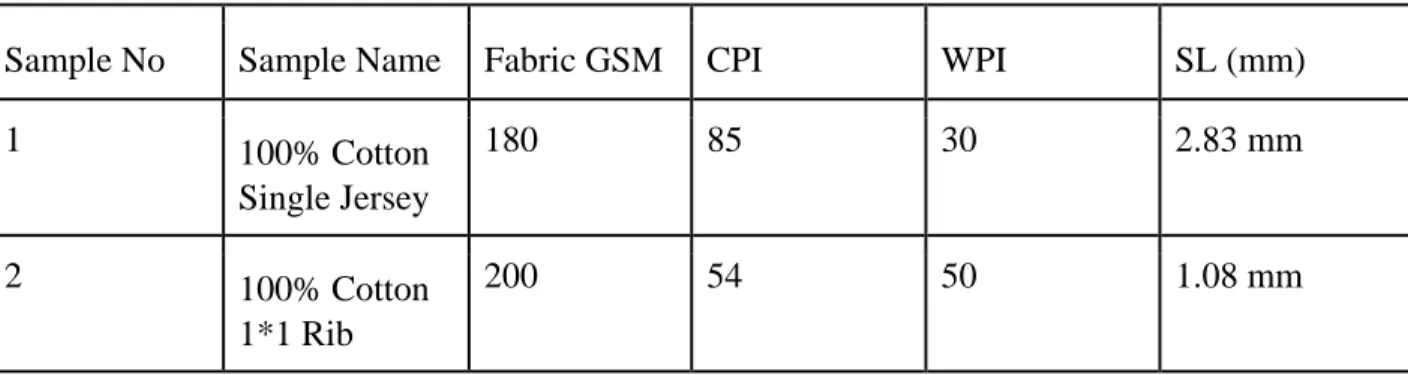
For this research we took 3 grey fabric samples. Specification of these samples is mentioned in Table 3.1
Table 3.1: Sample specification.
Sample No Sample Name Fabric GSM CPI WPI SL (mm)
1 100% Cotton
Single Jersey
180 85 30 2.83 mm
2 100% Cotton
1*1 Rib
200 54 50 1.08 mm
C
HAPTER-3METHODOLOGY
“©Daffodil International University” 22
3 100% Cotton
Interlock
300 94 72 1.30 mm
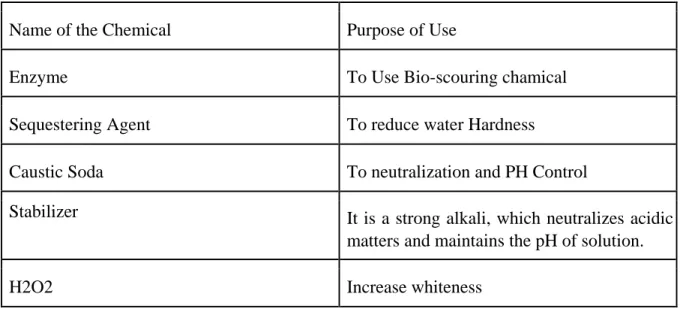
For this research we have been following chemical use. About details of the chemicals used are mentioned in Table 3.2.
Table 3.2: Types of chemicals used in the research.
Name of the Chemical Purpose of Use
Enzyme To Use Bio-scouring chamical
Sequestering Agent To reduce water Hardness
Caustic Soda To neutralization and PH Control
Stabilizer It is a strong alkali, which neutralizes acidic matters and maintains the pH of solution.
H2O2 Increase whiteness
3.2 Methods
3.2.1 Methods of bio-scouring
Firstly, we tend to delineate the collected samples into three baths in wherever 3 samples are treated singly with the addition of surfactant, pectinase accelerator and emulsion for 30 min, 45 min, 60 min, severally. The amounts of chemicals were taken within the weight of the sample with the assistance of liquor quantitative relation.
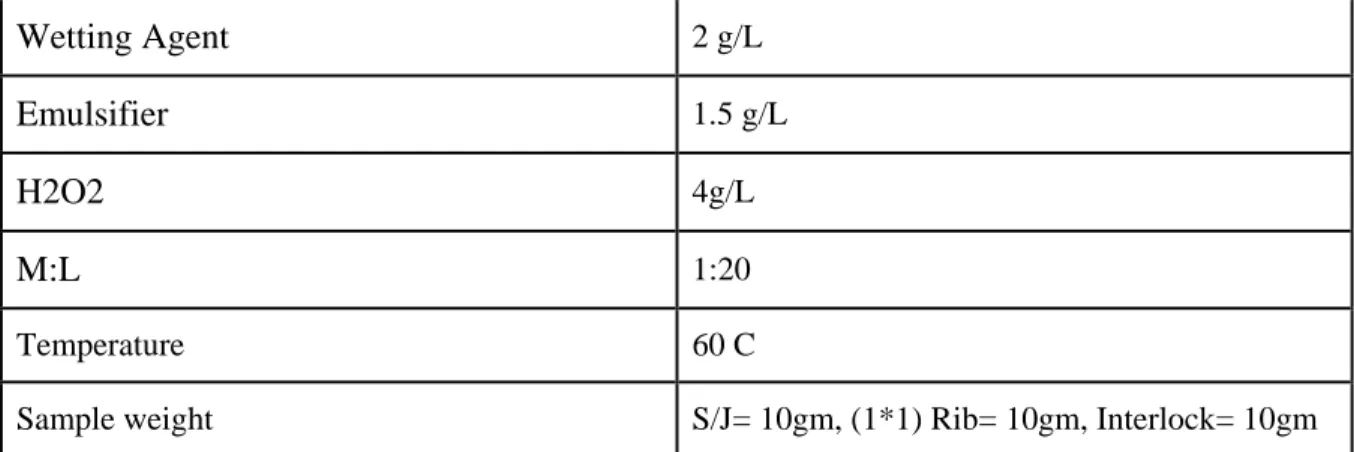
However, we tend to maintain specific time, temperature and pH throughout bio-scouring of material samples. The on top of parameters are the unit mentioned in Table 3.3.
Table 3.3: Bio-scouring & bleaching Recipe:
Particular Recipe
Enzyme 4 gL
Sequestering Agent 1.5 g/L
“©Daffodil International University” 23
Wetting Agent 2 g/L
Emulsifier 1.5 g/L
H2O2 4g/L
M:L 1:20
Temperature 60 C
Sample weight S/J= 10gm, (1*1) Rib= 10gm, Interlock= 10gm
In our investigation we used the apparatus mentioned in Table 3.4.
Table 3.4: Apparatus used in the research
SL. No Name of the Apparatus
1 Gas Burner
2 PH- Paper
3 Electronic Balance
4 Beaker
5 Glass rod
6 Thermometer
7 Tripod Stand
8 Padder M/c
3.2.2 Bio-scouring & Bleaching process
Recipe of bio-scouring process
The weight of 30 gm fabric from three samples (each sample contains 10 gm) have taken for bioscouring & bleaching by using the following recipe:
Enzyme : 4 g/l
Sequestering Agent:: 1.5 g/L
“©Daffodil International University” 24
Wetting Agent: 2 g/L Emulsifier : 1.5 g/L H2O2 : 4 g/L M:L : 1:20
Temperature: 60⁰C Time: 30, 45, and 60 mis.
pH: 6
Fabric weight:30gm (S/J =10+Rib =10 + Interlock =10gm).
Calculation For S/J:
Fabric weight = 10 gm
M:L = 1:20
Total liquor = (20×10) = 200 ml Enzyme= (4×200)/ (1000) =0.8 g/L
Sequestering Agent=(1.5x 200)/1000=0.3 g/L Wetting Agent =(2x200)/(1000)= 0.4 g/L H2O2= (4x200)/(1000)=0.8 g/L
Emulsifier=(1.5x200)/(1000)=0.3 g/L
For 1*1 Rid:
Fabric weight = 10 gm
M:L = 1:20
Total liquor = (20×10) = 200 ml
Enzyme= (4×200)/ (1000) =0.8 g/L
“©Daffodil International University” 25
Sequestering Agent=(1.5x 200)/1000=0.3 g/L
Wetting Agent =(2x200)/(1000)= 0.4 g/L
H2O2= (4x200)/(1000)=0.8 g/L
Emulsifier=(1.5x200)/(1000)=0.3 g/L
For Interlock:
Fabric weight = 10 gm
M:L = 1:20
Total liquor = (20×10) = 200 ml
Enzyme= (4×200)/ (1000) =0.8 g/L
Sequestering Agent=(1.5x 200)/1000=0.3 g/L
Wetting Agent =(2x200)/(1000)= 0.4 g/L
H2O2= (4x200)/(1000)=0.8 g/L
Emulsifier=(1.5x200)/(1000)=0.3 g/L
Process curve:
“©Daffodil International University” 26
Procedure
✓At first we took samples and calculated chemicals amount from recipe.
✓ Then we prepared three baths for three types of sample
✓ Then samples and chemicals were taken in the bath at room temperature.
✓ After raising the temperature at 60⁰C, we kept the samples in the bath for 30, 45, and 60 mins.
✓ Then we took the sample from the bath and washed it with water which is normal temperature.
✓ Then the samples were dried.
3.3 Method of Evaluation
“©Daffodil International University” 27
3.3.1 Determination of fabric weight loss%
During Bio-scouring, fabrics lose a remarkable quantity of oil, waxes, and fat. To take away impurities from textile merchandise, so merchandise loses some weight. The Bioscouring impact cab was evaluated to support this weight loss of fiber. This weight loss is calculated from the distinction of treated and untreated sample weight. Then it regenerates into share.
we have a tendency to take the burden of unscoured samples eroded. Then the burden leader determined.
3.3.2 WPI (Wales Per Inch)
The which means of WPI is wales per in.. it's a really abundant vital parameter for knitted fabric. to work out WPI, we tend to take the sample and mark it one in. consistent with wales wise. Then we tend to count WPI of material with magnifying numeration glass and determine the share in WPI.
3.3.3 GSM (Gram Per Square Meter)
The mean of GSM is Gram per square meter. It's a really vital parameter for fabric. To work out GSM, we tend to take the sample and Cut it with a GSM cutter and measure it with electrical balance. Then we tend to determine the share in GSM.
3.3.4 CPI (Course Per Inch)
The which means of CPI is Course per in.. it's a really vital parameter for fabric. to work out CPI, we tend to take the sample and mark it one in. consistent with course wise. Then we tend to count CPI of material magnifying numeration glass and determine the share in CPI.
3.3.5 SL (Stitch Length)
“©Daffodil International University” 28
The means of foreign terrorist organization is sew Length. It's a really vital parameter for fabric. it's the length of yarn in an exceedingly unwoven loop. To work out foreign terrorist organizations, we tend to take the sample and mark it one in. consistent with course and wales wise. At the moment we tend to take one course from one in. sample and measured that course by activity scale and so determined no. of wales in one in. of samples. Then we tend to get the sew length by victimization the formula and also the formula is that the length of the one course divided by the full no. of wales in one in. of samples.
3.4 Absorbency
a)Test Immersion
b)Test Drop
c)Test Wicking test
3.4.1 Immersion
For this take a look at, 1st we tend to take a (1×1) cm scoured (Bio-scouring) sample and place the sample gently on the surface of the water. Then we tend to record the time in seconds by the timer for submersion the sample into water.
3.4.2 Drop Test
Test For this take a look at, 1st we tend to take an eroded sample. Then we tend to ready 0.1% direct dye red solution. At the moment we tend to drop a drop on the material. At that point, we tend to record the time, whenever the drop is completely absorbed.
3.4.3 Wicking test
For this take a look at we tend to take a scoured sample that was (18×5) cm to immerse into a beaker of 0.1% direct dye red resolution during which one in. The bottom portion is
“©Daffodil International University” 29
immersed for five minutes. After five minutes we tend to measure the lordotic length.
Between 30-50 millimeter may be a customary dipped length.
SAMPLE ATTACHMENT
“©Daffodil International University” 30
SAMPLE ATTACHMENT
Sample before and after bio-scouring & Bleaching
“©Daffodil International University” 31
SAMPLE ATTACHMENT
Sample before and after bio-scouring & Bleaching
Single
Fabric
Jersey
“©Daffodil International University” 32
Before bio-scouring
& bleaching After 30 bio-scouring bleaching
minutes
&
After 45 min
bioscouring bleaching After 60 min bio- scouring &
bleaching
1x1 Rib
Before bio-scouring &
bleaching
After 30 minutes bio-scouring &
bleaching
After 45 min bioscouring bleaching
After 60 min bio- scouring &
bleaching
Interlock
Before bio-scouring
& bleaching
After 30 bio-scouring bleaching
minutes
&
After 45 min bio- scouring &
bleaching
After 60 min bio- scouring &
bleaching
Samples for drop test
“©Daffodil International University” 33
Single jersey fabric
Before bio-scouring
& bleaching After 30 minutes bio- scouring &
bleaching
After 45 min bio- scouring &
bleaching
After 60 min bio- scouring &
bleaching
1x1 Rib
Before bio-scouring
& bleaching After 30 bio-scouring bleaching
minutes
&
After 45 min
bioscouring bleaching After 60 min bio- scouring &
bleaching
Interlock
Before bio-scouring
& bleaching After 30 bio-scouring bleaching
minutes
&
After 45 min bioscouring bleaching
After 60 min bioscouring bleaching
“©Daffodil International University” 34
Samples for wicking length test
Single
Fabric
Jersey
Before bio-scouring
& bleaching After 30 bio-scouring bleaching
minutes
&
After 45 min
bioscouring bleaching After 60 min bio- scouring &
bleaching
1x1 Rib Fabric
Before bio-scouring &
bleaching After 30 minutes bio-scouring &
bleaching
After 45 min
bioscouring bleaching After 60 min bio- scouring &
bleaching
Interlock Fabric
Before bio-scouring &
bleaching After 30 minutes bio-scouring &
bleaching
After 45 min
bioscouring bleaching After 60 min bio- scouring &
bleaching
“©Daffodil International University” 35
4.1Change in WPI of fabric after bio-scouring & bleaching process
C
HAPTER-4DISCUSSION OF RESULTS
“©Daffodil International University” 36
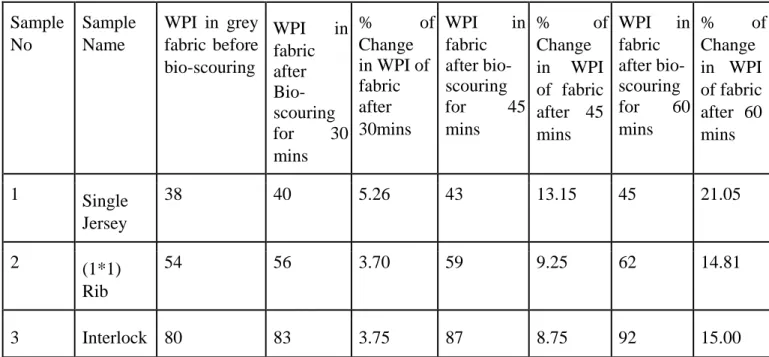
The change in WPI of fabric once bio-scouring method, completely different continuance is recorded within the Appendix-A1. Once, a bio-scouring method amendment in WPI of fabric in numerous times has been wont to draw the subsequent Figure 4.1.
The diagram has been drawn for the half of amendment in WPI of material underneath completely different stages of your time. During this diagram, you look after the everchanging worth of WPI is indicated vertically that is on the Y axis and completely different stages of your time worth is indicated horizontally that is on the X axis. for various stages of your time, the half of WPI worth of material additionally changes. If we have a tendency to increase the time then WPI of material additionally increases. as a result of dirt, dirt, oil off from cloth once bio-scouring. From this diagram we are able to see that for single jersey fabric, once 30 minutes of bio-scouring as to whether amendment in WPI of material is incredibly very little, once 45 minutes of bio-scouring you look after WPI increase a bit additional, . however after 60minutes of bio-scouring there's an additional slight increase another way of amendment in WPI. From this diagram we are able to see that for 1*1 rib fabric, once 30 minutes of bio-scouring you look after amendment in WPI is incredibly very little, once 45 minutes of bio-scouring WPI increase a bit additional, once however after 60 minutes of bio-scouring there's an additional slight increase another way of amendment in WPI. From this diagram we are able to see that for Interlock fabric, once 30 minutes of bio-scouring you look after amendment in WPI is incredibly very little, once 45 minutes of bio-scouring WPI increase a bit additional, . however 60 minutes hr of bio- scouring there's an additional slight increase another way of amendment in WPI. Finally, from the diagram we are able to see that,amendment in WPI of clothes materials after 60
“©Daffodil International University” 37
minutes of bioscouring is beyond alternative time stages and at this stage Single jersey fabric you look after amendment in WPI will increase beyond alternative materials.
4.2 Change in CPI of fabric after bio-scouring & bleaching process
The change in CPI of fabric when bio-scouring method, totally different note value is recorded within the Appendix-A2. when bio-scouring method amendment in CPI of fabric in numerous times has been wont to draw the subsequent Figure 4.2.
The diagram has been drawn for the % in CPI of fabric underneath completely different stages of your time. During this diagram, you look after the dynamical price of CPI is indicated vertically that is on the Y axis and completely different stages of your time price are indicated horizontally that are on the X axis. for various stages of your time, the half of the CPI price of cloth additionally changes. If we tend to increase the time then the CPI of fabric additionally increases. as a result of dirt, dirt, oil and spectral color area units aloof from cloth when bio-scouring and bleaching. From this diagram we will see that for single jersey fabric, after 30 minutes of bio-scouring as to whether amendment in CPI of fabric is extremely very little, when 45 minutes of bio-scouring you look after CPI increase a bit a lot of, however when 60 minutes of bio-scouring there's an extra slight increase another way of amendment in CPI. From this diagram we will see that for 1*1 rib fabric, after 30 minutes of bio-scouring you look after amendment in CPI is extremely very little, when 45 minutes of bio-scouring CPI increase a bit a lot of, however when 60 minutes of bio- scouring there's an extra slight increase another way of amendment in CPI
“©Daffodil International University” 38
From this diagram we will see that for Interlock fabric, after 30 minutes of bio-scouring you look after amendment in CPI is extremely very little, when 45 minutes of bioscouring CPI increase a bit a lot of, however when 60 minutes of bio-scouring there's an extra slight increase another way of amendment in CPI. Finally, from the diagram we will see that, you look when amendment in CPI of materials after 60 minutes of bioscouring is over different time stages and at this stage 1*1 rib fabric you look after amendment in CPI will increase over different materials and single jersey fabric you look after amendment in CPI is less than different stages of your time.
4.3 Change in GSM of fabric after bio-scouring & bleaching process
.
The change in GSM of fabric after bio-scouring method, completely different note value is recorded within the Appendix-A3. after bio-scouring method amendment in GSM of fabric in several time has been wont to draw the subsequent Figure 4.3
The diagram has been drawn for the 1/2 of change in GSM of material below totally different st