VEGETABLE FARMERS’ KNOWLEDGE ON BENEFICIAL EFFECT OF BOTANICAL PESTICIDES FOR
CONTROLLING PEST
SANDIP BISWAS
DEPARTMENT OF AGRICULTURAL EXTENSION &
INFORMATION SYSTEM
SHER-E-BANGLA AGRICULTURAL UNIVERSITY
DHAKA-1207
JUNE, 2020
VEGETABLE FARMERS’ KNOWLEDGE ON BENEFICIAL EFFECT OF BOTANICAL PESTICIDES FOR CONTROLLING PEST
BY
SANDIP BISWAS Reg. No. 13-05326
A thesis
Submitted to the Faculty of Agriculture Sher-e-Bangla Agricultural University, Dhaka In partial fulfillment of the requirements for the degree of
MASTER OF SCIENCE (MS)
IN
AGRICULTURAL EXTENSION
SEMESTER: JANUARY-JUNE, 2020
APPROVED BY:
(M. Zahidul Haque) Supervisor
Professor
Dept. of Agril. Ext. and Info. System Sher-e-Bangla Agricultural University
(Dr. Muhammad Humayun Kabir) Co-Supervisor
Professor
Dept. of Agril. Ext. and Info. System Sher-e-Bangla Agricultural University
Prof. Dr. Muhammad Humayun Kabir Chairman
Examination Committee
Dept. of Agricultural Extension and Information System Sher-e-Bangla Agricultural University
Department of Agricultural Extension and Information System Sher-e-Bangla Agricultural University Sher-e-Bangla Nagar, Dhaka-1207, Bangladesh
CERTIFICATE
This is to certify that the thesis entitled “VEGETABLE FARMERS’
KNOWLEDGE ON BENEFICIAL EFFECT OF BOTANICAL PESTICIDES FOR CONTROLLING PEST” submitted to the department of Agricultural Extension and Information System, Faculty of Agriculture, Sher-e- Bangla Agricultural University, Sher-e-Bangla Nagar, Dhaka in partial fulfillment of the requirements for the degree of Master of Science (M.S.) in Agricultural Extension, embodies the result of a piece of bona fide research work carried out by SANDIP BISWAS, Registration No. 13-05326 under my supervision and guidance. No part of the thesis has been submitted for any other degree or diploma.
I further certify that any help or source of information, as has been availed of during the course of this investigation has been duly acknowledged by the Author.
Dated:……
Dhaka,Bangladesh
Prof. M. Zahidul Haque Supervisor
Department of Agricultural Extensionand InformationSystem
Sher-e-Bangla Agricultural University Sher-e-Bangla Nagar, Dhaka-1207
DEDICATED TO
MY BELOVED
PARENTS
ACKNOWLEDGEMENT
All praises are due to Almighty God, the Great, Gracious and Merciful, Whose blessings enabled the author to complete this research work successfully. Guidance, help and co-operation have been received from several persons or authority during the tenure of the study, the author is grateful to them all who made a contribution to this research work. Although it is not possible to mention all by names it will be an act of ungratefulness if some names are not mentioned here for their immense contribution to the accomplishment of this study.
In particular, the author takes the opportunity to express his deepest sense of gratitude his honorable Supervisor Professor M. Zahidul Haque, Department of Agricultural Extension and Information System, Sher-e-Bangla Agricultural University, Dhaka for his continuous inspiration, valuable suggestions, constructive criticism, constant guidance and intensive supervision through the period of the study and preparation of this thesis without his intense co-operation this work would not have been possible.
The author deems proud privilege to extend his extreme gratefulness and best regards to his venerable Co-supervisor and Chairman Prof. Dr. Muhammad Humayun Kabir, Department of Agricultural Extension and Information System,
Sher-e-Bangla Agricultural University, Dhaka for her keen interest, valuable advice, creative suggestions, co-operation and encouragement to bring this thesis up to its present standard.
It is also a great pleasure for the author to express hearty appreciation and regard to all teachers of Department of Agricultural Extension and Information System, Sher-e-Bangla Agricultural University, Dhaka for their affectionate feelings and valuable suggestions during the research work.
The author deeply acknowledges the cooperation and sincere help of Upazila Agriculture Officer, Agriculture Extension Officer of Gopalgonj Sadar. The author
also expresses his heartfelt gratitude to the respondents of the study area who patiently provided the information during the interview with the author.
The author expresses his grateful thanks to all staff and employees of the Department of Agricultural Extension and Information System, Sher-e-Bangla Agricultural University, Dhaka for their co-operation and encouragement to prepare this thesis.
Finally yet importantly, the author expresses his deepest sense of gratitude, indebtedness and profound respect to his beloved mother, uncles, brothers, sister, relatives and friends for their blessings, encouragement and moral support in all phases of this academic pursuit from beginning to the end.
The Author
LIST OF CONTENTS
TITLE Page
ACKNOWLEDGEMENT i-ii
TABLE OF CONTENTS iii-v
LIST OF TABLES vi
LIST OF FIGURES vi
LIST OF APPENDICES Vii
ABBREVIATIONS Vii
ABSTRACT viii
CHAPTER I INTRODUCTION 1-7
1.1 General Background of the Study 1
1.2 Statement of the Problem 2
1.3 Specific Objectives 3
1.4 Justification of the Study 4
1.5 Scope of the Study 4
1.6 Assumptions of the Study 5
1.7 Limitations of the Study 5
1.8 Definition of Terms 6
CHAPTER II REVIEW OF LITERATURE 8-22
2.1 Concept of Knowledge 8
2.2 Farmers' Knowledge in Vegetable Cultivation 9 2.3 Literatures Related to Relationships between Selected
Characteristics of the Farmers and Knowledge 12
2.3.1 Age and knowledge 12
2.3.2 Education and knowledge 13
2.3.3 Farm size and knowledge 14
2.3.4 Annual income and knowledge 16
2.3.5 Training received and knowledge 17
2.3.6 Extension contact and knowledge 18
2.3.7 Organizational participation and knowledge 21 2.3.8 Time spends in vegetable farming and knowledge 21
2.3.9 Cosmopoliteness and knowledge 21
2.4 Conceptual Framework of the study 21
CHAPTER III METHODOLOGY 23-31
3.1 Locale of the Study 23
3.2 Population and Sampling Design 23
3.3 Instrument Development 24
3.4 Variables of the Study 24
3.5 Measurement of the Independent and Dependent Variable 25 3.5.1 Measurement of the independent variables 25
3.5.1.1 Age 25
3.5.1.2 Education 25
3.5.1.3 Farm size 25
3.5.1.4 Annual family income from cultivation 26
3.5.1.5 Training on pest control 27
3.5.1.6 Extension media contact 27
3.5.1.7 Organizational participation 27
3.5.1.8 Time spend in vegetables farming 28
3.5.1.9 Cosmopoliteness 28
3.5.2 Measurement of dependent variable 28
3.6 Statement of the Hypotheses 30
3.6.1 Research hypotheses 30
3.6.2 Null hypotheses 30
3.7 Data Processing 30
3.7.1 Editing 30
3.7.2 Coding and tabulation 30
3.7.3 Categorization of data 31
3.8 Data collection 31
3.9 Statistical Analysis 31
CHAPTER IV RESULTS AND DISCUSSION 32-44
4.1 Selected Characteristics of the Farmers’ 32
4.1.1 Age 33
4.1.2 Education 34
4.1.3 Farm size 34
4.1.4 Annual income from cultivation 35
4.1.5 Training on pest control 35
4.1.6 Extension contact 36
4.1.7 Organizational participation 37
4.1.8 Time spends in vegetable farming 37
4.1.9 Cosmopoliteness 38
4.2 Knowledge on beneficial effect of botanical pesticides
for controlling pest in vegetable cultivation 39 4.3
The Contribution of the selected characteristics of the respondents to their knowledge on beneficial effect of botanical pesticides for controlling pest in vegetable cultivation
39 4.3.1
Significant contribution of cosmopoliteness to the farmers’ knowledge on beneficial effect on botanical
pesticides for controlling pest in vegetable cultivation 41 4.3.2
Significant contribution of training on pest control to the farmers’ knowledge on beneficial effect of botanical pesticides for controlling pest in vegetable cultivation
42 4.3.3
Significant contribution of education to the farmers’
knowledge on beneficial effect of botanical pesticides for controlling pest in vegetable cultivation
42 4.3.4
Significant contribution of extension media contact to the farmers’ knowledge on beneficial effect on botanical pesticides for controlling pest in vegetable cultivation
43
CHAPTER V SUMMARY OF FINDINGS, CONCLUSIONS AND RECOMMENDATIONS
45-49
5.1 Summary of the Findings 45
5.1.1 Selected characteristics of the farmers 45 5.1.2 Knowledge on beneficial effect on botanical pesticides
for pest control 46
5.1.3 Result of hypothesis testing 46
5.2 Conclusions 46
5.3 Recommendations 47
5.3.1 Recommendations for policy implications 47
5.3.2 Recommendations for the further study 48
REFERENCES 50-55
APPENDIX 56-60
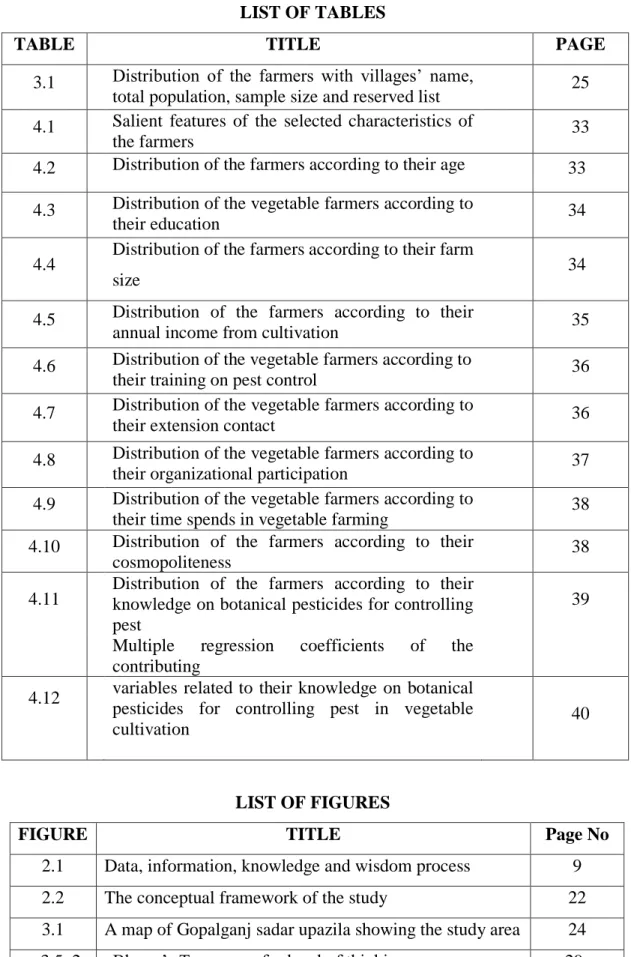
LIST OF TABLES
LIST OF FIGURES
FIGURE TITLE Page No
2.1 Data, information, knowledge and wisdom process 9
2.2 The conceptual framework of the study 22
3.1 A map of Gopalganj sadar upazila showing the study area 24 3.5 .2 Bloom’s Taxonomy for level of thinking 29
TABLE TITLE PAGE
3.1 Distribution of the farmers with villages’ name,
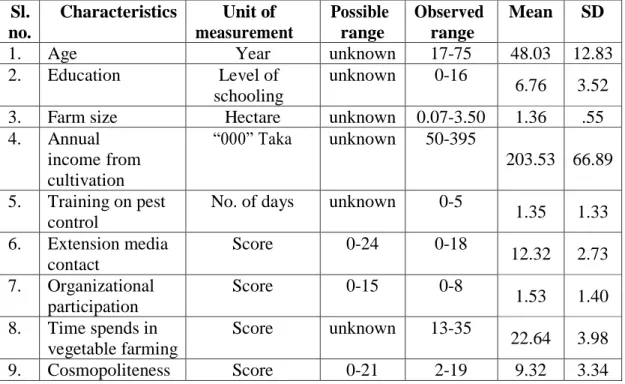
total population, sample size and reserved list 25 4.1 Salient features of the selected characteristics of
the farmers 33
4.2 Distribution of the farmers according to their age 33 4.3 Distribution of the vegetable farmers according to
their education 34
4.4 Distribution of the farmers according to their farm
size 34
4.5 Distribution of the farmers according to their
annual income from cultivation 35
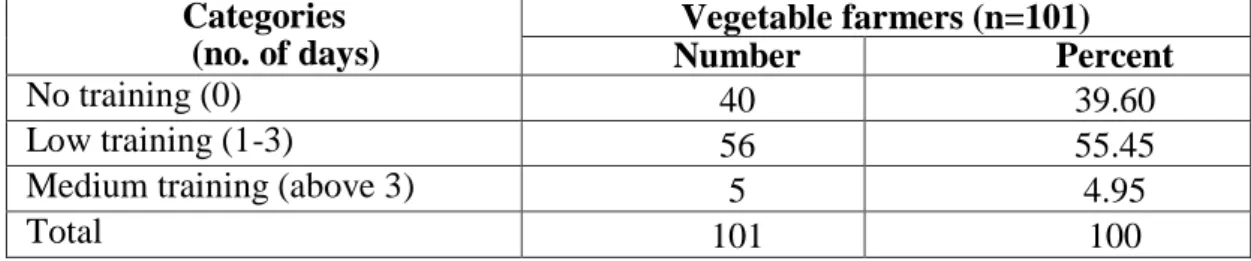
4.6 Distribution of the vegetable farmers according to
their training on pest control 36
4.7 Distribution of the vegetable farmers according to
their extension contact 36
4.8 Distribution of the vegetable farmers according to
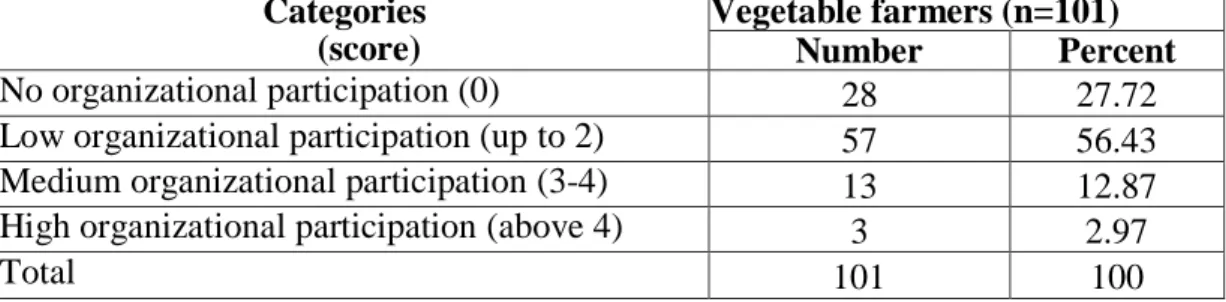
their organizational participation 37
4.9 Distribution of the vegetable farmers according to
their time spends in vegetable farming 38
4.10 Distribution of the farmers according to their
cosmopoliteness 38
4.11 Distribution of the farmers according to their knowledge on botanical pesticides for controlling pest
39 Multiple regression coefficients of the
contributing
4.12 variables related to their knowledge on botanical pesticides for controlling pest in vegetable
cultivation 40
LIST OF APPENDICES
APPENDIX TITLE Page No
APPENDIX-I
An English Version of the Interview Schedule on Vegetable farmer’s knowledge on beneficial effect of botanical pesticides for controlling pest”
56
ABBREVIATIONS
GDP Gross Domestic Product
BBS Bangladesh Bureau of Statistics H.S.C Higher Secondary Certificate S.S.C Secondary School Certificate UAO Upazila Agriculture Officer
BRRI Bangladesh Rice Research Institute VEOs Village Extensions Officer's
HYV High Yielding Varieties IPM Integrated Pest Management
DAE Department of Agricultural Extension SPPS Strengthening Plant Protection Services FAO Food and Agriculture Organization SAU Sher-e-Bangla Agricultural University SPSS Statistical Product and Service Solutions SAAO Sub-Assistant Agriculture Officer HRDP Hypothetical Reference Digital Path INFS Nutrition survey of Bangladesh
FYM Farm Yard Manure
VEGETABLE FARMERS’ KNOWLEDGE ON BENEFICIAL EFFECT OF BOTANICAL PESTICIDES FOR CONTROLLING PEST
SANDIP BISWAS
ABSTRACT
The objectives of this study were to describe the socio-economic characteristics of the respondents, to determine the extent of vegetable farmers’ knowledge on beneficial effect on botanical pesticides for controlling pest ; and to find out the contribution of selected characteristics of the farmers to their knowledge on beneficial effect of botanical pesticides for controlling pest in vegetable cultivation. The study was conducted with randomly selected 101 farmers in Raghunathpur union under Gopalgonj Sadar upazila of Gopalgonj district. A pre-tested interview schedule was used to collect data from the respondents during 1 January to 30 January, 2020. Farmer’s knowledge on beneficial effect of botanical pesticides for controlling pest was the dependent variable and it was measured on the basis of knowledge scores. Nine selected characteristics of the respondents considered as the independent variables of the study.
For this study, regression analysis was performed to major the contribution of independent variables on dependent variable . Majority (64.36 percent) of the respondents had medium knowledge on beneficial effect of botanical pesticides for controlling pest in vegetable cultivation. Four characteristics of the farmers i.e.
education,training on pest control ,extension contact and cosmopoliteness had the significant positive contribution with their knowledge on botanical pesticides for pest control. Rest five characteristics i.e. age, farm size, annual income from cultivation, organizational participation and time spends in vegetable farming had no significant contribution with their knowledge on beneficial effect of botanical pesticides for controlling pest.
CHAPTER-I INTRODUCTION
1.1 General Background of the Study
Bangladesh is an agro-based country. Most of the farmers cultivate vegetable besides other crops all the year round. Vegetables are cultivated in 4.22 percent of the total cultivatable land. Besides this, the premises of houses, tin sheds and roof tops are used for vegetable cultivation. Vegetable production has increased five times in the past 40 years. Bangladesh has scored 3rd in global vegetable production, next to China and India (FAO, 2017). The farmers are getting large amount of money from vegetable production which is changing their life (Hossain, 2017). Near about 90% of the pest infestation occurs during vegetable cultivation. In Bangladesh, vegetables are grown generally in summer and winter seasons.
Vegetables are also good source of vitamins and minerals. Nutrition survey of Bangladesh (INFS, 2013) reported that average intake meet only 80 percent of Calorie, 58 percent of Vitamin A, 50 percent of Riboflavin and 51 percent of Vitamin C requirements. The Production of vegetables in Bangladesh is not sufficient that per capita/day available is hardly 32 gm whereas the requirement is estimated to 220 gm.
This gap is probably one of the main reasons for widespread malnutrition in the country (HRDP, 2013).
Being a overpopulated nation with limited territory , it is difficult to overcome such a big malnutrition problem by eating fish, meat, egg, butter, ghee. But problems related to malnutrition can easily be overcome by eating adequate quantity of vegetables, which require some adjustment in the dietary habit and also by increasing per yield of vegetable (Mahasin, 1996). However, to increase vegetable production, farmers face various problems including pest infestation.
Pest infestation is the major problem in vegetable cultivation. Near about 90% of the pest infestation occurs during vegetable cultivation. The farmers of Bangladesh are mostly dependent on pesticides in the endeavor to control the pests. At present different kinds of pesticides with thousands of trade names have been registered in Bangladesh and use of pesticides is not only expensive but also leads to negative environmental
consequences. In addition, use of pesticide increase health hazards to the growers and consumers of crop products. It helps to develop pest resistance to insecticides, destroys beneficial insects and imbalances the natural position between the pests and their natural enemies which lead to the increase in the population of the target pests and even creates new pest problems. To avoid such consequences and to increase the crop production at the same time, a viable alternative is needed to pest management.
Botanical pesticides are the best alternative strategy for pest management. Botanical pesticides are not a new practice in Bangladesh and it was started in 1981 on a small- scale basis. By inter country programme, FAO gave same thrust on botanical pesticides in 1989. Based on the success of FAO’s inter country programme, two botanical pesticides and Strengthening Plant Protection Services(SPPS) project started in 1996 and 1997 respectively. Both the projects were implemented by the Department of Agricultural Extension (DAE) (Roy, 2009). Agricultural development and sustainability are very much linked to maintaining a healthy agricultural environment, ecological balance, sound environment and sustainable agriculture. It should be maintained for the better future and to maintain sustainable agriculture botanical pesticides should be implemented with collaboration of other related organizations.
Botanical pest control method is a broad ecological approach to pest control using various pest control methods in a compatible manner; that is why botanical pesticides is a holistic approach to pest control keeping sound environment. To maintain ecological balance, sound human and animal health, increasing farm output and farmers’ income on a sustainable basis, botanical pesticides is considered as good practices. Botanical pesticides are better than conventional method in social and environmental aspect but what about economic aspect is not known. Therefore, there is a need to conduct a study on knowledge on beneficial effect of botanical pesticides for controlling pest in vegetable cultivation.
1.2 Statement of the Problem
At present, there are three methods or approaches followed in vegetable cultivation.
Those are conventional farming system, IPM and organic. Organic vegetable cultivation is sound in environmental aspect but have limitation to gain desire production. In a country like Bangladesh where there is no compromise with
production, organic method is not good. Therefore, majority of the farmers cultivate vegetable by following either conventional method or biological pesticides practices.
In conventional technique of vegetable cultivation, farmers are only use pesticides to control pest. So, in this regard the cost of production becomes high. Benefit obtained from this very lower than other techniques. In botanical pesticides are only used when there are no alternatives. Therefore, cost for pesticides is relatively lower than conventional system. However, there may be question arise regarding gaining yield as well as profitability in botanical pesticides system. In this regard, following questions should be answered through investigation.
I. What are the characteristics of the farmers cultivate vegetable with or without botanical pesticides for controlling pest?
II. To what extent the farmers had knowledge on beneficial effect of botanical pesticides for controlling pest in vegetable cultivation?
III. What are the factors that significantly influence vegetable farmer’s knowledge on beneficial effect of botanical pesticides for controlling pest in vegetable cultivation?
1.3 Specific Objectives
The specific objectives of the study:
1. To describe the socio-economic characteristics of the respondents.
These are:
Age
Education
Farm size
Annual income from cultivation,
Training on pest control,
Extension media contact,
Organizational participation
Time spends in vegetable farm
Cosmopoliteness
2. To determine the extent of knowledge on beneficial effect of botanical pesticides for controlling pest in vegetable cultivation; and
3. To find out the contribution of selected characteristics of the farmers to their knowledge on the effect of botanical pesticides for controlling pest in vegetable cultivation.
1.4 Justification of the Study
There are a number of studies have been conducted on vegetable cultivation and pesticides application. Many of them based on botanical pesticides application by the vegetable grower. Some of them focused on farmers’ attitude towards effect of pesticide application. In one hand controlling pest from vegetable can be done through only the use of chemical method. On the other hand, pest can be control by using of botanical pesticides . The debate is which one is better for economic and environmental aspects.
To get answer, there is a need to conduct study on farmers’ knowledge on using botanical pesticides for controlling pest in vegetable cultivation. So, this is an urgent need to undertake a study on this perspective. The investigator believes that the findings are likely to be helpful to develop at sound policy for the environment friendly agricultural research and extension system of the country.
1.5 Scope of the Study
The present study was designed to have an understanding of farmers’ knowledge on using botanical pesticides for controlling pest in vegetable cultivation and the characteristics that influence farmer’s knowledge. The findings of the study will fit to the areas of Bangladesh where physical, socio-economic, cultural and geographic condition do not differ much from those of the study area. Thus, the findings are expected to be useful to students, researchers, extension workers, and particularly for planners in formulating and designing the procedures for maintaining the natural balance. The findings may also be helpful to the field workers of different nation building departments to improve strategies of action to conform environment friendly sustainable production to the rural people. Lastly, the researcher believes that the findings and recommendations of this study will definitely lead to minimize the cost of production for vegetables and simultaneously reduce the risk of environmental damages.
1.6 Assumptions of the Study
An assumption has been defined as “the supposition that an apparent fact or principle is true in light of the available evidence” (Goode, 1945). An assumption is taken as a fact or belief to be true without proof. So the following assumptions were in mind of the researcher while carrying out this study:
i) The respondents included in the sample were capable of furnishing proper responses to the questions of the interview schedule.
ii) Views and opinions furnished by the respondents were the representative views and opinions of the whole population of the study.
iii) The responses furnished by the respondents were reliable and they truly expressed their opinions on farmers’ knowledge on using botanical pesticides for controlling pest in vegetable cultivation.
iv) The data collected by the researcher were free from bias.
v) The researcher who acted as the interviewer was well adjusted to the social and cultural environment of the study area. Hence, the respondents furnished their correct opinions without any hesitation.
vi) The respondents had almost similar background and seemed to be homogenous to a great extent.
vii) The information sought by the researcher revealed the real situation to satisfy the objectives of the study.
viii) The findings were useful in choosing the clients as well as for planning execution and evaluation the extension programme.
1.7 Limitations of the Study
The present study was undertaken to have an understanding of the farmers’ knowledge on beneficial effects of botanical pesticides for controlling pest in vegetable cultivation and to determine the contribution factors with selected characteristics of the farmers.
Considering the time, money and other necessary resources available to the researcher and to make the study manageable and meaningful from the point of view of research, it becomes necessary to impose certain limitations. The limitations were as follows:
i. The study was confined in one union of Gopalgonj Sadar upazila Under Gopalgonj district.
ii. The study was restricted within the farmers who had some cultivable land under their own cultivation.
iii. The population for the study was kept confined to the heads of the family who regularly cultivated their land.
iv. There were many characteristics of the farmers but in the study only 9 of them were selected for investigation.
v. For information about the study, the researcher depended on the data furnished by the selected respondents during their interview with him.
vi. Major information, facts and figures supplied by the respondents were applicable to the situation prevailing in the locality during the year 2019.
1.8 Definition of Terms
A researcher needs to know the meaning and contents of every term that he uses. It should clarify the issue as well as explain the fact to the investigator and readers.
However, for clarity of understanding, a number of key concepts/terms frequently used throughout the study defined are interpreted as follows:
Age: Age was defined as the period of a respondent from his/her birth to the time of interview. It was measured in terms of years.
Education: Empirically it was defined to the development of desirable changes in knowledge, skill and attitudes in an individual through reading, writing, walking, observation and other selected activities. It was measured on the basis of classes a farmer has passed from a formal educational institution.
Farm size: Farm size meant the total area of land on which a farmer's family carried on farming operations in terms of full benefit to the family.
Annual income from cultivation: Income from cultivation of a respondent was defined in taka annually earned by cultivation.
Training on pest control: Training of a respondent was referred by the number of days a respondent trained on pest control. The measurement included from the day of starting training on pest control and till the day of data collection
Extension contact: These terms referred to an individual’s access to or contact to the communication media and sources being used for dispersion of new technologies among farmers.
Organizational participation
Organization participation of an individual refers to his participation in various organizations as ordinary member, executive committee member or executive officer within a specified period of time.
Cosmopoliteness
Cosmopoliteness refers to the degree to which an individual was oriented external to his own social system.
Knowledge: Knowledge is operationally defined for the purpose of this investigation as ‘those behaviors and test situations, which emphasized on the remembering either by recognition or recall of ideas, material or phenomenon’. It referred to the amount of understood information possessed by the farmers on various aspects of beneficial effect of botanical pesticides for controlling pest in vegetable cultivation.
CHAPTER II
REVIEW OF LITERATURE
This chapter deals with the review of past researches related to this investigation. The reviews are conveniently presented based on the major objectives of the study. In spite of sincere effort, adequate numbers of directly related literature were not readily available for this study. However, the literatures of available studies have been briefly discussed in this chapter.
2.1 Concept of Knowledge
Knowledge can be defined as the ‘understanding obtained through the process of experience or appropriate study’. Knowledge can also be an accumulation of facts, procedural rules, or heuristics. Here-
A fact is generally a statement representing truth about a subject matter or domain.
A procedural rule is a rule that describes a sequence of actions
A heuristic is a rule of thumb based on years of experience
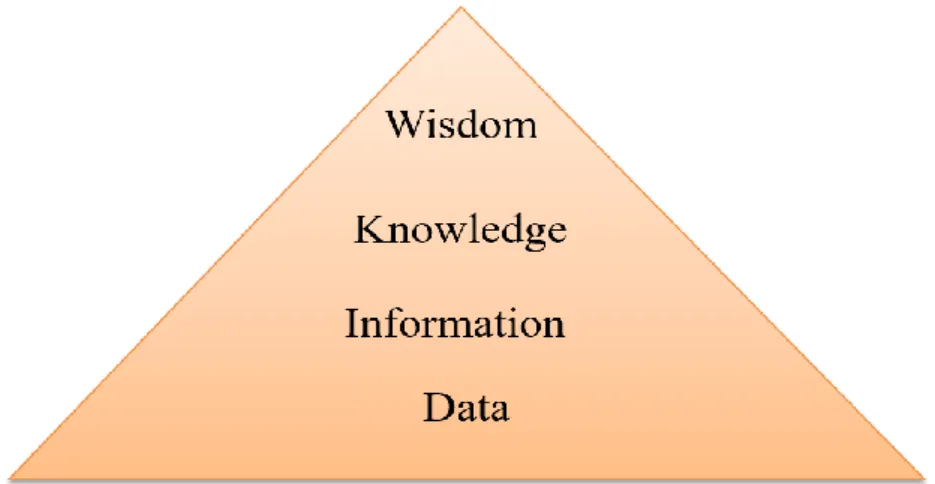
Knowledge is the result of some activity such as generation, storage, dissemination and utilization of something that entails either information or data. It is usually based on learning, thinking, and proper understanding of the problem area. It is not information and information is not data. Knowledge is derived from information in the same way information is derived from data when processed or patterned in human mind. It can be considered as the integration of human mind. It can be considered as the integration of human perceptive processes that helps them to draw meaningful conclusions.
So when a pattern relation exists among the data and information, the pattern has the potential to represent knowledge. It only becomes knowledge, however, when one is able to realize and understand the patterns and their implications.
Figure 2.1 Data, information, knowledge and wisdom process (Azad, 2014) 2.2 Farmers' Knowledge in Vegetable Cultivation
Knowledge recalls or recognizes information, ideas and principles in the approximate form, which were learned previously (Huitt, W. 2004). Bhuiyan (2012) indicated that
“knowledge may be defined as the scientific fact of an idea which is experimentally or empirically verified.”
Boudreau (1995) indicated “human faculty resulting from interpreted information;
understanding that germinates from combination of data, information, experience, and individual interpretation. Variously defined as, Things that are held to be true in a given context and that drive us to action if there were no impediments."
Khan (2005) studied on knowledge of maize cultivation and found that majority (68 percent) of the farmers had relatively low level of knowledge and 32 percent of the farmers possessed relatively high level of knowledge.
Rahman (2004) found in his study that the highest proportion (62.22 percent) of the respondents had medium knowledge compared to 25.56 percent having low knowledge and only 12.22 percent had high knowledge on HYV boro rice cultivation practices.
Hussen (2001) found in his study on farmers‟ knowledge and adoption of modern sugarcane cultivation practices found that highest proportion (84 percent) of the farmers possessed medium knowledge, 13 percent high knowledge and lowest proportion (3
percent) possessed low knowledge.
Hossain (2000) study on farmers’ knowledge and perception of Binadhan-6. His study at 4 selected upazilas of Sherpur distinct reported that majority of the farmers (62%) had medium knowledge while, 21% had low knowledge and the rest 14% possessed high knowledge on Binadhan-6.
Saha (2001) made an attempt on farmers’ knowledge on improved practices of pineapple cultivation and found that the majority (62 percent) of the farmers possessed good knowledge, 33 percent poor knowledge and only 5 percent possessed excellent knowledge.
Khan (1996) conducted a research on the effectiveness of a farmer primers‟ on growing rice in knowledge change of the farmers in Shaktipur Thana and found that 67 percent farmers had good knowledge at initial stage, where 21 percent had excellent knowledge and 12 percent had poor knowledge.
Nurzaman (2000) conducted a study on knowledge, attitude and practices of FFS and non-FFS farmers in respect of IPM. His study at sadar upazilla under Mymensingh district revealed that the FFS farmers had a significant higher knowledge on IPM than the non-FFS farmers.
Parveen (1995) in her study found that 58 percent of the farm women had moderate knowledge while 35 percent had high and 7 percent had poor knowledge on the use of fertilizer, pesticides and irrigation water.
Rashid (1998) reported that the total value of vegetables produced in Bangladesh is around Tk. 19400 million, calculated at average retail price. About 70% of the vegetables pass through the marketing channels. If the spoilage is 10%, the loss comes to Tk. 1,462 millions. These losses are due to inadequate knowledge on harvesting, carrying, packaging, transport and storage techniques. In the vegetable marketing channels, traders suffer maximum losses, because they handle and transport more quantities from one place to another than any other intermediaries.
Islam (2007) studied on famers‟ knowledge on ecological practices and found that majority (68 percent) of the farmers possessed medium knowledge compared to 23
percent had high knowledge and only 9 percent low knowledge on ecological agriculture.
Hossain (2001) found in his study on knowledge gained by the participation farmers under crop cultivation programme of care in a selected area of Mymensingh district that majority of the farmers (35 percent) had medium knowledge of crop cultivation, while 32 percent had low knowledge and the rest 33 percent possessed high knowledge of crop cultivation.
Reddy and Devi (1984) found that allied agriculture activities (the activities jointly done by husband and wife) were mostly performed by the woman of high and medium economic categories as compared to those of low economic category. There was no significant difference between role expectation of husbands and the role performance of rural woman. It was observed that majority of rural women belonged to the high and medium economic categories did not go out for to farm operations. The study further revealed that farm women of low economic category participated much in farm operations, on the other hand, farm women of high and medium economic categories participated to a great extent in allied farm operations.
Shalaby (1991) revealed that woman engaged in gardening to supplement incomes and to provide food for the family. Almost 30% of the farmers did not buy vegetables from the market, and claimed to be to tally self-sufficient in theseproducts.
Safilios et al. (1989) reported that household production was in the hands of women.
The major tasks and decisions regarding homestead crops and spices were the responsibility of the women in all except the large farm households.
Islam and Ahmed (1987) found that landless, marginal and small farm households concentrated primarily on vegetable and spice cultivation, large and medium farm households cultivated more often fruit and timber trees.
Review of studies exploring relationship between independent variables and their knowledge on of exploring vegetable production program. Age and the extent of vegetable production
Soemarwote and Conway (1991) reported that in Java, the home gardening had a greater diversity of production and frequently produced a higher net income.
2.3 Literatures Related to Relationships between Selected Characteristics of the Farmers and Knowledge
2.3.1 Age and knowledge
Islam et al. (2019) concluded that age of the farmers had no significant relationship with their knowledge on climate change effects in agriculture.
Rahman (2006) found in his study that age of the farmers had a significant and negative relationship with their knowledge on prawn culture. Similar results were observed by Sarker (2002), Kashem (1987), Hansara and Chopra (1986) in their respective studies.
Roy (2006) found in his study that age of the farmers had no significant relationship with their knowledge on boro rice cultivation. Similar results were observed by Khan (2005), Islam (2005) and Rahman (2004) in their respective studies.
Akhter (2003) found in his study that the age of the farmers had no significant relationship with their knowledge on agricultural activities.
Saha (2003) found no relationship between poultry farmers’ age and their knowledge on poultry production.
Sana (2003) found in his study there was no relationship of age with their knowledge in shrimp farming.
Sarker (2002) conducted a study on farmer's knowledge of and attitude towards BRRI Dhan 29 variety of rice and found that the age of the farmers was not related to farmer's knowledge on BRRI Dhan 29
Saha (2001) made an attempt on farmer's knowledge on improved practices of pineapple cultivation and found that the age of the farmers had no significant relationship with their knowledge on improved practices of pineapple cultivation.
Rahman (2001) conducted a study to determine the knowledge, attitude and adoption of the farmers regarding Alok 6201 hybrid rice. He found that age of the farmers was not related to farmer's knowledge on Alok 6201 hybrid rice.
Hossain (2000) in his study found that age of the farmer's had no significant relationship with their knowledge on Binadhan-6 technology.
Rayaparaddy and Jayaranaiah (1989) worked on Village Extensions Officer's (VEOs) knowledge of rice production technology, and found that age of the VEOs showed negative relationship with the knowledge level of VEOs.
Chandargi (1980) found that there was significant association between age and knowledge gain as a result of training. Mundhua and Patel (1987) found that the farmer's age and their level of knowledge had a significant relationship.
2.3.2 Education and knowledge
Islam et al. (2019) concluded that education of the farmers had no significant relationship with their knowledge on climate change effects in agriculture.
Nasrin et al. (2019) concluded that education of the farmers had positive significant relationship with their knowledge on pesticide application in vegetable cultivation.
Rahman (2006) observed in his study that education level of the farmers had significant and positive relationship with their knowledge on prawn culture.
Roy (2005) in his study found that education level of the farmers had significant and positive relationship with their knowledge on boro rice cultivation.
Islam (2005) in his study explored that education level of the farmers had significant positive relationship with their knowledge on IPM in crop production.
Rahman (2004) in a study found that level of education of the farmers had significant and positive relationship with their knowledge on boro rice cultivation.
Hossain (2003) found that with increased level of education of the farmers, there was a
corresponding increase in the knowledge level of modern Boro rice farmers.
Akhter (2003) found in his study that level of education of the farmers had a significant and positive relationship with their knowledge on agricultural activities.
Saha (2003) found among the six independent variables, only education was positively and significantly related at 0.01 level of probability with poultry farming knowledge.
Sana (2003) found that education of the shrimp farmers were found to be significantly related with the knowledge of shrimp culture.
Sarker (2002) conducted a research on farmer's knowledge of and attitude towards BRRI Dhan 29 variety of rice and found that education of the respondents had positively relationship with their knowledge of BRRI Dhan29.
Saha (2001) found that the education of the farmers had a positive significant relationship with their knowledge on improved practices of pineapple cultivation.
Hossain (2000) found that the education of the respondents had significant positive relationship with their knowledge on Binadhan-6
2.3.3 Farm size and knowledge
Islam et al. (2019) concluded that farm size of the farmers had no significant relationship with their Knowledge on climate change effects in agriculture.
Nasrin et al. (2019) concluded that farm size of the farmers had no significant relationship with their knowledge on pesticide application in vegetable cultivation.
Sana (2003) found in his research that he was no relationship of farm size with their knowledge in shrimp culture.
Sarker (2002) also found that there was a positive relationship between farm size of the farmers and their knowledge of BRRI Dhan 29.
Hossain (2001) in his study found that farm size of the farmers was significantly related to farmer's knowledge of crop cultivation.
Hossain (2000) found that farm size of the farmers had no relationship with their knowledge of Binadhan-6.
Rahman (2006) examined in his study that farm size of the farmers had a significant relationship with knowledge on prawn culture.
Islam (2005) in his study explored that farm size of the farmers had significant positive relationship with their knowledge on IPM in crop production.
Khan (2005) determined that farm size of the respondent had no significant relationship with their knowledge on maize cultivation.
Hossain (2003) reported that the farm size of the respondents had positive and significant relationship with their knowledge on modern Boro rice at 0.05 level of probability.
Farhad (2003) found that farm size of rural women farmer had a positive significant relationship with their knowledge in using IPM in vegetable cultivation.
Sana (2003) reported that farm size of the shrimp cultivators had no relationship with their knowledge of shrimp culture.
Sutradhar (2002) found that farm size of the respondents had a significant positive relationship with their awareness on environmental degradation.
Hanif (2000) found that there was a negative insignificant relationship between farm size of the respondents and their awareness on environmental pollution.
Hossain (2000) found that farm size of the farmers had no relationship with their knowledge on Binadhan-6.
2.3.4 Annual income and knowledge
Islam et al. (2019) concluded that annual family income of the farmers had no significant relationship with their Knowledge on climate change effects in agriculture.
Nasrin et al. (2019) concluded that annual family income of the farmers had no significant relationship with their knowledge on pesticide application in vegetable cultivation.
Ali (1984) also found that income of the contact and non-contact farmers differed significantly. He also found that income of the contact and non-contact farmers had significantly positive contribution to both of their agricultural knowledge and adoption of innovations.
Hossain (2003) found that income of the rural woman farmers had negative relationships with their knowledge of modern Boro ricecultivation.
Nurzaman (2000) found that incomes of the rural women farmers had no relationships with their knowledge of the FFS and non-FFS farmers.
Islam (2008) found that annual income had a positive and substantial significant relationship with knowledge on vegetables production activities by woman members in homestead area under world vision project.
Chowdhury (2010) found that annual income had a significant positive relationship with knowledge on maize cultivation in five selected villages of Shibalaya Upazila under Manikgonj District.
Hossain (2003) found that the annual income of the respondents had positive and significant relationship with their knowledge on modern Boro rice cultivation practices.
Farhad (2003) found that annual income of the rural women farmer had significant positive relationship with their knowledge in using IPM in vegetable cultivation.
Sutradhar (2002) revealed that annual family income of the respondents had a significant positive relationship with their awareness on environmental degradation.
Uddin (2001) reported that annual income of the BSs had no significant relationship with their opinion on environmental hazards and associated problems due to continuous and intensive rice farming.
Hanif (2000) found that in his study there was a negative insignificant relationship between annual income of the respondents and their awareness on environmental pollution.
Hossain (1999) found that family income of the farmers had significant positive relationships with their perception on environmental degradation.
Ali and Anwar (1987) categorized farmers as low, medium and high on the basis of their problem confrontation score. Sixty one percent of the respondents were under medium problem confrontation categories, 39 percent were under high problem confrontation categories and no respondent was under low problem sericulture, mushroom culture and fruit preservation might generate extra employment opportunities for the farm women specially female rural youth and gradually they will proceed to these operations.
2.3.5 Training received and knowledge
Islam et al. (2019) concluded that training received of the farmers had positive significant relationship with their Knowledge on climate change effects in agriculture.
Nasrin et al. (2019) concluded that training received of the farmers had positive significant relationship with their knowledge on pesticide application in vegetable cultivation.
Sana (2003) found that training received of the farmers had a positive significant relationship with their knowledge in shrimp culture.
Hossain (2001) found that the length of the training of the respondents had positive relationship with their knowledge of crop cultivation.
Mannan (2001) in his study found that the training received by the farmers had a positive significant relationship with their knowledge on food and nutrition.
Islam (2008) found that training on vegetable cultivation had a positive and substantial significant relationship with knowledge on vegetables production activities by woman members in homestead area under world vision project.
Sana (2003) found that training received of the farmers had a positive significant relationship with their knowledge in shrimp culture.
Hossain (2001) found that the length of the training of the respondents had positive relationship with their knowledge of crop cultivation.
Mannan (2001) in his study found that the training received by the farmers had a positive significant relationship with their knowledge on food and nutrition.
2.3.6 Extension contact and knowledge
Islam et al. (2019) concluded that extension media contact of the farmers had positive significant relationship with their knowledge on climate change effects in agriculture.
Nasrin et al. (2019)concluded that extension media contact of the farmers had positive significant relationship with their knowledge on pesticide application in vegetable cultivation.
Sana (2003), Sarker (2002) and Rahman (2001) found in their study that media exposure of farmers were highly positive significant relationships with their knowledge.
Hossain (2000) concluded that media exposure of the farmers had a significant relationship with their knowledge.
Ahmed (1974) found that here was a significant positive relationship between extension contact of the farmers and their agricultural knowledge.
Ali (1984) found that contact and non-contact farmers differed significantly in respect of their media exposure. He observed that media exposure of the contact and non- contact farmers had significant contribution towards their agricultural knowledge.
Kaur (1988) found that extension contact and mass media exposure had significant influence upon opinion and level of knowledge of selected programme of rural women.
Rahman (1995) study on farmers’ knowledge on improved practices of potato cultivation by the farmers of Kajipur upazilla of Sirajgonj district. The study indicated a significant relationship between extension contact of farmers and their knowledge on improved practices of potato cultivation.
Hossain (2000) concluded that media exposure of the farmers had a significant relationship with their knowledge of Binadhan-6.
Venugopal (1977) found that there was a significant association between the overall knowledge of agricultural extension officers in respect of rice cultivation and type of training received by them.
The findings of the study of Manjunatha (1980) revealed that the trained farmers had higher knowledge level and adopting behaviour compared to untrained farmers.
Sana (2003), Sarker (2002) and Rahman (2001) found in their study that media exposure of farmers were highly positive significant relationships with their knowledge.
Vidyashankar (1987) in his study found that the contact with extension agencies had contribute favorably to the attitude of the farmers.
Bezbora (1980) studied adoption of improved agricultural technology by the farmers of Assam. The study indicated a positive relationship between extension contact and adoption of improved agricultural technology.
2.3.7 Organizational participation and knowledge
Islam et al. (2019) concluded that organizational participation of the farmers had positive significant relationship with their Knowledge on climate change effects in agriculture.
Nasrin et al. (2019)concluded that organizational participation of the farmers had no significant relationship with their knowledge on pesticide application in vegetable cultivation.
Ahmad (1974) concluded that there is a relationship between organizational participation of farmers and their agricultural knowledge.
Alam (1997) fond that organizational participation of the rice farmers had no significant relationship with their use of improved farm practices in rice cultivation.
Ali (1984) found that organizational participation of contact and non-contact farmers had significant positive contribution to their agricultural knowledge.
Hamid (1995) found a positive significant relationship between organizational participation of the farmers and their awareness on environmental pollution.
Hoque (1984) concluded that organizational participation of the farmers had a significant relationship with the adoption of improved practices in sugarcane cultivation.
Hossain (1991) reported that organizational participation had a significant and positive relation with the adoption of improved farm practices in wheat cultivation.
2.3.8 Time spends in vegetable farming and knowledge
Nasrin et al. (2019) concluded that time spend in vegetable cultivation of the farmers had no significant relationship with their knowledge on pesticide application in vegetable cultivation.
2.3.9 Cosmopoliteness and knowledge
Islam et al. (2019) concluded that cosmopoliteness of the farmers had positive significant relationship with their knowledge on climate change effects in agriculture.
Hossain (2000) concluded that cosmopoliteness of the farmers had no significant relationship with their knowledge and perception of Binadhan-6 in the boro season.
Hussen (2001) concluded that cosmopoliteness of the farmers had positive significant relationship with their knowledge and adoption of modern sugarcane cultivation practices.
2.4 Conceptual Framework of the Study
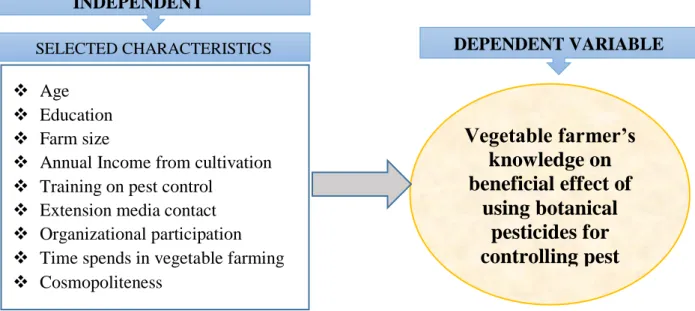
In scientific research, selection and measurement of variables constitute on important task. The hypothesis of a research while constructed properly contains at least two important elements i.e. a dependent variable and an independent variable. A dependent variable in that factor which appears, disappears or varies on the researcher introduces, removes or varies as the independent variables. An independent variable is that factor which is manipulated by the researcher in this attempt to ascertain its relationship to an observed phenomenon. A simple conceptual framework for the study is shown in Figure 2.2.
Figure 2.2. The conceptual framework of the study
Age
Education
Farm size
Annual Income from cultivation
Training on pest control
Extension media contact
Organizational participation
Time spends in vegetable farming
Cosmopoliteness
Vegetable farmer’s knowledge on beneficial effect of
using botanical pesticides for controlling pest
DEPENDENT VARIABLE INDEPENDENT
VARIABLES
SELECTED CHARACTERISTICS
CHAPTER-III METHODOLOGY
The researcher took proper care in using appropriate techniques for data gathering throughout the study. Methodology deserves a very careful consideration in scientific research; Methodology should be such as would enable the researcher to collect valid and reliable information and to analyze that information to arrive at correct decisions.
The principal method used in this study was survey. A semi structured (interview schedule having both closed and open-ended questions were used to collect needed information.
3.1 Locale of the study
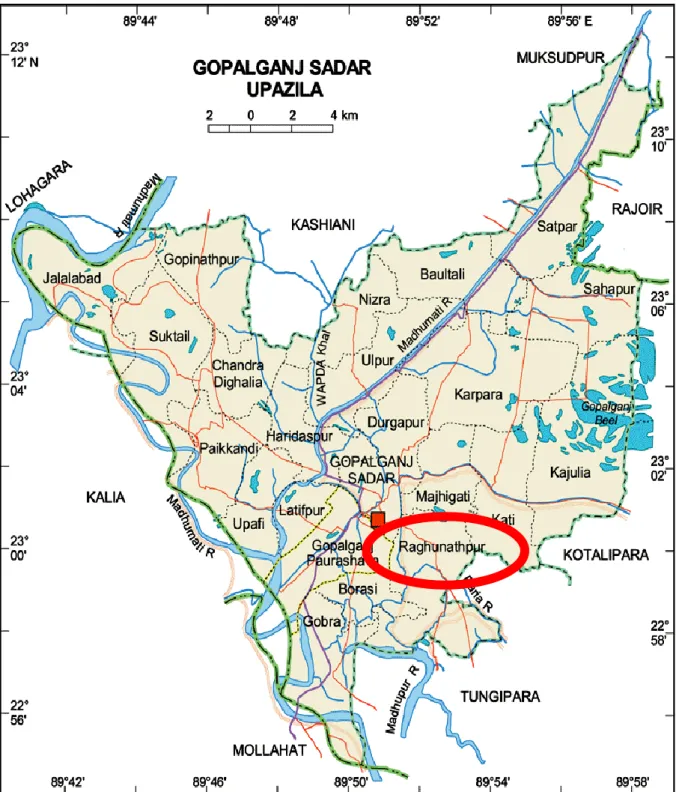
The study was conducted in five villages of Raghunathpur union in Gopalgonj Sadar upazila Under Gopalgonj district. Gopalganj Sadar is located at 23.0167°N 89.8333°E . It has 51, 630 households and a total area of 391.35 km² .Gopalganj sadar is the main town of Gopalgonj District. There are 15 banks, including 3 commercial banks.It may take 5 hours to reach by road from the capital city (depending on traffic). After the Liberation War Gopalgonj Sadar become 'Pourashava'. The area of the town is 46.88 km². The town has a population of 85, 398; male 51.07%, female 46.93%. The density of population is 6874 per km². The literacy rate among the town people is 75.1%. The selected area plays an important role in cultivation and marketing of vegetables in the local markets , that is why the researcher have identified the area for his purposive research .The location of the study villages is shown in figure 3.1.
3.2 Population and Sampling Design
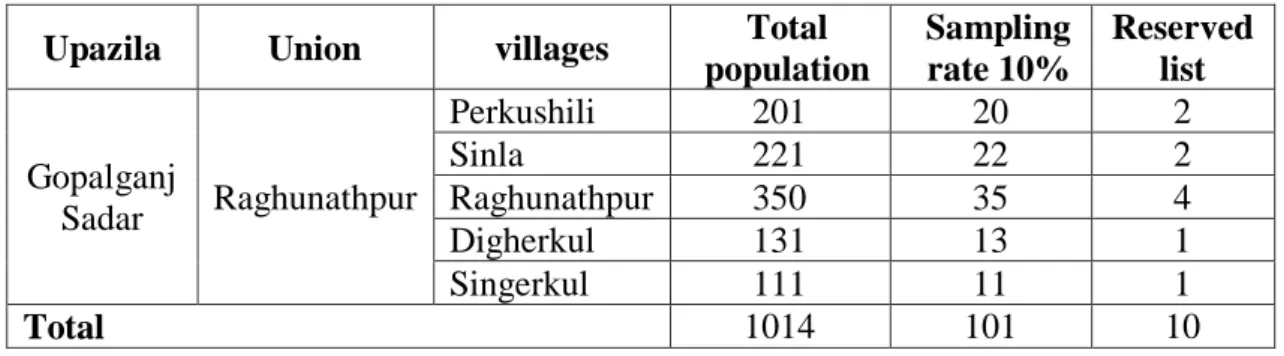
Five villages of the whole union were selected out for purposive sampling. The researcher collected five list of vegetable cultivars for selecting the population of the study .Updated lists of all the vegetables growers of the selected 5 villages were collected with the help of Upazila Agriculture Officer (UAO) of Gopalgonj Sadar upazila. The total numbers of farmers were1014. Sampling rate was 10% and the respondents were selected through, simple random sampling technique. Thus 101farmers were chosen to conduct the study. The distribution of selected respondents is shown inTable 3.1.
Figure 3.1: A map of Gopalganj sadar upazila showing the study area
Table 3.1 Distribution of the farmers with villages’ name, total population, sample size and reserved list
Upazila Union villages Total
population
Sampling rate 10%
Reserved list Gopalganj
Sadar Raghunathpur
Perkushili 201 20 2
Sinla 221 22 2
Raghunathpur 350 35 4
Digherkul 131 13 1
Singerkul 111 11 1
Total 1014 101 10
3.3 Instrument Development
Keeping the objectives of the study in mind an interview schedule was carefully designed to collect the required information from the farmers
3.4 Variables of the Study
In descriptive survey research, the selection and measurement of the variables constitute important tasks. A Research hypothesis contains at least two important elements, an independent variable and a dependent variable. The independent variable is the factor that is manipulated by the experimenter to ascertain its relationships to an observed phenomenon. A dependent variable is the factor that appears, disappears, or varies as the independent variable varies (Townsed, 1953).The independent variables of this study were: age, education, farm size, annual income, income from cultivation, training on pest control, extension media contact, organizational participation, time spends in vegetable farming and cosmopoliteness. The dependent variable was farmer’s knowledge on beneficial effect of using botanical pesticides for controlling pest.
3.5 Measurement of the Independent and Dependent Variable
In order to conduct the study in accordance with the objectives it was necessary to measure the selected variables. The procedures followed in measuring the variables are described below.
3.5.1 Measurement of the independent variables 3.5.1.1 Age
Age of the rural respondents was determined by the number of years from their date of birth to the date of interview. One score was assigned for each and every complete year of their age. Since many respondents usually do not keep record of their date of birth, the age mentioned by them seems to be on estimation or guess. However, based on the available information of respondents’ age, they were categorized into following:
Young-the respondents are considered young age ranged from 17 to 35 years; medium- 36 to 50 years; old-if she completed the age of above 50 years. One score was assigned for each and every complete year of respondent’s age.
3.5.1.2 Education
Level of education was measured as the ability of an in individual respondent to read and write or the formal education received up to a certain standard. If a respondent did not attain formal education, his score was assigned as zero (0). A score of 0.5 was given to a respondent who only could sign his/her name. A score of one (1) was assigned for each year of schooling. If a respondent passed the S.S.C examination, his education score was given as 10, 12 for H.S.C., and so on. This variable appears in item number 2 in the interview schedule as presented in Appendix-I.
3.5.1.3 Farm size
Farm size was measured by using the following formula:
FS= A+B+1/2 (C+D) +E Where,
FS= Farm size
A= Homestead area (Including pond) B= Own land under own cultivation C= Land given to others as borga D= Land taken from others as borga E= Land taken from others as lease
According to farm size of the respondents were categorized like land less (home stead area only), marginal (0.02-0.20 ha), small (0.20-1.00 ha), medium (1.00-2.5 ha) and large (3 ha and above) (BBS, 2001).
3.5.1.4 Annual family income from cultivation
Annual income of the respondents was measured in taka on the basis of total yearly earning from cultivation of her family. Yearly earning from cultivation was added to calculate the actual amount of annual income of the respondents. It was expressed in
‘000’ taka.
3.5.1.5 Training on pest control
Training on pest control was measured by total number of days of agricultural training received by the respondents` farmer in his/her life. One score was assigned for each day of training received by the respondent. According to training received the respondents`
farmer were categorized as no training, low training and medium training.
3.5.1.6 Extension media contact
The extension media contact of a respondent was measured on the basis of the response of the media contact user farmers against the extent of his using of selected six media by putting tick mark against any one of the five responses- regularly, often, occasionally, rarely, not at all. The responses were scored as 4, 3, 2, 1 and 0 respectively. The use of extension media contact score of the respondents ranged from 0 to 24 where, 0 indicates no use and 24 indicates very high use. Based on their extension media contact, the respondents were classified into three categories as low contact, medium contact, and high contact. This variable appears in item number 6 in the interview schedule as presented in Appendix-I.
3.5.1.7 Organizational participation
Organizational participation of a respondent was measured by computing an organizational participation score according to his/her nature and duration of participation in five (5) selected different organizations up to the time of interview. The organisational participation score was evaluated for each respondent on the basis of his/her membership with those organisations. The following scale was used for computing the organisational participation score. The nature of participation was no participation, participation as ordinary member, participation as executive member and participation as secretary/president. The score was 0, 1, 2 and 3 respectively.
Organisational participation score of a respondent was determined by adding together the scores obtained from each of the five types of participation. Organisational
participation score of the respondents could range from 0 to 15, where, 0 indicating no participation and 15 indicating high participation. This variable appears in item number 7 in the interview schedule as presented in Appendix-I.
3.5.1.8 Time spend in vegetables farming
Time spend in vegetable cultivation by the vegetables growers was measured by total hours per week. This variable appears in item number 8 in the interview schedule as presented in Appendix-I.
3.5.1.9 Cosmopoliteness
Cosmopoliteness of a respondent was measured in terms of his nature of visits to the seven (7) different places external to his own social system. The cosmopoliteness of a respondent was measured by computing cosmopoliteness score on the basis of his/her visits with 7 selected cosmopoliteness. Respondents mentioned the nature on his/her visits by putting a tick mark against any one of 4 responses, not at all, rarely, occasionally and regularly. The score for each respondent was determined by his/her response to all the items on the basis of his/her frequency of visits with a score of 0, 1, 2 and 3 respectively. The cosmopoliteness score of the respondents could range from 0 to 21, where, 0 indicates low cosmopoliteness and 21 indicates high cosmopoliteness.
This variable appears in item number 9 in the interview schedule as presented in Appendix-I.
3.5.2 Measurement of dependent variables
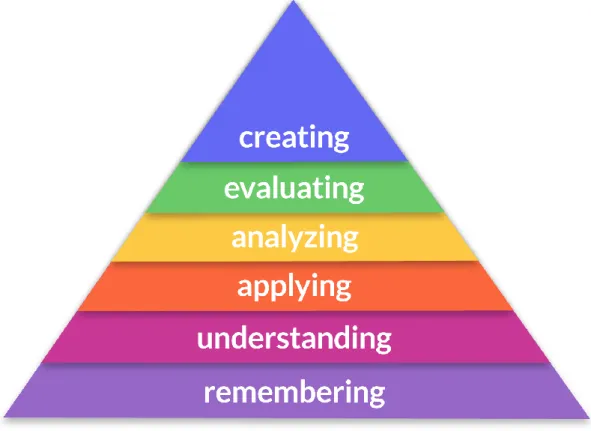
Knowledge refers to the ability of a respondent to recall or recognize items of information related to anything. Knowledge on beneficial effect of botanical pesticides for controlling pest in vegetable cultivation was the dependent variable of the study. It was measured based on Knowledge on beneficial effect of botanical pesticides for controlling pest in vegetable cultivation. The knowledge on beneficial effect of botanical pesticides for controlling pest in vegetable cultivation was determined by computing a knowledge score based on the responses against 12 questions on beneficial effect of botanical pesticides for controlling pest in vegetable cultivation. These questions were developed under the concept of Blooms Taxonomy to define and distinguish different levels cognition of respondents . The Bloom's Taxonomy helped the researcher to distinguish between Higher Order Thinking Skills (HOTS) and Lower
order Thinking Skills(LOTS) of the respondents . At the lowest level respondents just remembered the information, then understanding, then applications, then analysis, Evaluation and at highest level it is creation of knowledge. This helped the researcher in forming strategies for delivering the content. From each components of Blooms Taxonomy a pair of question were developed . Each of the question carried a full weight of 2 (two). For correct answer respondents was given full marks. If a respondent was totally unable to provide the answer then he or she got zero marks. At the same time , partially correct answer to the questions were given partial score between 0-2 .Thus, knowledge score of a farmer could range from 0 to 24, where ‘0’ indicated very low knowledge and 24 indicated highest level of knowledge on beneficial effect of botanical pesticides for controlling pest in vegetable cultivation.
Figure 3.5.2: Bloom’s Taxonomy for level of thinking assumption (Bloom et all;
1957)
3.6 Statement of the Hypotheses
As defined by Goode and Hatt (1952) a hypothesis is “a proposition which can be put to test to determine its validity. It may seem contrary to, or in accord with common sense. It may prove to be correct or incorrect. In any event, however, it leads to an empirical test.”
3.6.1 Research hypotheses
In the light of the objectives of the study and variables selected, the following research hypotheses were formulated to test them in. The research hypotheses were stated in positive form, the hypotheses were as follows:
“Each of the selected characteristics of the farmers had contribution to their knowledge on beneficial effect of botanical pesticides for controlling pest in vegetable cultivation.”
3.6.2 Null hypotheses
In order to conduct statistical tests, the research hypotheses were converted to null form.
Hence, the null hypotheses were as follows: “Each of the selected characteristics of the farmers had no contribution to their knowledge on beneficial effect of botanical pesticides for controlling pest in vegetable cultivation.”
3.7 Data Processing 3.7.1 Editing
The collected raw data were examined thoroughly to detect errors and omissions. As a matter of fact the researcher made a careful scrutiny of the completed interview schedule to make sure that necessary data were entered as complete as possible and well arranged to facilitate coding and tabulation. Very minor mistakes were detected by doing this, which were corrected promptly.
3.7.2 Coding and tabulation
Having consulted with the research supervisor and co-supervisor, the investigator prepared a detailed coding plan. In case of qualitative data, suitable scoring techniques were followed by putting proper weight age against each of the traits to transform the data into quantitative forms. These were then tabulated in accordance with the objective of the study.