WOMEN'S REQUIREMENTS FOR CAPACITY BUILDING IN POST HARVEST ACTIVITES OF
I VEGETABLES
BY
Mohammad Abu Bakar Siddique Khan REGISTRATION NO. 00847
A Thesis Szthmitted to the Fc,cudn•
Slzer-e-/Jwigla Agricultural Universin', Dhaka.
in par ml fulfillment of/he requirc'uwnts fbi the degree of
MASTER OF SCIENCE EN
AGRICULTURAL EXTENSION AND INFORMATION SYSTEM SEMESTER: .JuIy-Dec, 2008.
- . Approved by:
i-/-
Md. Shadat Ulla . M./4 niduqhaqtie
Professor nressdc
Supervisor C'. visor
Prof. M. Z99iduI -laque Chatii man
Examination Committee
Department of Agricultural Extension and Information System Sher-e-Bangia Agricultural University
cEctrJcIcAqt
EThis is to certify that thesis entitled. "WOMEN'S REQUIREMENTS FOR CAPACITY BUILI)INC IN POST HARVEST ACTIVITES OF VEGEtABLES"
submitted to the Faculty of Agriculture. Sher-e-Bangla Agricultural University, l)haka in partial tblfillment of the requirements for the degree of Master of Science IN Agricultural Extension and information System, embodies the result of a piece of hona tide research work carried out by Md. Mohammad Abu Bakar Siddique Khan.
Registration No. 0047 under my supervision and guidance. No pan of the thesis has been submitted for any other degree or diploma.
I Further certify that such help or source of information, as has been availed of during the course of this investigation has been duly acknowledged.
Dated: (Prof. Md. Shadat Ulia)
Place: Dhaka, Bangladesh Supervisor
Dedicated
To
My Family
ACKNOWLEI)GEM ENTS
4// princes CIJiCI COfllj)liflit'il/S belong 10 il linight v ill/a/i /or helping the author in accomplish his research v/nc/v s,wcessfitTh.
The author wishe.v to express his (lee;) selLs-c of gratitude from the core 0//lear! to his einmeni research supervisor A.M. Shuiclat U/la. Pro/i'ssor. Department of .4 gncu/iura/
Lxtension and Itifonncitiwi s.ctei;m, Sher-e-Iiang/a Agricultural University, /)humka /hr his sincere ink rest, intel/c dual guidance ,s cholastic super vision. constructive criiictvmn. editing and cons&mit inspiration throughout the (C/il/Ie of the research work.
The author expresses his sincere appreciation. prqfounc/ sense of respect mid
immense indebtedness to respected co-supervisor Al Zahidul /Iaque. Professor anti Chairman. De;'arunent of Agricultural Extension and Information .S\'.vteni, Slier-c- Ilangla Agricullural University. Ohaka, for his constamii encouragement, cordial suggestions. constructive critic isms and va/nab/c ac/vice to complete the thestv.
The author also wislws to express sincere gratitude to other benevolent teachers of the department for their cordial he/p, inspiration, all soils of assistance and guidance not vim/v in this research but also in oilier academic matters while undertaking
CO it? WI'S (55 H.S.student
The author Lv deeply indebted and profoundly grak'fill to his parents and brother
fi,
their moral si.mpporl mimi scar if les.
I'?,zai/v. special thanks are extended to the i'omen vegetables grott'ers in the study area fOr rendering valuable help in collecting required infOrmation.
The Author
V
LIST OF CONTENTS
('IIAPIFSR LIEMS PAGE
ACKNOWLED(;EMENTS V
LIST OF CONTENTS VI
LIST OF TABLES X
LIST OF FIGURES Xl
LIST OF APPENDICES Xl
ABSTRACT XII
CHAPTER I
INTRODUCTION
1.1 General Background I
1.2 Statement of the Problem
,
31.3 Objectives olthe Study 4
1.4 justification cii the Study
L/"/
51.5 Scope of the Study
-
61.6 1 .irni Lalions of the Study 6
1.7 Assumptions of the Study 6
1.8 Statements of the Flypothesis 7
1.9 Definition of Important lerm
$
REVIEW OF LITERATURE 10
2.1 Reviews Related to Studies on Capacity Building of tO Women
2.2 Reviews Related to Studies on Women's Requirement 12 Assessment
2.3 Reviews Related to Studies on Post I larvest Issues of 13 Vegetables
2.4 Reviews on Relationship between Selected 14 Characteristics of \Vonien and their Capacity Building
2.3 The Conceptual Framework ol the Study 19
METHODOI .OGY 21
3.1 Locale of the Study 21
CHAPTER 2
CHAP1ER 3
CONTENTS (Contd.)
CHAPTER TITLE PAGE
3.2 Population and Sample of the Study 21
3.3 Variables of* the Study 2$
3.3.! Independent variables 24
3.3.2 Dependent variable 24
3.4 Measurement of Variables 24
3.4.1 Measurement of independent variables 25 3.4.2 Measurement of dependent variables 27 3.5 Measurement of Problem Confrontation 28 3.6 Preparation of Data Gathering instrument 29
3.7 Data Collection Procedure 29
3.8 Processing of Data 29
3.9 Categorization 30
3.10 Method of Data Analysis 30
CHAPTER 4
RESULTS AND DISC:USSION 3!
4.1 Characteristics of the Women 3 I
4.1.1 Age 31
4.1.2 Education 32
4.1.3 Dependency ratio of the family 33
4.1.4 Farm size 33
4.1.5 Annual family income 34
4.1.6 Decision making capacity 35
4.1.7 Training received 35
4.1.8 Credit received 36
4.1 .9 Knowledge on vegetable production 37
4.1.10 Use of post harvest technology 37
4.2 Women's Requirements for Capacily Building 38 4.2.1 Overall requirements for capacity building 38 4.2.2 Dimension-wise womens requirements for capacity 39
building
Vi'
CONTENTS (Gould.)
CHAPTER TITLE l'A(;E
4.3 Relationship between the Selected Characteristics 41 of the \'omen and their Extent of Requirements for
Capacity Building
4.3.1 Age and requirements for capacity building 42 4.3.2 Education arid requirements for capacity building 42 4.3.3 Dependency ratio of the larnily and requirements 43
for capacity building
4.3.4 Farm size and requirements for capacity building 43 4.3.5 Annual family income and requirements for 44
capacity building
4.3.6 Decision making capacity and requirements for 44 capacity building
4.3.7 Training received and requirements [hr capacity 45 building
4.3.8 Credit received and requirements Ihr capacity 45 building
4.3.9 Knowledge on vegetables production and 46 requirements for capacity building
4.3.10 Use of' post harvest technology and requirements 46 for capacity building
4.4 Problems confronted in Using Post I larvest 47 lechnologies of Vegetables
CIIAPIER 5
SUMMARY, CONCLUSIONS AND RECOMMENDATIONS 49
5.1 Summary of the Findings 49
5.1.1 Characteristics ofthe women 49
5.1.2 Requirements for capacity building 49 5.1.3 Relationship between the selected characteristics of 50
the beneficiaries and their poverty alleviation
5.1.4 Problems confronted in using post harvest 50 technologies of vegetables
5.2 Conclusions SI
5.3 Recommendations 52
5.3.1 Recommendations for policy implication 52 5.3.2 Recommendations for ftiture study 53
CONTEN1'S (Cont'd)
CHAPTER TITLE PAGE
REFERENCES 54
APPENDICES
58Jx
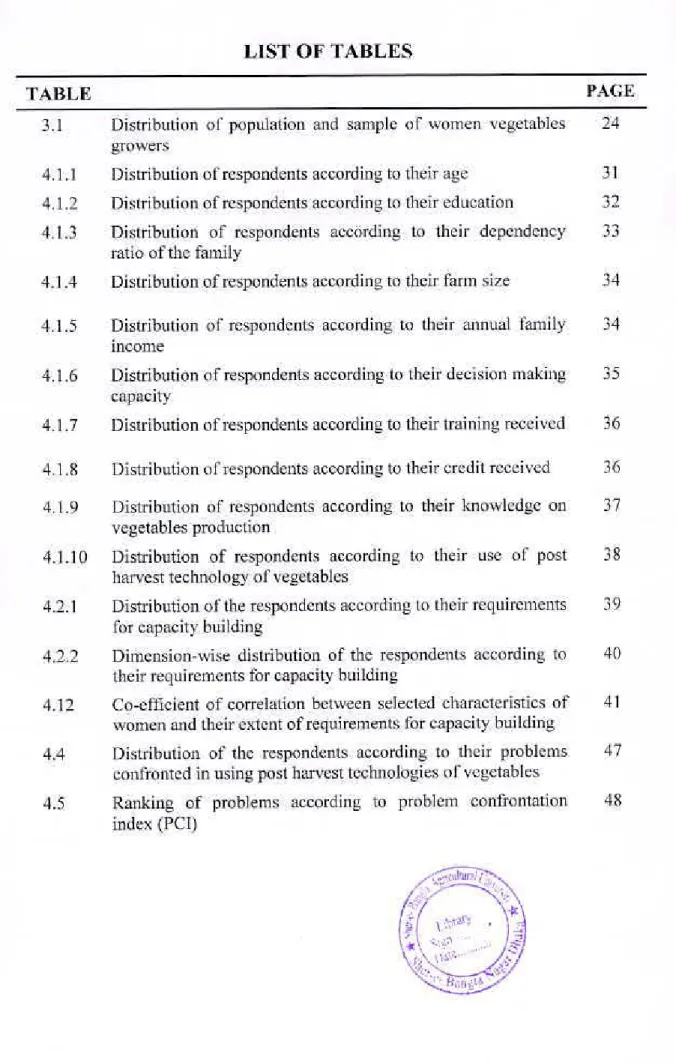
LIST OF TABLES
TABLE PACE
3.! Distribution of population and sample of women vegetables 24 growers
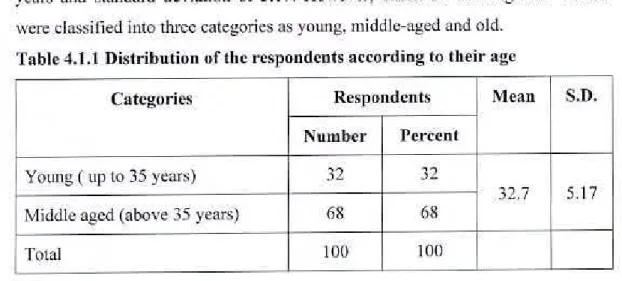
4.1.1 Distribution of respondents according to their age 31 4.1.2 Distribution of respondents according to their education 32 4.1.3 Distribution of respondents according to their dependency 33
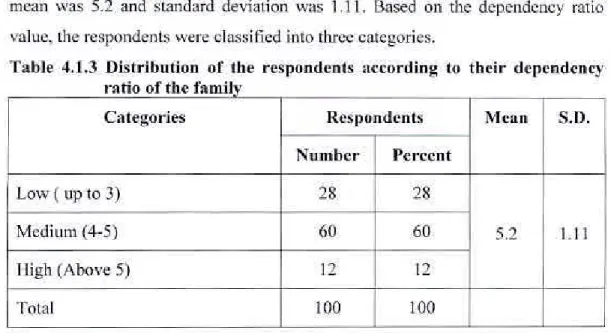
ratio of the family
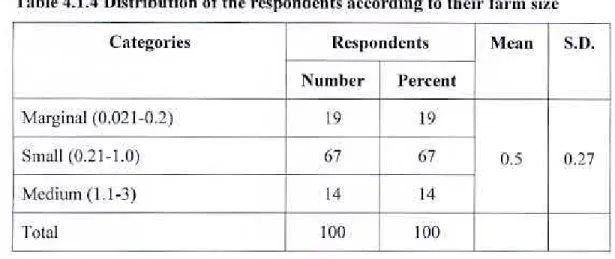
4.1.4 Distribution of respondents according to their farm size 34 4.1.5 Distribution of respondents according to their annual Iimi1v 34
inconie
4.1.6 Distribution or respondents according to their decision making 35
capacity
4.1.7 Distribution of respondents according to their training received 36 4.1.8 Distribution of respondents according to their credit received 36 4.1.9 Distribution 01 respondents according to their knowledge on 37
vegetables production
4.1.10 Distribution of respondents according to their use ol' post 38 harvest technology ol' vegetables
4.2.1 Distribution of the respondents according to their requirements 39 for capacity building
4.2.2 Dimension-wise distribution of the respondents according to 40 their requirements for capacity building
4.12 Co-efficient of correlation between selected characteristics of 41 women and their extent of requirements for capacity building
4.4 Distribution of the respondents according to their problems 47 conironted in using post harvest technologies ol vegetables
4.5 Ranking of problems according to problem confrontation 48 index
(f ) (,
l)/
LIST OF FIGURES
FIGURE. PAGE
2.1 A simple conceptual framework of the study 20 3.1 A map of Netrokona district showing Kcnclua upazila 22 3.2 A map oiKendua upazila of I3arisal district showing the 23
studs' union
LIST OF APPENDICES
APPENDICES PAGE
Appendix A An English Version of the Interview Schedule 58 Appendix B Correlation Matrix of the Dependent and Independent 53
Variables
xl
WOMEN'S REQUIREMENTS FOR CAPACITY BUILDING IN POST HARVEST ACTIVITIES OF VEGETABLES
Mobammad Abu Bakar Siddique Khan
fl;11
w :txwi
The specific objective of the study was to determine the women's requirements for capacity building in post harvest activities of vegetables. Attempts were also made to determine ten selected characteristics of the women and their relationship with requirements for capacity building in post harvest activities of vegetables and to find out the problems faced by the women in using improved post harvest technologies of vegetables. Data were collected from a sample of 100 women vegetables growers of the two villages of Roailbari union of Kendua upazila of Netrokona district. Pearson's correlation co-efficient was used to determine the relationships between the selected characteristics of the women with their requirements for capacity building. The highest proportion (63 percent) of the respondents had high extent of requirements while 34 percent of them had medium and only 3 percent of them had low extent of requirements for capacity building. Women's farm size, annual family income and use of post harvest technology showed significant negative relationship with their requirement's for capacity building in post harvest activities of vegetables but credit received and knowledge on vegetables production were positively significant. On the other hand. the rest of characteristics viz, age, education, dependency ratio of the family. decision making capacity and training received did not show any significant relationship with their requirements for capacity building in post harvest activities of vegetables. According to problem faced index (FF1), 'Lack of knowledge on post harvest activities of vegetables' was ranked first followed by 'Distance from sale centre' and 'Lack of marketing facility' while 'Low access to communication media' and 'Others' ranked last.
xI1
CHAPTER I INTRODUCTION
H
Ii (;eal Background
Women empowerment. enhancement capabilities as well as their shilLs and exercise their rights in decision making are three important factors for partieipauon of women in development activities. Participation of women in development was not started hi a day rather it has long histoncal background. It started in Bengal as a movement againstearly marriage and injustice to women in the name of religious nornis. At a kiter period. rights of women to have education and to participate in vote and elections, peasant movements, politics, economic activities and administration were added. Now-a- (lays in all over the world different organizations give emphasis on the issue of women development.
It is not easy for women to participate in development process. Usually they do not get same wages compared to men. Rather they have to face a lot of problems to entry to labor market in general and even if sonic access is available they do not have the opportunity to he able to intluence decisions. They have not sulliciently been involved in the development activities that ailed their lives (Murlaza. 2005).
In our country. women have long been subjected to discrimination mostly due to gender bias in social traditions and practices. \Vomen are neglected by some social norms and practices which is reflected in Ihmily laws. Due to the discrimination women are still leg behind from men in casc of development.
Study of ILC) (1995) revealed that in early nineties women comprised 70% of the world's poor and the number of rural women living below the poverty line rose luster than rural men in poverty. In I3anglaclesh 241/0 rural and I 0% ttrban women are under extreme poverty line. Women should be the key targets to alleviate poverty. IEPRI (2000) reported that increasing women's human capital is one of the most effective ways to reduce poverty. Moreover. Millennium Development Goals (MDGs) ptti the first goal as eradicating extreme poverty and hunger (LNDP. 2004). Therefore. it is tirgent to mainstream the women in the income generating activities to make them sell reliant,
Women may play a vital role in economic and social development both in national and tdohal level. Participation in development issues is being needed lbr them [or upgrading their livelihood status. Sociologists identified them as the poorer of the poor and in generally in rural areas they gel the lesser share ol lood and healthcarc as well as of inherited property. They are the most disadvantaged grotip in the social structure. Most of them are not mUCIl aware of their own abilities due to lack of education and restricted social mobility. though some of them are clualitied they often (10 not have the kind of access to credit or control over capital.
Besides these, there are so many barriers which create problems for them.
traditional mobility constraints and social conventions discourage women to undertake income generating activities.
Although half of the population is women, on an average they do two-thirds of the total works including household works and received only one-tenth of world income. Majority of them are uneducated, unskilled. milnoutished and economically and social lv dependent on men. Partic i patio ti of women in hither professional and managerial position is very limited and in garment industries they received lower wage then men though they have same level 01' education (tJNDP. 1994).
For changing this situation of' women and their development, government of Bangladesh and hundreds of non-government organizations have launched massive programs [or women empowerment. They work at grass root level for poverty alleviation and employment generation. They have developed a number of seetoral program such as, agriculture, livestock, education. health and sanitation.
nutrition, housing, saving, which are facilitated by its credit, training zuid technical support services and being implemented through overall alleviation programs. l3esidc these women can increase their capabilities and status through some homestead activities which may serve commercial purpose also.
On the oilier hand, vegetables have not only commercial value but also nutritional value in human diet. It is one ol the most important income generating activities in alleviating poverty. The post harvest losses of vegetables in Bangladesh arc estimated to be 26% (Khun. 1991). I ugh perishability of vegetables, lack of storage facilities, mechanical injury due to improper handling, packaging, transportation and microbial infection are major causes of post harvest losses in vegetables. The post harvest losses incLude signiticant quantitative, qualitative and economic losses. II' these losses could be minimized the growers as well as the intermediaries of the markeling channel could get a better economic return. These losses of vegetables can be minimized through improving capacity building of the women such as storage facilities and taking care while handling, packaging and transporting. Another way to tackle this problem is to process the vegetables fbr different purposes like pickle, jam, jelly dc. Processed vegetables have considerably increased market puce than that of unprocessed vegetables and it brings about better economic return from the sector of vegetables when the post harvest operations are performed accordingly.
Since women are mostly involved in vegetables cultivation. they should be provided improve post harvest technological facilities for their self-reliance.
ThereIire. it has become imperative to assess women requirements for capacity building in post harvest activities of' vegetables.
1.2 Statement of the Problem
More than 60 types of' vegetables of indigenous and exolic origin are groWn it) Bangladesh. Based on the growing season, vegetables arc categorized as summer/rains' season vegetables, winter season vegetables, and all-season vegetables. Of the stimmer vegetables, various cuetirbits. vegetables cowpea.
hyacinth bean, stem amaranth and Indian spinach is predominant. Winter vegetables include tomato, cabbage. ('hinese cabbage. catilillowcr. eggplant.
carrot. spinach, bottle gourd. hush bean and radish. Crops like okra, heat-tolerant tomato, eggplant, carrot, spinach, many leafy vegetables and small onion are grown all year round. Summer vegetables are cultivated during the monsoon season l'rom May to October. On the other hand, winter vegetables are grown
from November to April.
the production of vegetables is higher during t•inter (60 to70%) and most districts produce marketable surplus during that season. As a restil t there is an nettle shortage of vegetables during tile summer. which leads lo chronic malnutrition anmng the people of Bangladesh. The average post harvest loss is estimated to he 26 percent (Khan. 1991). Singh and Chadha (1990) reported that a loss of nearly 25 to 40 percent of the vegelables occurs due to rough and improper post harvest handling, transportation and storage practices, and the variation ollen depends on the type of vegetables.
Women are the pioneer and chief producer of vegetables. 1'herefore. their capacity of handling post harvest operations needs to he improved. The requirements of women for capacity building in post harvest activities of vegetables is necessary to explore before lunching improvement flri",rams Oil
capacity building. Keeping these flicts in mind the present resea. been undertaken as an inquiry to the iölloing questions:
I. What are the requirements of women for building their capacity in post harvest activities of vegetables?
\Vhat are the characteristics of women that influence their requirements for capacity building?
To what extent the relationships prevail between their requirements Ibr capacity building in post harvest activities of vegetables tvi th their characteristics?
What are the problems Iheed by, the women in using the post harvest facilities of vegetables?
1.3 Specific objectives of the study
The specific objectives of the study are as lollows:
To determine and describe the characteristics of women that inlittenee for capacity building in post harvest activities of vegetables:
To determine the women's requirements lbr capacity building in post harvest activities of vegetables:
To explore the relationships between selected characteristics of the women requirements br capacity building in post harvest activities of vegetables:
[he selected characteristics are as tollows:
Ave Education
Dependency ratio of the family Farm size
,-\nnual family income Decision making capacity Training received
Credit received
Knowledge on vegetables production Use of post harvest tecliiiologv
d) To find out the problems confronted by the women in using improved post harvest technologies of vegetables.
1.4 Justification of the Study
Fstiniates of the post-harvest losses of lood grains in the developing world from mishandling, spoilage and pest infestation are put at 25 percent: this means that one-quarter of what is produced never reaches the consumer for whom it was grown, and the efiort and money required to produce it are lost-lorever. Fruit.
vegetables and root crops are much less hardy and are mostly quickly perishable, and if care is not taken in their harvesting, handling and transport. the,,, will soon decay and become untiL for human consumption. Estimates of production losses in developing countries are hard to judge. but sonic authoritie.s put losses of sweet potatoes. plantain, tomatoes, bananas and citrus fruit sometimes high percent or half of what is grown. Reduction in this wastage. particularly it' it can econoniicully he avoided_ would be of great significance to growers and consumers alike.
A little additional cost or modern marketing practices can improve the traditional methods of harvesting. handling, packaging and storing of vegetables. Not only expensive machinery and technology can improved this condition but also efficient and better utilization of the existing liteilitics is often stifficient. Inadequate knowledge about post harvest handling and storing of' vegetables is responsible for this loss. Prolonging the shell' life and maintaining the quality of' vegetables during storage are very important. \'arious loss reduction technologies have been devised to minimize the post harvest deterioration of vegetables. it is ye t to explored that how much of these post harvest facilities are needed by the women. In addition.
information on need ior capacity building of women for practicing post harvest]
activities of vegetables are very limited. The present research was. therefore, a modest attempt to discover the very lhcts and likewise the study has been entitled as
"\Vomen Requirements ]or Capacity Building in Post-harvest Activities of
\'egetahles.
1.5 Scope of the Study
[he major Findings of the present study may relevant to other areas of Banuladesh where the physical. .socio-economic and cultural conditions are more or tess similar to the study area. I lowever. the Findings of the study may hclpftul for the field workers of different development departments including Department of Agricultural Extension (DAli) under the Ministry of Agriculture and other Non-Government Organizations (NCiOs) to improve strategies of extension to work elkctivelv with the rural women. The outcomes of the study may also help settle down government strategic plan in incorporating the rural women in economic development of the country through poverty alleviation.
1.6 Limitations of the Study
Considering time, money and other necessary resources available to the researcher and to make the study meaningfitl and manageable from the point of view of
research. some restrictions strictly followed in this study were as follows:
The study was confined to two villages of Royalbari union of Kendua upazila under Netrokona district.
There were many farm women in the study area, but only the rural women who involved in vegetables production were considered for this study.
There were many aspects of capacity building br using post harvest technologies of vegetables but only live aspects were selected for assessing the extent of requirements of women.
Characteristics of the women were many and varied but only 10 characteristics were selected for this study.
For information about the study. the researcher depended on data as given by the selected respondents during data collection.
1.7 Assumptions of the Study
"An assumption is the supposition that an apparent fact or principle is trite in the light ol' the available evidence (Goode. 1945)." The researcher had the Following assumptions in mind while undertaking this study:
The respondents were capable of furnishing proper responses to the questions contained in the interview schedule.
The responses furnished by the respondents were valid and reliable.
Information furnished by the respondents. included in the sample. were the representative of the whole population of' the study area.
The researcher who personally collected data well adjusted himself to the social environment of the study area. I knee the data colLected from the
respondents were li-ce from interviewer bias.
The findings of the study are expected to he useful for planning and execution of various programmes in connection with the improved post harvest activities of vegetables.
The extent of requirements for capacity building of women iii post harvest activities of vegetables gave a representative feature in the context of the other areas of l3angladesh
L.8 Statement of the Hypothesis
A hypothesis simply means a mere assumption or some supposition to he proved or disproved. But for a researcher, hypothesis is a formal question that lie intends to resolve. According to Kerlinger (1973) A hypothesis is a conjectural statement of the relation between two or more variables. Hypothesis are always in declarative sentence form and they related either generally or specifically variables to variables." As delined by Goode and halt (1952) "A hypothesis is a proposilion which can he Put to test to determine its validity. It may he contrary to or in accord with the common sense. It deals to in empirical test" In broad sense.
hypothesis may he divided into two categories. (a) research hypothesis (lii) and (b) null hypothesis (110). I lowever. for the present study the hypotheses were
lbnii u I ated in null form.
Ilie following mill hypothesis was lOnnulated to explore the relationship between some selected characteristics of the women and their requirenients for capacity
building in post harvest activities of vegetables.
"There is no relationship between the selected characteristics of the women and their requirements for capacity building in post harvest activities of vegetables."
7
1.9 Definition of Important Terms
For clarity of understanding. certatn terms lrequentiv used throughout the study are defined and interpreted as helo
Annual family income: Income was defined as the toutl financial return per year of a family from thrni (crops. livestock, poultry and fish) and non-larni sources (service, business, selling labor, bank interests, remittance. linancial help from relatives, etc.).
Capacity building: Capacity building of the women for practicing post harvest activities of vegetables was defined as tile extent to which tile)' have the accessibility to financial, physical, managerial support services as well as the ability to make decision about utiliziiw the post harvest facilities of vegetables.
Credit received: Credit received ol' a respondent woman was measured in terms of the amount of money received by her as loan from different sources.
Decision making capacity: Decision making capacity in the family was measured on the basis of the respondcnes ability to make decision in the QimH regarding some selected social activities.
Dependency ratio of the family: Dependency ratio of the family is the proportion of dependent lhnliiv members to the earning fhmily members. it was computed with the following formula:
Total number of family members— Total number ol earning members Dependency ratio =
Total number of earning members
Farm size: Farm size of a respondent referred to the total area of land on which her limily carried out thrming operation. the area being in terms of lull benefit to the tam ily.
Knowledge on vegetables production: It was the extent of basic understanding of the respondent in different aspects of vegetables production.
Management skill: It expressed the knowledge on post harvest activities, operational ability, market Ujcilitv exploitation and financial management.
Requirement assessment: It was defined as the measurement of prerequisites required by the rural women towards post facilities of vegetables.
Physical facilities: Processing materials or equipments. processing ground.
transporting vehicles, store house and sales centers were collectively termed as physical facilities.
Post harvest facilities of vegetables: These included the access to and availability of processing equipments and ground. cold storage, marketing channel, credit, transport. labor market etc.
Problem confrontation: It rcirrecl to the ten selected prohleiis faced by the lèrnalc in utilizing the post harvest facilities oh' vegetables.
Support services: Support services referred to facilities like preservation or cold storage. labor market, marketing channel, credit. transport, development workers etc.
Technolo: l'echnology is it design br instrumental action that reduces the uncertainty in the cause-chiëct relationships involved in achieving desired outcome and is usually generated by research institutes, intelligent litrn'iers and other to meet the farming needs.
'l'raining received: •l'raining received was defined by total number of day's it respondent attended in different training programs in her life from diiThrent organizations.
Use of post harvest technology: It was defined as the nature of use (not at all, rarely, occasionally and regularly) of post harvest technologies of Ilirni produces.
Women: Women respondents were defined as the housewives living in the study area.
I)
CIIAI9'ER 2
REVIEW OF LITERATURE
The present study was mainly concerned with the requirement assessment of women for capacity building for practicingpost harvest activities of vegetables.
Reviews of related literatures representing this study have been presented in this Chapter.
2.1 Reviews Related to Studies on Capacity Building of Women
Chandramoni (2005) observed that involvement of women was essential in all stages of economic and social activities. Therefore, organizing women in self help groups (SI-LOs) will enhance the Mains of women as participants. decision maker and beneficiaries in democratic, economic and cultural sphere of life. SHGs have included a great confidence in the minds of rural women to succeed in their day to day liI.
l"ankajam et cii. (2005) found that the rural woman was disadvantages compared to her urban counterpart. The profile of rural women was that of illiterate, ignorant. superstitious. suppressed and oppressed because of their limited skills.
The rural women need to be trained, educated and organized so that she is empowered to be equal to her counterpart in urban area.
Sulaiman el aL (2005) stated that special program for farm women enables or helps women to access to improved information and resources which increase agricultural production significantly. They also stated that to make sustainable improvement in women's livelihoods, women's access to employment and income generating opportunities sources of credit, skill for establishing enterprises etc.
should have to be improved.
Fisher and Sriram (2002) reported that Indian micro-finance to explore how it can be design in practice. to contribute in it wide range of development objectives.
'I'hey also reported that including providing social and economic security.
promoting livelihoods: building democratic people's organizations; empowering women and changing wider system within society.
Rahman c'l al. (2002) Ibund that women's jartieipation in economic activity not only increases their income but also generates some secondary influences on the Ilk and attitude of these women. If women earn money. they have more prominent role in flimity's decision making with respect to expenditure of income and other related Jiuiiily matters. Such an active participation by women may help to develop their personality as well as help the family by making it possible to take more judicious decisions.
Khan (1999) reported that niicro-hnance programs are inereasmgly popular in Bangladesh. The paper examines the loan use pattern on women involved in wage employment and the henelits they gain from such loans. It is. thus, argued that more employment opportunities should he created for women as these would help to promote economic and social empowerment.
Amin and I ladi (1998) showed that age and years of schooling were positively correlated with buying capacity and decision making role in the household.
Buying capacity and decision making role and power relation with the husband increased higher br the women who were involved in credit based programs than br the women who were not involved
Beguni and l3iswas (199$) found that education. women's income and employment had positive impact on decision making power of women. Mobility of women was also positively related with education, women's income.
employment and involvement with development institutions and mass media contact. Women's empowerment is the combined elThct of multi-dimensional factors, such as disseminating ability, autonomy. mobility etc.
Kabeer (1 99) observed that earning an independent income through credit access has shown to lead to an increase in women's ability to increase 'voice' in the household decision making process.
13u1111 1996) in her study examined the relationship between women's access to training and their empowerment with special reference to Bangladesh situation Women empowerment was measured in terms of' raising awareness, self- confidence, economic independence and decision making process in the
household. It was revealed that training had an impact of' the hehavionil predisposition. Skills of women were also developed through skill development training.
I lashemi ci of. (1996) fowd that group based meeting promotes social empowerment of women by providing an opportunity for initiating a greater sense of, awareness of social and political iSStLCS which have been recognized to promote personal empowerment.
Ackerly (1995) noted that when women members play leadership roles. group leaders and/or centre leaders might experience an increased sense of self- confidence and self-worth. Similarly, in programs where credit groups are
federated at a spatially higher level group meeting are significantly more empowering for women as they provide an enhanced status and greater bargaining power in local communities. lie concluded that effectiveness of a credit program at empowering women depends on the success with which i defines for itself and its workers ways to challenge, while working within, the constraints on women's empowerment that may exist in the bolTower's country. Support (or this argument is found in the case of rural Bangladesh. Statistical evidence demonstrates the importance of a borrower's involvement in the labor, selling and accounting for the activity funded by her loan for increasing the likelihood that credit leads to empowerment
Pitt and Khandker (1995) slated that access to credit was seen as a mean of empowering of the assumption that the increased labor time of women spent in income eamine work as a result of credit led to greater inlluenee of' women in household decision making.
2.2 Reviews Related to Studies (in Women's Requirement Assessment
\'crma c/cit (1992) stated that in Indian, women have a crucial role to play in post harvest technology particularly that relating to winnowing and grain storage.
I lowever. little attention has been paid to food losses: it is suggested that proper handling and management needs to he taught systematically to rural women. A study of needs of training in P1-IF (Post I larvest Technologies) for farm women was launched which covered the involvement of women in operations, the
eflectiveness of the messages on P1 IT transmitted in terms of knowledge grain and associated lactors influencing knowledge acquisition and attitudinal change.
This study was undertaken to examine women's role in P1-LI and the results inferred that the message of P1-IF can be transmitted eflèetively without any consideration for age. caste, education or fhmilv type. implying that need based training can overcome the harners of personal Jhctors or limitations. Pill is, therefore, relevant to farm women irrespective of their personal profile variables.
Chandargi and Vanighese (1990) carried out a research in India to identilS' the subject matter areas ol' training with respect to food products and prepanitton and to determine the duration and tinimg of training program. 1 'hey concluded that with appropriate technology transfer through training centers. Food products can be improved and their quality can be standardized. Individual or group activity could help women to increase their lhmily income by preserving and marketing of difibrent food products. Specialists in food preparation and extension workers should work for the betterment of the rural women.
2.3 Reviews Related to Studies on Post Ilanest Issues of Vegetables
Banu (2000) studied the post harvest behavior olsorne local vegetables where she used various post harvest treatments such as. storing vegetables in wet gunny sacks and in perforated polythene bag, washing vegetables with cool water immediateIN, aller harvest and splashing of water directly on the vegetables at an interval of' tour hours (luring storage. She stated that the post harvest losses include signilieanL qualitative, quantitative and economic losses and these losses could be minimized by prolonging the shelf lilb oI'vegetahles.
Guerra ci aL (199$) studied the losses in the field and at harvest (in Mcrida State) and during marketing (in Lara Slate) in Venezuela for nine vegetables viz, lettuce.
cabbage. carrot, spinach beet, leek, celery, cauliflower, broccoli and potato.
Results showed the highest percentage of losses at the held level in cauliflower (37 percent), carrot (2$ percent) and potato (21 percent). at harvest in cabbage (28 percent) and spinach bed (17 percent) and at marketing for broccoli (49) percent).
celery (4$ percent), lettuce (35 percent). cauliflower (33 percent) and leek (20 percent).
13
Savita et of. (1998) reported that participation of rural women in agricultural activities was low except tbr farming. bee keeping and rabbits fanning. Along with major role in household activities. rural women engage themselves in various economic activities such as. food processing (25 percent) and preparation of detergent (I 5 percent) that supplement litrnitv income. •Fhc major constraints reported were marketing, transport. procuring raw materials, lack of technical knowledge and no loan Iäeilitics.
l..al et at. (1997) estimated the marketing loss of winter vegetables in two major vegetables producing disiricts. which is ranged from 1.09 to 3.54 percent at farm level. The loss was higher in tomato (5.54 percent) due to higher perishability.
followed by radish (2.67 percent), cauliflower (2.50 percent) and brinjal (2.33 percent).
Sharma ci at (1995) in a study conducted in India observed that the highest percentage of marketing loss occurred during assembling and transportation of tomato and capsicum.
2.4 Reviews on Relationship between Selected Characteristics of Women and their Capacity Building
Very lèw studies have been Ibund to be speci iicallv undertaken in a scientilic way in the direction of the recent study. Therefore, an elibrt has been made in subsequent subsection to review sonic interlinked literature in this aspect.
2.4.1 Age and capacity building
Rhowniiek (2004) Ibund that there was signilicant but negative relationship between age and empowerment of the women beneficiaries of a selected NC1O in Narshingdi district.
Naoroze (2004) in his study found that age of the rural women had no significant relationship with their empowerment.
Asaduzzainan (2003) found no significant relationship between age of rural women and their decision-making ability.
Biswas (200$) found that age of the rural women had a significant but negative relationship with their accessibility to fiumily decision-making process.
Aktcr (2000) in his study found that there was a positive significant relationship between age of the women and their participation in decision-making role in the family.
l3egum c/cd. (2000) in their study Ibund that there was no significant effect oF age of women on their taking household decisions.
Kumari (1999) in a study found that age of rural women had no significant relationship with their perfbrrnance in ihrm decision-making.
2.4.2 Education and capacity building
Sarkar (2005) stated that there was .siunificant and positive relationship between level of education of the women beneficiaries of CONCERN Bangladesh and their level of empowerment.
l3howmick (2004) found that there was significant positive relationship between education and empowerment of the women beneficiaries of a selected NCIO in Narshingdi district.
Naoroze (2004) in his study Ibund that personal education of the rural women had a significant relationship with their empowerment.
Malinwd (2002) found significant relationship between number of schooling spent by women and their empowerment.
Akter (2000) in his study found that there was a positive significant relationship between education oi women and their participation in decision-making role in the
fiiniily.
Asaduzvanian (2003) found significant relationship between education at rural women and their decision-making ability.
Biswas (2003) found that education of the rural women had a significant and positive relationship with their accessibility to family decision-making ability.
IS
2.4.3 Dependency ratio and capacit' building
Sarkar (2005) revealed that there was signilicant but negative relationship between Ihmitv size of the women benejiciaries of CONCERN Bangladesh and their Level olenipowerment.
Bhowniick (2004) lound that there was no significant relationship between tamil size and enipowenilent of the women beneficiaries of a selected NCiO in Narshingdi district.
Naorozc (2004) in his study found that there was no significant relationship between family size of 'rural women and their empowerment.
Asaduzzaman (2003) Ibund no significant relationship between Iltrnily size of rural women and their decision-making ability.
2.4.4 Farm size and capacity building
Sarkar (2005) concluded that there was no significant relationship between Ihmilv farm size of the women heneiciaries of CONC'ERN Bangladesh and their level of enipowemient.
Uhowmick (2004) found that there was no significant relationship between farm size and empowerment of the women beneliciaries of a selected NGO in Narshingdi district.
Naoroze (2004) in his study found that there was no significant relationship between family size of rural vomen and their empowerment.
Asaduzmnian (2003) found no significant relationship between farm size of rural women and their decision-making ability.
Kumari (1999) found 110 significant relationship between rural womens socio- economic status and their parlicipation in tiirm decision-making.
13haumik e/ at (1996) in a study found that the socio-cconomic status of the rural women had no significant relationship with their performance in decision-making process.
2.4.5 Annual family income and capacity building
Sarkar (2005) reported that there was no significant relationship between annual Iamilv income of tile women beneficiaries of CONCERN l3anuiadesh and their level of empowerment.
13hontick (2004) found that there was significant and positive relationship between annual income and empowerment of' the women beneficiaries of a selected NGO in Narshintzdi district.
Nuoroze (2004) in his study lound significant relationship between ftunilv annual income of rural women and their empowerment
Asaduzzaman (2003) found signi Ikant relationship between annual income of rural women and their decision-making abi lily.
lliswas (2003) ihund that income of the rural women had no significant relationship with their accessibility to Ihmily decision-making Process.
Begtini ci at (2000)K found that there was no significant etThct of gross income from homestead agro-forestry practices of the women (in their making household decisions.
CIRDAP's study (1998) buttressed this condition that working women with access to personal income exhibit a greater degree of autonomy and participation in house hold decision-making leading to better leeling of self-worth and high status within the households. [he central message of this is that economic improvement olwomen is a fundamental issue lbr attaining reasonable degree of empowerment.
BRAC (1995) reported that family income of rural women had significant effect on their decision-making. power. status in the làmily and mobility. It was also found that individual contact of the rural women had significant iniluenec on their improvement of knowledge, attitude mid skills.
2.4.6 Training received and capacity building
Sarkar(2005) revealed that there was significant and positive relationship between training received by the women beneficiaries oF CONCERN Bangladesh and their level of empowerment.
17
Naoroze (2004) in his study loiind that there was no significant relationship between training received of rural women and their empowerment.
Asadtwzanian (2003) Ibund significant relationship between training received of rural women and their decision-making ability.
2.4.7 Credit received and capacity building
Sarkar (2005) in his study concluded that there was significant and positive relationship between credit received by the women beneficiaries of CONCERN Bangladesh and their level of empowerment.
Mahmud (2002) found that women's participation in micro-credit program was associated with greater access to household income. Women's access to household income was negatively related to the degree of male involvement in income earning and also positively related to the degree of involvement in income earning by her.
(octz and Gupta (1996) and Ackerly (1995) found that loan reception was not empowering women in Bangladesh because institutions and norm were generally not favorable for women's independent use oINGO loans.
1-lashemi ci aL (1996) and Kaheer (1998) ibund that loan reception was empowering the women in Bangladesh.
2.4.8 Knowledge on vegetables J)rocluction and capacity building
Sarkar (2005) in his study stated that there was significant and positive relationship between knowledge of the women beneficiaries of CONCERN
Bangladesh and their level of empowerment.
ljhowniick (2004) found that there was significant and positive relationship between agricultural knowledge and empowerment of the women beneficiaries of a selected MX) in Narshingdi district.
Avad (2003) mentioned from his research findings that there was positive significant relationship between agricultural knowledge of the women and their participation in decision making role in the family regarding farming activities.
Aktcr (2000) reported that there was positive signiticant relationship between agricultural knowledge of the women and their participation in decision making role in the family.
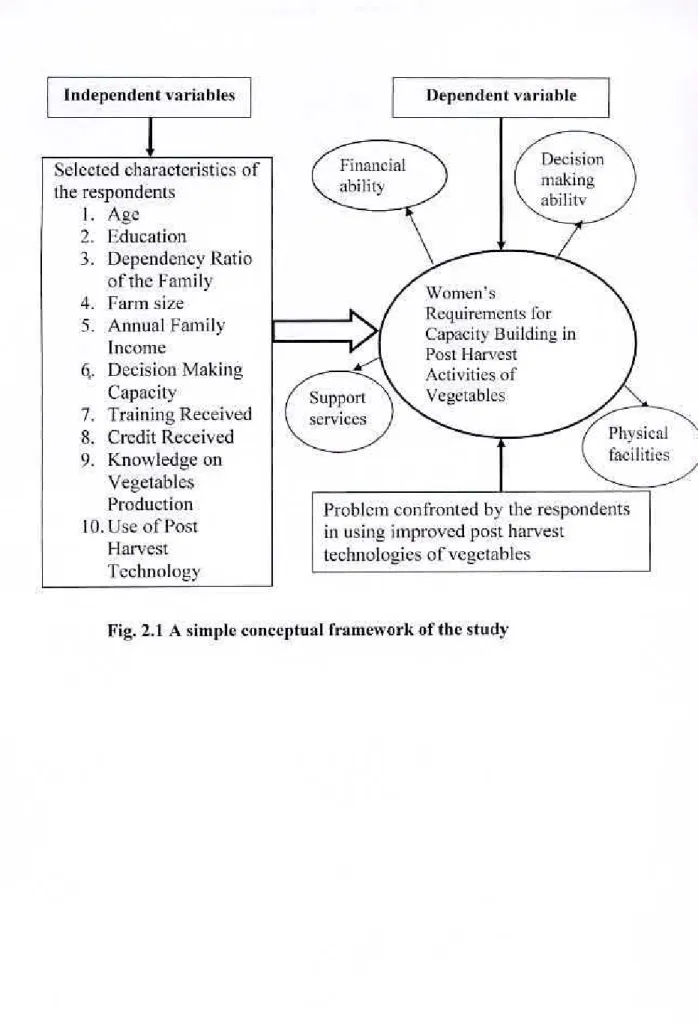
2.5 Conceptual Framework of the Study
The present study was concerned with the womens requirements for capacity building in post harvest activities of vegetables. Capacity building is a complex idea and it may be affected through interacting tbrecs of many other characteristics and social propaganda in their surroundings. In this study, it could he expected that 'women requirement for capacity building as dependent variable which would he intlueneed by selected characteristics of' the respondents as independent variables viz, age. education, dependency ratio of the family, Ilirm size, annual family income, decision making capacity in the family, training exposure. credit received, knowledge on vegetables production and use of post harvest technology. The conceptual model of the study has been presented in Figure 2.)
19
Support services
Vvonens
Requirements for Capacity Building I) Post Ilarvest
Activities of Vegetables
Physical facilities Independent variables 1)ependent variable
Selected characteristics of the respondents
I. Age Education
Dependency Ratio of the Family Farm size Annual Family
Income
.
Decision Making CapacityTraining Received Credit Received Knowledge on
Vegetables Production Use of Post
Harvest lcchnology
Financial Decision
atl,ilitv making
ability
Problem confronted by the respondents in using improved post harvest
technologies of vegetables
Fig. 2.1 A simple conceptual framework of the study
CHAPTER 3 NWThOI)OLOGY
Methodology deserves a very careful consideration in a scientific research.
\iethodology of any study should be such as to enable the researcher to collect valid and reliable inlormation to analyze the same properly and to arrive at appropriate decisions. Methods and produces followed in conducting this study has been discussed in this chapter.
3.1 Locale of the Study
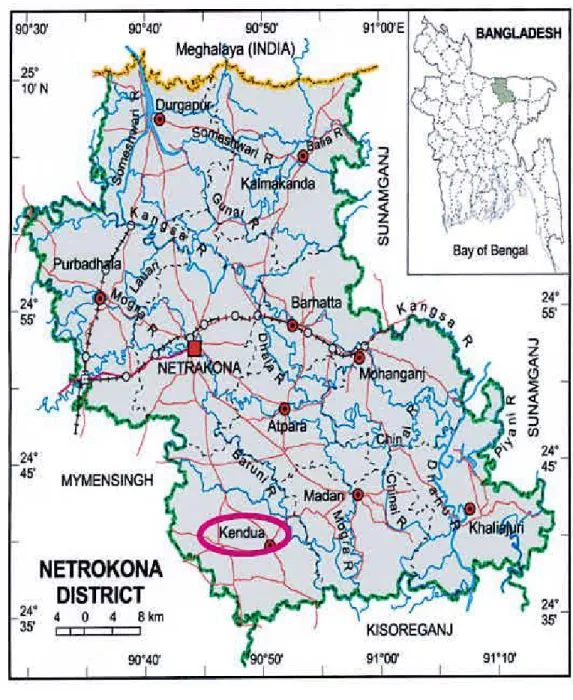
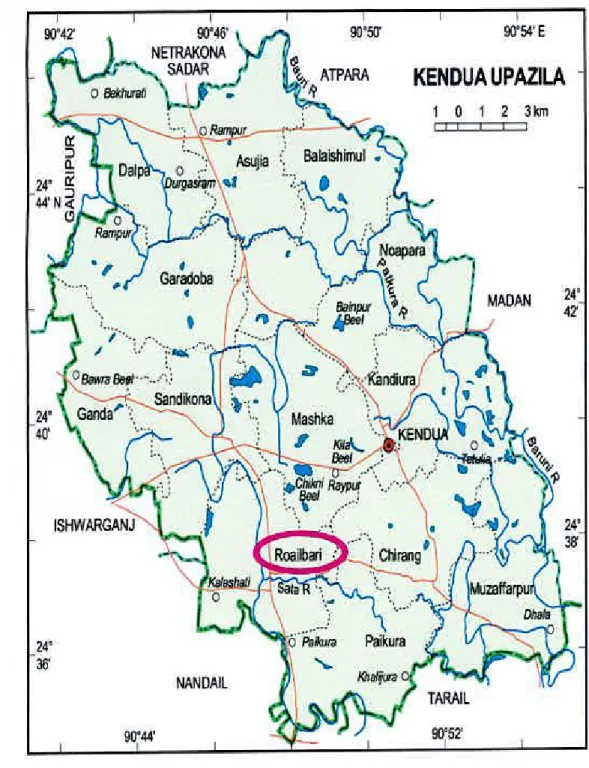
Roailbari union of Kendua upazila under Netrokona district was purposively selected as the locale of the study. Considering time. money. resources.
availability of vegetables growers and communication lbcilities two villages namely Puranbari and Amta!a Crorn Roailhari union were randomly selected as a locale of the study. A map of Netrokona district showing Kendua upazi lzt has been presented in Figure 3.1. Again a map of K.endua upazila showing the study union has been presented in Figure 3.2.
3.2 Population and Sample of the Study
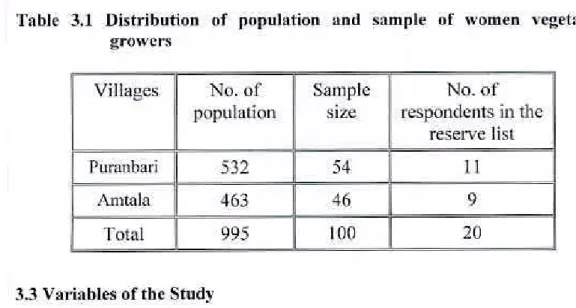
The researcher himself with the help of the Sub-Assistant Agriculture 011icer (SAAO) of these villages prepared an updated list of all the women vegetables growers. The total number of growers in these villages was 995. which constituted the population of the study. One hundred beneficiaries were randomly selected 11Dm the population as the sample by taking to pereenL from each village. A reserve list of 20 bencticiaries (2% of the population) was also prepared. The respondents in the reserve list were used only when a respondent in the original list was not available for interview. The disiribtition of the population and the sample (including in the reserve list) is shown in Fable 3.1
21
'OO'E BANGLADESH
-,
z . z
HBay of Bengal \
- 24°
hanganj'
24° / 1 '
MYMENSINGH C\r
Madan
NETROKONA
.\_
jP¼n
DISTRICT
r24-24' 0 4 8km 36-
ç
910101
I I I
91OO
Fig. 3.1 A map of' Netrokona district showing Kcndua upazila
'47
I
90'46
I
i
90'5t1 '54 E
NERAKONA
%ATPIA
KENDUAUPAZILA -
10123bn
- .
oRa'cir-
Asu Jia Bshimui 24' Dal asr!7?if
o . .H
S 1 Noapaa
-
Garioba .: 10
N aak;pw 3 MADAN
47
/
... ...r.
08mwa-
a A
nthura - --- -Sanddona t..•
24' Ganda' Masbka
'KEN
S
• -o--- •..'.. f•.•Cips \/.. ''2'
P
SHWARGANI
I
ItRoaitan c*ang ...
Su
24° öPflvra Paikura
:36
NANDAII.
TARAJL
9!M'
Fig. 3.2 A map of Kcndua upazila showing the study union
'-4
Table 3.1 Distribution of population and sample of women vegetables growers
Villages No. of Sample I population size
Puranhari 532
[ 54
Amtala 463 46
Total 995 100
J
No. of respondents in the
reserve list II
9 20
3.3 Variables of the Study
independent and dependent variables oithe study are presented below:
3.3.1 Independent variables
The selected characteristics of the respondents were considered as independent variables which were as follows:
I) Age Education
Dependency ratio of the family Farm size
Annual family income Decision making capacity
•Fraining received Credit received
Knowledge on vegetables production Use of post harvest technology
3.3.2 E)epcndcnt variable
Wometfs requirements for capacity building in post harvest activities of veactables were the main focus of the study. I lence, it constituted the dependent variable.
3.4 Measurement of Variables
The procedures Ibliowed in measuring the independent and dependent variables are presented below:
3.4.1 Measurement of independent variables 3.4.1.1 Age
Age of a respondent was measured in terms of actual years from her birth to the time of interview. A score of one (1) was assigned for each year of age. It was measured in complete years as reported by a respondent.
3.4.1.2 Education
Education was measured on the basis of formal education. It was expressed in enis of year of schooling completed by a respondent. One score was given for each complete year of schooling. If a respondent (toes not know reading and i1ting his score was zero. A score of 0.5 was given to it rcsponclent who only could sign his or her name only.
3.4.1.3 Dependency ratio of the family
Dependency ratio of the family is the proportion of dependent family members to the total earning members. The family members included litmily head and other dependent members like husbandfwife. children, etc. who lived and ate together.
Dependent flimily members were those who were unemployed in the lhmily. It was determined by subtracting the number of earning members from total number
a
of family members. Finall . dependency ratio was computed with the Ibilowing formula:Total number of family members-- Total number of earning members Dependency ratio
Total number of earning members
H-
'.3-
3.4.1.4 Farm size
Farm size of a respondent referred to the total area of land on which her family calTied out fanning operation, the area being in terms of full benefit to ihe family.
It was measured in hectares for each respondent using the fbllowing formula (Hasan. 2006):
FS" A -i- A2
+
A3+ '/
2 (A4-- A5)25
W here.
FS - Fanu size -
I /
A i I loniestead area
I
•.V -•' i1
/ rrJ
A, =On land unclei on culti anon
A; - Cultivated area taken on lease by a respondent Irom others A.i I and taken Ironi others on lorga
AR Land given to others on borga
3.4.1.5 Annual family income
Income referred to the total financial earnings of a household from farm (crops, livestock. poultiy and lish) and non-tami Sources (service, business, selling labor.
bank interests, remittance, financial hell) from relatives. etc.). It was expressed in laka. In measuring this variable, total earning in l'aka of a respondent was convened into score. A score ol one was given for every 1000 I'aka.
3.4.1.6 Decision making capacity
Decision making capacity was measured on the basis of a respondent's ability to make decision in the thmily regarding 10 selected social activities. A score was given against each of the activities by asking question on the same. such as. '0 for not at all. I for joint decision. mainly by other family members. '2' Ibr joint decision, equally by self and others. '3' for joint decision, mainly by sell and '4' for full decision by self. Finally sum of the scores was given to each respondent.
In this variable the total scores might range between 0 to 40. where '0' indicated no capacity to make decision and '40' indicated MI capacity to make decision in the Ihniilv.
3.4.1.7 Training received
This referred to the days of training which all individual received in her life. One score was given br day training. the scores obtained in respect of all the training received by all individual respondent were added to determine her total scores of training received
3.4.1.8 Credit received
It refers to the amount of money received by a respondent as loan from dilThrent sources. It was expressed in 'laka. The total credit in Taka was converted into credit received score. A score of one was given for each thousand Taka loan.
3.4.1.9 Knowledge on vegetables production
Knowledge on vegetables piDduction of an individual iulën-ed to the extent of knowledge about vanous iSpCCLS 0! vegeta1les production. For meastuing knowledge on vegetables production. the respondents were asked 16 questions about vegetables production.
Score was assigned correct responses of'different questions as 2 and 3 according to the nature of the questions. Thus dilThrent scores were assigned 11w the correct responses 11w difThrent questions. Correct responses were given the highest score of the respective questions. Consequently. for correct responses to all 16 questions a respondent could secure a total score of 45. while for wrong responses to all the questions she could score zero (0). Thus, knowledge on vegetables production of the respondents could range from C) to 45.
3.4.1.10 the of post harvest technology
A four-point scale was used for computing the extent of use of post harvest technologies of fbi-rn produces. Weights of responses against the technologies were assigned 0. 1. 2 and 3 for 'not at all'. 'rarely'. 'occasionally' and 'regularly' respectively. The weights of responses of all the post harvest technologies a respondent adopted were added together to obtain the total score of use of post harvest technology. The score could range from 0 to IS. where •0 indicated no use and '1$' indicated highly use of post harvest technology.
3.4.2 Measurement of dependent variable
Women's requirements for capacity building in post harvest activities of vegetables were the dependent variable of the present study. To measure the extent of requirements for capacity building of women four dimensions ol capacity building were included. They were: requirements for financial ahiliiy (capital.
credit, labour cost and equipments and materials cost). requirements for decision making ability (harvesting, grading, packaging. processing, storing and selling of vegetables), requirements for support services (storage fttcilities, marketing
27
facilities_ transport facilities, credit availability, labour availability), and requirements for physical Facilities (processing ground, processing materials/equipment, store house, sales centers and vehicles). The dimensions were nicasured on a buy-point rating scale. Scores were assigned as 0. I. 2 and 3 for 'no. low'. 'medium' and 'high' respectively. The scores of all items of each dimension were added to obtain the total score ot'a single dimension. Finally.
scores of all the four dimensions lomied the total score of the extent of requirements for capacity building of women for a respondent. ilius, total score ol'a subject for this variable could range from 0 to 60. where .0' indicated 'no requirement' and '60' indicated 'high requirements' for capacity building of
women towards capacity building
33 Measurement of Problem Confrontation
To find out the problems faced by the women, the respondents were asked 10 questions of different issues on post harvest activities of vegetables. A four point scale was used for computing the problem score of' a respondent. For each constraint score of V. 1'. 2' and '3' was assigned to indicate extent of constraint as 'not at all'. 'low'. 'medium' and 'high' respectively. 'l'lw total scores were computed for each respondent by adding her scores fbi all the problems. 'Ihe possible range of constraint score could be 0 to 30 where '0' indicated no problems an '30' indicated highest problems in respect ol using post harvest activities of vegetables.
To ascertain the comparison among the problems. Problem Confrontation Index (PCi) was computed using the following formula:
PCI = (P11 X 3) + (P X2) (P1 X I) (P0 X 0) Where. PCI = Problem Confrontation Index
Ph = Number of respondents having high problem Number of respondents having medium problem P1 Number ol respondents having low problem
P1 Number of respondents having not any problem at all
3.6 Preparation of Data Gathering Instrument
In order to collect relevant inkwniation. an interview schedule was prepared carefully keeping the objective of the research in mind. The questions and statements obtained in the schedule were simple. direct and easily understandable to the respondents. Appropriate scales and measurement techniques were developed to ensure correct responses in the variables concerned.
After devoting considerable time and efforts to prepare the interview schedule, the researcher felt further improvement of the same. lie interview schedule was pre- tested with to respondents under actual situation. Necessary corrections, inodiheations and additions were made in the interview schedule on the basis of results of pre-test. The interview schedule was than printed in its final lorms. A copy of the interview schedule in English version has been presented in appendix-
I'
3.7 Data Collection Procedure
The researcher himself collected data from the sample respondents through the personal contact with the help of interview schedule during the 10 March to 10 April. 2008. Relire starting collection of' data, the researcher met the Sub- Assistant Agriculture Officer (SAAO) of the two study villages. The researcher also discussed the objectives of the present study with the respondents so that they did not feel any hesitate at the time of interview. I lowever. ii any respondent foiled to understand any question. the researcher took necessaty care to explain the issue as far as possible. After completion of the interview, it was checked and editing was done in ease of necessity. The researcher did not face any mqior problem in collecting data. Excellent cooperation and coordination were extended by the respondents and other concerned persons at the time of data collection.
3.8 Processing of Data
Data obtained from the respondents were coded, compiled, tabulated and analyzed in accordance with the objectives of the study. Qualitative data were converted to qtiantitattve data by means of suitable scoring to fhcilitate analysis and interpretation.
29
3.9 Categorization
For describing the various independent and dependent variables, the respondents were classified into several categories in respect of each variable. Ihese categories were developed by considering the nature of distribution of the data and general understanding prevailing in the social system. The procedures for categorization oldata in respect ol different variables are elaborately discussed in Chapter 4.
3.10 Method of Data Analysis
The collected data were complied, tabulated, coded and analyzed in accordance with the objectives of the study. The statistical measures such as. number and percentage distribution, range. mean. standard deviation were used for describing the variables of the study. To find out the relationships between woniens requirements for capacity building in post-harvest activities and their selected characteristics, the Pearsons Prodttct Correlation co-efficient (r) was computed.
Correlation matrix was also computed to determine the inter-relationships among the variables. If the computed value of co-efficient of correlation 'r' was equal or greater than the tabulated value at 0.05 level ol significance for the 98 degree of freedom, the null hypothesis was rejected and it was concluded that there was signiheant relationship between the concerned variables. llowevcr, when the computed value of co-efficient of correlation was found to be smaller than the tabulated value at 0.05 level of signilicant [or the relevant (98) degree oF Freedom.
it was concluded that the null hypothesis could not he rejected and hence there was no relationship between the concerned variables.
c:J1APFER 4
RESULTS AND DISCUSSION
A sequential and detailed discussion on the tindings of the study has been presented in this chapter. The chapter is divided into lour sections. In the first section. independent variables i.e. characteristics of the women vegetables growers have been discussed. The second section dealt with dependent variable (voniens requirement for capacity building in post harvest activities of vegetables) and in the third section the relationships between the dependent and independent variables have been discussed. Finally, in the 1'ourth section problem Riced in using po