ABSTRACT
THE USE OF VOCABULARY LEARNING STRATEGIES AND VOCABULARY SIZE OF THE SECOND GRADE STUDENTS AT MAN 1
BANDAR LAMPUNG
By
KHARIS MUNANDAR
Vocabulary plays crucial role in communication. It is a core component of language proficiency and provides much of the basis for how well students speak, listen, read, and write.
The objective of this research aimed at exploring the correlation between students’ vocabulary learning strategies and vocabulary size. The data were analyzed by using the Correlation in SPSS (Statistical Program for Social Science).
The results indicated that social strategy was the most frequently used strategy compared to the other strategies with the mean score was 3.213. Otherwise, the least frequently used strategy was metacognitive strategy with the mean score was 2.968. Based on the data of vocabulary size test result, it showed that the highest score was 90, the lowest score was 57, and the average was 75.52.
v
ACKNOWLEDGEMENTS
Alhamdulillahirabbil’alamiin. Praise to Allah, the lord of the world, who has
given the writer such a great opportunity to finish this script which the title is
“The Use of Vocabulary Learning Strategies and Vocabulary Size of the Second
Grade Students at MAN 1 Bandar Lampung”. The aim of this script is to fulfill
one of the requirements in accomplishing the S-1 Degree at English Department of Teacher Training and Education Faculty, Lampung University.
In this case, the writer would like to express his deep gratitude and respect for those who have well contribution in helping and supporting him to finish this script.
1. Dr. Ari Nurweni, M.A., as the first advisor who has a big heart and a burning desire to make the writer better and she always guides him well in composing this script.
2. Drs. Mahpul, M.A., Ph.D, as the second advisor who always helps him to gain knowledge and gives a lots of criticism in accomplishing this script. 3. Prof. Ag. Bambang Setiyadi, M.A., Ph.D., as the examiner who gives some
inputs, contributions, suggestions, and great advices to the writer in examining this script.
4. All the honorable lecturers of English Department, Lampung University who are never reluctant to motivate ordinary students dream to do extraordinary things.
vi
8. KKN Team of SMPN 2 Pematang Sawa, Pekon Tampang Muda. Bunch of thanks for the memorable friendship.
Bandar Lampung, 17 Desember 2015 The Writer
ii
CURRICULUM VITAE
The writer’s name is Kharis Munandar who was born in Gisting, 13th
February, 1994. He is the third child of Mr. Mukhlasin and Mrs. Purwani.
He started a formal education at SDN 1 Simpang Kanan 1999 before continuing his study at MTs Al-Ma’ruf Margodadi which graduated in 2008. Then, he continued to senior high school level at SMAN 1 Sumberejo and successfully finished it in 2011. In the same year, he was registered as an S-1 college student of Lampung University, particularly at English Department of Teacher Training and Education Faculty.
iv
DEDICATION
With a bunch of love and appreciation, this script is proudly dedicated to:
My wonderful parents, Mukhlasin and Purwani. They are truly the most perfect gift God has ever given to me and they are as the stars in my life who always
guide me in their love.
My beloved brother and sister & my lovely niece. Having you all is the greatest blessing in my life.
My best friends and my best supporters.
THE USE OF VOCABULARY LEARNING STRATEGIES AND VOCABULARY SIZE OF THE SECOND GRADE STUDENTS AT MAN 1
BANDAR LAMPUNG
By
KHARIS MUNANDAR
A Script in a Partial Fulfillment of The Requirements for S-1 Degree
In
The Language and Arts Department of Teacher Training and Education Faculty
FACULTY OF TEACHER TRAINING AND EDUCATION LAMPUNG UNIVERSITY
x
LIST OF APPENDICES
Page
Appendix 1. Research Schedule... 54
Appendix 2. Validity of Vocabulary Size Test ... 55
Appendix 3. Validity of VLS Questionnaire ... 57
Appendix 4. Level of Difficulty and Discrimination Power of the Test ... 58
Appendix 5. Reliability of Vocabulary Size Test ... 60
Appendix 6. Reliability of VLS Questionnaire ... 61
Appendix 7. Reliability Computation ... 62
Appendix 8. Vocabulary Size Test Result ... 63
Appendix 9. VLS Questionnaire Result ... 66
Appendix 10. Correlation Analysis ... 69
Appendix 11. Anova Analysis ... 70
Appendix 12. Pearson Product-Moment Correlation Coefficient Table of Critical Values ... 72
Appendix 13. Correlation VLSs and VS Test ... 73
Appendix 14. VLS Questionnaire ... 76
ix
LIST OF TABLES
Page
Table 1. Classification of Taxonomy of Vocabulary Learning Strategies ...10
Table 2. Vocabulary Size and Text Coverage...16
Table 3. Specification of VLS Questionnaire ...25
Table 4. The Reliability of Questionnaire ...26
Table 5. Difficulty Level of the Vocabulary Size Try-out Test ...29
Table 6. Discrimination Power of Vocabulary Size Try-out Test ...30
Table 7. Means of Vocabulary Learning Strategies ...34
Table 8. The Value of Mean and Standard Deviation (SPSS) ...34
Table 9. The Value of Correlation between Vocabulary Learning Strategies and Students’ Vocabulary Size ...35
Table 10. The Value of Correlation between Metacognitive Strategy and Students’ Vocabulary Size...36
Table 11. The Value of Correlation between Cognitive Strategy and Students’ Vocabulary Size...37
Table 12. The Value of Correlation between Determination Strategy and Students’ Vocabulary Size ...37
Table 13. The Value of Correlation between Memory Strategy and Students’ Vocabulary Size...38
Table 14. The Value of Correlation between Memory Strategy and Students’ Vocabulary Size...38
iii
MOTTO
THE USE OF VOCABULARY LEARNING STRATEGIES AND VOCABULARY SIZE OF SECOND GRADE STUDENTS AT MAN 1
BANDAR LAMPUNG
(A Script)
KHARIS MUNANDAR 1113042046
Advisors
Advisor 1 :Dr. Ari Nurweni, M.A. Advisor 2 : Drs. Mahpul, M.A., Ph. D.
ENGLISH EDUCATION STUDY PROGRAM LANGUAGE AND ARTS EDUCATION DEPARTMENT FACULTY OF TEACHER TRAINING AND EDUCATION
ix
2.2.The Role of Vocabulary Learning Strategy in Vocabulary Learning ...11
2.3.Types of Vocabulary ...13
2.4.Vocabulary Size ...15
2.4.1 Word Frequency and Text Coverage ...16
2.5.Vocabulary in the Language Learning...17
2.6.Theoretical Assumption ...18
2.7.Hypothesis ...18
III. METHODS 3.1.Design ...20
3.2.The Variables ...20
3.3.Population and Sample ...21
3.4.Data Collecting Techniques ...21
3.5.Instruments...22
3.5.1 Vocabulary Learning Strategies Questionnaire ...22
3.5.2 Vocabulary Size Tests ...23
3.6.The Validity of The Instrument ...24
x
3.6.2 The Validity of Vocabulary Test ...25
3.7 The Reliability of the Instruments ...26
3.7.1 The Reliability of the Questionnaire ...26
3.7.2 The Reliability of the Vocabulary Test...27
3.8 The Difficulty Level of the Test Items ...27
3.9 Discrimination Power of the Test ...28
3.10 Scoring System ...30
3.11 Research Procedures ...30
3.12 Data Analysis ...31
3.13 Hypothesis Testing ...31
IV. RESULT AND DISCUSSION 4.1. Result of the Research...33
4.1.1. Result of Students’ Vocabulary Learning Strategies ...33
4.1.2. Result of Students’ Vocabulary Size Test ...34
4.1.3. Correlation between Students’ Vocabulary Learning Strategies and their vocabulary size ...34
4.1.4. Correlation between Each Students’ Vocabulary Learning Strategies and their vocabulary size ...36
4.1.5. Result of Students’ Learning Strategies Preferences Based on Vocabulary Size Level ...38
4.2. Discussion ...40
4.2.1. Vocabulary Learning Strategies ...40
4.2.2. Vocabulary Size ...42
4.2.3. The Correlation between Vocabulary Learning Strategies and Vocabulary Size ...43
4.2.4. The Correlation between Each Vocabulary Learning Strategies and Vocabulary Size ...44
4.2.5. Vocabulary Learning Strategies Use Based on Vocabulary Size Level ...45
V. CONCLUSIONS AND SUGGESTIONS 5.1.Conclusion ...47
5.2. Suggestions ...47
5.2.1. For the Teachers ...47
5.2.2. For Further Research ...48
REFERENCES ...50
I. INTRODUCTION
This chapter is concerned with the backgrounds of the study. It also includes the
research question, the objective of the research, the significances of the research,
the scope of the research, and the definition of terms as elaborated in the
following sections.
1.1. Backgrounds
To master English, students should pay attention to many aspects of language
(grammatical structure, vocabulary, and so on) in order to achieve a high degree
of competence in English. Vocabulary is one of the most important aspects.
McCarthy (1990) emphasizes that communication just cannot happen in any
meaningful way if students do not know enough words to express the meaning,
yet their grammar and pronunciation are good. This indicates that vocabulary size
is fundamental in communication in both spoken and written.
Students are likely to have problem in their communication unless their
vocabulary size is adequate. Moreover, they cannot write when they want to
2
know very large number of words. Thus, it is important to find out ways that will
be useful to help the students increasing their vocabulary size.
A common belief within foreign language pedagogy is the notion that some
foreign language learners are more successful than others. One of the reasons may
be the fact that successful learners tend to approach the task of language learning
with different, sometimes more effective strategies (Anderson, 2005). Successful
foreign language learners know that to learn the form and meaning of a large
number of foreign language words, to be able to store them in their memory and
recall them at will, and to learn how to use them appropriately in a variety of
contexts and situations, they should be aware of wide ranges of learning
strategies. Considering the fact above, this current study is about to find out the
answer.
Catalán (2003) proposed the following working definition for vocabulary learning
strategies (VLS) in her study of VLS among foreign language learners:
Knowledge about the mechanisms (processes, strategies) used in order to learn
vocabulary as well as steps or actions taken by students (a) to find out the
meaning of unknown words, (b) to retain them in long-term memory, (c) to recall
them at will, and (d) to use them in oral or written mode.
A number of studies (Barcroft, 2009; Borer, 2007; Catalán, 2003; Fan, 2003; Gu,
2002; Gu & Johnson, 1996; Schmitt, 1997; Tseng & Schmitt, 2008) showed that
3
significantly more often than less proficient students, and used learning strategies
that require more cognitive effort. In fact, it has been suggested that foreign
language learners can be categorized on the basis of their learning strategies
(Ahmed, 1989; Lawson & Hogben, 1996). Successful foreign language learners,
according to Ahmed (1989), are able to use wider variety of demanding strategies,
while less successful learners generally use fewer strategies and tend to use them
inadequately. Ahmed’s conclusion is an important factor to consider since
research in cognitive psychology has shown that the more cognitive effort is
invested in learning a word, the easier it becomes to recall that word at a later
time.
Based on the researcher’s pre-observation while having PPL in SMP N 2
Pematang Sawa, it was found that students had their own way to deal with a new
word such as: taking a note, looking up in dictionary, using picture etc. In the
context of learning English as foreign language the way they learn new
vocabulary is called as vocabulary learning strategies. Those vocabulary learning
strategies help them to learn vocabulary. For example, some students learn and
memorize a new word once that has been indirectly taught. While, other learners
may look up the meaning of new words in a bilingual dictionary. In reality, some
students are not aware of their learning strategy. In addition, there are students
who do not know about learning strategy even though they are using it
unconsciously. Those students do not know whether their strategy is good or not,
as the result their vocabulary size is still poor. Different students may employ
4
their vocabulary size itself. Concerning the problem above, this current study will
classify the vocabulary learning strategy used by students of the second year
academic in MAN 1 Bandar Lampung and analyse its correlation with their
vocabulary size.
On the basis of the idea above, as teachers, it is crucial to be aware of the basic
of vocabulary learning strategies. Moreover, teachers also should know how
students adopt the strategies effectively. Thus the principal focus of this study
was to examine which vocabulary learning strategies that the students use are
effective and useful so that it will help teachers to design lesson plans and to
construct practical instructions in order to effectively support students’
competence in English language.
1.2. Research Questions
Dealing with the issues presented in the background, the research question in this
research was:
1. Is there any correlation between the use of vocabulary learning strategies and
students’vocabulary size?
1.3. Objectives of the Research
1. To find out whether there is correlation between the use of vocabulary learning
5
1.4. Significances of the Research
The significances of this research were as follows:
Theoretically:
1. Verify and contribute the previous studies.
2. Be used as a reference for further research.
Practically:
1. The result of this research can be used as information for those who want to
learn English as foreign language by considering their vocabulary learning
strategies.
2. The result of this research can be used as reference for language teacher to
assess the vocabulary learning strategy of their students and adapt their
classroom method to best fit each student’slearning strategy.
1.5. Scope of the Research
This research investigated and elaborated about the correlation between
vocabulary size and the use of vocabulary learning strategies used by the eleventh
year students of MAN 1 Bandar Lampung in the academic year 2015/2016. This
current study used 3 classes of the second year which approximately consist of 40
students in each class. So, the total number of the subjects was approximately 120
students. After conducting this research, it was expected that the result would be a
6
1.6. Definition of Terms
In order to specify the topic of the research, it provides some definition of terms
related to the research. There were some terms used by the researcher and to
make them clear and to avoid misunderstanding, they were clarified as follows:
1. Learning strategy: is any set of operations, steps, plans, routines used by the
learner to facilitate their learning.
2. Language learning strategies (LLS): Language learning strategies generally
known as techniques or learning process that students use to support their
language learning.
3. Vocabulary learning strategies (VLS): is a technique or steps that used by
learner to help them in vocabulary learning.
4. Vocabulary: is a set of words within a language that are familiar to that person
or the user of a language.
5. Vocabulary size: is degree of learner’s vocabulary. There are two types of
vocabulary that is receptive vocabulary size and productive vocabulary size.
Receptive vocabulary size is words that recognized when the meaning of the
target words are given. While, productive vocabulary size refers to the number
of words that can be memorize by seeing the context.
These are the explanation about backgrounds, research questions, objectives,
significances, scope, and definition of terms. The explanation would be used by
II. LITERATURE REVIEW
This chapter elaborates the literature of vocabulary learning strategies and vocabulary
size as follows:
2.1. Vocabulary Learning Strategies (VLS)
In term of vocabulary learning, Catalán (2003) says that vocabulary learning strategy
is a knowledge about the mechanisms (processes, strategies) used in order to learn
vocabulary as well as steps or actions taken by students to find out the meaning of
unknown words. Based on the statements above vocabulary learning strategy is any
set of techniques; including actions or mental processes that learners use in order to
facilitate their English vocabulary learning with the purpose of enhancing their
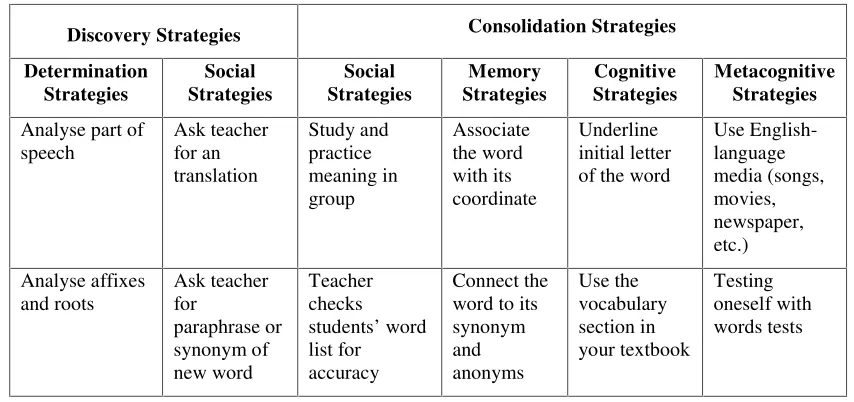
vocabulary size. Schmitt (1997) develops a comprehensive inventory of vocabulary
learning strategies. He divides the strategy into two groups namelydiscovery strategy
and consolidation strategy. Then, he further classifies those strategies into sub
aspects. Discover strategy consists of determination strategy and social strategy while
in consolidation strategies involves social strategy, cognitive strategy, metacognitive
strategy and memory strategy. Catalán (2003) believes that this taxonomy is popular
8
2.1.1. Discovery Strategies
This type of vocabulary learning strategies according to Schmitt (1997) is a strategy
used to infer the meaning of the unknown words. There are two strategies in
discovery. These strategies will be explained as follows:
• Discovery-determination is a strategy used by the learner to discover new words
meaning without another person assist (e.g. analyzing parts of speech, checking for
L1 cognates, guessing from context, and use of bilingual or monolingual
dictionary).
• Discovery-socialis a strategy used by the learner to discover new words by asking
someone for help (e.g. asking the teacher for an L1 translation, asking classmates
for meaning, and discovering meaning through a group work activity).
2.1.2. Consolidation Strategies
Schmitt (1997) says that consolidation strategies are strategies used to consolidate the
meaning of the new word. There are four categories in consolidation strategies. These
strategies will be discussed below.
• Consolidation-social, a strategy where the learners discover the new words by
including in cooperative group learning through which learners study and practice
the meaning of new words in a group (e.g. study and practice word meaning in a
group and interaction with native speakers),
• Consolidation-memory, this strategy relates the word with some previously learned
9
pictorial representation of its meaning, using semantic maps, imaging word form,
using keyword mnemonics, and connecting words to a personal experience),
• Consolidation-cognitive, this strategy is similar to memory strategies but it is not
focused on manipulative mental processing. They include repetition and use
mechanical means (e.g. note-taking, verbal repetition, written repetition, word
lists, flash cards, and keeping a vocabulary journal or notebook)
• Consolidation-metacognitive, it is known as a strategy used by learners to control
and evaluate their own learning, by having an overview of the learning process in
general (e.g. testing oneself with word tests, use of target language media, using
spaced word practice and continuing to study a word over time).
To be more specific, here is Schmitt’s taxonomy classifies vocabulary learning
strategies as in the table below:
11
In conclusion, VLS, being specific actions, behaviours, tactics, or techniques,
facilitate the learning of the target language by the language learner. All language
learners, needless to say, use language learning strategies in the learning process.
Since the factors like age, gender, personality, motivation, self-concept,
life-experience, learning style, excitement, anxiety, etc. affect the way in which
language learners learn the target language, it is not reasonable to support the
idea that all language learners use the same good vocabulary learning strategies to
learn a new word.
2.2. The Role of Vocabulary Learning Strategy in Vocabulary Learning
Nation (2001) states that vocabulary learning strategies are one part of language
learning strategies which in turn are part of general learning strategies. Based on the
principal above, it is clear that vocabulary learning strategy has important role in
vocabulary learning because VLS is helpful in learning vocabulary. Wenden (1998)
12
proficiency have acquired some degree of knowledge about language learning which
influences their approach to language learning and the expectations they hold about
learning strategies and the outcome of their efforts.
Moreover, Oxford (1990) observes that language learning strategies encourage
greater overall self-direction for learners. Self-directed learners are independent
learners who are able to assume responsibility for their own learning and gradually
gaining confidence, involvement and proficiency. Thus, students need training in the
vocabulary learning strategies they need most. Yet Schmitt (1997) claims that
learners are mostly inclined to use basic vocabulary learning strategies. This in turn
makes strategy instruction an essential part of any foreign or second language
program. However, a greater knowledge of vocabulary learning strategies could be
very useful in supporting teachers to plan their lessons more effectively and give
guidance to students in adopting successful strategies. Over the decades, many
researchers have made an effort not only to classify, but also gather, these strategies
in order to support learners’ learning.
The previous researches so far suggest that VLS used by foreign language learners
may vary depending on the learners’ language proficiency and experience with the
target language. It is in line with Schmittt (1997), he finds that less experienced
learners tend to use less learning strategy than the experienced learners. In Schmitt
finding, the experienced learner had more awareness in using vocabulary learning
13
show a pattern of selecting more complex, appropriate, and task-compatible strategies
for learning new words and achieving results comparable to more proficient foreign
language learners. Considering the principles above, vocabulary learning strategy
helps learners to facilitate their learning so that the learner will achieve their aims in
vocabulary learning. Language learners have to be aware of the benefits of conscious
and continuous use of effective vocabulary learning strategies for making learning
quicker and more effective in vocabulary learning.
2.3. Types of Vocabulary
According to Nation (2001), there are two kinds of vocabulary. The type of
vocabulary is divided based on the vocabulary knowledge namely receptive and
productive vocabulary. The types of vocabulary will be discussed below.
1. Receptive Vocabulary
Receptive vocabulary is learners’ words that are generally understood when heard or
read or seen constitute a person's receptive vocabulary. Receptive vocabulary is used
passively in either listening or reading. There are two units of receptive vocabulary as
follow:
a) Listening vocabulary
Listening vocabulary is every word that is used by people that can be recognized
14
before using clues such as tone, gesture, the topic of the discussion, and the social
context of the conversation.
b) Reading vocabulary
Reading vocabulary is every word that people can recognize when reading. This is
generally the largest types of vocabulary simply because reader tends to be exposed
to more words by reading than by listening.
2. Productive vocabulary
Productive vocabulary refers to words which can be produced within an appropriate
context and match the intended meaning of the speaker or signer. Productive
vocabulary is used actively either in speaking or writing. There are two units of
productive vocabulary as follow.
a) Speaking vocabulary
Speaking vocabulary is every word that is used by people in speech. It is likely to be
a subset of the listening vocabulary. Due to the spontaneous nature of speech, words
are often misused. This misused may be compensated by facial expressions, tone of
15
b) Writing vocabulary
Writing vocabulary is every word that is used in numerous forms of writing from
formal essays to twitter feeds. Many written words do not commonly appear in
speech.
In short, there are four units of vocabulary such as listening vocabulary, reading
vocabulary, writing vocabulary, speaking vocabulary and focal vocabulary. Those
kinds of vocabulary are distinctive from the use and the context of the vocabulary.
2.4. Vocabulary Size
Vocabulary size refers to the degree of learners’ vocabulary. Anderson and Freebody
(1981) define vocabulary size as the number of words for which the person knows at
least some the significant aspects of meaning. Based on the statement above,
vocabulary size of learners can be measured statistically. There are some ways to
measure namely token, type, lemma, and word family. Token refers to any running
words that occur in a written or spoken text, typetreats repeated tokens as one word,
lemma includes a headword and its inflected or reduced forms and word family
consists of a headword, its inflected forms, and its closely related derived forms. As
FL (foreign language) learners, the best way to measure their vocabulary size is based
on how many of words that appear in textbooks (Nation 2001). In short, vocabulary
size is the breadth of vocabulary knowledge. It can simply be regarded as the number
16
2.4.1 Word Frequency and Text Coverage
Word frequency refers to how often the word occurs in normal use and text of the
language. Nation (1997) suggests that there are 3 types of word frequency, that is,
high-frequency words, specialized vocabulary (academic words), and low-frequency
words. According to several studies, the high-frequency words approximately have
76.1% to 82.5% text coverage, academic Word Lists (570 word families) represent
8.5% to 10% of the tokens in a wide range of academic texts, and low frequency
words rarely occur in textbooks and have low text coverage. As a general principle,
Nation (1997) indicates that 2,000 word level is enough for productive use in
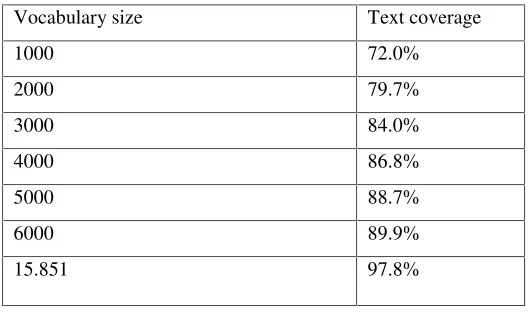
speaking and writing. Here are some figures showing what proportion of a text is
covered by certain number of frequency words:
Table 2. Vocabulary Size and Text Coverage
Vocabulary size Text coverage
1000 72.0%
2000 79.7%
3000 84.0%
4000 86.8%
5000 88.7%
6000 89.9%
15.851 97.8%
Based on the table above high frequency words are known before lower frequency
words. It shows that knowing about 2000 word families gives near to 80% coverage
17
gives greater coverage of informal spoken text. With a vocabulary size of 2000
words, a learner knows 80% of the words in the text.
Based on this opinion, when the students learn English, they must be taught
vocabulary to strengthen their language acquisition from the early beginning step. By
learning vocabulary, the students will not only learn single words of foreign
language, but also set phrases, variable phrases, phrasal verbs, and idioms of foreign
language.
2.5. Vocabulary in the Language Learning
Vocabulary seemed not touched in the teaching and learning English as a Second
Language (ESL) and English as a Foreign Language (EFL) during the period 1940
until 1970 since it had been emphasized too much in language classroom during the
years that time. It was believed that vocabulary was less important than the other
language skills because it did not have ‘content’ or ‘expression’. And in the late
1970s, finally vocabulary has been convinced that it is important skill which should
be learnt in learning English as a Second Langauge and English as a Foreign
Language.
Vocabulary has an important role in developing the students’ competence in
speaking, listening, reading and writing skills. It also can be said that that vocabulary
18
skill. In other words, if the student’s vocabulary is good, they can be good in practice
English too.
In short, vocabulary is a vehicle to communicate orally and writtenly. It means that
learners who intend to have a good speaking and writing, they must master
vocabulary first in order that they can convey the meaning and message of the
expression. Dealing with this opinion, it is deniable that learning English without
vocabulary is nothing since it gives meaning to the English language using.
2.6. Theoretical Assumption
Referring to the frame of the theories, it is assumed that vocabulary learning
strategies have a great contribution in helping learner learns vocabulary and there will
be correlation between vocabulary learning strategy and vocabulary size. In
vocabulary learning, learners who tend to use more vocabulary learning strategies
will be successful in learning foreign language. Successful foreign language learners
know that to learn the form and meaning of a large number of foreign language
words, to be able to store them in their memory and recall them at will, and to learn
how to use them appropriately in a variety of contexts and situations, they will have
to rely on wide ranges of learning strategies.
2.7. Hypothesis
Based on the theoretical assumption above, the researcher formulation of hypothesis
19
- There is a correlation between vocabulary learning strategies and vocabulary size
among English foreign language learners.
This chapter already discussed the literature review of this research which deals with
several points of theories. The next chapter discusses about the method of this
III. METHOD
This chapter discusses some aspects. They are classified like the following:
research design, population and sample, data collecting technique, validity and
reliability, scoring criteria, procedure of data collecting technique, data analysis
and hypothesis test.
3.1. Design
In this research, the researcher would find out the correlation between vocabulary
learning strategy and vocabulary size. This research would take the vocabulary
size as the dependent variable and vocabulary learning strategy used by learners
as the independent variable. According to Setiyadi (2006), the design of the
research was as follows:
T1
→
T2
Where:
T1 = Vocabulary learning strategy
T2 = Vocabulary size
3.2. The Variables
21
1. The students’ vocabularysize (Y), and
2. Students’vocabulary learning strategy (X)
3.3. Population and Sample
In this research, the students of the second grade at MAN 1 Bandar Lampung
would be taken by the researcher as the population. There are eleven classes of the
second grade. The number of the students of each class is approximately 40
students. Three classes namely XI IIS 2, XI MIA 2, and XI MIA 4 of second
grade at the MAN 1 Bandar Lampung would be used by the researcher as the
subject to collect the data.
3.4. Data Collecting Techniques
In collecting the data, the researcher used:
1. Questionnaire
After deciding the subject, the researcher would give the questioner to the subject.
To find out what type of vocabulary learning strategies they use. There were
several questions and the students had to checklist the optional honestly.
2. Vocabulary Size Test
This step was done after the researcher had given the questioner to the subject.
22
3.5. Instruments
This current study would use two instruments, that was, vocabulary learning
strategy questionnaire and vocabulary size test.
3.5.1. Vocabulary Learning Strategy Questionnaire
This questionnaire required 30 minutes to be answered.The questionnaire items
were intended to measure the VLS preferences under five categories of strategies,
i.e, determination, social, memory, cognitive, and metacognitive strategies. The
questionnaire instruments consisted of 30 items, there would be 6 questions for
each strategy. It was designed specifically based onSchmitt‘s (1997) taxonomy of
L2 vocabulary learning and used by the previous research by Kallayanasute
(2011). The questionnaire test given to the students had been translated into
Indonesian in order to facilitate the students in understanding the questionnaire.
After deciding the subject, the researcher gave the questionnaire to the sample. In
addition, the result of the questionnaire was scored based on Likert Scale. The
scores ranged from 1-5. There are five options to answer the question in one item
of questionnaire. They are 1 (never use it), 2 (seldom use it), 3 (sometimes use it),
4 (often use it), and 5 ( always use it ). The following scales were used to indicate
the frequency of the usage of each strategy:
Directions:
• This of vocabulary learning strategies is designed for students who learn
English as a foreign language. You will find about vocabulary learning
23
• Put (√) in the box (4, 3, 2, 1, or 0) that tells the degree of opinion on the
strategies you use to learn English vocabulary. Please mark the statement that
most describe you.
0 = never use it
1 = seldom use it
2 = sometimes use it
3 = often use it
4 = always use it
3.5.2. Vocabulary Size Tests
Receptive Vocabulary Level Test (RVLT) which was originally created by Nation
(1983; 1990), revised and expanded by Schmitt, and Clapham (2001) would be
used by the researcher. It is considered that RVLT is as a ‘nearly’ standard test
since there is no truly standard test for vocabulary. This test categorizes the
knowledge of vocabulary based on the word frequency: 2,000 word level, 3,000
word level, 5,000 word level, and 10,000 word level.
Normally, in curriculum, there is a core, basic competence and goal that define
that in second grade of senior high school students, the students must achieve
3000 words of vocabulary. It is in line with Senior High School English
Curriculum Guidelines (1996) that senior high school students are expected to
24
The test would be given to the subject of in order to measure their vocabulary
size. The receptive version of VLT named RVLT was created to measure a
controlled receptive vocabulary. The test is a mixed version of the original new
version of Vocabulary Size Test designed by Schmitt and Clapham (2000). The
format of the test is like the following example (with the expected answers):
The test aimed to measure receptive vocabulary size through word recognition.
Basically, to measure word knowledge, it includes spelling, word associations,
grammatical information and multiple meanings of the target words. This test
does not measure deep lexical knowledge because according to Nation (1990),
word recognition measures only taps into a small part of the complexity of the
vocabulary knowledge of any given language learners, a word recognition count
can be a useful indication of the outer limits of the learner’s vocabulary
knowledge.
3.6. Validity of the Instrument
Generally, the validity of a test shows how far the test measures what is supposed
to be measured (Setiyadi, 2006). Validity can be defined as the degree to which a
25
3.6.1 The Validity of Questionnaire
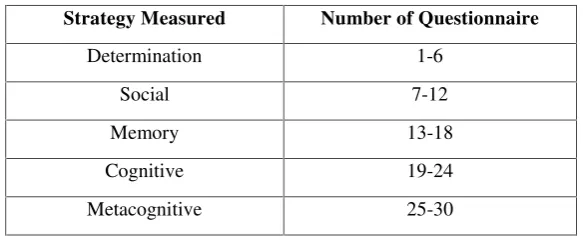
The composition of the questionnaire items was presented in the table of
specification below.
Table 3. Specification of VLS Questionnaire
Strategy Measured Number of Questionnaire
Determination 1-6
Social 7-12
Memory 13-18
Cognitive 19-24
Metacognitive 25-30
Table 3. showed that all of aspects of vocabulary learning strategies had been
included in the questionnaire. Thus, it was considered that the construct validity of
the questionnaire had been standardized.
3.6.2 The Validity of Vocabulary Test
Validity is a matter of relevance. It can be said that validity is the test measures
what is claimed to measure. To measure whether or not, the test is good. It can be
analyzed from its content validity and construct validity. The construct validity of
VLT was analyzed by Schmitt, and Clapham’s (RVLT) Laufer and Nation’s
(PVLT).
The analysis of validity by using Pearson Product Moment formula showed that
all items in the questionnaire of vocabulary learning strategies were valid
26
Therefore, the questionnaire was used completely as what had originally been
conducted from the previous research (Kallayanasute, 2011).
3.7. The Reliability of the Instruments
Reliability is the overall consistency of a measure. A measure is said to have a
high reliability if it produces similar results under consistent conditions.
3.7.1 The Reliability of the Questionnaire
The questionnaire was scored according to Likert scale and the reliability of the
questionnaire was measured by using Cronbach Alpha Coefficient, since it is the
most common scoring to assess the consistency of the indicators in the
questionnaire. Having analyzed the items, the computation showed the reliability
coefficient of the questionnaire was 0,809.
Table 4. The Reliability of Questionnaire
Reliability Statistics
Cronbach's Alpha
Cronbach's Alpha Based on Standardized
Items N of Items
.809 .800 30
The Cronbach’s Alpha score was 0.809 meaning that all items were reliable and
that the questionnaire could be used to investigate the students’ vocabulary
learning strategies see (Appendix 6). As Nunally (1978) offered a rule of thumb
27
3.7.2 The Reliability of Vocabulary Test
The split-half method was used to estimate the reliability. The test was classified
into two similar parts (the odd-numbered items and the even-numbered items). By
splitting the test into two similar parts, it was supposed as if the whole tests had
been taken twice. The calculation showed that the reliability coefficient of the test
was = 0,847 (Appendix 7). This instrument was regarded as a very high reliable
test to be used in the research since the range of very high criteria in the criteria of
reliability was 0.80–1.00 (Arikunto, 1998: 260).
3.8. The Difficulty level of the Test Items
Difficulty level relates to how easy or difficult the item is from the point of view
of the students who take the test. It is important since the items, which are too
easy (that students get right) can tell us nothing about differences within the test
population. To see the level difficulty, the research used the formula as follow:
R
LD =
N
in which:
LD : Level of Difficulty
R : the number of students who answer correctly
N : the total of students following the test
28
• Less than 0.30 = difficult
• 0.30-0.70 = middle (good item)
• More than 0.70-1.00 = easy
(Shohamy, 1985)
Based on the statements above, it is clear that all the test item should base on the
criteria above and the items which do not fulfill the requirements should be
omitted or revised.
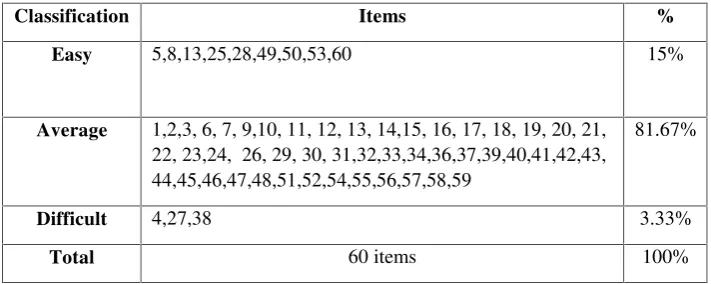
The result of difficulty level of the vocabulary size try-out test showed that there
were 9 easy items, 48 average items, and 3 difficult items in this instrument.
Below is the table displaying the difficulty level of the vocabulary size try-out
test.
Table 5. Difficulty Level of the Vocabulary Size Try-out Test
Classification Items %
Easy 5,8,13,25,28,49,50,53,60 15%
Average 1,2,3, 6, 7, 9,10, 11, 12, 13, 14,15, 16, 17, 18, 19, 20, 21, 22, 23,24, 26, 29, 30, 31,32,33,34,36,37,39,40,41,42,43, 44,45,46,47,48,51,52,54,55,56,57,58,59
81.67%
Difficult 4,27,38 3.33%
Total 60 items 100%
3.9. Discrimination Power of the Test
Discrimination power refers to the extent to which the item differentiates between
high and low level students on the test. A good item according to this criterion is
29
calculate the discrimination power (DP) of the test items, the following formula
was used by the researcher:
In which,
DP: Discrimination Power
U: the total of correct answer of the higher group
L: the total of correct answer of the lower group
N: total number of students
(Shohamy, 1985)
The criteria are:
0.00- 0.20 = Poor
0.21- 0.40 = Satisfactory
0.41- 0.70 = Good
0.70- 1.00 = Excellent (should be omitted)
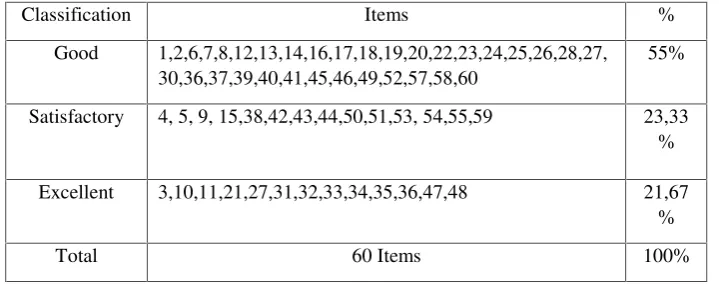
The Discrimination Power of the vocabulary size try-out test showed that there
were 33 good items, 14 satisfactory items, and 13 excellent items. The following
table presents the distribution of discrimination power of this instrument.
Table 6. Discrimination Power of Vocabulary Size Try-out Test
Classification Items %
Good 1,2,6,7,8,12,13,14,16,17,18,19,20,22,23,24,25,26,28,27, 30,36,37,39,40,41,45,46,49,52,57,58,60
55%
Satisfactory 4, 5, 9, 15,38,42,43,44,50,51,53, 54,55,59 23,33
%
Excellent 3,10,11,21,27,31,32,33,34,35,36,47,48 21,67
%
30
Due to the analysis result on the difficulty level and the discrimination power
described above, the test would be administered by the researcher to measure the
students’ vocabulary size.
3.10. Scoring System
In scoring students’ result of the test, Percentage Score was used. The ideal
highest score was 100. The score of vocabulary size calculated by using as follow:
S= ×100
Where:
S = the score of the test
r = the total of the right answer
n = the total of test items
3.11. Research Procedures
To conduct the research, some procedures would be used by the researcher. It
started from determining the research problem to making a report and discussion
of findings. The procedures of the research were as follows:
1. Constructing the instruments for getting appropriate test items.
2. Selecting the population and sample for getting appropriate test items.
3. Trying of two kinds of the instruments (test of vocabulary size and vocabulary
learning strategies questionnaire) in order to check its validity, reliability,
difficulty level and discrimination power.
4. Identifying which test items that appropriate for getting the data (see from the
31
5. Giving those tests to the students in order to identify the vocabulary size and
the use of vocabulary learning strategies.
6. Scoring the students’ test in order to find how far the students can answer all
the test items.
7. After getting all the data, the researcher will analyze the data by using SPSS to
know the result.
8. The last, making the conclusion of the research.
3.12. Data Analysis
Some steps had been made before the research was conducted by using tests, the
Correlation in SPSS (Statistical Program for Social Science) would be used as the
tool to analyze the data. The data would be taken by looking at the result of test of
vocabulary size and questionnaire of vocabulary learning strategies. The result of
the test would be in form of score or interval data. The correlation between
students’ vocabulary learning strategies and their vocabulary size would be
analyzed at last.
3.13. Hypothesis Testing
After finding the coefficient correlation between vocabulary learning strategy and
vocabulary size, the researcher used the criterion of hypothesis acceptance. The
32
H0=rvalue< rtable
• There is no correlation between the use of vocabulary learning strategy
and vocabulary size among English foreign language learners. We can
accept this hypothesis if rvalueis lower than rtable.
H1=rvalue>rtable
• There is correlation between the use of vocabulary learning strategy and
vocabulary size among English foreign language learners. We can accept
this hypothesis if rvalueis higher than rtable.
This chapter has explained the overview of research design, population and
sample, instrument, criteria of good vocabulary learning strategies questionnaire
and vocabulary size test, research procedure, data analysis, hypothesis testing that
would be applied in this research. The next chapter discusses about result and
V. CONCLUSIONS AND SUGGESTIONS
This chapter offers the conclusions of the research findings and suggestions for
futher research.
5.1. Conclusions
This study provides evidence that vocabulary learning strategies can play a role in
learning vocabulary. This is in line with Schmitt’s (1997) claim that learners in
the context of vocabulary learning are mostly inclined to use basic vocabulary
learning strategies which in turn make strategy instruction an essential part of
any foreign or second language program.
However, vocabulary learning strategies were not sufficient to account for
students’ performance in learning vocabulary. Instead, students’ level of
proficiency also played an important role in performance.
5.2. Suggestions
Referring to the conclusion above, some suggestions could be listed as follows:
5.2.1. For the Teachers
Explicit vocabulary strategy instruction should be embedded into regular activities
48
vocabulary learning strategies they might use in order to improve their own
vocabulary size. Cohen (2002) suggest that strategy training should be integrated
into the language curriculum under the guidance of the teacher and should be
implemented into the language lessons in forms of various activities and tasks
where a wide range of strategies are practiced.
Furthermore, social strategies are recommended to be highlighted in teaching and
learning vocabulary as it has a possitive correlation with students’ vocabulary
size. This training also helps shift the role from teachers to the students, in which,
as stated in Nation’s (2008) Four-Strands Approach, the teacher’s main job
involves planning lessons and training students’ vocabulary learning strategies,
while the students’ main jobs are to take active responsibility for their own
vocabulary learning.
Finally, training program should contain few steps such as: identifying student
population and their needs, introducing strategies, practicing using different
strategies and designing appropriate classroom activities.
5.2.2. For Further Researchers
This research was limited by the sample size. So the result should not be
generalized into all contexts of situation since this result was probably compatible
in certain field but not in the others. Therefore, further research on vocabulary
learning strategies should try to investigate with random subjects, bigger sample
49
Further research will be better to conduct deep investigation on the process of
vocabulary learning strategies by adding variables such as learning style,
REFERENCES
Ahmed, M. 1989. Vocabulary learning strategies. In P. Meara (Ed.), British studies in applied linguistics: Vol. 4. Beyond words (pp. 3-14). London: British Association of Applied Linguistics/Center for Language Teaching.
Alhaysony, M. 2012. Vocabulary Discovery Strategy Used by Saudi EFL Students in an Intensive English Language Learning. context. International Journal of Linguistics, 4(2), (pp. 518-535).
Anderson, Richard C. and Peter Freebody. 1981. "Vocabulary Knowledge."
Comprehension and Teaching: Research Reviews. Ed. John T. Guthrie. Newark, DE: International Reading Association, (pp. 77-117).
Anderson, N. 2005. L2 strategy research. In E. Hinkel (Ed.), Handbook of research in second language teaching and learning (pp. 757-772). Mahwah, NJ: Lawrence Erlbaum Associates.
Arikunto, S. 1998. Prosedur Penelitian Suatu Pendekatan Praktek. Jakarta: Rineka Cipta.
Barcroft, J. 2009. Strategies and performance in intentional L2 vocabulary learning. Language Awareness, 18(1), (pp. 74-89).
Baumann, J., Kame‘enui, E., & Ash, G. 2003. Handbook of research on teaching the English language arts. In J. Flood, D. Lapp, J. Squire & J. Jensen (Eds.),
Research on vocabulary instruction: Voltaire redux (2nd ed., pp. 1128): Lawrence Erlbaum.
Borer, L. 2007. Depth of processing in private and social speech: Its role in the retention of word knowledge by adult EAP learners. Canadian Modern Language Review, 64(2), (pp. 269-295).
Catalán, R. 2003. Sex differences in L2 vocabulary learning strategies.
International Journal of Applied Linguistics, 13(1), (pp. 54-77).
Cook, V. 1986. Experimental Approaches to Second Language Teaching. Pergamon Press.
Fan, M. 2003. Frequency of use, perceived usefulness, and actual usefulness of second language vocabulary strategies: A study of Hong Kong learners.
Modern Language Journal, 87(2), (pp. 222-241).
Folse, K. 2010. Is explicit vocabulary focus the reading teacher’s job? Reading in
a Foreign Language, 22, (pp. 139-160). Retrieved from
http://nflrc.hawaii.edu/rfl/April2010/articles/folse.pdf
Gu, Y. 2002. Gender, academic major, and vocabulary learning strategies of Chinese EFL learners. Regional English Language Centre Journal, 33(1), (pp. 35).
Gu, Y., & Johnson, R. 1996. Vocabulary learning strategies and language learning outcomes. Language Learning, 46(4), (pp. 643-679).
Hatch, E and Farhady, H. 1982. Research Design and Statistic for Applied Linguistic. London: New Burry House, Inc.
Kallayanasute, C. 2011. A Study of VLS Used by Graduated Students at
Thammasat University. Bangkok, Thailand. Thammasat University Press.
Lado, R. 1997. Language Testing: The Construction and Use of Foreign
Language Test. London: Longman Group.
Lawson, M., & Hogben, D. 1996. The vocabulary-learning strategies of foreign-language students. Language Learning, 46(1), (pp. 101-135).
McCarthy, M. 1990. Vocabulary. Oxford: Oxford University Press.
Milton, J. 2009. Measuring second language vocabulary acquisition. Bristol, UK: Multilingual Matters.
Mongkol, N 2008. A Study of Vocabulary Learning Strategies of The First and Second Year Students from English Department at Phetchaburi Rahabhat University.Unpublished Master’s thesis, Kasetsart University, Thailand
Nation, P. 1997. Vocabulary Size, Text Coverage, and Word Lists. Cambridge: Cambridge University Press, (pp. 6-19).
Nation, P. 2001. Learning vocabulary in another language. New York: Cambridge University Press.
Nation, P. 2001. Learning Vocabulary in Another Language. Ed. Michael H. Long and Jack C. Richards. Cambridge: Cambridge University Press.
Nur, C. 2004. English Language Teaching in Indonesia: Changing Policies and Political Constrains. In H. W. Kam & R. Y. L. Wong. (Eds.), English language teaching in East Asia today: changing policies and practices (pp. 178-194). Singapore: Eastern Universities Press.
Oxford, R. L. 1990. Language learning strategies: What every teacher should know. New York: Newbury House.
Oxford, R. 2003. Toward A More Systematic Model Pf L2 Learner Autonomy. In Palfreyman, P., and Smith, R. (Eds.), Learner Autonomy Across Cultures: Language Education Perspectives (pp. 75-91). Great Britain: Palgrave Macmillan.
Oxford, R. 2004. Language learning styles and strategies: An overview. GALA. Retrieved August, 2010 from http://web.ntpu.edu.tw/~language/workshop/ read2.pdf
O’Malley, J. M., & Chamot, A. 1990. Learning strategies in second language acquisition (The Cambridge Applied Linguistics Series). Cambridge: Cambridge University Press.
Rubin, J. 1987. Learner strategies: Theoretical assumptions, research history and typology. In A. Wenden & J. Rubin (Eds.), Learner strategies and language learning. Englewood Cliffs: Prentice Hall.
Sahbazian, S. 2004. Perceived vocabulary learning strategies of Turkish University students. Unpublished doctoral thesis.
Senior High School English Curriculum Guidelines. 1996. London: Oxford University Press.
Setiyadi, B. 2006. Metode Penelitian Pengajaran Bahasa Asing. Yogyakarta. Graha Ilmu.
Schmitt, N., & McCarthy, M. (Eds). 1997. Vocabulary, description, acquisition, and pedagogy: Vocabulary learning strategies. Cambridge: Cambridge University Press.
Schmitt, N. 2000. Vocabulary in language teaching. New York, NY: Cambridge University Press.
Schonell, F.J., Meddleton, I.G. & Shaw, B.A. 1956. A study of the oral vocabulary of adults. Brisbane: University of Queensland Press.
Retrieved March 30, 2015, from http://tesl-ej.org/ej26/a3.html
Shohamy, E. 1985. A Practical Handbook in Language Teaching for Second Language. Tel Aviv: Raanana.
Tseng, W.-T., & Schmitt, N. 2008. Toward a model of motivated vocabulary learning: A structural equation modeling approach. Language Learning, 58(2), (pp. 357-400).
Waldvogel, D. 2013. The Relationships between Vocabulary Learning Strategies and Vocabulary Size among Adult Spanish Foreign Language Learners.
Journal of Language Teaching and Research, Vol. 4, No. 2, (pp. 209-219).
Wenden, A. 1991. Learning strategies for learner autonomy: Planning and implementing learner training for language learners. London: Prentice.