TRANSLATION TECHNIQUES BETWEEN THE TRANSLATION OF ENGLISH NOVEL COCO SIMON’S CUPCAKE DIARIES 2: MIA IN THE
MIX INTO BAHASA INDONESIA AND THE TRANSLATION OF INDONESIAN NOVEL ANDREA HIRATA’S LASKAR PELANGI INTO
ENGLISH
A THESIS
BY
FATIMAH RIZKI REG. NO. 100705035
DEPARTMENT OF ENGLISH FACULTY OF CULTURAL STUDIES UNIVERSITY OF SUMATERA UTARA
TRANSLATION TECHNIQUES BETWEEN THE TRANSLATION OF ENGLISH NOVEL COCO SIMON’S CUPCAKE DIARIES 2: MIA IN THE
MIX INTO BAHASA INDONESIA AND THE TRANSLATION OF INDONESIAN NOVEL ANDREA HIRATA’S LASKAR PELANGI INTO
ENGLISH
A THESIS BY
FATIMAH RIZKI REG. NO.100705035
SUPERVISOR CO-SUPERVISOR
Dr. Roswita Silalahi, Dip. TESOL M. Hum Dra. Roma Ayuni Lubis, MA NIP. 19540528 198303 2 001 NIP. 19680122 199803 2 001
Submitted to Faculty of Cultural Studies University of Sumatera Utara Medan in partial fulfillment of the requirements for the degree of Sarjana Sastra from
Department of English
DEPARTMENT OF ENGLISH FACULTY OF CULTURAL STUDIES UNIVERSITY OF SUMATERA UTARA
Approved by the Department of English, Faculty of Cultural Studies University of Sumatera Utara (USU) Medan as thesis for The Sarjana Sastra Examination.
Head, Secretary,
Accepted by the Board of Examiners in partial fulfillment of requirements for the degree of Sarjana Sastra from the Department of English, Faculty of Cultural Studies University of Sumatera Utara, Medan.
The examination is held in Department of English Faculty of Cultural Studies University of Sumatera Utara on Thursday, 17th July 2014
Dean of Faculty of Cultural Studies University of Sumatera Utara
Dr. H. Syahron Lubis, M.A. NIP. 19511013 197603 1 001
Board of Examiners
Dr. H. Muhijar Muchtar, M.S ……….
Rahmadsyah Rangkuti, M.A. Ph.D ……….
Dr. Ridwan Hanafiah, SH. MA ……….
Dr. Roswita Silalahi, Dip. TESOL M. Hum ……….
Dr. Eddy Setia, M. Ed. TESP ……….
AUTHOR’S DECLARATION
I, FATIMAH RIZKI DECLARE THAT I AM THE SOLE AUTHOR OF THIS THESIS EXCEPT WHERE REFERENCE IS MADE IN THE TEXT OF THIS THESIS. THIS THESIS CONTAINS NO MATERIAL PUBLISHED ELSEWHERE OR EXTRACTED IN WHOLE OR IN PART FROM A THESIS BY WHICH I HAVE QUALIFIED FOR OR AWARDED ANOTHER DEGREE. NO OTHER PERSON’S WORK HAS BEEN USED WITHOUT DUE ACKNEWLEDGEMENT IN THE MAIN TEXT OF THIS THESIS. THIS THESIS HAS NOT BEEN SUBMITTED FOR THE AWARD OF ANOTHER DEGREE IN ANY TERTIARY EDUCATION.
Signed:
COPYRIGHT DECLARATION
NAME : FATIMAH RIZKI
TITLE OF THESIS : TRANSLATION TECHNIQUES BETWEEN THE TRANSLATION OF ENGLISH NOVEL COCO SIMON’S CUPCAKE DIARIES 2: MIA IN THE MIX INTO BAHASA INDONESIA AND THE TRANSLATION OF INDONESIAN NOVEL ANDREA HIRATA’S LASKAR PELANGI INTO ENGLISH
QUALIFICATION : S-1/SARJANA SASTRA
DEPARTMENT : ENGLISH
I AM WILLING THAT MY THESIS SHOULD BE AVAILABLE FOR REPRODUCTION AT THE DISCREATION OF THE LIBRARIAN OF DEPARTMENT OF ENGLISH, FACULTY OF CULTURAL STUDIES, UNIVERSITY OF SUMATRA UTARA ON THE UNDERSTANDING THAT USERS ARE MADE AWARE OF THEIR OBLIGATION UNDER THE LAW OF THE REPUBLIC OF INDONESIA.
Signed:
ACKNOWLEDGEMENTS Bismillahirrohmanirrohim,
Alhamdulillahirobbil’alamin, I would like to thank and praise Allah SWT for giving me everything I need especially to finish this thesis in order to get the degree of Sarjana Sastra from the Department of English, Faculty of Cultural Studies University of Sumatera Utara.
I would like to thank the Dean of Faculty of Cultural Studies, Dr. Syahron Lubis, M.A., the Head of English Department, Dr. H. Muhizar Muchtar, MS., and the secretary of English Department, Rahmadsyah Rangkuti, M.A. Ph.D. I also would like to thank my supervisor, Dr. Roswita Silalahi, Dip. TESOL M. Hum and my co-supervisor Dra. Roma Ayuni Lubis, M.A., my examiners Dr. Eddy Setia, M. Ed. TESP and Dr. Ridwan Hanafiah, SH. MA and also for all my lecturers.
Special thanks to my family, espescially for my mother, my uncles and my aunts, for every support for me so I can finish my study in the university. Thanks to all my friends, espescially Mitha, Sonya, Fani and Ayu and my teachers of life, Kak Linda, Kak Emma, Kak Putri and Kak Dian for every help and advice for me.
I have written this thesis with all my limitation of knowledge, time and references but I do hope this thesis will be useful for anyone who read it.
Medan, 21st July 2014
ABSTRAK
ABSTRACT
TABLE OF CONTENTS
AUTHOR’S DECLARATION ... i
COPYRIGHT DECLARATION ... ii
ACKNOWLEDGEMENTS ... iii
ABSTRAK ... iv
ABSTRACT ... v
TABLE OF CONTENTS ... vi
CHAPTER I INTRODUCTION ... 1
1.1. Background of the Study ... 1
1.2. Problem of the Study ... 5
1.3. Objective of the Study ... 5
1.4. Scope of the Study... 5
1.5. Significance of the Study ... 6
CHAPTER II REVIEW OF LITERATURE ... 7
2.1 Definition of Translation ... 7
2.2 Translation Process ... 8
2.3 Translation Techniques ... 9
2.4 Couplets ... 12
2.5 Translation Techniques As Tool For Analysis... 12
2.6 Related Studies ... 13
CHAPTER III METHOD OF RESEARCH ... 14
3.1 Research Design ... 14
3.2 Data and Sources of Data ... 14
3.4 Steps of the research ... 16
3.5 Data Analysis ... 17
CHAPTER IV ANALYSIS AND FINDING ... 18
4.1 Analysis ... 18
4.1.1 The Translation Techniques in the Translation of English Novel into Bahasa Indonesia (MTM – MCG) ... 18
4.1.1.1 Amplification ... 18
4.1.1.2 Borrowing ... 18
4.1.1.3 Compensation ... 19
4.1.1.4 Description ... 20
4.1.1.5 Established Equivalent ... 20
4.1.1.6 Generalization ... 21
4.1.1.7 Linguistic Amplification ... 22
4.1.1.8 Linguistic Compression ... 23
4.1.1.9 Literal Translation ... 24
4.1.1.10Modulation ... 24
4.1.1.11Reduction ... 25
4.1.1.12Transposition ... 26
4.1.2 The Translation Techniques in the Translation of Indonesian novel into English (LP – TRT) ... 28
4.1.2.1 Amplification ... 28
4.1.2.2 Borrowing ... 29
4.1.2.3 Calque ... 30
4.1.2.5 Description ... 31
4.1.2.6 Discursive Creation ... 32
4.1.2.7 Established Equivalent ... 33
4.1.2.8 Generalization ... 34
4.1.2.9 Linguistic Amplification ... 35
4.1.2.10Linguistic Compression ... 36
4.1.2.11Literal Translation ... 37
4.1.2.12Modulation ... 37
4.1.2.13Particularization ... 38
4.1.2.14Reduction ... 38
4.1.2.15Transposition ... 89
4.2 Findings ... 40
CHAPTER V CONCLUSIONS AND SUGGESTIONS ... 47
5.1 Conclusions ... 47
5.2 Suggestions ... 50
REFERENCES ... 51 APPENDIX 1: ENGLISH – BAHASA INDONESIA (MTM – MCG)
ABSTRAK
ABSTRACT
CHAPTER I INTRODUCTION 1.1 Background of the Study
Many people use English beside their native language, but not all of them able
to do translation both in written and spoken from English to their native language or vice versa. The reason is simple; translation is a difficult thing although we master
both of the source language and the target language. Some factors of the difficulty according to Nababan (1999:55) are the different language system between source language and target language, the semantic and stylistic complexity of source
language and target language, the different ability of translator and the quality of source text writing. We could see that no translation can bring the totally same
message and structure from the original text.
That is why we have to study first how to do good a translation before make a translation. One way to study how to make a translation is by analyzing a translation
product. One way to analyze a translation product is by analyzing the translation techniques the translator used in his/ her translation as Molina and Albir (2002:499)
state in their article:
We needed the category of translation techniques that allowed us to describe the actual steps taken by the translators in each textual micro-unit and obtain clear data about the general methodological option chosen.
It means analyzing the translation technique will make clear the steps of translating.
categories so different labels are used, they are: procedures, techniques and strategies
(Molina and Albir, 2002: 499).
It can’t be denied that translation is an important thing. Newmark (1988:7) even said that translation is a means of communication. And as a means of
communication, translation is used for multilingual notices; for instructions issued by exporting companies; for tourist publicity; for official documents, such as treaties
and contracts; for reports, papers, articles, correspondence, textbooks to convey information, advice and recommendations for every branch of knowledge (Newmark, 1998:7).
Other uses of translation are first, translation has been instrumental in transmitting culture, sometimes under unequal conditions responsible for distorted
and biased translations, ever since countries and languages have been in contact with each other. Then, as a technique for learning foreign languages, translation is a two-edged instrument: it has the special purpose of demonstrating the learner’s
knowledge of the foreign language, either as a form of control or to exercise his intelligence in order to develop his competence. This is its strong point in
foreign-language classes, which has to be sharply distinguished from its normal use in transferring meanings and conveying messages (Newmark, 1988:7).
As we know, translation is not a new thing. It has a very long history. In Egypt,
at one century BC, the people chiseled hieroglyph writing in Rosetta stone with its translation in Ancient Greek. This translation is the most famous translation of the
past. In the history of Arabic society, we know Baghdad as a translation city. In this city, the works of Aristotle, Plato, Galen, Hippocrates, Panini from India and others were translated into Arabic. Because of that activity, the Arabic society led the
Mataram and Kahuripan kingdom, the literary work of Indian people like Ramayana
and Mahabharata was translated into Indonesian people’s language. After the Independence Day, many foreign erudition and literary works are translated into Indonesian (Yusuf, 1994:33-34).
The purpose of translation is to reproduce various kinds of texts—including religious, literary, scientific, and philosophical texts—in another language and thus
making them available to wider readers (Ordudari in Zainurrahman, 2009:121). Throughout any kind of literary texts, novel is one of popular reading for people and is one of writing that is often translated. Because of there are so many effort in
translation, we can read the novels from over the world. There are some benefits in reading novels from other country, among other things, to understand the culture of
the society, to expand our knowledge, to study their literary works, and etc. Watson (2013) says, “Reading novels is an excellent way of getting to know something about a country when one is newly arrived, doesn’t know much about it, and is going to be
spending some time there.”
This thesis analyzes the translation techniques between the translation of
English novel into bahasa Indonesia and Indonesian novel into English. From the analysis, the writer concludes how the comparison of the translation techniques of the two translation novels is. So, we will know how are the comparison of translation
techniques of the translation of English novel into bahasa Indonesia and Indonesian novel into English. Will it be different when the source text and the target text are
changed or not.
To be the object of the analysis, the writer chooses one novel from Coco Simon titled Cupcake Diaries 2: Mia in the Mix and the Indonesian translation of this novel
novel, the writer chooses a very popular novel from Andrea Hirata, Laskar Pelangi,
and the English translation of this novel by Angie Kilbane The Rainbow Troops. These two novels are talking about children, school and friendship. Cupcake Diaries is a teen novel series which talk about 4 Middle School students, Katie, Mia,
Emma and Alexis. These four characters form a club in their Middle School named Cupcake Club. They name their club Cupcake Club because they love cupcake and
love making cupcake and their rule in the club is every Friday one of the members should brings cupcakes to eat at lunch.
The main character of each Cupcake Diaries series is one member of Cupcake
Club. The main character of the first series is Katie, the second is Mia, the third is Emma, the fourth is Alexis, the fifth back to Katie, and soon. Mia in the Mix is the
second novel from eighteen series of Cupcake Diaries. The main character is Mia Velaz-Cruz, a girl who loves fashion so much. In the Middle School there is another club named PGC (Popular Girls Club) which always talk about fashion. So when the
PGC takes interest in Mia’s awesome fashion style and wants to recruit her, Mia has to decide between them and her Cupcake Club. The writer choose this novel because
this novel is a new novel (the original is printed on 2011 and the translation is printed on 2013) and has a good translation.
Laskar Pelangi by Andrea Hirata talks about the real story of the writer. Andrea
Hirata or usually called Ikal, studies in a very poor school in Belitong Island with his ten friends. There are so many bittersweets they experience during their school age
1.2 Problem of the Study
There are three problems in this thesis, they are:
1. What are the translation techniques applied in the translation of English novel Coco Simon’s Cupcake Diaries 2: Mia in the Mix into its translation in bahasa
Indonesia Cupcake Diaries 2: Mia dan Cupcake Galau?
2. What are the translation techniques applied in the translation of bahasa Indonesia
novel Andrea Hirata’s Laskar Pelangi into its translation in English The Rainbow Troops?
3. How is the comparison of translation technique between the two translation
novels?
1.3 Objective of the Study
The objectives in doing this analysis are:
1. To see what translation techniques applied in the translation of English novel
Coco Simon’s Cupcake Diaries 2: Mia in the Mix into its translation in bahasa Indonesia Cupcake Diaries 2: Mia dan Cupcake Galau.
2. To see what translation techniques applied in the translation of bahasa Indonesia novel Andrea Hirata’s Laskar Pelangi into its translation in English The Rainbow Troops.
3. To see how is the comparison of translation technique between the two translation novels.
1.4 Scope of the Study
The scope of the study is the translation techniques applied by the translator of
Cupcake Diaries 2: Mia dan Cupcake Galau and by the translator of Andrea Hirata’s
Laskar Pelangi in translate the novel into The Rainbow Troops. The theory of the
translation techniques is Molina and Albir theory (2002). The analysis focuses on the comparison of the translation techniques applied in both novels. The writer takes
sample for this analysis. The samples are the chapter 1 and chapter 2 of each novel.
1.5 Significance of the Study The significances expected are:
1. The reader will know the comparison of the translation technique applied between the translation of English novel into bahasa Indonesia and Indonesian novel into English.
CHAPTER II
REVIEW OF LITERATURE 2.1 Definition of Translation
What is translation? According to Munday (2001:4), the term translation has
several meanings: it can refer to the general subject field, the product (the text that has been translated) or the process (the act of producing the translation, otherwise
known as translating). In here, we will talk about translation as a process. The process of translation between two different written languages involves the translator changing an original written text (the source text or ST) in the original verbal
language (the source language or SL) into a written text (the target text or TT) in a different verbal language (the target language or TL) (Munday, 2001:4-5).
Catford (1978:20) defines translation as the replacement of textual material in one language (SL) by equivalent textual material in another language (TL). Translation according to Newmark (1988:5) is rendering the meaning of a text into
another language in the way that the author intended the text. Larson (1988:3) stated that translation consists of transferring the meaning of the source language into the
receptor language (target language). While Dubois (in Bell, 1991:5) said that translation is the expression in another language (or target language) of what has been expressed in another, source language, preserving semantic and stylistic
equivalences.
Larson (1998:3) explains that translation is done by going from the form of the
first language to the form of a second language by way of semantic structure. It is meaning which is being transferred and must be held constant. Only the form changes. The form from which the translation is made will be called the source
language (target language). Translation, then, consist of studying the lexicon,
grammatical structure, communication situation, and cultural context of the source language text, analyzing it in order to determines its meaning, and then reconstructing this same meaning using the lexicon and grammatical structure which
are appropriate in the receptor language and its cultural context.
2.2 Translation Process
Nababan (1999:24) defines the translation process as a series of activity which are done by a translator when he transfers the message of a source txt into the target
text. Translation process can also be defined as a system of activity in translating activity.
The processes of translation according to Nida (in Hatim, 2005:22) are: analysis, transfer and restructuring. As Nida (in Hatim, 2005:22) says, “the translator first analyses the message of the source language into its simplest and structurally clearest
forms, transfers it at this level, and then restructures it to the level in the receptor language which is most appropriate for the audience which he intends to reach.”
1. Analysis
Analysis begins with a set of procedures which are employed in ‘discovering the kernels underlying the source text and the clearest understanding of the meaning, in
preparation for the transfer’ (Nida and Taber in Hatim, 2005:22). Kernels are the basic structural elements to which syntactically more elaborate surface structures of a
language can be reduced. Underlying the procedure of kernel analysis is a theory of semantics: kernels are realized by sequences of items belongings to four basic categories:
• event words (including actions represented by verbs)
• abstracts (words relaying features of objects, events, other abstracts)
• relationals (linguistic items functioning as linking devices)
(Nida in Hatim, 2005:22)
2. Transfer
Transfer is the stage ‘in which the analyzed material is transferred in the mind of
the translator from language A to language B. The translators has the kernels to work with and in the light of his or her knowledge of target-language structure, these are modified until a form is settled on which ‘will be optimal for transfer into the
receptor language’ (Nida and Taber in Hatim, 2005:23) 3. Restructuring
The final stage in the process of translation is ‘restructuring’ the transferred material, which until now exists only in the form of kernel sentences. What is needed is a mechanism by which the input that has accrued so far may be transformed into a
‘stylistic form appropriate to the receptor language and to the intended receptors’ (Nida and Taber in Hatim, 2005:24). Another important aim of the restructuring
process is to ensure that the impact which the translation is to have on its intended receptors is what the source-text producer has intended (Nida in Hatim, 2005:24).
2.3 Translation Technique
Molina and Albir (2002:509-511) define translation techniques as procedures to
analyse and classify ho translation equivalence work There are 18 translation techniques:
1. Adaptation
2. Amplification
Amplification is to introduce details that are not formulated in the ST: information, explicative paraphrasing. Amplifiction is in opposition to reduction. 3. Borrowing
Borrowing is to take a word or expression straight from another language. It can be pure (without any change) or it can be naturalized (to fit the spelling rules in the
TL).
4. Calque
Calque is literal translation of a foreign word or phrase; it can be lexical or
structural.
5. Compensation
Compensation is to introduce a ST element of information or stylistic effect in another place in the TT because it cannot be reflected in the same place as in the TT. 6. Description
Description is to replace a term or expression with a description of its form or/and function.
7. Discursive Creation
Discursive creation is to establish a temporary equivalence that is totally unpredictable out of context.
8. Established Equivalent
Established equivalent is to use a term or expression recognized (by dictionaries
or language in use). 9. Generalization
Generalization is to use a more general or neutral term. It is in opposition to
10. Linguistic Amplification
Linguistic Amplification is to add linguistic elements. It is in oppo sition to lingu istic compression.
11. Linguistic Compression
Linguistic compression is to synthesize linguistic element in the TT. It is in opposition to linguistic amplification.
12. Literal Translation
Literal translation is to translate a word or an expression word for word. 13. Modulation
Modulation is to change the point of view, focus or cognitive category in relation to the ST.
14. Particularization
Particularization is to use a more precise or concrete term. It is in opposition to generalization.
15. Reduction
Reduction is to suppres a ST information item in the TT.
16. Substitution (linguistic, paralinguistic)
Substitution is to change linguistic elements for paralinguistic elements (intonation, gestures) or vice versa.
17. Transposition
Transposition is to change a grammatical category.
18. Variation
Variation is to change linguistic or paralinguistic elements (intonation, gestures) that affect aspects of linguistic variation: changes of textul tone, style, social dialect,
2.4 Couplets
Couplets, triplets, quadruplets combine two, three or four of the above-mentioned procedures respectively for dealing with a single problem (Newmark, 1988:91). Vinay and Darbelnet (in Venuti, 2000:93) said that it is obvious that
several of methods (or techniques) can be used within the same sentence, and that some translations come under a whole complex of methods so that it is difficult to
distinguish them; e.g., the translation of “paper weight” by “pressepapiers” is both a fixed transposition and a fixed modulation.
2.5 Translation Techniques As Tool For Analysis
Molina and Albir (2002:498-499) said that the categories used to analyze
translations allows us to study the way translation works. These categories are related to text, context and process. Process categories are designed to answer two basic questions. Which option has the translator chosen to carry out the translation project,
i.e., which method has been chosen? How has the translator solved the problems that have emerged during the translation process, i.e., which strategies have been chosen?
However, research (or teaching) requirements may make it important to consider textual micro-units as well, that is to say, how the result of the translation functions in relation to the corresponding unit in the source text. To do this we need translation
techniques. Textual and contextual categories were not sufficient to identify, classify
and name the options chosen by the translators for each unit studied. We needed the category of translation techniques that allowed us to describe the actual steps taken
2.6 Related Studies
In doing this analysis, some theses are referred to be the orientation for the writer. The first thesis is Nellissa Samasstasa Debora’s A Comparative Analysis on
Translation Techniques Used by the Original Translator of Stephenie Meyer’s The
Host and by Daerah Sumber Translator. The second thesis is Klaudia Gibová’s
Translation Procedures in the Non-literary and Literary Text Compared (based on
an analysis of an EU institutional-legal text and novel excerpt “The Shack” by
William P. Young). These theses become the orientation because they both compare
CHAPTER III
METHOD OF RESEARCH 3.1 Research Design
This research is descriptive qualitative research. Social research using
descriptive qualitative form has a purpose to describe, summarize every condition, every situation, or every phenomenon of social reality among the people which
become the object of the research, and try to draw the reality to the surface as a feature, characteristic, model, sign, or image about condition, situation, or certain phenomenon. As quoted from Bungin:
Penelitian sosial menggunakan format deskriptif kualitatif bertujuan untuk menggambarkan, meringkaskan berbagai kondisi, berbagai situasi, atau berbagai fenomena realitas sosial yang ada di masyarakat yang menjadi objek penelitian, dan berupaya menarik realitas itu ke permukaan sebagai suatu ciri, karakter, sifat, model, tanda, atau gambaran tentang kondisi situasi, ataupun fenomena tertentu.
(Bungin, 2007:68)
3.2 Data and Sources of Data
The source of the data for this analysis are first, Coco Simon’s novel Cupcake Diaries 2: Mia in the Mix, second, the Indonesian translation of this novel by Ruth
Linda Cupcake Diaries 2: Mia dan Cupcake Galau, third, Andrea Hirata’s novel
Laskar Pelangi and fourth, the English translation of the novel by Angie The
Rainbow Troops.
Cupcake Diaries 2: Mia in the Mix contains 18 chapters and consist of 146
sample for this analysis. The sampling method is simple random sampling. Simple
random sampling means techniques that involve an unsystematic random selection process. Basically, simple random sampling involves identifying every element in the sampling frame and choosing them on the basis of any planned process that also
ensures that every element has an equal opportunity of being selected (Dane, 1990:297). In this analysis the writer chooses to analyze 2 chapters for each novel,
they are chapter 1 and chapter 2.
Newmark (1988:81) said that translation procedures (techniques) are used for sentences and the smaller units of language. So, the data for this analysis are first,
every word and sentence in chapter 1 and chapter 2 of novel Cupcake Diaries 2: Mia in the Mix, second, every word and sentence in chapter 1 and chapter 2 of the
Indonesian translation of the novel, Cupcake Diaries 2: Mia dan Cupcake Galau, third, every word and sentence in chapter 1 and chapter 2 of novel Laskar Pelangi and fourth, every word and sentence in chapter 1 and chapter 2 of the English
translation of the novel, The Rainbow Troops.
3.3 Data Collection Procedures
According to Bungin (2001:173), in the qualitative research, researcher can choose some certain data collection technique, they are: (1) Participant Observation
(Observasi Partisipasi), (2) In-depth Interviewing (Wawancara Mendalam), (3) Life History, (4) Document Analysis (Analisis Dokumen), (5) Researcher’s Daily Note
(Catatan Harian Peneliti), and (6) Media Content Analysis (Analisis Isi Media). In this analysis, Document Analysis technique is used. This technique is used to collect the data from four sources; first, Coco Simon’s novel Cupcake Diaries 2: Mia
Diaries 2: Mia dan Cupcake Galau, third, Andrea Hirata’s novel Laskar Pelangi and
fourth, the English translation of the novel by Angie The Rainbow Troops.
3.4 Steps of the Research The steps of the research are:
1. Listing every data from first source text (English novel) and first target text
(Indonesian translation) by put them in a table.
2. Listing every data from second source text (bahasa Indonesia novel) and second target text (English translation) by put them in the other table.
3. Comparing the data from source text with the translation in the target text to figure out the translation technique applied in each sentence.
4. Describing the translation techniques applied in the translation of English novel into bahasa Indonesia.
5. Describing the translation techniques applied in the translation of bahasa
Indonesia novel into English.
6. Drawing the frequency table of the translation techniques applied in both
translation
7. Comparing each frequency of translation technique applied.
8. Finding the comparison of the translation techniques applied in both translation
Throughout this analysis, the writer uses some abbreviations, they are: MTM = Mia in the Mix, MCG = Mia dan Cupcake Galau, LP = Laskar Pelangi and TRT =
3.5 Data Analysis
Because the writer uses descriptive qualitative research, the analysis is done with qualitative descriptive strategy (Bungin, 2001:290). The using of qualitative descriptive strategy is started from the analysis of various data which are collected
from a research, then move to categorical conclusion drawing or certain general characteristic. On that ground, this strategy is started from data classification activity.
The researcher should minimize the diversity into a certain small amount based on some similarities or differences. From here, the researcher enters the general characteristics conclusion expected. As quoted from Bungin:
Penggunaan strategi deskriptif kualitatif dimulai dari analisis berbagai data yang terhimpun dari suatu penelitian, kemudian bergerak kearah pembentukan kesimpulan kategoris atau ciri-ciri umum tertentu. Oleh karenanya, strategi ini dimulai dari pekerjaan klasifikasi data.
………... … peneliti harus mampu mengecilkan keanekamacaman ini dengan suatu jumlah yang kecil berdasarkan beberapa persamaan atau perbedaan. Dari pijakan seperti ini, barulah peneliti dapat memasuki kesimpulan ciri-ciri umum yang diinginkan”.
CHAPTER IV
ANALYSIS AND FINDING 4.1 Analysis
4.1.1 The Translation Techniques in the Translation of English Novel into Bahasa Indonesia (MTM – MCG)
4.1.1.1Amplification
Amplification is to introduce details that are not formulated in the ST: information, explicative paraphrasing. Amplification in the translation of MTM into MCG is only 1 number i.e. in data number 90. The amplification in this target text is
the explicative paraphrasing which explained about word “braided”.
Data Source Text Target Text
I/90 I changed the blue shirt to a white one, then changed the belt to a braided silver belt and checked again.
Kuganti kaus biruku dengan kaus putih lalu ikat pinggang cokelat dengan ikat pinggang braided (berbentuk jalinan) berwarna silver dan kuperiksa sekali lagi.
4.1.1.2Borrowing
Borrowing is to take a word or expression straight from another language. It can
be pure (without any change) or it can be naturalized (to fit the spelling rules in the TL).
Below, some examples:
Data Source Text Target Text
I/9 On the weekends I visit my dad, he drives me back to my mom’s house late on Sunday nights.
Pada akhir pekan aku mengunjungi Dad, dan Dan mengantarku kembali ke rumah Mom pada minggu malam. I/14 Five days of Mrs. Moore’s hard math
quizzes.
Lima hari untuk kuis matematika Mrs. Moore yang sulit.
I/44 At the dance that night, Principal LaCosta gave us our prizes: four Park Street Middle School sweatshirts.
In the data above, the translator take the words “dad”, “mom”, “Mrs.” And
phrase “Middle School” straight from the source language.
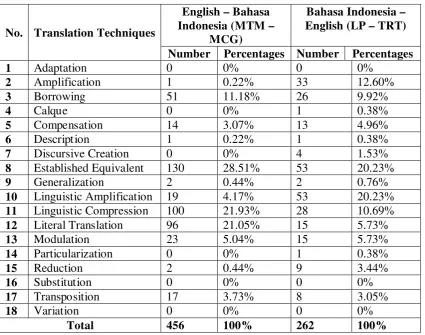
The borrowing technique in the translation of MTM into MCG is 51 numbers i.e.:
6 39 68 114 164 231 285 349 372 7 42 69 120 171 269 288 351 390
9 43 71 133 172 278 290 354 396 14 44 73 157 174 279 308 355
31 52 79 158 220 280 341 356
32 62 95 161 229 282 344 362
The expressions that are borrowed in the translation of MTM into MCG are
“Mom”, “Dad”, “Cupcake”, “Fashion”, “Highlite”, “Mrs”, “Legging”, “Peep Toe”, “Flat”, “Chic”, “Middle School”, “Salad”, “Heavy Metal”, “Play” and “Bye”.
4.1.1.3Compensation
Compensation is to introduce a ST element of information or stylistic effect in another place in the TT because it cannot be reflected in the same place as in the TT.
Below, some examples:
Data Source Text Target Text
I/6 My parents are divorced, and my mom and I moved out to a town in the suburbs, an hour outside the city.
Orangtuaku bercerai, lalu aku dan Mom pindah ke sebuah kota kecil di daerah pinggiran, satu jam dari Manhattan.
I/151 Callie is in the club too, and she’s also the girl who used to be Katie’s best friend.
Callie juga ikutan klub itu, dia adalah cewek yang pernah jadi sahabat Katie.
I/164 “Those were great cupcakes you guys made on Saturday,” Callie told me.
From the data number 6, we could see that the translator change the place of
“my mom” and “I” from “my mom and I” to “aku dan ibuku”. Also in number 151, the translator changes the place of word “too”. In the data number 164, the translator decides to translate “Those were great cupcakes you guys made on Saturday” as
“Cupcake yang kalian buat Sabtu kemarin enak banget” instead of “Itu adalah cupcake yang enak banget yang kalian buat Sabtu kemarin”.
This technique in the translation of MTM into MCG is 14 datas i. e: 6, 75, 114, 151, 164, 168, 218, 219, 260, 263, 274, 278, 288 and 305.
4.1.1.4Description
Description is to replace a term or expression with a description of its form or/and function. In the translation of MTM into MCG, this technique is only applied
once. This technique is applied in data number 202:
Data Source Text Target Text
I/202 So, the next Mondayesque thing happened at lunchtime.
Jadi, hal menyebalkan di hari Senin selanjutnya terjadi pada jam makan siang.
In here, the translator does not maintain the word “Mondayesque”, instead the
word is replaced with the description i.e. “hal menyebalkan di hari Senin.
4.1.1.5Established Equivalent
Established equivalent is to use a term or expression recognized (by dictionaries or language in use). Established Equivalent technique is the most technique applied in the translation of MTM into MCG.
Below, some examples:
Data Source Text Target Text
I/1 An Interesting Remark Komentar yang Menarik I/51 It made me think maybe it wasn’t
bad that we moved out here.
I/256 “I’ve been so alone!” Katie said in a funny, dramatic way.
“Aku sangat kesepian!” kata Katie dengan lucu dan gaya dramatis.
The literal translation of “remark” is “pernyataan” and the literal translation of “alone” is “sendirian” but in here the translator use the more suitable terms for those
words i.e. “komentar” and “kesepian”. And also in data number 51, the translator translates “it” as “kemenanganku itu” as the equivalence term and recognized by the target language.
This technique in the translation of MTM into MCG is applied in 130 numbers:
1 37 66 87 137 161 215 249 277 363 4 40 67 88 138 170 220 250 282 367
5 45 68 89 140 175 221 251 290 371 7 46 70 92 141 177 222 254 292 372 10 49 73 97 144 184 226 256 295 376
13 51 75 98 145 192 228 257 296 379 19 52 76 100 148 195 229 258 298 381
20 53 77 103 149 197 230 262 308 385 28 54 78 104 151 199 231 266 343 391 30 59 81 116 153 203 234 269 344 398
31 62 83 121 155 208 235 272 353 399 32 63 84 127 157 210 239 274 354 402
36 64 85 135 160 213 248 275 361 404
4.1.1.6Generalization
Generalization is to use a more general or neutral term. It is in opposition to
Data Source Text Target Text
I/117 She pointed to her sweatshirt. Dia menunjuk bajunya. I/208 Luckily, I always carry a few dollars
around in case of an emergency.
Untungnya, aku selalu membawa sedikit uang untuk berjaga-jaga.
“Sweatshirt” is a long-sleeved cotton sweater, means that sweatshirt is one kind of clothes. In this number, the translator generalize the word “sweatshirt” into “baju” instead of use the equivalence of sweatshirt she uses in other parts of the text, that is
“baju hangat”. “Dollars” is a currency of United State. In the target text, the translator uses the general term i.e. “uang”
4.1.1.7Linguistic Amplification
Linguistic Amplification is to add linguistic elements. It is in opposition to lingu istic compression.
Below, some examples:
Data Source Text Target Text
II/3 I know, everybody says that, right? Aku tahu, semua orang pasti bilang begitu, kan?
II/23 And when did I find it? Lalu kapan aku menemukannya lagi? II/69 So fashion is in my blood. Jadi fashion mengalir dalam
darahku.
In data number 3, the translator adds the word “pasti” and in the data number 23,
the translator adds word “lagi”. The addition of the words emphasizes the meaning of the sentence. But, in data number 69, the addition of word “mengalir” clears the
meaning of the sentence because with no addition, the meaning of the sentence will blur.
This technique in the translation of MTM into MCG is applied in 19 numbers:
4.1.1.8Linguistic Compression
Linguistic compression is to synthesize linguistic element in the TT. It is in opposition to linguistic amplification.
Below, some examples:
Data Source Text Target Text
I/242 “Oh!” I said, because I didn’t really know what to say.
“Oh,” kataku, karena aku tidak tahu harus jawab apa.
I/264 She’s so sweet and funny, it’s hard to be in bad mood when you’re around her.
Dia sangat manis dan lucu, susah untuk bersedih di dekatnya.
I/281 I see her a lot more now. Aku bisa menemuinya lebih sering.
In data 242, the translator translates “I didn’t really know” as “aku tidak tahu” which a little bit change the meaning because if we translate back the target text, it
will be “I didn’t know”. And in data 264, “It’s hard” is translated as “susah” since without translate the word “it’s” the meaning is already clear.
This technique in the translation of MTM into MCG is applied in 100 numbers: 4 28 80 112 142 175 206 276 352 369 8 35 82 115 143 178 217 277 353 372
9 39 84 120 144 180 242 279 354 373 10 47 87 126 151 181 244 281 356 375
12 49 95 130 155 183 248 297 357 386 13 55 97 131 162 189 259 299 358 394 15 56 99 133 163 190 264 306 359 395
16 65 101 136 164 196 268 342 362 400 18 70 105 139 166 204 270 348 366 401
4.1.1.9Literal Translation
Literal translation is to translate a word or an expression word for word. Below, some examples:
Data Source Text Target Text
I/2 My Name is Mia Velaz-Cruz, and I hate Mondays.
Namaku Mia Velaz-Cruz, dan aku benci hari Senin.
I/147 There’s Sophie, who I like a lot. Ada Sophie, yang sangat kusukai. I/186 I don’t normally brag about my
mother’s job like that, but I didn’t know what to say to Sydney.
Biasanya aku tak mengumbar-umbar pekerjaan ibuku seperti itu, tapi aku tak tahu harus mengatakan apa pada Sydney.
This technique in the translation of MTM into MCG is applied in 96 numbers:
2 60 118 156 193 224 243 284 346 387 22 61 119 159 194 225 245 287 364 388
24 74 122 165 198 227 246 291 370 389 25 91 123 169 200 232 247 294 374 393 26 94 124 179 201 233 252 300 377 397
27 96 125 185 209 236 253 301 378 405 29 102 129 186 212 237 265 302 380
33 108 132 187 214 238 267 303 382 57 111 134 188 216 240 273 340 383 58 113 147 191 223 241 283 345 384
4.1.1.10Modulation
Modulation is to change the point of view, focus or cognitive category in
relation to the ST.
Below, some examples:
Data Source Text Target Text
I/6 My parents are divorced, and my mom and I moved out to a town in
the suburbs, an hour outside the city. daerah pinggiran, satu jam dari Manhattan.
I/34 A little while after we formed the club, Principal LaCosta announced there was going to be a contest the day of the first school dance.
Tak lama setelah Cupcake Club terbentuk, Kepala Sekolah LaCosta mengumumkan aka nada
perlombaan pada hari pesta dansa sekolah.
I/309 It has weird flowery wallpaper, like something you’d find in an old lady’s house.
Kertas dindingnya bemotif bunga-bunga yang aneh, seperti yang kau lihat di rumah nenek-nenek.
The point of view that changed in the data number 6 is the changes of the sentence from passive into active. On the contrary, in data number 34, the change is
from active into passive. Meanwhile the change in the data number 309 is the change in the focus of the sentence. In source text the focus is “it” that means the room. It means that the room has weird flowery wallpeaper, while in the target text; the focus
is the wallpaper (kertas dinding) that has a weird flowery motif.
This technique in the translation of MTM into MCG is applied in 23 numbers:
6 34 48 86 146 211 286 309 17 40 71 109 176 255 289 400 21 41 72 110 182 270 304
4.1.1.11Reduction
Reduction is to suppres a ST information item in the TT. This technique in the
translation of MTM into MCG is applied in data number 81 and 360.
Data Source Text Target Text
I/81 But you could wear a sweater or a jacket and any shoes, so you could get pretty creative with it and not look gross on a daily basis.
Namun kau bisa pakai jaket dan sepatu apapun, jadi kau bisa berkreatif-ria mengakalinya dan nggak terlihat menjijikkan setiap hari.
I/360 The way my room is decorated isn’t the only thing I don’t like about it.
In data number 81 and 360, the translator suppresses information of the source
text by reduces “a sweater” in data 81 and translates “the way my room is decorated” as “kamarku”. This decision is changed the meaning of the text, but it’s not too influential for the meaning.
4.1.1.12Transposition
Transposition is to change a grammatical category. This technique in the
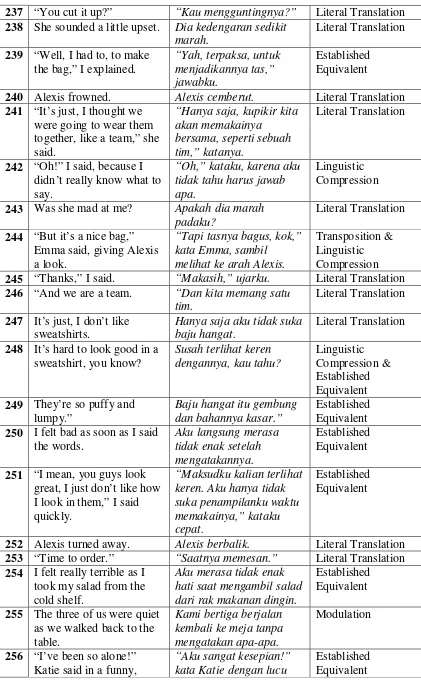
translation of MTM into MCG is applied in 17 numbers:
11 38 106 150 163 207 280 307 372 36 45 128 154 166 244 285 355
For more detail, the grammatical categories that changed in the translation of MTM into MCG are:
Data Source Text Target Text GC Type
I/36 We hadn’t really planned on participating in the fund-raiser, but then this other group in our class, the Popular Girls Club, kept telling everyone they were going to win.
Kami sebenarnya tak punya rencana untuk ikutan dalam penggalangan dana itu, tapi ada kelompok lain di kelas satu, Popular Girls Club, yang terus berkoar-koar kepada semua orang kalau mereka akan menang.
V – N
I/38 It’s not like we’re rivals or anything, but once we heard that, we decided to enter the contest too.
Bukan berarti kami ini bersaing atau apa lah, tapi begitu mendengarnya, kami putuskan untuk ikut
perlombaan juga.
N – V
I/45 I know it’s not a huge deal or anything, but it fells really good to win.
Aku tahu ini bukan hal besar atau apa lah, tapi rasanya gembira banget jadi pemenang.
V – N
I/106 Nobody makes loud burping noises either, like Wes Kinney does every single day in the back of the school bus, which is extremely disgusting.
Enggak ada yang bersendawa dengan suara keras, seperti yang dilakukan Wes Kinney setiap hari dari belakang bus sekolah, dan itu menjijikkan banget.
N – V
I/128 Katie grabbed it to get a closer look.
Katie mengambilnya untuk melihat lebih dekat.
N – V
the Popular Girls Club. pembentuk Popular Girls Club.
I/154 They say she’s always making mean comments to them.
Katanya, Sydney selalu berkomentar jelek tentang mereka.
N – V
I/163 Callie gave me a smile when I sat down.
Callie tersenyum saat aku duduk.
N – V
I/166 I thought I saw Sydney give Callie a glare.
Sepertinya aku melihat Sydney melotot pada Callie.
N – V
I/207 “This is seriously
disappointing,” I said with a sigh.
“Ini benar-benar
menyebalkan,” kataku sambil menghela napas.
N – V
I/244 “But it’s a nice bag,” Emma said, giving Alexis a look.
“Tapi tasnya bagus, kok,” kata Emma, sambil melihat ke arah Alexis.
N – V
I/280 Mom’s starting up her own fashion consulting business, so she works out of the house, which is nice.
Mom sedang merintis bisnis konsultan fashion-nya sendiri, jadi dia bekerja di rumah dan itu adalah hal bagus.
Pro – Conj
I/285 Your mom had to go into the city for a meeting.
Ibumu harus meeting di kota. N – V
I/307 I walked up the stairs to my room, and Milkshake and Tiki followed me.
Aku menaiki tangga menuju kamar dengan Milkshake dan Tiki mengikutiku.
Conj – Pre
I/355 Which she promises to do soon.
Dan Mom berjanji akan segera melakukannya.
Pro – Conj I/372 I pressed play on my iPod, and
a song by my favorite singer filled my ears—but I swear I could still see the walls shaking.
Kutekan play pada iPod lalu sebuah lagu dari penyanyi favoritku terdengar, tapi aku bersumpah aku masih melihat dinding yang bergetar.
V – Adj
We could see that in the translation of MTM into MCG the change of grammatical categories is more various than in the translation of LP into TRT, i.e. Noun to Verb 9 times (56.25%), Verb to Noun 3 times (18.75%), Pronoun to
4.1.2 The Translation Techniques in the Translation of Bahasa Indonesia Novel into English (LP – TRT)
4.1.2.1Amplification
Amplification is to introduce details that are not formulated in the ST:
information, explicative paraphrasing.
There are 5 numbers of explicative paraphrasing in the translation of LP into
TRT.
Data Source Text Target Text
II/9 Mereka adalah seorang bapak tua berwajah sabar, bapak K.A. Harfan Efendy Noor, sang kepala sekolah dan seorang wanita muda berjilbab, ibu N.A. Muslimah Hafsari atau Bu Mus.
There was an old man with a patient face, Bapak K.A. Harfan Efendy Noor, or Pak Harfan—the school principal—and a young woman wearing jilbab, or headscarf, Ibu N.A. Muslimah Hafsari, or Bu Mus for short.
II/80 Namun ketika beliau akan mengucapkan kata pertama
Assalamu’alaikum seluruh hadirin terperanjat karena Trapani
berteriak sambil menunjuk ke pinggir lapangan rumput luas halaman sekolah itu.
However, when he went to utter his first words, ‘Assalamu’alaikum, Peace be upon you’, Trapani yelled and pointed to the edge of the school yard, startling everyone.
II/106 Kerudungnya juga berwarna bunga crinum demikian pula bau bajunya, persis crinum yang mirip bau vanili.
Her veil was the soft white of the lily, and her clothes even gave off the flower’s vanilla aroma. II/137 Bagi Lintang, kota kecamatan,
tempat sekolah kami ini, adalah metropolitan yang harus ditempuh dengan sepeda sejak subuh.
For Lintang, the city district of our school was like a metropolitan city, and to get there he had to begin his bicycle journey at subuh, early morning prayer, around four o’clock a.m.
II/169 Kemudian kulihat lagi pria cemara angin itu.
Then I saw Lintang’s father, the pine tree man,
The rest of the amplification technique application is the addition of the content of the novel by the translator of LP. Below, there are some data for example:
Data Source Text Target Text
II/53
II/54
---
I understood how she felt, because her hope to teach was a great as our hope to go to school.
II/55
---
Today was Bu Mus’ first day as a teacher, a moment she had been dreaming of for a very long time. II/56
---
She had just graduated the week before from Sekolah Kepandaian Putri (Vocational Girls’ School), a junior high school in the capital of the regency, Tanjong Pandan. II/57 --- She was only fifteen years old. II/58
---
Sadly, her fiery spirit to be a teacher was about to be doused by a bitter reality—the threat of her school closing because they were short by just one student.
II/59
---
Bu Mus stood like a statue under the bell, staring out at the wide
schoolyard and the main road. II/60 --- No one appeared.
This technique in the translation of LP into TRT is applied in 33 numbers: 6 54 58 87 116 148 152 156 196
9 55 59 93 125 149 153 169 36 56 60 94 137 150 154 175 53 57 80 106 147 151 155 192
4.1.2.2Borrowing
Borrowing is to take a word or expression straight from another language. It can
be pure (without any change) or it can be naturalized (to fit the spelling rules in the TL).
Below, some examples:
Data Source Text Target Text
II/11 Namun, senyum Bu Mus adalah senyum getir yang dipaksakan karena tampak jelas beliau sedang cemas.
Yet Bu Mus’ smile was a forced smile: she was apprehensive.
From the data above, we could see that the translator take the words “Bu” and
“Pak” straight from the source language. In the translation of LP into TRT the words that are borrowed are “Ibu”, “Bapak”, “Bu”, “Pak”, “Pak Cik”, “Pamanda Guru”, “Cunghai”and “Bapak Guru”.
This technique in the translation of LP into TRT is applied in 26 numbers: 9 17 45 51 74 91 104 119 168
11 19 47 64 76 97 108 124 176 16 43 48 65 90 101 112 132
4.1.2.3Calque
Calque is literal translation of a foreign word or phrase; it can be lexical or structural. Calque technique is only 1 number (0.38%) in the translation of LP into
TRT i.e in data number 46 when the translator translate literary an Indonesia’s ministry.
Data Source Text Target Text
II/46 Guru-guru yang sederhana ini berada dalam situasi genting karena Pengawas Sekolah dari Depdikbud Sumsel telah memperingatkan bahwa jika SD Muhammadiyah hanya mendapat murid baru kurang dari sepuluh orang maka sekolah paling tua di Belitong ini harus ditutup.
Those humble teachers were in this nerve wracking situation because of a warning issued by the School Super intendent from the South Sumatra Department of Education and Culture: if Muhammadiyah Elementary School had fewer than ten new students, then the oldest school in Belitong would be shut down.
4.1.2.4Compensation
Compensation is to introduce a ST element of information or stylistic effect in
another place in the TT because it cannot be reflected in the same place as in the TT. Below, some examples:
Data Source Text Target Text
memeluk pundakku dengan kedua lengannya dan tersenyum
mengangguk-angguk pada setiap orangtua dan anak-anaknya yang duduk berderet-deret di bangku panjang lain di depan kami.
shoulders with both his arms as he nodded and smiled to each parent and child sitting side by side on the bench in front of us.
II/14 Ia demikian khawatir sehingga tak peduli pada peluh yang mengalir masuk ke pelupuk matanya.
so worried that she didn’t even care about the sweat pouring down onto her eyelids.
II/22 Lebih mudah menyerahkannya pada tauke pasar pagi untuk menjadi tukang parut atau pada juragan pantai untuk menjadi kuli kopra agar dapat membantu ekonomi keluarga.
It would have been much easier to send me to work as a helper for a Chinese grosery stall owner at the morning market, or to the coast to work as a coolie to help ease the family’s financial burdens.
In the data number 4, the translator decides to translate “tersenyum
mengangguk-angguk” as “nodded and smile” instead of “smile and nodded”. Also in data number 14, the word “Ia” in source text is in the beginning of the sentence but the word is introduced in the other place in the target text. In the data number 22, the
translator translate “pada tauke pasar pagi untuk menjadi tukang parut” as “to work as a helper for a Chinese grosery stall owner at the morning market” instead of “to
work for a Chinese grosery stall owner at the morning market as a helper”.
This technique in the translation of LP into TRT is applied in 13 numbers i.e: 4, 14, 22, 48, 62, 73, 100, 104, 136, 142, 161, 163 and 164.
4.1.2.5Description
Description is to replace a term or expression with a description of its form
or/and function. This technique in the translation of LP into TRT is applied in 1 number:
Data Source Text Target Text
II/104 Ibu Muslimah yang beberepa menit lalu sembap, gelisah, dan coreng-moreng kini menjelma menjadi sekuntum Crinum Giganteum.
Bu Mus, who, just a few minutes earlier, had been on edge with a puffy, smudged face, now
In data number 104, the translator does not maintain the Latin name of the flower. Instead she changes it into the English name. This decision can be understood because not everybody know what Crinum Giganteum is.
4.1.2.6Discursive Creation
Discursive creation is to establish a temporary equivalence that is totally
unpredictable out of context. Discursive Creation technique is only applied in data number 64, 103 and 126.
Data Source Text Target Text
II/64 Saat itu sudah pukul sebelas kurang lima dan Bu Mus semakin gundah. Lima tahun pengabdiannya di sekolah melarat yang amat ia cintai dan tiga puluh dua tahun
pengabdian tanpa pamrih pada Pak Harfan, pamannya, akan berakhir di pagi yang sendu ini.
It was five till eleven. Bu Mus could no longer hide her dejection. Her big dreams for this poor school were about to fall apart before they could even take off, and thirty two faithful years of Pak Harfan’s unrewarded service were about to come to a close on this tragic morning.
II/103 Antediluvium The Pine Tree Man
II,121 Beliau adalah seorang nelayan, namun pembukaan wajahnya yang mirip orang Bushman adalah raut wajah yang lembut, baik hati dan menyimpan harap.
He was a fisherman, but his face was like that of a kind shepherd,
showing he was a gentle, good hearted and a hopeful man.
II/126 Cuaca cenderung semakin memburuk akhir-akhir ini maka hasil melaut tak pernah memadai.
Belitong fishermen, like Lintang’s father, strongly believed these birds came to the island to warn of approaching storms.
As we could see that the target texts are totally unpredictable and out of context. “Lima tahun pengabdiannya” is translated as “Her big dreams”. This is as the compensation of the paragraph added by the translator before:
The former information that said it was the first day for Bu Mus as a teacher and she was only fifteen years old forces the translator to change the information that said that Bu Mus has been a teacher for five years. And also for the source text “tiga
puluh dua tahun pengabdian tanpa pamrih pada Pak Harfan, pamannya” must be changed because it is impossible for a fifteen years old girl to serve for thirty two
years. So the translator decided to change the text into “thirty two faithful years of Pak Harfan’s unrewarded service” that out of context.
Data number 103 is also out of context. “Antediluvium” is a period when the
Malay people lived as nomads, while “The Pine Tree Man” is the title of Lintang’s father that given by the main character, Ikal, because Lintang’s father resembled a
pine tree struck by lightning: black, withered, thin and stiff.
“Bushman” in data number 121 is translated as “a kind shepherd” and that is out of context. “Bushman is an etnis in Africa and they are not shepherd. They are a
huntur-gatherer.
And the last application of Discursive Creation technique is data number 126
where the translator changes sentence “Cuaca cenderung semakin memburuk akhir-akhir ini maka hasil melaut tak pernah memadai” into “Belitong fishermen, like Lintang’s father, strongly believed these birds came to the island to warn of
approaching storms”. The source text emphasizes the difficulty of Lintang’s father while the target text emphasizes what Lintang’s father believes about the birds.
4.1.2.7Established Equivalent
Established equivalent is to use a term or expression recognized (by dictionaries or language in use).
Data Source Text Target Text II/68 Suaranya berat selayaknya orang
yang tertekan batinnya.
Her voice was grave, normal for someone with a sinking heart. II/69 Akhirnya, waktu habis karena telah
pukul sebelas lewat lima dan jumlah murid tak juga genap sepuluh.
Finally, time was up. It was already five after eleven and the total number of students still did not equal ten. II/70 Semangat besarku untuk sekolah
perlahan-lahan runtuh.
My overwhelming enthusiasm for school dwindled away.
There are many data that the translator decides to applied the established
equivalent technique as in the data number 69 which word “genap” is translated as “equal” instead “exactly enough”.
This technique in the translation of LP into TRT is applied in 53 numbers
2 26 46 75 95 117 130 146 185 3 29 62 77 98 120 131 158 186
21 30 68 82 107 123 132 171 190 22 34 69 84 109 127 135 176 191 23 40 70 85 112 128 136 177 196
25 41 74 88 115 129 141 182
4.1.2.8Generalization
Generalization is to use a more general or neutral term. It is in opposition to particularization. In the translation of LP into TRT, this technique is applied twice i.e. in data number 22 and 30:
Data Source Text Target Text
II/22 Lebih mudah menyerahkannya pada tauke pasar pagi untuk menjadi tukang parut atau pada juragan pantai untuk menjadi kuli kopra agar dapat membantu ekonomi keluarga.
It would have been much easier to send me to work as a helper for a Chinese grosery stall owner at the morning market, or to the coast to work as a coolie to help ease the family’s financial burdens. II/30 Pagi ini mereka terpaksa berada di
sekolah ini untuk menghindarkan diri dari celaan aparat desa karena tak menyekolahkan anak atau sebagai
This morning they were forced to be at this school, either to avoid
orang yang terjebak tuntutan zaman baru, tuntutan memerdekakan anak dari buta huruf.
school, or to submit to modern demands to free their children from illiteracy.
In data number 22, “tukang parut” is translated as “a helper” and “kuli kopra” is
translated as “a coolie”. In data number 30, “aparat desa” is translated as “government officials”.
“Tukang parut” is one of helper’s works, because there are other works of helper especially in a grosery. “Kuli kopra” is one kind of “coolie” because there are other kind of coolie such as kuli bangunan, kuli pelabuhan etc. “Aparat desa” is one of
“government officials” because “aparat desa” is titled for a government official in a village.
4.1.2.9Linguistic Amplification
Linguistic Amplification is to add linguistic elements. It is in opposition to lingu istic compression.
Below, some examples:
Data Source Text Target Text
II/7 Kosen pintu itu miring karena seluruh bangunan sudah doyong seolah akan roboh.
The door frame was crooked. The entire school, in fact, leaned as if it would collapse at any moment. II/51 “Kita tunggu sampai pukul sebelas,”
kata Pak Harfan pada Bu Mus dan seluruh orangtua yang telah pasrah.
“We will wait until eleven o’clock,” Pak Harfan said to Bu Mus and the already hopeless parents.
II/140 Energi yang berlebihan di tubuhnya serta-merta menjalar padaku
laksana tersengat listrik.
The over abundance of energy in his body spread over to mine, stinging me like an electric shock.
Since linguistic amplification is the most dominant technique beside established
number 51, the translator adds “will” and in data number 140, the translator adds
“stinging me”.
This technique in the translation of LP into TRT is applied in 53 numbers: 7 22 43 76 110 122 144 166 185
9 26 45 78 111 130 145 168 187 15 32 51 89 112 132 157 171 188
17 35 61 90 113 134 158 173 193 20 38 66 95 114 140 159 174 196 21 39 75 99 118 142 161 183
4.1.2.10Linguistic Compression
Linguistic compression is to synthesize linguistic element in the TT. It is in
opposition to linguistic amplification. Below, some examples:
Data Source Text Target Text
II/5 Hari itu adalah hari yang agak penting: hari pertama masuk SD.
It was an important day: the first day of elementary school.
II/19 Aku cemas karena melihat Bu Mus yang resah dan karena beban perasaan ayahku menjalar ke seluruh tubuhku.
Anxious because of the restless Bu Mus, and because the sensation of my father’s burden spreading over my entire body.
II/50 Kenyataan bahwa beliau hanya memerlukan satu siswa lagi untuk memenuhi target itu menyebabkan pidato ini akan menjadi sesuatu yang menyakitkan hati.
The fact that he only needed one more student would make this speech even more painful to give.
In data number 5, the translator translates “hari yang agak penting” as “an
important day” which a little bit change the meaning that if we translate back to the source language, it will be “hari yang penting”. Also in data number 50, the translator doesn’t maintain the phrase “untuk memenuhi target itu” since without the
This technique in the translation of LP into TRT is applied in 28 numbers:
5 19 43 50 86 102 129 162 179 189 7 26 45 62 92 111 136 171 187
11 27 47 67 95 117 143 178 188
4.1.2.11Literal Translation
Literal translation is to translate a word or an expression word for word.
Below, some examples:
Data Source Text Target Text
II/8 Di mulut pintu berdiri dua orang guru seperti para penyambut tamu dalam perhelatan.
In the doorway stood two teachers, like hosts welcoming guests to a party.
II/13 Ia berulang kali menghitung jumlah anak-anak yang duduk di bangku panjang.
She kept counting the number of children sitting on the long benches,
II/31 Aku mengenal para orangtua dan anak-anaknya yang duduk di depanku.
I knew all of the parents and children sitting in front of me—
Some data is translated word for word i.e. in 15 numbers:
1 10 18 42 71 83 138 180
8 13 31 52 81 96 167
4.1.2.12Modulation
Modulation is to change the point of view, focus or cognitive category in relation to the ST.
Below some examples:
Data Source Text Target Text
II/28 Setiap wajah orangtua di depanku mengesankan bahwa mereka tidak sedang duduk di bangku panjang itu, karena pikiran mereka, seperti pikran ayahku, melayang-layang ke pasar pagi atau ke keramba di tepian laut membayangkan anak lelakinya lebih baik menjadi pesuruh
disana.
II/165 Tapi pandangan ayahku menyuruh mereka bungkam, membuat perut mereka kaku.
One look from my father was enough to silence them. II/194 Buku bersampul biru itu bergaris
tiga.
It had a dark blue cover and was three lined.
The change in the data is the change in the focus. As in the data number 28, in the source text, the focus of word “setiap” (each) is for word “wajah” (face) while in
the target text, the focus is for the word “parent”.
This technique in the translation of LP into TRT is applied in 15 numbers:
24 33 61 124 139 162 170 194 28 44 63 133 160 165 183
4.1.2.13Particularization
Particularization is to use a more precise or concrete term. It is in opposition to generalization. Particularization technique is only applied in data number 40.
Data Source Text Target Text
II/40 Pertama, karena sekolah
Muhammadiyah tidak menetapkan iuran dalam bentuk apa pun, para orangtua hanya menyumbang sukarela semampu mereka.
The first, Muhammadiyah
Elementary didn’t require any fees, and parents could contribute
whatever they could afford whenever they could do so.
Since particularization technique is in opposition to generalization technique, the
technique the translator uses in translates “sekolah” as “elementary” is called particularization technique because “sekolah” is the general term for �