UNIVERSITI TEKNIKAL MALAYSIA MELAKA
INVESTIGATION ON VIABLE KNOWLEDGE TRANSFER
This report submitted in accordance with requirement of the Universiti Teknikal Malaysia Melaka (UTeM) for the Bachelor Degree of Manufacturing Engineering
(Manufacturing Process)(Hons.)
by
WAN FAKHRURRAZI BIN W ABDUL RAHMAN B051110072
910510-11-5485
FACULTY OF MANUFACTURING ENGINEERING 2015
DECLARATION
I hereby, declared this report entitled “Investigation of Viable Knowledge Transfer” is the results of my own research except as cited in references.
Signature : ...
Author’s Name : WAN FAKHRURRAZI BIN W ABDUL RAHMAN
APPROVAL
This report is submitted to the Faculty of Manufacturing Engineering of UTeM as a partial fulfillment of the requirements for the degree of Bachelor of Manufacturing Engineering (Manufacturing Process) (Hons.). The member of the supervisory is as
follows:
‘Peralihan pengetahuan’ telah menjadi peralihan sebagai aliran yang pelbagai di mana ianya berkaitan dengan penghasilan pengetahuan dari akademik dan berpotensi untuk diadaptasikan kepada persekitaran di luar akademik. Kertas kajian ini adalah sebahagian daripada kajian yang luas di dalam menerokai isu-isu yang berkaitan dalam pemindahan pengetahuan dari proses inovasi. Mengikut tanggapan asas, pemindahan pengetahuan untuk institusi akademik di Malaysia adalah pada tahap yang lemah menimbulkan persoalan penting tentang masalah-masalah yang dihadapi oleh sistem pengurusan bagi penyelidikan dan innovasi dan cara yang terbaik untuk menyelesaikan jurang daripada masalah tersebut. Peralihan pengetahuan adalah satu proses yang penting bagi penyelidik dan inovator, kertas kajian telah mengenal pasti masalah yang terdapat di dalam proses peralihan pengetahuan dengan membuat analisa tentang elemen yang perlu dititik beratkan melalui boring soal selidik yang dieadarkan kepada penyelidik di bawah fakulti kejuruteraan Universiti Teknikal Malaysia Melaka (UTeM) di mana elemen berkenaan di tambahkan ke dalam model yang sedia ada sebagai garis panduan untuk penyilidik menjalani proses ‘Peralihan Pengetahuan’ dengan lebih efektif. Hubungan antara elemen tersebut telah di analisa menggunakan T-Test untuk menyelidik hubungan signifikan antara elemen tersebut.
‘Knowledge transfer’ has become established as shorthand to wide variety that linked the production of academic knowledge to the potential use of the knowledge in non-academic environments. This study which is a part of large study explores the issues related in transferring knowledge of the innovation processes. Under basic perception that knowledge transfer in Malaysian academic institution is still weak, the question on major problems faced by the management systems in research and innovations, improvement to solve the existing gap become, becomes crucial. As knowledge transfer has a significant important to the researchers and innovators, this study had determined the existing gap and barriers to conduct Knowledge Transfer (KT) process by analysing the critical element through surveys that had been conducted among researchers under manufacturing engineering faculties in Universiti Teknikal Malaysia Melaka (UTeM) and the lacking element(s) was added into the existing knowledge transfer model as a guideline for the researchers to conduct Knowledge Transfer (KT) process in more effective ways. The relations between the elements were analysed using T-test in order to check the significant different between those elements.
DEDICATION
To my beloved parents, W Abdul Rahman Hj W Said and Norkiah Ghazali
To my Siblings,
Wan Mohd Hilmi bin W Abdul Rahman
Wan Nadiah binti W Abdul Rahman
Wan Mohd Zahir bin W Abdul Rahman
ACKNOWLEDGEMENT
“Bismillahirrahmanirrahim”
In the name of Allah, the most gracious, and most merciful...
Alhamdulillah, first and foremost, praise to Allah S.W.T for giving me the opportunity to complete my Bachelor’s degree Final Year Project from the very beginning until the very end. Without His help, I would not have been able to complete my project. For my beloved parents, who have been very supportive no matter how dark the times were. Your love is the greatest gift that I ever had. Last but not least, to my nine good friends, whom I considered brothers, thank you and good luck for the upcoming journey.
TABLE OF CONTENT
2.3 Research and Development to Commercialization 8 2.4 Creating the Ideation Process in Research and Development 10 2.5 Innovation of Research and Development Process TowardsCommercialization Phase 11
2.6 Research, Innovation and Commercialization 12
2.7 Role of Academia in Innovation and Commercialization 12
2.8 Strategy in handling Commercialization 13
2.8.1 Licensing for Commercializing 14
2.8.2 Alliances Branch 15
2.8.2.1 Government Involvement 16
2.8.2.3 Industries-Universities ties 17
2.10 Equity Investment in Spin-off 20
2.10.1 Early stage Spin-off 20
2.10.2 Enterprising Company 20
2.11 Factor influence the formation of Spin-off 21
2.11.1 Government policies 21
2.11.2 Strong Motivation in Institutional 21
2.11.3 Networking 22
2.11.4 Geographic Location 22
2.12 Protection of University Intellectual property and patents 22
2.12.1 Copyrights 23
2.12.2 Trademark 23
2.12.3 Patents 23
2.13 Universities Internal Structure Arrangement 25
2.13.1 Assemble a Diverse Team 26
2.13.2 Individual engagement in university-industries 26
2.13.3 Institutional Role 27
2.14 Establishing Technology Park 27
2.15 Summary from Literature Review Input 28
CHAPTER 3: METHODOLOGY 29
3.1 Overview 29
3.2 Introduction 30
3.3 Introduction to Methodology 30
3.4 Planning of Study 30
3.5 Research process Flow chart 31
3.6 Research Tool 31
3.6.1 Clustering Data in Matrix form 31
3.6.2 3 Phase Planning 33
3.6.3 Research questionnaire 33
vi
CHAPTER 4: RESULTS AND DISCUSSION 35
4.1 Introduction 36
4.2 Background of Data Respondents 36
4.3 Analysis of Discussion of Survey Data 40
4.3.1 Relation between elements that influence viable Knowledge Transfer Process
40
4.3.2 Knowledge Transfer (KT) flow relation with Research
and Innovation Process 42
4.3.3 Research outcome(s) in conducting research during
careers 45
4.3.4 Relation of research network and barriers in conducting
knowledge transfer process 48
4.3.5 Relation between network collaboration and experience
in conducting spin-off activities 51 4.3.6 Barriers for the researchers in conducting spin-off
activities 54
4.3.7 Relation between network collaboration and experience
in conducting Technology Transfer Process 57 4.3.8 Relation between Intellectual Property (IP) that
influence the Technology Transfer process 59 4.3.9 Important factors which restraint Technology Transfer
process among researchers in universities
62
4.4 Addition of Lacking Element into Existing Model 64
4.5 Creation of Spin-off Process 67
CHAPTER 5: CONCLUSION AND FUTURE WORK 69
5.1 Conclusion 69
5.2 Further Study 70
vi
LIST OF TABLES
1.1 Types of definition in knowledge transfer 7 3.2 Example of constructing initial phase, execute phase and post
phase
33
4.1 Statistic of Patent Application by the IPTA and IPTS from year 2005-2010
2010
46
4.2 The result of T-Test for network collaboration affecting Spin- off activities
53
4.3 The result of T-Test for network collaboration affecting Technology Transfer
58
4.4 The result of T-Test for Intellectual property affecting Technology Transfer process
LIST OF FIGURES
2.1 Research and Development (R&D) Model 8
2.2 The stages of research towards the commercialization phase 9 2.3 MOHE funds for higher education institution 18 2.4 MOSTI funds for higher education institution 19 2.5 Intellectual Property Management (IPM) process 25
3.1 Flowchart of study 32
4.0 Percentage of respondent’s gender obtain from survey data 37 4.1 Percentage of respondents according to academic position 37 4.2 Percentage of respondents according to academic level 38 4.3 Percentage of respondents according to faculty 39
4.4 Research experiences among researchers 40
4.5 Percentage of researcher’s age affects primary intention
researches 41
4.6 Percentage of researcher’s intention before conducting research 42 4.7 Incentives for the researchers involve in knowledge transfer
process 43
4.8 Researchers outcome in conducting research during the carriers 45 4.9 Relation of research network - barriers in conducting
knowledge transfer
48
4.10 Collaboration network-conducting spin-off activities 51 4.11 Barriers in conducting spin-off activities in research academic 54 4.12 Research network – technology transfer process 57 4.13 Relation between intellectual property-Technology Transfer
processes
59
4.14 Conceptual model on efficient Technology Transfer (TT) model 61
4.15 Factors that restraint efficient for the Technology Transfer 62 4.16 Existing model of Commercialization Outcomes 64 4.17 Addition of lacking elements in existing commercialization
outcomes model
66
NOMENCLATURE
Intellectual Property IP
Intellectual Property Management IPM
Knowledge Transfer KT
Research and Development R&D
Small and Medium sized enterprises SME
Technology Transfer Office TTO
1 This chapter emphasize the background, problems statement, objectives, scope and important of the study. Besides, it also explained information about knowledge transfer issues in academic institution.
1.1 Background
Many researchers believed that universities must have strong environment towards management system in conducting knowledge transfer of innovation process. As already know that universities are one of the institutions that act as a knowledge producers. It is important issues when the knowledge developed from the universities to be transfer to the economies sectors through innovation support in order to create a new development in nation growth. The knowledge transfer can be more effective if the interrelationship and collaboration between universities-industries occurs (Bjerregaard, 2010).
However, there is a need in seeking alternative on how the knowledge is transferred in order to support the innovation by focusing on the invention disclosure and other types of measurable forms of university-industry linkage (Agrawal, 2001).
2 Our education system before this had only focused on teaching and learning process. Thus, in order to face the new growth of globalization era, the perception of universities need to be change in performing universities role of learning, investigating, producing and transferring the knowledge that are produced in a better ways. (Etzkowitz, 2003) stated that amount of majority of universities in Europe, America and most recently Asia begin to adopt the entrepreneurial university model.
In this particular area, the needs of government to encourage universities in improving their research and development by exploiting the intellectual property and patents in order to be more competitive and productive like other develop countries. The goals of researcher in universities in Malaysia is becoming leaders in innovation, conducting researches approved in the world class research, becoming one of the centre of excellence that will bring benefits to the country and development of research, innovation and commercialization phase that would bring benefits to the societies (Yaacob, 2011).
1.2 Problems Statement
3 Although there are a lot of initiative supports from the government to strengthen the rate of knowledge transfer by stressing out programmes including providing grants, there are still gaps occurs which need to be solved. As already noticed knowledge transfer process would take longer time to be accomplished as the flow in the process is complex (Ismail et. al., 2012) that involved capital investment to be success in order to complete the filling of intellectual property (IP) and marketing the outcomes of research and development (R&D).
Associated to the discoveries of intellectual property (IP), universities management in knowledge transfer system also has a low efficiency in ensuring the commercialization opportunities. The technology transfer office (TTO) in universities is lack in skilfulness in managing the scientific discoveries from their research (Aniza et al., 2014). There are a lot of alternatives treated by the universities management on investigating the problems that occurs in the areas. Yet, there is still an opportunity to identify the ways to conduct better knowledge transfer by proposing a suitable model.
1.3 Objectives
This study aiming to achieve the following objectives are:
i. Identify the lacking elements for the researchers in conducting Knowledge Transfer (KT) process.
ii. Recognize the barriers in conducting Knowledge Transfer (KT) process towards the commercialization phases.
4 1.4 Scope of study
5
CHAPTER 2
LITERATURE REVIEW
2.1 Introduction to Knowledge Transfer (KT)
Knowledge transfer (KT) is a process in which the ideas is ready to be commercialize from the academic sectors to outside of academic environment in which the idea from an innovation is transform into a profitable commercialize product. The commercialization process depends on the technology transfer, knowledge and sharing resource among the university researcher, company and also federal entities. In short, to be success in commercialization phase, the innovators must set up the market need, address ownership and disclosure considerations, identify the issues that regulated with the environment on commercialization and develop models for the commercialization plan. First and foremost, innovators must assure that the idea that created must align with the existing need in the market place.
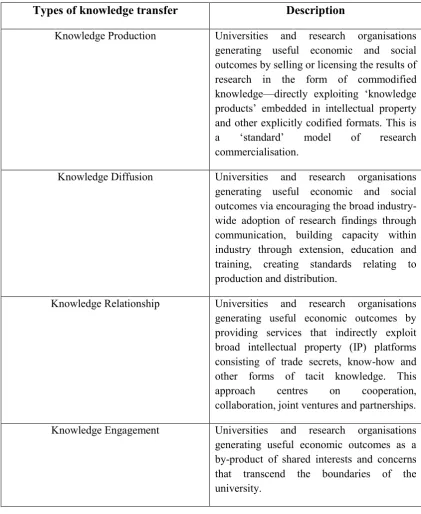
6 The idea that might solve the problems will create a demand among the customers who really need the kind of products. Many of products which are created and pushed into the market place without receiving any feedback from the audience. In order to avoid this kind of problems, it is important for the innovators and researcher must satisfy the distribution channels and planning ways to communicate the benefits of the new technology. According to (K Smith, 2005), commercialization is the process of transforming the ideas and knowledge into a better property for individuals, business or the society site. Commercialization is a subdivision of a broader process of innovation phase. According to the conference held by Department of Education, Science and Training in Australia in 2005, research commercialization refers to the process that generates commercial returns through the return and capital gain. The incomes are gain from the licenses and revenue from the sales of new technology development products. However, (Howard, 2005) disagree with the traditional statement and define that the commercialization is phase of the knowledge transfer that might solved the problems by discovering a new ways on developing products where interactions occurs between the customers and developer or innovators not only to gain profits but to received feedback so that the collaboration between research and innovation keep on rotating and find a better ways of producing new ideas. (Howard, 2005) discover four types of knowledge transfer which extend beyond the traditional understanding of commercialization which are stated in Table 1.
7
Table 1.1: Types of definition in knowledge transfer (Howard, 2005).
Types of knowledge transfer Description
Knowledge Production Universities and research organisations
generating useful economic and social outcomes by selling or licensing the results of research in the form of commodified knowledge—directly exploiting ‘knowledge products’ embedded in intellectual property and other explicitly codified formats. This is
a ‘standard’ model of research
commercialisation.
Knowledge Diffusion Universities and research organisations
generating useful economic and social outcomes via encouraging the broad industry-wide adoption of research findings through communication, building capacity within industry through extension, education and training, creating standards relating to production and distribution.
Knowledge Relationship Universities and research organisations
generating useful economic outcomes by providing services that indirectly exploit broad intellectual property (IP) platforms consisting of trade secrets, know-how and other forms of tacit knowledge. This
approach centres on cooperation,
collaboration, joint ventures and partnerships.
Knowledge Engagement Universities and research organisations
generating useful economic outcomes as a by-product of shared interests and concerns that transcend the boundaries of the university.
2.2 Necessity for Effective Commercialization
8 technology based new idea creation but they failed to attract the customers based on creative works and products. According to (Eric Ries, 2011) the planning of works must be done clearly and the connection must be strong among all researcher, innovators and entrepreneurs so that the problems can be solved easily and systematically. Strategic alignment in the organization “Plan, Structure, Invest and Act” will eventually help the flow becoming more systematic. Researcher and innovators also must focus on the customers and competitiveness to ensure that the ideas and products can be commercializes and ready for the market sectors. Collaboration and understanding among the leaders through partnerships with players established in each territorial market and thus capable of acting fast and decisive with tangible results and need to be proactive in seeking appropriate anchor companies which can pull through sales as partners.
2.3 Research and Development to Commercialization
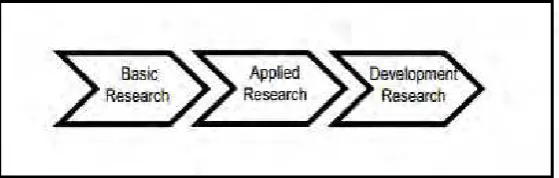
Research and development has become an important approach for the development of technology according to the scientific knowledge. Through the research and development (R&D) process, the new ideas and outcomes will be generated and it is assumed as the new scientific knowledge which is discover from the three stages of research. The three stages of research are basic research, applied research and development research (Figure 2.1) also named as Research and Development (R&D) Model for technology development (Darius Mahdjoubi, 2009).
Figure 2.1: Research and Development (R&D) Model (Darius Mahdjoubi, 2009).
9 and its law which provides the means of resolving the important practical problems and leads to the development of new ideas but the ideas created in this type of research tends to not directly applicable to the real world. This basic research is the important scientific capital that will be continued by the applied research. Applied research will serve as the answer for the findings from the basic research that may direct the application of the ideas created to the real world before entering the last stage of research and development (R&D) model that is the development research. According to (Seels & Richey, 1994), development can be view as the “process of translating the design specification into the physical form”. Thus, the development research stage is more likely towards the innovation phase before the commercialization phase takes over as shown in Figure 2.2.
Figure 2.2: The stages of research towards the commercialization phase (Darius Mahdjoubi, 2009).
10 2.4 Creating the Ideation Process in Research and Development
An organizations needs to be more creative in creating of new ideas to develop new products, business and solutions for the customers in order to achieved the customer satisfaction. Innovators and researchers were simply “freelancing” and works to produce new ideas on their own initiative and creativity rather than having a joint venture with other organizations to get better idea production. Robert B. Tucker, (2014) stated that almost without the exception, these ideas generations methods has been applied sporadically rather than develop them strategically, systematically and continuously. According to Streling Speirn et al, (2008) many ideas productions from innovators nowadays do not come to the intention from the management and some of the ideas not develop until the commercial success. The needs of better idea creation flow to be applied among the innovators in order to have development for the ideas to be successfully commercialize and remained systematic. Innovators must have some change in their ways of thinking in producing new ideas and paying more attention to the front end of innovation where possibilities first come to light. Thus, innovators and researchers must fortify their ideas by managing the ideas in superior idea management systems. There were several keys need to be highlight in order to produce a better flow in ideas creation which are the innovators might include more employees in the process of creating new ideas and solving the problems in the organization.
11 thinking forward not by focusing the formation of the ideas and products for the present customers but must also consider for the future the customers where the will be question whether the ideas might meet the customer’s need.
2.5 Innovation of Research and Development towards
Commercialization Phase
Innovation is the phase after the research and development phases which encompasses an end-to-end process and extract the value of the idea through implementation into new activities and products. Innovation is likely to adopting things that have been successfully tried by other innovators which is categories as “innovation-on-innovation” and mostly the innovators has to moving outside the existing paradigms to get the better production or development of new ideas. The ideas created from innovators must be more specific and more towards the solving problems in order to get attraction from the customers when the commercialization occurs. Innovation is considerably important in an organization as it is closely related to the productivity even though there are highly avenues in increasing productivity; innovation is the most significant factor.