Methods for Measuring Rates of Protein
Binding to Insoluble Scaffolds in Living Cells:
Histone H1-Chromatin Interactions
Tanmay Lele,1Stefan R. Wagner,2Jeffrey A. Nickerson,2and Donald E. Ingber1* 1Vascular Biology Program, Departments of Pathology and Surgery, Children’s Hospital, Harvard Medical School, Boston, Massachusetts
2Department of Cell Biology and Cancer Center, University of Massachusetts Medical School, Worcester, Massachusetts
Abstract Understanding of cell regulation is limited by our inability to measure molecular binding rates for proteins within the structural context of living cells, and many systems biology models are hindered because they use values obtained with molecules binding in solution. Here, we present a kinetic analysis of GFP-histone H1 binding to chromatin within nuclei of living cells that allows both the binding rate constant kONand dissociation rate constant kOFFto be determined based on data obtained from fluorescence recovery after photobleaching (FRAP) analysis. This is accomplished by measuring the ratio of bound to free concentration of protein at steady state, and identifying the rate-determining step during FRAP recovery experimentally, combined with mathematical modeling. We report kOFF¼0.0131/s and kON¼0.14/s for histone H1.1 binding to chromatin. This work brings clarity to the interpretation of FRAP experiments and provides a way to determine binding kinetics for nuclear proteins and other cellular molecules that interact with insoluble scaffolds within living cells. J. Cell. Biochem. 99: 1334–1342, 2006. ß2006 Wiley-Liss, Inc.
Key words: FRAP; nuclear; photobleaching; mathematical model; scaffold; histone; binding
Our understanding of cell form and function is largely based on static images. Yet virtually, all cellular structures undergo continual turn-over in which individual molecules can diffuse throughout the cytoplasm, and bind and unbind to other soluble molecules, as well as to larger insoluble scaffolds in the cytoplasm and nucleus. Because analysis of molecular binding interactions is difficult in whole cells, most of our knowledge of molecular binding rates is based on studies with isolated components
carried out in solution, and these are the rates used in most systems biology models of cell regulation. But many cellular proteins nor-mally function when bound to insoluble mole-cular scaffolds, such as signaling complexes, cytoskeletal filaments, chromatin, and the nu-clear matrix that appear beneath the surface membrane, in the cytoplasm, or within the nucleus [Ingber, 1993; Nickerson, 2001; Zink et al., 2004]. It is therefore crucial to be able to determine the binding rates for these molecules in the physiological context of living cells.
Analysis of molecular binding interactions can be carried out in living cells expressing proteins that are labeled with fluorescent dyes or tagged with green fluorescent protein (GFP), in combination with the fluorescence recovery after photobleaching (FRAP) technique. In FRAP, fluorescently labeled molecules within a small region of the surface membrane, cytoplasm, or nucleus are exposed to a brief pulse of laser irradiation that bleaches mole-cules within the path of the beam without altering their structure or function. Repeated fluorescence images of the bleached zone can be
ß2006 Wiley-Liss, Inc.
Grant sponsor: NIH; Grant number: CA-45548; Grant sponsor: NSF grant; Grant number: DMR-0213805; Grant sponsor: American Cancer Society; Grant number: RSG 99-262-04; Grant sponsor: National Cancer Institutes; Grant number: PO1 CA82834.
*Correspondence to: Donald E. Ingber, MD, PhD, Vascular Biology Program, KFRL 11.127, Children’s Hospital, 300 Longwood Avenue, Boston, MA 02115.
used to measure the rate at which fluorescent molecules redistribute and replace photo-bleached ones. Most papers in the biological literature, however, only report the data in terms of the half time of recovery measured over several minutes. Others report ‘‘apparent’’ diffusion coefficients, even though FRAP recov-ery may be limited by binding and not by diffusion depending on the experimental condi-tions. Thus, the need for a better interpretation and mathematical analysis of FRAP data has become clear [Kaufman and Jain, 1990, 1991; Lele et al., 2004; Sprague et al., 2004; Sprague and McNally, 2005]. This is particularly true for nuclear proteins which can exhibit complex binding dynamics with insoluble chromatin or nuclear matrix [Koppel and Sheetz, 1983; Kauf-man and Jain, 1990, 1991; Tardy et al., 1995; Phair and Misteli, 2000, 2001; Stenoien et al., 2001, 2002; Presley et al., 2002; Carrero et al., 2003; Karpova et al., 2004; Lele et al., 2004; Phair et al., 2004a, 2004b; Sprague et al., 2004; Hinojos et al., 2005].
In the present study, we focus on the devel-opment of a method to measure the binding and unbinding rate constants (kONand kOFF,
respec-tively) for histone H1 protein to chromatin within nuclei of living cells. Chromatin struc-ture is highly complex as almost 2 m of DNA are packaged into a nucleus with a typical diameter of 10 mm in human cells. The first level of packaging is the nucleosome, formed by the wrapping of DNA around a nucleosomal core consisting of an octamer complex with two molecules each of histones H2A, H2B, H3, and H4 [Luger et al., 1997; Richmond et al., 1984]. This forms a chromatin structure that appears as ‘‘beads on a string’’ when viewed in an electron microscope [Olins and Olins, 1974]. Histone H1 binds to 23 base pairs of DNA that extend out from this nucleosomal core [Travers, 1999]. Binding of histone H1 facilitates further folding of the nucleosomal strings into more condensed chromatin structures; this represses transcription, and the release of histone H1 from internucleosomal DNA-binding sites may be an important step in the activation of gene transcription [Zlatanova et al., 2000]. Binding of histone H1 to DNA has been characterized in vitro [Mamoon et al., 2005]; however, the relevance of these results for understanding kinetics of histone exchange with binding sites on DNA within intact chromatin in living cells remains unclear. Histone H1 is also a good
choice for this analysis because it is abundant and widely distributed in the nucleus, it binds to specific DNA sequences through a simple bimolecular interaction [Wolffe, 1998] and, unlike the nucleosomal core histones, it does not bind to DNA as part of a larger multi-protein complex. In addition, the binding and unbind-ing of histone H1 to DNA is likely to be altered in much simpler ways than the complicated mechanisms by which whole nucleosomes are ‘‘remodeled’’ [Imbalzano and Xiao, 2004].
Past studies have shown that when molecular diffusion is much faster than both binding and unbinding rates, FRAP recovery depends only on kOFF, and not kON[Kaufman and Jain, 1991;
Bulinski et al., 2001; Lele et al., 2004]. Based on this observation, the FRAP method can be modified to determine the kOFFof certain
pro-teins within living cells [Lele and Ingber, 2005; Lele et al., 2005]. But an independent experi-mental technique is needed to reliably estimate kON. Here, we present a new method to estimate
kON by measuring the ratio of bound to free
concentration of protein at steady state in living cells; this ratio is equal to kON=kOFF. We further
present a method to identify the rate-determin-ing step durrate-determin-ing FRAP recovery to allow the reliable formulation of simplified mathematical models and estimate kOFF. Together, this
information allows us to estimate kON.
MATERIALS AND METHODS Cell Culture
NIH3T3 cells were cultured in DMEM sup-plemented with 10% fetal bovine serum. GFP-Histone H1.1 was kindly provided by Prof. Mike Hendzel. Transfections were performed using Superfect (Qiagen). For FRAP experiments, cells were grown on 40 mm glass coverslips and transferred to a FCS2 live cell chamber (Bioptechs) mounted on a Leica SP laser scan-ning confocal microscope with objective heater. The temperature was maintained at 378C. In some experiments, the cells were fixed with 4% formaldehyde/0.1% glutaraldehyde in per-meabilization buffer (20 mM HEPES, pH 7.3; 110 mM potassium acetate; 2 mM magnesium acetate) for 45 min prior to transferring them to the microscope.
Fluorescence Recovery After Photobleaching
full power) on the Leica SP laser scanning confocal microscope. Cells were chosen ran-domly with respect to protein expression level, nuclear shape and size; 15–20 cells were analyzed for each condition. Routinely, 2 images were taken before and 20–30 images after the bleach at intervals of 20 s depending on the time of recovery. To bleach all fluorescent EGFP-proteins in the nucleus, maximal laser power (100% of full power) was applied to the region of interest for 3 s. Leica confocal software (version 2) was used to measure the intensity of fluorescence in the bleached area and in the whole nucleus for the whole stack of images. For analysis, these data were first corrected for loss in bleaching during image acquisition as fol-lows: at any given time t, D¼ðIIbÞ=ðIwIbÞ
is the corrected data where I is the average fluorescent intensity in the bleached spot, Iband
Iw are the background and whole nucleus
average intensities; all at time t. To plot Figure 2A, D was normalized to the amount photobleached, that is, DðtÞ=ðDð0Þ DðtbÞÞ
where tb is the time at which bleaching was
performed. To plot Figure 2B, the data was normalized as DðtÞDðtbÞ
Dðt1ÞDðtbÞ;ttb; this was also fit to an exponential function 1ekOFFtfor deter-mining kOFF. Fitting was performed using
Matlab v6.5 with the lsqcurvefit function. Statistical analysis was performed using the Student’st-test (t-test 2 function in Matlab v6.5).
RESULTS
Determination of the Rate-Limiting Step
To calculate the rate constants for binding (kON) and unbinding (kOFF) for a protein within
living cells, a mathematical model must be formulated that faithfully represents the phy-sical process. This demands that the rate-limit-ing step that governs recovery durrate-limit-ing FRAP analysis be correctly identified. If the fluores-cence recovery measured during FRAP in cells is diffusion-limited, then the characteristic recovery time (e.g., time required for 50% fluorescence recovery, t1/2) is proportional to
the area of the photobleached spot [Lele et al., 2004; Sprague et al., 2004].
To identify the rate-limiting step for histone H1 binding to chromatin, we carried out FRAP experiments in NIH3T3 cells expressing EGFP-histone H1 which localized throughout the nucleus in a diffuse pattern (Fig. 1), as pre-viously described [Th’ng et al., 2005]. We carried out FRAP experiments by either photo-bleaching a small circular spot (16mm2) in the nucleus (Fig. 1A), or exposing more than half of the nuclear cross-sectional area to laser light (Fig. 1B). In both cases, complete fluorescence recovery due to diffusion of fluorescent GFP-histone H1 from non-irradiated regions into the bleached zone, and binding to chromatin at this site, occurred in approximately 3 min.
Fig. 1. FRAP recovery of GFP-Histone H1 is insensitive to spot size. Fluorescence confocal microscopic
Analysis of these results revealed that the final level of recovered fluorescence intensity at steady state was significantly lower when the larger area was photobleached due to a greater loss of total fluorescence intensity (Fig. 2A). However, when the data were normalized for the total amount of fluorescent recovery in each cell (see Materials and Methods), we found that the temporal dependence of the normalized fluorescence recovery was insensitive to the size of the photobleached spot (Fig. 2B). In other
words, although the total level of fluorescence intensity recovered was less for the larger bleach spot size, the rate of recovery of fluores-cence remained unchanged (Fig. 2B). Impor-tantly, this finding indicates that diffusion did not play a significant role in the recovery, because it if did, then the rate of recovery would depend directly on the spot size. Thus, the fluorescence recovery of GFP-histone H1 during FRAP in these cells is limited by binding and unbinding kinetics, rather than diffusion [Lele et al., 2004; Sprague et al., 2004]. Although the rate of recovery during FRAP may be sensitive to spatial location of the photobleached spot, measurements were performed without regard to spatial location, and hence they represent an average value measured over different spatial domains.
GFP-histone H1 exists in the nucleus in two states: chromatin-bound or freely diffusing. Because FRAP recovery of GFP-histone H1 is not diffusion limited (Figs. 1 and 2), the bound histone protein must exchange with the free protein much more slowly than free histone can diffuse. This is expected because the molecular weight of GFP-histone H1 (50 kDa) is not significantly different from that of unconju-gated GFP (27 kDa), which diffuses very rapidly inside the nucleus. A mutant GFP-histone created by the deletion of the globular or C-terminal domain of the histone molecule which mediates DNA binding has been shown to diffuse as rapidly as free GFP [Lever et al., 2000; Hendzel et al., 2004]. Thus, our FRAP data indicate that non-specific binding of GFP-histone H1 to chromatin or other insoluble nuclear scaffolds is insignificant in these cells. These observations, taken together with the results in Figures 1 and 2, suggest that free GFP-histone H1 diffuses across the entire nuclear space in a time scale of less than a second, whereas chromatin-bound GFP-histone H1 exchanges with the nucleoplasmic pool over a much slower time scale.
The FRAP recovery dynamics for GFP histone H1 are therefore indicative of a ‘‘reaction-dominant’’ mechanism in which the binding and unbinding rate are much faster than the rate of diffusion as represented by the Damko¨h-ler number kONw2=DH1 [Lele et al., 2004;
Sprague et al., 2004] where w is the size of the photobleached spot and DHis the diffusion
coefficient of GFP histone H1. Under these con-ditions, the rate of FRAP recovery is determined
Fig. 2. FRAP recovery curves of GFP-histone H1 are not
by a time scale of 1/kOFF(see Appendix), thus
allowing the direct determination of kOFF for
histone H1 binding to DNA in the living nucleus from FRAP [Bulinski et al., 2001; Lele et al., 2004].
Estimation of the Ratio of Free Versus bound Protein
To determine kON, it is necessary to first
estimate the free versus bound concentration of protein in the nucleus. To accomplish this, we measured the level of nuclear fluorescence intensity for GFP-histone before and after cells were extracted in buffer containing 0.5% Triton-X-100 to remove lipids and soluble proteins. The level of fluorescence intensity after extraction reflects the concentration of the bound protein, and the lost fluorescence intensity corresponds to the concentration of free protein. On average, 25% of the fluorescence signal was lost during the extraction process indicating that the ratio of free to bound histone H1 was approximately 1:3. However, in addition to freely diffusing histone molecules, some bound histone H1 may also be removed due to unbinding and exit from the nucleus during the 4 min extraction process. Thus, this detergent-extraction experiment may overestimate the percentage of free histone H1 in living cells.
To more accurately estimate this ratio, we developed a method to rapidly photobleach all the freely diffusing GFP-histone H1 molecules in the nucleus without losing the bound form of the molecule, and to quantify the resulting loss in fluorescence. We took advantage of the fact that free GFP-histone H1 diffuses very rapidly (as fast as free GFP). When we exposed a small circular region (4mm diameter) of the nucleus of a cell expressing GFP alone to laser light for an extended time (3 s), all of the rapidly diffusing free GFP molecules were free to enter the light path; this resulted in bleaching of theentirepool of freely diffusing GFP-labeled molecules as indicated by loss of more than 80% of the nuclear fluorescence intensity, without affecting cyto-plasmic staining levels (Fig. 3A,B).
Given that free GFP and GFP-histone H1 have similar mobilities, we reasoned that a similar photobleaching experiment with his-tone H1 will bleach all the freely diffusing protein throughout the nuclear space while leaving the bound fluorescent protein outside the photobleached spot unbleached. When we photobleached GFP-histone H1 in the nucleus
at a fixed spot in a similar manner (Fig. 4A), the fluorescence intensity in non-irradiated regions of nucleus surrounding the spot decreased by over 7% (P<0.00001) (Fig. 4B).
This lost fraction that appears to be attribu-table to free GFP-histone H1 is much smaller than the 25% we measured using the Triton X-100 permeabilization technique. To explore this further, similar photobleaching experiments were performed in cells that were fixed with a mixture of paraformaldehyde and glutaralde-hyde to irreversibly cross-link GFP-Histone H1 to chromatin and other nuclear structures and thereby prevent diffusion. There was no decrease in nuclear fluorescence outside the bleach zone when these fixed cells were irra-diated in a similar manner (Fig. 4B). These data confirm that the decrease of fluorescence inten-sity measured in regions of the nucleus outside the photobleached zone was indeed due to freely diffusing GFP-histone molecules.
When diffusion is much faster than binding and unbinding, the normalized FRAP recovery data yield kOFF (see Appendix). Fitting normalized
Fig. 3. Extended exposure of a small region of the nucleus to
GFP-Histone H1 FRAP recovery curves to the formula 1ekOFFt, we estimated that kOFF¼0:0131=s. Because freely diffusing GFP
was not bleached completely (80%) after the 3 s laser exposure, the free to bound ratio measured in Figure 4 was corrected for this difference. We obtained the ratio of kOFF=kON¼
K¼0:096 (K is the equilibrium constant) which indicates that kON¼0.14/s for histone H1 in the
nuclei of these living cells.
DISCUSSION
We have developed a method to determine kONand kOFFfor the binding of histone H1 to
chromatin in living cells using photobleaching methods and mathematical modeling. First, we demonstrated that GFP-histone H1 binding is not limited by diffusion and thus, we were able to directly determine the unbinding rate con-stant kOFF from FRAP experiments. We then
developed a modified photobleaching method whereby we can estimate the proportion of free
to bound histone H1 molecules within nuclei, which is equal to kOFF=kON (see appendix for mathematical analysis). Together, these mea-surements allowed us to estimate the binding constant kON of histone H1 in living cells.
It should be noted that the normalized recovery time we observed during FRAP for GFP-histone-H1 is slower than that previously observed [Th’ng et al., 2005]; however, this is likely due to differences in cell type as has been observed for other nuclear proteins [Kruhlak et al., 2000].
Histone binding and unbinding rate con-stants are direct measures of protein interac-tions that can be regulated biologically. For example, linker histone release from DNA is a regulated phenomenon in the mechanism of gene activation [Zlatanova et al., 2000]. Com-pared to nucleosomal core histones, fewer reported postranslational modifications and protein-binding partners have been reported for histone H1 variants; however, histone H1 can be serine phosphorylated. FRAP experi-ments withTetrahymenashow that mutants of histone H1 engineered to mimic the charge distributions of either the phosphorylated or unphosphorylated forms have different rates of exchange on chromatin [Dou et al., 2002]. Cyclin/CDK phosphorylation was shown to govern histone H1 exchange kinetics as mea-sured by FRAP in mammalian cells [Contreras et al., 2003].
Histone H1 also binds to heterochromatin protein 1 (HP1) during heterochromatin forma-tion [Nielsen et al., 2001] and this interacforma-tion could stabilize condensed chromatin structures. Additionally, histone H1 binds barrier-to-auto-integration factor (BAF) in vitro [Montes de Oca et al., 2005], an interaction that could also be important in the spatial organization of chro-matin at the nuclear periphery. If all these interactions are biologically significant we might expect local alterations in histone H1 binding and unbinding rates that could, with appropriate biological manipulations, be probed with the methods we present here. Additionally, different histone H1 subtypes may have differ-ent binding kinetics because they recover differently during FRAP [Th’ng et al., 2005]. Thus, the measurement of histone H1 rate constants by FRAP could be an important tool for probing fundamental biological regulatory mechanisms underlying the function of this critical chromatin protein in living cells.
Fig. 4. Loss of fluorescence intensity of GFP-histone H1 from
There are certain assumptions underlying our analysis that are important for the inter-pretation of binding constants. All histone H1 binding sites are assumed to be identical. As there is no consensus DNA sequence for histone H1 binding, it is likely that the binding constants that we measured are an average for all sites. There are also some caveats before this method can be generalized to other nuclear proteins that exist in bound and freely diffusing forms. First, when we irradiated a small region of the nucleus for 3 s to bleach all free diffusing proteins, it is possible that some of the bound fluorescent protein unbinds, diffuses into this region, and hence, also gets bleached during the experiment; in this case, the free to bound ratio may be overestimated. The interconversion between fluorescent bound and free protein in unbleached areas is determined by the rate constant kON(see Equation (7) in the Appendix).
Thus, this analysis will be most accurate under conditions in which the binding rate is much slower than diffusion so that the cross talk between bound and freely diffusing protein does not play a significant role. This can be con-firmed, as we did here, by showing that the FRAP recovery is insensitive to spot size, as shown in Figures 1 and 2.
The kON for histone H1 measured in this
paper is the multiplicative product of the binding rate constant kON and the concentra-tion of protein binding sites available S (see binding rate expression in the Appendix). Thus, any changes that are measured in kON could
arise from a change in either the rate constant kON (indicating changes in binding energy landscapes) or the number of available binding sites. A separate assay would be necessary to distinguish between these two effects.
In conclusion, we have developed a simple method to estimate kOFFand kONfor proteins
that bind to insoluble nuclear structures when diffusion is not rate limiting in FRAP experi-ments. To accomplish this, the rate-limiting step must be identified and we demonstrated that this can be done experimentally by carry-ing out FRAP experiments in which the spot size areas are varied. If diffusion is very fast compared to binding and unbinding, the frac-tional amount of freely diffusing protein can be determined by bleaching a small stationary spot in the nucleus for an extended time and exposing all rapidly diffusing free molecules to the fixed laser light. This ratio of free to bound
protein yields kOFF=kONwhich together with an
independent determination of kOFFwith FRAP
allows the estimation of kON. This method can
be readily applied to quantify binding interac-tions in living cells for all those proteins where binding and unbinding are significantly faster than diffusion, and thus may be useful for many areas of cell biological research.
ACKNOWLEDGMENTS
Prof. Mike Hendzel’s kind gift of GFP-histone H1.1 is gratefully acknowledged. These studies were supported by grants from NIH (CA-45548) to D.E.I., and an NSF grant (DMR-0213805 to Harvard University in support of its Materials Research Science Engineering Center). J.A.N. acknowledges funding from the American Can-cer Society (RSG 99-262-04) and the National Cancer Institutes (PO1 CA82834).
APPENDIX
Kinetic Rate Laws for Histone H1
Let free histone H1 molecules be denoted by H, and available binding sites by S, then we can denote the binding process by
HþS kON
Ð
kOFF
HS ð1Þ
where HS denotes bound histone molecules where kONand kOFFdenote rate constants for
the forward and reverse steps in Equation (1). The rate of binding will depend on the con-centration of free histone molecules as well as the number of available binding sites. Thus, the rate of binding is given by (e.g., see the derivation of the Langmuir isotherm; [Hiemenz and Rajagopalan, 1997])
rON¼kON
ðfree histoneÞ
ðavailable binding sitesÞ ¼kONCS
where C is the concentration of freely diffusing histone molecules and S is the concentration of available binding sites. The rate of the reverse step in (1) is determined purely by the number of bound histone molecules, thus rOFF¼kOFF
ðboundhistoneÞ ¼kOFFC where ˆˆ C is the
Mathematical Model
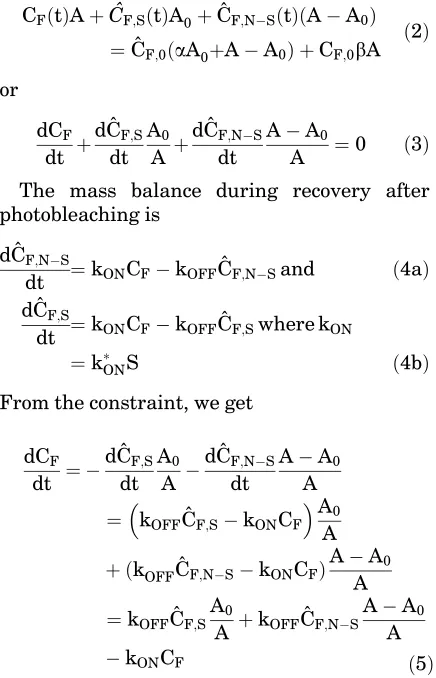
We assume that there is no spatial gradient during fluorescence recovery; this assumption was verified using the method developed in Figure (1). Let the area of photobleach be A0and
the total nuclear area be A. Before photobleach-ing, let the concentration of fluorescent free protein be CF,0 and that of fluorescent bound
protein be ˆCF;0. Then on photobleaching, there is
a loss ofbCF;0Aþ ð1aÞCˆF;0A0whereaCˆF;0A0is
the fluorescence in the photobleached spot immediately after bleach (different from zero) and bCF;0A is the extent of bleaching of the
freely diffusing protein throughout the nucleus (for example, b¼0.8 for our experiments (Fig. 3)). Let the concentration of fluorescent bound protein in the non-bleached areas be
ˆ
CF;NSand that of fluorescent free protein be CF.
Since photobleaching does not disturb local equilibrium in any way, but merely makes a fraction of the fluorescent molecules invisible, we have the constraint
CFðtÞAþCˆF;SðtÞA0þCˆF;NSðtÞðAA0Þ
The mass balance during recovery after photobleaching is
From the constraint, we get
dCF
Before the photobleaching experiment, if the bound and free protein are assumed to be at
steady state, then ˆCF;0¼
Equations (4) and (5) become
dˆcF;NS
From Equation (7), it is immediately apparent that the free protein recovers on a time scale of 1/kON. FRAP does not distinguish between
bound and freely diffusing protein, the mea-surement is of the total fluorescence due to freely diffusing and bound protein. We add the differential equations describing free and bound protein (using Equations (4) and (5)) in the photobleached spot to get
d
From this equation, it is clear that the time scale governing the sum of freely diffusing and bound protein concentrations is kOFFand does
not involve kON. Substituting for ˆCF;NS from
Equation (2), Equation (8) becomes
d
A popular normalization strategy followed in the literature is to calculate the following ratio FðtÞ ¼ ðCFðtÞþCˆF;SðtÞÞðCFðt¼0ÞþCˆF;Sðt¼0ÞÞ
ðCFðt!1ÞþCˆF;Sðt!1ÞÞðCFðt¼0ÞþCˆF;Sðt¼0ÞÞ
. The solution to Equation (9) in terms of this ratio is FðtÞ ¼1ekOFFt. This indicates that normalized FRAP data under reaction domi-nant conditions only depends on kOFF and is
independent of other parameters like kON, a,
andb.
REFERENCES
Carrero G, McDonald D, Crawford E, de Vries G, Hendzel M. 2003. Using FRAP and mathematical modeling to determine the in vivo kinetics of nuclear proteins. Methods 29:14–28.
Contreras A, Hale TK, Stenoien DL, Rosen JM, Mancini MA, Herrera RF. 2003. The dynamic mobility of histone H1 is regulated by cyclin/CDK phosphorylation. Mol Cell Biol 23(23):8626–8636.
Dou Y, Bowen J, Liu Y, Gorovsky MA. 2002. Phosphoryla-tion and an ATP-dependent process increase the dynamic exchange of H1 in chromatin. J Cell Biol 158:1161–1170. Hendzel MJ, Lever MA, Crawford E, Th’ng JP. 2004. The C-terminal domain is the primary determinant of histone H1 binding to chromatin in vivo. J Biol Chem 279:20028– 20034.
Hiemenz PC, Rajagopalan R. 1997. Principles of colloid and surface chemistry. Marcel Dekker.
Hinojos CA, Sharp ZD, Mancini MA. 2005. Molecular dynamics and nuclear receptor function. Trends Endo-crinol Metab 16(1):12–18.
Imbalzano AN, Xiao H. 2004. Functional properties of ATP-dependent chromatin remodeling enzymes. Adv Protein Chem 67:157–179.
Ingber DE. 1993. The riddle of morphogenesis: A question of solution chemistry or molecular cell engineering? Cell 75:1249–1252.
Karpova TS, Chen TY, Sprague BL, McNally JG. 2004. Dynamic interactions of a transcription factor with DNA are accelerated by a chromatin remodeller. EMBO Rep 5:1064–1070.
Kaufman EN, Jain RK. 1990. Quantification of transport and binding parameters using fluorescence recovery after photobleaching. Biophys J 58:873–885.
Kaufman EN, Jain RK. 1991. Measurement of mass transport and reaction parameters in bulk solution using photobleaching. Biophys J 60:596–608.
Koppel D, Sheetz M. 1983. A localized pattern photobleach-ing method for the concurrent analysis of rapid and slow diffusion processes. Biophys J 43:175–181.
Kruhlak MJ, Lever MA, Fischle W, Verdin E, Bazett-Jones DP, Hendzel MJ. 2000. Reduced mobility of the alternate splicing factor (ASF) through the nucleoplasm and steady state speckle compartments. J Cell Biol 150:41–51. Lele T, Ingber D. 2006. A mathematical model to determine
molecular kinetic rate constants under non-steady state conditions using fluorescence recovery after photobleach-ing (FRAP). Biophys Chem 120:32–35.
Lele TP, Oh P, Nickerson J, Ingber D. 2004. An improved mathematical approach for determination of molecular kinetics in living Cells with FRAP. Mechanics and Chemistry of Biosystems 1:181–190.
Lele T, Pendse J, Kumar S, Salanga M, Karavitis J, Ingber D. 2005. Mechanical forces alter zyxin unbinding kinetics within focal adhesions of living cells. J Cellular Physiol-ogy In press.
Lever MA, Th’ng JP, Sun X, Hendzel MJ. 2000. Rapid exchange of histone H1.1 on chromatin in living human cells. Nature 408:873–876.
Luger K, Mader AW, Richmond RK, Sargent DF, Richmond TJ. 1997. Crystal structure of the nucleosome core particle at 2.8 A resolution. Nature 389:251–260. Mamoon NM, Song Y, Wellman SE. 2005. Binding of
histone H1 to DNA is described by an allosteric model. Biopolymers 77:9–17.
Montes de Oca R, Lee KK, Wilson KL. 2005. Binding of barrier-to-autointegration factor (BAF) to histone H3 and selected linker histones including H1.1. J Biol Chem
Nickerson J. 2001. Experimental observations of a nuclear matrix. J Cell Sci 114:463–474.
Nielsen AL, Oulad-Abdelghani M, Ortiz JA, Remboutsika E, Chambon P, Losson R. 2001. Heterochromatin forma-tion in mammalian cells: Interacforma-tion between histones and HP1 proteins. Mol Cell 7:729–739.
Olins AL, Olins DE. 1974. Spheroid chromatin units (v bodies). Science 183:330–332.
Phair R, Misteli T. 2000. High mobility of proteins in the mammalian cell nucleus. Nature 404:604–609.
Phair R, Misteli T. 2001. Kinetic modelling approaches to in vivo imaging. Nat Rev Mol Cell Biol 2:898–907. Phair RD, Gorski SA, Misteli T. 2004a. Measurement of
dynamic protein binding to chromatin in vivo, using photobleaching microscopy. Methods Enzymol 375:393– 414.
Phair RD, Scaffidi P, Elbi C, Vecerova J, Dey A, Ozato K, Brown DT, Hager G, Bustin M, Misteli T. 2004b. Global nature of dynamic protein-chromatin interactions in vivo: Three-dimensional genome scanning and dynamic interaction networks of chromatin proteins. Mol Cell Biol 24:6393–6402.
Presley J, Ward T, Pfeifer A, Siggia E, Phair R, Lippincott-Schwartz J. 2002. Dissection of COPI and Arf1 dynamics in vivo and role in Golgi membrane transport. Nature 417:187–193.
Richmond TJ, Finch JT, Rushton B, Rhodes D, Klug A. 1984. Structure of the nucleosome core particle at 7 A resolution. Nature 311:532–537.
Sprague BL, McNally JG. 2005. FRAP analysis of binding: Proper and fitting. Trends Cell Biol 15:84–91.
Sprague BL, Pego RL, Stavreva DA, McNally JG. 2004. Analysis of binding reactions by fluorescence recovery after photobleaching. Biophys J 86:3473–3495.
Stenoien DL, Nye AC, Mancini MG, Patel K, Dutertre M, O’Malley BW, Smith CL, Belmont AS, Mancini MA. 2001. Ligand-mediated assembly and real-time cellular dynamics of estrogen receptor alpha-coactivator complexes in living cells. Mol Cell Biol 21(13):4404– 4412.
Stenoien DL, Mielke M, Mancini MA. 2002. Intranuclear ataxin1 inclusions contain both fast and slow-exchanging components. Nat Cell Biol. 4(10):806–810.
Tardy Y, McGrath J, Hartwig J, Dewey C. 1995. Interpret-ing photoactivated fluorescence microscopy measure-ments of steady-state actin dynamics. Biophys J 69: 1674–1682.
Th’ng JP, Sung R, Ye M, Hendzel MJ. 2005. H1 family histones in the nucleus. Control of binding and localiza-tion by the C-terminal domain. J Biol Chem 280:27809– 27814.
Travers A. 1999. The location of the linker histone on the nucleosome. Trends Biochem Sci 24:4–7.
Wolffe A. 1998. Chromatin: Structure and function. London: Academic Press.
Zink D, Fischer AH, Nickerson JA. 2004. Nuclear structure in cancer cells. Nat Rev Cancer 4:677–687.