ASSESSMENT OF THE HAND GRIP STRENGTH AND
HAND INJURIES FOR UTEM SPORTSPERSON
ELYASDIN BIN YAMAN
B050910221
UNIVERSITI TEKNIKAL MALAYSIA MELAKA
This report submitted in accordance with requirement of the Universiti Teknikal Malaysia Melaka (UTeM) for the Bachelor Degree of Manufacturing Engineering
Management (Hons.)
by
ELYASDIN BIN YAMAN
B050910221
FACULTY OF MANUFACTURING ENGINEERING 2012
UNIVERSITI TEKNIKAL MALAYSIA MELAKA
BORANG PENGESAHAN STATUS LAPORAN PROJEK SARJANA MUDA
Taj uk : Assessment of The Hand Grip Strength and hand inj uries for UTeM
Sportsperson
SESI PENGAJIAN: 2011/ 12 Semest er 2
Saya ELYASDIN BIN YAMAN
mengaku membenarkan Laporan PSM ini disimpan di Perpust akaan Universit i Teknikal Malaysia Melaka (UTeM) dengan syarat -syarat kegunaan sepert i berikut :
1. Laporan PSM adalah hak milik Universit i Teknikal Malaysia Melaka dan penulis.
2. Perpust akaan Universit i Teknikal Malaysia Melaka dibenarkan membuat salinan
unt uk t uj uan pengaj ian sahaj a dengan izin penulis.
3. Perpust akaan dibenarkan membuat salinan laporan PSM ini sebagai bahan
pert ukaran ant ara inst it usi pengaj ian t inggi.
4. **Sila t andakan (√)
SULIT
TERHAD
TIDAK TERHAD
(Mengandungi maklumat yang berdarj ah keselamat an at au kepent ingan Malaysiasebagaimana yang t ermakt ub dalam AKTA RAHSIA RASMI 1972)
(Mengandungi maklumat TERHAD yang t elah dit ent ukan oleh organisasi/ badan di mana penyelidikan dij alankan)
Alamat Tet ap:
ABSTRAK
ABSTRACT
iii
DEDICATION
ACKNOWLEDGEMENT
v
List Abbreviations, Symbols and Nomenclatures xi
CHAPTER 1 : INTRODUCTION 1
1.1 Background 1
2.3 Sports and the Equipments which are related to Hand Grip 9
2.3.1 Hand Grip Test 10
2.4 Comparison Previous Study Done on Hand Grip Strength for Athletes
11
2.5 Microsoft Excel 12 2.6 Hand and Arm Injuries and Syndrome 18
CHAPTER 3 : METHODOLOGY 20
3.1 Planning of Study 20
3.2 Methods 22
vi
3.2.1 Questionnaire 22
3.2.2 Dynamometer 23
3.3 Participants 23
3.4 Gantt Chart 23
CHAPTER 4 : RESULT AND DISCUSSION 26
4.1 Average Pain Severity 26
4.2 Average Hand Grip Strength 27
4.3 Area of Pain 29
4.5.1 Level of Injuries for Badminton 38
4.5.2 Level of Injuries for Handball 39
4.5.3 Level of Injuries for Kayak 39
4.5.4 Level of Injuries for Rugby 40
4.5.5 Level of Injuries for Softball 41
4.5.6 Overall Level of Injuries 41
4.6 Overall Discussion 42
4.7 T Test for Pain Severity and Hand Grip Result 43
vii
4.7.2 T Test for Pain Severity 44
4.7.3 T Test for Area of Pain 44
CHAPTER 5 : CONCLUSION AND RECOMMENDATIONS 45
REFERENCES 46
APPENDICES
A Questionnaire
viii
2.1 Types of Hand Grips 9
3.1 Gantt Chart for PSM 1 24
3.2 Gantt Chart for PSM 2 25
4.1 Average Pain Severity 27
4.2 Average Hand Grip Strength 28
4.3 Overall Area of Pain 33
4.4 Overall Types of Pain 37
4.5 Overall Level of Injuries 42
4.6 Correlation of Hand Grip Strength and Gender 43
4.7 Correlation of Pain Severity and Gender 44
4.8 Correlation of Types of Sports and Area of Pain 44
ix
2.1 Hand Muscles 6
2.2 Sports Equipment 10
2.3 Normative Data for 16-19 Years Old 12
2.4 Dynamometer 12
2.5 Microsoft Excel Timeline 17
2.6 Carpal Tunnel Syndrome Disorder 19
2.7 Cumulative Trauma 19
3.1 Process Flow Chart 21
4.1 Pain Severity Scale 26
4.2 Pain Severity Average 27
4.3 The Average Hand Grip Strength 28
4.4 Area of Pain 29
4.15 Level of Injuries for Badminton 38
4.16 Level of Injuries for Handball 39
4.17 Level of Injuries for Kayak 40
4.18 Level of Injuries for Softball 40
4.19 Level of Injuries for Rugby 41
x
4.20 Level of Injuries for Badminton 42
xi
CTS - Cumulative Trauma Disorder ODBC - Open Database Connectivity OOS - Occupational Overuse Syndrome RMS - Repetitive Motion Syndrome RSI - Repetitive Strain Injury
SPSS - Statistical Package for Social Sciences
1
CHAPTER 1
INTRODUCTION
1.1 Background
Malaysian athletes need to be good at fitness strength and coordination efficiency. A lot of manual hand grip strength and dexterity tests are created to assess the efficiency. These tests are usually not accurate and need to be done repeatedly. The hand grip strength is the force applied by the hand to pull on an object and is a specific part of hand strength. Stair rails are an example of where shape and diameter are critical for proper grip in case of a fall. Other grip strengths that have been studied are the baseball bat and other hand tools. In applications of grip strength, the wrist must be in a neutral position to avoid developing cumulative trauma disorders (CTD's).
2 Most studies evaluating the usability of the hand grip force match procedure have been conducted in a controlled laboratory environment (Bao and Silverstein, 2005; Koppelaar and Wells, 2005; Marshall et al., 2004). These studies have explored volunteers’ ability to replicate specific hand force levels (King and Finet, 2004; umar et al., 1997; Lowe, 1995). Results have varied regarding the accuracy and precision of force matching when compared to known forces in instrumented handles or tools (Koppelaar and Wells, 2005). Despite limited testing of the force match procedures in field studies, the methods are commonly used to collect hand force information for prevention and intervention studies. In this study, dynamometer and questionnaires are used to collect the data. This study also evaluated the validity of the relationship of the hand grip force with the hand and arm injuries.
1.2 Problem Statement
The performance of arm and hand function may be used to identify the efficiency of humans. In this study, it is to identify the performance of arm and hand functions of UTeM athletes and its relationship to the arm and hand injuries. Different group of athletes are exposed to different type of hand and arm injuries since they are trained in different hand grip type according to the sports they are involved in. The aim of this study is to evaluate the hand grip and dexterity for UTeM sportsperson and to compare the relationship between their hand grip strength with the hand problems or syndrome.
This study emphasis on sportsperson as they are trained well and have better hand grip strength compared to normal people. These people tend to be more invincible to hand and arm injuries and in the other hand may be the most potential type of people who are exposed to hand and arm injuries if they are trained excessively and not properly.
3 extract information on the specific body part which will lead to the hand and arm injuries and at the same time are able to get to know the participants background. The data then will be collected and processed using the Microsoft Excel. The software is very helpful to relate the target group data with the hand and arm injuries.
1.3 Objective
This study has a few objectives to accomplish. Each of the objectives will be encountered using the appropriate method that will be explained more in chapter 3. The aim of this study is divided into 3 parts as follow:
1. To identify significant relationships between hand grip strength of hand and general hand and arm injuries.
2. To evaluate the hand grip strength for UTeM sportsperson. 3. To investigate the hand pain experience for UTeM sportsperson.
1.4 Scope of study
The scopes of the study justify the participants for this study. In general, this study is on the UTeM sportsperson. As we all know, sportsperson are usually expert and well trained for one type of sport. Different sportsperson have different expertise in their hand grip strength. The scope of this study is divided into 5 categories. There are as below:
4
1.5 Report Outline
5
CHAPTER 2
LITERATURE REVIEW
This Chapter discusses on manual hand grip assessment and injuries may occur from it. The assessment or test is subjective and need to be done a few times to get the most accurate result. This study is more on UTeM athletes including male and female.
2.1 Hand Grip
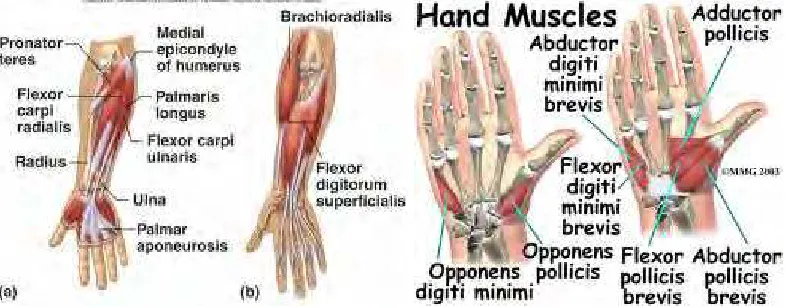
There are 35 muscles involved in movement of the forearm and hand, with many of these involved in gripping activities during gripping activities; the muscles of the flexor mechanism in the hand and forearm create grip strength while the extensors of the forearm stabilize the wrist (Waldo, B. Grip Strength Testing, 1996). There are four major joints of the hand, Carpometacarpal, Intermetacarpal, Metacarpophalangeal, and interphalangeal joint, with 9 extrinsic muscles that cross the wrist and 10 intrinsic muscles with both of their attachments distal to the wrist (Hall S. Basic Biomechanics, 2007). These muscles include the pronator radii teres, flexor carpi radialis, flexor carpi ulanris, flexor sublimis digitorum, and Palmaris longus on the extrinsic layer and the flexor profundus digitorum, flexor policus longus, pronator quadratus, flexor pollicus brevis, and abductor pollicus brevis on the intrinsic layer. Each of these muscles is active during gripping activities.
6 fact that the thumb can be opposed to the fingers. The fingers and the thumb act as a versatile pair of pliers. They need the palm of the hand as a flat base, on which the object grasped can be held (Weinick J. Functional Anatomy in Sports, 1990). From this statement, it can be concluded that the anatomy of the hand is more geared toward flexion than extension. Further proof lies in the research of Li, Zatsiorsky, and Latas on the strength of finger flexor vs. finger extensor musculature during isometric tasks. Their findings revealed the flexor mechanism of the fingers to be 62% stronger than the extensor (Li Z., Zatsiorsky V., Latash M, 2001)
Figure 2.1: Hand Muscles
2.2 Hand Grip in Sports
A sportsperson or athletes is a person trained to compete in a sport involving physical strength, speed or endurance. Sportsperson may be professional or amateur. Most professional sportsperson have particularly well-developed physiques obtained by extensive physical training and strict exercise accompanied by a strict dietary regimen.
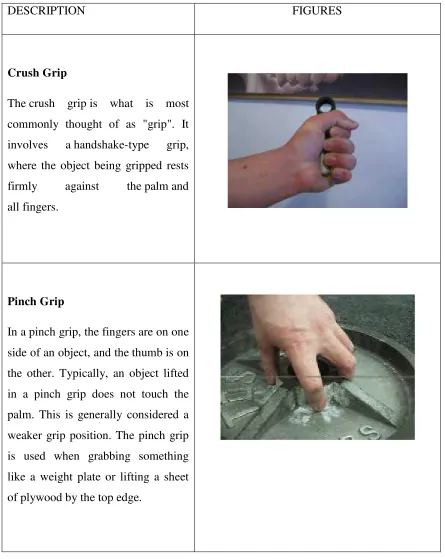
7 based on the way the hand is being used. Following are the table of the types of hand grip.
DESCRIPTION FIGURES
Crush Grip
The crush grip is what is most commonly thought of as "grip". It involves a handshake-type grip, where the object being gripped rests firmly against the palm and all fingers.
Pinch Grip
8
Support Grip
A support grip typically involves holding something, such as the handle of a bucket, for a long time. A great deal of muscular endurance is necessary to have a good carrying grip.
Wrist Strength
9
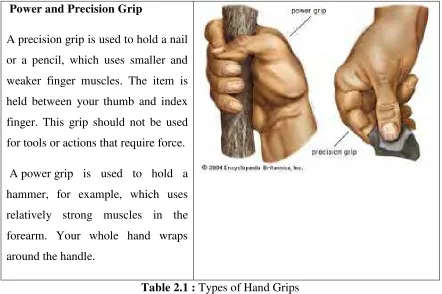
Power and Precision Grip
A precision grip is used to hold a nail or a pencil, which uses smaller and weaker finger muscles. The item is held between your thumb and index finger. This grip should not be used for tools or actions that require force. A power grip is used to hold a hammer, for example, which uses relatively strong muscles in the forearm. Your whole hand wraps around the handle.
Table 2.1 : Types of Hand Grips
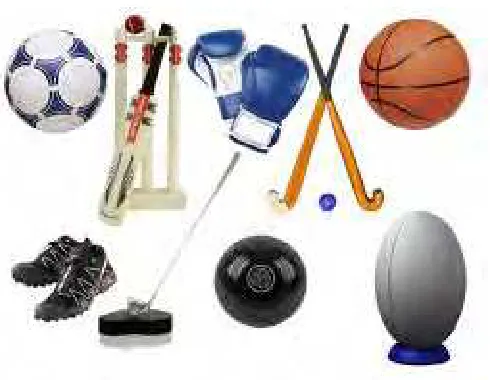
2.3 Sports and the Equipments which are related to Hand Grip
10
Figure 2.2 : Sports Equipment
2.3.1 Hand Grip Test
Quantification of the forces applied with or by hand tools can be a difficult but important component of an ergonomic evaluation. An ergonomic evaluation should include estimates of the force requirements and the repetitiveness of the task being analyzed. Grip is critical to many daily activities; grip strength is often used in clinical settings as an indicator of overall physical strength and health. Many professions rely on grip strength to perform. For example, the admission process for fire departments, police departments, and the military may require applicants to pass a grip test.