• Tidak ada hasil yang ditemukan

Real Time Production Monitoring System.

N/A
N/A
Protected

Academic year: 2017

Membagikan "Real Time Production Monitoring System."

Copied!
24
0
0

Teks penuh

(1)

REAL TIME PRODUCTION MONITORING SYSTEM

SIVA KUMAR S/O SUBRAMANIAM

A thesis submitted in fulfillment of the requirements for the award of the degree of Master of Science in Electronics Engineering

(2)

REAL TIME PRODUCTION MONITORING SYSTEM

SIVA KUMAR S/O SUBRAMANIAM

A thesis submitted in fulfillment of the requirements for the award of the degree of Master of Science in Electronics Engineering

(3)

" I declare that this thesis entitled Real Time Production Monitoring System is a result of my own works except as cited in the references "

Signature

Name Date

: Siva Kumar s/o Subramaniam : 16 February 2009

(4)

We hereby declare that we have read this thesis and our opinion this thesis is sufficient in terms of scope and quality for the award of the degree of

Master of Science in Electronics Engineering

Signature

ABDUL HAMID BIN HAMIDON

¥

P rofesor _

c::::::-7 Fakulti Kejuruleraan Elektrooik Dan Keiuruteraan Komputer

, ⦅Z⦅ セ@ i i\I Teknikal Malaysia Melaka (UTeM)

• • .. • • • • - • •• • • .. • .LJo yゥAイセ@ ᄋ セ。イオョ|ゥ@ B'ett.011er No 11s2 Pejabat Pos Durian Tunggal 76109 Durian Tunggal, Melaka

Name of supervisor I : Professor Abdul Hamid bin Hamidon Date

Signature

: 16 February 2009

sm

HUZAIMAH BINTI HUSIN

⦅ i\N セ@ Jabatan (Elektronik lnduslri)

fャャャャNエャャゥ ⦅ kセ@ Elabonik 0111 kセオョ@ icセ@ Urwerliti Taknikal Malaysia Melaka (UTeM)

• • • • • • • • • • • • • • ᄋ セエオョァ@ Berkunci No 1752

,.ajabat Poa Durian Tunggal 71109 Durian Tunggal, M1laka Name of supervisor II : Madam Siti Huzaimah bin ti Husin

Date : 16 February 2009

(5)

ACKNOWLEDGMENTS

As usual when a piece of work this size comes to an end there are many people to thank than is practically possible. To those I have forgotten to mention, thank you first of all. There are however a few people I remember in particular.

I am deeply thankful to my supervisor Professor Abdul Hamid bin Hamidon. He has been enthusiastically inspiring and encouraging me since I started my research. Without his excellent guidance and tremendous support, this research work would not have been possible.

My heartfelt gratitude also goes to my co-supervisor Madam Siti Huzaimah binti Husin for her great enthusiasm, interaction, friendship and valuable advice over the years.

My deepest gratitude goes to my mother and father who supported me mentally. I' m also grateful to my wife Miss Kavitha d/o Krishnan who showed infinite patience and understanding during my study and gave tremendous moral support and loving encouragement.

Writing a thesis is an extremely time consuming task I therefore would like to thank my friends for persistently asking me the killer question "How is your Master's ?"

(6)

ABSTRACT

A production monitoring system is a system that is used in real time to record production line problems. It is constructed using programmable logic controller and sensors to collect data from production lines. The real time production monitoring system is designed to collect data automatically and display the data on display boards for the workers to see. Devices in the real time production monitoring system are capable of working as individual units or working together with multiple terminal links such as automated machineries, robotic systems and manual process line. The data will also be relayed to the management for prompt action.

Data on production time, non-production time, targets, rejection rates, planned stops, and cycle times will be displayed as well as relayed to the management. Unadulterated data collected from the real time production monitoring system should be relayed to the management without human intervention. Such data would then be interpreted accordingly in order to identify the faults at production level and to spur corrective measures from the management. With the help of this real time production monitoring system the management will be able to monitor both the workers and machine performance. Display of data can also prompt instant action from both workers and line supervisors.

The data collected is in line with the requirements of overall equipment effectiveness. Overall equipment effectiveness is the tool for improving efficiency. Efficiency of production lines enables better yield and utilization of the available resources. The real time production monitoring system together with overall equipment effectiveness will help companies to generate higher revenue.

(7)

ABSTRAK

Sistem pengawasan pengeluaran merupakan sistem yang digunakan di dalam masa nyata bagi merekodkan sebarang permasalahan yang berkaitan dengan talian pengeluaran. Ia dibina menggunakan sistem kawalan logik boleh aturcara (PLC) dan beberapa pengesan bagi mendapatkan data daripada talian pengeluaran. Sistem pengawasan pengeluaran masa nyata adalah direka untuk memperolehi data secara automatik dan memaparkan data pada paparan bagi membolehkan ianya dilihat oleh para pekerja. Alat peranti di dalam sistem ini adalah berkebolehan untuk berkerja sama ada secara persendirian mahupun bekerjasama dengan beberapa rangkaian pangkalan seperti mesin berautomatik, sistem robot dan talian pengeluaran secara manual. Data-data juga akan dialirkan kepada pihak pengurusan bagi tindakan lanjut.

Data-data yang terlibat di dalam masa pengeluaran, masa bukan pengeluaran, sasaran pengeluaran, kadar tolak, pemberhentian berjadual, dan masa kitaran akan dipaparkan dan dihantar kepada pihak pengurusan. Data-data asli yang dikumpulkan melalui sistem pengeluaran masa nyata ini akan diagihkan kepada pihak pengurusan tanpa campurtangan manusia. Data-data tersebut kemudiannya akan ditafsir bagi mengenalpasti kelemahan di peringkat pengeluaran dan membolehkan pihak pengurusan mendapatkan pengukuran yang sepatutnya. Adalah difikirkan sesuw sekiranya data-data ini disambungkan terns ke dalam sistem komputer. Dengan adanya bantuan dari sistem pengawasan pengeluaran masa nyata ini, pihak pengurusan mampu mengawasi kedua-dua pihak, samada pekerja mahupun kemampuan mesin. Melalui paparan data ini, tindakan segera dari pekerja dan penyelia talian mampu diperolehi.

Data-data yang terkumpul seharusnya setara dengan syarat-syarat keberkesanan keseluruhan peralatan. Keberkesanan keseluruhan peralatan merupakan alat atau medium penambahbaikan kecekapan. Kecekapan satu-satu talian pengeluaran membolehkan hasil yang baik diperolehi dan penggunaan sumber-sumber yang sedia ada dipertingkatkan. Sistem pengawasan pengeluaran masa nyata digandingkan bersama dengan keberkesanan keseluruhan peralatan mampu membantu sesebuah syarikat dalam memacu keuntungan yang lebih tinggi.

(8)

TABLE OF CONTENTS

CHAPTER TITLE PAGE

VERIFICATION OF WORK BY AUTHOR 11

VERIFICATION OF WORK BY SUPERVISOR 111

ACKNOWLEDGMENTS 1v

ABSTRACT ( ENGLISH VERSION ) v

ABSTRACT (MALAY VERSION) v1

TABLE OF CONTENTS vu

LIST OF FIGURES x11

LIST OF TABLES xv

LIST OF ABBREVIATION xv11

Chapter 1 INTRODUCTION

1.1 The production line 1

1.2 Factors contributing to inefficiency of production 4 lines

1.2.1 Machine efficiency 4

1.2.2 Man power utilization 5

1.2.3 Other factors affecting production line 5 efficiency

1.3 Existing Production monitoring system 1.3 .1 Andon Lights

1.3.2 Goal and Variance Counters 1.3.3 Accept and Reject Counters

6

6

7 7

(9)

CHAPTER TITLE PAGE

1.3.4 White Board or Tracking Sheets 8 1.3.5 Machine Controllers and Programmable Logic 9

Controller (PLC)

1.4 Real Time Production Monitoring System 10

1.5 Objective of study 12

1.6 Scope of research 12

Chapter 2 JIDOKA AND OVERALL EQUIPMENT

EFFECTIVENESS

2.1 The concept of Jidoka 14

2.2 The concept of Andon 15

2.3 Overall Equipment Effectiveness 17 2.4 Calculation of Overall Equipment Effectiveness 19

2.4.1 Availability 21

2.4.2 Performance 22

2.4.3 Quality 22

2.4.4 Overall Equipment Effectiveness 23 2.5 Losses due to ignorance of Overall Equipment 24

Effectiveness

2.5.l Breakdowns 25

2.5.2 Setup and adjustments 26

2.5.3 Small stops and reduced speed 26 2.5.4 Startup rejects and production rejects 27 2.6 Other methods of analyzing collected data 27

2.6. 1 Root Cause Analysis 27

2.6.2 Fault Tree analysis 28

(10)

CHAPTER TITLE PAGE

Chapter 3 PRODUCTION DATA MANAGEMENT SYSTEM

3.1

Accurate data management

30

3.1.1

Man power (Operators)

31

3.1.2

Supervisors

32

3.1.3

Production team

33

3.1.4

Management

34

3.2

Machine efficiency

34

3.3

Other factors

35

Chapter 4 REAL TIME PRODUCTION MONITORING SYSTEM

4.1

The elements of a Real Time Production Monitoring

37

System

4.2

Control unit

39

4.2.1

Primary control unit

39

4.2.2

Secondary control unit

41

4.3

Input devices

42

4.4

Output devices

43

4.4.1

Production and non production time display

43

board

4.5

Programming the control unit of the real time

46

production monitoring system

4.5.1

The program of SR PLC

46

4.5.2

Program design of OMRON PLC

49

4.6

Hardware connection of the real time production

50

monitoring system

(11)

CHAPTER TITLE PAGE

Chapter 5 MEASUREMENTS AND RESULTS

5.1

Measurements

52

5.2

Process flow of the real time production monitoring

53

system

5.3

Production information from company B

56

5.3.1

Data on machineries

57

5.3.2

Data on man power

59

5.3.3

Data on the supporting departments

60

5.3.4

Data on the production output

61

5.3.5

Data on the operation time

62

5.3.6

Data on the rejection rate

63

5.3.7

Data on bottle neck

64

5.4

Analysis of data by using a PMS

64

5.5

Analysis of data without using a PMS

65

Chapter 6 SUGGESTION FOR FUTURE WORK AND

CONCLUSION

6.1

Suggestion for future works

68

6.1.1

Automated of production data

68

6.1.2

Multiple work cell communication using

70

wireless networking

6.1.3

Integrated calling unit via short messaging

71

system (SMS) and email

6.2

Conclusion

73

REFERENCES

75

(12)

CHAPTER TITLE PAGE

Appendix A PROGRAM OF THE CONTROL UNIT

A.I Design of the SR program 79

A. I.I Reset function 80

A.1 .2 Normal production schedule 81 A.1.3 Public holiday schedule 81 A.2 Design of the OMRON PLC program 82

Appendix B ACKNOWLEDGEMENT

B.l Letter on problems faced by company B 87

(13)

CHAPTER FIGURE Chapter 1 Chapter 2 1.1 1.2 1.3 1.4 1.5 1.6 1.7 1.8 1.9 1.10 2.1

2.2

2.3 2.4

2.5

2.6 2 .7 2.8

2.9

2.10

LIST OF FIGURES

DESCRIPTION

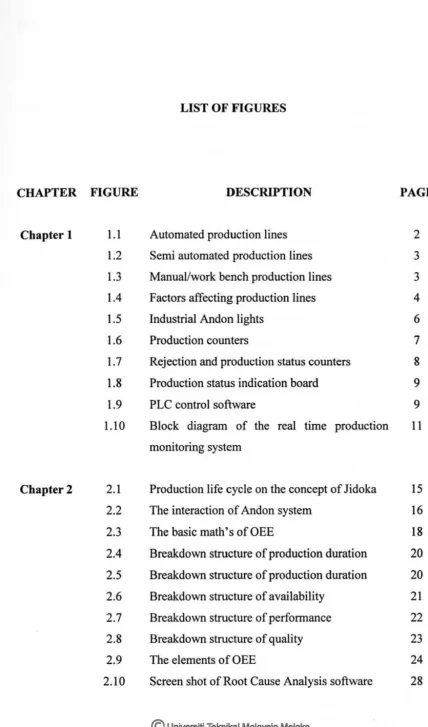
Automated production lines

Semi automated production lines

Manual/work bench production lines

Factors affecting production lines

Industrial Andon lights

Production counters

Rejection and production status counters

Production status indication board

PLC control software

Block diagram of the real time production

monitoring system

Production life cycle on the concept of Jidoka

The interaction of Andon system

The basic math's of OEE

Breakdown structure of production duration

Breakdown structure of production duration

Breakdown structure of availability

Breakdown structure of performance

Breakdown structure of quality

The elements ofOEE

Screen shot of Root Cause Analysis software

[image:13.532.35.464.49.777.2]
(14)

CHAPTER FIGURE DESCRIPTION Chapter 3 Chapter 4 Chapter 5 2.11 3.1 3.2 4.1 4.2 4.3 4.4 4.5 4.6 4.7 4.8 4.9 5.1 5.2

5.3

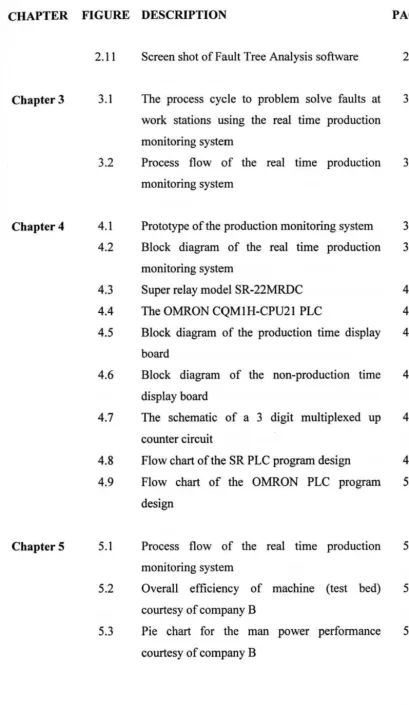
Screen shot of Fault Tree Analysis software

The process cycle to problem solve faults at work stations using the real time production monitoring system

Process flow of the real time production monitoring system

Prototype of the production monitoring system Block diagram of the real time production monitoring system

Super relay model SR-22MRDC The OMRON CQM1H-CPU21 PLC

Block diagram of the production time display board

Block diagram of the non-production time display board

The schematic of a 3 digit multiplexed up counter circuit

Flow chart of the SR PLC program design Flow chart of the OMRON PLC program design

Process flow of the real time production monitoring system

Overall efficiency of machine (test bed) courtesy of company B

Pie chart for the man power performance courtesy of company B

[image:14.532.44.453.58.762.2]
(15)

CHAPTER FIGURE DESCRIPTION PAGE

Chapter 6

Appendix A

Appendix B

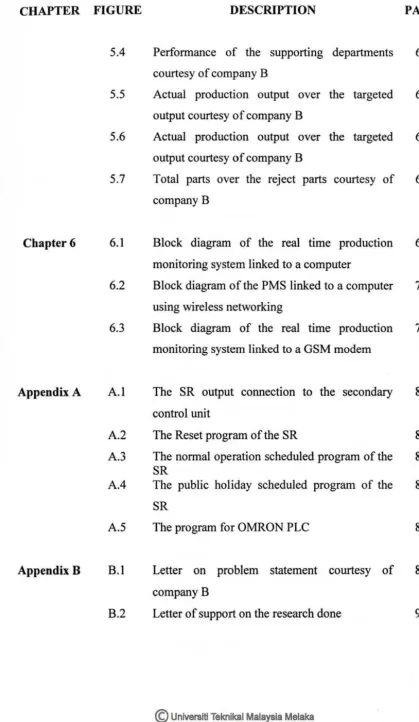
5.4 Performance of the supporting departments 60

courtesy of company B

5.5

5.6

Actual production output over the targeted

output courtesy of company B

Actual production output over the targeted

output courtesy of company B

61

62

5.7 Total parts over the rej ect parts courtesy of 63

company B 6.1

6.2

6.3 A.I A.2 A.3 A.4

A.5

B.1 B.2

Block diagram of the real time production

monitoring system linked to a computer

Block diagram of the PMS linked to a computer

using wireless networking

Block diagram of the real time production

monitoring system linked to a GSM modem

The SR output connection to the secondary

control unit

The Reset program of the SR

The normal operation scheduled program of the SR

The public holiday scheduled program of the

SR

The program for OMRON PLC

Letter on problem statement courtesy of

company B

Letter of support on the research done

[image:15.534.32.452.63.785.2]
(16)

CHAPTER

Chapter 2

Chapter 4

Chapter 5

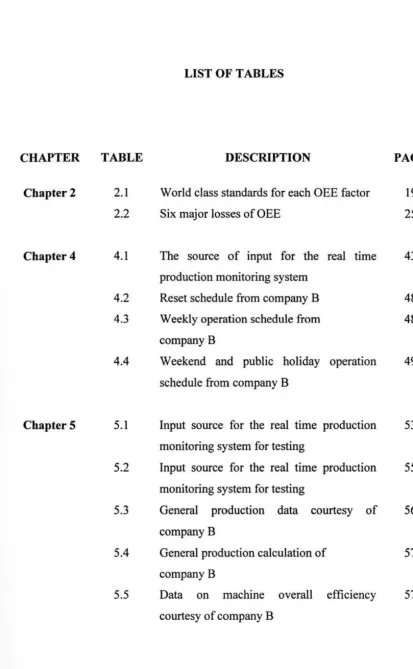
LIST OF TABLES

TABLE DESCRIPTION

2.1 World class standards for each OEE factor 2.2 4.1 4.2 4.3 4.4 5.1

5.2

5.3

5.4 5.5

Six major losses of OEE

The source of input for the real time production monitoring system

Reset schedule from company B Weekly operation schedule from company B

Weekend and public holiday operation schedule from company B

Input source for the real time production monitoring system for testing

Input source for the real time production monitoring system for testing

General production data courtesy of company B

General production calculation of company B

Data on machine overall efficiency courtesy of company B

[image:16.529.35.448.85.754.2]
(17)

CHAPTER Appendix A TABLE 5.6

5.7

5.8 5.9 5.10 5.11 5.12 5.13 5.14 A.I DESCRIPTION

Data on machine overall efficiency by factors courtesy of company B

Data on man power performance courtesy of company B

Performance of the supporting department courtesy of company B

Production output courtesy of company B Operating time courtesy of company B Rejection rate courtesy of company B Data on actual output performance courtesy of company B

Production data courtesy of company B Comparison on data collected from company B and PMS

Input source for the SR

[image:17.532.33.447.48.780.2]
(18)

SHORT FORM PMS PLC OEE TQM PPC TPM RCA FTA SR LCD LED PCB CMOS IC BCD VDC VAC SOP

LAN

WiFi SMS ZLSR

LIST OF ABBREVIATION

DESCRIPTION

Production Monitoring System Programmable Logic Control Overall Equipment Effectiveness Total Quality Management Production Planning and Control Total Productive Maintenance Root Cause Analysis

Fault Tree Analysis Super relay

Liquid crystal display Light emitting diode Printed circuit board

Complementary metal-oxide semiconductor Integrated circuit

Binary coded decimal Direct current (voltage) Alternative current (voltage) Standard operating procedure Local area network

Wireless fidelity

Short messaging system Zelio logic super relay

(19)

SHORT FORM

GSM PCU

scu

DESCRIPTION

Globe system for mobile Primary control unit Secondary control unit

(20)

CHAPTER I

INTRODUCTION

Production line inefficiencies are the main factors that contribute to less yield and hence less profit to any industry. The aim of this study is to design a real time production monitoring system for use on these production lines. Such a monitoring system will be used to automatically gather production line data and distribute/send it to the industry management or anyone on the shop floor for instant action (Kumar et. al., 2007b). The availability of these data can help the industry in improving their production yield and hence profit.

1.1 The production line

A production line is a set of sequential operations established on a factory shop floor whereby materials are put through a refining process to produce an end product that is suitable for onward consumption or components are assembled to make finished goods. In general a production process involves a moving platform or conveyor to move partially completed products to workers who perform simple repetitive tasks designed to permit very high rates of production per worker.

(21)

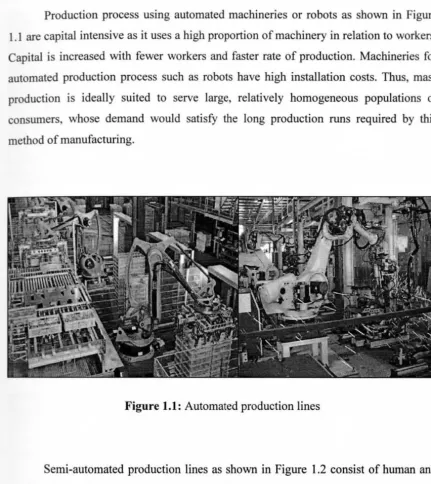
Production process using automated machineries or robots as shown in Figure 1. 1 are capital intensive as it uses a high proportion of machinery in relation to workers. Capital is increased with fewer workers and faster rate of production. Machineries for automated production process such as robots have high installation costs. Thus, mass production is ideally suited to serve large, relatively homogeneous populations of consumers, whose demand would satisfy the long production runs required by this method of manufacturing.

Figure 1.1: Automated production lines

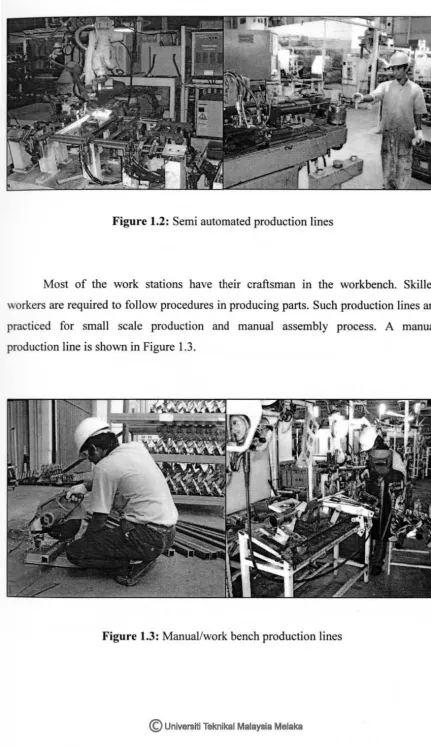
Semi-automated production lines as shown in Figure 1.2 consist of human and machineries working together to accomplish certain task. Such production lines are practiced for moderate production output. The production process involves repetitive task for both the humans and machineries to establish products within definite standards.

[image:21.512.30.462.45.529.2]
(22)

Figure 1.2: Semi automated production lines

[image:22.514.31.463.39.787.2]

Most of the work stations have their craftsman in the workbench. Skilled workers are required to follow procedures in producing parts. Such production lines are practiced for small scale production and manual assembly process. A manual production line is shown in Figure 1.3.

Figure 1.3: Manual/work bench production lines

(23)

1.2 Factors contributing to inefficiency of production lines

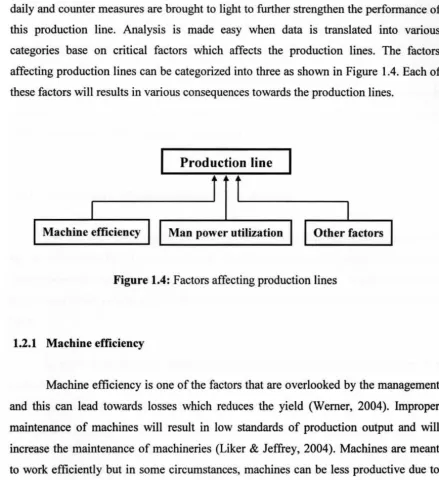
Analysis are carried out by the management on production line problems almost daily and counter measures are brought to light to further strengthen the performance of this production line. Analysis is made easy when data is translated into various categories base on critical factors which affects the production lines. The factors affecting production lines can be categorized into three as shown in Figure 1.4. Each of these factors will results in various consequences towards the production lines.

Production line

[image:23.512.27.467.113.594.2]

Machine efficiency Man power utilization Other factors

Figure 1.4: Factors affecting production lines

1.2.1 Machine efficiency

Machine efficiency is one of the factors that are overlooked by the management and this can lead towards losses which reduces the yield (Werner, 2004). Improper maintenance of machines will result in low standards of production output and will increase the maintenance of machineries (Liker & Jeffrey, 2004). Machines are meant to work efficiently but in some circumstances, machines can be less productive due to improper preventive maintenance. Preventive maintenance is a key factor which keeps the machine running efficiently. The maintenance activity on machineries needs extra attention by the management to ensure the optimum usage of machineries and to eliminate unwanted wastages due to machine stoppages.

(24)

Gambar

FIGURE DESCRIPTION
FIGURE DESCRIPTION
FIGURE DESCRIPTION
TABLE DESCRIPTION
+5

Referensi

Dokumen terkait

yaitu sebagai sistem monitoring untuk Mobil Listrik Ezzy ITS. Sedangkan dari proses identifikasi sinyal output pada Mobil Listrik Ezzy ITS telah diketahui bahwa terdapat 3

The pilot study was conducted to test the hypotheses that the WeMos WiFi development board could be used to stream the heart rate to the cloud for tele-monitoring applications.. The

In this study, monitoring was implemented using Raspberry Pi and sensors, which are widely used in IoT development, and the monitored data was implemented so that an alarm could be sent

Figure 13: Homepage of the energy monitoring system Figure 14: Air conditional power consumption Figure 15: Lighting power consumption Figure 16: Plug load power consumption

13:40-14:00 Keynote Lecture From Devices to Data Analytics: the DAPHNE experience of personal exposure andambient air quality monitoring in Delhi D K Arvind, University of Edinburgh

WEB-BASED REAL-TIME ENERGY MONITORING Page 54 of 60 FOR LOYOLA BUILDING AT ATMI CIKARANG Alfonsus Tri Widiyatmoko Website : [1]

https://doi.org/10.3889/oamjms.2021.4960 eISSN: 1857-9655 Category: B - Clinical Sciences Section: Cardiology Comparison of 24 h ECG Holter Monitoring with Real-time Long-term ECG

The first scheme presents a Bluetooth based home control and the second scheme uses the current sensor ACS712-20A for monitoring of voltage, current, and energy consumption.. System