A comprehensive management of hypertension among patients with
metabolic syndrome: an evidence-based update
Alvin Nursalim,1 Parlindungan Siregar2
1 Faculty of Medicine, Universitas Indonesia, Jakarta, Indonesia
2 Department of Internal Medicine, Universitas Indonesia, Cipto Mangunkusumo Hospital, Jakarta, Indonesia
Abstrak
Individu dengan hipertensi dan sindrom metabolik memiliki risiko yang lebih besar untuk menderita berbagai komplikasi di masa depan. Oleh karena itu, tatalaksana komprehensif yang berdasarkan bukti sangat diperlukan. Perubahan pola hidup merupakan langkah awal yang disarankan dan jika tidak berhasil dapat dilanjutkan dengan pemberian obat anti-hipertensi. Penurunan berat badan melalui penurunan konsumsi kalori dan peningkatan
olahraga terbukti memberikan efek yang baik pada kontrol diabetes, tekanan darah, dan proil lipid. Penghambat renin-angiotensin merupakan pilihan pertama untuk populasi ini, sementara penghambat reseptor-β dan diuretik
lebih baik disimpan untuk pilihan kedua karena peningkatan risiko terjadinya diabetes dengan penggunaan obat ini. Sasaran tekanan darah pada populasi ini adalah <130/80 mmHg. Tatalaksana komprehensif dengan kontrol baik
terhadap tekanan darah, berat badan, gula darah, dan proil lipid, diharapkan dapat menurunkan morbiditas pada
penyandang hipertensi yang juga menyandang sindrom metabolik. (Med J Indones. 2013;22:189-94. doi: 10.13181/ mji.v22i3.590)
Abstract
Individuals with hypertension and metabolic syndrome are at increased risk of developing future morbidities. Therefore, an evidence-based comprehensive approach is required. It is recommended to start with lifestyle modiication as the irst step, then followed by antihypertensive drugs. Weight loss through decreased caloric intake and increased excercise have been proven to yield a better control over diabetes, blood pressure, and lipid proile. Inhibitor of renin-angiotensin is the recommended irst-line drugs for this population, while β-blocker and diuretic should remain as the second line drugs due to increased risk of developing new onset diabetes with these drugs. A more rigorous blood pressure control is reasonable with a target of < 130/80 mmHg. A comprehensive management which include good control over blood pressure, weight, blood glucose, and lipid proile, may reduce future morbidities among hypertensive individuals with metabolic syndrome. (Med J Indones. 2013;22:189-94. doi: 10.13181/mji.v22i3.590)
Keywords: Cardiovascular, diabetes, hypertension, metabolic syndrome
Metabolic syndrome (MetS) refers to the clustering of cardiovascular (CV) risk factors that include fasting hyperglycemia, obesity, dyslipidemia, and hypertension. Each of these risk factors when
considered individually has a borderline signiicance,
but when taken together pose an increased risk of developing future complications like diabetes and CV disease.1 The rate of MetS is increasing
wordwide. As MetS cases increase, the complications would eventually rise as well. According to non-communicable disease risk factor the surveillance in 2006 performed in Jakarta, the prevalence of MetS among 1591 subjects was 28.4%. The increasing number of MetS cases is very much associated with obesity cases.2 Judging by today’s obesogenic
environment, it seems the MetS cases will continue to rise.
Hypertension, one component of MetS, is a common diagnosis in daily clinical practic yet the control rate is poor. Hypertension is the number one cardiovascular risk factor, contributing to one half of coronary heart disease and two thirds of cerebrovascular disease cases worldwide. As evidence showed, there is a
trend towards increased prevalence of hypertension. This alarming number of hypertensive cases are
expected to be higher in the future.3
It is postulated that there is a substantial interconnection between metabolic factors and hypertension, beyond what we comprehend at the moment.4 The underlying pathophysiology of this
interplay is yet to be understood, however increasing evidence regarding this topic is emerging. Among non-diabetic hypertensive patients, poor blood pressure (BP) control is associated with two fold increased risk of diabetes.5 The incident of type 2
diabetes mellitus is more frequent in hypertensive than in normotensive subjects. BP progression are associated with an increased risk of incident type 2 diabetes.6 Therefore, it is mandatory to
Metabolic syndrome
Currently, there is no internationally-agreed criteria for diagnosing MetS. The most common criteria used in clinical setting is the criteria by National Cholesterol Education Program/Adult Treatment Panel III (NCEP/ATP III). An increased waistline is
the irst criteria of MetS in addition to BP elevation,
fasting hyperglycemia, increased triglyceriedes, and decreased high density lipoprotein cholesterol (HDL-C). Three of this components are required for the diagnosis of MetS. The complete ATP III criteria is summarized in Table 1.7
Three potential etiological factor of MetS are obesity and disorders of adipose tissue, insulin resistance, and constellation of independent factors (eg, molecules of hepatic, vascular, and immunologic origin) that
mediate speciic components of the MetS.7 Evidence
accumulating that insulin resistance may be the initial culprit for MetS.7,8
Hypertension and metabolic syndrome
It is common to ind a person with abnormal glucose
tolerance that also has other CV disease risk component, such as hypertension. Hypertension is more common in individuals with diabetes mellitus than the general population, with the prevalence of hypertension in diabetic populations ranging from 40% to 80%. In a recent analysis by Chen G9 from the Framingham
original and offspring cohorts, the risk of CV complications has a linear pattern with blood pressure. Moreover, the combination of hypertension and other
risk factors in the MetS would eventually increase the likelihood of future CV complications.9
Sattar, et al10 analyze the association of the amount of
risk factors with CV outcome. The risk of developing future CV events is proportional to the amount of MetS features. Individuals with 4 or 5 features of MetS had a 3.7 fold increase risk of coronary heart disase and a 24.5 fold increase risk for diabetes compared with those with none.10 The risk of future CV events
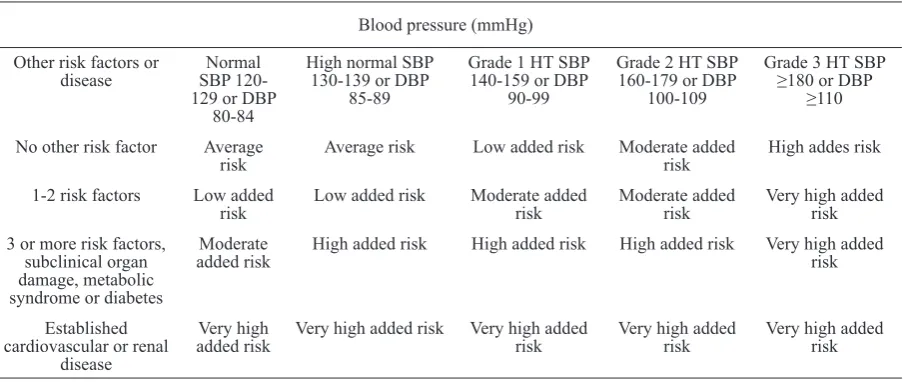
among hypertensive patients with MetS is obvious, so a rigorous hypertensive management among this population is strongly advised (Table 2).
Treating hypertension, when to start?
According to The Seventh Joint National Committee
Report (JNC 7), pre-hypertension is deined as
systolic blood pressure of 120-139 mmHg or a diastolic blood pressure of 80-89 mmHg. Patients with pre-hypertension were considered at increased risk for progression to hypertension.12 Is it necessary
to start early and treat pre-hypertensive patients who also have MetS?
Individuals with high CV risk, such as MetS, but with blood pressure still fall into pre-hypertensive stage,
should be irst advised to adopt an intense lifestyle
measure. A close BP monitoring and detailed assessment of subclinical organ damage is recommended. Since this particular group of people has an increased risk of developing overt hypertension, measuring ambulatory and home blood pressure is also desirable, when available. Current guidelines consider a reduction in
Component Description
Elevated waist circumference ≥ 102 cm in men, ≥ 88 cm in women*
Elevated triglycerides ≥ 150 mg/dL or
On drug treatment for elevated triglycerides Reduced HDL-C < 40 mg/dL in men, < 50 mg/dL women or
On drug treatment for elevated HDL-C
Elevated blood pressure
≥ 130 mmHg systolic blood pressure or ≥ 85 mmHg diastolic blood pressure or
On anti-hypertensive drug treatment in a patient with a history of hypertension Elevated fasting glucose ≥ 110 mg/dL or
On drug treatment for elevated glucose Table 1. ATP III criteria for metabolic syndrome
*Lower waist circumference cutpoint ( ≥ 90 cm in men and ≥ 80 cm in women) appears to be appropriate for Asian Americans.
Table 2. Risk stratiication of blood pressure related to the amount of other risk factors
body weight by low caloric diet and physical exercise as the irst and main treatment strategy in subjects
with the MetS.11 Intense lifestyle intervention has been
proven to decrease the onset of diabetes and reduce systolic BP in the range of 8 mmHg.13-15
The high-normal BP is a further stratiication of pre-hypertensive stage, deined as systolic BP of 130-139
mmHg or a diastolic BP of 85-89 mmHg. The increased chance of developing overt hypertension among this high risk population, made it rationale to start pharmacological agent for those who have high-normal BP. The recommendation to start pharmacological treatment in high risk individuals when BP is still in the high-normal stage is supported by European
Guidelines. Nevertheless, lifestyle modiication should always be implemented irst and concomitantly.
Doctors may consider anti- hypertensive agents particularly those drugs more effective in protecting against organ damage, new-onset hypertension, and new-onset diabetes among high risk population, like inhibitors of renin-angiotensin system.11
The best anti-hypertensive agent, any class effect?
The fact that more and more anti-hypertensive agents available in the market will lead to the question, as to which one is the best for patients with MetS. Is there any class effect? Or is it solely the achieved blood pressure that determine any future morbidities? The
best answer to that question is by looking at existing
studies on that particular topic.
The irst class to be considered is ACE inhibitors or
angiotensin aceptor blocker (ARB). Angiotensin II is playing a deleterious role in the atherosclerotic process. Therefore, the blockade of the renin-angiotensin system is effective in preventing renal and CV events in high risk patients.16 The ultimate
goal of hypertensive medication is to prevent any future morbidities and put as little side effects as
possible to the patients. So a drug with good eficacy, good safety proile, and less side effects would be
the best choice.
A meta analysis of 50 studies by Matchar, et al17
conclude that ACE inhibitor and ARB have a similar blood pressure control and outcome (including mortality and CV events). Both of these drugs have similar good control over risk factors, such as lipid control and diabetes progression. The population in this analysis is mainly the so called “relatively low-risk” individual, unfortunately detailed patient’s characteristic elaboration was lacking. Furthermore, it is also noteworthy that there were fewer withdrawls due to adverse events and greater persistence with therapy for ARBs than for ACE inhibitors.17
Additional information was provided by ONTARGET
study, in which study the conclusion justiied equal beneit of ACE-inhibitor and ARB which extends into
high risk population (diabetes, CV disease) as well.18
So, what are the lessons we can take from these studies? ARB has the ability to reduce blood pressure as effective
as ACE-inhibitor, with similar beneit in hard end points
such as CV related death, yet with minimal side effects (cough in particular) in a wide range of patients.
Blood pressure (mmHg) Other risk factors or
disease
No other risk factor Average risk
Average risk Low added risk Moderate added risk
High addes risk 1-2 risk factors Low added
risk
Low added risk Moderate added risk
Moderate added risk
Very high added risk 3 or more risk factors,
subclinical organ damage, metabolic syndrome or diabetes
Moderate added risk
High added risk High added risk High added risk Very high added risk
Very high added risk Very high added risk
Very high added risk
Very high added risk HT: Hypertension; SBP: Systolic blood pressure; DBP: Diastolic blood pressure.
In Indonesia, with its current “out of pocket” healthcare system and the low economic background of some patients, cost condiseration is inevitable. ARBs are
usually more expensive than ACE-inhibitor since these
drugs generally are not available as generic drugs. So the choice on which drug is the best, should always be decided upon patient’s characteristics, some of which
are patients’ health proile, side effects or response to
previous therapy and socio-economic condition.
Current guideline advise againts initial use of
β-blocker and high dose diuretic in individuals with
MetS.11 Some studies linked β-blocker and diuretic
with increased risk of developing new-onset diabetes, while calcium channel blocker remain a neutral choice.19,20 Nebivolol and carvedilol might be an exception, however lack of studies warrant a cautious
use of this agents.11 So, unless required by speciic indications, β blockers and diuretic should remained
a second line drugs for individuals with MetS. Based
on existing studies, it is prudent to give preference on ACE inhibitor and ARB as the irst line agents for
hypertensive individuals with MetS.
Blood pressure target, the lower the better?
Current international guidelines on hypertension recommend to obtain a blood pressure target below 140 mmHg systolic and 90 mmHg diastolic in the general hypertensive population.11 High risk individuals like diabetic patients, would receive additional beneit with a
more aggresive blood pressure goal. Since the presence of MetS is related to high CV risk, it is logical to pursue a more rigorous blood pressure control, similar to that of diabetic patients. A study by Schrier, et al21 demonstrated
a slowed progression of diabetes nephropathy, diabetes retinopathy, and lowered incidence of stroke among diabetic patients with intensive hypertension treatment with BP target of 128/75 mmHg. However, a different result was reported by ACCORD study. According to this
study there was no further beneit by lowering systolic
blood pressure down to 120 mmHg as compared to 140 mmHg among diabetic individuals. Nevertheless, this
conlicting result should be intepreted with caution. Since
in the ACCORD study, the populations’ other risk factors
(lipid proile and blood glucose) were well controlled with
other treatment that could mask the statistical analysis of
BP lowering beneicial effect. Other explanation would be
that it requires longer period of follow up to prove any
beneicial effect in this population, as CV complications
happen over a long period of time.22
Is it really necessary to achieve a lower blood pressure target among MetS population? Is there any such principle as ”the lower the better”? There is currently
limited data regarding the optimal blood pressure target among individuals with MetS. However, recent evidence rebutted the idea of J-shaped curve of blood pressure control and support the idea of lowering the blood pressure, even below the normal value. A meta analysis study involving almost one million participants by Lewington,23 showed that a difference
as small as 2 mmHg in systolic BP is associated with a 10% reduction of stroke mortality and 7% reduction in
risk of ischemic disease mortality. The beneit from BP
lowering showed no threshold down to at least 115/75 mmHg. This evidence conclude that there is a linear relationship between BP and CV events and achieving a more aggresive blood pressure target indeed reduce the occurence of future morbidities.23 So, does the rule
of ”the lower the better” really applies? Based on latest studies yes it is, but to a certain level. According to the current insight, it is logical to pursue a BP target as low as 130/80 mmHg among individuals with MetS.
Healthy lifestyle
Managing a person with hypertension and other features of the MetS should focus not only on BP control but also on other CV risk factors. One simple way to start is by adopting a healthy lifestyle measures. Tuomilehto, et al13 study the eficacy of intense lifestyle changes in preventing
the progression of impaired glucose intolerance to full blown diabetes. Most of the patients had some characteristics of MetS. The incidence of diabetes was 11% in the intervention group as compared to 23% in the control group.13
This positive outcome on healthy lifestyle is also supported by a study performed by Diabetes Prevention Program Research Group among 3234 individuals with impaired glucose tolerance and impared fasting glucose.
Weight reduction (7% from initial weight), low-fat diet and regular excercise (150 minutes per week) are
proven to reduce the incidence of diabetes as much as 58% as compared to placebo.16 Healthy lifestyle which include healthy diet rich in iber, decreased fat intake, and increased endurance excercise should be adopted
by every individuals with MetS.13,14 We should pay
more attention on disease primary prevention than secondary prevention. Healthy lifestyle, are a cost-effective primary prevention to lower future diseases and morbidities.24 The reduced rate of lifestyle
related-diseases would eventually reduce one’s country
inancial burden over the cost that was spent over
disease and its complication management, that could be otherwise prevented by healthy lifestyle measures. The reduction of lifestyle related diseases would
the cost that was spent over lifestyle related disease and its complication management. Please bear in mind that metabolic syndrome would result in many complication that could be otherwise prevented by healthy lifestyle measures.
Multifactorial intervention: weight control, lipid control, and glucose control
Weight control, lipid control, and glucose control
are as much important as maintaining a good blood
pressure control among individuals with MetS. Weight
loss through decreased calory intake and increased physical activity, is proved to have a better control over
diabetes, blood pressure, and lipid proile.25 In selected
patients, drug regimens might be needed. Statin
therapy is justiied if patients have dyslipidemia. Statin administration signiicantly reduce the occurence of
CV complication, cerebrovascular complication, and mortality among high risk individuals.26-28 To aim
low-density lipoprotein cholesterol (LDL-C) below 100 mg/dL seems appropriate for individuals with MetS. Even further reduction of LDL-C to below 70 mg/dL is reasonable for very high risk individuals (individuals with establish CV disease plus one of the following: diabetes, ciggarette smoking, dyslipidemia).29 Some studies also report a beneicial effect of early metformin
administration among glucose intolerance individuals to halt the disease progression into overt diabetes, especially those with other features of metabolic syndrome.13,14,30
In conclusion, managing hypertension among individuals with MetS should comprise not only BP control but also other risk factors control. Inhibitor
of the renin-angiotensin should be the irst-line
anti-hypertensive agent used in MetS population in general. The reasonable BP target is < 130/80 mmHg, even
lower value is proved to yield further beneit. Lifestyle modiication should always be the cornerstone of MetS management. There should never be an exact
pattern of MetS management since a comprehensive treatment should always be tailored according to each
patients risk factors proile. Finally, a sustained and
good control over BP, weight, blood glucose and lipid
proile, would hopefully reduce future morbidities
among hypertensive individuals with MetS.
REFERENCES
1. Grundy SM, Brewer HB, Cleeman JI, et al. Deinition of metabolic syndrome: report of the National Heart, Lung, and Blood Institute/ American Heart Association conference on scientiic issues related to deinition. Circulation. 2004;109(3):433-8.
2. Purnamasari D. Metabolic syndrome. Acta Med Indones. 2010;42(4):185-6.
3. Cutler JA, Sorlie PD, Wolz M, Thom T, Fields LE, Rocella E. Trends in hypertension prevalence, awareness, treatment and control rates in United States Adults between 1988-1994 and 1999-2004. Hypertension. 2008;52(5):818-27.
4. Arcucci O, de Simone G, Izzo R, et al. Association of suboptimal blood pressure control with body size and metabolic abnormalities. J Hypertens. 2007;25(11):2296-300.
5. Izzo R, Simone GD, Chinali M, et al. Insuficient control of blood pressure and incident diabetes. Diabetes Care. 2009;32(5):845-50.
6. Conen D, Ridker PM, Mora S, Buring JE, Glynn RJ. Blood pressure and risk of developing type 2 diabetes mellitus: The women’s health study. Eur Heart J. 2007;28(23):2937-43. 7. Grundy SM, Cleeman JI, Daniels SR, et al. Diagnosis
and management of the metabolic syndrome: an American heart Association/ National heart, Lung and Blood Institute Scientiic Statement. Circulation. 2005;112(17):2735-52.
8. World Health Organization [Internet]. Deinition, diagnosis and classiication of diabetes mellitus and its complications: report of a WHO Consultation. Part 1: diagnosis and classiication of diabetes mellitus [update 1999; cited 2003 Dec 12]. Geneva, Switzerland: World Health Organization. Available from: http://whqlibdoc.who.int/hq/1999/WHO_ NCD_NCS_99.2.pdf.
9. Chen G, McAlister FA, Walker RL, Hemmelgarn BR, Campbell NRC. Cardiovascular outcomes in Framingham participants with diabetes: The importance of blood pressure. Hypertension. 2011;57(5):891-7.
10. Sattar N, Gaw A, Scherbakova O, et al. Metabolic syndrome with and without C-reactive protein as a predictor of coronary heart disease and diabetes in the west of Scotland Coronary Prevention Study. Circulation. 2003;108(4):414-9.
11. Mancia G, De Backer G, Dominiczak A, et al. 2007 Guidelines for the Management of Arterial Hypertension: The Task Force for the Management of Arterial Hypertension of the European Society of Hypertension (ESH) and of the European Society of Cardiology (ESC). J Hypertens. 2007;25(6):1105-87.
12. Chobanian AV, Bakris GL, Black HR, et al. Seventh Report of the Joint National Committee on Prevention, Detection, Evaluation, and Treatment of High Blood Pressure. Hypertension. 2003;42(6):1206-52.
13. Tuomilehto J, Lindstrom J, Eriksson JG, et al. Prevention of type 2 diabetes mellitus by changes in lifestyle among subjects with Impaired Glucose Tolerance. N Engl J Med. 2001;344(18):1343-50.
14. Diabetes Prevention Program Research Group. Reduction in the incidence of type 2 diabetes with lifestyle intervention or metformin. N Engl J Med. 2002;346:393-403.
15. Lien LF, Brown AJ, Ard JD, et al. Effects of PREMIER lifestyle modiications on participants with and without the metabolic syndrome. Hypertension. 2007;50(4):609-16. 16. HOPE investigators. Effects of an
angiotensin-converting-enzyme inhibitor, ramipril, on cardiovascular events in high-risk patients. N Eng J Med. 2000;342:145-53. 17. Matchar DB, McCrory DC, Orlando LA, et al. Systematic
blockers for treating essential hypertension. Ann Intern Med. 2008;148(1):16-29.
18. The ONTARGET investigators. Telmisartan, Ramipril, or both in patients at high risk for vascular events. N Engl J Med. 2008;358:1547-59.
19. Lam SKH, Owen A. Incident diabetes in clinical trials of antihypertensive drugs. Lancet. 2007, 369(9572):1513-4. 20. Tuomilehto J, Rastenyte D, Birkenhager WH, et al.
Effects of Calcium-Channel Blockade in Older Patients with Diabetes and Systolic Hypertension. N Engl J Med. 1999;340(9):677-84.
21. Schrier RW, Estacio RO, Esler A, Mehler P. Effects of aggressive blood pressure control in normotensive type 2 diabetic patients on albuminuria, retinopathy and strokes. Kidney Int. 2002;61(3):1086-97.
22. The ACCORD study group. Effect of intensive blood-pressure control in type 2 diabetes mellitus. N Engl J Med. 2010; 362:1575-85.
23. Lewington S, Clarke R, Qizilbash N, Peto R, Collins R; Prospective Studies Collaboration. Age-speciic relevance of usual blood pressure to vascular mortality: a meta-analysis of individual data for one million adults in 61 prospective studies. Lancet. 2002;360(9349):1903-13. 24. Diabetes Prevention Program Research Group. Within-trial
cost-effectiveness of lifestyle intervention or metformin for the primary prevention of type 2 diabetes. Diabetes Care. 2003;26(9):2518-23.
25. Look AHEAD Research Group, Pi-Sunyer X, Blackburn G. Reduction in weight and cardiovascular disease risk factors
in individuals with type 2 diabetes: one-year results of the look AHEAD trial. Diabetes Care. 2007;30(6):1374-83. 26. Colhoun HM, Betteridge DJ, Durrington PN, et al. Primary
prevention of cardiovascular disease with atorvastatin in type 2 diabetes in the Collaborative Atorvastatin Diabetes Study (CARDS): multicentre randomised placebo-controlled trial. Lancet. 2004;364(9435):685-96.
27. Collins R, Armitage J, Parish S, Sleight P, Peto R; Heart Protection Study Collaborative Group. Effects of cholesterol-lowering with simvastatin on stroke and other major vascular events in 20536 people with cerebrovascular disease or other high-risk conditions. Lancet. 2004;363(9411):757-67.
28. Goldberg RB, Mellies MJ, Sacks et al. Cardiovascular events and their reduction with pravastatin in diabetic and glucose-intolerant myocardial infarction survivors with average cholesterol levels: subgroup analyses in the cholesterol and recurrent events (CARE) trial. The Care Investigators. Circulation. 1998;98(23);2513-9.
29. Smith SC, Benjamin EJ, Bonow RO, et al. AHA/ACCF secondary prevention and risk reduction therapy for patients with coronary and other atherosclerotic vascular disease: 2011 update: A guideline from the American Heart Association and American College of Cardiology Foundation. Circulation. 2011;124(22):2458-73.