Access to health information may improve behavior in preventing Avian infl uenza
among women
Ajeng T. Endarti,1,2 Shamsul A. Shah2
1Faculty of Health Sciences, Universitas Pembangunan Nasional “Veteran” Jakarta 2Department of Community Health, Faculty of Medicine, Universiti Kebangsaan Malaysia
Abstrak
Latar belakang: Peningkatan perilaku terhadap Flu burung dapat menurunkan risiko infeksi Flu burung. Tujuan penelitian ini ialah untuk mengetahui faktor-faktor dominan yang mempengaruhi perilaku pencegahan penyebaran penyakit Flu burung pada masyarakat.
Metode: Desain studi potong lintang dilakukan dalam bulan Juli 2008 untuk mengetahui perilaku yang diukur dengan menghitung skor pengetahuan, sikap dan tindakan. Penelitian ini dilakukan di suatu kecamatan di Depok, Jawa Barat, yang merupakan wilayah berisiko terjadinya penyebaran kasus Flu burung. Dalam menentukan unit sampel, untuk memilih kepala rumah tangga digunakan metode multi stage sampling.
Hasil: Dari 387 responden 29,5% responden berperilaku baik terhadap penyakit Flu burung. Perilaku subjek yang baik dipengaruhi oleh jenis kelamin dan akses terhadap informasi kesehatan. Perempuan dibandingkan lelaki 67% lebih tinggi berperilaku baik terhadap penyakit Flu burung [risiko relatif (RRa) = 1,67; 95% interval kepercayaa (CI) = 0,92-3,04; P = 0,092]. Sedangkan, subjek yang mempunyai dibandingkan yang tidak yang mempunyai akses terhadap informasi kesehatan 3,4 lipat berperilaku baik terhadap penyakit fl u burung (RRa = 3,40; 95% CI = 0,84-13,76; P = 0,087).
Kesimpulan: Akses terhadap informasi mengenai fl u burung terutama efektif di antara perempuan untuk meningkatkan perilaku penyakit fl u burung. (Med J Indones 2011; 20:56-61)
Abstract
Background: Improving human behavior toward Avian infl uenza may lessen the chance to be infected by Avian infl uenza. This study aimed to identify several factors infl uencing behavior in the community.
Method: A cross-sectional study was conducted in July 2008. Behavior regarding Avian infl uenza was measured by scoring the variables of knowledge, attitude, and practice. Subjects were obtained from the sub district of Limo, in Depok, West Java, which was considered a high risk area for Avian infl uenza. The heads of household as the sample unit were chosen by multi-stage sampling.
Results: Among 387 subjects, 29.5% of them was had good behavior toward Avian infl uenza. The fi nal model revealed that gender and access to health information were two dominant factors for good behavior in preventing Avian infl uenza. Compared with men, women had 67% higher risk to have good behavior [adjusted relative risk (RRa) = 1.67; 95% confi dence interval (CI) = 0.92-3.04; P = 0.092]. Compared to those with no access to health information, subjects with access to health information had 3.4 fold increase to good behavior (RRa = 3.40; 95% CI = 0.84-13.76; P = 0.087).
Conclusion: Acces to health information concerning Avian infl uenza was more effective among women in promoting good behavior toward preventing Avian infl uenza.(Med J Indones 2011; 20:56-61)
Key words: avian infl uenza, behavior, gender, health promotion
Correspondence email to: [email protected]
WHO have stated the risk of Avian infl uenza to humans was almost confi ned to those who had close contact with infected domestic poultry. The fi rst Avian infl uenza outbreak in Hong Kong in 1997 caused 18 cases with 6 deaths.1 The study revealed that live poultry markets
were the primary source of infection.2 The pandemic
then was started in Vietnam in 2003 and spread to other Asian and African countries.1 In Indonesia, the number
of confi rmed cases of human Avian infl uenza in 2006
was 28 cases with 71.4% deaths, and most of them had high interaction with chicken and ducks.3 Authorities Network
showed a large number of confi rmed human cases acquired the infection during the slaughtering and subsequent handling of diseased or dead birds prior to cooking.4
education and reinforced through behavioral counseling. Based on research in Thailand,2 attitudes, which will
infl uence behavioral changes,5 such as how to protect
oneself from poultry with Avian infl uenza. The behavior changed signifi cantly after the respondents heard about Avian infl uenza. These changes in human behavior, included those related to food handling, can reduce the opportunity to be infected by Avian infl uenza. Therefore behavioral changes can become the most important way to reduce the risk of further human infection.4
The importance of identifying preventive behavior in Avian infl uenza have encouraged researchers to conduct studies of knowledge attitude and practice in Avian infl uenza on many different subjects. For instance studying behavior among school children,1
poultry workers,6 health workers,7 and people living in
high risk Avian infl uenza areas.8,9
The mode of transmission of Avian infl uenza is known and many evidence showed that Avian infl uenza occurrences in humans were due to unhealthy behavior when in contact with poultry and also by unhygienic behavior.2,10,11 Besides the behavioral factors, other
non-pharmaceutical interventions that can be utilized to prevent Avian infl uenza were good surveillance and case reporting and increasing rapid viral diagnosis.12
The aim of this study was to identify several dominant risk factors infl uencing the behavior of the community in preventing Avian infl uenza.
METHODS
This cross-sectional study was conducted in a sub district of District Depok, West Java, Indonesia in July 2008 which was considered to be a high risk area for Avian infl uenza. In this area many homes keep poultry in the backyard, and the poultry were not certifi ed free of Avian infl uenza virus.13 In addition, the location of sub
district Limo borders with DKI Jakarta Province (the second largest Avian infl uenza cases in Indonesia)3 and the rate of
migration of people between these areas was high.
Multi-stage sampling was used in determining the sample. This method was suitable because there was a hierarchy within study area, such as village and neighborhood, to reach the sample unit (head of household).
The instrument for this study was modifi ed from Avian Flu Baseline Survey Backyard Poultry Farmers of
Vietnam (USAID 2006)14 and A Guide for Monitoring
and Evaluating Avian infl uenza Programs in Southeast Asia (USAID 2007) questionnaires.15 To assure
the reliability of the questionnaires, we conducted questionnaire tryouts to 20 persons.
Behavior was defi ned as the respondent’s activities in preventing the spread of Avian infl uenza. At the end of the study, behavior was categorized into good behavior and poor behaviorbased on Knowledge, Attitude and Practice (KAP).
Knowledge was the respondents’ knowledge about Avian infl uenza (defi nition, symptoms, route of transmission and preventive activities). Knowledge was categorized into poor and good. If the respondents could answer at least 6 questions correctly (from 10 questions), the respondent knowledge was good (score 1).
Attitude was response of the respondents about Avian infl uenza. Attitude was categorized into poor and good. If the respondents could answer at least 7 questions correctly (from 11 questions), the respondent attitude was good (score 2).
Practice was the respondent’s action in preventing the spread of Avian infl uenza within their surroundings. Practice was categorized into poor and good. If the respondents could answer at least 9 questions correctly (from 14 questions), the respondent practice was good (score 3).
This categorization was used to decide whether the respondent’s behavior was good or poor. From these three variables (Knowledge, Attitudes and Practices) if the sum of those variables were 6 the behavior was good. But if the sum were less than 6the behavior was poor.
Variable such as access to health care was categorized into good if respondents answered all three questions (regarding accessibility, affordability, and satisfaction to health services). Family/neighbor support was categorized as good if they answered at least 2 out 3 questions. Age was grouped as young (18-29 years), young adults (30-50 years), and old (50 years or older)
Cox Regression was used to analyze data. This study obtained ethical clearance from the ethical committee of the Faculty of Medicine, Universitas Kebangsaan Malaysia.
RESULTS
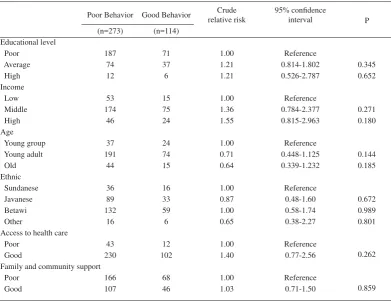
infl uenza. Subject with good behavior and poor behavior was similarly distributed by educational level, income, age group, ethnic, access to health care, and family and community support (table 1).
In the fi nal model, gender and access to health information were two dominant factors for good behavior in preventing Avian infl uenza (table 2).
Compared with men, women had 67% higher risk to good behavior [adjusted relative risk (RRa) = 1.67; 95% confi dence interval (CI) = 0.92-3.04; P = 0.092]. Compared to those with no access to health information, those with access had 3.4 fold risk to good behavior (RRa = 3.40; 95% CI = 0.84-13.76; P = 0.087).
Poor Behavior Good Behavior
Adjusted relative risk 95% confi dent interval P (n=273) (n=114)
Gender
Men 53 12 1.00 Reference 0.092
Women 220 102 1.67 0.92-3.04
Access to health information
No 21 2 1.00 Reference
Yes 251 112 3.40 0.84-13.76 0.087
Table 1. Several characteristics of subjects and the risk of good behavior in preventing Avian infl uenza
Table 2. The relationship between gender, access to health information and good behavior in preventing Avian infl uenza
Poor Behavior Good Behavior Crude
relative risk
95% confi dence
interval P
(n=273) (n=114) Educational level
Poor 187 71 1.00 Reference
Average 74 37 1.21 0.814-1.802 0.345
High 12 6 1.21 0.526-2.787 0.652
Income
Low 53 15 1.00 Reference
Middle 174 75 1.36 0.784-2.377 0.271
High 46 24 1.55 0.815-2.963 0.180
Age
Young group 37 24 1.00 Reference
Young adult 191 74 0.71 0.448-1.125 0.144
Old 44 15 0.64 0.339-1.232 0.185
Ethnic
Sundanese 36 16 1.00 Reference
Javanese 89 33 0.87 0.48-1.60 0.672
Betawi 132 59 1.00 0.58-1.74 0.989
Other 16 6 0.65 0.38-2.27 0.801
Access to health care
Poor 43 12 1.00 Reference
0.262
Good 230 102 1.40 0.77-2.56
Family and community support
Poor 166 68 1.00 Reference
0.859
DISCUSSION
Generally, respondents’ behavior towards Avian infl uenza was poor (79.5%). That is caused by not practicing prevention of Avian infl uenza in their daily life, even though most of them have good knowledge (79.1%) and attitude regarding Avian infl uenza (91.5%). Theoretically, change in behavior is brought about through three steps, which are change in knowledge, change in attitude, and change in behavior. The process is complex and needs time to reach the goal, which is behavioral change.16 Poor behavior was also identifi ed
in a study in Cambodia, where people have contact with sick/dead poultry with their bare hands, make use of dead domestic and wild poultry as their source of food, and using manure originating from diseased poultry.9
Women were one of two variables that was dominant in affecting good behavior for preventing Avian infl uenza. The risk for women performing good behavior was almost two times higher than men (RRa 1.67). It was infl uenced by exposure to health information. Ninety-four percent of women respondents received information of Avian infl uenza from electronic media. In men, only 84.61 % of used electronic media as their source of information for Avian infl uenza. A similar result was found in a study in China where television was found to be a major source of information regarding Avian infl uenza.17 Many women respondents used electronic
media, especially television. This was probably due to having more time for watching television while during the house work. Advertisements of Avian infl uenza prevention were presented on TV during day and night time for wide coverage. These advertisements increased the knowledge of female respondents. The data showed that women with good knowledge of Avian infl uenza was 81.99% while good knowledge among men was only 64.61 %. Another study showed that information, particularly from media, also infl uenced good attitude of respondents.18
Compared with men, perceived curiosity of women towards Avian infl uenza was higher. Perceived susceptibility toward Avian infl uenza reached 91.56% in women, whereas in men it was only 68.75%. Similar results were found in many European and Asian countries, except Singapore. The perception of risk of Avian infl uenza was higher in women than men but this difference was less in Asian countries compared to Europe.19
The Health Belief Model explained that perceived susceptibility toward a disease will lead to perceived of threat of disease and at the end it will change the
behavior into preventive behavior concerning the disease.20 Perceived susceptibility was also a stronger
predictor of preventive health behavior rather than sick-role behavior.
Women were more curious toward Avian infl uenza because in Indonesia, the case fatality rate (CFR) for Avian infl uenza among female was higher than male. A study in 2006 showed than CFR of Avian infl uenza (AI) cases in females was 91.67%.3 This was signifi cantly
different when compared to CFR in males, which was 56.25%. In addition, a study in Saudi Arabia found that females were more concerned toward the spread of AI infection, the possibility catching the infection, and the response to a hypothetical threat compared to males.1 Furthermore, perceived vulnerability, in seven
consecutive studies in the Netherlands, was higher in women as well as in the elderly and respondents without children under 12 years old.21
All these data were appropriate when applied to the theory of notion. Knowledge, attitude and, behavior are congruent and that once an individual has the required knowledge, they will change their attitude which will ultimately lead to a change in their behavior.22 In this
study, the number of women with good knowledge and attitude were higher compared to men and as a result the number of good behavior in preventing Avian infl uenza was also higher.
Health information was related to behavior in preventing Avian infl uenza. Ninety-six percent of the respondents was exposed to Avian infl uenza information with electronic media as the main source for information. This fi nding was similar to a study in Kubang Pasu, Malaysia that showed 81.3% of the respondents obtained information of Avian infl uenza from the mass media (television).23 Giuseppe et al also noted that
85.8% of respondents in Italy received information about Avian infl uenza through the mass media.24
All these results showed that mass media especially television has the biggest infl uence in enhancing people’s knowledge, which will change people’s behavior in the end. In Cambodia, KAP II Survey on Avian infl uenza revealed that the increased number of people who watched television (during 2005-2007) increased the people’s knowledge on Avian infl uenza and changed their behavior in preventing Avian infl uenza.25
reporting when there were signs and symptoms of Avian infl uenza in poultry and human. Preventive behavior that was recommended in the advertisement were not to touch sick or dying birds, or if they did, they have to immediately wash their hands and report to the local authority, washing hand and utensils with soap and water before eating or cooking, cooking all poultry and egg well, and separating birds and all new fl ocks for two weeks. Although the major source of information in the study area was television, in Afganistan, leafl ets were also used to inform about Avian infl uenza. Both sources of information signifi cantly increased the people’s awareness.26
Half of the respondents complied with the recommended behavior promoted in the advertisements. It was found that 17.6 % washed their hands after handling the poultry, 12.1% did not eat undercooked poultry and eggs. The number people complying with reporting of any signs and symptoms in poultry and human increased. The reports reached 87.6% of respondents would report to the local authorities (76.5%) when they saw signs and symptoms in the poultry. But only 16.3% of the respondents reported the signs and symptoms Avian infl uenza in humans, since the fi rst thing they did was to bring the suspected patients to the nearest health care facility.
Advertisement was effective in infl uencing at least 20% of respondents in this study. This was because the advertisement fulfi lled the criteria for effective health communication.27Accuracy, in all the advertisements
(TV, radio, printed material), information about how to prevent Avian infl uenza was clearly delivered without needing any interpretation. Availability, the messages were delivered by TV, radio and printed material, which had broad coverage where most Indonesians can access.
Consistency, even though there were many version of Avian infl uenza advertisements, the content remains internally consistent over time and was consistent when compared to information from other sources.
The effect of this campaign can be seen by the decreasing number of new cases in May 2008. In May 2007 there was a 50% decrease in cases while in May 2008 the decrease reached 88.8%. Up to early July 2008, there were no new cases of Avian infl uenza in humans in Indonesia.28
The limitation of this study was selection bias since we could not interview equal numbers of female and male respondents. The study covered a majority of women (83.2%). This number was higher than the actual number of women in the population. In the Limo sub district, the
percentage of women was 47.70%. The high number of females who took part in this study was due to the time of the survey, which was done during weekdays when most women were at home, because around 77% of the female respondents were housewives.
In conclusion, health promotion about Avian infl uenza was more effective among female respondents. Therefore, health promotion to promote good behavior in male respondents will need more attention.
Acknowledgments
We would like to express our gratitude to Prof. Bastaman Basuki for his technical assistance in reanalyzing the data, and to Dr. Minarma Siagian for reviewing and editing the fi nal draft.
REFERENCES
Shehri ASM, Abdel-Fatah, Hifnawy T. Knowledge and 1.
concern about Avian infl uenza among secondary students in Taif, Saudi Arabia. Eastern Mediterranean Health J. 2006; Vol 12 (Suplement 2) [cited 2010 December 11]. Available from URL: http://www.emro.who.int/publications/emhj/12_ S2/article17.htm
Olsen SJ, Laosiritaworn Y, Pattanasin S, Prapasiri P, Dowell SF. 2.
Poultry-handling practices during Avian infl uenza outbreak, Thailand. 2005 [cited 2007 July 21]. Available from URL: http://www.cdc.gov/ncidod/EID/vol11no10/04-1267.htm. Ajeng TE, Ratna D. Descriptive epidemiology of human 3.
Avian Infl uenza within fi ve provinces in Indonesia, 2005-2006. J Kes Masy Nasional. 2006;1:42-8. Indonesian. Infosan. Highly Pathogenic H5N1 Avian infl uenza Outbreaks 4.
in Poultry an in Humans: Food Safety Implications. Infosan Information Note No. 2/04-Avian infl uenza, 17 Dec 2004. 2005 [cited 2007 July 19]. Available from URL: www.who. int/foodsafety
LJ Donaldson, RJ Donaldson. Essential public health. 2
5. nd
Ed. Revised. Oxon: Radcliffe Publishing; 2005.
Akinola A. Fatiregun, Mobolaji M. Saani. Knowledge, 6.
attitudes and compliance of poultry workers with preventive measures for Avian infl uenza in Lagelu, Oyo State, Nigeria. J. Infect Developing Countries. 2008;2:130-4. [cited 2010 December 14]. Available from URL: www.jidc.org/index. php/journal/article/viewFile/19738338/258
Butsashvili M, Triner W, Kamkamidze G, Kajaia M, 7.
Louise-Ann McNutt. Knowledge and anticipated behavior of health care workers in response to an outbreak of pandemic infl uenza in Georgia (Short Communications). J. Infect Developing Countries. 2007;1:329-32 [cited 2010 December 11]. Available from URL: http://www.jidc.org/ index.php/journal/article/viewFile/373/221
M
area, Song Phi Nong District, Suphan Buri Province, Thailand. J Public Health. 2008; 38 (1) [cited 2010 December 12]. Available from URL:http://thailand.digital journals.org/index.php/JPH/article/view/2862
Van Kerkhove MD, Ly S, Guitian J, Holl D, San S, Mangtani 9.
P, et al. Changes in poultry handling behavior and poultry mortality reporting among rural Cambodians in areas affected by HPAI/H5N1. PloS ONE 4(7) [cited 2010 December 12]. Available from URL: http://www.plosone.org/article/ info%3Adoi%2F10.1371%2Fjournal.pone.0006466 FAO. Protect poultry-protect people: basic advice for 10.
stopping the spread of Avian Flu. Undated [cited 2007 July19]. Available from URL: www.fao.org/docs/eims/ upload//207623/FAO_HPAI_messages.pdf
CARE International. Strategic thinking: knowledge, 11.
attitudes, practices study of small holder poultry raising farmers in response to Avian infl uenza. 2006 [cited 2007 July21]. Available from URL: http://www.comminit.com/ avianinfl uenza/st2006/thinking-1637.html
Aledort JE, Lurie N, Wasserman J, Bozette SA. Non-12.
pharmaceutical public health intervention for pandemic infl uenza: an evaluation of the evidence base. BMC Public Health. 2007;7:208 [cited 2010 December 12]. Available from URL: http://www.ncbi.nih.gov/pmc/articles/PMC2040158/ District animal husbandry offi ce published 152 poultry 13.
certifi cates, people of Depok town were less interested in certifi cation. Monitor Depok. 2007 [cited 2007 February 14]. Available from URL: http://www.monitordepok.com/ news/bebenah/11600.html. Indonesian.
USAID. Avian fl u baseline survey backyard poultry farmers 14.
of Vietnam. 2006 [cited 2007 September 30]. Available from URL: www.ngocentre.org.vn/fi le_lib/ai_kap_survey.ppt. USAID. A guide for monitoring and evaluating Avian infl uenza 15.
programs in Southeast Asia. 2007 [cited 2007 September 30]. Available from URL: www.cpc.unc.edu/measure.
Notoatmodjo S. Concept of behavior and health behavior. 16.
In: Health promotion and behavior science]. Jakarta: PT Rineka Cipta; 2007. Indonesian.
Nijuan X, Ying S, Jiabing W, Shunxiang Z, Min Y, Zhiin 17.
P, et al. Knowledge, attitude and practices (KAP) relting to avian infl uenza in urban and rural areas of China. BMC Infect Dis. 2001;10:34 [cited 2010 December 12]. Available from URL: www.ncbi.nlm.nih.gov/pubmed/20170542 Maton T, Butraporn P, Kaewkangwal J, Fungladda W. 18.
Avian infl uenza protection knowledge, awareness and behavior in a high risk population in Suphan Buri Province,
Thailand. Southeast Asian J. Trop Med Public Health. 2007 (May);38(3):560-8 [cited 2010 December 12]. Available from URL: http://www.ncbi.nlm.nih.gov/pubmed/17877234 de Zwart O, Veldhuijzen IK, Elam G, Aro AR, Abraham T, 19.
Bishop GD, et al. Avian infl uenza Risk Perception, Europe and Asia. Emerging Infectious Disease. 2007; 13 (3):522 [cited 2010 December 12]. Available from URL: http:// www.ncbi.nlm.nih.gov/pubmed/17479894.
Glanz K, Barbara K. Rimer, Lewis FM. Health behavior and 20.
health education: theory, research and practice. 3rd edition.
San Francisco: John Wiley and Sons, Inc; 2002.
de Zwart O, Irene K. Veldhuijzen, Jan Hendrik Richardus, 21.
Johannes Brug. Monitoring of risk perceptions and correlates of precautionary behavior related to human Avian infl uenza during 2006-2007 in the Netherlands: result of seven consecutive surveys. BMC Infect Dis. 2010;10 (114) [cited 2010 December 12]. Available from URL: http://www.ncbi. nlm.nih.gov/pmc/articles/PMC2885389/?tool=pubmed Haggart M. Promoting the health of communities. In: Joanne 22.
Kerr (ed.). the community health promotion, challenges for practices. London: Bailliere Tindall. 2000;pp 9
Knowledge, attitudes and beliefs on Avian infl uenza among 23.
the rural community in Kubang Pasu. 2006 [cited 2006 July 2001]. Available from URL: http://spm.ummc.edu.my/crp/ thematic/KubangPasu2006.pdf
Di Giuseppe G, Abbate R, Albano L, Marinelly P, Angelillo IF. 24.
A survey of knowledge, attitudes and practices towards Avian infl uenza in an adult population of Italy. BMC Infectious Diseases. 2008; 8:36 [cited 2010 December 11]. Available from URL: www.biomedcentral.com/1471-2334/8/36 USAID, AED, FAO. Avian infl uenza KAP II survey. 25.
2007 [cited 2007 July 21]. Available from URL: http:// www.avianflu.aed.org/docs/research/AI%20KAP-II%20 presentation%20November%2012%202007.
Leslie T, Billaud J, Mofl eh J, Mustafa L, Yingst S. KAP 26.
regarding Avian infl uenza (H5N1), Afganistan. Emerg. Infect Dis. 2008 Sep [cited 2010 December 12]. Available from URL: http://www.cdc.gov/EID/content/14/9/1459.htm Offi ce of Disease Prevention and Health Promotion. Health 27.
communication. undated [cited 2008 June 19]. Available from URL: http://www.healthypeople.gov/Document/ HTML/Volume1/11HealthCom.htm
National Committee FBPI. Situation update of bird fl u 28.