CITIZEN PARTICIPATION
IN SELECTED LOCAL GOVERNANCE OF ASIA PACIFIC COUNTRIES
@2015 APSPA and JKSG First published by: JK School of Government Tamantirto, Yogyakarta Indonesia
Email: [email protected] Telp: +62274387656
Website: http://jksg.umy.ac.id and http://apspa.org
Number of pages and Dimensions books xii+ 1-154 page and 170 x 250 mm
Copyright ©2015 Editorial matter and selection, Achmad Nurmandi,
Sataporn Roengtam, Eko Priyo Purnomo, Amporn W Tamronglak; individual chapters, the respective contributors
Printed in Yogyakarta, Indonesia by CV. Visitama Cover Design dan Lay-Out By Komar Yusuf
National Library of Indonesia Cataloging in Publication Data
A catalog record for this book is available from the National Library of Indonesia ISBN : 978-6021-9922-4-1
DOI: http://dx.doi.org/10.18196/book.2015.0001
h is book develops a better theoretical understanding of the linkage between the process and result within the government dealing with public participation. h e prospects of balancing democracy’s goals are at the points how bureaucracy focusing on ei ciency and expertise and then it should inline with openness and public inclusion. Understanding these discourses has been become increasingly important as many scholars concern a wide range of citizen participation opportunity to more stimulus of public administration (Daniel Lathrop 2010; Spiraki and Nikolopoulos 2010). h e mechanism and procedures on Government should be managed on a good way or we called it as Governance. h erefore, this book stresses the continuing importance of the citizen participation towards the local governance.
h is book series not only reviews the literatures on citizen participation but also provides the selected cases of the citizen participation in Asia Pacii c countries. Each chapter shows enormous evidence and lesson learned how many types of citizen participation move from a direct participation to indirect participation and transforms from traditional to be a virtually participation model. In the chapter one, it shows that the role of NGOs in governmental af airs as the bad governance existing in Bangladesh. h is chapter explains the relationship between the NGOs and Government particularly how the NGOs can inl uence the government policy and support the good governance. We can i nd several types of the relationship of them and its relation benei ts to the local participation.
campaigning the idea and monitoring the local governance processes by using Social Media such as Facebook and Tweeter.
h ere are six selected local governments in Malaysia would be explored in the Chapter three. Interestingly, the agenda for public participation has been introduced and pushed by the Local authorities in Malaysia. However, the bureaucracy in Malaysia is still complex due to lack of public participation and the absence of a transparent method for public participation and consultation. h erefore, by reducing complex bureaucratic procedures is one of the main results of this chapter.
Transparency and openness of bureaucracy are essentials in the way of Governance process. In many cases, those ideas are quite dii cult to be implemented and executed by the local governments. Chapter four explores the budgeting processes from the budget preparation step to, Budget Authorization, Budget Review, Budget Execution, and the last step is Budget Accountability in the city of Tagum, the Philippines. h e authors suggest that the local government need to reform and innovate in their budgetary system because their system is still less transparent and participative.
h e wave of h ai decentralization reforms mostly initiated at the stage of i scal decentralization initiative. h e Chapter i ve criticizes the decentralization procedure in h ailand especially how the local government not only providing public services but also supporting local participation. h ere are three phases should be followed in order to build those ideas which are organization and administration, duties and responsibilities, and public participation mechanism.
Civil society is so limited for demanding the government policy in Vietnam. h e Chapter six examines how participation can involve directly in the local governance system. h ere are interesting cases that many decisions and development projects and programs remained being built based on a top-down approach without consultation with local people. However, the economic freedom generating income for peoples is meaningless while there is not widening their social opportunities and enhancing their bargaining powers in political process.
and students who want to learn and understand the citizen participation in local contexts and in the contemporary period.
We are very grateful to all of the contributors; Mohammed Asaduzzaman, Nasrin Jahan Jinia, Ahmad Martadha Mohamed, Halimah Abdul Manaf, Nor-Aima Serajan Saro-Dilna, Andi Luhur Prianto, Solahudin, Moch Jaenuri, Dao h i Hoang Mai, Nguyen h i Anh Tuyet, and Kim Sunhyuk. While we were preparing the manuscripts, those contributors helped enormously with their comments and suggestions.
We are accordingly indebted to the Board of the Asia Pacii c Society for Public Af air (APSPA) and Jusuf Kalla of Government (JKSG). Every ef ort has been made to publish this book series. We dedicate this book to all of you who wants to learn and support citizen participation and create good local governance. If you have any ideas, please do not hesitate to contact us.
Preface ... iii
Table of Contents ...vii
List of Tables ...ix
List of Figures ...xi
Relations between Non-Governmental Organizations ( NGOs) and Government in Bangladesh Dr. Mohammed Asaduzzaman & Nasrin Jahan Jinia ...1
h e Current Practice of Citizen Participation in Indonesia Netizen and Selected Cases of Local Democracy in Indonesia Achmad Nurmandi, Eko Priyo Purnomo, Andi Luhur Prianto, Solahudin & Moch Jaenuri ... 21
Public Participation in Local Government: A Case Study of Selected Local Governments in Malaysia Ahmad Martadha Mohamed & Halimah Abdul Manaf ...49
Assessment on the Budgeting Process in the City Government of Tagum Nor-Aima Serajan Saro-Dilna ... 69
h ailand Decentralization System Sataporn Roengtam, PhD. ... 89
Citizen-Centered Local Governance Vietnam: h e Participation At Local Level Dao h i Hoang Mai, Ph.D. & Nguyen h i Anh Tuyet, MA. ... 111
Civil Society and Local Democracy Kim Sunhyuk ...129
Indeks... 149
Table 1.1. No. of NGOs registered from 1980 to July 2013 ...10 Table 2.1. Autonomy Law No 22/1999 and No. 4/1974 ...26 Table 2.2. A Chronology of Indonesia’s Local Autonomy Development ...27 Table 2.3. h e ARVIN Framework: A Way to Assess the Enabling Environment
for Civic Engagement ...29 Table 2.4. Institutionalized Use of Social Media in Local Government ...33 Table 3.1. Comparative Analysis of Public Participation ...59 Table 4.1. Frequency, Percentage and Mean Score Distribution of Responses on
the Actual Practice of Planning-Budgeting Linkage ...77 Table 4.2. Frequency, Percentage and Mean Score Distribution of Responses on
Actual Practices in Budget Preparation ...78 Table 4.3. Frequency, Percentage and Mean Score Distribution of Responses on
Actual Practices in Budget Authorization ...79 Table 4.4. Frequency, Percentage and Mean Score Distribution of Responses on
Actual Practices in Budget Authorization ...79 Table 4.5. Frequency, Percentage and Mean Score Distribution of Responses on
Actual Practices in Budget Execution ...80 Table 4.6. Frequency, Percentage and Mean Score Distribution of Responses on
Actual Practices in Budget Accountability ...81 Table 4.7. Extent of Compliance by the City Government of Tagum to Standard
Budgeting Process ...82 Table 4.8. Frequency Distribution of Respondents and Measurement of
Seriousness on the Problems encountered in the Budget Process ....83 Table 4.9. Frequency Distribution of Respondents Responses and Measurement
of the Feasibility of Solutions Propose ...84 Table 4.10. Local Planning and Budgeting Process ...86 Table 5.1. Administrative services to be transferred under the decentralization
Table 6.1. Key Demographic Variables in PAPI and 2009 Census (%) ...119
Table 6.2. PAPI Overall Scores by Dimension and Sub-dimension: 2011-2013 .. 119
Table 6.3. List of Indicators on Participation at Local Levels ...120
Table 6.4. Inequality across provinces by Survey Year ...123
Table 6.5. Correlates of Participation Score with other Dimentions (Ordinary Least Squares method) ...124
Table 6.6. Gender and Participation Indicators ...125
Table 6.7. Ethnic and Participation Indicators ...125
Figure 1.1. Government-NGOs Mutual Concerns ... 14
Figure 2.1. Regional Rebellion 1958-1959 ... 23
Figure 2.2. India and Indonesia Social Media Role in Election ... 32
Figure 2.3. Picture of Citizen Complaint to Bekasi City Government... 34
Figure 2.4. h e Number of Topic Bekasi City in Social Media ... 35
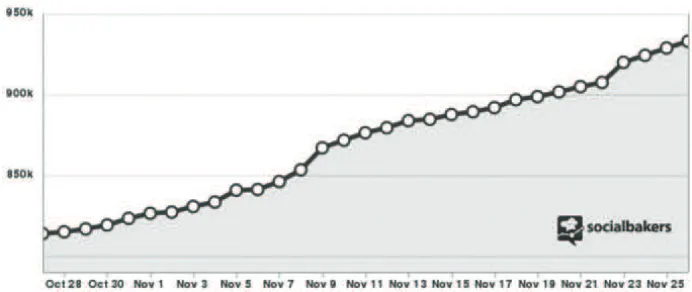
Figure 2.5. Basuki PurnamaAhok Basuki TPurnama Twitter Followers ... 36
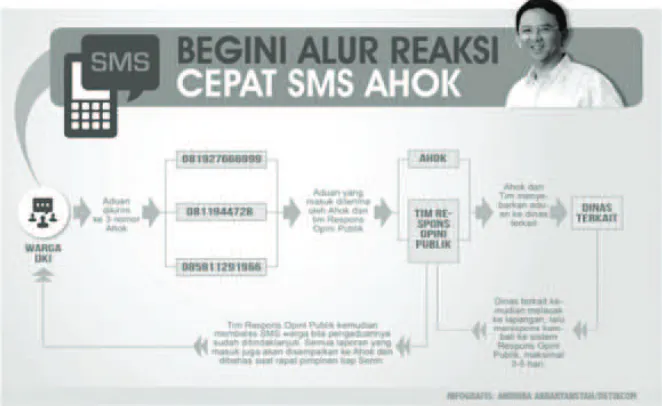
Figure 2.6. Short Message Community Report System ... 36
Figure 2.7. Ridwan Kamil Twitter Followers ... 37
Figure 2.8. Response and Sentiment Rate of Bandung City Departement .... 38
Figure 2.9. Musrenbang Plan Mechanism ... 40
Figure 2.10. Musrenbang in Malang City ... 43
Figure 3.1. Malaysian Local Government System ... 51
Figure 4.1. Analytical Diagram showing the Interrelationships of the Concepts of the Study ... 72
Figure 5.1 Frame work Of decentralization plan ... 94
Figure 5.2 Administrative structure of the Royal h ai Government ... 98
Fugure 5.3 Administrative Structure of h e Royal h ai Government ... 100
Figure 5.4. Budget l ow path ... 105
Figure 6.1. Introduction to the administration system of Vietnam ... 115
Mohammed Asaduzzaman, Ph.D Nasrin Jahan Jinia
Introduction
In recent years, remarkable growth and rise of the Non-Governmental Organizations ( NGOs) in poverty alleviation in developing world have changed the discourse of public administration, governance and international development. h e role of NGO has increased immensely in most developing countries and thus gained more fame in comparison with public institutions (Haque 2002). Despite a huge amount of foreign aid and consultation and many reform initiatives, the local governance of the developing world remains weak, context less, poor, incapable and corrupted. It has been repeatedly argued that with the existing context-less framework of governance, poor nations would not be able to overcome the bad features of their poor governance. On the other hand, despite all inherited limitations, the NGOs are doing well and have gained more reputation in comparison with public institutions. h e irony is that “while the scope of the public sector is being reduced, government spending is diminished, and state agencies are discredited, NGOs have proliferated, their membership has increased, and the assistance they receive from external agencies has multiplied. In fact, the local institutional linkages of government have been weakened by the growing networks of NGOs at the grassroots level” (Haque 2002, 412. As a result, NGOs activities have become inl uential in world af airs and emerged as an integral part of the institutional structure to address the problems of poverty, under-development, gender inequality, environmental conservation, disaster management, human rights and other social issues of developing world (Bhardwaj et al 2011).
h e World Bank (1991a, 1991b) claims that the NGOs and civil societies are more ef ective than the public institutions in reaching out to the rural poor. NGOs are not only reaching out to the poor more ef ectively, but also are able to deliver services and implement programmes more ei ciently. In other words, the NGOs can both mobilize the poor as well as ensure their participation in the programme formulation and implementation better than the public institutions. Unquestionably, the countries like Bangladesh, NGOs has emerged as an alternative actor of development and precisely recognized with major achievements in improving the welfare of the poor. h e industry of micro-i nance has its roots in Bangladesh with the Grameen Bank and enjoys international fame. Bangladesh is rich in NGOs and most of them are established with the framework of Grameen Model. h e Grameen Model has been replicated in many countries due to its enormous success. In the recent past, in achieving vision-2021, the present ruling party assumes that the NGOs will put forward the development goals of the government and will work as the supplementary force of the government ef orts.1
Anheier (1990) highlights this actor with social, economic, political, and cultural arguments for its comparative advantage for the developing world. Likewise, Brown (1988) argues that NGOs can also be taken as potentially critical catalysts for unlocking the energies and resources of the poor and voiceless, and for building pluralistic and democratic societies. As a result, international aid agencies repeatedly urge the closer relation between NGOs and government (Brinkerhof 2002, Young 2000, Tvedt 2002, Clark 1995, Lillehammer 2003, Najam 2000). h e most important fact is that it would really be dii cult for both parties to ignore each other. A constructive and friendly relation between the government and NGOs is thus inevitable.
However, despite its growing role in poverty alleviation a formal relation between the government and NGOs has not yet been established in Bangladesh. Rather, in some cases, the relation between these two parties has been politically motivated since the independence. h e paper intends to examine the relations between the government and NGOs i.e. what has happened during the last 40 years in Bangladesh and how they have seen to each other? We argue that a formal and long-lasting institutional relationship between the government and NGOs is inevitable in order to alleviate colossal poverty and reduce massive corruption in one hand and to provide better services to the poor people on the other hand in Bangladesh. h is paper is based on secondary information. h us, the i ndings are presented through interpreting and reinterpreting the secondary data.
Nature of Government in Bangladesh: At a glance
Although Bangladesh has emerged as an independent state in 1971, it is an old country with a long recorded history dating back several thousand years. Before independence, it was a part of Pakistan (1947-1971) and known as East Pakistan. Prior to this, dif erent parts of its territory had been under the British rule (1765-1947). Before the British rule, Mughal and other Muslim, Buddhist and Hindu rulers had taken over and ruled the present Bangladesh. Until 1971, Bangladesh was under Pakistani military rule (1958–71), an exploitative rule imposed by the military–bureaucratic oligarchy of Pakistan. Under this repressive system of governance, all forms of opposition politics and civil society groups were rigidly controlled. As a result, there was very little scope for NGO activities (Haque 2002).
Based on the historical development, the nature of the government of Bangladesh can be classii ed as authoritarian single party system, Military-Bureaucratic alliance and dictatorship, Care-taker government, political instability and conl ict. Soon after the independence (1971-1975), the government introduced authoritarian rule through disbanding all other political parties and media and moved towards single party presidential system until its fall in 1975. h ere was a very limited scope for development of NGOs during this period.
From 1975 to 1990, this period is known as military dictatorship and military-bureaucratic alliance. During this time, two military dictators Major General Ziaur Rahman and General Hossain Mohammad Ershad ruled the country for 15 years and formed their own political parties known as Bangladesh Nationalist Party (BNP) and Jatiyo (National) Party. Ironically, “during this military rule, the number and activities of NGOs expanded considerably, which was largely due to the regime’s ef orts to enhance its legitimacy at the grassroots level, coopt and use large NGOs as substitutes for opposition political parties and, more importantly, respond to the emerging global trend toward greater NGO power since the early 1980s” (Haque 2002, 414).
NGOs-Government Relations: Points of Departure
h e endless crisis of governance of the developing world has paved the way of introducing alternative approaches in solving the problems of governance of 21st century. In addition, globalization has considerably weakened traditional
governance process. h e 1990s witnessed a dramatic increase in the involvement of NGOs in global governance (Gemmill and Bamidele Izu 2002). NGO as an agent of change has already occupied a strong position to the current discourse of development. As Fisher (1998) maintained that increasing challenges in meeting sustainable development have…..opened up unprecedented opportunities for NGOs not just to replace governments but to protest against them, inl uence them, and collaborate with them- in short, to radically after the way that people in most of the world are governed.
Relations between NGOs and government refer to occurrences of interaction i.e. how they perceived each other and concrete activities in the NGOs-government interface. Farrington and Bebbington (1993) identii ed two major reasons that NGOs enter into relationships with the government. h ey are: to improve the quality of their own voluntary works: and they initiate relations to inl uence political decisions and policies in favor of their general objectives. Similarly, government creates political space in which NGOs operate (Jenkins 1995). In this perspective, three categories of political systems can be identii ed in order to dei ne the relations between NGOs and government (Tandon 1989, Clark 1991, and Ferrington and Bebbington 1993). h ey are: military dictatorship, single party-systems and liberal democratic system. In the i rst two systems, NGOs activities are restricted and the relation between state and NGOs is politically guided.
Military dictatorship and single party systems are known as non- democratic. Under these political systems, the activities of NGOs are very restricted, controlled and politically motivated. On the other hand, liberal democratic system is considered as favorable for NGOs activities since it provides political space and room for maneuver. Ironically, the political history of Bangladesh went through these three systems. Although, the single party system did not last long, the military dictatorship rules the country for almost 15 years (1975-1990) of its 43 years history. Literally, the democratic governance begins in Bangladesh since 1991 which is known as liberal democratic system. h us, the relations between NGOs and the government went through various matrixes over the last 43 years.
According to this approach, the emergence of NGOs is caused of declining of state authority and deteriorating political parties. NGOs proponents and IDAs are supporting this approach. Structural studies claim that volunteerism is one of the key factors for nation building of developing nations like Bangladesh. h ere is also assumption that ef ective cooperation on equal terms between these two parties would create synergetic outcomes i.e. their relationship is not a zero-sum game (Farrington and Lewis 1993, Heyzer et al. 1995). Synergy can be divided into such as complementarity and embeddedness and interrelatedness (Evans 1996). According to the complementarity responsibilities are shared between NGOs and the government while embeddedness means day to day interaction and norms and loyalties between NGOs and the government.
From the contexts of South Asian countries with special reference to Bangladesh, the relations between these two can be seen as fragile and dependent on the willingness of ruling parties and in some cases civil servants. Fragility of willingness is related to the patronage logic of relations. Importantly, willingness is based on personalized reasons and if anything disturbs this type of relation then NGOs will immediately be cut off from bureaucrats and others working inside the state apparatus (Holloway 1998).
h eoretical Notes on NGOs
NGO is a very popular concept and known by dif erent names by dif erent actors at the dif erent places. h erefore, it is a dii cult task to provide a straightforward or a general dei nition of NGO due to its varied roles, nature and the contexts it works. Nevertheless, as a concept, NGO comprises everything from a small grassroots traditional organization to the international organization, from rural to urban, with varying and diversii ed objectives and capacities which often make it dii cult to demarcate the boundary of its area of functions and responsibilities (Dhakal 2006, 50). According to Tvedt (1998, 16) the concept NGO should be used as a “common denominator, a collective term, for all organizations with in the aid channel that are institutionally separate from the state apparatus and are the non-proi t-distributing. At the same time it is important to avoid the catch-all quality and the political l avor which past usage the channel, whether on political, institutional or value-based grounds”.
regarded as alternative development institutions (Fukuyama, 1995: OECD 1995: Putnam 1993). World Bank (1990) highlights NGOs as the institutions outside the public and private sectors whose goals are primarily value driven rather than proi t driven. OECD possesses similar view. According to OECD, NGOs are the organizations established and governed by a group of private citizens for a stated philanthropic purpose and supported by voluntary individual contributions (OECD 1988).
In the recent economic turmoil of the welfare states, NGOs or mostly known as “third sector organizations (TSOs)” are treated as a remedy for the crisis of the welfare state. TSOs are seen to possess characteristics that have become increasingly attractive to public policy makers of the North. h ey are “providing services and care, mobilizing communities, helping to identify and solve new needs as well as old ones, campaigning for social change, focusing on the needs of service users, tackling complex needs and dii cult social issues, being l exible and of ering joined up services, capable of earning users’ trust, promoting volunteering and mentoring, building stronger and connected communities and helping to transform services” (Billis 2010, 10).
Interpreting and reinterpreting the literatures, despite of its diversii ed nature, names and roles, NGOs can be seen as non-proi t voluntary organizations run by the private people and which are not part of the state and involved in various development activities in general. However, in the perspective of Bangladesh, NGOs are not only known as value driven, they are also known as proi t driven. h e mission and vision of NGOs have shifted from charitable organizations to commercial organizations widely known as micro i nance institutions during the last two decades. Palli Karma Shohayok Foundation (PKSF) becomes the mother organization of NGOs (micro i nance industry of Bangladesh). As a result, it can be said that literally NGOs of Bangladesh are neither fully non-proi t oriented nor proi t oriented. h ey have both non-proi t and proi t characteristics.
Framework of NGO-Government Relations
and local government gets highest priority to the both national and international development communities.
However, the irony is that a i rm theoretical and methodological framework of NGO and government relations has not yet been developed. More than a decade ago Seibel (1992) organizes the scholarship on NGO-government relations as emerging from three major perspectives: analysis of resources l ows, of interorganizational interaction styles, and of comparative advantage (in Najam 2000, 6). Jennifer (1998) suggests eight points typology spectrum of relations that range from repression to rivalry to competition to contracting to third party government to cooperation to complementary to collaboration (in Najam 2000, 6). While Fisher (1998) proposes a more nuanced framework that ranges from government repression of NGOs, to ignoring them, to co-opting them, to taking advantage of them without trying to take control, to being genuinely collaborative and indulging in an autonomous partnership.
Brinkerhof (2002) suggests NGOs and government relations through partnership framework. To him, the nature and scale of public service needs and challenges are impossible to address in isolation and their complexity and intransigence require multiple actors and resources to solve. He further emphasizes that this kind of partnership between NGOs and Government can provide a means of developing strategic direction and coordination in this context, af ording a scale and integration of services that is impossible for any actor operation alone. Based on empirical experience and existing literature, Najam (2000, 7) recommends four possible combinations of NGO-local government relations: (1) seeking similar ends with similar means; (2) seeking dissimilar ends with dissimilar means; (3) seeking similar ends but preferring dissimilar means; and (4) preferring similar means but for dissimilar ends. He calls these dimensions as four C’s of NGO-government relations: (1) cooperation; (2) confrontation; (3) complementary; and (4) co-option.
operational collaboration with oi cial bodies; (5) inl uencing local development policies of national and international institutions; and (6) helping government and donors fashion a more ef ective development strategy through strengthening institutions, staf training and improving management capacity.
Dennis R. Young (2000, 150-151) suggests three alternative models for NGO and government relationship. h ey are: supplementary, complementary and adversarial. According to the supplementary model, NGOs are seen as fuli lling the demand for public goods left unsatisi ed by government. Complementary model is opposite to the earlier one. It means NGOs are seen as partners to government, helping to carry out the delivery of public goods largely i nanced by government. In this case, NGOs and government expenditures have a direct relationship with one another. Adversarial model states that NGOs inl uence government to make changes in its public policy and to maintain accountability to the public. Reciprocally, government attempts to inl uence the behavior of NGOs by regulating its services and responding to its advocacy initiatives as well.
h us, from the existing literature we found dif erent strategies/models of NGO-government relations. Although, Bangladeshi NGOs gained international fame for their innovation of micro-credit, non-formal education, women empowerment and in delivering primary health care service, a formal framework of relationship between NGOs and government has not been established yet. Rather, the governments of Bangladesh have introduced some regulatory frameworks in order to control and ensure accountability of NGOs in dif erent regimes.
Growth and Development of NGOs and its power in relation to government in Bangladesh
NGO is not a new phenomenon in the discourse of development. Voluntary organizations have a long history to assist the victims of wars and natural disaster and to provide welfare service to the poor (Begum 2000). Likewise, the genesis of NGOs in Bangladesh deeply rooted to the self-reliant village system (Gram Janapad). In the absence of welfare government and other external possibilities, people had to fuli ll their collective desires, needs, aspirations which created an objective situation for non-governmental activities very often under the leadership of social elites. h e need for collective life in general and that of the dominant sections of the society created an ideal situation for the growth of the non-governmental ef orts in Bangladesh but religious spirit and cultural urges always play a vital role behind any philanthropic work in Bangladesh rural society.
Inhuman suf erings of people and massive destruction of infrastructure and the backbone of economy of the country caused by the war of liberation in 1971 called for immediate relief and rehabilitation. h e government had to face a task of renewal and reconstruction of the economy after the independent war. However, the government had neither the ability nor the appropriate institutional mechanism to address the volume and diversity of such enormous problems alone. h is situation led in the emergence of a large number of national and international NGOs operation in Bangladesh. h us, with other global socio-economic and political changes, certain specii c conditions/factors are responsible in the emergence of NGOs in Bangladesh (Aminuzzaman and Begum 2000, 202-203). h ey are:
Tradition of Voluntary Activities: voluntarism is a long and historical tradition of the Indian Sub-Continent. By tradition it has become a part of culture and religion of the people of Bangladesh. Such traditional values and beliefs inl ame people to work for underprivileged under a formal organization, which are now known as NGOs and some of them are the world largest NGO working across the world for example BRAC.
Dissatisfaction of Donor Agencies: another factor for fast growth of NGOs is the dissatisfaction of international donor agencies with the government institutions which are incompetent to reach to the people due to bureaucratic rigidity and hierarchy and corruption. As a result, local people do not trust the public institutions while NGOs have built friendly and trustworthy relations with the local people.
Unsuccessful Government Ef orts: the growth of NGOs in Bangladesh is the result of the failure of the government to satisfy hope and aspirations of the people. h us, NGO’s have emerged as an integral part of the institutional structure for addressing poverty as well as rural development, gender equity, environmental conservation, disaster management, human rights and other social issues.
h e development of NGOs in Bangladesh can be described under the framework of four generations (Korten 1987).h ese are:
First generation: h e i rst generation NGO’s are charitable, focused on welfare, rehabilitation and relief.
h ird generation: h e third generation of NGO’s stems from the re-examination of basic strategic issues relating to sustainability, import and recurrent cost recovery.
Fourth generation: It entirely depends on the development phase of NGO’s in realizing their vision of society characterized by strong people’s movements. h erefore, even though NGOs started their journey with the motive of philanthropist, they have turned into one of the key actors of development in Bangladesh.
Although NGOs activities started from the very beginning of its independence, they have got formal acknowledgement since 1980. It has been found that from 1980 to July 2013 about 2252 NGOs have been formally registered by the government of Bangladesh and the registration of 502 NGOs has been cancelled due to multifarious allegations. h e data shows that the trend of growth of NGOs has been increased since 1990 after ousting the military regime (see the following table).
Table 1.1. No. of NGOs registered from 1980 to July 2013
Period No. of NGOs registered
1980 to 1989 249
1990 to 1999 809
2000 to 2009 916
2010 to July 2013 278
Total 2252
Source: www.ngoab.gov.bd/Files/NGO_LIST.pdf & www.ngoab.gov.bd/Files/ CANCELLED_ NGOs.pdf, accessed on 02.02.2014
h e NGOs are not only mushrooming, they become a formidable force af ecting the political and economic domains, especially the power and legitimacy of the government. Haque (2002, 419-421) identii ed several indicators that the power of NGOs has increased in relation to government. h ey are:
• Takeover some of the basic activities that used to be performed by various state agencies. Large development NGOs such as BRAC, Grameen Bank, Proshika, and ASA have become credible institutions to provide varieties of inputs and services related to microi nance, small industry, livestock, i sheries, sanitation, basic education, and health care;
• h e majority of their members are women who represent a formidable political force as a group participating in elections and shaping the election outcomes (especially at the local level);
NGOs to certain policy options devised by the government, and more involvement by NGOs in advocating or publicizing their activities in order to inl uence government decisions in their favor;
• An essential indicator of the expanding power of development NGOs is their direct involvement in macro- level political processes such as educating voters and ai liating with national political parties; and
• Many development NGOs have gained further power by expanding the scope of their i nancial transactions and taking over various proi t-making economic enterprises. h is growing economic power of NGOs makes them relatively autonomous and independent of i nancial controls exercised by the government.
In addition to these indicators, Haque (2002) also identii ed local and external factors that are playing important role of growing power of NGOs in relation to government. For example: increasing scope of their membership; through their comprehensive educational and training programs that shape the orientations of millions of NGO members and, through them, other citizens; the rise of a market-biased neoliberal ideology; most foreign donors or aid agencies are increasingly portraying NGOs as the means of democratization, remedies for poverty, constituents of a civil society, and substitutes for state agencies in developing countries; NGOs have become more inl uential in relation to the government because of their worldwide recognition and replication; many local NGOs in developing countries have increased both their power and inl uence by setting up alliances or partnerships with foreign NGOs located in developed countries; and i nally the economic power of Bangladeshi NGOs has been strengthened due to the fact that the above international bodies, foreign donors, and bilateral agencies have increased their i nancial support to these local NGOs while limiting their assistance to the government during the last two decades.
Above interpretations show that NGOs have emerged as vital actors in the socio-economic development of Bangladesh during the last three decades. h e NGO- Government relations can be summarized into three paradigm shifts (Alam 2007, 28).
• The fi rst paradigm shift occurred in the mid 1970s, when the charity and relief orientation of NGOs switched to community development programmes incorporating some basic services to the poor and also a new emphasis on institution building;
the beginning of relations marked often by but also, in some cases, tension and mistrust. GO-NGO collaboration extended to many sectors including education, health, environment, population, women and youth development, livestock and fi sheries, resettlement and disaster management; and
• The third paradigm shift occurred when some NGOs focused their activities on political advocacy in the disguise of non-party politics, though they also continued to work in various spheres of socio-economic development. NGO involvement in political movements, voter education, and elections has damaged their non-partisan standing. This has created feud and factionalism within the NGO sector that led to divisions in the leadership of NGOs.
NGOs and Government in Bangladesh: Adversaries or Allies?
Unanimously, NGO is a very popular concept in Bangladesh and has become a key partner of development during the last two decades. It has gained international fame for its contribution to development. Although the genesis of NGO in Bangladesh has a long history, it has achieved high proi le since the disaster l oods of 1988 (White 1999) and later the success history of NGOs went to a dif erent height. Microi nance predominantly known as micro-credit is one of the leading social and economic philosophies has created much attention among the global development community especially as a tool of poverty eradication and women empowerment (Khandkar 2005, Pitt, Khandker, Chowdhury and Millimet 2003, Schuler and Hashemi 1994). Microi nance institutions have been considering as the leading partner of international aid agencies to achieve MDGs. h e idea of microcredit is something for which Bangladesh can claim the intellectual property right. h is model has been replicated many parts of the world. As a result, Dr. Muhammad Yunous, the father of the micro-credit model and his Grameen Bank have been awarded with the Nobel peace prize in 2007. Bangladeshi NGOs have also gained recognition from the world development community for theirs success in non-formal education, public health and sanitation and women empowerment. However, despite the colossal success of NGOs in development, a formal relation between NGOs and government has not been established in Bangladesh yet. After the independence, the various regimes have introduced some regulatory framework for controlling NGOs and their activities rather than introducing a healthy relationship between these two actors.
to govern the activities of NGS. h e World Bank (1996) highly criticises the role of NGOAB and emphasizes on the weaknesses of NGOAB. Sanyal (1991) describes the relationship between NGOs and state from the shadow of a triangle with the donors, alternately posing as matchmaker, coni dent or rival. It has been found that the NGOs are more dependent to the donors rather than to the state (Jamil 1998). In many cases they are not accountable to the state. h e donor’s advocacy of the NGOs has challenged the state’s monopoly as development actor, with far reaching implications for its funding base, sovereignty, and internal legitimacy (Sanyal 1991).
It is evident that the donors have fellow feelings for the NGOs in Bangladesh. At the same time they are very much frustrated about the state bureaucracy. As a result there are conl icts between the government oi cials and NGOs oi cials. In many cases government oi cials consider NGOs oi cials as their rival (Asaduzzaman 2008). Research i nding shows that government employees feel resentful at seeing staf at a comparable level in the larger NGOs having greater l exibility in working, more chances for foreign tour, better salaries and a higher budget for oi ce support, vehicles, and so on (Sanyal 1991). h e executive branch (bureaucracy) of Bangladesh is very powerful than other branches. As Hamza Alavi (1972) states that colonialism (post-colonial state) had resulted in an overdeveloped state relative to a comparatively underdeveloped local bourgeoisie. Later Migdal (1998) highlights it as strong societies and weak states. As a result, bureaucracy is itself reluctant to build a healthy relationship between the state and NGOs in Bangladesh. h e state organs do not trust NGOs and their allies. h e root causes of mistrust and rivalry between GO- NGOs are (Alam 2007):
• NGOs have gradually emerged as strong actors in both political and socio-economic spheres undermining the state’s role and authority.
• NGOs receive large amounts of foreign funds and this creates competition for limited resources between state and NGOs.
• DPs are in favour of implementing many development programmes through NGOs.
• NGOs’ involvement in local level elections and in electioneering and also in national politics has created suspicion and mistrust about NGOs’ long run motives.
• NGOs’ involvement in business (superstores, printing presses, hotels, transport, education, real estate, i nance and banking) has raised questions in the mind of common people as well as within the state apparatus.
What government thinks of NGOs:
• Lack accountability.
• Practice insui cient inter-NGO coordination leading to overlapping and
unnecessary spending.
• Spend too much money on their operations.
Rely too much on foreign funds.
• Charge high interest on credit. • Have an insignii cant impact.
• h eir success stories get unduly positive coverage in the local and international media. • Contract DPs without the knowledge of government.
• Undertake programmes which are sensitive and have political implications. • Get involved in political activities in the name of non-party politics.
What NGOs thinks of government:
• It is rigid, bureaucratic and tries to over-regulate NGO activities. • Unnecessarily requires prior approval for foreign funded projects.
• Lacks appreciation of the dif erences in approach and style of NGOs’ project
management.
• Does not dif erentiate between NGOs with a proven record of performance and
less-committed NGOs.
• Does not dif erentiate between politically biased and unbiased NGOs. • Harasses NGOs due to their claimed political activity.
• Has dif erent mission and vision from government.
• By comparison with government, NGOs are poor, environmentally friendly and
work in the remote areas of the country.
Sources: Alam 2007
Figure 1.1. Government- NGOs Mutual Concerns
h e relationship between the government and NGO can also be describes from the political perspective. Farazmand (1987) describes it as love-hate relationship. It is already mentioned that the conl icting relationship between the government and NGO has started since 1991. After the parliamentary election of 1991, the opposition claimed that the winning party has got huge support from the NGOs. h is conl icting relationship has been worsen and got a new dimension in 2012 when the present regime ousted Nobel laureate Dr. Mohammad Yunus from the position of chairman of Grameen Bank (GB).
In January 2011, the present government formed a i ve member review committee in order to know the overall management and condition of GB. h e committee recommended 212 suggestions. Based on the recommendations,
government has passed Grameen Bank amendment bill in 2013 and reorganized the board of directorate of Grameen Bank. h is initiative of the government has been criticized by the current opposition political parties led by Bangladesh Nationalist Party (BNP) and they ensured that they will reinstate Dr. Yunus as the chief of GB and its previous regulations if they come to the power. Even the civil society members (known as pro-BNP) criticized the government decision about GB. Moreover, the donors and USA have also expressed several times their concern about the government intervention over the autonomy of GB.
From the above, four major barriers for building a healthy relationship between NGO and government in Bangladesh can be identii ed. h ese are: policy environment, government factors, NGO factors and donors factors (Clark 1995).
Policy environment: “NGOs often fall in the opposition camp while the government or ruling party may see itself as the sole legitimate voice of the people. In such a highly politicized policy environment neither party would have sui cient trust in the other to be able to work together, nor would they desire to do so” (Clark 1995, 396).
Government factors: “Government-NGO relations may also be strained where corruption and nepotism are rife, or where there is a shortage of competent staf especially at local level. h e jealously of civil servants toward NGOs can exacerbate policy tensions” (Clark 1995, 397).
NGO factors: “NGOs often display a distinct preference for isolation. h ey are not only unwilling to engage in dialogue with government but they often coordinate poorly with one another” (Clark 1995, 397).
Donors factor: “When the NGO sector is dominated by foreign or international NGOs problems can arise between the government and the NGO, if the government feels that it is being squeezed out of development decision making” (Clark 1995, 397).
Conclusions
Although NGO is not a panacea, it becomes a key actor of development in Bangladesh. Neither the government nor the political parties can ignore the
role of NGOs in poverty alleviation and women empowerment. Historically the poor performance of the government has paved the way of mushrooming NGOs in Bangladesh. However, the above analysis shows that the government has not always been enthusiastic about the direct involvement of NGOs into the government apparatus.
h e indirect benei ts of NGOs are enormous for example creating employment opportunity for young educated people. In other words it can be assumed that the growth of NGOs are blessing for the state. NGOs have created jobs for all categories of people and thus millions are engaged directly and indirectly in this sector. It has been evident that in recent times smart and talented young people are very much interested in building their career in this sector. For jobless educated people, NGOs are the best and last hope for getting a job. h erefore, a healthy and working relationship between NGOs and government need to be established in Bangladesh rather than introducing regulatory frameworks, politicizing NGOs and increasing tension. h e Post-2015 Development Agenda categorically emphasizes the importance of participation, inclusion and partnership of Government and NGOs in achieving sustainable development of the developing world.
Building a healthy or formal relationship between NGO and Government is not an easy task in the country like Bangladesh. However, government has to take momentous initiative in this regard. It is widely recognized that the government alone is not able to resolve the multidimensional problems, but NGOs and civil society organizations should be brought together for concerted action directed towards environmentally and socially sustainable development (Elander 2002, Asaduzzaman 2008, 2011).
References
Ahmad,M.M. (2000) Donors NGOs the State and their Clients in Bangladesh, Maniruddin Ahmed and Lutfun Nahar, Dhaka
Alam, S.M.N., (2007) Whose Public Action? Analysing Inter-Sectoral Collaboration for Service Delivery Bangladesh Country Review History of State-NSP Relations, International Development Department, University of Birmingham, UK
Aminuzzaman, S. (1998) NGOs and the Grassroots Base Local Government in Bangladesh: A Study of h eir Institutional Interaction, in Hossain F. and Myllylä S. (Eds.) 1998, NGOs under Challenge Dynamics and Drawbacks in Development, Ministry of Foreign Af airs, Finland
Asaduzzaman,M. (2011) Innovation in Local Governance: Decentralization and Citizen Participation in Bangladesh, in (eds) Ari-Veikko Anttiroiko et. al Innovative Trends in Public Governance in Asia, ISO Press, 220-233
Asaduzzaman,M. (2009) Development Role of the Local Governance Institutions in Bangladesh, Nepalese Journal of Public Policy and Governance, Vol.xxiv, No.1, 117-132
Anheier, H.K. (1990) Private Voluntary Organizations and the h ird World: h e Case of Africa, in Anheier H.K. and Seibel, W. (eds.1990) h e h ird Sector. Comparative Studies of Non-Proi t Organizations, Berlin and New York, de Gruyter
Anheier, H.K., and Salamon L.M. (1998) h e Non-proi t Sector in the Developing World, Manchester University Press
Bhardwaj, S., and Khemundu, C. (2011) Institutional Relationship between Government and Non-Governmental Organizations in Bangladesh, Journal of International Af airs, 15(1&2)
Begum,A. (2000) Government-NGO Interface in Development Management: Experiences of Selected Models in Bangladesh, Tampere University Press Bills, D. (2010) Towards a h eory of Hybrid Organizations, in Bills, D. (eds.)
Hybrid Organizations and the h ird Sector: Challenges for practice, h eory and Policy. Palgrave, Macmillan
Bingham, L.B., Nabatchi, T., and O’Leary, R. (2005) h e New Governance: Practices and Processes for Stakeholder and Citizen Participation in the Work of Government, Public Administration Review, 65(5), pp. 547-558. Brinkerhoof, J.M. (2002) Government-Nonproi t Partnership: A Dei ning
Framework, Public Administration and Development, Vol.22, 19-30
Proceedings of the ANGOC Regional seminar on NGO Strategic Management in Asia, Manila, ANGOC
Clark, J. (1995) h e State, Popular Participation, and the Voluntary Sector, World Development, Vol.23 (4), 593-601
Clark, J (1991) Democratizing Development: the Role of voluntary Organizations, West Hartford, CT: Kumarian
Dhakal, T.N. (2006) NGOs in Livelihood Improvement: Nepalese Experience, Adroit Publishers, New Delhi
Elander,I (2002) Partnership and Urban Governance, International Social Science Journal, 172, UNESCO
Fisher,J (1998) Non- Governments: NGOs and the Political Development of the h ird World, West Hartford, Kumarian Press
Fukuyama,F (1995) Trust: h e Social Virtues and Creation of Prosperity, New York, h e Free Press
Gemmill,B. and Bamidele-Izu, A. (2002) h e Role of NGOs and Civil Society in Global Environmental Governance, http://environment.research.yale.edu/ documents/downloads/a-g/gemmill.pdf, accessed on 11.11.2013
Hasan, S.G. and Mulamootil, K. J. E. (1992) Voluntary Organizations in Bangladesh: A Proi le, Environment and Urbanization, 4: 2.
Haque,M.S.,(2002) h e Changing Balance of Power between the Government and NGOs in Bangladesh, International Political Science Review, 23(4):411-435
Holloway, R. (1989) Foreword in (ed.) R. Holloway Doing Development: Government, NGOs and the Rural Poor in Asia, London, Earthscan
Jreisat,J. (2004) Governance in Globalizing World, International Journal of Public Administration, 27(13&14):1003-1029
Korten, D. ( 1987) h ird Generation NGO Strategies, A key to people –centered Development, World Development, Vol.15, P.149
Lillehammer, G.C. (2003) State-NGO Relationships in Transitional Democracies: h e Case of CPA-ONG- a Government Centre for the Advancement of NGOs in Bennin, UNDP
Najam, A. (2000) h e Four Cs of Government-h ird sector Relations: Cooperation, Confrontation, Complementarily, Co-option, A Publication of the Sustainable Development Policy Institute, Pakistan
OECD (1995) Development Co-operation: Ef orts and Policies of the Members of Development Assistance Committee, Chairman Reports, Paris
Putnam, R.D. (1993) h e Prosperous Community: Social capital and Public Af airs, h e American Prospects, Vol.13, 35-42
Saifullah, A.K.M. (2001) NGOs capacity in Development Management: Experience from Bangladesh, Published PhD h esis, University of Tampere. Shah, A. and Shah, S. (2006) h e New Vision of Local Governance and h e
Evolving Roles of Local Governments, in Shah Anwar (ed.) Local Governance in Developing Countries, World Bank, (Public Sector Reform and Governance Series)
Sarker A.E and Rahman M.H. (2007) h e Emerging Åerspective of Governance and Poverty Alleviation: A case of Bangladesh, Public Organization Review, Vol.7(2), 93-112
Stones, P. (1963) Local Government for Students, London: McDonald and Evons Tandon, R (1989) h e State and Voluntary Agencies in Asia, in R. Holloway (ed.)
Doing Development: Governmenr, NGOs and the Rural Poor in Asia, London, Earthscan
Tvedt, T. (2002) Development NGOs: Actors in a Global Civil Society or in a New International Social System? Voluntas: International Journal of Voluntary and Nonproi t Organizations, Vol.13 (4), 363-375
Tvedt, T. (1998) Angles of Mercy or Development diplomats? NGOs and Foreign aid, Trenton, Africa World Press, Oxford
UNDP (1993) Human Development Repot, 1993, London
Werlin, H.H. (2003) Poor Nations Rich Nations: A h eory of Governance, Public Administration Review, 63(3):329-342
World Bank (1990) How the World Bank Work with the Non-governmental Organizations, World Bank Publication, Washington D.C. World Bank World Bank (1991a) World Development Report 1991: h e Challenge of
Development. Oxford: Oxford University Press
World Bank (1991b) Trends in Developing Countries 1991, Washington, DC: World Bank
Young, D.R. (2000) Alternative Models of Government-Nonproi t Sector Relations: h eoretical and International Perspectives, Nonproi t and Voluntary Sector Quarterly, Vol.29, 149-172
PARTICIPATION IN INDONESIA
NETIZEN AND SELECTED CASES OF
LOCAL DEMOCRACY IN INDONESIA
Achmad Nurmandi Eko Priyo Purnomo Andi Luhur Prianto Solahudin
Moch Jaenuri
Introduction
h e Republic of Indonesia is the world’s largest archipelago country by area and by population. It is also the world’s most populous Muslim-majority nation and is home to 240 million people living across more than 17,504 islands in an area of 1.910.931,32 km2. Despite its diversity, which includes 300 distinct
ethnic groups and more than 700 languages and dialects, Indonesia has managed to develop a shared national identity.
Historical Context of Democratization and Decentralization
Democratization and decentralization are two variables that are related each other. Decentralization in some countries has been persued by national elites for a mixture of reasons, including democracy, making government more ei cient, and reducing state expenditure (Selee and Tulchin, 2004). In the history of Indonesia’s decentralization, there has been a unique relationship between the central government and local government independence. In the period of 1945-1949, local governments had broad autonomy in managing their abundant local resources. h e system of the Dutch colonial administration of the so-called East Indies consisted of a simple top-down structure. Within this administration, around 300 Dutchmen in the Interior Ministry (Binnenlandsche Bestuur) managed the main functions of government in Jakarta (then called Batavia by the Dutch) and staf ed the territorial administration down to the level of regency (Furnivall 1944:ch. 9) Local administration below the regency level was carried out by the indigenous aristocracy (pangreh praja), which was led by regents (bupati) and assisted by their bureaucrats (wedana) (Rohdewohld 1995:3; Sutherland 1979). At the beginning of the twentieth century, liberal movement in Netherland pushed new policy to more human colonial policy called Ethical Policy and introduced h e Decentralization Law (Dezentralizatie Wet) of 1903 provided the legal basis for this i rst autonomy experiment according to which the territory was divided into three administrative units (Gewesten, Plaatsen, and Gemeenten). Also in 1903, the municipality of Batavia became the i rst local government authority, followed by the municipality of Surabaya in 1905. By the year 1939, 32 urban municipalities had been formed (Furnivall 1944: 291). h ese municipalities and 18 residencies (kabupaten) were allowed to form local councils (raad), which were intended to serve the interests of their European majorities (Legge 1961:6).
h e Japanese occupation in the 1940s had a radicalizing ef ect on this decentralization process (Bunte, 2006). First, the provinces and regency councils were abolished, and the territory divided into three administrative units, which ran parallel to the military subdivision of the country. Second, the Indonesian aristocracy (pangreh prajah) moved up into senior positions while nationalist leaders (including Sukarno) became part of the government. At the same time, the authoritarian bureaucracy was extended down to the level of hamlets and households. With this step, “every household, neighborhood association, hamlet and village, all of which had previously fallen outside the formal administrative structure, was incorporated into the all-encompassing single administrative pyramid dominated by the Japanese Army” (Sato 1994:28).
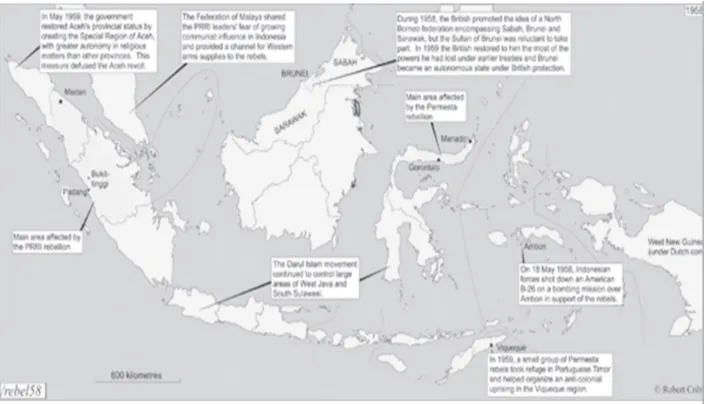
1950-1965, there were local secessionist movements or rebellions throughout Indonesia. h e rebellion of PRRI Permesta ( Revolutionary Government of the Republic of Indonesia/ Piagam Perjuangan Semesta (Universal Struggle Charter) in Sumatera and Celebes was a revolt involving the army which was dissatisi ed with the central government in Jakarta (Fryer,1957). h e role of these areas in the revolution is very important for the nationalisst movement outside Java after independence; however the central government policy ignored their role in the independence movement (Amal, 1993). One important case triggered a local rebellion in Sumatra was the appointment of a governor from Java, Ruslan Mulyoharjo, to be the governor of the western region of Sumatra in the 1956 (Amal,1993). h e PRRI rebellion and the Permesta in Sulawesi, which was lead by Kahar Muzakar, had the goal of central government recognition of the Sulawesi community in Indonesia (Amal, 1993). Similarly, the Free Acheh Movement (GAM) was triggered by unjust distribution of oil and gas revenues, the secessionist movement was formed in Aceh in 1976, just as a large natural gas facility was beginning its operations.
Figure 2.1. Regional Rebellion 1958-1959
Source: Robert Gribb, Digital Atlas of Indonesia History, Niaspress, 2007
administrative decentralization. h e central government had authority to appoint governors and mayors or regents similar to the colonial Dutch era. All local government had same delegated authorities transferred by the central government. Under Guided Democracy, the military played an enhanced role in governance, through Nasution’s presence in the cabinet, through the appointment of military oi cers as provincial governors, and through the army’s control of the enterprises seized from the Dutch in 1957, which were subsequently nationalized (Cribb, 2010).
New Order
h e coup attempt of 1 October 1965 gave the army, now led by General Suharto, the opportunity to seize power from President Sukarno. A major feature of the New Order, therefore, was the removal of the once powerful party presence in the administration and its substitution with a military presence (Cribb, 2010). Indeed, under New Order era, the Suharto regime’s objective was to attain political order through military dual-function, political structure, and governing process (Mas’oed, 1989). h e new political structure was designed into a controlled bureaucracy, a solid military organization, controlled democracy, a house of representative, and a limited number of political parties. h e i rst controlled bureaucracy strategy was to centralize the decision making process at the central government, to limit devolution process and to control local government. h e central government appointed military personnel (active and retired) to positions throughout the government. h ey were especially prominent in the Department of Internal Af airs (Dalam Negeri), holding positions ranging from governor down to village chief (Cribb, 2010). In sum, h e New Order stopped short of doing away with political parties and elections, but allowed both to continue only under tightly controlled conditions (Cribb, 2010).
In this way, the New Order stipulated Law No. 5 Year 1974 as very centralized local government law. h e central government played an important role in recruiting governors, regents, or mayors through appointing active or retired military personnel to local government. h rough this mechanism, the central government was able to ef ectively control the governing process. District oi cials often liken this assignment of functions to a farm animal that has been entrusted to another’s care, with the owner insisting that he must continue to hold onto the beast’s tail (terus pegang ekornya) (Ferrazi, 2000).
Era Reformasi (Reform Era)
law on democratic decentralization. Between May 1998 and October 1999 he managed to lay the foundation for a more democratic and decentralized political system, and Indonesia emerged from that transitional period to join the ranks of the world’s democracies, not its failed states (Malley in Bland and Arnson, 2006). Based on MPR Decree No. XV/MPR/1998, in November 1998 BJ Habibie instructed his minister of home af airs to put together a team of civil servants, academics and advisors to formulate a draft of Law No. 22/1999 regarding regional governance. Simultaneously, the Finance Ministry started work on a reform of the system of intergovernmental i nances and formulated the draft for Law No. 25/1999 on the “Fiscal Balance between the Centre and the Regions” (Bunte, 2008). In May 1999, Laws No. 22 and 25 were passed by parliament in great haste and with a minimum of debate. Indeed, no substantial changes were made from the government’s original draft legislation (Rasyid 2003:63).
JICA (2001) noted that there were i ve important changes in Law No. 22/1999 and Law No. 25/1999. Namely, autonomy to local governments with emphasis on their diversity; distribution of authority and redistribution of personnel between the central and local governments; distribution of authority and redistribution of personnel between the central and local governments. Law No. 22/1999 states that the i elds of government that must be covered by regencies and municipalities including public works projects, health, education and culture, agriculture, transport and communications, industry and trade, capital investment, the environment, land, co-operatives, and manpower af airs, and these i elds may not be devoluted to the provinces (Article 11 (2) and the note thereto). In principle, the head of a local government is now elected by a majority vote of the local council, leaving little room for the central government to intervene.(ii) h e head of a local government is now accountable to the local council. If the i scal year-end administrative report by the head is rejected twice by the local council, the head is forced to resign. As a result, the local council now has signii cant bargaining power over the head of the local government.(iii) h e regional budget over which a local council has the auditing right has been increased after the regional allocations increased in absolute terms and the percentage of block grants to total subsidies from the central government has grown. (iv) h e potential opposition within the local council to the head of the local government has increased because various political parties now have representation. Finally Under Law No. 22/1999, the i eld agencies of central government ministries have been abolished except for those in i ve i elds, and in addition it has become dii cult for the central government to intervene in elections for governors, chief executives, and mayors.
Law No. 22/1999. h is law stipulated several radical changes: the declaration of regency/ city governments as autonomous regions which are not hierarchically subordinate to the provincial government; election right of local legislative body for regents, mayors, and governors; and strong power of local councils. Article 4 (1) Law 22/1999 stated that in the context of the implementation of the decentralization principle, province, regency and city shall be formed and authorized to govern and administer in the interests of the local people according to their own initiatives based on the people’s aspirations. Article 18 (1) states that the local council (DPRD) shall elect regional government heads. However, implementation of Laws 22 and 25 had several problems. Hidayat and Antlov (2003) noted that devolution initially led to deterioration in the provision of services, exacerbation of inequalities between districts, the capturing of economic benei ts of regional autonomy by local elite, the absence of local accountability, and the dominance of local councils. Finally, the central government coni rmed that Laws 22 and 25 as a “over acting autonomy (otonomi kebablasan) (Hidayat and Antlov, 2003).
Table 2.1.Autonomy Law No 22/1999 and No. 4/1974
Issue Law No.22/1999 Law 5/ 1974
Status of local
Local parliament is local house of representatives within frame of unitary state of Indonesia
Decentralization is transfer from government matters from central government to local governments or from upper to lower level local governments foreign af airs, defense, justice, i nances and religious af airs
Local government has right, authority and responsibility to manage their own af airs Assignment of certain governmental af airs to local government is determined by central government regulations
Source: Syarif Hidayat and Hans Antlov, “ Decentralization and Regional Autonomy in Indonesia”, in Philip Oxhorn, et al, Decentralization, Democratic Governnance and Civil Society in Comparative Perspective Asia Africa and Latin America, Wodrow Wilson Center Press, Washington D.C. 2004, p. 286.
government administration. and the election model of heads of local government. Article 56 (1) of Law mentions that “the regional heads and deputy regional heads shall be democratically elected in the one pair of candidates through direct, free, secret, honest and fair manner”.
Two autonomy acts have been causing much political change in the local level. Local governments in particular have become more independent than before and more democratic at the local level. Many experts noted the successful approach of big bang theory has at least empowered many to build local areas with the limited central government control. A 2008 survey funded by the U.S. Agency for International Development found that trust in local oi cials grew from 42% in 2006 to 55% in 2008. 70% of respondents said that local government executives were accountable to the people of their area, an increase from 61% in 2006. Some successful stories of locally autonomous policy implementation are the creativity of local governments in handling specii c local problems, such as street trader management in Solo city with Joko Widodo, information technology use introduced by Yogyakarta’ mayor Herry Zudianto in Yogyakarta, and local agriculture policy done by Damassara as a new autonomous regions. Bennett (2011) noted that the hope for decentralization in Indonesia was that with greater autonomy at the local level, constituents could increase the accountability of their local leaders. Along with the authority given to regional governments, however, these authorities have not been balanced with accountability, there for the cases of corruption in the local government. In line with the majority of the theoretical literature, we argue that the monitoring of bureaucrat’s behavior is an important determinant of the relationship between decentralization and corruption (Lessman and Markward, 2009).
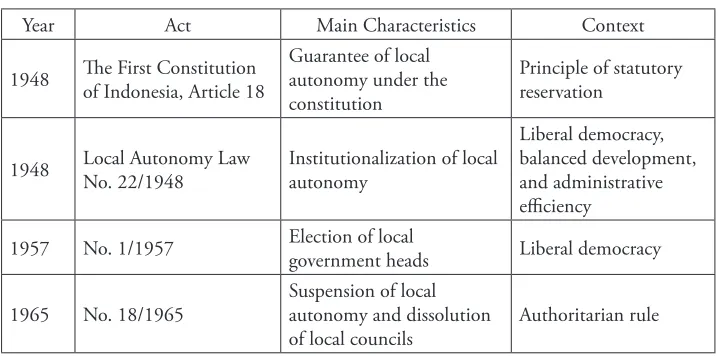
Table 2.2. A Chronology of Indonesia’s Local Autonomy Development
Year Act Main Characteristics Context
1948 h e First Constitution of Indonesia, Article 18
Guarantee of local autonomy under the constitution
Principle of statutory reservation
1948 Local Autonomy Law No. 22/1948 Institutionalization of local autonomy
Liberal democracy, balanced development, and administrative ei ciency
1957 No. 1/1957 Election of local government heads Liberal democracy
1965 No. 18/1965
Suspension of local autonomy and dissolution of local councils
1974 No. 4/1974 Indei nite postponement of local autonomy Military authoritarian rule
1999 No. 22/1999 Election of local government heads Liberal democracy
2004 No. 32/2004 Election of local government heads Liberal democracy
2014 No. 23/2014 Election of local government heads Liberal democracy
Act No. 23/2014 stipulated clearly community participation in Artile 354 as follows:
a) To inform local government af airs to public
b) To enhance civil society actively participation in local governance
c) To institutionalize civil society participation in decision-making processes in form of
a. 1) Local policy and regulation formulation
b. 2) Planning, budgeting, implementation, monitoring and evaluation of local development
c. 3) Asset management and natural resources development d. 4) Public services.
h e following method of public participation such as public consultation, policy deliberation, public engagement, controlling and other public engagement. h is legally civic participation in local governance af airs is a tremendeously step forward compared with the preceding act that does not regulate public participation clearly.
However, the election of local government heads is regulated in Government Regulation No. 1/2014 with the signii cant change particularly in elections. h is regulation stipulates only the election of local government’s head and does not stipulate the pair candidate of regent/mayor/governor and vice regent/mayor/ governor. h e vice regent/mayor/governor is appointed from high rank public oi cials based on the proposal of elected regent/mayor/governor.
Civic Engagement in Local Governance
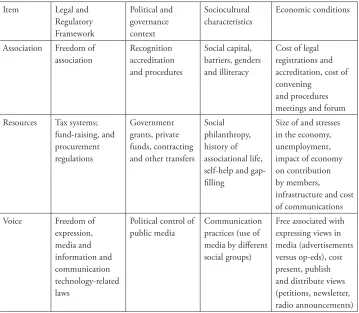
facilitates a comprehensive assessment of the legal and regulatory, political and governmental, socio-cultural and economic factors af ecting civic engagement. It is based on an analytical framework that identii es i ve critical dimensions that are ‘enabling elements’ of civic engagement. h ey are:
Association (A): the freedom of citizens to associate
Resources (R): their ability to mobilize resources to fuli ll the objectives of their organizations
Voice (V): their ability to formulate and express opinion
Information (I): their access to information (necessary for their ability to exercise voice, engage in negotiation and gain access to resources
Negotiation (N): the existence of spaces and rules of engagement for negotiation, participation and public debate.
Information Freedom of
Source: h indwa, Jef , Carmen Monico, and William Reuben.Enabling Environments forCivic Engagement in PRSP Countries.Social Development Note 82, World Bank, Washington, DC, 2003.
Netizen in Local Governance
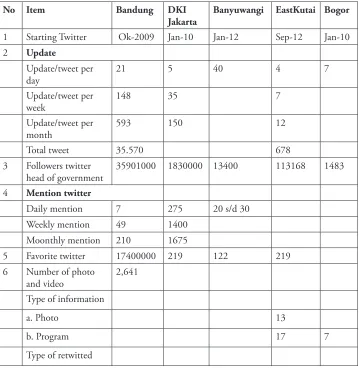
Citizen involvement in governance is a focal point to ensure better governance accountability through broad space of social media for public participation. Social media is dei ned as “a group of Internet-based applications that build on the ideological and technological foundations of Web 2.0, and that allow the creation and exchange of User Generated Content ( Kaplan & Michael Haenlei, 2010) “Web 2.0” refers to Internet platforms that allow for interactive participation by users. “User generated content” is the name for all of the ways in which people may use social media. h e Organization for Economic Cooperation and Development (OECD) specii es three criteria for content to be classii ed as “user generated:” (1) it should be available on a publicly accessible website or on a social networking site that is available to a select group, (2) it entails a minimum amount of creative ef ort, and (3) it is “created outside of professional routines and practices.” (OECD, Participative Web and User-Created Content: Web 2.0, Wikis, and Social Networking18 (2007) [hereinafter OECD Report] (Kaplan & Haenlein, 2010: 61)