Session C : Food and Agricultural Products Process Engineering (FAVE)
IMPROVEMENT OF THE TEEI{NOLOGY PACKAG|NG
FORTHE
TRANSPORTATION OF MANGOSTEEN
Niluh Yuliantil, Sutrisno2, Emmy Darmawati2
1
Graduated Student, Departmentof
Agriculturai Engineering, Bogor AgriculturalUniversity; email: [email protected]
z
Lacture.
Departmeni
of
Agricultural Engineering.
Faculty
of
AgriculturalTechnology,Bogor
Agricultural University;
email:
[email protected]; [email protected]ABSTRACT
The research
aimed
to
design
corrvgatedcafton board for
mangasteen packaging;fesf fhe
col"pression
strengthof
the packaging;analge
the
effectof
packaging
capacity and fruit
packingpaftem
in
the
containeron
some quality parameters after transpott, andanalwe
the economyof
the packaging used.The research was conducted in three stages, namelt/: the measurcment of physical and mechanical propeftiesof
fruit (Stagel);
the packaging designi.e.
determining thepackaging dimension (Stage
ll);
and
packaging
design testing (Stage
lll). Compressionand
vibration testing were
conducted.For
the
vibration
testing, transpotl simulations were conducted usingthe
vibration simulator of 3.50Hz
and amplitude of 4.61 cm for3
hours. The packaging was designed with a capaciA ofI
kgand
15 kg using two packing paftem, namely the fcc and Jumble. Based an the physical and mechanical propefties, optimal packing pattem ofI
kg container was 8,4, and 4 pieces af fruit for the long x, y, and z direction, respectively, with the density
of
62%. Therefore, gave packaging dimensionof
39.4x
21x
21 cm. Forthe
15 kg container, the optimal packing paftern was 8, 6 and5
pieces of fruit for the x, y, and z direction, respectively, with the packing densityof
65.6%. Thus, gave dimensionof
39.4x
30x
25 cm. Based on overalltest
results,it
can be stated that the design packaging capacity of 3 kg with dimensionof
39.4 cmx
2i
cmx
2i
cin and the fcc packing pattem gave the optimal setting for mangosteen transpoftation.key words; packaging design, fcc, jumble, transporlation, mangosteen
INTRODUCTION
Mangosteen is lndonesia predominant export commodity which is potential to
be
developedwith
transportationas its
criticalpart in the
post-harvest activities. Transportaiion becomes very important because in generai mangosieen prociuction is concentraied only in some areas, while the consumers spread across the countryeven
abroad. During
transportation, mangosteen experiencesvarious risks
of physical damage in the form of friction and collisions that cause mechanical damage/Dr!ar I t10E\ D.^.r,.a+ rL^+ L^^ ..-l^--^^^ *^^L^-i^^r r^:..-, ..,ill L^ -^-^
\rErEg
lvoir,r. Truirur,ttltclt d! u uetgu e
tEUltc Uar ttuuiy wiii uE iiiuii.; vuiiigiaijie to physiological and biological damages (Satuhu 2004).Facts in the field show that generally mangosteen is packed in plastic baskets
of
45cmx
35cmx
15cmwith
a
capacityof
8
kg
to
10
kg in bulk. This kind
ofpackaging
and
handling causes post-harvestloss due to
transportby
20%- Thisnumber can be significantly reduced by designing and applying a good and effective transport packaging. The design of a good transport packaging requires suitability of packing material
with
the
characteristicsof
the
packaged products. Corrugatedlnternational Symposiun Agicultural Engineering Towards
Suistainable Agiculture in Asia, Bogor, lndanesia, November 18-19,2009
Session C : Food and Agricultural Products Process Engineering (FAVE)
cardboard
is a
suitable packaging material forfruit
products suchas
mangosteenbecause
it
has advantages such as vibration damping, pressure resistance, smooth surface and the type of packaging material received in international markets (Syerief198e).
ln
general,
this
research
aims
to
design corrugated carton board
for mangosteen packaging;test
the
compressionstrength
of
the
packaging; andanalyze the influence
of
packaging capacity and thefruit
packing system inside the container on some quality parameters after transport. The study specifically aims to determine the effective fruit packing system inside packaging (number of fr^uits in theline/column); determine
the
dimensionsof
packaging (inner packaging, packagingdesigns and outer packaging); and perform cost analysis of the designed packaging.
RESEARCH METHODOLOGY
Materials and Equipments
The materials used are
first
quality, index2
mangosteen witha
diameter of 6.0 cm-
6.5 cm and the designed packaging (BC flute corrugated cardboard). Theinstruments used are: lnstron universal testing machine, vibrating table, Mettler PM
-4800 electronic balance, and carpentry tools. Research Procedures
The stuoy consisteci of 3 stages:
Siage
I :
ln stagel,
measurement of physical propedies and mechanical properties of fruit was conducted. The physical properties such as fruit dimensions (major and minor diameterof
the fruit),the
average fruit weight,fruit
heightand
stem height were measured. Measurement of mechanical properties of fruit was done by givingvertical load on individual fruit sample.
Stage
ll
:
ln stage
ll,
designingthe
packagingwas
performed. Dimensionof
the inner, design and outer packaging was calculated by using the following equation:1.
Counting the number of fruits (N) in the packagingI'l
=
I,ir.rnrbgr c'ffiuite
ir.
lkg
(fi'uit
jkgj
x
pr=,ckr""gir:g cr=,pr=,aif;(kg;
---(1)
Counting ihe number of fruit in each row/column in the packaging
l1
F'.'ir'.,1
=Lx-tjScls-r'nrnrerrlclc,,r
Fstt€r'r.
iN) =
ry.
---*----*-(2)
S!'nrr:rstr
lc
rc"r.,'pfitlerr:
iNlr
=
KA, KB and KC are number of fruit on the length, width and height in packaging, respectively.
2.
Counting dimensions of inner packagingLarghrc.f
fcc
rA)
= {r.,itrK1,-
0,59)...l\ idhtt;ltcc.
I,Hl=
11L,+LKC-
U,bY,li)---(3)
I nf.rn
^ti^nA l Sv m n,)si t t m A d riat rlf t t ral F nni naaai nn Tn\ e rd.
Suistainable Agiculture in Asia, Bogor, lndonesia, November 18-19,2009
Sesslon C : Food and Agricultural Products Process Engineering (FAVE)
H*isrt
+f
ft* iq)
-
ir",.l:
Kg--
fl,gs'lb
where a and b is the radius of major and minor fruit
3.
Counting dimensions packaging designLur.;ht
=
Lsne-hrcf
frr
i-4;
-
d
1.1.ijIf = l,','l,lht .-f frr
l..n.rlJ..'L1.-/ i F,'t-
u!Helght
=
Hslsht
c"f fcr.(c)
-
+---(4)
FL=,pr
-
{i\'lriht
c'ffc*i,Fj
-
Sji':
Stage
lll :
ln stage
lll,
compression strengthtest and
transport simulationof
the designed packagingwere
performed. Compression strengthtest to the
packaging was conducted in two forms i.e. direct compression sirength test usinga
universaltesting machine
and
calculated
compressionstrength (Equation
5).
Transport simulation was performed using vibration table of 3.50 Hz and amplitude of 4.61 for3
hours. Out of townor
long distance road transport with truck was applied in the simulationfor the
equality
of
vibrating table
with
the
real transport
situations (Construction Tesiing lnstitute, 1986).F=I,Sj qPn{.ihriZ
---(5)
where Pm, h and Z are the strength angle of corrugated cardboard, the thickness of corrugated cardboard, and circu mference, respectively.
Transport simuiation
was canied out
to
study the
characteristicsof
the packaging design and fruit packing patterns inside containers to changes in product quality. The packaging was designed in RSC type with a capacity ofI
kg and 15 kg using two patterns of fruit packing systems, namely the fcc (face centered cubic) andjumble foam rret. The design applied Cireles for ventilaiion with a totai of 3% of the
total
surface packaging. Experimentaldesign used in the study was
completely randomizeddesign
with
2
factors
for the
analysis
of
quality
parameters aftertransport.
RESULTS AND DISCUSSION
Stage I Measurement
of
Physical and Mechanical PropertiesA high level of uniformity in the dimensions of mangosteen fruit was found.
lt
is
shownby the low
standard deviation valueof the
measurement data which is between 1.41-
2.7.
The Fcc
patternis
a
packing pattern focusingon the
sameamount of fruits in
a
packaging capacity, therefore the fruits must have dimensions that are not much different from each other. The number of fruits that can be packed for each treatment capacity is 64 fruitsfor
packaging with a capacity of8
kg with a net weightof
8
kg
t
0.'l
kg per
packaging,and
120 fruitsfor
packagingwith
a capacity of 15 kg with net weight of 15 kgt
0.3 kg per packaging.Test
of
mechanical propertieswas
performedto
determinethe
maximumload that can be accepted by the fruit without causing damage to the fruit. From the results of the test, it was known that the average bioyield of mangosteen is 6.53 kgf
and deformation is 0.46 cm.
I nternational Symposi um Agicultural Engi neeri ng Towards
Suistainable Agiculture in Asia, Bogo4 lndonesia, November 18-19,2009
Sesslon C ; Food and Agricultural Products Process Engineering (FAVE)
Stage
ll
Determinationof
Packaging Dimensions'l.
Determinationof inner
packagingdimensions
Determination
of
inner packaging dimensionsis
basedon the
amount of ai,i1^ ^^6+^i^^,.t ;^6i'.t^ ^^^ ^^^t'^-i5^ ^^^^^ir^. .^'h^r^ +k^ ^^-tri^A+i^^ nurLD uu Lalltgu tJtq(' v (' pdL^dgIrg r,aPdurLy, wllErs LrrE urJ tu tauvrr ^a \Jr ltr^ .,^1..^UiE vct,urtof
KA, KB and
KC (Equation2) is
selectedfor
a
combinationthat
produces the highest percentage of packaging density and one that has a length-width ratio of 2:1.According to Tugimin (1993), design of
a
good RSC packaging has limit values for KA and KB that is the ratio of its length and width should equal to 2:1, while the KCvalue is limited by the height of the fruit piles inside containers that does not exceed
its bioyield.
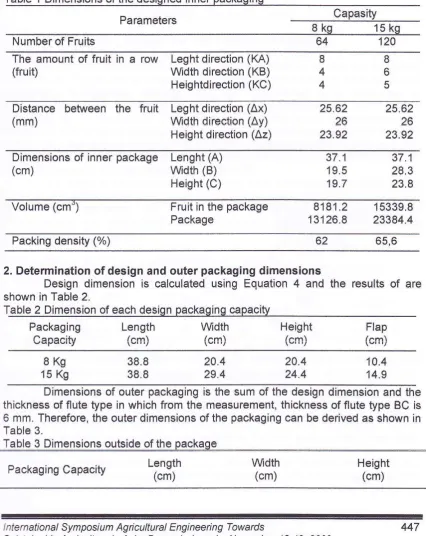
Table 1 Dimensions of the d.signed inner
pack.
Parameters Capasity
8ks
15 ksNumber of Fruits 64 120
The amount of
fruit
ina
row (fruit)Leght direction (KA)
Wdth
direction (KB)Heightdirection (KC)
8
5
a
4 4
Distance
between(mm)
the
fruit
Leght direction (Ax)Width direetion (Ay)
Height direction (Az)
25.62 26 23.92 25.62 26 23.92
Dimensions of inner package
(cm)
Lenght (A)
wdth
(B)Heisht (C)
37 "1
19.5 19.7
37.1 28.3 23.4
Volume (cm') Fruit in ihe package
Package
8181.2 13126.8
15339.8 23384 4
Packing density (%) 65,6
2. Determination of
design
andouter
packagingdimensions
Design dimension
!s
ealculatedusing
Equation4
and the
resultsof
areshown in Table 2.
Table 2 Dimension of each design packaging cap
Wldth
Height 62Packaging Length Flap
8Kg
15 Kg J6.d 38.8 20.4 29.4 20.4 24.4 10.4 14.9Dimensions of outer paekaging is the sum of the design dimension and the thickness of flute type in which from the measurement, thickness of flute type BC is 6 mm. Therefore, the outer dimensions of the packaging can be derived as shown in
Table 3.
Table 3 Dimensions outside of the package
Packaging Capacity Length
(cm)
wdth
(cm)
Height
(cm)
i nternational Symposi um Agricultural Engineering Towards
Suistainable Agiculture in Asia, Bogor, lndonesia, November 18-19, 2009
[image:4.595.72.499.226.763.2]Sesslon C : Food and Agricuftural Products Process Engineering (FAVE)
8Kg
'15 Kg39.4 39.4
21 25 21
30
[image:5.595.70.507.67.260.2]tt
tt
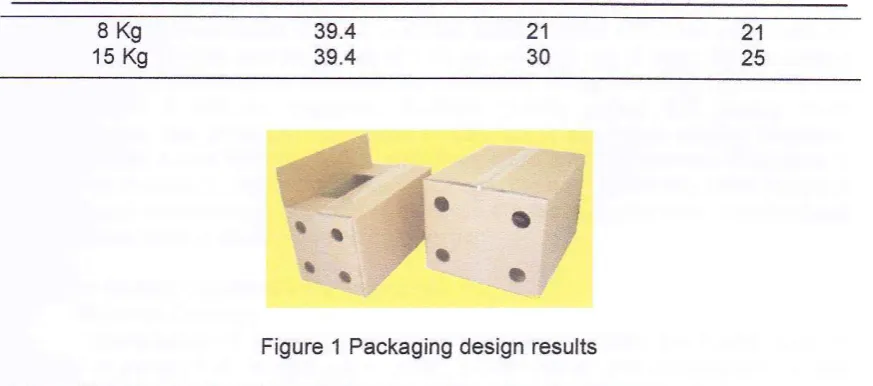
Figure 'l Packaging design results
Stage
lll Compression
Stength Test andTransport Simulation
During
transportation,cardboard boxes
are
stored
in
a
carrier
space (container) stackedwith
other containers, and this condition causes topto
bottomcompression. To prevent damages to the packaging and packaged products due to
congestion,
compressronstrength
tests
and
calculations
were
conducted
to determinethe
maximumpile ioad of the
designed paekaging.The
resultsof
the calculationfor the
theoretical compression strengthfor the
8
kg
packaging was 201.01 kgf and 15 kg packaging was 216.47 kgf, while direct compression strengthtest of 8 kg packaging capacity was 204 kgf and 15 kg packaging capacity was 256
kgf. The results shoyred
that
mathematical equations can be usedto
estimate the direct compression strength with accuracy of 98.5%.The height of packaging pile depends on each packaging net weight and the
safety factor used. For the same dimensions of packaging, but different fruit packing
system,
each
packaging
will
have
different
net
weight.
The net
weight
of measurementsand
calculationsfor each
packaging capacityand fruit
packaging pattern are shown in Table 4.faOte q Tne net weigh
at
i
Capacity (ks)
Dimensions (cm')
Number of fruits
(fruit) Net Weight (kg)
fcc jumble Fcc jumble
64 120
I
1F
39.4x21 x21
39.4x30x25
4480 15 + 0.38+0.1
9.94-10.445.38-5.48The net weight and number of fruits per capacity in Table
4
show that thenumber of paeked fruits with fee patt-e!'n is .30% more than that af Jumble pattems for the same package dimensions. The difference in number and weight is because on
the
fcc
pattern fruits are set and arranged with the same pattern hence the use of space becomes more effective. ln addition, on Jumble pattern fruits are packagedwith net foam before inserted into the cartons. Net foam addition is actually intended to protect the fruits from scratches and collisions, but with such condition less fruits are packed.
To
obtain the
equalityof
a
long
distanceroad
transportation,then
the transport simulations was carried out on a vibrating table with the average frequencyof
3.50
Hz, average amplitudeof 4.61 cm, and
vibratedfor
3
hours.
Based onI nternational Sym posium Agicultural Engineering Towards
.>ulSIalItapte Agltcutlute ttl /j'sta, Dugo|t tf iQ|JIlestat IyQvelupet Io-!y)zuvy
Sessior C : Food and Agicultural Products Process Engineering (FAVE)
calculations, such condition is equal to a road journey as lar 477 .5 km with trucks on a frequency ol 1.4 Hz and amplitude of 1.74 cm on a trip out of town. This condition may represent the distance between the centers
of
mangosteen productionto
theplace where
it
will
be
exported.
Sudibyo (1992)
stated
that
during
truck transportation,the
products experience shocks especially inthe
vertical direction. Other shocks in theform
of torsion and dingswere
ignored because they have avery small frequency. Based on these conditions, the use of vibrating table as a tool
for transport simulations is appropriate because the resulting dominant turbulence of the vibration table is also in the vertical direciion.
Product
Quality Ghanges afterTransport
1.
Physical
DamageMangosteen
is
subjectto
injury when these conditions are found: scar on the rind or dented fruit, broken calyx (petal), broken stems, and cracked skin. ln thisstudy, dented fruit and broken petals were found during the vibrating test.
Physical
damage
such
as
dented
fruit
is
easily
indicated
by
visual observation. Thefruit skin is
markedwith
severe bruisesthat give an
unsmooth shape of surface skin. From observation,the
level of total physical damageto
the packaging withfcc fruit
pattemwas
(2.3a/o -7 5o/o) grealer thanthat of
the Jumble pattern (2.3% -2.5o/o). The differencein
physical damage becausethe
numberof
fruits packed in
the
packaging withfcc
patternwas
more than thatof the
Jumble patierns.As
a
resuit,ihe
ioaci receiveci by thefruiis
with the t-cc paitern becomeslarger. Another cause is because the fruits in ihe
fcc
pattern inside the corrugated cardboard carton are ananged without using net foamas
inthe
Jumble patterns. This treatmenthas
made pressure, frictionand
collisions amongfruits in the
fcc pattern and caused direct contact on the fruit skin surface. Mangosteen skinlrind hasa
susceptible structurethat
is
easily
brokenand not
flexible, therefore physicaldamage in the form of dented fruit, although only
a
small curve, is clearly seen onfruits packed without using net foam.
The
physical damage that occured in fruits arranged withfcc
patlem was only in the form of dented rinds, while the physical damage to the fruit arranged in a Jumble pattern experienced broken calyxand
dented rind. Conditionof
complete calyxes is one of the quality parameters of mangosteen fruit that taken into account in intemational market. Therefore, thefcc
packing pattem can be appliedto
avoid broken calyxes on mangosteen transportation.Figure 2 Physical damage on mangosteen (a) broken calyxes; (b) dented rind
2.
Weight
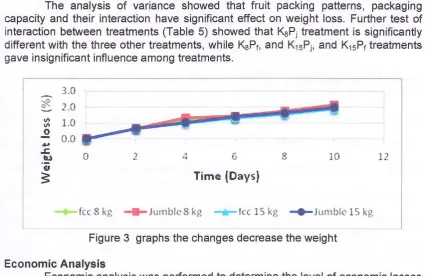
lossBased on observations made for 10 days in each packaging and fruit pattern
treatment, it was found that weight loss in each treatment increasing (Figure
3).
The lowest average value of weight loss (Table 5) was found in the fruits packed with a1 5 kg packaging using fcc pattern (K15Pf), in the amount of 1 .05%, while the highest
i ntemational Sym posi um Agricultural Engi neeri ng Towards
Suistainable Agiculture in Asia, Bogor, lndonesia, November 18-19,2009
Sesslon C : Food and Agricultural Products Process Engineeing (FAVE)
weighi
iosswas
founcjin iruits
packeciwiih
a 8
kg
packaging usingihe jumbie
[image:7.595.75.498.72.236.2]pattem (K8Pj), in the amount of 1.20%.
Table 5 Results of further tests in the interaction treatment to weight loss
Treatment Average lost weight
(%) Notation
Capacity
I
Jumble(lGPt
CapacityI
Fcc (K6P)Capacity 1 5 Jumble(K15P1)
Capacity 15 Fcc (K1sP)
1.20 1.09 1.11 1.05
a b b b
Note: numbers followed by the same letter in the same column are noi significantly different at 5% DMRT
The high value of weight loss in l$P; treatment describes
ihe
high extent of damage occurred in this treatment among other treatments. On the other hand, the lowest value of weight lossin
KrsPr treatment illustratesthe
low levelof
damage.The fruit damage in ftP1 treatment was because the fruits were unclosedly packed;
hence
the
intensity
of
friction
and
collisions between fruits
is
higher
causingconsiderable damage. High levels
of
damage on thefruit
skin surface caused the loss ofwax,
mangosteen natural protective layer. Asa
result, transpiration activity andwater
losstake
place muchfaster
causing moreweight loss.
Utama (2002) stated thatwater
lossof
productis
potentially occurred through natural openings found on the outer tissue surfaces of fresh products that are influenced by internalfactors such as injury to the surface of the product.
The
analysisof
variance showedthat
fruit
packing patterns, packagingcapacity and their interaction have significant effect on weight loss. Further
test
of interaction between treatments (Table 5) showedthat
lGPj treatment is significantly different with the three other treatments, while lGPr, and KrsPj, and K15Pr treatmentsgave insignificant influence among treatments.
l2
o
s
.9
0,
3
3.0 2.0 1,0 o.0
6
Time
{Days}fcr
I
\g
-'*-Jrrntblc.9
kg
-'*:,'
le cl5
kg
+Jttr)l)i('15
krr.Figure
3
graphs the changes decrease the weight EconomicAnalysis
Economic analysis was performed to determine the level of economic losses
and
benefitsdue
to
physical damageafter
transport simulationof
the
designedi nternational Symposium Agicultural Engi neering Towards
Suistainable Agiculture in Asia, Bogor, lndonesia, November 18-19,2009
[image:7.595.68.496.420.696.2]Session C : Food and Agicultural Products Process Engineering (FAVE)
packaging. Some assumptions were used in ihe caiculaiion: the designed packaging was made by the packaging manufacturer and the selling price of mangosteen was
Rp
35,000.00/kg,and that
to
avoid damagein the
bottom packagingdue to
the above packaging weight loadon
it,the
pilesof
packaging wereset
not exceeding^r-^^^ t^^l ^! ^^^L -^^t-^-;^a ^^^^^;i-, _rL^ a^A*^ ^^^t.,^i^ ^a rL^ ..^^
Lr19 llla^llrlurrl DLlliDD l(Jau (Jl gaull PAUNctVll rY UaPaully. I lltt \.\JJLJ allcrlyDlD (,l Ll19 UDI:
of
designed
packagingresulted that
the
maximumprofit
of
Rp
74,462,643.00 obtained in the use of the 8 kg packaging withfcc
pattern. The profit is gained fromthe
284 packaging/truckwith a
capital costof
Rp 2,256,000.00for the
packagingm, n r rfaaJr lrinar/ln rnk
Based on overall test results, it can be stated that the design of packaging
capacity of 8 kg with dimension of 39.4 cm x 21 cm
x
21 cm and fcc packing patterngives the optimal setting for mangosteen transportation.
coNcLUsroNs
1.
Based on the physical and mechanical properties, the optimal number of fruits on theI
kg packaging is 8 fruits in the longdirection,4
fruits in width direction,and
4
fruits
in
the
height
directionwiih
a
packagingdensity
of
62%.
The arrangement determines the packaging dimensions of 39.4 cmx21
cmx21
cm. Forthe
15kg
packaging,the
optimal arrangementof
thefruits
onthe
lenght, widthand
height directionis
I
fruits,6
fruits,and
5fruits,
respectively,with
a packing ciensiiyof
05.6%. Dimensions ofthe
i5
kg
packagingwas
gaineci of 39.4 cm x 30 cm x 25 cm.2.
The mathematical model can be usedto
predict compression strength value of the packaging without conducting the compression strength test directly, with the level of accuracy reached 98.5%.3.
Based on overall test results, it can be stated that the packaging capacity ofI
kg
size 39.4cm
x
21
emx
21 cm
withfcc
packing pattern gavethe
optimal setiin gs for mangosteen transporiation.REFERENCES
Constuction Testing lnstitute. 1986. Results
of
Freight Truck Motion TransportationEquals
to
30
km
on
Several
Road
Conditions.
(in
Bahasa
lndonesia).Constuction Testing lnstiiute. Jakarta.
Peleg,
K.
1985. Produce Handling Packaging
and
Distribution
Avi
PublishingCompany, lnc.Westport, Connecticut
Satuhu,
S.
1999. Handlingof
Fresh Mangosteen for Penebar Swadaya. JakartaSudibyo, M. 1991. Packaging and Transportation of lndonesia). Jurnal Hortikuliura 1(2) : 49-53.
Export (in Bahasa lndonesia).
Valensia
Oranges.
(in Bahasa Sudibyo,M.
1992. Simulation Toolsof
Fresh Fruit Transportation using Cars andTrains. (in Bahasa indonesia). Jurnal Hortikultura 2(1),6-73.
Syarief, R., 1989. Food Packaging Technology. Books and Monograph. Laboratory of the lnter-University Food and Nutrition. lnstitut Pertanian Bogor. Bogor.
Tugimin. 1986. Food
Packagingwith
Cartons and
the
Techniques(in
Bahasa lndonesia). Paperon
Labor Supervision Trainingon
Production Engineering in Food lndustries Bogor Branch: various groups. 20 January-8 FebruaryUtama, I Made. 2002. Horticulture Post Harvest Technology. (in Bahasa lndonesia). Assessment Center for Tropical Fruits Udayana University" Bali.
I nternational Symposium Agicultural Engineering Towards
Suistainable Agiculture in Asia, Bogor, lndonesia, November 18-19,2009