European
Journal of
Business
and
Management
ISSN 2222-1905
lPaper;
ISSN 222?-2839
{Online)
V o l 7 N o 1 1
2415
\
l , r r , '
/ r l l L r
/ i '
I t L r u
A b o u t t h i s E J B M
The scopes of the European Journal of Business and Managernent (EJBM) include, but not limited to bt
managenrent, marketing. finance, econonrics, human resource management. strategies and decision scienr
j o u m a l is published i n b o t h p r i n t e d a n d o n l i n e v e r s i o n s . T h e a r n b i t i t , , r o f E J B M i s t o b e c o n r e a r e c o g n i ;
tier journal. acclairned for redirecting internatioi'al business research and managernent studies for definir
d i r e c t i o n s .
E J B M i s p u b l i s h e d b y I I S T E a n d f b l l o w s a m o n t h l y p u b l i c a t i o n s c h e d u l e . E J B M i s a n o p e n - a c c e s s - j G e n e r a l i n q u i r i e s a n d P a p e r s u b r n i s s i o n : c o n t a c t a d m i n @ i i s t e . o r g o r E . I B M @ i i s t e . o r g
I n d e x o f t h i s j o u r n a l
INI)T.,X
ffi. C(''ORNICUS
'\.1
f;
open
r ;
l l
( , 1 { ) N ( , i ' l i } \ 1 \ t : \ 1 1 L . ! ( \ l } I
LITsI1"ARY
I I S T E ' s a c k n o w l e d g e m e n t s t o t h e s u p p o r t s fr o m c o - h o s t i n g u n i v e r s i t i e s w o r l d w i d e
o University of North Carolina at Charlotte, United States
. California State University. United States
o The City University of New York, United States
o A r i s t o t l e U n i v e r s i t y ' o f T h e s s a l o n i k i . G r e e c e
. U n i v e r s i t e i t L e i d e n . N e t h e r l a n d s
ffiuyrcls)^iEB Journarrocs
$) ffi
r z.s Elektronische
Lli,$ Zeitsch
rift
enbibl
iothek
ocLc"
I t l i r ? t ) . i ' . : r l r ; r 1 r . .
s
A c k n o w l e d g e m e n t o f E d i t o r s a n d l n t e r n a t i o n a l R e v i e r v e r s
Prof.Dr. Bibhu Kar Dr Riad Shams
I n d i a n S c h o o l o f B u s i n e s s , I n d i a A p e x F a s h i o n a n d A c c e s s o r i c s & C e n t r a l
Q u e e n s l a n d U n i v e r s i t y , A u s t r a l i a Prof. Dr. Y. Zhang
China Acadenry of Sciences (CAS), China Dr. Neeraj Pandey
J o h n s H o p k i n s C a r e v B u s i n e s s S c h o o l , . l o l r r r s
P r o f . D r . H a n a d i M u b a r a k A t - - N 4 u b a r a k i l l o p k i n s (J n i v e r s i t l , ' . L J . S . A .
K u v r a i t U r r i v e r s i t l ' . K u r v a i t
D r . W i l l i a r n F o n t a
P r o f . D r . D c s t i K a n n a i a h U n i v c r s i t y , o l ' N i g e r i a ^ N i g c r i a
J a r n e s C o o k U r r i v e r s i t v S i n g a p o r c
M o h a n r r n a d I r n t i a z F e r d o u s
Prof. Dr. Vasanth Kiran R [-a'T'robc University. Australia
V a n g u a r d B u s i n e s s S c h o o l . l n d i a
I ) r . M a h d i S a l e l r i
P r o f . D r . M O I J S U M I M A J I j M D A R F c r d o r . r ' s i U n i v e r s i t y o f M a s h h a d , I r a n
A l l ia n c e U n i v e r s i t y . I n d i a
D r . N 4 o h a r n e d S a h e e d B a y a t ,
P r o f . D r . K r i s h n a K i s h o r c K , M a n a g e r n c r t t C o l l c g e o f S o u t h e r n A l i i c a . S o
A l l i a n c e U n i v e r s i t l , , I n d i a A l i i c a
P r o f . D r . ' l ' a r i q ll . I s m a i l D r . N o o r u l S h a i f i t l F i t r i B i n A t r c l u l R a l r r r a n .
C a i r o U n i v e r s i t y , F i g l ' p t U n i v e r s i t i M a l a l ' s i a - l ' e r e n g r a n u , M a l a v s i a
A / P D r . M . A . l l . I r a r q u a d D r . H u s s i e n l l . K o n r i c h a
T h e L J n i v e r s i t l , o l ' I J o n g K o n g . ll o n e K o n g , S A R l l n t r c p r e n e u r s h i p . - f r t r i n i n g a r t c l ' l - r a d e . ( i o v e r o f M a n i t o b a . C a n a d a
Dr. Pedro Ferreira
P o r - t u g u e s e l n s t i t u t e o l ' M a r k e t i n g M a n a g c n r e n t . D r . Z u l r r a i d Y a a c o t r
P o r l u g a l U n i v e r s i t i S a i r r s M a l a y ' s i a ( U S M ) . M a l a y s i a
D r . C h i u n g f i n g C h a n g D r . A n i r s t a s s i o s G e n t z o g l a n i s
M a a s t r i c h t U n i v e r s i t y . N e l h e r l a n d s U n i v e r s i t v o l ' S h e l b r o o k e , C a n a d a
D r . M d G o l a r n M o h i u d c l i n a n l i ' r O o n . r t m a n d M a l a l ' e r i
U n i v e r s i t y T ' e c h n o l o g y M a l a y s i a , J o h o r , M a l i r y s i a I n t e r n a t i o n a l S c h o o l o f M a n a g e r n e n t ( l S M ) ; l'l'ance
Saotrssen Ben Gamra
C E P N - U n i v e r s i t ; , P a r i s 1 3 " F r a n c e D r . l z a i d i n A b d u l M a j i d
U n i v e r s i t i T e k n i k a l M a l a y s i a M e l a k a . M a l a l Dr. llasan Fauzi
l n d o n e s i a n C e n t e r f u i r S o c i a l a n d [ ' . n v i r o n r n e n t a l D r . F A B R I Z I O R O S S I
A c c o u n t i n g R e s e a r c h . I n d o n e s i a U n i v e r s i t y o f C a s s i n o a n d S o u t h e r n L a z i o , ll
Dr. Leonoralr Tendayi N1.'arurvata Dr Mohd Rizal Mur.vazir
Universitl' of Pretoria Soutlr Afiica Universitl' of Malay a, Mala;-sia
Dr. Enrrnanuel Arvuor
School of Management and Leadership The Dr. Richard Nyangosi.
Managernent Universiry of Africa. Kenl'a Rongo University College Constituent Colle
European .loumal of Busirtess and Nlanagcmcnt I S S N 2 2 2 2 - 1 9 0 5 ( P a p e r ) I S S N 2 2 2 2 - 2 8 3 9 ( O n l i n e ) V o l . 7 . N o . l 1 . 2 0 1 5
\ \ \ \ \ \ . l l s l c r ) r ! | $ 1 l
tt$r
Comparison
of Power Influence
Factors Shaping Loyalty
Indonesian
Domestic
Airlines
Reni Heviandri Riandarinir- Ujang Sumanvan2 Lilik Noor Yuliati2 Kirbrandokol
l.Graduate School of Managernent and Business, Bogor Agriculture Llniversity, Indonesia
2.Depafiment of Farnily and Consunrer Sciences, Bogor Agriculture University, Indonesia
* E-rnail of the correspondins author: [email protected]
A bstract
Passenger perception of the quality of airline service LFA lower than the FSA for airline passengers pay the
ticket realized with relatively cheaper rates. This study airned to analyze the differences in causality between
variables expected to affect the flight of custonrer loy'alty. By using Structural Equation Modeling (SEM) this
paper exarnines the relationship causal constructs quality ofservice, price, and satisfaction, to the irnage as rvell
as customer loyalty and LFA. FSA flight. The results indicate that there are differences in causality between
custonler loyalty nrodels of FSA with LFA. The quality of service and price together create satisfaction and
encourage the creation of a good inrage in the minds of passengers FSA and LFA. Quality of service has a
greater influence on satisfaction than the price effect and the direct effect on the irrage quality of service is
greater than its indirect effect through satisfaction. FSA found that customer satisfaction does not encourage
loyalty, customer satisfaction LFA opposite eff-ect on passenger lo1'alty.
Keywords: Customer Satisfaction, Customer Loyalty, Low Fair Airline, Full Service Airlines
t . I n t r o d u c t i o n
Flight Low Fare Airlines (LFA) into a new phenomenon as the impact of changes in the business aviation
industry in several countries, including Indonesia. The 2000s was the era of growth LFA flight in Indonesia. The
nurnber of airline LFA continues to grow with the effect of an increase in passenger numbers significantly from
),ear to y,ear. Intense competition between airlines not only provides an opportunity for the company to survive
and thrive and achieve their business objectives, but also resulted in some airlines are not able to survive or go
bankrupt.
Three airlines are considered quite successful in increasing the number of passengers today is Garuda
Indonesia, Lion Air and Air Asia. These LFA continues to grow and develop the business drivers of change in
the domestic airline industry, the impact on the change rnap market share in getting the passengers. Garuda
lndonesia has become the rrrarket leader rvith a master flight domestic and international market. Since the
presence of LFA particular airline Lion Air and Air Asia, the nunrber of passengers served by both airlines, are
able to exceed the growth in the number of passengers as the airline Garuda Indonesia Full Service Airline
( F S A ) .
Some airline LFA uses low price strategy to attract a number of passengers, intense cornpetition with
price differentiation as a parameter to force airlines to enter into price conrpetition or price war. The global
financial crisis of 2008 have an impact on the rvorld of transportation cost. irnpact of the crisis has pushed
passenger flight business goals and tourist passengers choose the low cost airlines as a result ofreduced levels of
welfare. In the last l0 years there has been a change in customer behavior as well as the sensitivity of passenger
airlines business purposes where the business goals domestic tend to consider in choosing airline prices. Mason
(2002) proved that 40% of short-haul passenger business goals becorne elastic to price and srvitching frorn FSA
to airline LFA. Changes in technology' and macro-econornic conditions have rnade the changing demographics
and lifestyles of custorners (Sumarwan 201 I ).
t-FA passengers not only consider the price but also the quality of service when selecting a flight (Jou.
Lanr, Hensher, Chen and Kou 2008). Quality of service is an important factor to develop and maintain
relationships with custonrers (Park, Robertson and Wu 2006). Passengers can assess and evaluate the quality of
the airline through a comparison between experiences and their erpectations on a nurnber of attributes of the
service (Grdnroos 2007).
The level of service quality has a direct irnpact on the satisfaction of air transporl passengers (Saha,
Theingi 2009). Quality of service has a positive influence on interest repeat purchase, recommend, and choose a
better alternative in which three have a relationship n'ith custorner loyalty, (Jones, Mothersbaugh, and Beatty
2000). One force airlines to survive in the increasingly fierce cornpetition is to create consumer loyalty.
Consumers who are loyal customers who rnake repeat purchases of the sarne airline.
t-oyalty to the airline is a very compler phenomenon because many background factors customers
become loyal to one parlicular airline. Some research on the antecedents of customer loyalty concluded that the
cost factors of quality of services offered, custonrer satisfaction, airline irnage, as rvell as confidence in the
services received, or even a consuffler preference towards a particular airline is affecting the willingness of
Europcan Jounral o1- Brrsiness and Managcntcnt \SSN llll- \q\\> rP,.rptr 1 \S:\ lll:-l$l9 r On\uc)
V o l . 7 , N o . l l . 2 0 1 5
'.rr,iuiiSli i'._l
i . , 'l
n$r
consumers to re-use the services of a the same airline. More specifically Forgas, Sanchez, ancl palau (2010)
stated that there are differences in the antecedents of loyalty arnong customers LFA with the FSA.
This study aims to examine the relationships betrveen the constructs of quality of service (pre-flight, in-f'light,
post-flight, and perceived safetl'). price, satisfaction, rirrage and custorner loyaliy of the dornestic flr'ghts ttrat wili
distinguish between the LFA customers arrd FSA.
2 . L i t e r a t u r e Review
2 . 1 A i r l i n e In d u s t r y ' s B u s i n e s s M o d e l
T h e r e a r e t h r e e m o d e l s o f a v i a t i o n b u s i n e s s i n I n d o n e s i a , n a m e l y rn o d e l s F u l l S e r v i c e A i r l i n e ( F S A ) or that we are familiar with the traditional cost, service models Lor,v Fare Airlines (LFA), and the ntixture between tlre two
service models (full service airlines and low fare airlines) (Manurung 20 l0).
LFA or low-cost airline is airlines generally offer lower rates by elinrinating sonre of tlre services that
are owned by traditional airlines or FSA. The terrn in the aviation industry is actually referring to the airline
which has a structure of lower operating costs than their cornpetitors, but the terrn is often applied also to all
airlines with low ticket prices and lirnited services, regardless of their operating rnodels (Miller. Vandome
.McBrewster 2009).
FSA concept known as the business rnodel of traditional airlines (legacy carriers), in this concept, the
enrphasis is complete and high quality services also at a prerniunr price. Services provided is conrprehensive.
flexible flight frequency, the grant of lounge facilities, provision of food and drink, loose seat and entertainrnent
facilities and so on, to support quality services, airporl used also is the main airporl. Urrtil tlre year 20 12, in
Indonesia. Garuda lndonesia, which onlv uses the concept of the FSA, but since the year 20 l3 appeared airline
Batik Air is the concept o1'the FSA.
The main difference betrveen the LFA and the FSA is the rate charged, fare difference occurs because
ol'the cost of LFA able to cut unnecessary costs arrd eliminating services that are not directlv related to the
operation and in principle can be accepted by the customer. The cost difference by Hansson et al. (2003)
includes sales and reservation, service in the plane, pilot salaries. aircraft ownership, maintenance and ground
h a n d l i n g .
2.2 Consumer Behavior
Consunrer behavior is essentially to understand "rvhy do consur.ners do rvlrat they do". Consumer behavior is all
the activities, actions, as well as the psychological processes that drive action at the tirne before buy, when to
buy. use, spending and evaluate products and services (Sunrarwan 2004). Decision-making choosing the airline
is defined as activities underlaken by passengers frorr beginning to recognize the need, seek as rnuch
infonnation about the existing airline, evaluate options, and finally decided to rnake reservations and purchase
a i r l i n e t i c k e t s o f c h o i c e .
2 . 3 Quality of Service
Quality ol'service is a total experience that can only'be evaluated b1,the customer (Pasuraman, Bern), Leonard.
Zeithamal, Valarie I 988). According to Pasuraman el a/. ( 1985), there are trvo main factors that afJ'ect the quality
ofservice that is Expected Service and Perceived Service. Ifthe services received or perceived as erpected. then
the perceived service quality is good and satisfoing, if the services received exceed consunler expectations, the
quality of service perceived by the excellent and qualified. Conversely, if the services received is lower than
expected, then the perceived poor quality ofservice (Ahna 2007).
Quality of service is an inrpofiant detenninant of the behavior of customer satisfactiorl and cost
(Sureshchanndar et a|.2003; Ling, Lin and Lu 2005; Dagsrer, Sweeney and Johnson 2007). Studies show that the
perception of service quality affects the feeling of satisfaction, which in turn affects the behavior of loyaltv and
post-purchase (Tanr 2000; Choi and Chu 2001; Petrick and Backnran 2002). Passenser perception ofthe quality
of airline services is one of the nrain drivers of satisfaction and perceived value. Failure to provide a quality
service to the customers also can destroy the inrage can'ier and cause a negative effect on customer lol,alty
(Archana &Subha 2012).
The airline that is able to create and rnaintain quality of service rvill gain sonre benefits, among others:
(l) establish a close relationship between the airline passengers, (2) provide a good basis for repurchase. (3)
encourage the loy,alty of passengers, (4) create rvord-of-rnouth, (5) create a good reputation in the minds of
passengers, and in the end (6) encouraging increase airline profits (Park et al. 2005; Rizan 20 I 0). Good quality
of'service is a conrpetitive strateg),for the airlines, in addition to irnproving satisfaction is also able to increase
the airline's image in the nrinds of customers, the quality of customer service is also pushing for a cornmitnrent to
the airline. which leads to an increase in market share.
In general, the evaluation of the service process can be divided into three distinct phases:
pre-consumption, consumption and post-consurnption (Kasper et ul. 2006), so that u,hen adapted into the aviation
Europcan .lounral of Business and Managcntenl I S S N 2 2 2 2 - 1 9 0 5 ( P a p e r ) I S S N ) 2 2 2 - 2 8 3 9 (O n l i n c ) V o l . 7 . N o . l 1 . 2 0 1 5
\\ \\ \\'. I I stc. t)rg ; . : ! l
n$r
industry, the third stage is the pre-flight services (pre-t'light, in flight, in-flight) and post-tlight activities
(post-flight), each stage, each containing several customer-oriented activities and contribute to the total custolner
experience (Leong 2008). Identification of the factors of service q,rality in the airline industry is done partly by
Ostrorvski 1993; Sultan and Simpson 2000; jaur et al 2002. Chang 2002.Mazzeo 2003; Park et aI.2004; Chen
a n d C h a n g 2 0 0 5 ; L i o u a n d T z e n g 2 0 0 7 ) .
Dirnensions of security and safety is the most inrportant dinrension is used to nteasure the quality of
service cost (Clemes et a|.2008), because when choosing an airline, passenger aircraft safety regarded as the
rnost irnportant criteria (Gilberl and Wong 200i; Atalik and Ozel 2007). Safety and comfort are the most
instrumental factor in the selection of Indonesian airlines (Marsetyawan 2006). Indonesia has a poor record
related to aviation safet1,, and accident airline Air Asia QZ 8501 on Sunday, December 28th, 20 l4 to add a bad
r e c o r d l b r f l i e h t ln d o n e s i a .
2.4 Price
Understanding the price of customer cognitive concept is something that must be sacrificed to obtain several
types of products and services, in which the lower the perceived price, then the lower the perceived sacrifice and
more satisfied custorners perceived price of the whole transaction was created (Zeithaml 1988). Provide
appropriate price to the customer is another way to achieve loyalty (Clemes et u\.2008); Chen et ul.20l l; Chen
and Hu 20 12). There is a relationship between the reasonableness of the price with satisfaction and loyalty in
service cornpanies (Consuegra et al. 2007). Price fairness perceptions are positively associated either directly or
indirectly through satisfaction on customer loyalty (Bei and Chiao 2001).
The reasonableness ofthe price can be rneasured through atlributes (Consuegra et a\.2007):
l. Customers feel paying a reasonable price on a purchase transaction faithful.
2. Reference price level, where custorners feel nornral if a product or services of a different kind of
cornpanies are set at different prices.
3. Policies price is detennined by the company are reasonable and acceptable to the customer.
4. Price set is an ethical, where tlre customer is alrvays notified of price changes that will be made by the
company before the new prices are set.
2.5 Customer Satisfaction
The conrpany recognizes that customer satisf'action is the nrain thing that should be achieved by the conrpany to
gain the loyalty of its customers. Satisfaction is a nrediating variable between service quality and custonrer
foyalty so many satisfied customers that will provide a high loyalty to the cornpany (Akbar et al. 2010).
Study the relationship between satisfaction and quality of service as well as its impact on loyalty has
been carried out, among others, Lee, Graefe, & Burns (200a); Tian - Cole, Crompton, & Wilson (2002). The
results Zins (200 1) on the future of passenger loyalty antecedents in the commercial aviation industry found that
custolner satisfaction rvith the brand image and quality of service is an irnportant colnponent to explain loyalty to
airline passengers.
The comparative study conducted by Bamford and Xystouri (2005) found that tlre failure of services
such as flight cancellation, diversion, delays, strikes and negative attitudes of employees is more comrnon in
LFA flight, so more prevalent cornplaints in airline service LFA compared to FSA.
2 . 6 A i r l i n e s h n a g e
Corporate image (the image of the conrpany) can be considered as a function of the accunrulated experience of
the purchase or consumption and has trvo main components; functional and emotional. Functional components
associated with real attributes that can be easily measured; while the emotional component is related to the
psychological dimension is rnanifested by feelings and attitudes toward an organization. This feeling comes from
individual experiences with the organization and processirrg of infonnation about the attributes, which constitute
a functional indicator of cornpany image (Tang 2007). Image positive a positive impact on the conrpany so as to
increase the nutrrber of sales, othenvise negative image caused losses to the company. Satisfaction follolved by
the image of the company is irnportant in a construct (Cohen et a|.2006). hnage companies affected by the
quality of service and customer satisfaction, which in turn affect customer loyalty (Tang 2007; Kandampully, l lu
2007). Customer loyalty arises through good image of the airline that is created through the irnprovement of
s e r v i c e q u a l i t y a n d c u s t o r n e r s a l i s l a c t i o n .
?.7 Customer Loy,alty
Loyal customers are very attractive to businesses because they are less sensitive to price, tlrerefore, maintain and
increase the number of loyal passengers is a must for the airline to survive in the current situation of tight
cornpetition (Gomez, Arranz, Cillan 2006).
I-uropcan .loumal of Business and Managenrent ISSN 2222-1905 (Paper) ISSN 2222-2839 (Online) V o l . 7 . N o l l . 2 0 l 5
\ \ \ \ \ \ . l t s l e . o r g
niri
Parvez 2009). The quality of services offered, customer satisfaction tor servrces
preference towards a particular airline is affecting the willingness of consurners to
airline (Hellier, Geursen, Carr, Rickard 2002; Li, Lee 200 l).
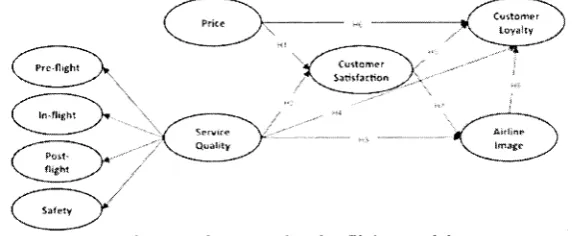
Based on the literature described abt, e, the conceptual model proposed
\'J:L,^
---"--.--.\
[image:7.595.143.431.153.271.2]( porr_ \ \
\.-_:___/
flr*hl J { surury fFigure l. Customer loyalty flights rnodel
3. Methodology, Variable and Data 3.1 Location and Time Researclt
The research was conducted from February to March 20 14, with an interview of the dornestic flight passengers
departing through terrninals 1,2 and 3 Soekarno-Hatta Airport, Jakarta (lndonesia).
3.2 Method Of Collecting Data
This study was designed as a survey with quantitative descriptive approach to obtain a picture, information,
explanations and current conditions related to customer loyalty. Data collected by using questionnaires and
interviews (face to face interview) to the respondent. The samples in this study using non-probability sampling
design, the sampling technique that does not give the same chance or opportunity for each element or member of
the population to be selected into the sarnple (Sekaran 2003). Types of non-probability sampling are purposive
sampling, the method of gathering infonnation from nrembers of the population who meet certain defined
criteria.
The criteria used by the consideration (judgment) on the characteristics of the population and the
pulpose of this study, in which the criteria used in selecting the sample in this study was a passenger aircraft over
| 8 years old, had been using two different dornestic airlines.
Hair et al. (1998) recommend an appropriate sarnple size ranged from 100 to 200, or a total of five
samples for each parameter observation. Respondents interviewed in this study were 352 respondents.
3.3 Variable Description and Measurentenl
Latent variables used in this study are service quality, price, custonrer satisfaction, images and customer loyalty.
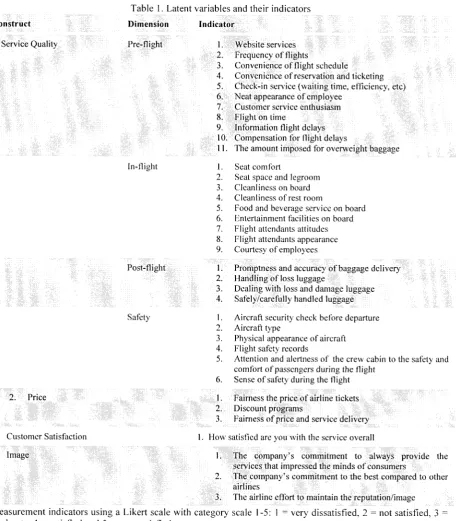
lndicators for each latent variable are described in Table |.
received, or even a consumer
re-use the services of the same
in this study is :(Figure l)
European .lounral of Business and Managentent I S S N 2 2 2 2 - 1 9 0 5 ( P a p e r ) I S S N 2 2 2 2 - 2 8 3 9 ( O n l i n e ) V o l . 7 . N o . l 1 . 2 0 1 5
rr tr rr iistc.trrg
irhii
[image:8.595.73.530.79.601.2]Construct I. Service Quality
Table l. Latent variables and their indicators
Dimension Indicator
Pre-flighl l. Website services 2" Frequcncy offlights
3. Conveniencc of flight schcdule 4. Convenicnce ofreservation and ticketing 5. Check-in service (waiting time, ef'ficieniy. etc) 6. Neat appearance ofcmplolee
7. Customer scrvicc enthusiasm 8. Flight on time
9. Inlbrmation flight dclal's 10. Compensation for l'light delays
I l. Tlre amount imposed for overweight baggage In-flight l. Seat comfbrl
2. Seat space and legroorn 3. Clcanliness on board 4. Cleirnliness of rest room
5. Food and beverage servicc on board 6. Irntertainment facilities on board 7. Flight attendants attitudes 8. Flight attendants appearancc 9. Courtesy of employees
Post-flight L Prorhptness and accuracy ofbaggage dclivcry 2. Handling ol loss luggage
i ff#,lill
l, ffi;j,3;'ill';!x'*'*.
Safety l. Aircraft security check belbre departure2. Aircraft t1'pe
3. Physical appearance ofaircraft 4. Flight safcty records
5. Aftention and aleftness of the crew cabin to the safetl,and comfbrt of passcngers during the llight
6. Sense ofsafety during the flight 2. Price l. Fairness the orice ofairline rickets
3l;
lfi"$'j,.*,'.ffi
, ..,;
.. ;";"
3. Customcr Satisfaction l. How satisficd are you r.vith the scrvice overall
4. Image |, The {iompany's comrnitmcnt to always provide the
- services lhar impressed the minds of consumeis
2. Thc company's commitment to the best compared to other
airlines
3. Thc airlinc cflbrt ro maintain thc repuration/imagc
Measurement indicators using a Likert scale with category scale l-5: I - very dissatisfied,2: not satisfied, 3
-moderate, 4 : satisfied and 5 - very satisfied.
3.1 Processing Methods and Datq Anal1,5ig
This study data processing using descriptive analysis to get an overview ofthe characteristics ofthe respondents,
and inferential analysis using the Structural Equation Model (SEM) to confinn that the model has been built.
Explaining the contribution of each indicator variables in the model are based on measurements Confirmatory
Factor Analysis (CFA) and to test the causality betrveen the constructs in the structural model is based on an
understanding ofthe theory as the study ofliterature.
Tests on the suitability of the model using criteria Goodness Of Fit Index (GOFI), CFA is used to test
the construct validity and reliability of the measurement model. Hair et al. (2006) stated that the factor loading
value of an indicator in nteasuring the latent variables as valid if the value is greater than 0.5 and significant. A
construct is said to reliably if the value of Construct Reliability (CR) is not less than 0.7, and the value of
Variance Extracted (VE) is not less than 0.5. The influence tests of the relationship between the constructs using
t-test to compare the t-test with t+able and we used SPSS | 7 for descriptive analysis and Lisrel version 8.3 for
124
E u r o p e a n J o u n r a l o f B u s i t r c s s a t r d N l a n a g e n r e n t I S S N 2 2 2 2 - 1 9 0 5 ( P a p e r ) I S S N 2 2 2 2 - 2 8 3 9 ( O n l i n e ) V o l . 7 . N o . l l . 2 0 l 5
\\\.!]!lcgg
' - : ' l
il$r
SE,M analysis.
3.5 H1;pothesis
Based on the above theory study proposed the f 'lowing hypothesis:
H I : Service Quality influence the satisfaction
H2: Loyalty influence the Quality of Service
H3: Loyalty inl'luence the Image Quality Service
H4: l'he price influence the satisfaction
H5: Price influence the Loyalty
H6: Satisfaction influence the Irnage
H7: Satisfaction influence the lo1'alty
H8: lmage influence the Loyalty
4 . R e s u l t s a n d D i s c u s s i o n
1. I Descriptit,e Anah'sis
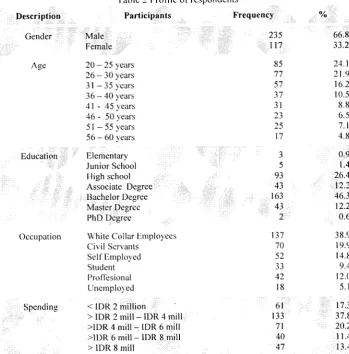
Characteristics of respondents is irnportant statistical measurernent tool in a population, the characteristics of the
respondents in this study is described on gender, age, incorne nteasured through rnonthly expenditure, as well as
education and ernployrnent levels associated with customer loyalty. Of the 352 respondents divided into two
groups. of which 222 respondents as well have used the FSA also use the LFA. Characteristics of the 352
respondents who becomes the object of research, most of the respondellts were male as much as 235 (66.8%),
with the highest age range in tlre age range 20-40 years, an age group in which the respondents have a greater
degree of mobility than the age group Other respondents so relatively frequent travel both for office / work or for
other purposes. Most of the respondents was 38.89% private employees with educational background Bachelor
[image:9.595.105.455.361.716.2]degree (Table 2).
Table 2 Profile of respondents
Frequency "h
235 66.8
l l l J J . z
Description ParticiPants Gender Male
Female Age
0ccupation
Spending
20 - 25 ycars 26 - 30 years 3l - 35 y'ears 36 * 40 years
-11 - 45 years
46 - 50 1'ears 5l - 55 years 56 - 60 1'ears
Elementary
Junior School
I ligh school Associate Degree
Bactrelor I)egree
Master Degrcc PhD Degree
White Collar Employees
Civil Scrvanls Self Employed Student [)roffesional
Uncmplol cd
< IDR 2 million
> IDR 2 mill- IDR 4 mill > l D R 4 mill .lDR 6 mill > l l ) R 6 n r i l l - l D R S m i l l > IDR 8 mill
8 5 77 5 7 ) t i l /.J 25 t 7
a , t I L + - |
2 1 . 9 16.2
Education
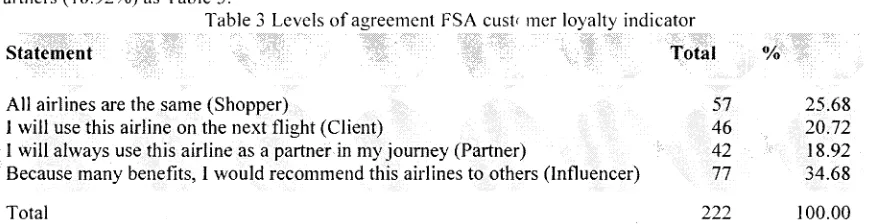
Loyalty developed fbllorving three stages, namely cognitive. affective, and conative. Usually become
loyal custorners first on cognitive aspects, then the affective aspects, and finally the conative aspect. Table 3
explains that of the 222 respondents who have used the FSA has a level of asreement that is different. some 77
+ J
1 6 3
43
n t - t /
70 { t J J n a
t 8
6 l
| -)-)
4 t ,
47
1 0 . 5 8 . 8 6 . 5 7 . 1 '1.8
0.9 I . 4 2.6.4
t2.2
4 0 . J
12.2 0.6
3 8 . 9 1 9 . 9 t 4 . 8
9 . 4 1 2 . 0
5 . 1
1 7 . 3 3 7 . 8 20.2
Europcan Jounral ol Busincss and Manac.cnrsnt ISSN 2222-1905 (Papcr) ISSN 2222-2839 (Online) V o l . 7 . N o . l 1 . 2 0 1 5
r \ ' \ \ \ \ . I t s 1 c . 0 r g l t ' . 1
il$TI
respondents (34.68%) is a customer who has reached the level of Influencer, lo),alty Client (20.72oh), and
[image:10.595.73.508.100.212.2]Pafiners (18.92%\ as Table 3.
Table 3 Levels of agreement IrSA custr txer loyaltv indicator
Statement
All airlines
are the same
(Shopper)
I will use
this airline
on the next flight (Client)
I will always use this airline as a partner in my journey (Partner)
Because
many benefits,
I would recommend
this airlines
to others
(tnfluencer)
Total
Total
Y"
57
25.68
46
20.72
42
18.92
77
34.68
222
100.00
The results showed that most.of the FSA customers already at the level began to be loyal clients and
partner to become an influencer; only 25.680/o said that all the airlines are same (shopper).
Of the 352 respondents who provide an assessment of the level of agreement that the LFA has a
different, a total of 32 respondents (9:09%) is a custorner who has reached the level of lnfluencer, loyalty Client
(1932%), and Partners (14.77%), but the very high number of customers who assume that the LFA airlines sarre
[image:10.595.71.509.294.406.2]as other airlines (Shopper) of 200 respondents (56.82%), as Table 4.
Table 4 Levels of agreement [-FA customer loyalty indicator
Total
'
Statement
All airlines are the same (Shopper)
I w i l l u s e th i s a i r l i n e o n t h e n e i t n i g f r t lCtienr;
I rvill always use this airline as u pJm"i in my journey (Partner)
Because many benefits. I would recommend this airlines to others (lnfluencer)
200
68
52
J L
s6.82
19.32
14.77
9.09
Total
352
100.00
The results of this study showed that the rnajority of airline customers LIrA is a custon.ler u'ho assurne
tlrat all the airlines are sanre. since many LFA airlines relatively offers the same product so that the airline is able
to provide different services, routes and flight times rnore with price cheaper would be preferred by LFA
customers.
1.2 Anulysis Measut'entent Model
Inl'onnation on the level of agreement of each indicator can be read separately, but the explanation latent
variables cannot be done individually because of the aspects of the relationship (correlation) between indicators
of each other. Sequential effects occur in a set of indicators in explaining the latent variables. Therefore, it is
necessary that the measurement model based on the Cont'irmatory Factor Analysis (CFA) (Joreskog and Sorbom
1996) to explain tlre contribution of eaclr indicator. SEM provides facilities Unrveight Least Square (UL) to determine the performance or contribution of each indicator in explaining her latent variables. Facilities
Unweight Least Square (UL) in the SEM would suspect the magnitude of the coefficient value measurement
rnodel. Construct Reliability (CR) is an indicator of the ability to explain the variable (frorn the aspect of quality)
and Variance Extracted (VE) show the weight indicator is able to explain the latent variables (quantity aspect).
The measurement results show that there are several indicators to obtain load factor <0.5, although the results of
t-test was significant above 1.96, but when referring to the minimunr rules Joreskog coefficient value (rninimum
0.5), it can be said these indicators are not important enough to measure each variable. In some studies suggested
indicators with load factor of less than 0.5 should be elirninated, but in this study the researchers concluded that
these indicators are indicators measuring but their impoftance is not too hiqh.
1.3 Strtrctural trlodel Anall,sis
4.3.1 Structttral Model Full Settice Airline Cuslomer Loy,alry @SA)
Structural equation rnodels determine the causal relationship between the latent variables and describe the causal
effects, the analysis in this study'using LISREL version 8:30. Structural equation modeling was used to test the
model and the structural basis of the hy,pothesis on the relationship between the various constructs in the
conceptual model. The measurement results and the factor loading value-t model is presented in Figure 2 and
Figure 3. The measurement model (Chi-square - 80.16, df :40) rnatched with an index showing the designated
c u t o f f (R M R : 0 . 0 5 R M S E A - 0 . 0 6 7 , G F I - 0 . 9 8 , A G F I - 0 . 9 7 , N F I - 0 . 9 1 , C F I : 0 . 9 9 ) .
1 2 6
European Jounral ofBusiness and Managenrenl ISSN 2222-1905 (Paper) ISSN 2222-2839 (Online) V o l . 7 . N o . l 1 . 2 0 1 5
\\'t\'\\. llslc.org 1 - x l l
ilsTr
influence of the Satisfaction Quality of Service ()" - 0:a8) is greater than the price effect (), : 0:29) to
s a t i s f a c t i o n . C u s t o r n e r s a t i s f a c t i o n p o s i t i v e a n d s i g n i f i c a n t e f f e c t o n A i r l i n e I m a g e (B : 0 : 5 1 , t : 8 . 8 8 ) b u t n o t significant effect on customer loyalty (p : 0:07, t : 0.64), S.,nilarly Airline hnage no significant effect on loyalty.
Quality of service and price together affect FSA airline customer satisfaction, but no significant effect
on loyalty. Customer satisfaction with the airline FSA did not influence the customer loyalty, Jones and Sasser
(1995) concluded that the only satisfying customers is not enough to keep thern to remain loyal, while they are
free to make choices. Besides the rnany alternative choices of airlines today, customer loyalty behavior is also
strongly influenced by demographic factors, especially income.
The study concluded that the quality of airline service FSA influence the customer satisfaction and the
irnage of the airline, but has no effect on loyalty, when associated with a staternent of loyalty where most
customers FSA into the category of loyal, allegedly there are other variables tlrat affect customer loyalty FSA.
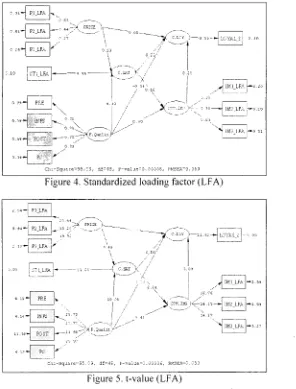
1.3.2 Structtrral Model Lov' Fare Airlines (LFA)
The measurement results and the factor loading value-t model is presented in Figure 4 and 5. The measurement
model (Chi-square - 95.09, df - 48) showed matched with an index in the designated cutoff (RMR : 0.028,
[image:11.595.168.464.276.665.2]R M S E A - 0 . 0 0 0 . G F r - 1 . 0 . A G F r : 0 . 9 9 . N F r - 0 . 9 9 . C F r - I . 0 0 ) .
Figure 4. Standardized loading factor (LFA)
.@-,."
,,-kI'
Figure 5. t-value (LFA)
1 2 8
I
I-uropean .loumal of Business and Managcnrcnt ISSN 2222-1905 (Paper) ISSN 2222-2839 (Ontine) V o l . 7 . N o . l 1 . 2 0 1 5
\\'\\'\r'. I lstc. ()rg { r i l
il$Tr
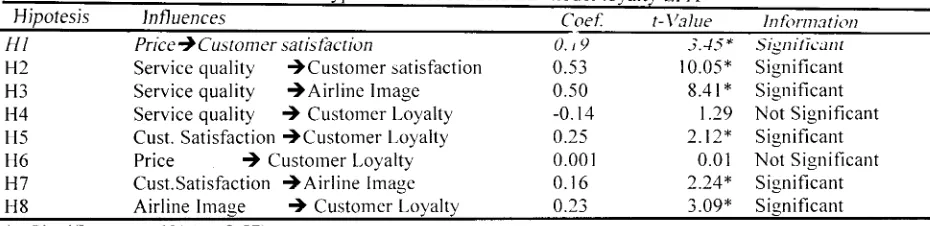
T a b l e 7 . H is test of customer rnodel
lnfluences Infonttation
HI
H2
H 3
H4
H 5
H 6
H 7
H 8
Price ) C u sto m er sat i s tac tio n
S e r v i c e q u a l i t y ) C u s t o m e r s a t i s f a c t i o n
Service quality )Airline lrnage
Service quality ) Custorner Loyalty
Cust. Satisfaction )Customer Loyalty
Price ) Custorner Loyalty
Cust.Satisfaction )Airline hnase
0 . r 9
0 . 5 3
0 . 5 0
- 0 . r 4
0 . 2 5
0 . 0 0 1
0 .
r 6
j.J,i* Srgililici:nt
[image:12.595.49.514.94.207.2]1 0 . 0 5 * S i g n i f i c a n t 8 . 4 1 * S i g n i f i c a n t
| . 2 s N o t S i g n i f i c a n t 2.12* Significant
0 . 0 1 N o t S i g n i f i c a n t 2.24" Significant
Airline lmage ) Custorner Loyalty 0.23 3.09* Significant
* : Significar:rt at a loh (t> 2.51)
Testing found that the Quality of Service (Service Quality) positive and significant effect on
satisfaction (Customer Satisfaction) and the Image of the airline (Airline Image) but no significant effect on
customer loyalty (custorner loyalty). Image Quality of Service direct influence (tr - 0:50, t:8.4 1), greater thatr
its indirect effect through Custorner Satisfaction (0:08).
P r i c e (f a i m e s s p r i c e ) a n d a s i g n i f i c a n t p o s i t i v e e f f e c t o n c u s t o m e r s a t i s f a c t i o n ( ) . : 0 : 1 9 , t : 3 . 4 5 ) b u t n o s i g n i f i c a n t e f f e c t o n C u s t o r n e r L o y a l t y () . : 0 . 0 0 1 , t : 0 : 0 1 ) , w h e n c o m p a r e d t o t h e p r i c e , t h e n th e i n f l u e n c e
of the Satisfaction Quality of Service (),: 0:53) is greater than the price effect (),: 0.19) towards satisfaction.
Customer satisfaction positive and significant effect on Airline Image (p : 0:16, t : 2.24) and Custorner Loyalty
( B : 0 : 2 5 , t: 2 . 2 4 ) , s i m i l a r l y A i r l i n e I m a g e s i g n i f i c a n t e f f e c t o n l o y a l t y ( p : 0 : 2 3 , t : 3 . 0 9 ) .
Results of research on customer loyalty LFA rnodels show different results, which affect service
quality indirectly loyalty through satisfaction. Perceived LFA price is cheaper than the FSA rates did not lead to
customer loyalty to the airline LFA. Satisfaction is central to improve custorrer loyalty, either through improved
quality ofservice and reasonable rates apply.
5 . C o n c l u s i o n
This study contributes about differences causality variable quality of service, price, satisfaction and loyalty
irrage between the FSA and LFA airline customers. FSA customer loyalty is not only influenced by satisfaction
and increase the image of the airline, but supposedly there are other factors that influence. While the satisfaction
of airline passengers LFA influence the loyalty. Dimensions of quality of service and pricing strategies can be
used by airlines in setting the strategic planning ffamework to maintain and increase the number of passengers,
through the correspondence between price and the services provided.
References
Akbar, S., Ahmad, P.M.S, Fazli, W., Naser, J.A. (2010), "Revitalization of service quality to Gain Customer
Satisfaction and Loyalty", Journal of Business and Managetnent 5,1 13-122.
Akbar, M.M, Parvez, N. (2009), "lrnpact of Service Quality, Trust, And Customer Satisfaction Engender
Customers Loyalty", ABAC Journal 29,24-38.
Alma B. (2007). Mana.ienten Pemasaran dan Pentasat'an Jasa, EdisiRevisi.Bandung :Alfabeta.
Archana, R., Subha, M.V. (2012), "A Study On Service Quality And Passenger Satisfaction On Indian Airlines".
I nt ern at i on a l .J ou r n a I of Mu lt i di s c i p I i n ar1; Rs5 s ev c 11.
Atalik, O., Emin O . 1ZOOZ1. "Passenger Erpectationsand Factors Affecting Their Choice of Low Cost Carriers
Pegasus Airlines", paper presented at the Northeast Businessand Econornics Association conference,
Central ConnecticutState University, New Britain, Novernber 7-9.
Bamford, D., Xystouri, T. (2005). "A case study of service failure and recovery rvithin an international airline",
ll4 an agi ng S e rv i c e Qu a I i tt, 1 5}06-322.
Bei, L.T., Chiao, Y.L. (2001). "An Integrated Model for the effects of perceived products. perceived service
quality, and perceived price fairness on consumer satisfaction and loyalty", Journal of Consunter
S at i sfa ct i o n, D i s s a t i s/a ct i on a n d C om p I a i n i n g B eh av i or | 4,21 6-292.
Chang, C.M., Chen, C.T., Hsu, C.H. (2002). "A review of service quality in corporate and recreational
sport/fitness programmes" . The Sport .Journal 5,1- 10.
Chen, Y.F., Chang, H.Y. (2005). "Examining Airline Service Quality from a Process Perspective", Journal of
Air Transport Managemenl 11,79-87 .
C h e n , Y . H . , T s e n g , M . L . , L i n , R . J . ( 2 0 1 1 ) , " E v a l u a t i n g T h e C u s f o m e r P e r c e p t i o n s O n I n - F l i g h t S e r v i c e
Quality", A./)'ican Journal of Business Managentent 5,2854-2864.
Chen, P.T., Hu, H.H.S. (20 l2), "The mediating role of relational benefit between service quality and custorner
loyalty in airline industry", Total Qualitl' Munagentenl & Business Excellence 2,1-12.
Clemes, M.D., Gan, C., Ka Tzu-Hui. (2008), "An ernpirical analysis of custonrer satisfaction in international air
travel", Innoval ive Market ing 4, 49-62.
Iluropean .lountal of Business and Managcnrcnt ISSN 2222-1905 (Paper) ISSN 2227-2839 (Online) V o l . 7 . N o . l 1 . 2 0 1 5
\\ \\ \\ . | | slc. t)rg l - B : f
il$It
Cohen, D., Gan, C., Yong, H., Choong, E. (2006), "Customer Satisfaction : A Study of Bank Custonter Retention in New Zealand", Canterbury: Cornmerce Division, Discussion Paper No. 109, Lincoln U n i v e r s i t y
Consuegra, D., Molina, A., Esteban, A. (: 07), "An Integrated Model of Price, Satisfaction and Lol,altv: an
Empirical Analysis in Service Sector", Journul rf'Product and Brancl trrttnagentenl l6,459-468.
Choi, T.Y., Chu, R. (200 l). "Determinants of hotel guests' satisfaction and repeat patronage irr the HongKong
hotel industry" ,.lnternational Journal oJ' Hospitality Management 20,217 -297 .
Dagger. T.S., Sweeney, J.C., Johnson, L.W. (2007). "A hierarchical model of health service quality: Scale
developrneniand investigation of an integrated model", Journal of Ser,-ice Research 10, 123-142. I
Forgas, S., Moliner, M.A., Sdnchez, J., Palau, R. (20 l0), "Antecedents of airline passenger loyalty: Low-cost \
tersus traditional airlines", Joanru/ of,lr)' Tran.rport ,l/unagentenl 16 .229-233. I
Gilbert, D., Wong, R.K.C. (200i), "Passenger expectations and airline service: a Hong Kong based study",
Tour isnt Man age nt e nl 24,5 19 -532.
Hair, J.F., Black, W.C, Babin, B., Anderson, R.E, Tatham, R.L. (2006), Aftrlttuariate Data Anal$is.6th edition.
Pearson Prentice Hall. Upper Saddle River, New Jersey
Hellier, Phillip, K., Gus, M.G. Rodney, A.C, John, A.R. (2003), "Customer Repurchase Intention : A General
Structural Equation Model", European Journul of lllarketing 37,1762-1800.
Jones, M.A., Mothersbaugh, D.L., Beatfy, S.E. (2000), "Switching Barriers and Repurchase Intentions in
Services", J ourn a I of Ret a i I i ng7 6, 259-27 4.
Joreskog, K.G., Sorborn. (1996), LISREL 8 : User's Rc.fet'cttce Guicle. Scientific Software International, Chicago.
J o u , R . C . . L a m , S . H . , H e n s h e r , D . A . . C h e n , C . C . , K u o , C . W . ( 2 0 0 8 ) , " T h e e f f e c t o f s e r v i c e q u a l i t y a n d p r i c e o n
international airline conpetition", TrctnsportationResearch Parl E 44, 580-592.
Kandarnpully, J., Hu, H.H. (2007), "Do hoteliers need to manage irnage to retain loyal customers?",
Internalional Journttl ct/'Contemporary Hospilaliry, lr4onofo,rent 19,435-443.
Kasper, H., Helsdingen van P, Gabbott, M. (2006), Service Morketing Managentent, A Strategic
Perspective.West Sussex: John Wiley & Sons.
Lee. J., Graefe, A.R., Burns, R.C. (2004), "Service qualiry, satisfaction, and behavioral intention among forest
visitors", Journal of Travel & Tr,turisnt Marketing 17,73-82.
Leong, C.C. (2008), "An irnportance-performance analysisto evaluate airline service quality: the case study of a
budget airline in Asia",.lournal Qualin'.4ssuruttce HospituliS'Tour8,39-59.
Li, C.L., t-ee, J. (200 1), "Dirnensions of Service and Their lnfluence on lntention to Repurchase", Department of
Leisure Studies Penn State University.
Liou, J.J.H., Tzeng, G.H. (2007), "A non-additive model for evaluating airline service quality", .Journal Air
Transporl Managemenll 3,1 3 I -l 38.
Ling, F.1., Lin, K., Lu, J.L. (2005), "Difference in service quality of cross-strait airlines and its effect on
passengers' preferences". Journal of Eastern Society Jbr Transportation Studies 6,798-8 I 3.
Manurung,L.(2010), Strategi dan Inovasi Model Bisnis Meningkatkan Kinerja Usaha: Studi Empiris lndustri
Penerbangan Indonesia. Jakarta: Elex Media Komputindo.
Marsetyarvan.(2006), "Analisis Perilaku Konsumen Pengguna Jasa Angkutan Penurnpang Udara Rute
Bandung-Yogyakarta.Menggunakan Analisis Faktor dan Logit Bitner" .Tesis. 52 - Transportation. ITB,
B a n d u n g
Mason, Keith, J. (2002), "Future Trends in Business Travel Decision Making", Journal of Air Transportalion J ,
4 7 -6 8 .
Mazzeo, J.M. (2003), "Competition and Service Quality' in the US. Airline Industry", Review ctf Induslrial Organ iz at i on 22, 27 5 -296.
Miller, Frederick, P., Agnes, F.V. John. McBrewster. (2009), "Lorv-cost Carrier: No Frills. Discounts and A l l o w a n c e s , B u d g e t , A i r l i n e , U n i t e d S t a t e s , E u r o p e , L i s t o f L o r v - c o s t A i r l i n e s , A n c i l l a r y R e v e n u e . B e a u B a s s i n , M a u r i t i u s : A l p h a s c r i p t P u b l i s h i n g .
Parasuranran, A. Berry, Leonard L, Zeithaml, Valarie, A. (1988), "SERVQUAL: AMultiple-ltern Scale for
Measuring Consumer Perceptions of Service Quality", Journal of Retailing 64,12-40.
Park, J.W.. Robertson, R., Wu, C.L. (2004), "The effect of airline service quality ol1 passengers' belravioural
intentions: A Korean case study", Journol oJ'Air Transport lllanagententl0,435-439
Park, J.W.. Robertson, R., Wu, C.L. (2005), "lnvestigating the effects of airline service quality on airline irrrage
and passengers'future behavioral intentions: Findings from Australian intemational air passengers",
Journal d Tourisnt Studies 16, 2-I I.
Park, J.W., Robertson, R., Wu. C.L. (2006), "Modeling the lmpact of Airline Service Quality and Marketing
Variables on Passengers Future Behavioral Intentions", Transportolion Planning and Tec'hnolog,,
2 9 , 3 5 9 - 3 8 1 .
Petrick, J.F., Backrnan, S.J. (2002), "An examination of the construct of perceived value for the prediction of
r 3 0
I
Europcarr JoLrmal of Business and Management ISSN 2222-1905 (Paper) ISSN 2222-2839 (Online; V o l . 7 . N o . l l . 2 0 l 5
t\ \\ \\ . I rstc.r)rg
; . * , v I
mlt
golf tr-avelers; Intentions to revisit", Journal of Tra,el Research 41,38-45.
Rizan.20 10. Analysis Of Service Quality And Custorner Satisfaction, And Its Influence On Customer Loyalty,
Oxford Business & Econornics Conference Program, St. Hugh'- College, Oxford University, Oxford,
uk.
Saha, G.C., Theingi. (2009), "Service quality, satisfaction, and behavioral intentions, A study of low-cost airline
carriers in Thailand", Managing Service Qualitl.' 19,350-372.
Sekaran, U. (2003). Researclt method.for httsiness: A skill building approat'h,4th edition, John Wiley & Sons.
Sultan, Jr.F., Sirnpson. M.C. (2000), "lnternational service variants: airline passenger expectations and
perceptions of service quality ".,Journal of Serrices Marketing 14, 188-2 16.
Sur.rrarwan, U. (2004), Perilaku Konsutnert, Teori, dctn Penerapannl,a clalam Pentasat'an. Bogor: Ghalia
I n d o n e s i a .
Sumarwan, U. (20 l1). Perilafu Konsunren Teori dan Penerupannl,a Dolam Pemasaran. Bogor: Chalia Indonesia.
Sureshchanndra, G.S., Rajendran, C., Anantharaman, R.N. (2003), "The relatiorrship between service quality arrd
customer satisfaction a factor specific approach", Journal of Service Markeling 16,363-319.
1'am, J.L.M. (2000), "The effects of service quality perceived value and customer satisfaction on behavioral
intentions", ,Journul of Hospitulitl, & Leisure Alurketing 6,31-43.
Tang,W. (2007), "lmpact of Corporate inrage and Corporate Reputation on Customer Loyalty : A Review",
Managentent Science and Engineet'ingl,57 -62.
Tian, C.S., Crompton, J., Wilson. V. (2002), "An enrpirical investigation of the relationships between service
quality, satisf'action and behavioral intentions among visitors to a wildlife refuge", .Journal oJ'Leisure
Researclt34,l -24.
Tsaur, S., Chang, T., Yen, C. (2002), "'Ihe evaluation of airline service quality by fuzz5, MCDM", Tourisnt
Managentent23, 1 07- I 1 5.
Zeithaml, V. (1988), "Consurner perceptions of price, quality, and value: A means-end nrodel and synthesis of
evidence", Journal of Marketing52 ,2-22.
Zins, A.H. (2001), "Relative attitudes and cornnritr.nent in customer loyalty models: Sonre experiences in the