ISBN: 978-979-99046-5-2
CSRD 2013
WVUTSRQPONMLKJIHGFEDCBA
P R O C E E D I G S
"Sustainable Rural Development - Towards a Better World"
Editorial Boards:
jihgfedcbaZYXWVUTSRQPONMLKJIHGFEDCBA
1 .
Prof. Robert C. Creese, Ph.D. PE.
CCE.I
West Virginia University,
USA
2. Prof. Van Wang, Ph.D.1 Georgia Institute
of Technology, USA
3. Prof. Dr. Budi Indra Setiawan
edcbaZYXWVUTSRQPONMLKJIHGFEDCBA
I
Bogor Agricultural
University,
INDONESIA
4. Prof. Dr. Taku Nishimura
I
The University of Tokyo, JAPAN
5. Prof. Dr. Zulkifli Yusop
I
Universiti Teknologi Malaysia, MALAYSIA
6. Dr. Hideto Ueno
I
Ehime University, JAPAN
7. Dr. Tetsuya Araki
I
The University
of Tokyo, JAPAN
8. Dr. Yasei Oikawa
I
Tokyo University
of Agriculture
and Technology, JAPAN
ISBN 978-979-99046-5-2
jihgfedcbaZYXWVUTSRQPONMLKJIHGFEDCBA
"S u stain ab le Rural Development - Towards a Better World"
Purwokerto, Central Java, INDONESIA, August 25-26, 2013 ~IC S R O 2 0 1 3
WVUTSRQPONMLKJIHGFEDCBA
P R O C E E D IN G S O F IN T E R N A T IO N A L C O N F E R E N C E O NS U S T A IN A B L E R U R A L D E V E L O P M E N T 2 0 1 3
E d ito r ia l B o a r d :
1. Prof. Robert C. Creese, Ph.D. PE. CCE.
edcbaZYXWVUTSRQPONMLKJIHGFEDCBA
IWest Virginia University, USA 2. Prof. Yan Wang, Ph.D. I Georgia Institute of Technology, USA3. Prof. Dr. Budi Indra Setiawan I Bogor Agricultural University, INDONESIA 4. Prof. Dr. Taku Nishimura I The University of Tokyo, JAPAN
5. Prof. Dr. Zulkifli Yusop I Universiti Teknologi Malaysia, MALAYSIA 6. Dr. Hideto Ueno I Ehime University, JAPAN
7. Or. Tetsuya Araki I The University of Tokyo, JAPAN
8. Dr. Yosei Oikawa I Tokyo University of Agriculture and Technology, JAPAN
P R O C E E D IN G S O F IN T E R N A T IO N A L C O N F E R E N C E O N S U S T A IN A B L E R U R A L
D E V E L O P M E N T 2 0 1 3
"Sustainable
Rural Development - Toward a Better World"
Published by:
Department of Agricultural Engineering, Jenderal Soedirman University
JI. Dr. Soeparno, Karangwangkal,
Purwokerto 53123
Phone/Fax. +62281 638791
ISBN 978-979-99046-5-2
ISBN 978-979-99046-5-2
PROCEEDINGSOF INTERNATIONALCONFERENCEON
SUSTAINABLERURALDEVELOPMENT2013
jihgfedcbaZYXWVUTSRQPONMLKJIHGFEDCBA
"S ustainable R ural D evelopm ent - T ow ards a B etter W orld"
Purwokerto, Central Java, INDONESIA, August 25-26, 2013
'Preface iii
List of Contents .. vii
A. KEYNOTE SPEAKERS
1 . Sustainability Innovation Through First-Principles Modelling and Simulation
edcbaZYXWVUTSRQPONMLKJIHGFEDCBA
L iju a n H e , M a so u m e h A m in za d e h , a n d V a n W a n g 12. Utilization of Organic Wastes in Local Area to Improve Plant Production and Soil Quality for Building Sustainable Agricultural Systems in Japan
H id e to U E N O 11
B. INVITED SPEAKERS
1 . Homegarden Intensification through Cooperation among Different
Stakeholders: Case Studies from Indonesia and Vietnam
Y o se i O IK A W A , V u -L in h N G U Y E N , a n d M a sa a ki Y A M A O A 1 5
2 . Field Evaluation of Infiltration Models under Oil Palm Plantation: Stemflow and Throughfall Areas
M. A ska ri, F .A . A h m a d , A.M. M o h d S a yu ti, C .B .S . T e h , S u h a rto n o , H . S a ito , Z.
Y u so p , a n d K . W ija ya 21
3 . Environmental Sustainability of Biodiesel Production in Indonesia
A rm a n sya h H . T a m b u n a n 31 4, Managing Concern: Indonesian Sustainability in Rice Production, A Rice
Breeding Perspective
S u p ra yo g i 43
C. SUPPORTING PAPERS
1stTopic: Sustainable Agriculture, Agricultural Productivity, and Modern Technologies
1 . Enhanced Water Use Efficiency for Irrigated Rice in Indonesia with System of Rice Intensification (SRI)
C h u sn u l A rif, B u d i In d ra S e tia w a n , H a n h a n A h m a d S o fiyu d d in , L o lly M a rtin a
M a rtie f, M a sa ru M izo g u ch i, a n d A rd ia n sya h 73
2 . Direct Seeding Plantation Rice System is One of Alternative in Agriculture Water Conservation Management Engineering at Farm Level
N u rp ilih a n B a fd a l 8 3
3 . Modeling Water Movement in Limited Strip-Tillage with Strip Shallow Irrigation for Crop Cultivation Concept
Y . I. In ta ra a n d A . S a p e i 8 9 4. Circular-Shaped Emitter as Alternative to Increase Irrigation Efficiency
S a tya n to K . S a p to m o , B u d i I. S e tia w a n , K M S F e rry R a h m a n , Y u d i C h a d irin , P o p i
R . O . M u sta n in g sih , a n d C h u sn u l A rif 97
5 . Suitability Analysis of East Borneo Marginal Lands for Food Estate
S id h a rta S a h irm a n , M u h a m m a d R ifa n , a n d A rd ia n sya h 103 6 . Study of Rice Growth and Yield as Well as the Available of N, P, K Soil
Content Given by Local Micro Organisms in System of Rice Intensification Rice Fields in the Cilacap District
W in d i H a rya n to , A rd ia n sya h , a n d /sm a n g il 109 7. Wireless Sensor Network (WSN) Application using Zigbee for Monitoring
Displacement Object
D w i K u rn ia w a n , Im ro n R o sya d i, a n d A zis W isn i W id h i N 1 1 5
rC S R D 2 0 1 3
zyxwvutsrqponmlkjihgfedcbaZYXWVUTSRQPONMLKJIHGFEDCBA
~PROCEEDINGSOF INTERNATIONALCONFERENCEON
SUSTAINABLERURALDEVELOPMENT2 0 1 3
"Sustainable Rural Development - Towards a Better World"
Purwokerto, Central Java, INDONESIA, August 25-26, 2013
ISBN 978-979-99046-5-2
8. Preliminary Experimental Investigation on Use of Low-Cost Components to
Construct Instrument for Nondestructively Measuring Optical
Characteristics of Golden Banana
edcbaZYXWVUTSRQPONMLKJIHGFEDCBA
(M u sa a cu m in a ta )A. M a rg iw iya tn o , S isw a n to ro , a n d R. E d ia ti 121
2nd Topic: Biodiversity, Agriculture, and Food Security
1 . Mathematical Model for Estimating Staple Food Stock in Temanggung Regency
A n to n T irn u r 133
2 . Application of Natural Preservation on Coconut Sap and Quality Profile Evaluation of Solidified Coconut Sugar
K a rse n o , T ri Y a n to , P e p ita H a rya n ti, a n d R e tn o S e tya w a ti 1 4 1 3 . Ge Interaction Assesment of Sr Sweet Corn Yield Based on Additive Main
Effect and Multiplicative Interaction (AMMI) and Biplot in West Java
S ya fi'i M ,M e /a ti R , W a /u yo B , a n d R u sw a n d i 0 1 4 7
4. Improving Beef Cattle Production System for Sustainable Rural
Development in Central Java
A kh m a d S o d iq , S u w a rn o a n d A rif H a rn o w o S id h i 155 5 . Biotic Investigation on A ca cia S p e cie s in Kordofan Region Sudan Against
Climate Change
M a ym o o n a A . E isa , Z e in a b M . H a m m a d , a n d O sm a n E .A .A b d e /ka re e m 163 6. Physical and Chemical Cracteristics of Modified Corn Starch
Nur Aini, V. Prihananto, and Gunawan Wijonarko 169
7. Amino Acids Composition and Minerals Content of Potato Tubers Cultivar Eigenheimer and Granola
C . W ib o w o a n d N . B a fd a / 1 7 7
8 . Dimensional Analysis for Measuring Coefficient of Unit Surface
Conductance of Steelbalss for Non Cooking Oil Frying Application
S isw a n to ro , S id h a rta S a h irm a n , a n d A g u s M a rg iw iya tn o 1 8 7
3rdTopic: Renewable Energy for Sustainable Rural Development
1 . A Grid Tied Photovoltaic System Using Three-Phase Five-Level Current-Source Inverter with Controlled Reactive Power
S u ro so , D a ru T ri N u g ro h o , W in a sis, a n d T o sh ih iko N o g u ch i 195 2 . A Comprehensive Evaluation Effort of Current Situation in Kupang City as
Local Government to Achieve Indonesia Government Target in Reducing C02E Emission Based on Analysis of Kupang Input-Output Table
A d ria n u s A M H E K A , Y o sh iro H /G A N O , T a ke sh i M /Z U N O Y A , a n d H e /m u t Y A B A R
203
4th Topic: Energy, Environment, and Sustainable Development
1 . Sustainable Development through Effective Waste Management in India: Opportunities at Community Level
U p e n d ra D . P a te /, R a jiv K . S in h a , a n d M a rg i U . P a te /... 2 1 9
2. Hydrothermal Synthesis of AG3P04 Photocatalyst for Phenol
Decomposition under Visible Light Irradiation
U yi S u /a e m a n , E va Vato n a h , A n u n g R ia p a n itra , P o n co /sw a n to , S h u Y in , a n d
T su g io S a to 225
viii
ISBN 978-979-99046-5-2
PROCEEDINGSOF INTERNATIONALCONFERENCEON
SUSTAINABLERURALDEVELOPMENT2013
jihgfedcbaZYXWVUTSRQPONMLKJIHGFEDCBA
"S ustainable R ural D evelopm ent - T ow ards a B etter W orld"
Purwokerto, Central Java, INDONESIA, August 25-26, 2013 ~rC S R D 2 0 1 3
5th
Topic: Environmental and Social Impact Assessment of Rural Development Programs
1 . Enhancing Social Capital of Local Chicken Farmers in Cianjur, West Java for Sustainable Rural Development
edcbaZYXWVUTSRQPONMLKJIHGFEDCBA
M o ch . S u g ia rto 235
2 . In S itu Bioremediation of Glyphosate Herbicide Using T ric h o d e rm a V irid e
Strain FRP 3
N o vi A rfa rita , B u d i P ra se tya , Y u lia N u ra in i, a n d T su yo sh i Im a i 241 3 . A Sustainable Smallholder Rubber Model: A Partnership between Private
Company and Local Communities
M u h a m m a d R id w a n sya h 247 4 . Agricultural Manpower Dynamic and Change of Economic Structure in
Central Java
T im o tiu s S e tia w a n 253
5. Human Capital and Survival of Small Scale Food Processing Firms Under Economic Crisis in Central Java Indonesia
P a lm a ru d i M a p p ig a u a n d A g u ssa lim M .. 259 6 . Impact of Climate Change on Hydrology of Gunungsewu Karst Area and
Local Community Adaptation
S u d a rm a d ji 275
7 . Impack of Development in Bogor Municipality on The Local Greenhouse Gas Emission
A rie f S a b d o Y u w o n o 287
8 . Comparative Study Agriculture Development Programs for Poverty
Reduction Evidences from Indonesia and China
M u h a m a d R u sliya d i 295
9 . Sustainable Livelihood Strategies after Merapi Volcanic Eruption (Aspects of Sustainable Rural Development)
N u g ro h o H a ri P u rn o m o a n d W id o d o H a riyo n o 305
1 0 . Application of Small Scale Program of Farmer Participation on Land and
Water Conservation Measures to Simulate Realistics Waterhed
Management
S a h id S u sa n to , C h a n d ra S e tya w a n , a n d S u kirn o 311
6th Topic: Community Health
1 . Criterias Identification of Eye Diseases in Order to Develop an Expert System for Early Diagnosis of Glaucoma
R e tn o S u p riya n ti, G u ru h S ya h ro n i, S ri W isn u R e sp a ti, Y o g i R a m a d h a n i, a n d
T u tik Id a R o sa n ti 321
2 . The Hepatoprotective Effect of Ethanol Extract of Plantain (P la n ta g o m a jo r L .)on Drug Induced Hepatotoxic Rat(R a ttu s n o rv e g ic u s ) Model
E S u trisn a , A A F itria n i, I A S a lim , A M M a sko e n , M S u ja tn o , a n d H S.
S a stra m ih a rd ja 331
3. Potential Analysis of Cottonwood Parasite (Dendropthoe Pentandra) Stem Extract in Decreasing of Mutant P53 Protein Expression on Cervical Cancer Cell (Hela Cells) in Vitro
G a m a l a n d E friko S e p ta n a n d a 339
4. Wareness and Willingnes to Health Policy: An Empirical Study with Reference to Malang Indonesia
G a m a l 345
ISBN 978-979-99046-5-2
XCSRD 2013 ~
PROCEEDINGSOF INTERNATIONALCONFERENCEON
SUSTAINABLERURALDEVELOPMENT2013
"Sustainable Rural Development - Towards a Better World"
Purwokerto, Central Java, INDONESIA, August 25-26,2013
edcbaZYXWVUTSRQPONMLKJIHGFEDCBA
5 . N ig e J la s a tiv a Gel Improves Granulation and Re-Epithelialization Tissue of Diabetic Rats
Y u n ita S a ri, D h a d h a n g W a h yu K , S a ryo n o , A rin g to n /G, a n d N a ka ta n i T o sh io ... 355
Posters
jihgfedcbaZYXWVUTSRQPONMLKJIHGFEDCBA
1 . Green House Effect Solar Dryers: An Appropriate Technology Pro-The Poor
Y u w a n a 363
2. Initial Screening of Green Super Rice (GSR) Lines and Sub 1 Gene
Containing Varieties for Seedling Stage Drought Tolerance
U n tu n g S u sa n to , R in a H a p sa ri W e n in g , M a d e Ja n a M e ja ya , a n d Ja u h a r A Ii 373 3. Climate Variability: Need for Collective Action in Conserving
Agro-Biodiversity
K .C . S iva b a /a n , B . S w a m in a th a n , a n d S . N ith ila 379 4. Application of Irradiation Mutation Technique Into Early Maturing Rice
Variety (9 0 -1 0 4 Day) for the Development of Improved Agronomic Performance-Ultra Early Maturing « 9 0 Days) Rice Variety
M o h a m a d Y a m in S a m a u lla h a n d U n tu n g S u sa n to 385 5. On Farm Trial of Green Super Rice (GSR) Pre-Released Variety in Raifed
Lowland Areas of Indramayu
M o h a m a d Y a m in S a m a u lla h , U n tu n g S u sa n to , a n d M a d e Ja n a M e ja ya 389
6. Life Cycle GHG Emission and Energy Consumption for Production of
Biodiesel Using Catalyst from Crude Palm Oil and Curde Jatropha Curcas Oil in Indonesia
K im a n S ire g a r, A rm a n sya h H . T a m b u n a n , A b d u / K . /rw a n to , S o n i S . W ira w a n , a n d
T e tsu ya A ra ki 393
7. Prototype Reactor Design for Biodiesel Production Based Coconut Oil
N u ru / R izki R a m a d h a n , A rie f R M A kb a r, a n d S u si 407 8. Response Surface Methodology for Regeneration of Lithium Bromida in
Absorption Refrigeration System Using Vacuum Membrane Distillations
B a yu R u d iya n to , T sa ir-W a n g C h u n g , a n d A rm a n sya h H . T a m b u n a n 415
9. Biodiesel Production Based Coconut Oil by Esterification and
Transesterification Process
N u ru / R izki R a m a d h a n , A rie f R M A kb a r, a n d S u si 425 1 0 . Assesssment of Socio Economic and Environmental Impact of Community
Water Supply Schemes in Kandy District
D .M .C .S . M im ro se , E .R .N . G u n a w a rd e n a , a n d H .B . N a ya ka ko ra /a 431 1 1 . Global Rice Trade and Some Issues of Restriction
E vi N u rifa h Ju lita sa ri 437
1 2 . Bare Soil Surface Temperature Determination from Energy Balance Equation
A rd ia n sya h , S h o S h io za w a , a n d B u d i /n d ra S e tia w a n 443
1 3 . Hydram Pump for Water Supply at Banteran Village, Sumbang Sub-District,
Purwokerto
P u tri R ie ski /m a n d a , R e za K u su m a N , A rd ia n sya h , a n d A fik H a rd a n to 455 1 4 . Isolation and Identification of Indigenous Microbe for Production of
Bioethanol from N y p a F ru tic a n s
W i/u d je n g T risa siw i, G u n a w a n W ijo n a rko , a n d M e lisa R iska P u tri 461
1
stWVUTSRQPONMLKJIHGFEDCBA
T O P ICISB N 978-979-99046-5-2
zyxwvutsrqponmlkjihgfedcbaZYXWVUTSRQPONMLKJIHGFEDCBA
PROCEEDINGS
International Conference on Sustainable Rural Development 2013
"Sustainable Rural Development - Toward a Better World" Purwokerto, 23-24 August 2013
ENHANCED WATER USE EFFICIENCY FOR IRRIGATED RICE IN
INDONESIA WITH SYSTEM OF RICE INTENSIFICATION
(SRI)
Chusnul Arif\ Budi Indra Setlawan ', Hanhan Ahmad Sofiyuddin", Lolly Martina Martief2
,
Masaru Mizoguchi3
, and Ardiansyah"
1Departmentof Civil and EnvironmentalEngineering,Sogor Agricultural University, Indonesia
2Experimental Station for Irrigation,ResearchCenter for Water Resources, Ministry of Public Work, Indonesia
3Departmentof Global Agricultural Sciences,the University of Tokyo, Japan
4Departmentof Agricultural Engineering,Jenderal Soedirman University, Indonesia
E-mail: [email protected]
ABSTRACT
Conventional rice cultivation with continuous flooding irrigation that commonly used in rice production characterized by insufficient water use because the quantity of irrigation water is usually supplied to the field is greater than plant water requirement.The current study was performed to evaluate System of Rice Intensification (SRI) practice in raising water use efficiency for sustainable rice production in Indonesia particularly in the rainy season. Achieving this goal, a field experiment was conducted in Karang Sari Village, Sekasi, West Java, Indonesia during the first rice season 2007/2008 (December 2007 to April 2008) in the rainy season. Here, two cultivation practices with different regimes were compared i.e., SRI regime and Conventional Practice (CP) regime. As the results, it was clearly observed that SRI regime raised water use efficiency index up to 37.6% by saving water input up to 26.07% compared to CP regime. The SRI regime also reduced excess water through percolation and runoff significantly.The SRI regime also resulted in better yield and crop performance compared to continuous flooding irrigation even if not significant. The main reason is that under SRI with intermittent irrigation, aerobic condition was created. This condition promoted higher activity of the plants for the establishmentof a larger and deeper root as reported previous studies. Therefore, the results suggested that SRI is suitable way to raise water use efficiencywithout decreasingyield for irrigated rice in Indonesia.
Keywords: water management,water use efficiency,paddy fields, system of rice intensification
INTRODUCTION
Rice
edcbaZYXWVUTSRQPONMLKJIHGFEDCBA
(O ry z a s a tiv a L.) has become the most important staple food in Indonesia, and it covers the largest agricultural area. The total harvested area and rice production in 2011 were 13.2 million ha and 65.8 million tons, respectively [1]. Recently, the challenges related to improving rice productivity in Indonesia have been increasing due to the increased population and reduced arable area. In addition, climate change issues have been affecting paddy irrigation water requirements during the rainy and dry seasons [2].Commonly in Indonesia, rice is cultivated under continuous flooding irrigation by maintaining the depth of water between 2 and 5 cm to control weeds, reduce the frequency of irrigation, and secure against
possible future shortage of water due to the unreliable water delivery system. Consequently,
agriculture is the largest consumer of fresh water especially for irrigation. The data in 2010 showed that water used for irrigation was 89% following by fisheries (7%), domestic and industrial (4%) and livestock (0.2%) [3]. Continuous flooding irrigation is less efficient because the quantity of irrigation water is usually greater than actual water requirement. This weakens water saving effects, causing large amounts of surface runoff, seepage and percolation [4]. Hence, an alternative rice production with less water input is needed to ensure a sufficient food supply.
From previous findings, rice is highly possible to be produced by water saving regimes under system of rice intensification (SRI) in which continuous flooding irrigation is no longer essential to gain high yields and biomass production [5, 6, 7]. SRI is well-known as a set of crop management practices for
- - - - K
j • .'
v.=ti
,
1·
jihgfedcbaZYXWVUTSRQPONMLKJIHGFEDCBA
stWVUTSRQPONMLKJIHGFEDCBA
T O P ICedcbaZYXWVUTSRQPONMLKJIHGFEDCBA'j-' , IS B N 978· 979· 99046-5- ., .~ (
• PROCEEDINGS
International Conference on Sustainable Rural Development 2013
"Sustainable Rural Development-Towards A Better World"
Purwokerto, August 25-26, 2013
raising the productivity of rice by changing the management of plants, soil, water, and nutrients.
Although some critics were dismissed to SRI [8, 9, 10], its benefits have been validated in 42 countries
of Asia, Africa and Latin America [11]. In SRI paddy fields, intermittent irrigation is applied in which the
field is allowed to dry during particular time instead of keeping them continuously flooding, a practice
called alternate wetting and drying irrigation [12].
Many researchers have been conducted to verify this system. As the results, it was clearly observed
that this system can increase water use efficiency significantly by saved water input as provided data
for different countries, e.g., in Japan [13], 38.5% in Iraq [14], 43.9% in China [7]. The results revealed
that the increasing water use efficiency by SRI varied among different countries. This was due to
different climate, rice variety and soil type among the countries.
However, only few information have been reported on enhancing water use efficiency under SRI
compared to conventional practice in Indonesia, e.g. Sato et. al [6] in eastern Indonesia. The aim of
the current study is to investigate enhancing water use efficiency by SRI practice in western Indonesia particularly in the rainy season.
METHODOLOGY
Field Location and Rice Cultivation
This study was conducted in the paddy fields in Karang Sari village, district of Cikarang Timur, Bekasi, West Java, Indonesia during the first rice season 2007/2008 (December 2007 to April 2008) in the rainy season. The soil was alluvial and had a heavy clay texture with a soil pH of 5.8 and a low organic matter content (1.7%). Here, we prepared six plots and each plot was a 9.6 m x 18 m rectangular shape. All
plots were planted with the local variety of rice (O ryza sa tiva L),S in ta n u r, a hybrid rice variety.
Three plots were planted by SRI practice consisting some elements such as single planting of young
seedling (10 days after seedling) spaced at 30 x 30 cm, using an organic fertilizer at 7 tons/ha and no
chemical fertilizer. Moreover, indigenous microorganisms grown in a bamboo sprout and fruits mixture
were supplied to the field 10, 20, 30, 40 and 50 days after transplanting (OAT). The indigenous
microorganisms enhance the biological activity of the soil [15]. Meanwhile, others plots were planted
by conventional practice with some elements such as old ceedlinq (30 days after seedling), spaced at
20 x 20 cm, using chemical fertilizer based on guideline of agricultural department officer.
Plant growth was observed a Id recorded every ten days, starting from 15 OAT. For each plot, we measured plant height and number of tillers/hill to assess effects of cultivation practices on plant performances.
Irrigation Regimes
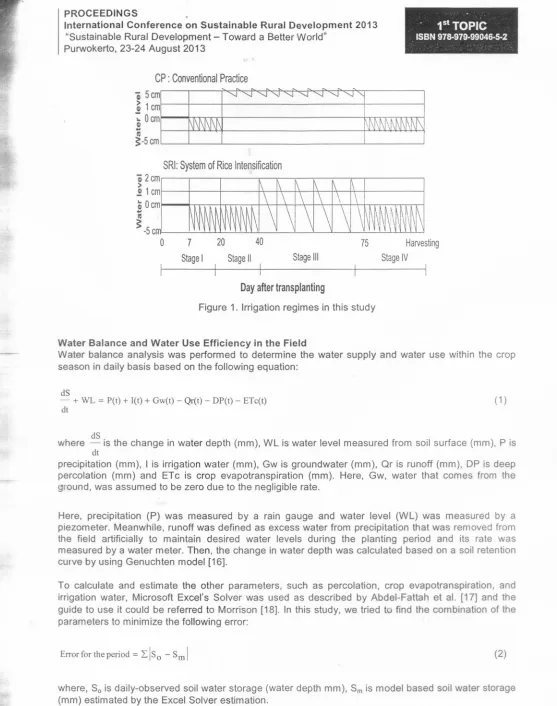
The detail irrigation regimes, SRI and Conventional practice (CP) were illustrated in Figure1. Here, the
experimental design was a single factorial design with three replications. Data were analyzed by one-way analysis of variance (ANOVA) hypothesizing irrigation regime to be the significant source of variation.
For the SRI regime, the soil was kept moist but with no standing water during vegetative stage, i.e.,
stage I (initial) and stage 11 (crop development stages), then shallow standing water ranging in depth
from -5 to 2 cm was applied during reproductive stage (stage Ill) and finally water was drained to
maintain saturated soil until harvesting day (stage IV). Meanwhile, for CP regime, the field was
maintained by ponding water with the interval 2-5 cm water depth during planting period except stage I, then in the stage IV, water was drained to maintain saturated soil until harvesting day.
· 1stT O P IC
zyxwvutsrqponmlkjihgfedcbaZYXWVUTSRQPONMLKJIHGFEDCBA
ISBN 978-979-99046-5-2
PROCEEDINGS
International Conference on Sustainable Rural Development 2013
"Sustainable Rural Development - Toward a Better World"
Purwokerto, 23-24 August 2013
CP : Conventional Practice
l::~~'~'~~~~'~~~~
SRI: System of Rice Intensification
'2:~
J_:~~~
o
7 20 40 75 Harvesting
StageI Stage11 StageIII StageIV
- - - + - - - 1 - - - + - - - 1
Day after transplanting
Figure 1 .Irrigation regimes in this study
Water Balance and Water Use Efficiency in the Field
Water balance analysis was performed to determine the water supply and water use within the crop
season in daily basis based on the following equation:
dS
- +W L =pet) +I(t) +G w (t) - Q r(t) - D P (t) - E T c(t) dt
(1)
dS
where - is the change in water depth (mm), WL is water level measured from soil surface (mm), Pis
dt
precipitation (mm), I is irrigation water (mm), Gw is groundwater (mm), Or is runoff (mm), DP is deep
percolation (mm) and ETc is crop evapotranspiration (mm). Here, Gw, water that comes from the
ground, was assumed to be zero due to the negligible rate.
Here, precipitation (P) was measured by a rain gauge and water level (WL) was measured by a
piezometer. Meanwhile, runoff was defined as excess water from precipitation that was removed from
the field artificially to maintain desired water levels during the planting period and its rate was
measured by a water meter. Then, the change in water depth was calculated based on a soil retention
curve by using Genuchten model [16].
To calculate and estimate the other parameters, such as percolation, crop evapotranspiration, and
irrigation water, Microsoft Excel's Solver was used as described by Abdel-Fattah et al. [17] and the
guide to use it could be referred to Morrison [18]. In this study, we tried to find the combination of the
parameters to minimize the following error:
E rror for the period =
edcbaZYXWVUTSRQPONMLKJIHGFEDCBA
LIso - S m I (2)where, So is daily-observed soil water storage (water depth mm), Srn is model based soil water storage
(mm) estimated by the Excel Solver estimation.
Water use efficiency index is defined as a measure of crop yield (dry matter) per unit water supplied, by following equation [12]:
[image:9.613.21.578.19.725.2]• PROCEEDINGS
International Conference on Sustainable Rural Development 2013
"Sustainable Rural Development-Towards A Better World"
Purwokerto,August25-26,2013
jihgfedcbaZYXWVUTSRQPONMLKJIHGFEDCBA
Y ield(kglha)
W U E (kg/ha/m m )= ---'---= ---'--
edcbaZYXWVUTSRQPONMLKJIHGFEDCBA
LIrrigationw atcr(m m )
(3)
Furthermore, we calculated water productivity (WP) to look up another water-rice production
relationship. In paddy fields, WP is calculated using the following equation [12]:
Y ield (kg/ha) W P (kg/ha/m m ) =
--'--'--E T c(m m )
(4)
where, ETc is crop evapotranspiration (mm) derived from water balance analysis previously.
RESULTS AND DISCUSSION
Plant Growth and Yield
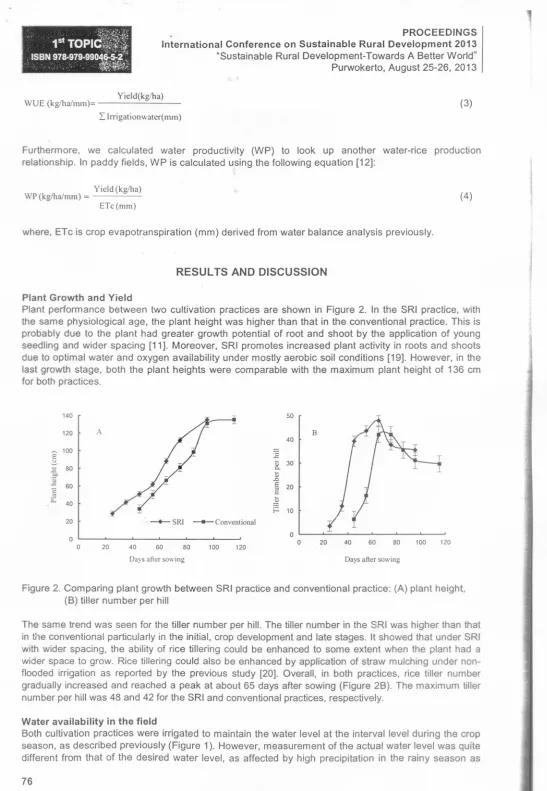
Plant performance between two cultivation practices are shown in Figure 2. In the SRI practice, with
the same physiological age, the plant height was higher than that in the conventional practice. This is
probably due to the plant had greater growth potential of root and shoot by the application of young
seedling and wider spacing [11]. Moreover, SRI promotes increased plant activity in roots and shoots due to optimal water and oxygen availability under mostly aerobic soil conditions [19]. However, in the
last growth stage, both the plant heights were comparable with the maximum plant height of 136 cm
for both practices.
140
120 A
100
"
~
80 0;, ";:; ..c
60
~
0: 40
20
0
0 20
50
B
40
.c
~ 30
0
-~
.rJ
E 20
::s
'"
~
f:: 10
0 0
--+-S R I - C onventional
20 40 60 80 100 120
40 60 80 100 120
[image:10.613.35.582.0.791.2]D ays after sow ing D ays after sow ing
Figure 2. Comparing plant growth between SRI practice and conventional practice: (A) plant height,
(B) tiller number per hill
The same trend was seen for the tiller number per hill. The tiller number in the SRI was higher than that in the conventional particularly in the initial, crop development and late stages. It showed that under SRI with wider spacing, the ability of rice tillering could be enhanced to some extent when the plant had a wider space to grow. Rice tillering could also be enhanced by application of straw mulching under non-flooded irrigation as reported by the previous study [20]. Overall, in both practices, rice tiller number gradually increased and reached a peak at about 65 days after sowing (Figure 2B). The maximum tiller number per hill was 48 and 42 for the SRI and conventional practices, respectively.
Water availability in the field
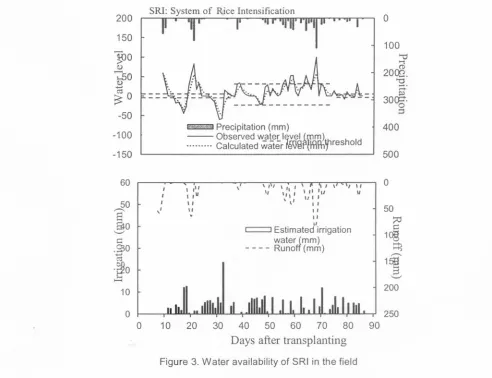
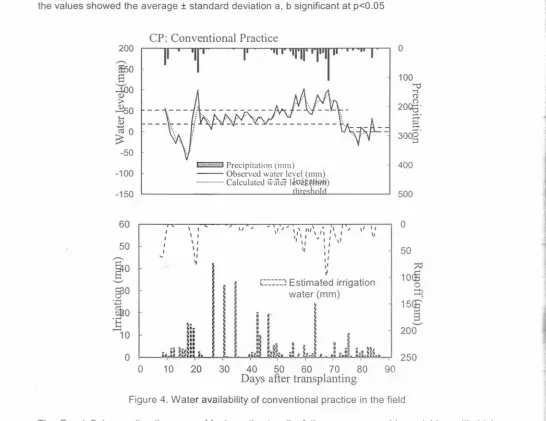
Both cultivation practices were irrigated to maintain the water level at the interval level during the crop
season, as described previously (Figure 1). However, measurement of the actual water level was quite
different from that of the desired water level, as affected by high precipitation in the rainy season as
PROCEEDINGS
International Conference on Sustainable Rural Development 2013
"Sustainable Rural Development - Toward a Better World"
Purwokerto, 23-24 August 2013
jihgfedcbaZYXWVUTSRQPONMLKJIHGFEDCBA
1
stWVUTSRQPONMLKJIHGFEDCBA
T O P IC IS B N 978· 979· 99046-5-2shown in Figure 3 and Figure 4. This occurred when the restarting of irrigation time was determined visually and the natural environment was unpredictable, particularly in terms of precipitation. Even if it was kept saturated for 7 to 20 days after transplanting (DAT), the actual water level dropped below the soil surface, particularly within 12 to 17 DAT due to the high evaporation that occurred on some days. Furthermore, the actual water level increased dramatically on 20 DAT and reached approximately 10 cm above the soil surface in both regimes. This was caused by a high amount of precipitation (136 mm) over three days.
200 150
~O
v~O
~o
-50 -100 -15060
50
,...,8
@o '-' 10o
S R I: S ystem of R ice Intensification
o
~ Precipitation(mm)
-- Observedwater l€lvel(mm)
... Calculatedwater leQ~r{~fIi~reshold
,
,,
"
,
,"
•• u ""
.
edcbaZYXWVUTSRQPONMLKJIHGFEDCBA
\ I I \ ,.' \ ,I .,,' \ " ~
I, ',.' ". 1
\ \' I I
"
1 1
"
c:::=::::JEstimated irrigation water (mm) - - - - Runoff (mm)
100 '"i::j '"i (1) 201X?
'9.
...•.
P l30a;-·
o ::1 400 500o
50
~1Dg
;::::; ,..., 1$1:3
<;»200
250
90
Within the period of 20 to 40 DAT, water stresses were likely to exist for both water management regimes, as illustrated by the lowest water level in Figure 2 and Figure 3. At that time, the water level reached 5.8 cm below the soil surface and 0.8 cm above the soil surface for the SRI and the CP practices, respectively. This condition occurred when precipitation was limited within this periods and minimum irrigation was supplied to the field.
o
10 20 30 40 50 60 70 80 [image:11.613.49.541.177.555.2]D ays after transplanting
Figure 3. Water availability of SRI in the field
----~ ~====
~====~r
-
zyxwvutsrqponmlkjihgfedcbaZYXWVUTSRQPONMLKJIHGFEDCBA
',,",
:
1
stTOPIC
/~
: ISBN97S-979-99046-i2'
, .,' ~./~::~
WVUTSRQPONMLKJIHGFEDCBA
P R O C E E D IN G S
In te r n a tio n a l C o n fe r e n c e o n S u s ta in a b le R u r a l D e v e lo p m e n t 2 0 1 3
"Sustainable Rural Development-Towards A Better World" Purwokerto, August 25-26, 2013
a e a er a ance components between e practices
Water balance components SRI CP
Inflow:
Precipitation (mm) 920+0a 920±Oa
lrriqation water (m m) 289±32a 390±11b
Total Inflow (mm) 1209±32 1310±11
Outflow:
Crop evapotranspiration (mm) 292±6a 290±5a
Runoff (mm) 808+34a 876+11b
Percolation (mm) 108+10a 143±1b
Total Outflow (mm) 1208±50 1309±17
Error between inflow and outflow (%) 1.61% 0.54%
T bl 1 W t b I th
the values showed the average ± standard deviation a, b significant at p<0.05
C P : C onventional P ractice
200
,--..~O
El
'-'?pO
>~O
~ Q ) +-'roO
~-50
-100
-150
60 50 ,--..§to
El
'-' .§30 +-' ~O'E
•...•10 0 0~ P recipitation (mm)
[image:12.615.16.562.256.677.2]-- O bserved w ater level. (m m )
... C alculated w m er ItQ(!g~ifflft)
edcbaZYXWVUTSRQPONMLKJIHGFEDCBA
\ I " J ,,/'" l,' '\/\/~ " ,./ ,,\,
" " W I ' ' , "
"
,\
"
:'
" "i•.::::::!
Estimated irrigation water (mm),,
,,
,
, ,
,
, ,
" "~1---"'1-
..,i~•...•.••
"..
!,"r-_-"---f-'""--¥"' ••...•
""i"''-AIl~•••••.
..r...-¥-'':.~L;¥Jt
40 50 60 70 80
D ays after transplanting
10 20 30
Figure 4. Water availability of conventional practice in the field
o
100
'i::j >-t (D20o§:
•....•.a
30og'
400
500
o
50 ~ 10eE o ::!; 15t§'S
'-' 200 250 90The Excel Solver estimation was able to estimate all of the non-measurable variables with high
accuracy shown as low cumulative error values of 1.61% and 0.54% for the SRI and the CP,
respectively (Table 1). The higher water input in the CP regime did not result in higher water
consumption represented by crop evapotranspiration. Instead, this regime significantly increased the
water loss through percolation by up to 24% (Table 1). Thus, the SRI regime can be considered as an
alternative way to reduce percolation during the crop growth period, as also investigated in a previous study [21]. The percolation rate depends on the physical soil condition and it rate increases when the
7 8
.
-
jihgfedcbaZYXWVUTSRQPONMLKJIHGFEDCBA
1
stWVUTSRQPONMLKJIHGFEDCBA
T O P IC IS B N 978-979· 99046-5-2.
.
PROCEEDINGS
International Conference on Sustainable Rural Development 2013
"Sustainable Rural Development - Toward a Better World" Purwokerto, 23-24 August 2013
depth of water standing in the field increases [22, 23, 24]. The increasing standing water in the field will increase hydrostatic pressure, thus this situation stimulate downward movement of excess water in
the soil to be percolation. Consequently, the CP regime with ponding water 2-5 cm in the field
contributed to higher percolation rate compared to the SRI regime. Moreover, the CP regime also
contributed to higher runoff significantly compared to the SRI regime (Table 1). These results
suggested that the application of continuous flooding irrigation for irrigated rice was insufficient in water use because more excess water occurred through percolation and runoff.
Water Use Efficiency
Table 2 presents the water use efficiency index, water saving, and productivity in both irrigation
regimes. It was clearly observed that the SRI can save a substantial amount of water, so the water use efficiency index can be increased significantly up to 37.6%. The higher value of the index was due to
the minimum irrigation water in the SRI with comparable amounts of water consumption in both
regimes (Table 2). Also, the excess water through percolation and runoff can be minimized by the application of the SRI. The increasing of water use efficiency index also was affected by high precipitation in the rainy season. Therefore, minimum irrigation water was needed especially for the SRI. However, for the dry season with different pattern of precipitation and weather conditions, the increasing of water use efficiency index for SRI is probably different with the current values.
In addition, the current study revealed that water productivity for both regimes was not significantly different (Table 2). The comparable values of water productivity were caused by the comparable crop
evapotranspiration and yield between the SRI and the CP regimes (Table 2). The comparable yield
was obtained from the similar plant performances between the regimes, as shown in Figure 2, which reveals no significant differences in plant height and number of tillers/hills during the crop season. The similar result was also reported by the previous study [25]. They reported that during two rice seasons in China (1999 and 2000), there was no significant difference in yield between continuous flooding and intermittent irrigations.
As early mention, SRI resulted in better yield and plant performances compared to conventional practice even if not significant. The main reason is that under SRI, aerobic condition was created. This condition promoted higher activity of the plants for the establishment of a larger and deeper root system [15]. Also, this condition enhanced shoot activities when optimal water and oxygen available under intermittent irrigation [19]. These results suggested that SRI is suitable way to increase water use efficiency without decreasing yield at the same time.
CONCLUSIONS
The main findings of this study were that SRI enhanced water use efficiency index significantly by up 37.6% in the rainy season. Also, this regime can save water input up to 26.07% compared to conventional practice (CP). The SRI regime reduced excess water through percolation and runoff significantly. The SRI regime also resulted in better yield and crop performance compared to CP regime even if not significant. The main reason is that under intermittent irrigation, aerobic condition was created. This condition promoted higher activity of the plants for the establishment of a larger and deeper root reported previous studies. Therefore, the results suggested that intermittent irrigation is suitable way to raise water use efficiency without decreasing yield for irrigated rice in Indonesia particularly in the rainy season. More experiments particularly in the dry season will be meaningful to examine water use efficiency index under SRI regime with different pattern of precipitation and weather conditions.
.
.WVUTSRQPONMLKJIHGFEDCBA
: '. 1stT O P IC ~ ~
, IS B N
jihgfedcbaZYXWVUTSRQPONMLKJIHGFEDCBA
9 7 8 -9 7 9 .9 9 0 4 ~ S -2 .•..• .' ~ 0;,.... •
• > .'..
..-• PROCEEDINGS
International Conference on Sustainable Rural Development 2013
"Sustainable Rural Development-Towards A Better World" Purwokerto,August25-26,2013
A C K N O W L E D G M E N T S
We are grateful to the Directorate of Higher Education, Ministry of National Education, Republic of Indonesia for generous financial support through grant of International Research Collaboration and
Scientific Publication. Also, the study was partially supported by GRENE (Green Network of
Excellence) project of MEXT in Japan.
R E F E R E N C E S
[1] Statistics Indonesia. "Production, Harvested area, Productivity of Rice and Crops in
Indonesia", 2011. Accessed from
http://www.deptan.go.id/lndikator/tabel-1-prod-lspn-prodvitas-padi-palawija.pdf. 4 April 2013
[2] De Silva CS, E K Weatherhead, J W Knox, J A Rodriguez-Diaz. Predicting the impacts of
climate change-A case study of paddy irrigation water requirements in Sri Lanka.
edcbaZYXWVUTSRQPONMLKJIHGFEDCBA
A g ricW a te r M a n a g 93 pp.19-29., 2007, doi:10.1016/j.agwat.2007.06.003
[3] Radhika, S. Amirwandi, Ratna Hidayat, Muhammad Fauzi, Waluyo Hatmoko. Kebutuhan air
di Indonesia. Kolokium Hasil Litbang Sumber Daya Air 2012. Bandung 2 May 2012
[4] Bouman B.A.M. Water-efficient management strategies in rice production. In te rn a tio n a l R ice
R e se a rch N o te 26 (2) pp. 17-22,2001
[5] Zhao LM, Wu LH, Wu MY, Li VS. Nutrient uptake and water use efficiency as affected by
modified rice cultivation methods with reduced irrigation. Paddy Water Environ 9 (1) pp.
25-3 2 .2 0 1 1 , d o i:1 0 .1 0 0 7 /s1 0 3 3 3 -0 1 1 -0 2 5 7 -3
[6] Sato S, Yamaji E, Kuroda T. Strategies and engineering adaptions to disseminate SRI
methods in large-scale irrigation systems in Eastern Indonesia. Paddy Water Environ 9 (1)
pp. 79-88. 2011, d o i:1 0 .1 0 0 7 /s1 0333-01 0-0242-2
[7] Lin XQ, Zhu DF, Lin XJ. Effects of water management and organic fertilization with SRI crop
practices on hybrid rice performance and rhizosphere dynamics. Paddy Water Environ 9 (1) pp. 33-39. 2011, d o i:1 0 .1 0 0 7 /s1 0 3 3 3 -0 1 0 -0 2 3 8 -y
[8] Sinclair TR, Cassman KG. Agronomic UFOs. Field Crop Res 88 (1) pp. 9-10. 2004.
doi:10.1016/j.fcr.2004.01.001
[9] Sheehy JE, Peng S, Dobermann A, Mitchell PL, Ferrer A, Yang JC, Zou VB, Zhong XH,
Huang JL. Fantastic yields in the system of rice intensification: fact or fallacy? Field Crop Res 88 (1) pp. 1-8. 2004. doi:10.1016/j.fcr.2003.12.006
[10] Dobermann A. A critical assessment of the system of rice intensification (SRI). Agr Syst 79
(3) pp. 261-281. 2004. doi:10.1016/S0308-521x(03)00087-8
[11] Uphoff N, Kassam A, Harwood R. SRI as a methodology for raising crop and water
productivity: productive adaptations in rice agronomy and irrigation water management.
Paddy Water Environ 9 pp. 3-11.2011. doi: 10.10 0 7 /s1 0333-01 0-0224-4
[12] Van der Hoek W, Sakthivadivel R, Renshaw M, Silver JB, Birley MH, Konradsen F. Alternate
weVdry irrigation in rice cultivation: a pratical way to save water and control malaria and
Japanese encephalitis? Research Report 47. International Water Management Institute,
Colombo, Sri Lanka, 2001.
[13] Chapagain T, E Yamaji. The effects of irrigation method, age of seedling and spacing on crop
performance, productivity and water-wise rice production in Japan. P a d d y W a te r E n viro n 8
p p .8 1 -9 0 . 2010, doi:10.1007/s10333-009-0187-5
[14] Hameed KA, Mosa AKJ, Jaber FA. Irrigation water reduction using System of Rice
Intensification compared with conventional cultivation methods in Iraq. P a d d y W a te r E n viro n
9 (1) pp. 121-127.2011, d o i:1 0 .1 0 0 7 /s1 0 3 3 3 -0 1 0 -0 2 4 3 -1
[15] Uphoff N, and Kassam, A. Case study: The system of rice intensification. C a m e l/In te rn a tio n a l
In stitu te ofF o o d A g ricu ltu re a n d D e ve lo p m e n t (C l/F A D ) NY 14853, USA. 2008
[16] Van Genuchten MT. A Closed-form Equation for Predicting the Hydraulic Conductivity of
Unsaturated Soils. S o il S ci Sac Am J 44 pp. 892-898, 1980
[17] Abdel-Fattah YR, EI-Enshasy HA, Soliman NA, EI-Gendi H. Bioprocess Development for
Production of Alkaline Protease by Bacillus pseudofirmus Mn6 Through Statistical
Experimental Designs. J M icro b ia l B io te ch n 19 (4) pp. 378-386. 2009.
doi: 10.4014/jmb.0806.380
80
.-1stT O P IC
WVUTSRQPONMLKJIHGFEDCBA
IS B N 978-979· 99046-5-2
zyxwvutsrqponmlkjihgfedcbaZYXWVUTSRQPONMLKJIHGFEDCBA
PROCEEDINGS
International Conference on Sustainable Rural Development 2013
"Sustainable Rural Development - Toward a Better World" Purwokerto, 23-24 August 2013
[18] Morrison FA. Using the Solver add-in in Microsoft Excel®. Michigan Technological University
Web. http://www.chem.mtu.edu/-fmorriso/cm4650/Using_Solver_in_Excel.doc. 2005
[19] Yang JC, Zhang JH. Crop management techniques to enhance harvest index in rice. J Exp
Bot 61 (12) pp. 3177-3189. 2010,
edcbaZYXWVUTSRQPONMLKJIHGFEDCBA
d o i:1 0 .1 0 9 3 /jxb /e rq 1 1 2[20] Wang D, Li H. X, Qin J. T, Li D. M, Hu F. Growth characteristics and yield of late-season rice
under no-tillage and non-flooded cultivation with straw mulching. Rice Science, 17(2) pp. 141-148.2010
[21] Mao Zhi. Environmental impact of water-saving irrigation for rice. In Irrigation scheduling:
From theory to practice. P ro c e e d in g s o f th e IC ID /F A O W o rk s h o p o n Irrig a tio n S c h e d u lin g ,
Rome, Italy, 12-13 September 1995. Rome: FAO. 1996.
[22] Tuong TP, Bhuiyan SI. Increasing water-use efficiency in rice production: farm-level
perspectives. A g r W a te r M a n a g e 40 (1) pp. 117-122, 1999.
[23] Guerra LC, Bhuiyan SI, Tuong TP, Barker R. Production more rice with less water from
irrigated systems. SWIM Paper 5. In te rn a tio n a l W a te r M a n a g e m e n t In s titu te , Colombo,
Srilanka, 1998.'
[24] Kalita PK, Kanwar RS, Rahman MA. Modeling Percolation Losses from a Ponded Field under
Variable Water-Table Conditions. W a te r R e s o u r B u ll 28 (6) pp. 1023-1036. 1992,
doi: 10 .1 1 1 1 /j.1 7 5 2 -1 6 8 8 .1 9 9 2 .tb 0 4 0 1 4 .x
[25] Belder P, Bouman B A M, Spiertz J H J, Peng S, Castaneda A R, Visperas R M. Crop
performance, nitrogen and water use in flooded and aerobic rice. P la n t S o il 273 pp.167-182.
2005. doi:1 0.1007/s111 04-004-7401-4
, ,1s t T O P IC '.
, " IS B N 9 7 8 -9 7 9 -9 9 0 4 6 -5 -2
jihgfedcbaZYXWVUTSRQPONMLKJIHGFEDCBA
t •zyxwvutsrqponmlkjihgfedcbaZYXWVUTSRQPONMLKJIHGFEDCBA
....
,.
".'.
~.
. '. ,~.'.~.82
.
-. PROCEEDINGS
International Conference on Sustainable Rural Development 2013
"Sustainable Rural Development-Towards A Better World"