A Skripsi
Submitted to the Faculty of Language Education as a Partial Fulfillment of the Requirements
For the Degree Sarjana Pendidikan
Hardiansyah Rizky Mahendra 20120540076
English Education Departement Faculty of Language Education Universitas Muhammadiyah Yogyakarta
i A Skripsi
Submitted to the Faculty of Language Education as a Partial Fulfillment of the Requirements
For the Degree Sarjana Pendidikan
Hardiansyah Rizky Mahendra 20120540076
English Education Departement Faculty of Language Education Universitas Muhammadiyah Yogyakarta
ii
Muhammadiyah Yogyakarta
We hereby approve the Skripsi of
Hardiansyah Rizky Mahendra 20120540076
Candidate for the degree of Sarjana Pendidikan
December 26th, 2016 _______________________
Ika Wahyuni Lestari, S.Pd., M.Hum. The Skripsi Supervisor
December 26th, 2016 _______________________ Fitria Rahmawati, S.Pd., M. Hum. Examiner 1
December 26th, 2016 _______________________ Dr. Suryanto
Examiner 2
Accepted Yogyakarta, December 26th, 2016
iii
Name : Hardiansyah Rizky Mahendra
NIM : 20120540076
Program Study : English Education Department Faculty : Faculty of Language Education
University : Universitas Muhammadiyah Yogyakarta
Certify that this thesis with the title of “Students’ Perception on the Instructional Media Used by Lecturers in Teaching and Learning Process at English Education Department of Universitas Muhammadiyah Yogyakarta” is definitely my own work. I am completely responsible for the content of this thesis. Others’ opinion or findings included in this thesis are quoted in accordance with ethical standards.
Yogyakarta, December 26th 2016
iv
(QS. Ash-Sharh 94:5-6)
“After asking Allah to guide you to the straight path, don’t just stand there, start walking!” – Amal Albaz.
“It’s time to change from doubters to believers” – Jurgen Klopp.
“Anfangen ist leicht, beharren eine kunst (To begin is easy, to persist is an art)” – Friedrich Heinrich Wilhelm Korte.
“It’s not so important what people think when you come, it’s much more important what people think when you leave” – Jurgen Klopp.
“The important phase of development is the start”
v
has given to me. All praise be to Allah SWT also for the health, power, and capability he gave me so that I can finish writing my skripsi.
I would like to say thank you to my family. To my father, Ashar Febrianto, my mother, Diyah Purningsih, and my sister, Asyifa Rizka Vianindya, for the support and encouragement they gave me throughout my skripsi writing process. I am really grateful that I was born and grew in such a loving family.
For my supervisor, Ms. Ika Wahyuni Lestari, S.Pd., M.Hum., I would like to express my gratitude for the support you gave me in my skripsi writing process. Thank you for every guidance, and help you gave me throughout my skripsi writing process, so that I can finish my skripsi. I learn a lot from you. I am really thankful to have a very kind supervisor like you.
I would like to say thank you to my skripsi examiners, Ms. Fitria
Rahmawati, S.Pd., M.Hum., and Dr. Suryanto. Thank you for your kindness in my skripsi defense. I would also like to say thank you for every valuable suggestion
vi
Then, I would like to say thank you to Adib, Antok, Didin, Rizky, and Teguh. Thank you for the friendship and the memories. Thank you for the help and support you have given to me throughout my time here. We have been through a lot of things and I really am thankful to have friends like you guys.
For Yuliani Puspita Dewi, thank you for your support and help you have given to me through these years. Thank you for every help, support, and
encouragement you gave me in my skripsi writing process. I am really thankful to be able to know you.
Finally, for the members of ‘B’rilliant class, thank you for the friendship, togetherness, and memories. I will never forget you guys.
Yogyakarta, December 26th, 2016
vii
reach certain goals that have been set prior to teaching and learning process. In teaching and learning process, teachers need to help students to achieve the goals which have been set and to improve their skills. In doing so, teachers can use instructional media in their teaching. Instructional media is a tool to help teachers deliver the material in teaching and learning process. The aim of this research was to investigate students’ perception on the use of instructional media by lecturers at English Education Department of Universitas Muhammadiyah Yogyakarta (EED of UMY). This research focused to explore students’ perception on the types of instructional media used by lecturers of EED of UMY, identify students’ perception on the advantages of instructional media in teaching and learning and investigate students’ perception on the disadvantages of instructional media in teaching and learning. Descriptive qualitative research was employed in this research while interview used as the instrument of data collection. Participants of this research were four students of EED of UMY. There were three findings of this research. The first finding showed some types of instructional media used by lecturers at EED of UMY; those were book, slide show, flashcard, video, projector, music, film, whiteboard, and newspaper. The second finding showed several advantages of instructional media includes improving students’ knowledge, creating interesting classroom environment, promoting interactivity, providing easier way for students to receive material, and promoting students’ autonomous learning. The last finding showed some
disadvantages of instructional media includes the use of inappropriate instructional media, the lack of interactivity, the cause of boredom and the cause of students’ demotivation in teaching and learning.
viii
Approval Sheet ... ii
Statement of Authenticity ... iii
Motto ... iv
Acknowledgement ... v
Abstract ... vii
Table of Contents ... viii
Chapter One: Introduction ... 1
Background of the Study ... 1
Identification and Limitation of the Problem ... 5
Formulation of the Problem ... 6
Objective of the Study ... 7
Significance of the Study ... 7
Outline of the Study ... 8
Chapter Two: Literature Review ... 10
Instructional Media in English Teaching and Learning ... 10
Definition of instructional media ... 10
Types of instructional media ... 11
Advantages of instructional media ... 15
Disadvantages of instructional media ... 16
ix
Setting and Participants of the Study ... 25
Data Collection Method ... 28
Data Analysis ... 30
Chapter Four: Finding and Discussion ... 32
Types of Instructional Media Used by Lecturers at EED of UMY as Experienced by Students ... 32
Types of instructional media ... 32
Frequently used instructional media ... 36
Discussion about types of instructional media used by lecturers at EED of UMY as experienced by students ... 37
The Advantages of Instructional Media in Teaching and Learning ... 42
Improving students’ knowledge ... 43
Creating interesting classroom environment ... 44
Promoting interactivity ... 45
Providing easier way for students to receive material ... 46
Promoting students’ autonomous learning ... 46
Discussion about the advantages of instructional media in teaching and learning ... 46
The Disadvantages of Instructional Media in Teaching and Learning ... 49
x
Discussion about the disadvantages of instructional media in
teaching and learning ... 52
Chapter Five: Conclusion and Recommendation ... 55
Conclusion ... 55
Recommendation ... 57
References ... 59
Appendices ... 62
Appendix 1: Interview Guidelines ... 62
Appendix 2: Interview transcript 1 ... 64
Appendix 3: Interview transcript 2 ... 68
Appendix 4: Interview transcript 4 ... 73
ii
Muhammadiyah Yogyakarta
We hereby approve the Skripsi of
Hardiansyah Rizky Mahendra 20120540076
Candidate for the degree of Sarjana Pendidikan
December 26th, 2016 _______________________
Ika Wahyuni Lestari, S.Pd., M.Hum.
The Skripsi Supervisor
December 26th, 2016 _______________________ Fitria Rahmawati, S.Pd., M. Hum. Examiner 1
December 26th, 2016 _______________________ Dr. Suryanto
Examiner 2
Accepted Yogyakarta, December 26th, 2016
vii
reach certain goals that have been set prior to teaching and learning process. In teaching and learning process, teachers need to help students to achieve the goals which have been set and to improve their skills. In doing so, teachers can use instructional media in their teaching. Instructional media is a tool to help teachers deliver the material in teaching and learning process. The aim of this research was to investigate students’ perception on the use of instructional media by lecturers at English Education Department of Universitas Muhammadiyah Yogyakarta (EED of UMY). This research focused to explore students’ perception on the types of instructional media used by lecturers of EED of UMY, identify students’ perception on the advantages of instructional media in teaching and learning and investigate students’ perception on the disadvantages of instructional media in teaching and learning. Descriptive qualitative research was employed in this research while interview used as the instrument of data collection. Participants of this research were four students of EED of UMY. There were three findings of this research. The first finding showed some types of instructional media used by lecturers at EED of UMY; those were book, slide show, flashcard, video, projector, music, film, whiteboard, and newspaper. The second finding showed several advantages of instructional media includes improving students’ knowledge, creating interesting classroom environment, promoting interactivity, providing easier way for students to receive material, and promoting students’ autonomous learning. The last finding showed some
disadvantages of instructional media includes the use of inappropriate instructional media, the lack of interactivity, the cause of boredom and the cause of students’ demotivation in teaching and learning.
Chapter One
Introduction
This chapter presents the background of this study which divided into six parts that are background of the study, identification and limitation of the
problem, formulation of the problem, objectives of the study, significance of the study, and outline of the study.
Background of the Study
Teaching and learning process is an important activity in education. It is an activity which involves teachers and students in an educational environment. The aims of teaching and learning process is to achieve some goals that have been created prior to the teaching and learning process. It is in line with the statement of Farhadi (2014) who stated that the teaching and learning is a contact between a teacher and student in an educational situation that aimed to reach a goal, using four key elements which are the sequence or steps of teacher and student
activities, teacher’s role, student’s role, and the route of communication between teacher and students. During the teaching and learning process, students will be able to get some new knowledge from many subjects in the school.
create a dynamic teaching and learning process. Also, media and technology can give a lot of advantages for teachers in their teaching and learning. “It is
indispensable to take advantage of the modern technological facilities in aiding the task of English language education. Media and technology is needed by the lecturers to help them during teaching and learning”, (Nomass, 2013, p. 111).
During the teaching and learning process lecturers need to help students to reach their potential. In doing so, lecturers can use instructional media to help them deliver the material. Farhadi (2014) argued that educational media is an instrument of teaching and learning and also a part of learning process and technology. Using instructional media in learning process is a good idea because students can actively involve in the process of learning. Pun (2013) stated that “the use of multimedia technology makes the language class lively and
interesting, motivating the students to participate in the classroom activities” (p. 33). Instructional media is also able to help students to understand material given by lecturers easily. Heinich, Molenda, Russel and Smaldino (2002) stated that “properly designed instructional media can enhance and promote learning and support teacher-based learning” (p. 12).
responsibility to facilitate and improve students’ knowledge and skills, a lecturer is also responsible to give some feedback to students. Beside lecturers’
responsibility to facilitate and improve students’ knowledge, a lecturer is also the one responsible to decide types of instructional media they are going to use in their teaching. Since there are many types of instructional media available to be used in teaching and learning, a lecturer has the responsibility to choose the best media to be used based on their teaching objectives. A lecturer needs to make sure that the media can work properly during teaching and learning process or they may prepare a backup media if the media they have fail to be put on use. Then, the important part is that the lecturer should be able to maximize instructional media to support them in teaching and learning.
The teaching and learning process in English Education Department has already using instructional media. Instructional media in teaching and learning process at English Education Department is usually employed as a medium to deliver materials to students. Instructional media is also used during teaching and learning process because it can provide interactivity between lecturer, students and the environment. Ruis, Muhyidin and Waluyo (2009) stated that “instructional media are created the possible direct interaction between the learners and their environment” (p. 3). There are some types of instructional media used in teaching
used to support some listening activities. The use of instructional media in teaching and learning at EED of UMY is very important because it always motivates students to be more active and engaged into the activity in the classroom. Ruis, Muhyidin and Waluyo (2009) argued that “the learners’ motivation are aroused by using media in learning” (p.3).
Instructional media is something usually used in teaching and learning process. Instructional media in teaching and learning has some impacts in teaching and learning especially for students. The lecturers should be aware on choosing the instructional media for teaching and learning process because students are the one that get the impact of the use of instructional media. Alobo (2010) stated that "learning English can be so cumbersome to learners, unless it is taught in an interesting way utilizing appropriate learning resources” (p. 106). The use of appropriate instructional media will provide great benefits for students as students can learn easily and enjoy the learning process as Alobo (2010) argued that “adequate and appropriate selection and use of instructional media by both teacher and learner to facilitate better learning of the English language are most desirable” (p. 106). In the other hand, the use of inappropriate instructional media will only give students disadvantage. Inappropriate media in teaching and learning sometime can affect students’ motivation in learning.
influence the process of teaching and learning. Also, the researcher feels that it is important to conduct a research about students’ perception on instructional media as students are the one that get the impact from instructional media. Also, there is no research about instructional media in teaching and learning yet to be conducted at English Education Department, the researcher chose to carry research about students’ perception on the instructional media used by lecturers in teaching and learning process at English Education Department of Universitas Muhammadiyah Yogyakarta.
Identification and Limitation of the Problem
As the importance of instructional media in teaching and learning process is inevitable, the use of instructional media becomes an issue for some
researchers. Media provides so many options for the lecturers to help them giving instruction in teaching and learning process. The various kinds of instructional media that can be used in teaching and learning process is a great advantage for the lecturer because the use of media will provide better environment in teaching. Pun (2013) stated that “the use of multimedia technology in the classrooms creates a favorable environment for language teaching” (p.33). Beside the advantages, the variety of instructional media can provide a problem if lecturers are fail to choose suitable media for their teaching and learning. It is also
become a focus for the researcher to do a research. Those problems are selection of instructional media for teaching and learning process, utilization of
instructional media in teaching and learning, and effectiveness of instructional media.
This study focused to investigate types of instructional media used by lecturers in English Education Department of Universitas Muhammadiyah Yogyakarta. In addition, the researcher also focused to find out advantages of instructional media in teaching and learning, and disadvantages of instructional media in teaching and learning at English Education Department of Universitas Muhammadiyah Yogyakarta based on the perception of the students of English Education Department of Universitas Muhammadiyah Yogyakarta.
Formulation of the Problem
The goal of this research is to explore students’ perception on the use of media in teaching and learning process. The formulation of the problems are as follows:
a. What are the types of instructional media used by lecturers of EED of UMY as experienced by students of EED of UMY?
b. How is students’ perception on the advantages of instructional media used by the EED lecturers in teaching and learning?
Objective of the Study
This research contains three research objectives, which is set as follow:
a. To investigate the types of instructional media used by lecturers of EED of UMY as experienced by students of EED of UMY.
b. To identify students’ perceptions on the advantages of instructional media used by the EED lecturers in teaching and learning.
c. To identify students’ perceptions on the disadvantages of instructional media used by the EED lecturers in teaching and learning.
Significance of the Study
Researcher. This study is expected to give the researcher an information
about the use of instructional media during teaching and learning process. In addition, this study is hoped to widen the researcher’ knowledge on how to maximize the use of media in English classroom.
Institution. Hopefully this research can give the institution some input
about the use of instructional media, so that the institution can provide teachers with instructional media to help teachers in teaching and learning process.
Lecturers. The result of this study hopefully help lecturers to be careful to
media in teaching and learning, so that lecturers can make a correct decision on what kinds of media that should be applied in the classroom.
Students. Since students of EED of UMY is pre-service teacher, this study
is expected to give students information about kinds of instructional media that can be used in teaching and learning process. This study also aims to give students clear information about what kinds of media that are suitable to be use in the classroom and its advantages and disadvantages. Then, the information from this study is expected to help students when they become a teacher in the future.
Future Researchers. This study is expected to inspire the future
researchers to conduct a research related to the instructional media used in the process of teaching and learning. The future researcher may conduct a research focused to certain types of instructional media, the advantages, or the advantages of instructional media itself. The researcher also hope that this study can be a reference for the future researcher.
Outline of the Study
This study consists of five chapters, namely introduction, literature review, methodology, finding and discussion, and conclusion.
The first chapter discusses about the introduction. This chapter consists of background of the study, statement and limitation of the problem, research
instructional media, types of instructional media and advantages and
disadvantages of media. Review of related study presented after those reviews and will be followed by conceptual framework. The third chapter discusses research methodology used in this study. It discusses the research design employed in this study, research setting and participant, data collection method and data analysis. The method used in this study was a qualitative research method with a
descriptive qualitative research design. Interview was chosen as the instrument of data collection by the researcher to collect the data. There were four participants in this study. Those participants were students of EED of UMY batch 2014. They were selected by the researcher using convenience sampling technique. The data gathered by the researcher was analyzed by coding the data. Then, the fourth chapter presents the finding and discussion. This chapter reveals the finding of this research and followed with the discussion of the findings. There were three findings revealed in this study. The first finding was about the types of
instructional media used by lecturers of EED of UMY as experienced by students of EED of UMY. The second finding was about advantages of instructional media in teaching and learning. The third finding was about disadvantages of
Chapter Two
Literature Review
This study aims to investigate student’s perceptions about instructional media used in the process of teaching and learning. To get the framework of the issue, this literature review discusses some important aspects related to the study. First, this chapter presents some definitions of the terminology used in this paper that are definition of instructional media, types of instructional media, advantages of instructional media in teaching and learning and disadvantages of instructional media in teaching and learning. Second, this chapter presents the review of related studies and followed by the conceptual framework of the study.
Instructional Media in Teaching and Learning
This part of literature review provides the view of some expert related to instructional media in teaching and learning. There are four topics discussed in this part of literature review. The first topic discussed is definition of instructional media, followed by types of instructional media, advantages of instructional media in teaching and learning and the last is disadvantages of instructional media in teaching and learning.
Definition of instructional media. Instructional media is something that
that instructional media is “the collection of materials and equipment that can be used effectively for communication. These materials are used in the planning process of giving instruction” (p.13). Further, Wamalwa & Wamalwa (2014) refers the instructional media as “the kind of media used in teaching to aid in learners’ easier understanding according to the set objectives” (p.141). Instructional media is something that deliver information from a source to a receiver and they transfer an information in an instructional purpose such as video, television, diagrams, printed materials, computers and instructor, (Heinich, Molenda, Russel, & Smaldino, 2002). Reiser (2001) defines instructional media as “every physical means of instructional delivery, from the live instructor to the text book to the computer and so on” (p. 54).
From the statements above, the researcher can conclude that instructional media is tools that can help lecturer to deliver instructional information through media such as audio, video, printed materials, Television, diagrams, whiteboard and LCD projector.
Types of instructional media. Instructional media has few different
Heinich, Molenda, Russel, & Smaldino (2002). Heinich, Molenda, Russel, & Smaldino (2002) highlighted that types of instructional media include visual, audio, video, computer, and multimedia. Those types of instructional media discussed below.
Visual. The first instructional media as mentioned by Heinich, Molenda,
Russel, & Smaldino (2002) is visuals. Visuals are traditional media associated into classroom. Types of visual media can be divided into non-projected visuals, projected visuals, document cameras, overhead projection, slides, digital images, and digital images projection. The first type of visual media is non-projected visuals which are easy to use in many ways at all levels of instruction and there are six types of visuals commonly used in classroom includes still pictures, drawings, charts, graphs, posters, and cartoons. Then the second visual is projected visuals that are media format in which still images are enlarged and projected on a screen which also suitable for all levels of instruction in all curriculum areas. The third visual media is document cameras which is a video camera pointed on document, pictures, or graphics to project them into a bigger screen. The following visual is overhead projection which become the most widely used audiovisual device in North American classrooms as it is easy to use and can project some materials. The fifth visual aid is slides which is a small
television monitor. And the last visual media is digital image projection that can be used to project individuals digital image format using computer monitor, an LCD panel, overhead projector, or a data projector.
Audio. The second instructional media as stated by Heinich, Molenda,
Russel, & Smaldino (2002) is audio media that can make several unique
contributions to both teaching and learning. Audio media format usually used in giving instruction are audiotapes, compact disc (CD), and MP3. Audiotapes can be used to record your own audio easily and cheaply and are not easily damaged and the content of audiotapes can be edited easily. Compact disc is an attractive educational program as the user can quickly choose the desired program or contents to be played. The disadvantage of compact disc is that a scratch can damage the quality of the content in the disc. The last audio media type is MP3 or MPEG audio layer 3, it is an audio format which can easily take on the internet and can be played using computer programs.
Video. Then, the third instructional media type highlighted by Heinich,
do not have. The last video format is internet video that can be viewed through internet using video streaming as the user do not need to download the file as the contents starts playing shortly as the user clicks on the link.
Computer. The fourth type of instructional media according to Heinich,
Molenda, Russel, & Smaldino (2002) is computer that can provide virtually instantaneous response to student input, has extensive capacity to store and manipulate information, and is unmatched in its ability to serve many students simultaneously. The roles of computers in learning are as an object of instruction, as a tool, as an instructional device, and as a means of teaching logical thinking.
Multimedia. Then, the last instructional media based on the statement of
Heinich, Molenda, Russel, & Smaldino (2002) is multimedia which refers to the sequential or simultaneous use of a variety of media formats in a given
presentation or self-study program. The goal of multimedia in education is to immerse the learner in a multisensory experience to promote learning.
third type is drawing that should be simple but consist of rich information. Then, chart, poster, and cartoon are visual media that can be used in four language skills. The fifth is blackboard or whiteboard which can be used to present drawing, diagram and written language. Audio media can be a very valuable media for listening activities since teachers can provide authentic materials from radio or create a listening material using a recorder. The next one is Over Head Projector which is very useful to be used in large classes because OHP allows teachers to face students all the time while presenting the material. And the last, LCD
projector which is often used to show presentation because it is more practice and efficient.
Advantages of instructional media in teaching and learning. There are
many advantages of using instructional media in teaching and learning. There are two experts discussed advantages of instructional media. Those experts are Pun (2013) and Liu (2010).
Pun (2013). The first expert, Pun (2013), stated that there are seven advantages of using media. The first is to motivates students to learn English as implementation of new multimedia technology in teaching that includes audio, visual and animation effects encourages students to learn English efficiently. The second one is developing students' communicative competence through
language that can make them motivated to learn. Then, improves teaching efficiency as media in language classroom provide real-life environment for students, could give students more information and improves teaching efficiency. Enhances interaction among students and between teachers and students since the use of media can attract students to be more active in classroom and it improves communication between teacher and students. Then, creates a conducive teaching environment in the classrooms since using media while teaching will develop dynamic involvement of teacher and students and it can produce positive language classroom. And the last is to provides opportunities for English teaching outside the classrooms so that teacher able to conduct teaching outside classroom since the students can contact the teacher using the internet.
Liu (2010). Liu (2010), the second expert, argued that the advantages of using multimedia are English teaching and learning become more efficient, provide a lot of useful information and saving a lot of time.
Disadvantages of instructional media in teaching and learning. Apart
from the advantages of the use of instructional media in teaching and learning, there is also disadvantages. Statements of three experts who discussed
disadvantages of instructional media presented in this study. Those experts are Pun (2013), Liu (2010), and Reddi and Mishra (2003).
facilitator because the teacher perhaps become very dependent to multimedia in classroom. The second one is lack of communication between teachers and students as the use of multimedia technology in language classroom may create an exciting classroom by the help of audio, visual and text but it may limit the communication between teachers and students. Then, lack of real-time teaching because the use of multimedia in classroom by teacher, there will be lack of real-time teaching by teacher and it could give students difficulties since there will be no feedback. Loss of students' logical thinking may occur because the use of multimedia may help students to understand the material easily but it can reduce students’ logical thinking. The last is expensive way of conducting language classes as the use of multimedia in language classroom can be very expensive because the school need to buy hardware, software etc. to support the use of multimedia in classroom.
Liu (2010). Liu (2010), the second expert, stated that the disadvantages of using multimedia is that students can feel lost and they do not know what to choose because there is so many information provided by multimedia.
Review of Related Studies
There are three research which carried out a topic related to instructional media will be discussed in this research. The first research was conducted by Aini in (2013) with the title Instructional Media in Teaching English to Young
Learners: A Case Study in Elementary Schools in Kuningan. The research was
conducted in Kuningan, Indonesia and the researcher was investigating three things which are the use of instructional media in teaching English to young learners, problem encountered in using instructional media, and problem solving toward the challenge of media utilization. The research was conducted in three elementary school. The researcher use observation and interview as the technique of data collection. This research mentioned some instructional media which can be used by teacher such as the students themselves, realia, pictures, course book, boards, overhead projector, flipcharts and computer-based presentation
Then, the second research was done by Erastus Juma Walmawa and Eric W. Wamalwa in (2014) entitled Toward the utilization of Instructional Media for Effective Teaching and Learning of English in Kenya. This research discusses the
use of instructional media in teaching and learning of English in Kenya. The research aims to assess the place and the role of instructional media in enhancing teaching and learning of English in Kenya. The researcher discovers that the lack of instructional media in teaching and learning gives big learning challenge to learner. Thus, this research urges the use of instructional media in teaching and learning. The researcher classifies instructional media into three types that are unprocessed materials, projected media, and non-projected media. This research discusses the role of instructional media in teaching and learning as it can enhance and facilitate the learning process. Then this research discusses about the criteria for selection and the use of instructional media should be based on lesson objectives according to learners’ ability. This research also discusses theories to the use of instructional media in teaching includes the component display theory and cognitive load theory. Then, this research discusses instructional media in teaching and learning, teaching language skills with selected instructional media, using instructional media to teach English in schools, and classroom language learning. At the end of the research, the researcher concludes that instructional media is an integral part to teaching and learning process as it can enhance
The third research was conducted by Adegbija and Fakomogbon in (2012) entitled Instructional Media in teaching and learning: A Nigerian perspective. The research discussed the use of instructional media in teaching and learning in Nigeria as a developing country. The researcher found that the inconsistency of government policies in education, corruption, mismanagement of oil resources, and also the lack of vision of the Nigerian leaders leads to the lack of attention toward instructional media and education in general. Then, the researcher mentioned some media which used in other developed countries such as real equipment, simulator, training device, computer, interactive multimedia, virtual reality, radio or TV broadcast, motion picture, programmed text, slide tape or filmstrip, audio poster or chart whiteboard, and overhead transparencies. The researcher also discussed about choosing appropriate media for a lesson, sources of instructional media for tertiary institutions, print resources, and resources centers and the virtual library. At the end of the research, the researcher concluded that lecturers have the responsibility to determine appropriate teaching methods and provide suitable instructional media which will fit in the implementation of the method. The researcher suggested that lecturers and students should be more exposed to the use of every form of instructional media through training and retraining whether at the local or international setting, and the government should encourage the use of instructional media for teaching and learning by
This research is different from three related studies mentioned above in terms of the setting of the research. This research focuses to investigate the types of instructional media used by lecturers, advantages and disadvantages of
instructional media in teaching and learning process. Qualitative research method employed in this research and the researcher use interview to collect the data. The participants of this research are students of a private university in Yogyakarta.
Conceptual Framework
using multimedia in English Language Teaching able to make students elaborate easily in the process of teaching and learning. Pun (2013) stated that technology offers a lot of selection which create a dynamic teaching and learning process. Wamalwa & Wamalwa (2014) classifies materials or media for instruction into three types such as unprocessed materials, projected media, and non-projected media.
Then, the use of media in teaching and learning process can provide advantages and disadvantages. There are many advantages of using media in teaching and learning process as Pun (2013) highlighted some advantages such as motivate students to learn English, develop students’ communicative competence, widens students’ knowledge about the culture of English, improves teaching efficiency, enhance interaction among students and between teacher and students, creates a conducive teaching environment, and provide opportunities for English teaching outside the classroom. Pun (2013) argued that there are some
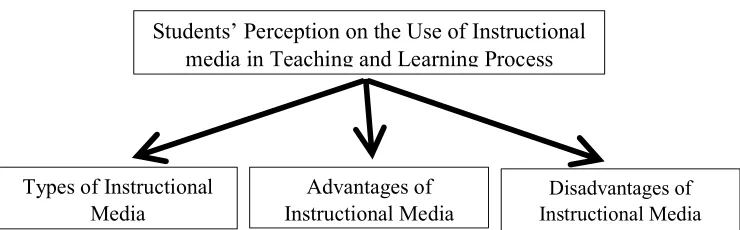
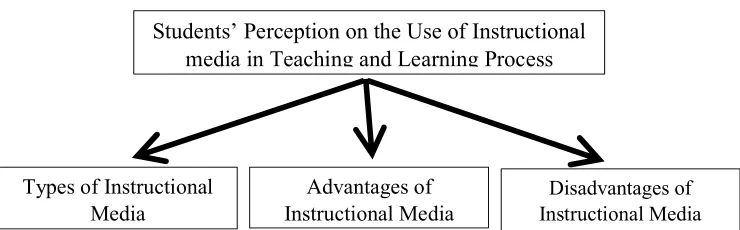
Figure 1: Conceptual Framework
Students’ Perception on the Use of Instructional media in Teaching and Learning Process
Types of Instructional
Chapter Three
Research Method
This chapter discusses the methodology used in this study; which is presented in four parts. The first part is design of the study. It discusses what method used in this study and the reason of the researcher used the method. The second part is setting and participants of the study. In this part, the researcher presents the reason and the way the researcher chose the setting and participants. Continued by data collection method as the third part which discuss what data collection method applied in this study and how long the data gathering takes time. Finally, analysis of data is elaborated at the end of this chapter. This part presents the method used by the researcher to analyze the data.
Design of the Study
phenomenon related to the use of instructional media at EED of UMY. Cresswell (2009) argued that “qualitative research is a means for exploring and
understanding the meaning individuals or groups ascribe to a social or human problem” (p.4). Creswell (2012) again stated that “qualitative research is best suited to address a research problem in which you do not know the variables and need to explore” (p. 16). Based on those statements, the researcher employed qualitative research method in this study.
Then, descriptive qualitative research design was employed in this study. Descriptive approach chosen as the researcher explore detailed information for this research from participants. Creswell (2012) stated that “a descriptive approach incorporates a detailed description of people and places to carry the narrative. A study in this mode might convey “a typical day in the life” of an individual” (p. 274).
Setting and Participants of the Study
Setting of the study. This research was conducted at English Education
Education Department students have already attended various classes, and the researcher believes that all students of English Education Department have experience in attending classes where the lecturers employ media in their
classroom. The third reason is that the researcher is studying at English Education Department, so that the researcher is familiar with the setting and it makes it feasible for the researcher to conduct a research at English Education Department of UMY. Based on those reasons, English Education Department was chosen as the setting of this research by the researcher. This research was conducted on November 2016. The researcher gathered the data for approximately nine days, started on November 9th and ended on November 16th 2016.
Participants of the study. Participants of this study were students of
English Education Department of Universitas Muhammadiyah Yogyakarta. They were four students of EED of UMY batch 2014. The participants consisted of two male and two female students. Participants of this study were taken using
convenience sampling method. Convenience sampling method is one of the most effective and easy way to select the sample as Cresswell (2012) argued that the researcher only selects participants because they are willing and available to be studied. Cohen, Manion, and Morrison (2007) stated that “convenience sampling involves choosing the nearest individuals to serve as respondents and continuing
Four students of English Education Department of Universitas
Muhammadiyah Yogyakarta batch 2014 were selected as participants in this study because of four reasons. The first reason of the researcher chose students to become the participants was because they were the one that get the impact of the instructional media used in teaching and learning. Then, the second reason of the researcher selected students of EED of UMY batch 2014 was because they have experiences in attending classes that employed instructional media in its teaching and learning for at least two years. The third reason was because students of EED of UMY batch 2014 also had the same experiences being taught using
instructional media. The last reason of the researcher chose students of EED of UMY batch 2014 as participants was because they were available and accessible to be researched.
The participants of this study were four students of English Education Department of Universitas Muhammadiyah Yogyakarta batch 2014. They were consisted of two male students and two female students. The participants were chosen by the researcher as they were available and willing to be the participants at that time. The researcher used pseudonym in this study to mention these four participants. Pseudonym used to protect the secrecy of the participants. The pseudonym assigned to the participants were “Anton” for participant number one,
Data Collection Method
Interview was chosen as the instrument to collect the data in this study. The researcher used interview because the researcher was trying to explore students’ perception related to the types, advantages, and disadvantages of instructional media used by lecturers in teaching and learning at EED of UMY. Thus, interview was used to collect the data as Creswell (2012) stated that “a qualitative interview occurs when researchers ask one or more participants general, open-ended questions and record their answers” (p.217). One on one interview was used in this study as it was best suited for this study as Creswell
(2012) stated that “One-on-one interviews are useful for asking sensitive questions and enabling interviewees to ask questions or provide comments that go beyond the initial questions” (p. 384). Based on those consideration, the researcher decided to conduct one on one interview to gather the data.
Before conducting the interview, the researcher prepared something which was used during the interview, those are the copy of interview guidelines and voice recorder. The copy of interview guidelines used to provide questions list for the researcher. The voice recorder was used to record answers from the
participants. The researcher used Indonesian language in the interview to prevent any misunderstanding between both the researcher and participants. Indonesian language was also used because it is easier for the researcher and participants to give the questions and explained their answer.
The interview was conducted between November 9th and November 16th 2016. Before conducting the interview, the researcher contacted four students of EED of UMY asked about their availability and willingness to be the participants of this study. Those four students contacted by the researcher were Andi, Bela, Choki, and Dinda. After those students agreed to be the participants of this study, the researcher made appointment with those students to conduct the interview. The first interview was conducted on November 9th 2016. Anton was the first participant interviewed by the researcher. The interview lasted for 7 minutes. The second participant interviewed was Bela. She was interviewed on November 13th with the interview lasted for eight minutes. The third interview was conducted on November 15th with Choki as the participant. The interview lasted for eleven
Data Analysis
After the researcher finished the process of data collection, the researcher did the transcribing. Transcribing is a process where the researcher writes down data collected from participants into an interview transcript. Creswell (2012) argued “transcription is the process of converting audiotape recordings or
fieldnotes into text data” (p.239). The researcher did the transcribing in three days, started from November 16th to November 18th 2016. The next step after the transcribing process was member checking. Member checking is used to check the validity of the data. Creswell (2012) stated that “member checking is a process in which the researcher asks one or more participants in the study to check the accuracy of the account” (p.259). The researcher did the member checking on November 19th, 20th, and 21st 2016. In member checking, the researcher met the participants and gave the participants a copy of the interview transcript to check if there was any mistake made by the researcher in transcribing the data. In the member checking process, there were no major problem as most of the transcript were correct. There were only small number of mistake in the transcript. It was the transcript of interview number three which was revised as the participants asked to change some words that were used in the transcript. Then, after the process of transcribing and member checking was done, the researcher did the
data analysis.
Chapter Four
Findings and Discussion
This chapter presents the findings to answer research questions based on the answers of four participants. The researcher used pseudonym to call the participants. Those pseudonyms are Anton for participant one, Bela for participant two, Choki for participant three and Dinda for participant four. This chapter presents three findings to reveal the study based on three research questions. Those findings are about types of instructional media used by lecturers at EED of UMY as experienced by students, students’ perception on the advantages of instructional media, and students’ perception on the disadvantages of instructional media. Then, the researcher presented the discussion after each finding.
Types of Instructional Media Used by Lecturers at EED of UMY as
Experienced by Students.
There are some instructional media used by lecturers at EED of UMY as all four participants mention types of instructional media.
Types of instructional media. All participants said that their lecturers
Book. The first instructional media is book which was mentioned by all participants. All four participants reported book as the instructional media used by lecturers at EED of UMY. Anton stated that his lecturers used book. He reported, “mm, there are many media, such as book…” (P1.3). Bela also said that book is also used in teaching and learning process. Bela reported, “first, ee video and also book” (P2.3). She also mentioned some types of book used in teaching and learning such as novel, journal article and textbook as she reported, “Book has many types such as novel, journal article and also book, not the article, it’s like a textbook” (P2.4). Then, Choki the third participant also mentioned that book is used at EED of UMY. He reported on the interview the following, “eeem, usually lecturers use book…” (P3.4). The last participant, Dinda also stated that one of instructional media used by lecturers of EED of UMY is book. She reported, “there are many types of instructional media used by lecturers in the classroom such as book…” (P4.3).
Slide show. The second instructional media is slide show. Three
participants mentioned slide show as the instructional media used in teaching and learning process at EED of UMY. Anton stated that lecturers use slide show to deliver the material in their teaching. He reported, “…Then, eem presentation, it’s like slide if it is an instructional media then it is also often used by lecturers to
She stated that many lecturers of EED of UMY use slide show in their teaching. She reported, “yes, many of them use slide show” (P4.16).
Flashcard. The third instructional media mentioned by participants was flashcard as mentioned by Bela and Choki. Bela stated that flashcard was used at EED of UMY. She reported, “it’s like flashcard, it is more like a tool or maybe we can call it as instructional media….” (P2.5). Then, Choki stated that sometimes flashcard used in the classroom as he reported the following, “ee usually lecturers use…sometimes flashcard, that’s it” (P3.4).
Video. Video was the fourth instructional media mentioned in the
interview. Two participants discussed about video as the instructional media used in teaching and learning process at EED of UMY. Bela and Dinda mentioned video during the interview. When asked about instructional media that have been used by lecturers at EED of UMY, Bela responded the following, “First, eerm, video…” (P2.3). Dinda also stated that video has been used in teaching and learning at EED of UMY as she reported, “there are many types of instructional media used by lecturers, such as book, music, video…” (P4.3).
Projector. The other instructional media was projector as mentioned by two participants. Choki stated that projector is one of the media used by lecturers in the classroom. He reported, “eem, usually lecturers use book, projector also one of the media…” (P3.4). Then, Bela stated that projector is also used in teaching and learning process she reported, “…of course the one surely used is
Music. Beside the instructional media mentioned above, Dinda, was also mentioned some other instructional media. One of the instructional media was music as she reported, “there are many types of instructional media used by lecturers, such as book, music, video, film, of course the one surely used is projector and whiteboard” (P4.3).
Film. Beside music, Dinda also mentioned film as the instructional media have been used by lecturers at EED of UMY. She reported, “there are many types of instructional media used by lecturers, such as book, music, video, film, of course the one surely used is projector and whiteboard” (P4.3).
Whiteboard. Beside those instructional media already mentioned by the participants, Dinda also highlighted other media has been used by lecturers at EED of UMY. She mentioned whiteboard. She reported, “there are many types of instructional media used by lecturers, such as book, music, video, film, of course the one surely used is projector and whiteboard” (P4.3).
Newspaper. Dinda also mentioned newspaper as the instructional media has been used in the classroom during the interview when she reported, “other than what I’ve already mentioned, maybe it was newspaper” (P4.4).
Frequently used instructional media. There were several instructional
media mentioned by the participants as the media frequently used by lecturers of EED of UMY. Those instructional media include book and projector.
Book. Three participants gave similar respond when asked about frequently used instructional media. The frequently used instructional media mentioned by three participants was book. Participants who mentioned book as the frequently used instructional media were Anton, Bela and Choki. Anton reported, “most of lecturers use book, it is dominantly used to deliver the material” (P1.7). Bela also stated that book is the instructional media frequently used by lecturers as she reported, “book, because the book itself, we need the knowledge, we need the material to teach, material to learn, and we get the material by reading the book provided by lecturers” (P2.7). Then, Choki reported, “book, it is the most frequently used, and also slide show maybe” (P3.6). Beside mentioned book as the most frequently used instructional media, he also
mentioned slide show as the other media usually used by lecturers.
Based on the statements of the participants above, the researcher concluded that book and projector were the most frequently used instructional media at EED of UMY.
Discussion about types of instructional media used by lecturers at
EED of UMY as experienced by students. All participants stated that their
lecturers used instructional media in teaching and learning process. There were several instructional media mentioned by participants of this research. Those instructional media were book, slide show, flashcard, video, projector, music, film, whiteboard and newspaper.
The second type of instructional media was slide show. This type of instructional media was mentioned by three participants. Anton reported, “…then, eem presentation, it’s like slide if it is an instructional media then it is also often used by lecturers to deliver the material, that’s it” (P1.5). The other participant, Choki also mentioned slide as instructional media used at EED of UMY as he reported during the interview, “as far as I know that’s all, oh yes, slide show perhaps” (P3.5). The last participant who gave similar view on slide as the instructional media used at EED of UMY was Dinda. She stated that many lecturers of EED of UMY use slide show in their teaching. She reported, “yes, many of them use slide show” (P4.16). Their statement about slide show as the type of instructional media is in line with the statement of Heinich, Russel, Molenda and Smaldino who explained that “powerpoint is a presentation software package that has become very popular. It is easy to use and markes very colorful projected presentation. Each slide can have a variety of style” (p.165).
The third type of instructional media was flashcard. Two participants mentioned flashcard during the interview. Bela and Choki stated that their lecturer used flashcard in teaching and learning process. Bela reported, “it’s like flashcard, it is more like a tool or maybe we can call it as instructional media….” (P2.5). Then, Choki stated that sometimes flashcard used in the classroom as he reported
Then, the fourth instructional media was video. Two participants
mentioned video when asked about types of instructional media used in teaching and learning process. Dinda stated that video has been used in teaching and learning at EED of UMY as she reported, “there are many types of instructional media used by lecturers, such as book, music, video…” (P4.3). The other
participant mentioned video was Bela. When asked about instructional media that have been used by lecturers at EED of UMY, Bela responded the following, “First, eerm, video…” (P2.3). Heinich, Russel, Molenda and Smaldino (2002) explained that “video combines motion, color, and sound in ways that can dramatize ideas better than any other medium. Your students can experience the past, present, and future without leaving the classroom” (p.190). Heinich, Russel, Molenda and Smaldino (2002) also stated that “video lends itself to all types of objectives—cognitive, affective, psychomotor, and interpersonal” (p.190).
The fifth instructional media mentioned by participants was projector. Choki stated that projector is one of the media has been used by lecturers in the classroom. He reported the following, “eem, usually lecturers use book, projector also one of the media…” (P3.4). Then, Bela, the second participant, stated that projector is also used in teaching and learning process she reported, “…of course the one surely used is projector…” (P4.3). This statement is in line with the
Other expert, Heinich, Russel, Molenda and Smaldino (2002) stated LCD projector “designed for use with presentation graphic software, liquid crystal display (LCD) projection panels project computer images onto a screen—the electronic equivalent of overhead transparency” (p.164).
The sixth instructional media reported by the participant was music. Dinda stated that her lecturer used music in teaching and learning as she reported, “there are many types of instructional media used by lecturers, such as book, music, video, film, of course the one surely used is projector and whiteboard” (P4.3). She also stated that music is an interesting media. She reported the following, “music also, when we listen to music it is clear from what I feel, it is more interesting…” (P4.12). Music here can be referred to audio. Heinich, Russel, Molenda and Smaldino (2002) explained that “audio media can make several unique
contributions to both teaching and learning: self-study for nonreaders, realistic foreign language practice, stories to stimulate the imagination, and music for physical activity, to name a few” (p.170).
The next instructional media reported by the participants was film. Dinda, the fourth participant, said that her lecturer used film. She reported, “there are many types of instructional media used by lecturers, such as book, music, video, film, of course the one surely used is projector and whiteboard” (P4.3). The statement of Dinda is in line with the statement of Mishan (2005) who stated that “Any teacher who has used a film with learners will have felt the thrill of
Heinich, Russel, Molenda and Smaldino (2002) explained that “video combines motion, color, and sound in ways that can dramatize ideas better than any other medium. Your students can experience the past, present, and future without leaving the classroom” (p.190).
Then, the eighth instructional media reported by was whiteboard. One participant mentioned whiteboard during the interview. Dinda said that her lecturer used whiteboard. She stated the following, “there are many types of instructional media used by lecturers, such as book, music, video, film, of course the one surely used is projector and whiteboard” (P4.3). Dinda’s statement about the use of whiteboard in teaching learning is in line with the statement of Ruis, Muhyidin and Waluyo (2013) who stated the following, “The blackboard or whiteboard is the most important visual media which most of the classrooms have. The board can be used for presenting drawings, diagram and written language. It is always available for various purposes without special preparation” (p.8).
Then, there were also two instructional media reported as the frequently used by lecturers at EED of UMY. Those media as reported by the participants are book and projector. Anton, the first participant, stated that book used frequently by lecturers of EED of UMY. He reported, “most of lecturers use book, it is dominantly used to deliver the material” (P1.7). Dinda said that the lecturer frequently used projector. She reported, “as far as I know, the most frequently used instructional media is projector, and also they used whiteboard, also video, that’s the most frequent” (P4.5).
The researcher concluded that types of instructional media used by lecturers in teaching and learning at EED of UMY includes book, slide show, flashcard, video, projector, music, film, whiteboard, and newspaper. Then, the most frequently used instructional media by lecturers as reported by the participants are book and projector.
The Advantages of Instructional Media in Teaching and Learning
Improving students’ knowledge. The first advantage of instructional
media was to improves students’ knowledge. This statements were mentioned by three participants. Those participants were Anton, Bela, and Dinda. They
mentioned book as the instructional media which can improve students’
knowledge. Bela stated that the book can increase students’ knowledge. She said that students can get the material from the book provided by lecturers as she reported, “book, because the book itself, we need the knowledge, we need the material to teach, material to learn, we can get the material that will be delivered from the book provided by lecturers” (P2.8). The fourth participant, Dinda stated that the advantage of book is that students can get additional knowledge from the material. She reported, “the advantage of reading book is that we can get
additional knowledge that we need from a material” (P4.13). The other participant, Anton, stated that book can improve students’ knowledge. He reported, “the advantage of the book, in my opinion it improves students’ knowledge, from they don’t know something then they know about it” (P1.9). Anton also said that he will be more enthusiastic to learn when book is used. He also said that the use of book is effective because he can get the knowledge as he reported the following:
In my opinion, I will be more enthusiastic to learn when one of the
Creating interesting classroom environment. Dinda, the fourth
participant, stated that the use of instructional media makes teaching and learning process more interesting. She reported the following, “when we learn something new and use instructional media it is interesting for us” (P4.7). Choki, the third participant stated that the use of instructional media can make students more interested in teaching and learning process. He reported, “the advantages maybe because the use of instructional media is attractive, so that we will be more interested in teaching and learning process” (P3.17). Dinda also stated that the use of instructional media can make students more interested, more focused, and more attention in teaching and learning process. She reported, “the advantages are attracted students to learn, more focused and more attention while material being taught by lecturers” (P4.9). There were some instructional media mentioned by participants as interesting media. those instructional media were slide show, video, flashcard, and music.
Slide show. The first participant, Anton said that slide show is interesting as he reported, “Ee for slide show, it is good because it has visual…” (P1.12). Choki, the third participant, stated that the design of slide show is interesting. He explained in the interview, “The design of the slide show is interesting, because the appearance of the slide show can be designed” (P3.11). Then, Dinda, the
Video. Two participants, Bela and Dinda mentioned video as interesting instructional media. Bela stated that the use of video is interesting as students can learn using video and audio as she reported, “the advantages of video is
interesting, we can learn from the image, from the audio” (P2.11). Then, Dinda said video is interesting as students can learn the material by watching video. She reported the advantages of video as “more attractive for students themselves to watch the video while learning the material on it” (P4.10).
Flashcard. Bela said that the advantages of flashcard are interesting and capable to be used to deliver many types of material. She reported the following, “for the flashcard, it is more like, it is interesting, it can also be used to deliver many types of material” (P2.12).
Music. Dinda mentioned that music is one of interesting instructional media as she reported the following, “music also, when we listen to music it is clear from what I feel, it is more interesting…” (P4.12).
Promoting interactivity. Choki stated that book can promote interaction
if it is used in a group as he reported the following, “usually if we use book we read by ourselves, but sometimes there is a groupwork, so there is an interaction, but it is not too often, we learn to analyze the content…” (P3.8). Beside
Providing easier way for students to receive material. Dinda stated that
the use of instructional media made the material given by lecturer can be easily received. Dinda reported, “we can receive material given by lecturers easily” (P4.8). Choki, the third participant, stated that projector is more effective and attractive so that it is easier to see the material. He reported the following, “projector can help students easier receive the material as the material shown on the projector itself, so it is easier for the students to receive the material” (P3.11). Dinda discussed the advantage of projector by stated that the use of projector can help students visually, as they can see the material easily. She reported, “projector it is clear, if there is a projector, it is easier for us to see the material visually with slide show” (P4.14).
Promoting students’ autonomous learning. Choki, the third participant,
argued that book can be used to develop students’ autonomous learning. He stated that the advantage of book is to promote students’ autonomous learning. He then reported, “the advantage of book maybe it is more like self-study, so the book teaches us to explore by ourselves” (P3.7).
Discussion about the advantages of instructional media in teaching
and learning process. All four participants gave their view on the advantages of
The first advantage of instructional media is improving students’ knowledge. They said that the use of instructional media improves their
knowledge and provide useful information. Bela stated that the book can increase students’ knowledge. She reported, “book, because the book itself, we need the knowledge, we need the material to teach, material to learn, we can get the material that will be delivered from the book provided by lecturers” (P2.8). Dinda stated that the advantage of book is that students can get additional knowledge from the material. She reported, “the advantage of reading book is that we can get additional knowledge that we need from a material” (P4.13). Andi also stated that book can improve students’ knowledge. He reported, “the advantage of the book, in my opinion it improves students’ knowledge, from they don’t know about something then they know about it” (P1.9). This statement is in line with the statement of Liu (2010) who argued that the advantages of using multimedia are English teaching and learning become more efficient, provide a lot of useful information and saving a lot of time.
The second advantage is that the use of instructional media in teaching and learning is interesting for the students. Dinda said that the use of interesting instructional media can attract students to learn. She reported, “the advantages are attracted students to learn, more focused and more attention while material being
The third advantage of instructional media is promoting interactivity. Choki stated that book can promote interaction if it is used in a group as he reported the following, “usually if we use book we read by ourselves, but sometimes there is a groupwork, so there is an interaction, but it is not too often, we learn to analyze the content…” (P3.8). The statement of Choki is in line with Pun (2013) who argued that “one of the main uses of multimedia technology in the classrooms is to improve students’ ability to listen and speak, and thereby develop their communicative competence” (p.32).
The fourth advantage as reported by Dinda is that by the use of
instructional media, students can receive the material given easily. She stated “we can receive material given by lecturers easily” (P4.8). This statement is in line with the statement of Pun (2013) who stated the use of multimedia “brings about an information-sharing opportunity among students and makes them actively participate in the class activities that help the students to learn the language more quickly and effectively” (p.32).
The researcher concluded there are five advantages of instructional media in teaching and learning as reported by the participants. Those advantages are improving students’ knowledge, creating interesting classroom environment, promoting interactivity, providing easier way for students to receive material, and promoting students’ autonomous learning.
The Disadvantages of Instructional Media in Teaching and Learning
All four participant in this research reported the disadvantages of
instructional media in teaching and learning. Those disadvantages mentioned by participants were the use of inappropriate instructional media, the lack of interactivity, the cause of boredom and the cause of students’ demotivation in teaching and learning.
The use of inappropriate instructional media. The first disadvantage is
the use of inappropriate instructional media in teaching and learning process. Dinda stated that the use of inappropriate media can make students feel confused. She reported, “the disadvantage is if the media used is inappropriate with the material, then we will become confused and misunderstand” (P4.9). Based on that statement, the use of inappropriate instructional media will only become a
confusion and misunderstanding for the learner. Then, Bela stated that