Bit-Communication in Artificial Swarm
1 2 2 1 1 2
Abstract—Bit communication in swarm agents is a communication process of transmitting data within specific area. The data must be delivered to all agents in the area which this process also closely related to broadcasting manner through bit-communication as a way to spread out the data among all those agents. This research field is supposed to have a deep study of behavior of homogeneous agents by inspecting the reversing and non-reversing approach. It also included the investigation of the independent and characteristic of transmitting and receiving data for random process of swarm. In this paper, swarm technique is implemented which is useful for bit-communication behavior. There are two approaches are used for transmitting and receiving process. For the reverse approach, the data can be resend back to the sender for the next cycle where the program randomly select one-of nearest agent for transmitting the data. While in non-reversing approach, the data cannot retransmit back to the sender in the previous cycle; this approach may increase the system performance and efficiency.
Keywords-component; Swarm, agent
I. INTRODUCTION
Communication is a process that has meaning between two or more living organisms. Basic communication must involve with two variables which is sender and receiver. Sender will send the message to the receiver using some protocol or language that can be understood by the receiver. There are two types of communication which are wired and wireless communication. Wired communication involves physical connection for data transfer that connects directly between sender and receiver. Telephone network, internet access, television cable and fibre-optic cable are some examples of wired communication medium. However for wireless communication does not have directly physical connection between sender and receiver. Wireless communication can be used to transfer data and information for short or long distance. TV remote control is a short distance device for wireless communication while cellular phone likes GSM, radios, and personal digital assistance (PDAs) are used for long distance in wireless. The difference between wired and wireless communication is wireless communication must be communicate in analogue signal while wired communication can communicate either in analogue or digital signal.
Swarm is a collective behaviour by animals of similar size which aggregate together perhaps milling about the same spot or perhaps moving or migrate in some specific direction. Normally swarm is applicable to the insect’s behavior which
has a special rule, behavior or techniques during their daily lives. There are several terms used in swarm such as flocking, herding, shoaling or schooling. Flocking is behavior of bird’s flies in a group together, while herding used by quadruped and shoaling or schooling is refer to swarm behavior of fish.
II. REVIEW
A. Swarm Intelligence of Bees
Swarm intelligence is a modern artificial intelligence (AI), focus on design the system based using multiagent in several applications such as for robotics and optimization application. The design method using swarm intelligence is different as compare with the traditional method.
“He must be a dull man who can examine the exquisite structure of a comb so beautifully adapted to its end, without enthusiastic admiration.” [Charles Darwin, 1872]. Back in 5000 years ago, the Egyptian was kept the honeybees and surely amazed on the beauty of bees’ comb. Although the beautiful of the bees’ comb, in logical thinking about how did the bees can build the hexagonal cells perfectly? It was suggested that the shape of hexagon can hold the most honey, however R.A.F. de Réaumur researched that the amount of material and wax is needed to build the equality of the area in hexagon. Normally to create the hexagon shape, every angle needs 120° for six angles. However for bees, the colony did not learn that because bees were “blindly using the highest mathematics by divine guidance and command” [1]. This theoretical which the bees need for divine guidance totally removed because it was the natural of bees to build hexagonal cell for their colonies.
It was exactly such ‘Darwinian fables’ that inspired the biologist and mathematician D’Arcy Wentworth Thompson to write his book On Growth and Form [10]. Previously Thompson argued about the hexagonal cell, built by the bees is a simple example that show the pattern formed to all layers of bubbles to the space. The wax of the Bees’ is a soft wax that simply pulled a perfect hexagonal cell in array form by physical forces techniques. Hence the patter form spontaneously and no natural selection or divine interference needs to be invoked [1].
According to the swarm behavior shows that the pattern formation for every swarm can be explained by physical forces, and the arrangement of the cell can be found in our
Research supported in part by Universiti Teknikal Malaysia Melaka grant PJP/2011/FKEKK (41c)S00973
978-1-4673-1938-6/12/$31.00 ©2012 IEEE
Jaafar, A. , Alias, N. F. , Othman, W.A.F.W. ,M.N.Shah Zainudin , M.Muzafar Ismail , M.N.Mahmud
environment. So it is not a surprising thing that the patterns are inspired for many people either they are scientist or not. Furthermore by evaluation several patterns, surprisingly revealed the similarity among themselves in very different object and biological for a non-established by conditioning or learning objects. Lately the hexagonal pattern of Bees’ in their honeycombs is not unique anymore, this because by using some chemical reaction, the pattern can be form as same as the hexagonal shapes. Autocatalytic reaction-diffusion systems will lead to Turing patterns (think stripes on tiger) in both chemical and biological mediums [1, 7], and minerals form patterns that have even been mistaken for extra-terrestrial fossils [8].
All those similar patterns for huge range of the systems recommend the principles are shared by not established by conditioning or learning and also by biological. All these similarities were illustrated on pattern formation of bacteria colonies for their working principles. Each bacterium manipulated the amount of food to another bacteria and resistance of a liquid to shear forces of their medium. In fact, the growth of bacterial colonies has proven to be an important playground for testing idea on non-living branching systems [1]. He found that many branches pattern and formation in the bacteria nature of lives.
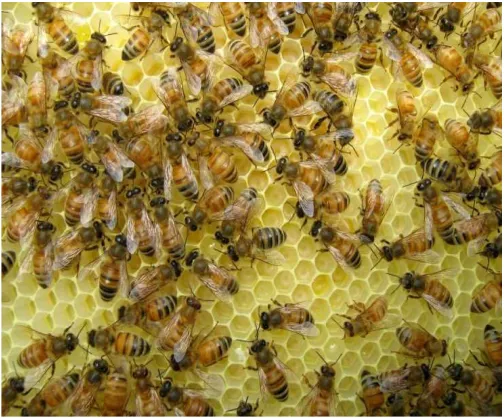
The honeybee’s comb is not just amaze because of the perfect form of hexagonal cells. Furthermore they also can fill every cell with their eggs for the next populations. The egg will turn to larvae, pupae and finally be a new bee in the colony. In addition the bees’ also can fill the cell with pollen which is to feed the egg, and nectar that will convert to honey in a characteristic pattern. The pattern can be differentiating into three parts; for egg (new population), honey and also pollen as shown in Figure 1. When the behavior of bees studied more, the egg and pollen must be closer to each other, because the egg needs a food to live before it can be transformed to a new bee. After the new bees were produced, it needs to work to find the food and honey to their colonies. This process continues until the bees can produce the egg.
Figure 1: The colonies of Bees’
The beauty about the Bees’ working environment, they are working in macroscopic entities that are very small to see by normal eye. Honeybees are suitable for observation and study, because the population or colonies of bees can experimented in a small house or area as shown in Figure 1. For a deeper observation, all bees can be marked with the number to see the movement and interaction among them. The best way to mark all bees is by putting the number on their head. However observe all of these population, the bees must be put in their environment, for the population ecosystem not to be interrupted. Furthermore, the new bees can be determined by the bees without any number that paste on them. In observation also, the behavior of bees can be distinguish for the different three parts for food, egg and honey. All these three parts allocated clearly in several pattern for the process or working of the bees anytime.
Figure 2 shows the structure pattern of bees’ colonies. The hexagonal with grey, white and black colors indicates the honey, pollen and brood respectively. The locations of eggs are more in the hexagonal cells. It is about 54.49% for the eggs while 16.02% and 29.49% for pollen and honey respectively. This percentage shows that the bees are more focused on their colonies and population to increase their community. Meanwhile for the honey collection from bees is about twice of the pollen in the hexagonal cells. In Bees colony, the pollen that collected everyday will be consumed in the same day also, means that they do not keep the pollen for the day after. This shows that the bees are work consistently because they have to find the food (pollen) to survive continuously.
Figure 2: Typical pattern of honey, pollen, and brood (egg)
B. How to forage in Ant colonies?
During collection information and studied about the bees, foraging for the bees need to organized clearly. The recruitment processes were required for the social insects. Recruitment is a collective term for any behavior that results in an increase in the number of individuals at a particular place [5], and allows insect societies to forage efficiently in an environment in which food sources are patchily distributed or are too large to be exploited by single individuals [3, 4, 6]. In addition, the colonies of insect can forage the food in 10km radius. This shows that when the insects finding the food, it can go up to 62.84 km square area. The insects can survive because the area is large compared to the size of the insects. This forage process repeat every day until they want to migrate to another place or location.
The recruitment mechanism can be divided into two classes which are direct and indirect mechanism. Direct mechanism are transferring information, mouth to mouth, speaking and figuratively. The best way to illustrate the direct mechanism is in bees colonies. Some of the bees called ‘dancing bees’ have their own dance language to provide information of direction to their colonies. Successful forages, the recruiters, perform a stylized ‘dance’ which encodes information about the direction and distance of the food source found and up to seven dance followers [9], potential recruits, are able to extract and decrypt this information based on upon bees’ dancer. Then the recruits will place the food in the specific location of cells. These dancing bees are form from several numbers of total populations of bees. Meanwhile indirect mechanism like mass recruitment by way of a chemical trail is an example for this mechanism. By default the recruiter and recruited are not connected physically. The communications among them were by modulation of the environment which is the trail. The recruiters bring back the pheromone to the cells while the recruits follow back the trail. This mechanism pattern is like the process of broadcasting data, which the sender does not care the receiver either it can receiver it or not. The senders not control the receiver, which mean the sender, not block the data for specific receiver only. Radio and television signals broadcasting are the best example to describe the process of broadcasting data.
The concept of trail can be described for ant colonies. Firstly, when the ants want to forage the food for their colonies, it will find randomly to the location that have the food. During the finding process, it will put the pheromone in their path. So the ants at the back will follow the path according to the trail. After reach the place that has the foods, the ants will bring the food back to their colonies. During the path back to the colonies, it also put the pheromone in the path. After some time the vast majority of forages converges on the shorter path [3]. The result of shortest path is the positive feedback process. The trail behavior allowed the ants to know the qualities of the food source that they will take. Ants will put pheromone in their trail depend on the quality of food. The relationship between quantity of pheromone and quality of food is proportional to each other. If the ants found the two source of food in their forage, it will distinguish between two trails, which food is better. So the process is continuous until
the foods are finished or they have enough foods for their colonies.
C. Wireless communication
Wired communication was started in early 1843 by using first commercial telegraph line between two different place which are Baltimore and Washington. The founder of telephone Alexander Graham Bell’s in 1876 had tried for marketing but did not succeed. A public telephone service was available in year 1881, which was a first public voice. Furthermore video service was first available in 1936 between Berlin and Leipzig.
However wireless communication is a process of communication between sender and receiver without any wire connection among them. Lately wireless communications use a light as a reference. The light was either modulated or used signal code words. In early 150 BC, smoke signal was used for communication as mentioned by Polybius, Greece. Furthermore in early Han Dynasty in ancient China (206 BC-24 AD), the light was mostly used in signaling message among capitol of Chang’an (Xi’an). It also important for wireless communication for navy that used radio transmission same goes to the sailor needed to know the meaning of flags when they were in the ocean. Otherwise the wireless communication is failed. Claude Chappe invented a wireless communication technique called optical telegraph in 1794 which was a wireless technique that used for long distance.
III. METHODOLOGY
In this paper, the software used to study the algorithm is NetLogo software version 4.1.1. NetLogo is an open source software that uses Java as their development tools. It is also a multi-agent programmable modeling environment, which a programmer can program and design a model in any environment desired.
To design the bit-communication for artificial swarm, the review about behavior base, collective, biology and sociology about swarm and wireless networking, has to be well understood. The behavior of every swarm agent is different to one another because they have a unique pattern to survive. The communication process in swarm has protocol that needs to be followed in their colonies. After that the process of communication and data transmission in their colony is developed in order to determine their behaviors. By using some understanding, the swarm model can be designed with static and homogeneous agents. The designed model can be either graphically or numerically. Later on the model can be evaluated and analyzed by using statistical method for data averaging, interpretation, and validations.
bits are used in the communication process. For reverse approach, the data can be retransmit or resend back to the sender in the previous cycle. However for non-reverse approach, the data cannot be retransmitted back to the sender in the next cycles. These different approaches are to study the behavior of the swarm during transmitting the data to others. In this paper, the behavior of one-, two-, three-bit communication are studied.
Cue-based model in swarm is the process of indirect communication between the agents. Agents take an action depending on environment cues. Stigmergy is the example of cue-based behavior. Stigmergy is a mechanism that communications occur between agents indirect coordination. The principle of stigmergy is when an agent traces the environment changed or not same with it, it will then change according to the environment. This is because stigmergy is a self-organization and independent. It produces a complexity and seems like intelligent structure, because of without planning, direct communication and control among agents. In addition the stigmergy support simple agent that lacks of information and aware about other agents.
IV. RESULT
The models were tested for 50 times attempt to get the average, number of ticks and margin of error. The result obtained for 1-bit, 2-bit and 3-bit communications are as below:
(a) (b)
(c)
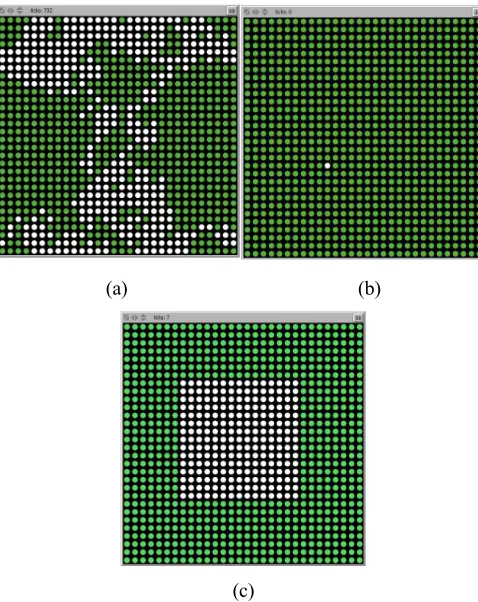
Figure 3: Simulation result; (a) Initial program; (b) After several cycle of simulation; (c) After 7 cycles for cue-based
One agent is randomly selected from the arena as shown in Figure 3(a). The number of agent can be selected for the initialization is only one agent. This is because every program needs to initialize where to start. In real application, like in Penang area, when somebody sees the wave of tsunami at the beach, he wants to tell people about the danger that will occur. After that, he uses his mobile phone to broadcast the data and information about that to other people. Another example can be used is during earthquake. Earthquake can be feel anyway because the vibrations occur randomly in certain area. Due to the concept of suddenly and randomly happen, this initialization can be applied. The best way to describe the concept is passing a baton to another which means that after the baton has been passed, sender does not has the baton anymore. For 1-bit communication, there is only 1 baton exists in the arena.
Furthermore for 2-bit and 3-bit communications, there are 2 and 3 batons respectively, which means that for the initialization, the sender have two or three data to transmit to the nearest receiver. The concept is, when the observer of the event want to send the data, he will choose to send to many receivers that already built in his mobile phone, depending the number of receivers he wants.
However for the cue-based approach, the initialization process is set to the center of the arena. This is the example of the radio and television broadcasting which only one transmitter and others as receiver. In this model, there are 899 agents were used as the receiver.
Figure 3(b) shows the result of simulation in the middle process (at ticks = 732). As continued from Figure 3(a), the data were transmitted from the initial agent to the nearest neighbors. Firstly the agent will determine the nearest neighbors from eight neighbors. For 1-bit communication, it will randomly select one agent to transmit the data. Moreover for 2-bit and 3-bit communications, the data transmit even quicker because any agent that has a data will transmit to its neighbors using n-bit data. In order to make sure that all 900 agents received the data, it is depending on the process for reverse and non-reverse approaches. So, the pattern of distributed data will be different for depending on every trial. The goal is to send the data to all agents. To indicate all 900 agents received the data, all agents will change their color to white.
The cue-based process let the process increments by the factor of square. This is because of the using of rectangular shape in the arena as shown in Figure 3(c). The process of distributed data is determined when an agent found that one of its nearest neighbors has different color with it. After that, it will change it’s color to make it the same with the weird agent previously. In the middle of simulation process, it remains the shape of rectangular until all 900 agents have the same data that represent in white color.
when the number of ticks are 4000, 6000, 8000 and 10000 shows that the margin of error quite high. Averagely half of the agents received data after 200 ticks.
(a) (b)
Figure 4: 1-bit communication (a) reverse approach; (b) non-reverse approach
Figure 5(a) shows the result of 2-bit communication with reverse approach. The margin of error is quite high when the model is in the middle of the process as can be seen in Figure 5(a), in between of 12 to 24 ticks. Half of agents received the data after ticks number 17. The 2-bit communication non-reverse approach as shown in Figure 5(b), obviously a lot of margin error occurred. However the number of tick to complete the process is about 33 ticks.
(a) (b)
Figure 5: 2-bit communication (a) reverse approach; (b) non-reverse approach
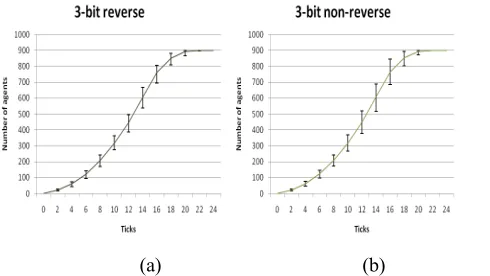
The margin error for 3-bit communication with reverse approach as shown in Figure 6(a) seems like a constant error. Means that the can be predictable for range of error. However in Figure 6(b), the margin error is not constant. The number of ticks need to complete the process is about 24 ticks.
Figure 7 shows the relationship of number of agents against time taken for cue-based approach. This method shows the process of broadcasting data in specific area. The flow is the data will be transmitting to all nearest agents, which mean that there are no random agents will be selected to retrieve the data. This process can be considered as ideal case in communication. The result remained same when tried for several attempt. The possibilities of data can be transmit to all neighbors is 1 because of using 8/8 agents.
(a) (b)
Figure 6: 3-bit communication (a) reverse approach; (b) non-reverse approach
Figure 7: Cue-based communication
V. DISCUSSION
Figure 4 shows the results for 1-bit communication for reverse and non-reverse approaches. From the result, it shows that the reverse approach took longer where it takes more than 26000 cycles to complete the task, as compared with the non-reverse approach which took 16000 cycles. As mentioned previously, the data cannot be retransmitted back to the sender for non-reverse approach. The non-reverse process will increase the probability of being selected to receive the data with ratio of 1/7 instead of 1/8.
Figure 6 shows plots for 3-bit communication, in which its take up to 24 cycles to complete the task. In reality, when using higher bits, the task should be completed quicker. From the graph plotted, the results converge to as similar as a linear graph. After a linear graph obtained, for higher bit-communication, the model can be calculated using a linear equation. This mimic to the cue-based approached as shown in Figure 7, in which the cue-base approach completed the task in only 14 cycles. In addition the probability of an agent will change itself depending on it's environment is 1 because of using all of it's neighbors.
The bit-communication in swarm agent has difference result depending on the number of bits used. From the result obtained in 1-bit communication, it took up to 26000 cycles to disseminate the data to all agents in the arena. The plotted graphs were taken from 50 simulation runs for each technique. The process of 1-bit communication is like passing a ball in the field. However for 2-bit communication, the result seems to complete quicker. This is because the process of transmitting data is in a factor of square. Every agent that has the data can transmit the data to two different agents. It shows that up to 42 cycles are needed to complete the task.
Furthermore, the 3-bit communication technique is quicker compare to other approach because of the factor of transmit data is power of 3, means that the data can send to difference three agents in one cycles. When the process increased up to 4-bit communication process, it does not have slightly increase the performance. This shows that the performance of the 3-bit communication is better that compare to 1-bit and 2-bit communications. However, the complexity of the design for higher bit is higher because it needs the capability to transmit the data to multiple agents in one cycle. In term of cost, it is proportional to the complexity of the design.
Meanwhile for cue-based communication, it is a process of indirect mechanism. The agent will do same as it neighbors when it sees other agent did it. For example of ants, when one
of ant colonies that leaves the pheromone for others ants. The concept of this approach is just follow others compare to previous communication that directs others to do something.
As conclusion the performance of higher bit communication is quicker but more complexity and cost. However by implementing indirect communication like cue-based, it will improve the performance because of the swarm can do something similar as same as source.
REFERENCES
[1] Ball, P. (1999) The self-made tapestry. Pattern formation in nature. Oxford University Press, Oxford UK, 287 pp.
[2] Beckers, R., Deneubourg, J. L. and Goss, S. (1993) Modulation of trail laying in the ant Lasius niger (Hymeoptera: Formicidae) and its role in the collective selection of a food source. Journal of Insect Behavior, 6:751-759.
[3] Beckers, R., Deneubourg, J. L., Gross, S. and Pasteels, J. M. (1990) Collective decision making through food recruitment. Insects Sociaux,
37:258-267.
[4] Beekman, M. and Ratnieks, F. L. W. (2000) Long range foraging by the honeybee Apis mellifera L. Functional Ecology, 14:490-496
[5] Deneubourg, J. –L., Aron, S., Foss, S., Pasteels, J. M. and Duerinck, G. (1986) Random Behaviour, amplification processes and number of participants: how they contribute to the foraging properties of ants.
Physica D, 22:176-186
[6] Detrain, C. and Deneubourg, J. –L. (2002) Complexity of environment and parsimony of decision rules in insect socities. Biological Bulletin,
202:268-274.
[7] Kondo, S. and Asai, R. (1995) A reaction-diffusion wace on the skin of the marine anglefish Pomacanthus. Nature, 376:765-768.
[8] McKay, D. S., Gibson, E. K., Thomas-Keprta, K. L., Vali, H., Romanek, C. S., Clemett, S. J., Chillier, X. D. F., Maechling, C. R. and Zare, R. N. (1996) Search for past life of Mars: possible relic biogenic activity in Martian meteorite ALH84001. Science, 273:924-930.
[9] Tautz, J. and Rohrseitz, K. (1998) What attracts honeybees to a waggle dancer? Journal of Comparative Physiology A, 183:661-667.