THE EFFECTIVENESS OF TEACHING THE
PRESENT PERFECT TENSE THROUGH GAMES
(An Experimental Study at the Tenth Grade Students of MA Jam’iyyah IslamiyyahPondok Aren South – Tangerang)
A “Skripsi”
By:
FUNGKY ANDITASARI 107014000884
ENGLISH EDUCATION DEPARTMENT
FACULTY OF TARBIYAH AND TEACHERS TRAINING
SYARIF HIDAYATULLAH STATE ISLAMIC UNIVERSITY
THE EFFECTIVENESS OF TEACHING THE
PRESENT PERFECT TENSE THROUGH
GAMES
(An Experimental Study at the Tenth Grade Students of MA Jam’iyyah Islamiyyah
Pondok Aren South – Tangerang)
A “Skripsi”
Presented to the Faculty of Tarbiyah and Teacher’s Training
In a Partial Fulfillment of the Requirements for the Degree of Strata 1 (Bachelor of Art) in English Language Education
By:
FUNGKY ANDITASARI 107014000884
Approved by the Advisor
Drs. Sunardi Kartowisastro, Dipl, M. Ed. NIP. 15022779
DEPARTMENT OF ENGLISH EDUCATION
FACULTY OF TARBIYAH AND TEACHERS TRAINING
SYARIF HIDAYATULLAH STATE ISLAMIC UNIVERSITY
ENDORSEMENT SHEET
The Examination Committee of the Faculty of Tarbiyah and Teachers’ Training certifies that the “Skripsi” (Scientific Paper) entitled “THE EFFECTIVENESS OF TEACHING THE PRESENT PERFECT TENSE THORUGH GAMES” (An Experimental Study at the Tenth Grade Students of
SURAT PERNYATAAN KARYA SENDIRI
Saya yang bertanda tangan di bawah ini,
Nama : Fungky Anditasari
Tempat/Tanggal Lahir : Jakarta, 15 Januari 1990
NIM : 107014000884
Program Studi : Pendidikan Bahasa Inggris
Judul Skripsi : The Effectiveness of Teaching the Present Perfect Tense Through Games
Dosen Pembimbing : Drs. Sunardi Kartowisastro, Dipl, M. Ed
Dengan ini menyatakan bahwa skripsi yang saya buat benar-benar hasil karya saya sendiri dan saya bertanggung jawab secara akademis atas apa yang saya tulis. Pernyataan ini dibuat sebagai salah satu syarat menempuh Ujian Munaqasah
Education Department, Faculty of Tarbiya and Teachers’ Training, Syarif Hidayatullah State Islamic University Jakarta.
Advisor : Drs. Sunardi Kartowisastro, Dipl, M. Ed
Key Words : Games Technique, Teaching the Present Perfect Tense, MA Jam’iyyah Islamiyyah South - Tangerang
Pendidikan Bahasa Inggris, Fakultas Tarbiyah dan Ilmu Keguruan, UIN Syarif Hidayatullah Jakarta.
Dosen Pembimbing : Drs. Sunardi Kartowisastro, Dipl, M. Ed
Kata Kunci : Games Technique, Teaching the Present Perfect Tense, MA Jam’iyyah Islamiyyah Tangerang Selatan
In the Name of Allah, the Most Gracious, the Most Merciful
Praise be to Allah, Lord of the worlds, Who has given the writer His love and compassion to finish the last assignment in her study. Peace and salutation be upon the final prophet Muhammad, his family, his companion, and his adherence.
On this occasion, the writer would like to say her great honor and deepest gratitude to her beloved parents: H. Mursid and Poni, and the whole members of the family who always give their love, support, motivation, and advice in accomplishing her study.
The writer would like to extend her thanks to those who have helped her in finishing the skripsi, among others:
1. Drs. Sunardi Kartowisastro, Dipl, M. Ed., her advisor who has patiently given his valuable help, guidance, and corrections to finish this skripsi
2. All lecturers and staffs of English Education Department
3. Drs. Syauki, M. Pd., the Head of English Education Department, and Mrs. Neneng Sunengsih, M. Pd., the Secretary of English Education Department
4. Mrs. Lena Rivai MA. Ph. D., the Dean of the Faculty of Tarbiya and Teachers’ Training Syarif Hidayatullah State Islamic University Jakarta
5. H. Baharuddin, S. Ag., the Head Master of MA Jam’iyyah Islamiyyah Pondok Aren, South - Tangerang who allowed the writer to do research in his school
6. Ahmad Masruri, S. Pd. I., the English teacher of MA Jam’iyyah Islamiyyah Pondok Aren, South - Tangerang, thanks for the assistance and appreciation
7. Feri Setiawan, her husband, thanks for his support, love, the advices, kindness, and everything
8. Her friends who give contribution: Anindita Widiani, Nurul Laili, M and all members of “Pengajian Asrama Polri”
9. All friends in the 2007 English Department, especially class B for sharing their knowledge, time and being good friends.
The words are not enough to say any appreciations for their help and contributions on this skripsi. May Allah SWT protect and give them happiness throughout their life. Finally, the writer realizes that the skripsi is far from being perfect. It is a pleasure for her to welcome constructive criticism and suggestions from the readers.
ACKNOWLEDGEMENT ... iii
TABLE OF CONTENTS ... iv
LIST OF TABLES ... vi
LIST OF APPENDICES ... vii
CHAPTER I : INTRODUCTION A. Background of the Study ... 1
B. The Limitation and Formulation of the Study ... 4
C. Research Problem ... 5
D. The Objective of the Study ... 6
E. Method of Study ... 6
F. The Use of the Study ... 6
G. Organization of Writing ... 7
CHAPTER II : THEORETICAL FRAMEWORK A. Present Perfect Tense ... 8
1. The Meaning of the Present Perfect Tense ... 8
2. The Form of the Present Perfect Tense ... 9
3. The Usage of the Present Perfect Tense ... 13
B. Games ... 14
1. The Meaning of Games ... 14
2. The Form of Language Games ... 15
3. The Principles of Choosing and Using Language Games .... 16
4. The Advantages and Disadvantages of Using Games ... 18
C. Teaching Present Perfect Tense Through Games ... 21
CHAPTER III : RESEARCH METHODOLOGY A. Research Design ... 24
B. Purpose of Research ... 25
C. Place and Time of Research ... 25
D. Population and Sample ... 25
E. Technique of Data Collecting ... 26
C. Test of the Hypothesis ... 44 D. Interpretation of the Data ... 44 CHAPTER V : CONCLUSIONS AND SUGGESTIONS
A. Conclusions ... 46 B. Suggestions ... 47 BIBLIOGRAPHY
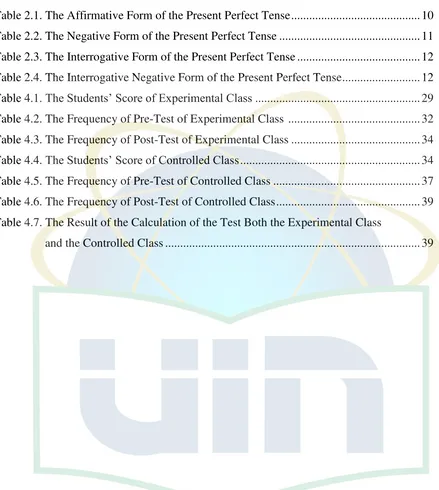
Table 2.2. The Negative Form of the Present Perfect Tense ... 11
Table 2.3. The Interrogative Form of the Present Perfect Tense ... 12
Table 2.4. The Interrogative Negative Form of the Present Perfect Tense ... 12
Table 4.1. The Students’ Score of Experimental Class ... 29
Table 4.2. The Frequency of Pre-Test of Experimental Class ... 32
Table 4.3. The Frequency of Post-Test of Experimental Class ... 34
Table 4.4. The Students’ Score of Controlled Class ... 34
Table 4.5. The Frequency of Pre-Test of Controlled Class ... 37
Table 4.6. The Frequency of Post-Test of Controlled Class ... 39
Appendix 2 : Answer Key of the Instrument of Research Appendix 3 : Kisi – Kisi Soal Pre – Test dan Post – Test Appendix 4 : Lesson Plan
Appendix 5 : Ways of Rule Games Appendix 6 : Excercise Sheets Appendix 7 : Sample of the Research Appendix 8 : T – Table
Appendix 9 : Surat Pengajuan Judul Skripsi Appendix 10 : Surat Bimbingan Skripsi
Appendix 11: Surat Permohonan Izin Penelitian
CHAPTER I INTRODUCTION
A. Background of the Study
In our life, when someone wants to learn English language, he or she should have a capability to learn the rules of English that is grammar. As a result, mastering grammatical rules is urgent for language learners besides mastering the four skills (reading, writing, listening and speaking). By mastering grammar, they will understand the rules and know how the sentences are constructed. As Penny Ur said that “There is no doubt that the knowledge –implicit or explicit- of grammatical rules is essential for mastery of the language: you cannot use words unless you know how they
should be put together”.1
So what is grammar?
Grammar is a description of the way language works. The parts of grammar such as syntax (form), semantic (meaning), and pragmatic (use) work together to enable people to communicate through language with grammar they can communicate their message clearly and precisely. So, the effective communication would be seriously impaired without an ability to put grammar to use in a variety of a situation.
Bowers and Brumfit stated that “Mastering the grammatical structure is necessary in teaching for communication, the learners actively
1
do things through the language that means the learners know how the sentences are constructed”.2
Teaching foreign language grammar has a paramount importance for good command of the foreign language where there is no natural way of acquiring the language as Batstone stated that “Language without grammar would certainly leave us seriously handicapped”.3
Grammar keeps important position in acquiring the four language skills and that is why we should learn grammar well. But the problem is that the learning of grammar for many students is something boring and difficult to memorize the formula of every tense. Because the technique used in teaching learning process is not attractive, so we should look for another way to attract our students in order the teaching learning process is enjoyable and they can get the lesson easily.
Those statements above show us that grammar plays an important role in teaching and learning foreign language.
Talking about grammar, there are many parts to be learnt by
students, and one of the most essential to be learnt is “tense’. And Bauer
stated that “Tense is usually defined as relating to the time of an action,
event or state”.4 The time of the action is commonly expressed by the verb. Almost all verbs can show the difference between the past and present by changing in the verb form. With tense students can know when the time action occurs, and understand the correspondence between the form of the verb and their concept of time.
Allen noted that “English has three main divisions, past, present and future...”5 Absolutely, the verb in English is influenced by the “time”, when it happens or will happen (past, present, or future). So a verb should
relate with the time. When the students want to tell a verb that “used to
2
Roger Bowers, and Christopher Brumfit, Applied Linguistics and English Language Teaching, (London: Macmillan Publishers Limited, 1994), p. 49
3
Rob Batstone, Grammar, (Oxford: Oxford University Press, 1994), p. 3 4
Laurie Bauer, English Word-Formation, (Cambridge: Cambridge University Press, 1983), p. 157 5
indicate an action that took place at an indefinite time or over a period of
time in the past, but still has relevance in the present”6
we call the present
perfect tense. “And the most common time expression is prepositional phrase beginning with for or since. Other such expression includes up to the present/ now, many times, often, frequently, finally, already,etc.”7
The present perfect is not easy to be learnt without a proper way of how to learn it. Mostly, an English teacher uses the conventional or traditional techniques; one of them is Grammar Translation Method
(GTM). Wikipedia writes “The grammar translation method is a method of teaching foreign languages derived from the classical (sometimes called traditional) method of teaching Greek and Latin. In grammar-translation classes, students learn grammatical rules and then apply those rules by translating sentences between the target language and the native
language”.8In this case, English teacher has an important role to stimulate
the students to learn the present perfect tense. Therefore, it is necessary for the teacher to look for a new way in teaching the present perfect tense.
“Games reduce tension by adding fun and humor to lessons, and they add an element of competitiveness that motivates students to
participate (Cross 1992; Martin 2000)”.9
According to Andrew Wright, David Betteridge and Michael Buckby about games, “ „game’ means an activity which is entertaining and engaging, often challenging, and an activity in which the learners play and usually interact with others”.10
Based on talking about the definition of game above, to apply the effective strategy in teaching the present perfect tense to the tenth year students of MA Jam’iyyah Islamiyyah Pondok Aren South - Tangerang, the effective way to teach the present perfect tense is by using games.
6
George E. Wishon and Julia M. Burks, Let’s Write English, Revised edition, (New York: Litton Educational Publishing International, 1980), p. 206
7
George E. Wishon and Julia M. Burks, Let’s Write English, Revised edition, p. 207 8
http://en.wikipedia.org/wiki/Grammar-translation_method 9
Emerita P. Cervantes, Livening Up College English Classes with Games, (English Teaching Forum, Vol. III, 2009), p. 21
10
Because by using games the students can be motivated to learn the present perfect tense and also they focus on the message, not only at the language itself. In addition, it is hoped that the students could be fun and enjoy the lesson because the games will interest to be used and the present perfect subject can be understood well by the students.
In this “skripsi” the writer is interested in finding out the influence of games in teaching learning process of the present perfect tense. The study is done in 10th year of senior high school. Based on the observation many students in this grade still find some difficulties in learning the present perfect tense and also caused by its subject that must be acquired by the students in this grade.
Based on the description above, the title of this skripsi is “THE EFFECTIVENESS OF TEACHING THE PRESENT PERFECT TENSE THROUGH GAMES ( An Experimental Study at the 10th Year Students of MA (Islamic Senior High School) Jam’iyyah Islamiyyah Pondok Aren South - Tangerang )”
B. The Limitation and Formulation of the Study 1. The Limitation of the Study
The target of this study was investigating the effectiveness of teaching the present perfect tense to tenth year students of MA
Jam’iyyah Islamiyyah Pondok Aren South – Tangerang by using games. Furthermore, this study attempted to describe students’ achievemnent in learning the present perfect tense by using games. Where the scopes of the study are limited to subject and object of the research:
a. Subject
The research subject was limited to the tenth year students of MA
b. Object
The research object was limited on the chievement or score of the tenth year students of MA Jam’iyyah Islamiyyah South – Tangerang in learning the present perfect tense through games. 2. The Formulation of the Study
The formulation of the problem in this research is “Can using games improve the score of the students in experimental class?”
To answer this question, the writer tries to apply games as a teaching aid in teaching present perfect tense at the tenth year students of MA (Islamic Senior High School) Jam’iyyah Islamiyyah Pondok Aren, Tangerang.
C. Research Problem
From the background that have been explained before, by using games technique to teach the students the present perfect tense also has some problems in its application. The problems are:
a. Can the games (Using signal, Find Someone Who, Lines-Up)
overcome first year students’ difficulties in learning the present perfect tense at the experimental class of MA Jam’iyyah Islamiyyah South –
Tangerang?
b. Can the games (Using signal, Find Someone Who, Lines-Up) improve
first year students’ achievements and comprehension of the present perfect tense at the experimental class of MA Jam’iyyah Islamiyyah
South – Tangerang?
c. How do the games (Using signal, Find Someone Who, Lines-Up)
improve first year students’ achievements and comprehension of the present perfect tense at the experimental class of MA Jam’iyyah
Islamiyyah South – Tangerang??
d. Is games technique effective to guide tenth year students of MA
D. The Objective of the Study
The objective of the study is to find whether there are any significant different achievements between two classes that one used games in teaching present perfect and the other one did not use it and the difference between the results in the experimental class and the controlled class.
E. Method of Study
Based on the research, there are two ways in collecting data, Library Research and Field Research. Observing some theories and to conduct the library research through reading books and website information as references and reports to support this paper.
In the field research, the writer uses field research that is aimed at collecting data by taking some samples from the tenth year students of MA (Islamic Senior High School) Jam’iyyah Islamiyyah Pondok Aren Tangerang.
This research is an experimental study in which there are experimental class and the controlled class. The writer will take the
pre-test first to know the student’s score in both classes which have the same knowledge, and have not been taught the present perfect tense before. At the end of the experiment, the writer will take the post-test to compare and to know the achievement of students, which is higher score in both classes.
F. The Use of the Study
G. Organization of Writing
This skripsi consists of five chapters. Chapter one is introduction. It covers background of study, limitation and formulation of study, the objective of study, method of study, the use of study and organization of writing.
Chapter two is theoretical framework. This chapter discusses the present perfect tense; the meaning of the present perfect tense, the form of the present perfect tense and the use of the present perfect tense; games, the meaning of games, the form of language games, the principles of choosing and using language games and the advantages and disadvantages of using language games and also thinking framework.
Chapter three is research methodology. The research methodology is divided into six items; they are the purpose of research, place and time of the study, population and sample, technique of data collecting, technique of data analysis and procedure of experiment.
Chapter four is research findings. This chapter discusses data description, data analysis, test of hypothesis, and the interpretation of the data.
CHAPTER II
THEORITICAL FRAMEWORK
A. Present Perfect Tense
1. TheMeaning of the Present Perfect Tense
Grammatical rules have parts of speech. One of them is called verb (main verb and auxiliary verb). Verb is the most complex part of speech. Like many parts of speech, verb also has grammatical properties, one of those grammatical properties is Tense. According to
Marcella Frank “Tense is special verb endings or accompanying auxiliary verbs signal timean event takes place”11
Actually, based on Marcella Frank in her book Modern English,
“English has two kinds of tense-system, six-tense system and two-tense formal system. But the one most commonly found in English text books for non-native speakers and most familiar to them is the six-tense system. It includes past six-tense, present six-tense, future and six-tense and plus three perfect tense; present perfect, past perfect, future perfect”12or it usually known as sixteen tenses.
According to Betty S. Azar, the present perfect tense expresses the idea that something happened (or never happened) before now, at an
11
Marcella Frank, Modern English: a practical reference guide, (New Jersey: Prentice-Hall, 1972), p. 47
12
unspecified time in the past. The exact time happened is not important. The example situation of this, as follows:
Marry is looking for her wallet. She can’t find it. She has lost her wallet.
„She has losther wallet’ means that she lost it in a short time ago,
before now, at an unspecified time in the past.
In addition, Marcella Frank said that “the present perfect tense expresses indefinite time that begins in the past and extends to the present. It is a special kind of past time that ends with the moment of speaking. An event may continue beyond the present moment of speaking, but the statement is not concerned with this segment of time.”13
2. The Form of the Present Perfect Tense
The present perfect tense is a rather important to learn for students because the students have to know the difference between the regular and irregular verbs. Some of the students have confused in using of the present prefect tense. In fact, the structure of the present perfect tense is very simple. The problems come with the use of the tense.
The present perfect tense is formed with the auxiliary verb “have”
in the corresponding form for the subject of the sentence, followed by the participle of the main verb.14Raymond Murphy stated “the present
perfect tense is formed with have/has + the past participle”15
13
Marcella Frank, Modern English: a practical reference guide, (New Jersey: Prentice-Hall, 1972), p. 78
14
http://www.geocities.com/SiliconValley/2527/presentperfect.html#introduction,18
15
According to AJ. Thomson and A. V. Martinet “the present perfect
tense is formed with the present perfect tense of have/has + the past participle, for negative is formed by adding not to the auxiliary. The interrogative is formed by inverting the auxiliary and subject.”16
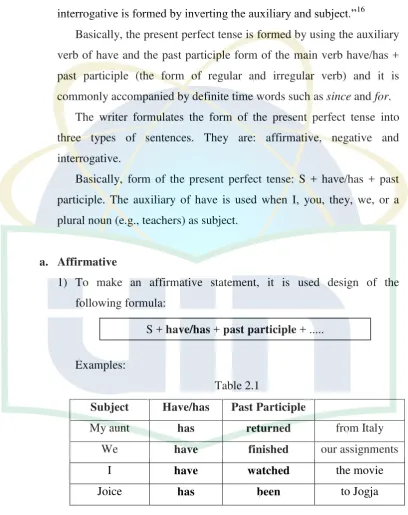
Basically, the present perfect tense is formed by using the auxiliary verb of have and the past participle form of the main verb have/has + past participle (the form of regular and irregular verb) and it is commonly accompanied by definite time words such as since and for.
The writer formulates the form of the present perfect tense into three types of sentences. They are: affirmative, negative and interrogative.
Basically, form of the present perfect tense: S + have/has + past participle. The auxiliary of have is used when I, you, they, we, or a plural noun (e.g., teachers) as subject.
a. Affirmative
1) To make an affirmative statement, it is used design of the following formula:
Examples:
Table 2.1
Subject Have/has Past Participle
My aunt has returned from Italy
We have finished our assignments
I have watched the movie
Joice has been to Jogja
16
A.J Thomson A.V Martinet, A practical English Grammar, (Oxford: Oxford University Press, 1986) 4th ed., p.165
Mark has been sick for a week
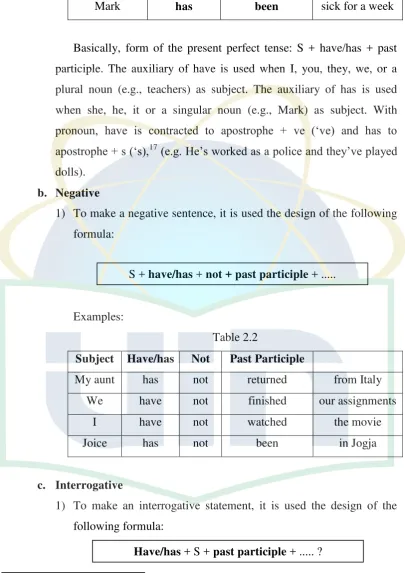
Basically, form of the present perfect tense: S + have/has + past participle. The auxiliary of have is used when I, you, they, we, or a plural noun (e.g., teachers) as subject. The auxiliary of has is used when she, he, it or a singular noun (e.g., Mark) as subject. With
pronoun, have is contracted to apostrophe + ve („ve) and has to apostrophe + s („s),17 (e.g. He’s worked as a police and they’ve played dolls).
b. Negative
1) To make a negative sentence, it is used the design of the following formula:
Examples:
Table 2.2
Subject Have/has Not Past Participle
My aunt has not returned from Italy
We have not finished our assignments
I have not watched the movie
Joice has not been in Jogja
c. Interrogative
1) To make an interrogative statement, it is used the design of the following formula:
17
Betty S. Azar, Understanding and Using English Grammar, (New Jersey: Prentice Hall Regents, 1986), 2nd ed., p.33
S + have/has + not + past participle + ...
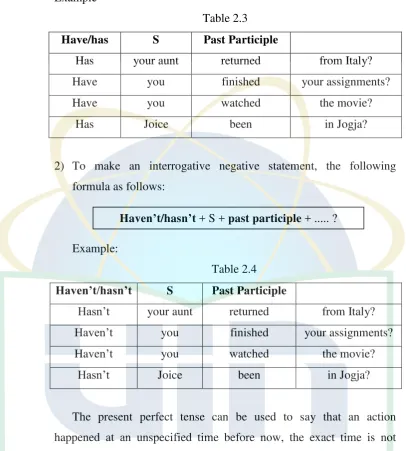
Example
Table 2.3 Have/has S Past Participle
Has your aunt returned from Italy?
Have you finished your assignments?
Have you watched the movie?
Has Joice been in Jogja?
2) To make an interrogative negative statement, the following formula as follows:
Example:
Table 2.4 Haven’t/hasn’t S Past Participle
Hasn’t your aunt returned from Italy?
Haven’t you finished your assignments?
Haven’t you watched the movie?
Hasn’t Joice been in Jogja?
The present perfect tense can be used to say that an action happened at an unspecified time before now, the exact time is not important. It can be used with unspecified expressions such as: never, ever, once, many times, several times, before, so far, already, yet, etc.
Therefore, from the descriptions above the writer can conclude, the present perfect tense is a result that can still feel or happen after something have done, for example: I have already eaten, and that
means “that’s why I don’t feel hungry anymore”.
3. The Usage of the Present Perfect Tense
Betty Schrampfer Azzar said that the present perfect expresses the idea that something happened (or never happened) before now, at an unspecific time in the past, the exact time it is not important.18 She also said that the present perfect also expresses repeated activities that occurred before now.19
Swan said we use the present perfect with ever and never to emphasize that we are talking about the whole of a period of time up until the present.20
In A Practical English Grammar, Thomson and Martinet state when we report that someone has recently invented, produced, discovered or written something chiefly used in conversation, letter and radio reports we use the present perfect.21
From those statements above which is conducted with Thomson statements, the present perfect tense has several usages as follows:22
a. To express past action whose time is not given and not definite. Examples:
I have read the newspaper but I don’t understand them.
Susan has never been to New Zealand
b. To express that an action or event has been repeated. Examples:
We have watched that movie three times He has visited Lampung several times
c. To express the action finished in the past and still progressing now. Examples:
I have lived in Indonesia since 1990 (I still live in Indonesia now) He has been in the army for two years (he is still in the army) d. To refer to the present result of an activity or experience in the
past.
18
Betty Schrampfer Azar, Understanding and Using English Grammar, (New Jersey: Prentice-Hall, Inc., 1989), 2nd ed., p. 29
19 Ibid 20
Michael Swan, Practical English Usage, (Oxford: Oxford University Press, 1987), p. 494 21
A. J. Thomson and A. V. Martinet, Opcit, p. 166 22
Examples:
I have come to school without my glasses (so now I can’t see to
read)
She has finished her works (so now she can sit back and rest)
Some adverbs that often used in present perfect tense.
1. Just: to indicate completed activities in the immediate past.23 Examples:
George has just gone out (he went out a moment ago)
We have just finished breakfast (we finished breakfast a few minutes ago)
2. Already: to say something happened sooner than expected.24 Examples:
‘What time is Mark living?’ ‘He has already gone’
3. Yet: to show that speaker is expecting something to happen. Use yet only in question and negative sentences.
Examples:
Has it stopped raining yet?
I’ve written the letter but I haven’t posted it yet 4. Lately
Examples:
I have been very busy lately
She hasn’t been well lately 5. Recently
Examples:
I’ve seen Michel recently
There have been a lot of changes recently
B. Games
1. The Meaning of Games
Everyone likes to play a game, boy and girl, no matter child or adult. Game is a fun activity to plays that acceptable for children and adult people. As Andrew Wright noted that “... it is generally accepted
that young learners and adults are very willing to play game”.25
23
Raymond Murphy, Opcit, p. 16 24
A. S. Hornby, Guide to Patterns and Usages in English, (Oxford: Oxford University Press, 1975), 2nd ed., p. 494
25
The experts interpreted the meaning of game in many different ways. According to Oxford Advanced Learner’s Dictionary, game is
“A form of competitive play or sport with rules”.26 Also Cambridge Advanced Learner’s Dictionary has stated that game is “An entertaining activity or the equipment needed for such an activity”.27
In her statement, Mania Moayat said that using games could energize in learning a foreign language. At the point when utilizing games within the classroom, it is helpful for educators to have a complete understanding of the meanings of games, which typically are characterized as a manifestation of play concerning guidelines, competition, and a component of fun.28
As discussed on web page, games are fun exercises that push association, considering, learning, and critical thinking methodologies (Amy Talak).29
From the descriptions above, the writer can say that game is an amusing activity, which is carried out by cooperating or competing with a set of rules, beside that the students also get fun in learning activity, in this case, to develop students’ knowledge in grammar especially about present perfect tense.
2. The Form of Language Games
There are many possible techniques in teaching learning process to transfer the teaching points to students such as discussion, the use of pictures, songs, games, and so on.
When teachers use games as a part of teaching techniques, there are also many different versions of each general type of games and each version may give rise to different language skills and be
26
A S Hornby, Oxford Advanced Learner’s Dictionary, (Oxford: Oxford University Press, 1955), 5th ed., p. 486
27 Cambridge Advanced Learner’s Dictionary, (Cambridge: Cambridge University Press, 2008), 3rd ed., p. 590
28
http://files.eric.ed.gov/fulltext/ED529467.pdf 29
appropriate for different levels of language achievement. It is essential to choose games which are appropriate to the class in terms of language and type of participation. Having chosen an appropriate game, its character and the aim of rules must be made clear to the learners.
William Francies Mackey divided games into four points based on the communicative activities which emphasize the four basic skills:
1) Listening game; perception games and comprehension games 2) Speaking game; observation games, guessing games, oral
composition games
3) Reading game; recognition games, comprehension games 4) Writing game; spelling games, composition games30
From the description above, the game technique that the writer uses in research is all the forms of game. They are listening game, speaking game, reading game and writing game which divided into comprehension and composition games.
3. The Principles of Choosing and Using Language Games
In determining the games in developing students’ knowledge about
the present perfect tense, the teachers should have the clear purpose in their mind. If the purpose is to make learning the present perfect tense effectively and successfully, the teachers need to prepare and think the games selection carefully ahead of time before working out the lesson plan, and on the other hand the teachers have to consider the principles of using games.
According to Wright (1982), there are five essential criteria of language games. They are:
30
1) Easy of preparation: the time and energy required to make the games is realistic
2) Easy of organization: using the game is easy and worth the effort 3) Intrinsic language: language must be used to play the games
successfully and that same language must be useful in other situation
4) Density of language
5) Likelihood of interest for the learner31
Based on John De Boer, other criteria’s of good drill for a game used primarily as a learning activity are:
1) The boys and girls should be cognizant of the purpose served by the drill
2) The game should be on the interest level of the participant
3) The game should not interfere with the development of good citizenship
4) If competition is an element of the drill, it should be primarily competition with self, rather than with other
5) The game should be a mean to an end, not an end itself32
Emilio G. Cortez suggests some principles of games selection that the games ought to; strengthen a specific purpose of language that the students need, offer drill for things at one time taught, include numerous parts of the class and not only a few, make a context of the language items connected to the games, contain component of shock or competition, give sufficient movement to elevate and manage interest, be suitable to the development and age levels of the participants and lead in an enough space of the classroom.33
From those theories, the writer concludes that principles of choosing and using games should be easy to prepare and not take too long which can make students feel bored and tired, and also the games
31
Sandra J. Savignon and Margie S. Berns, Initiatives in Communicative Language Teaching II, (Boston: Addison Wesley Publishing Company, 1987), p. 211
32
John J De Boer and Martha Dallmann, The Teaching of Reading, Revised Edition (University of Illinois, Ohio Wesleyan University, 1960) p. 123
33
should be easy to play and have some elements of language teaching beside being capable of entertaining the students.
And teachers also should look out the principle of selecting games before use it, so the games can be accepted by all students in the classroom.
4. The Advantages and the Disadvantages of Using Games a. The Advantages
There are many advantages of using games in English
learning, such as helping the students to reduce students’ boredom and improving students’ interest in learning tenses, make the students feel enjoy and comfortable
Andrew Wright stated the advantages of games are:34
1) Games help and encourage many learners sustain their interest and work.
2) Games also help the teacher to create context in which the language is useful and menaingful. The learners want to take part and in order to do so must understand what other have said and have written, and they must speak or write in order to express their own point of view or give information.
3) Many games cause as much density of practice as more conventional drill exercise.
4) Games can be found to give practice in all the skills (reading, writing, listening and speaking).
5) By making the language convey information and opinion,
games provide the key feature of “drill” with the opportunity to
sense the working of language as living communication.
34
Besides, Rebecca L. Oxford and David Crookal stated that games can encourage good strategies in learning foreign language, they are:
1) Games embody the communicative approach, the goal of which is to develop communicative competence. Games provide active involvement of the whole person (intellectual, physical, social, and emotional) and games also use all four language skills (Listening, Speaking, Reading, and Writing)
2) Games change the roles and relations of learners and teachers in a positive way, encouraging learners to take a more active role in their learning process
3) Games provide large quantities of input, which can be understood because of the meaningful and engaging context of the activity.
4) Games allow attention to be given to language form as well as to content.
5) Games have additional affective advantages, such as reduction of anxiety, increase in positive feelings and improved self confidence.
6) Games can make the participants encouraged to communicate even when their knowledge and competence in the language is less than they would wish.
7) Games help the learners to identify more closely with te target culture.
8) Games encourage adolescents and adults to once again play with symbols.35
Based on the statements above, the writer concludes that there are many advantages of using games in teaching the present perfect tense; most games make learners motivated in learning English, games make the learners encouraged to communicate, relaxed atmosphere created by using games; children remember, think faster and better, games to be a good way of practicing language for they provide a model of what children will use the language for in real life in the future and playing games involves more interactions among the children and their friends.
35
b. The Disadvantages
Games as the alternative teaching technique also have the disadvantages or limitations. The writer assumes that it is difficult to use the games, because in using games, the teachers have to know the principles of games and choosing the suitable of language games. The classes should be planned so that there is a minimum of formal drilling and a maximum of activities. Drs. Soeparno stated that the advantages of using games; games need a big class to involve all of the students in that games, only the certain materials are able to be connected by games and if the number of the participants are large, it can make a noise, so the condition of the class is not effective; games also only used in a lefttime, not in all the time of the class.36
For numerous educators still feel that games ought to be utilized just for a brief time, to give the class a bit of taking a rest from the monitory of boring, and a few educators think about games as an only trivial action (Stephen Mark Silver).37
From the statements above, it can be concluded that; games are generally difficult to apply in a big class, there are some materials of study that could not be communicated by games, games usually make a noise, many teachers still feel that games should be used only for a short time, to give a class a break from monitory of drilling, and some teachers consider games as a merely frivolous activity.
36
Soeparno, Language Teaching Media, (Yogyakarta: PT. Intan Pariwara, 1982) p. 64 37
C. Teaching Present Perfect Tense Through Games
Before the writer teaches, she prepares the suitable material. Preparing suitable material has to do by the teacher in order the teaching learning process run well successfully. So, the writer needs the strategy or technique actively and communicatively.
One of the teaching language strategies that the writers apply is
“Game”. In line with this case, Christ Weckert said, “...games are fun.
Require little or no equipment, and are designed to consolidate grammar learning. They can be played as an integral part of a lesson to focus or review student learning. They can also act as useful lesson breaks and transitions. At the same time, many of games present opportunities for further exploration of the English language and how it works.
In this research, the writer proposed several games (Using Signals, Find Someone Who, Line-Ups) in teaching the present perfect tense. The material and the procedure are as follows:
1) Using Signals
a. Materials
The materials for this game are board, marker, sheets of paper, pen. b. Procedure
1. The writer divides the class into groups of three or four then writes a list of signal words on the board.
Example: already, ever, for, just, many times, never, since, yet 2. Set a time limit (2 minutes, for example) and tell the groups
they must write a grammatical sentence for each signal word (one per sentence). The students should write sentences using different vocabulary words so you will not get
I have already eaten dinner. I have just eaten dinner.
3. Have one student from each group read the group’s answers. Assign one point for each grammatically correct and logical sentence.
2) Find Someone Who38
a. Materials
A set of cards or slips of paper, each of which has a task on it
beginning “find someone who‟ plus the present perfect. b. Procedure
1. The writer gives each student a worksheet. Then the teacher asks all the students to stand up and circulate.
2. All the students ask each other questions such as “Have you
ever been to Beijing?” “Have you ever drunk water from a tap?”
3. If they get answer “yes” they write that person’s name in the space provided. They can only ask someone a question once. 4. The activity ends when a student has got names for each
question. 3) Line-Ups
a. Materials
The material for this game is a set of cards or slips of paper, each of which has size 5 cm x 3 cm.
b. Procedure
1. The writer gives each student a question card. If making own,
use two different colors of 3” x 5” card. Call all students (half
the class) with a yellow card (for example) to the front and have them stand in a line facing the class.
2. The other half of the class stands in front of the first line. If there are an odd number of students, either one questioner waits
38
for someone to question, or the extra person in the answer line waits until the line moves.
3. Each person with a yellow question card (for example) questions the student standing in front of him/her. The student asking the question fills in the blank with the correct form of the verb given on the card. When everyone has answered the question, the students in the answer line move down one and are asked a new question. Continue until all the students in the answer line have talked to every student in the question line. (The students in the question line do not move.)
CHAPTER III
RESEARCH METHODOLOGY
A. Research Design
B. Purpose of Research
This research is aimed to:
a. Find out whether learning the present perfect trough games is effective or not.
b. Know the difference of the students’ achievement results in using games and without games in teaching and learning the present perfect tense.
C. Place and Time of Research
The study was carried out at Madrasah ‘Aliyah (Islamic Senior High School) Jam’iyyah Islamiyyah Pondok Aren South - Tangerang which is located on Jl Pesantren, Jurang Mangu Timur Pondok Aren, Tangerang. The writer conducted the research about five weeks. It was begun by observation and finished by giving the test of understanding the present perfect through games. From March, 11th 2013 up to April, 13th 2013, the writer did the research for six meetings. It consists of giving pre-test, presenting lesson and giving post-test.
D. Population and Sample
E. Technique of Data Collecting
The test was used to collect data. The pre-test and post-test were administered to experimental and control classes. The pre-test was done before the teaching learning process and the post-test was done after teaching learning process. The pre-test was done in order to know the
homogeneity of two classes and student’s knowledge of the present perfect
tense. While, the post-test was done in order to know the influence and the effectiveness of using games in teaching the present perfect tense.
F. Technique of Data Analysis
Data analysis is the last step in the procedure of research. In analyzing the data of the pre-test and post-test, the writer used the statistical calculation of T-test. T-test is used in order to find out the differences of the result or score of student’s achievement in teaching the present perfect through games and without games.
After getting the data, they are preceded and analyzed through the following:
a. Seeking gained score from student’s test of the present perfect items and describing it in the table. The gained scores of experimental class are variable I that symbolized by X and the gained scores of control class are variable II that symbolized by Y
b. Determining mean of variable of experimental class with formula MX= ∑X
N
c. Determining mean of variable of control class with formula MY= ∑Y
N
d. Determining Standard of Deviation Score of Variable X (SD1), with formula:
e. Determining Standard of Deviation Score of Variable Y (SD2), with formula:
=
√
f. Determining Standard Error of Mean of Variable X, with formula: SEM1 =
√
g. Determining Standard Error of Mean of Variable Y, with formula: SEM2 =
√
h. Determining Standard Error of Difference of Mean of Variable X and Variable Y, with formula:
SEM1-M2 = √ i. Determining to with formula:
to =
j. Determining t-table in significance level 5% with Degree of Freedom (df):
df = (N1 + N2) – 2
k. Analyzing the result by using statistic calculation of T-Test l. Giving interpretation
G. Procedure of Experiment
The writer performed several steps before doing the experiment as follows:
a. The writer made the research letter, and he asked permission to the headmaster of the school where the writer wanted to conduct the research.
c. Before treating the students using games in teaching present perfect tense in experimental class and without games in control class, the writer gave a pre-test to all of students in experimental class and control class with the same instrument to know the students comprehension of Present Perfect Tense.
d. The next step was treatment, where the experimental class would be taught present perfect tense by using games and the control class would be taught present perfect tense without games.
e. Post-test was given after finishing the treatment to both classes; the experimental class and the control class; the test items are same like pre-test.
CHAPTER IV RESEARCH FINDINGS
1. The Data Description
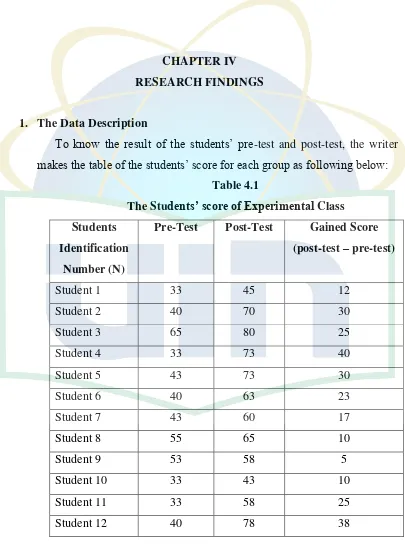
To know the result of the students’ pre-test and post-test, the writer
makes the table of the students’ score for each group as following below:
[image:40.595.112.517.204.748.2]Table 4.1
The Students’ score of Experimental Class Students
Identification Number (N)
Pre-Test Post-Test Gained Score (post-test – pre-test)
Student 1 33 45 12
Student 2 40 70 30
Student 3 65 80 25
Student 4 33 73 40
Student 5 43 73 30
Student 6 40 63 23
Student 7 43 60 17
Student 8 55 65 10
Student 9 53 58 5
Student 10 33 43 10
Student 11 33 58 25
Student 13 85 93 8
Student 14 40 85 45
Student 15 58 60 2
Student 16 38 80 42
Student 17 80 93 13
Student 18 43 70 27
Student 19 48 60 12
Student 20 35 80 45
Student 21 75 93 18
Student 22 63 88 25
Student 23 78 95 17
Student 24 38 58 20
Student 25 70 78 8
∑ 1262 1799 547
Average 50,48 71,96 21,88
The table 4.1 above describes that the lowest score in the pre-test is 33 and the highest score is 85. Meanwhile, the lowest score in the post-test is 43 and the highest score is 95. Therefore, it can be summarized that the lowest score and the highest score in the post-test is higher than in the pre-test.
To make the gained score clear which has been gotten by the students in the experimental class, based on the data which is founded that the average of gained scores between pre-test and post-test in experimental class is 21,88.
1) Pre-test Statistic Data of Experimental Class Frequency Distribution
a. Students’ Scores
53 55 58 63 65 70 75 78 80 85
The data above is the students’ score of the experimental class from
the lowest score to the highest score on pre-test.
b. Highest Score (H) and Lowest Score (L) H = 85
L = 33
The data above shows the highest score and the lowest score on pre-test in the experimental class.
c. Range R = H - L = 85 – 33 = 52
The range score above is the result of the subtraction between the highest score and the lowest score on pre-test in the experimental class.
d. Number of Class K = 1 + 3.3 log N = 1 + 3.3 log 25 = 1 + 3.3 . 1.39 = 1 + 4.5 = 5.5 = ~ 6
The “K” formula is obtained to determine the number of interval in the experimental class and the result means close or equal to 6.
= ~9
[image:43.595.111.515.213.681.2]The result above in determining class interval by dividing the range score with the number of interval in the experimental class and the result is close or equal to 9.
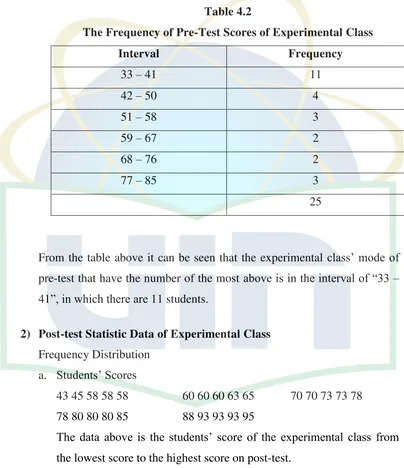
Table 4.2
The Frequency of Pre-Test Scores of Experimental Class
Interval Frequency
33 – 41 11
42 – 50 4
51 – 58 3
59 – 67 2
68 – 76 2
77 – 85 3
25
From the table above it can be seen that the experimental class’ mode of pre-test that have the number of the most above is in the interval of “33 – 41”, in which there are 11 students.
2) Post-test Statistic Data of Experimental Class Frequency Distribution
a. Students’ Scores
43 45 58 58 58 60 60 60 63 65 70 70 73 73 78 78 80 80 80 85 88 93 93 93 95
The data above is the students’ score of the experimental class from
the lowest score to the highest score on post-test.
L = 43
The data above shows the highest score and the lowest score on post-test in the experimental class.
c. Range R = H - L = 95 – 43 = 52 = 52
The range score above is the result of the subtraction between the highest score and the lowest score on post-test in the experimental class.
d. Number of Class K = 1 + 3.3 log N = 1 + 3.3 log 25 = 1 + 3.3 . 1.39 = 1 + 4.5 = 5.5 ~ 6
The “K” formula is obtained to determine the number of interval in the experimental class on post-test. The result means close or equal to 6.
e. Interval I = R/K = 52/6 = 8.7 ~ 9
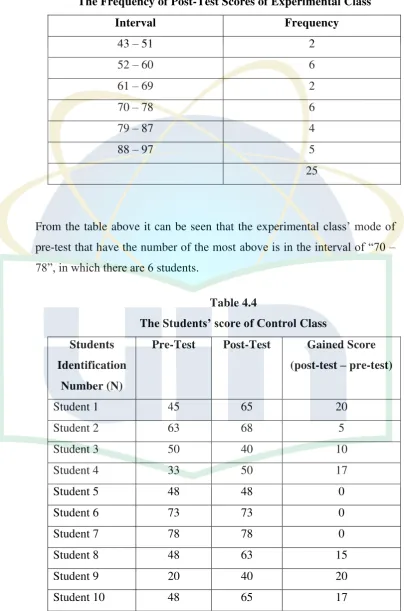
Table 4.3
The Frequency of Post-Test Scores of Experimental Class
Interval Frequency
43 – 51 2
52 – 60 6
61 – 69 2
70 – 78 6
79 – 87 4
88 – 97 5
25
From the table above it can be seen that the experimental class’ mode of pre-test that have the number of the most above is in the interval of “70 –
78”, in which there are 6 students.
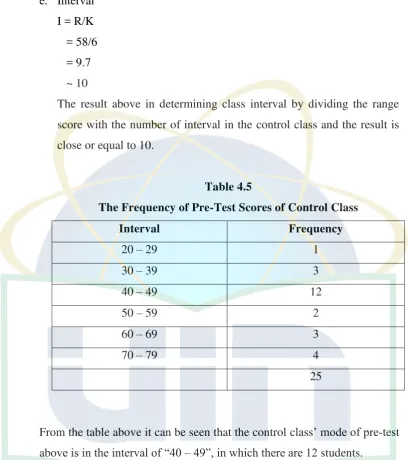
[image:45.595.114.519.140.752.2]Table 4.4
The Students’ score of Control Class Students
Identification Number (N)
Pre-Test Post-Test Gained Score (post-test – pre-test)
Student 1 45 65 20
Student 2 63 68 5
Student 3 50 40 10
Student 4 33 50 17
Student 5 48 48 0
Student 6 73 73 0
Student 7 78 78 0
Student 8 48 63 15
Student 9 20 40 20
Student 11 45 45 0
Student 12 68 75 7
Student 13 43 70 27
Student 14 38 38 0
Student 15 78 78 0
Student 16 38 40 2
Student 17 43 45 2
Student 18 40 65 25
Student 19 60 68 8
Student 20 53 70 17
Student 21 45 45 0
Student 22 43 50 7
Student 23 78 85 7
Student 24 45 50 5
Student 25 48 83 35
∑ 1271 1497 246
Average 50,84 59,88 9,84
The table 4.4 above describes that the lowest score in the pre-test is 20 and the highest score is 78. Meanwhile, the lowest score in the post-test is 38 and the highest score is 85. Therefore, it can be summarized that the lowest score and the highest score in the post-test is higher than in the pre-test.
1) Pre-test Statistic Data of Control Class Frequency Distribution
a. Students’ Scores
20 33 38 38 40 43 43 43 45 45 45 45 48 48 48 48 50 53 60 63 68 73 78 78 78
The data above is the students’ score of the control class from the
lowest score to the highest score on pre-test.
b. Highest Score (H) and Lowest Score (L) H = 78
L = 20
The data above shows the highest score and the lowest score on pre-test in the control class.
c. Range R = H - L = 78 – 20 = 58
The range score above is the result of the subtraction between the highest score and the lowest score on pre-test in the control class.
d. Number of Class K = 1 + 3.3 log N = 1 + 3.3 log 25 = 1 + 3.3 . 1.39 = 1 + 4.5 = 5.5 = ~ 6
e. Interval I = R/K = 58/6 = 9.7 ~ 10
[image:48.595.110.519.120.581.2]The result above in determining class interval by dividing the range score with the number of interval in the control class and the result is close or equal to 10.
Table 4.5
The Frequency of Pre-Test Scores of Control Class
Interval Frequency
20 – 29 1
30 – 39 3
40 – 49 12
50 – 59 2
60 – 69 3
70 – 79 4
25
From the table above it can be seen that the control class’ mode of pre-test above is in the interval of “40 –49”, in which there are 12 students.
2) Post-test Statistic Data of Control Class Frequency Distribution
a. Students’ Scores
38 40 40 40 45 45 45 48 50 50 50 63 65 65 65 68 68 70 70 73 75 78 78 83 85
The data above is the students’ score of the control class from the
b. Highest Score (H) and Lowest Score (L) H = 85
L = 38
The data above shows the highest score and the lowest score on post-test in the control class.
c. Range R = H - L = 85 - 38 = 47
The range score above is the result of the subtraction between the highest score and the lowest score on post-test in the control class.
d. Number of Class K = 1 + 3.3 log N = 1 + 3.3 log 25 = 1 + 3.3 . 1.39 = 1 + 4.5 = 5.5 ~ 6
The “K” formula is obtained to determine the number of interval in the control class on post-test. The result means close or equal to 6.
e. Interval I = R/K = 47/6 = 7.8 ~ 8
Table 4.6
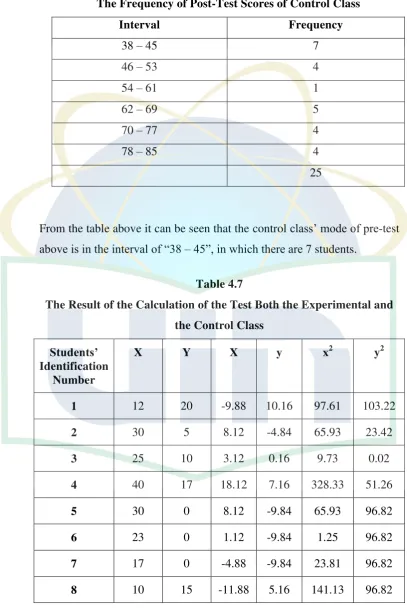
The Frequency of Post-Test Scores of Control Class
Interval Frequency
38 – 45 7
46 – 53 4
54 – 61 1
62 – 69 5
70 – 77 4
78 – 85 4
25
From the table above it can be seen that the control class’ mode of pre-test
[image:50.595.110.518.138.747.2]above is in the interval of “38 –45”, in which there are 7 students.
Table 4.7
The Result of the Calculation of the Test Both the Experimental and the Control Class
Students’ Identification
Number
X Y X y x2 y2
1 12 20 -9.88 10.16 97.61 103.22
2 30 5 8.12 -4.84 65.93 23.42
3 25 10 3.12 0.16 9.73 0.02
4 40 17 18.12 7.16 328.33 51.26
5 30 0 8.12 -9.84 65.93 96.82
6 23 0 1.12 -9.84 1.25 96.82
7 17 0 -4.88 -9.84 23.81 96.82
9 5 20 -16.88 10.16 284.93 103.22
10 10 17 -11.88 7.16 141.13 51.26
11 25 0 3.12 -9.84 9.73 96.82
12 38 7 16.12 -2.84 259.85 8.06
13 8 27 -13.88 17.16 192.65 294.46
14 45 0 23.12 -9.84 534.53 96.82
15 2 0 -19.88 -9.84 395.21 96.82
16 42 2 20.12 -7.84 404.81 61.46
17 13 2 -8.88 -7.84 78.85 61.46
18 27 25 5.12 15.16 26.21 229.82
19 12 8 -9.88 -1.84 97.61 3.38
20 45 17 23.12 7.16 534.53 51.26
21 18 0 -3.88 -9.84 15.05 96.82
22 25 7 3.12 -2.84 9.73 8.06
23 17 7 -4.88 -2.84 23.81 8.06
24 20 5 -1.88 -4.84 3.53 23.42
25 8 35 -13.88 25.16 192.65 633.02
∑ MX =
547/25 = 21.88
MY = 246/25
= 9.84
- - 3938.53 2489.42
Note :
X = the student’s gained scores of the experimental class
Y = the student’s gained scores of the control class x = X – MX
2. The Data Analysis
Statistic calculation of the t-test formula with degree of significance 5% was used to analyze the data from the result of pre-test and post-test. It follows:
a. Determining Mean 1 (MX) with formula:
=
= 21.88
b. Determining Mean 2 (MY) with formula:
=
= 9.84
c. Determining Standard of Deviation Score of Variable X (SD1), with formula:
=
√
=
√
d. Determining Standard of Deviation Score of Variable Y (SD2), with formula:
=
√
=
√
= √
= 9.97
e. Determining Standard Error of Mean of Variable X, with formula: SEM1 =
√
=
√
=
= 2.56
f. Determining Standard Error of Mean of Variable Y, with formula: SEM2 =
√
=
√
=
= 2.03
g. Determining Standard Error of Difference of Mean of Variable X and Variable Y, with formula:
= √ = √ = √ = 3.26
h. Determining to with formula:
to =
=
=
= 3.69
i. Determining t-table in significance level 5% with Degree of Freedom (df):
df = (N1 + N2) – 2 = (25 + 25) – 2 = 50 – 2 = 48
Use next lowest value, 60, to find α = .05
df = 60 (see the table of “t” values at the significance level of 5% = 1.67)
j. The comparison between t- and t-table values
The calculation result above proves that the score of experimental class is higher than the score of control class. The result of the comparison between to and t-table as follows:
3. Test of the Hypotheses
The writer should propose alternative hypothesis (Ha) and null hypothesis (Ho) as follows:
a. Null Hypothesis (Ho): there is no significant difference between students who are taught the present perfect tense by using games (Experimental Class) and who are taught the present perfect tense without games (Control Class) to the tenth year students of MA (Islamic Senior High School) Jam’iyyah Islamiyyah Pondok Aren Tangerang.
b. Alternative Hypothesis (Ha): there is significant difference between students who are taught the present perfect tense by using games (Experimental Class) and who are taught the present perfect tense without games (Control Class) to the tenth year students of MA (Islamic Senior High School) Jam’iyyah Islamiyyah Pondok Aren Tangerang.
4. Interpretation of the Data
The data were obtained from the students’ achievement scores of
the test of present perfect tense. They were pre-test and post-test scores from the experimental and control class. The average score for experimental class was 50.48 (pre-test) and 71.96 (post-test). The average score for control class was 50.84 (pre-test) and 59.88 (post-test). The following was the simple tables of pre and post-test students’ average score.
From the comparison between the value of to = 3.69 and the ttable on the degree of significance 5% = 1.67, it is proven that to was higher than ttable. Based on this finding, it can be concluded that the hypothesis that the alternative hypotheses (Ha) are accepted and the null hypotheses (Ho) are rejected.
Based on the result, the data shows that result test in experimental class is higher than result of test in control class. It can be concluded that students in experimental class have higher motivation in learning present perfect tense, thus, their achievement in post-test is better.
CHAPTER V
CONCLUSSIONS AND SUGGESTIONS
In this chapter, the writer would like to present the result gained from the research in the forms of conclusions and suggestions. The conclusions are formulated from the calculations of the gathered data, with the main function to provide answers for the question of the research and accomplish the research objective stated in Chapter I. The suggestions are formulated based on the conclusions as well as from the conditions and occurrences observed by the writer throughout the research, especially during the giving of the treatments to the research subjects.
A. Conclusions
After conducting the research and calculating all the data, it can be
conclude that the games can improve the students’ comprehension of the
present perfect tense. It can be seen from the following facts;
a. Students’ achievements of the experimental class had high improvement. It can be seen from the average score got by the students on post test was 71,96, whereas most of the students got the average score on pre test was 50,48.
formulated to > ttable therefore the alternative hypothesis (Ha) is accepted and the null hypothesis (Ho) is rejected. Based on this finding can be concluded that Games Technique has a significant effect on the
students’ understanding of Present Perfect Tense and that teaching Present Perfect Tense by using Games Technique is more effective than without using Games Technique.
c. Students were actively involved in teaching and learning activities such as playing the games, writing sentences of the present perfect tense, etc. The result of the observation sheet has showed the data.
B. Suggestions
There are some suggestions for the writer herself and English teacher after conducting the research:
a. The teacher is suggested to modify the games as attractive as she can in order students do not feel bored in learning English.
b. In choosing topic of teaching and learning, the teacher suggested to choose more interesting topic that can motivate students learning English.
c. The teacher is hoped can give much motivation to students in order they can improve their speaking ability especially while playing the games.
Azzar, Betty Schrampfer, Understanding and Using English Grammar, New Jersey: Prentice-Hall, Inc, 1989.
Batstone, Rob, Grammar, Oxford: Oxford University Press, 1994.
Bauer, Laurie, English Word-Formation, Cambridge: Cambridge University Press, 1983. Bowers, Roger and Christopher Brumfit, Applied Linguistics and English Language
Teaching, London: Macmillan Publishers Ltd, 1991.
Cervantes, Emerita P, English Teaching Forum: Livening Up College English Classes with Games, Number 3.
Cortez, Emilio G, English Teaching Forum: Some pointers on using games, Vol.XIII, 1975. De Boer, John J and Martha Dallmann, The Teaching of Reading, Revised Ed. Ohio:
University of Illinois, Ohio Wesleyan University, 1960.
Harmer, Jeremy, The Practice of English Language Teaching, New York: Longman Publishing, 1991.
Hornby, A. S, Guide Patterns and Usages in English, Oxford: Oxford University Press, 1975. Mackey, William Francies, Language Teaching Analysis, London: Longmans, Green and
Co, Ltd, 1965.
Murphy, Raymond, English Grammar in Use, Cambridge: Cambridge University Press, 1994.
Oxford, Rebecca L and David Crookal, Simulation, Gaming and Language Learning, New York: Newbury House Publisher, 1990.
Pierson, Ruth and Susan Vik, Making Sense in English Grammar in Context, Boston: Addison – Wesley Publishing Company, Inc, 1987.
Richards, Jack C, and Theodore S. Rodgers. Approaches and Methods in Language
Teaching: a description and analysis, Cambridge: Cambridge University Press, 1986. Savignon Sandra J and Margie S. Berns, Initiatives in Communicative Language Teaching II,
Soeparno, Language Teaching Media, Yogyakarta: PT. Intan Pariwara, 1982.
Thomson, A. J and A. V. Martinet, A Practical English Grammar, Oxford: Oxford University Press, 1986.
Ur, Penny, Grammar Practice Activities: a practical guide for teachers, Cambridge: Cambridge University Press, 1988.
Veit, Richard, Discovering English Grammar, Boston: Houghton Mifflin Company, 1986. Wishon, George E, and Julia M. Burks, Let’s Write English: Revised Edition, New York:
Litton Educational Publishing International, 1980.
1. Johnson has ... in Yogyakarta since 1999.
a. living b. lives c. live d. lived
2. I ... watched the movie The Lord of The Ring three times. I want to see it
again.
a. had b. has c. have d. am watching
3. The old car ... in that garage since two years ago.
a. is b. has been c. was d. has being
4. ... the show begun?
a. has b. have c. had d. do
5. I could not get a room at the Sangrila Hotel because I ... reservation.
a. had not