• Tidak ada hasil yang ditemukan

Practice

N/A
N/A
Protected

Academic year: 2017

Membagikan "Practice"

Copied!
82
0
0

Teks penuh

  • Sekolah: Standard University
  • Mata Pelajaran: Database Management
  • Topik: Oracle Database 10g: SQL Fundamentals I
  • Tipe: practice document
  • Tahun: 2023
  • Kota: Standard City

I. Practice 1

This section focuses on testing the knowledge of SQL commands and understanding the structure of the database tables. It includes exercises that require the learner to initiate an iSQL*Plus session and execute various SQL statements to retrieve and manipulate data from the Human Resources tables.

1.1 Test Your Knowledge

A series of true/false questions and SQL statement evaluations are provided to assess the learner's understanding of SQL syntax and database operations. For instance, learners are asked to identify errors in SQL statements and determine the success of SELECT commands.

1.2 Task Assignments

Learners are tasked with creating SQL queries to display specific data from the DEPARTMENTS and EMPLOYEES tables, including formatting outputs and saving SQL statements in designated files for submission to the HR department.

II. Practice 2

This section presents additional challenges for learners to create SQL queries based on specific requests from the HR department. It emphasizes the need for precise data retrieval and manipulation based on various criteria.

2.1 Query Creation

Learners are instructed to write SQL queries that return employee data based on salary thresholds, department numbers, and other conditions. Examples include generating reports for employees earning above a specified salary and those hired in a particular year.

2.2 Report Formatting

This subsection focuses on enhancing report readability by renaming columns and ordering results. Learners are encouraged to practice using aliases and organizing output for better clarity.

III. Practice 3

In this section, learners write SQL queries that involve date calculations and string manipulations. The exercises are designed to deepen their understanding of SQL functions and data types.

3.1 Date Functions

Learners create queries to display current dates, calculate employment duration, and format output dates. The focus is on using date functions effectively to derive meaningful insights from the data.

3.2 String Manipulation

Exercises in this subsection challenge learners to manipulate string data, such as formatting employee names and calculating salary projections. This builds proficiency in handling text data within SQL.

IV. Practice 4

This section introduces learners to group functions and aggregate queries. It emphasizes the importance of summarizing data and generating reports that provide insights into employee salaries and job distributions.

4.1 Aggregate Functions

Learners practice writing queries that use aggregate functions like MAX, MIN, SUM, and AVG to analyze employee salary data. The exercises require them to group results by job type and manager.

4.2 Grouping and Filtering

This subsection focuses on using GROUP BY and HAVING clauses to filter aggregated results. Learners are encouraged to think critically about how to structure their queries for effective data analysis.

V. Practice 5

This section challenges learners to write more complex SQL queries that involve joins and subqueries. The goal is to retrieve related data from multiple tables and present it cohesively.

5.1 Joins

Learners are tasked with creating queries that join multiple tables, such as EMPLOYEES and DEPARTMENTS, to produce comprehensive reports. They learn how to use INNER JOIN, LEFT JOIN, and other join types effectively.

5.2 Subqueries

This subsection emphasizes writing subqueries to filter main query results based on related data. Learners practice crafting nested queries to enhance their data retrieval capabilities.

VI. Practice 6

This section focuses on more advanced SQL concepts, including the use of set operators and compound queries. Learners explore how to combine results from multiple queries to provide a broader view of the data.

6.1 Set Operators

Learners practice using UNION, INTERSECT, and MINUS to combine results from different queries. This section encourages them to think about how to present data from various perspectives.

6.2 Compound Queries

This subsection discusses the importance of creating compound queries that return comprehensive results from multiple tables. Learners are tasked with writing queries that fulfill specific reporting requirements.

VII. Practice 7

In this section, learners are introduced to data manipulation commands, including INSERT, UPDATE, and DELETE. The focus is on managing employee data and understanding transaction control.

7.1 Data Insertion

Learners practice writing INSERT statements to populate tables with employee data. They learn how to structure their queries for effective data entry.

7.2 Data Updates and Deletions

This subsection emphasizes the importance of maintaining data integrity through UPDATE and DELETE commands. Learners are tasked with modifying existing records and removing unnecessary data.

VIII. Practice 8

This section concludes the practice exercises by focusing on views and sequences. Learners explore how to create and manage database views for secure data access.

8.1 Creating Views

Learners are instructed on how to create views to simplify data access for specific user roles. The exercises highlight the importance of security and data abstraction.

8.2 Using Sequences

This subsection covers the creation and utilization of sequences for generating unique identifiers in tables. Learners understand how sequences can streamline data entry processes.

IX. Practice 9

This section covers the creation of new tables and the management of existing ones. Learners focus on defining table structures and populating them with relevant data.

9.1 Table Creation

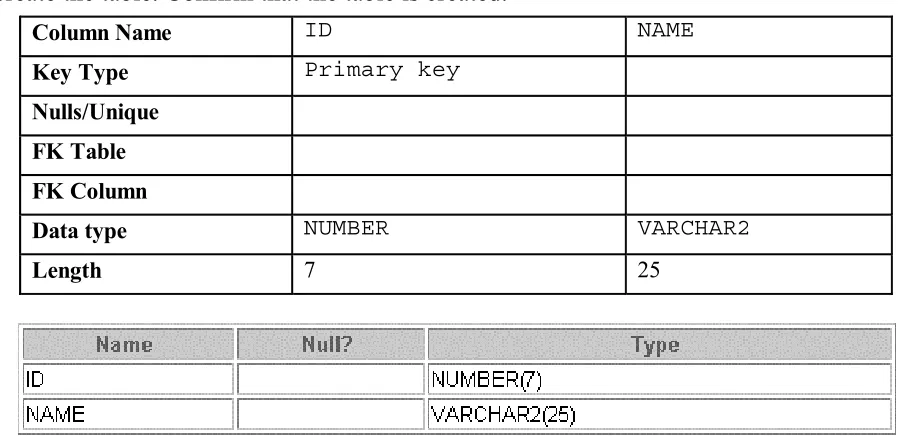
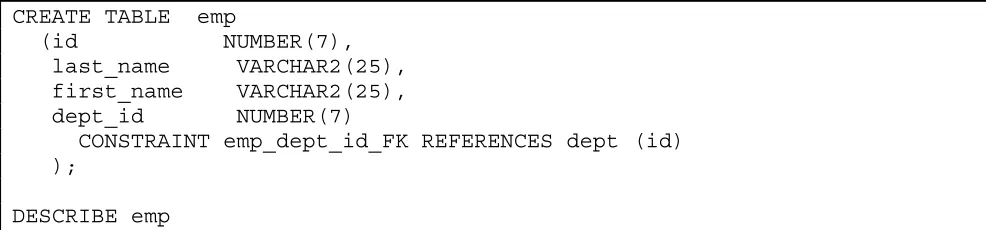
Learners practice writing SQL scripts to create new tables based on specified structures. They learn about data types, constraints, and primary keys.

9.2 Data Population

This subsection emphasizes inserting data into newly created tables and verifying the integrity of the inserted data. Learners understand the importance of maintaining accurate records.

X. Practice 10

In this final section, learners explore advanced SQL concepts, including comments, constraints, and data dictionary queries. The focus is on enhancing their overall understanding of database management.

10.1 Adding Comments and Constraints

Learners practice adding comments to tables and defining constraints to enforce data integrity. This section highlights the importance of documentation in database management.

10.2 Querying Data Dictionary

This subsection focuses on querying the data dictionary to retrieve metadata about database objects. Learners understand how to leverage this information for effective database management.

Gambar

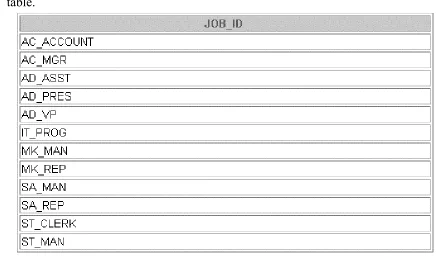
table.Oracle Database 10g: SQL Fundamentals I   1 - 40
table. Confirm that the table is created.

Referensi

Garis besar

Dokumen terkait

What makes this method even better than just giving great information away is the fact that you create a product that is chock full of back-end affiliate links for those that receive

The map frame contains PDF dictionary entries that describe the coordinate transformation matrix, all parameters required for a map projection (if used), the reference ellipsoid

(The following screenshot shows the Dialog form open in Design view.) To specify a record source for the form (the table or query that contains the records you want to display

Pond of the Mechanics Institute of Rochester, giving the needs and conditions of the pottery and modeling departments and stating that there was an opening for an instructor.. I

2 INSTRUCTOR: ROBERT LIPSHITZ b Find a basis for R2 with respect to which the matrix for F is diagonal.. Hint: there is a vector v so that Fv

Relative weight: The relative weight for each technical descriptor is determined by taking the dot product of the column in the relationship matrix and the column for absolute weight in

Conclusion In summary, this study found that job security, salary and working conditions significantly and positively influence job satisfaction among the Polytechnic academic

A good job application letter sparked the interest of recruiters companies/organizations and create the impression that the job applicant is personally competent.. Job application