UNIVERSITI TEKNIKAL MALAYSIA MELAKA
A FEASIBILITY STUDY OF 3D PRINTER PARAMETERS
OPTIMIZATION BY USING BAMBOO POWDERS
This report submitted in accordance with requirement of the Universiti Teknikal Malaysia Melaka (UTeM) for the Bachelor Degree of Manufacturing Engineering
(Design)
by
ABDUL ALIF BIN ABDUL AZIZ B050810322
UNIVERSITI TEKNIKAL MALAYSIA MELAKA
BORANG PENGESAHAN STATUS LAPORAN PROJEK SARJANA MUDA
TAJUK: A Feasibility Study of 3D Printer Parameters Optimization by Using Bamboo Powders
SESI PENGAJIAN: 2010/ 2011
Saya ABDUL ALIF BIN ABDUL AZIZ
mengaku membenarkan Laporan PSM ini disimpan di Perpustakaan Universiti Teknikal Malaysia Melaka (UTeM) dengan syarat-syarat kegunaan seperti berikut:
1. Laporan PSM adalah hak milik Universiti Teknikal Malaysia Melaka dan penulis. 2. Perpustakaan Universiti Teknikal Malaysia Melaka dibenarkan membuat salinan untuk
tujuan pengajian sahaja dengan izin penulis.
3. Perpustakaan dibenarkan membuat salinan laporan PSM ini sebagai bahan pertukaran antara institusi pengajian tinggi. kepentingan Malaysia yang termaktub di dalam AKTA RAHSIA RASMI 1972)
DECLARATION
I hereby, declared this report entitled “A Feasibility Study of 3D Printer Parameters Optimization by Using Bamboo Powders” is the results of my own research except
as cited in references.
Signature : ...
Author’s Name : ABDUL ALIF BIN ABDUL AZIZ
APPROVAL
This report is submitted to the Faculty of Manufacturing Engineering of UTeM as a partial fulfillment of the requirements for the degree of Bachelor of Manufacturing Engineering (Manufacturing Design) with Honours. The member of the supervisory committee is as follow:
(Signature of Supervisor) ………
i
ABSTRAK
ii
ABSTRACT
iii
DEDICATION
iv
ACKNOWLADGEMENT
In the name of ALLAH, the most gracious, the most merciful.
First of all, I am very thankful to ALLAH S.W.T, for giving me strength and opportunity to finish my “Projek Sarjana Muda”. With full of His merciful, now I am writing this report of this project.
I am grateful and would like to express my sincere gratitude to my supervisor Puan Rahimah Bt. Haji Abdul Hamid for her germinal ideas, invaluable guidance, continuous encouragement and constant support in making this study possible. She has always impressed me with his outstanding professional conduct. I am truly grateful for his the time spent proofreading and correcting my many mistakes, his tolerance of my naive mistakes, and his commitment to my future career.
v
2.1 Overview of Rapid Prototyping Technology 6
2.1.1 Application and advantage 6
2.1.2 Working principle 7
2.2 3D Printer Parameters 8
2.2.1 Build Orientation (Part Placement) 9
2.2.2 Layer Thickness (mm) 10
2.2.3 Speed (time) 14
2.3 Surface roughness (Ra) and dimensional accuracy (mm) 17
2.3.1 Surface Roughness (Ra) 17
vi
3.1.3 Variable Speed Rotor Mill (Fritsch Pulverrisette 14) 27 3.1.4 Vibratory Sieve shaker (Fritsch Pulverrisette 14) 28
3.2 Stage 2: Design selection 30
3.4 Stage 4: Quality testing process 37
3.4.1 Dimensional accuracy 37
3.4.1.1 Calibration procedure 39
3.4.2 Surface roughness 40
3.4.2.1 Calibration Procedure 42
3.5 Data Analysis 43
3.5.1 Dimensional accuracy data analysis 46
3.5.2 Surface roughness data analysis 47
4.0 CHAPTER 4: RESULTS AND DISCUSSION 49
4.1 Results 49
4.1.1 Powder Size 49
4.1.2 Prototype result 51
4.1.3 Observation and finding 51
vii
5.0 CONCLUSION AND RECOMMENDATIONS 66
5.1 Conclusion 66
5.2 Recommendations 67
REFERENCES 70
APPENDICES 73
viii
LIST OF TABLES
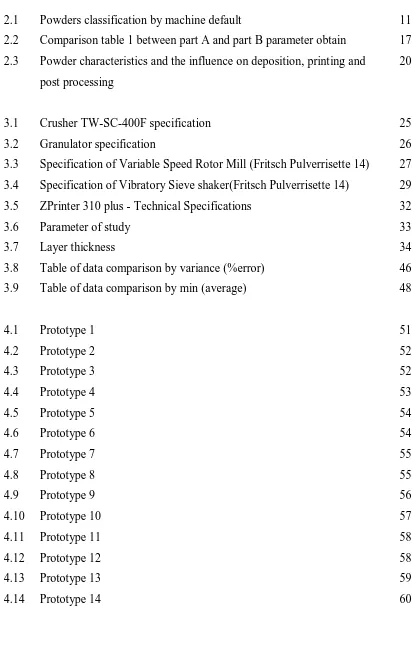
2.1 Powders classification by machine default 11
2.2 Comparison table 1 between part A and part B parameter obtain 17 2.3 Powder characteristics and the influence on deposition, printing and 20 post processing
3.1 Crusher TW-SC-400F specification 25
3.2 Granulator specification 26
3.3 Specification of Variable Speed Rotor Mill (Fritsch Pulverrisette 14) 27 3.4 Specification of Vibratory Sieve shaker(Fritsch Pulverrisette 14) 29
3.5 ZPrinter 310 plus - Technical Specifications 32
3.6 Parameter of study 33
3.7 Layer thickness 34
3.8 Table of data comparison by variance (%error) 46
ix
4.15 Prototype 15 60
4.16 Prototype 16 61
4.17 Prototype 17 62
x
LIST OF FIGURES
2.1 Z-Printer 310 Plus 6
2.2 Repeating process this same process over and over until a 8 3-dimensional part is created
2.3 Strength of Part in Regards to Part Orientation 9
2.4 Data material ZP130 12
2.11 Definition of the arithmetic average height, Ra 17
3.1 Methodology stage of investigation 23
3.2 Sequence of crushing flow 24
3.3 Crusher TW-SC-400F 25
3.4 Granulator 26
3.5 Variable speed rotor mill (Fritsch Pulverrisette 14) 27 3.6 Vibratory Sieve shaker (Fritsch Pulverrisette 14) 28
3.7 Designs for Prototype Product 30
3.8 Procedures on 3D printing process 31
3.9 3D Printer 310 Manual Plus 32
3.10 Build orientation horizontal (0°) 35
3.11 Build orientation vertical (90°) 35
3.12 Rotate part command 36
3.13 Example of rotating part setting 36
3.14 Coordinate measuring machine (CMM) WENZEL 3D/ LH 5.6.4 38
3.15 Measuring Area 38
3.16 Mitutoyo gauge block series sets 39
3.17 Portable Surface Roughness Tester Mitutoyo 40
xi
3.19 Measuring area 41
3.20 SurfTest 42
3.21 Full Process Illustration 44
3.22 Group classification and number of prototypes 45
3.23 Example of bar chat 47
3.24 Example of line chart 48
4.1 ZP 31 powder particle size 50
4.2 Bamboo powder particle size 50
4.3 Microstructure particle of prototype 1 63
4.4 Microstructure particle of prototype 3 64
4.5 Microstructure particle of prototype 5 65
5.1 Open matrix of green part 68
5.2 Infiltrant has been applied to the surface 68
5.3 Infiltrant is drawn into the part 69
xii
LIST OF ABBREVIATIONS
Ra - Arithmetic Average Height
DOE - Design of Experiment
RSM - Response Surface Methodology
HP - Horse Power
1
CHAPTER 1
INTRODUCTION
1.1 Background
Rapid prototyping is the combination of tools, technologies, and techniques that enable rapid fabrication of early devices that yield the visual and functional characteristics of a final device. Rapid prototyping is useful for many purposes, including rapid vetting of early designs and the determination of a given designs performance or suitability. Essentially, this particular technology provides rapidly try out new product and learn how to modified the idea in order to deliver better performance.
3D printer is the one of rapid prototyping process where a three dimensional object is created by laying down successive layers of material. 3D printers are generally faster, more affordable and easier to use than other additive manufacturing technologies. 3D printers offer product developers the ability to print parts and assemblies made of several materials with different mechanical and physical properties in a single build process. Advanced 3D printing technologies yield models that closely emulate the look, feel and functionality of product prototypes.
2
Therefore the purpose of this project is to determine the 3D printer parameters optimization by using bamboo powders. 3D printer 310 Manual Plus machine will be used to perform the parameters optimization of bamboo powders.
1.2 Problem statement
In producing the prototype by using 3D printer, the material (powder) used is a priority in order to obtain the best prototype. Bamboo is an alternative that this study involved by use trail approach to explore new material instead of existing material. Hence, the cost of existing material is too high. By founded bamboo as powder that can be used in 3D printer material, indirectly provide variety of material in market. In order to implement that approach, this paper will study and find the appropriate parameter which can be used and the best prevention way for the variable reaction while perform the operation.
3
1.3 Objectives
This study embarks on the following objectives:
i. To study the feasibility of the 3D printer machine (3D Printer 310 Manual Plus) in producing prototypes when using bamboo powders as raw material with three different proposed Z- binders (ZB 56, ZB 60, ZB 51).
ii. To apply different 3D-Printer parameter settings (build orientation, layer thickness and speed) when building up prototypes.
iii. To study on the prototypes quality [surface roughness (Ra) and dimensional
accuracy (mm)] with the different settings of 3D printer parameters (Build orientation, Layer thickness and speed).
1.4 Scope of project
4
1.5 Important of study
The importance of this study is to investigate how effective bamboo powders are in fabricating prototypes by using 3D printer machine. The effectiveness realized based on several optimizations parameter controls. It is hoped this study will successfully propose a new green material with suitable binder to be used in 3D printer together with the best parameter settings in machine.
1.6 Limitation of the study
In this study, the main focus is in optimizing machine parameters of bamboo powder in term of producing three dimensional designs. The core element is in selecting suitable parameter in 3D 310 Manual Plus machine to adjust the bamboo powder to suit with the design. In this study, the failure by properties of bamboo powder fabricate the prototypes will not be investigated.
1.7 Expected Results
From this study, it is expected to:
i. Investigate the effectivity of bamboo powder with the proposed binder to fabricate parts.
ii. Observe and evaluate any significant effects of different parameter settings on the final quality of 3D Printer prototypes [surface roughness (Ra) and
5
CHAPTER 2
LITERATURE REVIEW
This chapter reviews relevant literatures on prototypes process by using Z-Printer 310 Plus machine. Section 2.1 reviews the function of Z-Printer 310 Plus machine and the implementation on the prototyping process. Section 2.2 reviews 3D Printer parameters that relate to that scope on this investigation which are build orientation (part placement), layer thickness (mm) and speed (time). Section 2.3 reviews on mechanical properties of prototype through the prototyping process. Section 2.4 reviews on 3D-printer powder material which states the type and differentiates between powders. There is a review on the significant on surface roughness (Ra) and
6
2.1 Overview of Rapid Prototyping Technology
Rapid prototyping can be defined as a collection of fabrication methods that make engineering prototype products with minimal lead time through the use of computer aided design (CAD) (Stevens, 2009). Traditionally, prototypes were produced using multiple machining processes that took considerable time and money to produce.
2.1.1 Application and advantage
According to the 310 PLUS User’s Manual, the ZPrinter 310 Plus creates physical models directly from digital data. The system is fast versatile and simple, allowing designers and engineers to produce a range of concept models and functional test parts quickly and inexpensively. The system is ideal for an office environment or educational institution, providing product developers’ easy access to a 3D Printer. The ZPrinter 310 Plus sleek design and straightforward user interface make it the ideal monochrome rapid prototyping system. In addition, the versatility of the machine allows users to make parts quickly for early concept evaluation and testing, painted parts for a finished look, or patterns for casting applications.
7
2.1.2 Working principle
8
Figure 2.2: Repeating process this same process over and over until a 3-dimensional part is
created
2.2 3D Printer Parameters