SUPERVISOR DECLARATION
“I hereby declare that I have read this thesis and in my opinion this report is sufficient in terms of scope and quality for the award of the degree of
Bachelor of Mechanical Engineering (Design & Innovation)”
DECLARATION
“I hereby declare that the work in this report is my own except for summaries and quotations which have been duly acknowledged.”
i
ACKNOWLEDGEMENT
ABSTRAK
iii
ABSTRACT
TABLE OF CONTENTS
CHAPTER CONTENT PAGES
ACKNOWLEDGEMENT i
ABSTRAK ii
ABSTRACT iii
TABLE OF CONTENTS iv LIST OF TABLES vii
LIST OF FIGURES viii
LIST OF SYMBOLS xi LIST OF ABBREVIATION xii
CHAPTER 1 INTRODUCTION 1
1.1 Background Study 1
1.2 Problem Statement 2
1.3 Objective 3
1.4 Scope 4
CHAPTER 2 LITERATURE REVIEW 5
v
CHAPTER CONTENT PAGES
2.4 Basic Turbulence Modeling Concept 8 2.4.1 Reynolds Averaged Navier-Stokes 10
Equations (RANS)
2.4.2 Reynolds Stresses (Fluctuating 10 Component)
2.4.3 RANS-based Turbulence Models 12 2.4.4 Common and Popular Turbulence Models 13 2.5 Case Study on Comparison of Turbulence Models 14
CHAPTER 3 METHODOLOGY 20
3.1 Introduction 20
3.2 Geometry Modeling 23
3.2.1 Bluff Body Model 23 3.2.2 Computational Domain 25
3.3 Meshing 26
3.4 Flow Conditions 28
3.4.1 Hardware Specifications 29 3.4.2 Physical Conditions Settings 29 3.4.3 Numerical Settings 29 3.4.4 Turbulence Models Settings 30
CHAPTER 4 RESULTS 32
4.1 Introduction 32
4.2 Comparison of Flow Features and Patterns 32 4.2.1 Size of Vortices 33 4.2.2 Length of Separation Bubble 39 4.3 Comparison of Velocity Profiles along the Slant 40
and Wake Region
CHAPTER CONTENT PAGES
CHAPTER 5 DISCUSSION AND ANALYSIS 50
5.1 Introduction 50
5.2 Velocity Profiles and Drag Coefficient Comparison 50 5.3 Flow Patterns and Drag Coefficient Comparison 51 5.4 Other Case Study Comparison 52
CHAPTER 6 CONCLUSION AND RECOMMENDATION 54
6.1 Conclusion 54
6.2 Recommendation 55
REFERENCES 56
APPENDICES
vii
LIST OF TABLES
NO TITLE PAGES
2.1 List of Turbulence Models 13
LIST OF FIGURES
NO TITLE PAGES
2.1 An example of bluff bodies 6 (Source: Nakamura, 1993)
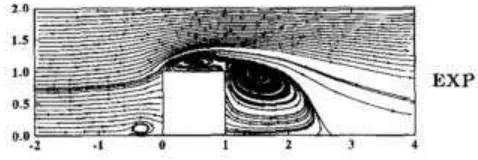
2.2 Streamline flow on a surface mounted cube 7 (Source: Lakehal and Rodi, 1997)
2.3 Velocity energy profiles in the symmetric plane 15 (Source: Guilmineau, 2008)
2.4 General view of streamlines in the symmetric plane 16 (Source: Guilmineau, 2008)
2.5 Comparison of streamlines for the flow around a cube 17 (Source: Seeta Ratnam and Vengadesan, 2008)
2.6 Comparison of time averaged volume lines on a cube 18 (Source: Seeta Ratnam and Vengadesan, 2008)
2.7 Mean velocity contours for Reynolds stress model 19 (Source: Kesarwani et al., 2014)
3.1 Schematic flow chart of the project 21 3.2 Dimensions and shape of Ahmed model 23
(Source: Ahmed et al., 1984)
3.3 Dimensions of the base slant length and base slant angle 24 (Source: Ahmed et al., 1984)
3.4 Ahmed model in CATIA 24
ix
3.6 Computational domain for Ahmed model 26 3.7 Mesh view of the symmetric plane 27
(Source: Kesarwani et al., 2014)
3.8 Overall meshing of Ahmed model 28
3.9 Prism layers around Ahmed model 28
3.10 Solution methods for simulation 30 3.11 List of turbulence models in solver 31 4.1 Flow patterns for 35 degree slant angle 33
(Source: Lienhart et al., 2003)
4.2 Streamline of large top vortex in symmetry plane: k-epsilon 34 (realizable)
4.3 Streamline of large top vortex in symmetry plane: k-epsilon 35 (RNG)
4.4 Streamline of large top vortex in symmetry plane: k-omega 35 (standard)
4.5 Streamline of large top vortex in symmetry plane: Reynolds 36 stress
4.6 Streamline of large top vortex in symmetry plane: transition SST 36 4.7 Streamline of small top vortex in symmetry plane: k-epsilon 37
(standard)
4.8 Streamline of small top vortex in symmetry plane: k-omega (SST) 37 4.9 Streamline of small top vortex in symmetry plane: Spalart 38
- Allmaras
4.10 Streamline of small top vortex in symmetry plane: transition 38 k-kl-omega
4.11 Isosurface of U-velocity in 3D view: (a) Spalart-Allmaras; 40 (b) k-epsilon (standard); (c) k-epsilon (RNG); (d) k-epsilon
(realizable); (e) k-omega (standard); (f) k-omega (SST);
4.12 Location of velocity profile (xy-plane) with coordinates: 41 (a) x = -203; (b) x = -183; (c) x = -163; (d) x = -143; (e) x = -123; (f) x = -103; (g) x = -83; (h) x = -63; (i) x = -43; (j) x = -23; (k) x = -3; (l) x = 37; (m) x = 87; (n) x = 137; (o) x = 187; (p) x = 237; (q) x = 287; (r) x = 337; (s) x = 437; (t) x = 537; (u) x = 637 (all values in mm)
4.13 Positions of slant and rear part of the model 42
4.14 Velocity profile at x = -183mm 43
4.15 Velocity profile at x = -163mm 43
4.16 Velocity profile at x = -143mm 44
4.17 Velocity profile at x = 287mm 46
4.18 Velocity profile at x = 337mm 46
4.19 Isosurface of separation bubble for k-epsilon (realizable) 47 4.20 Variation of drag against slant angle 48
xi
LIST OF SYMBOLS
µ = Kinematic Viscosity
F = Body Forces Acting on the Fluid H = Body Height
k = Specific Turbulent Kinetic Energy L = Length
ε = Turbulent Dissipation Rate ν = Dynamic Viscosity
ω = Specific Dissipation Rate � = Density
LIST OF ABBREVIATION
CAD = Computer Aided Design
CFD = Computational Fluid Dynamics DNS = Direct Numerical Simulation EVM = Eddy-Viscosity Models FRSM = Full Reynolds Stress Models LES = Large Eddy Simulation
RANS = Reynolds Averaged Navier-Stokes RNG = Renormalization Group
1
CHAPTER 1
INTRODUCTION
1.1 BACKGROUND STUDY
Analysis and prediction of turbulence has been an area of interest for researchers over the years as we encounter turbulence in our daily life. Among all fluid flows that occur, turbulence is one of the key phenomena in fluid dynamics. The major difficulty arises in predicting and solving turbulence is due to its random and chaotic behavior. Engineers and researchers have made an effort on getting the exact interpretation of flow behavior using various equations and numerical solutions. Turbulent flow calculations can be solved by Computational Fluid Dynamics (CFD) approach. A better understanding of flow physics especially turbulent flow can be achieved by conventional analysis and experimental techniques.
increased and improved the numerical simulation capabilities (Huang et al., 1997). Therefore, it becomes a significant importance to the automotive industry.
With the increase in applications of CFD every year, automotive industry makes great advances when it comes to aerodynamics and automotive designs of vehicles. Moreover, an execution of a good aerodynamic design states its importance as CFD has the ability of prediction for the performance of new designs before they are manufactured or carried out (Schaldach, 2000). Bluff body aerodynamics perhaps is one of the most distinguished research areas in wind engineering where turbulence will often occur in bluff body.
Bluff bodies have flow fields that can be characterized by random fluctuations, separation, stagnation, circulation and vortices. Mostly every phenomenon that is considered to be difficult to resolve in fluid mechanics is present in these flow fields (Murakami, 1997). With the help of RANS-based turbulence models, flow fields are modeled out with the help of detailed experimental data. However, validation and testing of various turbulence models are necessary to understand the capabilities and limitations of these models to accurately predict the complex flow of turbulence. This study is a part of the same venture to predict the flow behavior on bluff body using turbulence modeling which will be compared with experiments and to acquire the best turbulence model for automotive industries vehicle development.
1.2 PROBLEM STATEMENT
3
Most automobile industries required modeling and simulating the flow around a vehicle inspired bluff body as these industries need statistical aerodynamic properties to manufacture a vehicle. However, RANS has a variety of turbulence models to utilize and most industries do not know which turbulence models are more suitable for their simulation. Based on previous research, researches have perform a study on a cube-based body by comparing which RANS-cube-based turbulence model achieves a better results based on experimental values. However, not all bluff bodies exhibit the same results as some bodies have different shapes and angles which affect the flow characteristics. Therefore, a vehicle-inspired bluff body has been chosen in this study to verify which turbulence model performs better. The comparison between the simulation values has to be compared with the experimental values to prove which turbulence model performs better and provide the best turbulence model for industries.
1.3 OBJECTIVE
The objective of this study is:
a) To conduct vehicle-inspired bluff body flow simulation using different RANS-based turbulence models.
b) To access the performance of each turbulence model by comparing numerical results to experimental data.
1.4 SCOPE
5
CHAPTER 2
LITERATURE REVIEW
2.1 INTRODUCTION
Most fluid flow of engineering interest exhibits turbulence and this causes researchers to understand more about the characteristics and how turbulence may occur in a fluid flow. Furthermore, turbulence has the need to validate its flow features using various tools or software. This chapter describes the characteristics of a bluff body and introduces the methods of turbulence modeling using CFD.
2.2 AERODYNAMICS FEATURES ON BLUFF BODY
the fluid flow direction. Most examples of bluff bodies are cube-shaped body, building, vehicles and much more. However, for streamlined body such as airfoils, there is no particular need to describe as this study is only for bluff body.
Figure 2.1: An example of bluff bodies (Source: Nakamura, (1993))
One of the main features that characterized a bluff body in aerodynamics are a large region of separated flow where also a high amount of pressure drag occurs following vortex shredding phenomenon. The flow separations are determined mostly by sharp-edged contours such as a square shaped object that has a sharp corner.
7
Figure 2.2: Streamline flow on a surface mounted cube (Source: Lakehal and Rodi, (1997))
2.3 METHODS OF CFD NUMERICAL SIMULATION
In CFD, there are three methods of simulation where it includes levels of resolving turbulence which are fully resolved, partially resolved and unresolved.
Direct Numerical Simulation (DNS) is one of the methods that attempt to fully resolve all the arrangements of the flow by solving the Navier-Stokes equations. Turbulence and empirical models are not required for this method because DNS resolves the governing equations at all length and time scales. In a turbulent flow which consists of large and small eddies, DNS method is used to calculate and solve all large and small eddies in the flow where no turbulence modeling is used. However, the problem with this method is that it can consume tremendous computational resources and cause numerical difficulties. For now, DNS is just a research tool and is only feasible for simple flows at lower Reynolds number. Researchers agreed that DNS is not an option in the future but at least useful for general engineering problems and industrial applications. Moin and Mahesh (1998) issued a useful review of contributions of DNS in turbulence physics.
LES-based models. Comparing LES with DES, LES provide a considerable computational savings over DNS at the cost of modeling and a more complex numerical algorithm. The LES method will probably become the mainstream for CFD. However, for most engineering applications, particularly aerospace, LES is not yet feasible on this era of technology.
By discovering all these methods, the most compatible computational method for this study of dealing with turbulence flow is by using the Reynolds Averaged Navier-Stokes (RANS) equations. For this method, turbulent flow that consist of large and small eddies are completely unresolved where modeling is done for both large and small scales. This is accomplished by the time averaging or Reynolds averaging governing Navier-Stokes equations. In the RANS method, only the mean flow field is predicted as flow is statistically averaged. This offers a huge savings for the computational cost when RANS is compared to both DNS and LES. Therefore, the present study is an investigation and comparison of turbulence modeling using the RANS equation.
2.4 BASIC TURBULENCE MODELING CONCEPT
A turbulence model is defined as a set of equations whether they are algebraic or differential which determine the turbulent transport terms in mean flow equations. They do not simulate the details of turbulent motion but only the effect of turbulence on the mean flow behavior. The concept of Reynolds averaging and the averaged conservation equations are some of the main concepts forming the basic of turbulence modeling.
9 whereas the right side of the equation is the convection term. The first term on the right side is the pressure gradient term and then followed by the viscous dissipation term whereas F represents the body forces acting on the fluid. For fluid flows which are incompressible, the density, ρ is denoted as a constant term where ρ = 0 and therefore the equation can be simplified to equation (2.3). For a three-dimensional flow, the
For equation (2.2), which is the Navier-Stokes equation (momentum equation), it can be simplified when the flow is classified as incompressible flow and three-dimensional flow in Cartesian coordinates. Therefore, equation (2.2) can be simplified to equation (2.4) where equation (2.4) shows the x-direction of the simplified Navier-Stokes equation. The time factor is removed due to a steady flow including the force acting on the fluid and the equation is divided with density, ρ.
�
laminar flow of a fluid with constant properties. The derivation of Reynolds Averaged Navier-Stokes (RANS) equation starts here where the fluid has turbulent properties and requires turbulence modeling.
2.4.1 Reynolds Averaged Navier-Stokes Equations (RANS)
There are various fluctuating flow parameters such as the unsteadiness in the flow that can be averaged based on the averaging concepts suggested by Reynolds in the year 1895. The three most common forms of averaging technique which are most distinguished in turbulence modeling research, depending on the type of flow being analyzed are the ensemble averaging, spatial averaging and time averaging. These average forms of the Navier-Stokes equations are referred to as the Reynolds Averaged Navier-Stokes (RANS) equations.
For a fully developed turbulent flow, the technique of time averaging and ensemble averaging is being utilized. The models based on RANS equation calculate mean quantities and also the fluctuating quantities based on the additionally modeled variables. Therefore, these equations are able to model transport of large eddies using RANS-based turbulence model where computational is required. An example of turbulence models available are from the two-equation models to the stress-transport models that researcher use during simulation of fluid flow.
2.4.2 Reynolds Stresses (Fluctuating Component)