-Vol 4, No
j,
July - September 1995Initiation
of International
Japan and Indonesia
Yoshiyuki
Ohno*
Our
collaborative
study
has been officiallyentitled
as"Japan Indonesia
Joint
Study on Etiology
andClinicopathology of
Breast Cancer".
This project has
been supportedby
agrant from
the Ministryof
Educa-tion, Science and
Culture of
the JapaneseGovemment
(Grant
No.
01042007 andO4O420l3).
This
granting system
of
Intenrational
collaborative
study
has started
since
1984 as
Special
Cancer
Re-search
Project
in
Monbusho International (fonnerly
Over-sea)Scientific
Research Program inAnti-Cancer
1O-year
Comprehensive
Strategies
of
the
JapaneseGovernment,
theso-called Premier
Nakasone Project.Anti-Cancer
10-Year Comprehensive
Strategies haveiniliated to cope with hurnan enelny of cancer
in Japan,and
included
5
major fields
of
study: 1)
Studies
onOncogene,
2)
Studies
on
human
cancer caused
byviruses,
3)
Studies
on
promotion and inhibition of
callcer
development,
4)
Studies
on evolution
of
new cancerdiagnostics
andtherapy,
and5)
Studies onim-lnune
suppression
and suppressiol
substances.Be-sides these
5 major
studies
in Japan,
Special
Cancer ResearchProject encouraged
to
undertake
collabora-tive
studies
with
foreign
countries
such as cancerin-formation
exchanges
and basic studies
on
epidemiological characteristics of
cancersin
theworld
(Table 1).
When
thegranting
startedin 1984, there were
12 studyprojects covering
18 countries, and
now
il
1993,2l
study projects
covering 27
countries
areon-going. As
one
of
these
international collaborative
studies, our
study project
officially
startedin 1989,
when
17 studyprojects
covering
15countries were on-going.
Departmenl
of
Preventive Medicine Nagoya llniversity, School of Medicine, 65 Tsurumai-cho, Showa-ku, Nagoya 466, Japan..Coordinator
of
the Japanese leam, Japan-Indonesia Joinl Study on Etiology and Clinicopathology of Breast Cancer.Inlernational Collaborative Study on Breasl Cancer 131
Collaborative
Study
on Breast
Cancer
Between
2
3.
Table
l.
Studies Covered by Special Cancer Research Project in Monbusho Intemational Scientific Research Prog-ram in 10 Years (1984-1993)1. Exchanges of scientific information on cancer researches in advanced countries (with United States, Canada, Germany, France, other European countries)
Viruses related to carcinogenesis and parasites
ATL/HAM
(HTVL-l),
Hepatitis virus (HBV, HCV), Human Papiloma Virus (HPV)Mice Leukemia Virus, Opistborchis Veverrini Promoting/anti-cancer agents existing in the natural enviro-ment.
Natural plants (in Thailand,
USA,
Brazil, African countries such as Tanzania)Marine organism (in Australia) Migration studies on cancer
Korean in Osaka, Japanese Americans in Los Angeles, Japanese descendants in Brazil and Bolivia
Studies on very common or rare qtncers
Stomach, Colon, Liver, Bile duct, Lung, NasopJrarinx, Breast, Cervix uteri.
Skin (xeroderma pigmentosa), Neuroblastoma, Pros-tate, Leukemia, Lymphoma, etc).
Studies on c:incer diagnostics and therapy
Monoclonal antibody, Chemotherapy, hyperthermia, etc.
6.
Table2.
Chronological Developmentof
Special
Cancer Research Projects in Monbusho International Scien-tific Program in 10 Years (9184-1993)4
5.
Fiscal year
Projects (No.)
Countries collaborated (No.)
1984 1985 1986 1987 1988 1989 1990 1991 1992 1993
12
13
t4
15l6
l7
r8 20 222l
18 25 25 20 20
15
20 23 27 27
r32
OhnoTable3.
Countries collaboratedin Special CancerResearch
Projectsin Monbusho International
ScientificRe--search Program in 10 Years (1984-1993).
Region Countries
Asia, Chi-oa,
MedJ
Indonespathological
and
clinical
studies
would probably
be feasible, and anepidemiological investigation of
case-control
studywould
be amin
study design. We selected breast cancer as a cancersite to
bestudied,
because itis
the
second commonest cancer
among
females
in
lndonesia,
following cervicâl
cancer
which
had
been alreadyjointly
studied between Japan andIndonesia
in
1984-1986.
Again,
in April, 1988,
I
and
Dr.
Sakamoto
visited
Jakarta and discussedthe
planning of
acollaborative
study
between Japan andIndonesia
with
Drs.
SantosoCornain,
Gunawan
Tjahjadi,
Didid Tjindarbumi,
Muchlis Ramli
and JoedoPrihartono.
Inthis
meeting, wemainly
discussedfourmajorpoints.
Thefirst point
wastentative decision
of Indonesia teammembers and
a coordinator
of
the team.
the
secondpoint was planning
of
a
breast
cancer case control
study,
including
very practical
aspectsof study
design such as definition of cases andcontrols
with inclusion
andexclusion criteria,
information
to becollected
andtentative designing
of
a
questionnaire
to
be
used
atdirect interview of
thestudy subjects. The
third point
wasplanning
of
pathological
andclinical
studies. Thefourth point
was
planning
of
inviting
Indonesian
re-searchersto
Japanduring the study period
of
3
to
5years.
After
deliberate
discussions,
we
could
reachtentative conclusions
for
thesefour points.
In Septernber.
the
satneyear,
1988,
I
visited
Jakartaagain
to
finalize the study protocol
and
discuss
budgetary aspects
of
thecollaborative project.
this was thethird
visit
to Jakarta to ensuresemi-official
startof
our collaboration.
In
this
meeting, in particular,
we finally
decided
Indonesian
team
members
and
a
coordinator.
They
were
Dr.
SantosoCornain
as acoordinator, Drs.
JoedoPrihartono
and
Setyawati
Budiningsih
asepidemiologists,
Drs. Didid
!indarbumi,
Muchlis
Ramli and Idral Darwis
as
surgical oncologists ancl
Drs.
GunawanTjahjadi, Esti
Soetrisno and EndangSri
Roostini
aspathologists. (tn
theExtension
Study ofour
collaborative
project, we also included
two
nutritionists;
Drs. Drupadi
Dillon
andSusilowati
Her-man).
Then
we
finalized
all
study
designs
of
case-control
study and completed the
development
of
thequestion-naire to
be used atdirect interview of cases
andcon-trols.
The actual study design of ourcase-control study
of
breast cancer
will
be
described
in details in the
following
papersof
this monograph.
At
this stage, since wecould
finalize
all
aspects of casecontrol
study,
I
requestedthe Indouesian team
mern-No
South Korea, Mongolia, HongKong
Philipines, Taiwan, fiailand, Malaysia Indonesia, Singapore, Myanmar, Pakistan
India, Sri l-anka, Bangladesb
Ghana, Gabon, Kenya, T anzania, Zaire,
Liberia, Tunisia, South Africa,
Madagaskar, Cameroon, Chad, Ethiopia, Uganda, Somalia, North Yenren
Frencb Polynesia, Australia, Papua New guinea, Tonga
United States. Canada
Columbia, Chile, Brazil, Bolivia, Peru
Paraguay, Janraica, Guatemala, Costa Rica
U.K., Germany, France, Italy,
Netherlands, Switzerland, Sweden,
Finland, Hungary, Spain
15
Africa &
Middle East
Oceania
North America
Middle &
South Anrerica
Europe
2
s
Total
Since Special Cancer
ResearchProject
in
Monbusho
International
Scientific
Research
Program
usually
gives 3-5
years,financial
support for
oneproject,
then, asa
llet total,
50 study projects
have been conductedin
10 yearsfrorn
1984to
1993.(Table
2 andTable
3).In
the last fiscal
year, 1992, there were
22
study
projects
covering
27countries
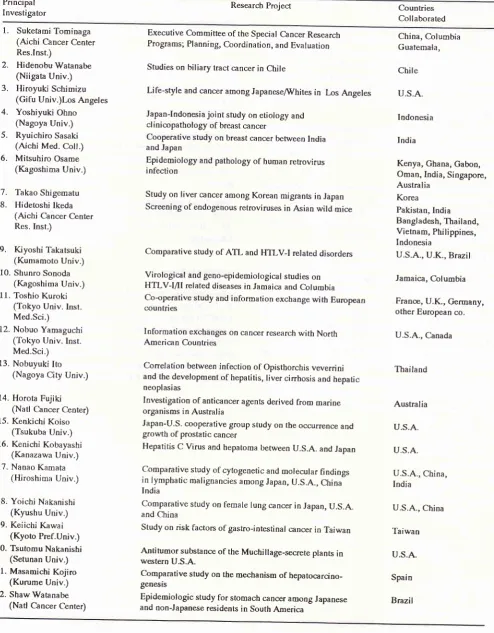
aslisted in Table
4.To initiate
our
joint
study,
which
officially
startedin
1989,
we
neededsome preparatory period
with
con-sultation
meetings.Chronological history of
initiating
anddeveloping this
joint
study
in
Indonesia
is as follows.In
August,
1987,
I
as
an
epiderniologist and Dr.
Sakamoto
as apathologist
visited
Jakarta
for
the
first
tirne to
searchfor
thepossibility or feasibility of
con-ducting collaborative study
herein
Jakartaby
rneetingand
discussing
with
several
key
investigators in
epidemiology, pathology
andsurgical oncology.
Per-sonswhom
we
actually
met andtalked
with
were
Drs.Alex
Papilaya,
Bambaug Sutrisna, Santoso
Cornain, SutisnaHimawan,
GunawanTjahjadi,
andDidid
Tjin-darbumi.
In
this meeting
we discussed andoverviewed
indetails
Vol 4, No 3, JuIy - September 1995 International Collaborative Study on Breast
Cancer
133
Table
4.
Principal Investigators, Research projects, and c-ountries collaboratedin
1992 PrincipalInvestigator Research Project Countries Collaborated
1.
Suketami Tominaga(Aicbi Cancer Center Res.Inst.)
2.
Hidenobu Watanabe (Niigata Univ.)3.
Hiroyuki Schimizu(Gilu Univ.)I-os Angeles
4.
Yoshiyuki Ohno(Nagoya Univ.)
5.
Ryuichiro Sasaki(Aichi Med. Colt.)
6.
Mitsuhiro Osame(Kagoshima Univ.)
7.
Takao Shigematu8.
Hidetoshi lkeda(Aichi Cancer C-enter Res. Inst.)
9.
Kiyoshi Takatsuki (Kumamoto Univ.) 10. Shunro Sonoda(Kagoshima Univ.) 11. Toshio Kuroki
(Tokyo Univ. Insr.
Med.Sci.)
12. Nobuo Yamaguchi (Tokyo Univ. Inst. Med.Sci.) 13. Nobuyuki Ito
(Nagoya City Univ.)
14. Horota Fujiki (Natl Cancer Center)
15. Kenkichi Koiso (Tsukuba Univ.) 16. Kenichi Kobayashi
(Kanazawa Univ.) 17. Nanao Kamata
(Hiroshima Univ.)
18. Yoichi Nakanisbi (Kyushu Univ.) 19. Keiichi Kawai
(Kyoto Prel.Univ.) 20. Tsutomu Nakanishi
(Setunan Univ.) 21. Masamichi Kojiro
(Kurume Univ.) 22. Shaw Watanabe
(Natl Cancer Center)
Committee of the Special Cancer Research
Planning, Coordination, and Evaluation
China, Columbia Guatemala,
Chile
U.S.A.
Indonesia
India
Kenya, Ghana, Gabon,
Oman, India, Singapore, Australia
Korea Pakistan, India Bangladesh, Thailand, Vietnam, Philippines, Indonesia
U.S.A., U.K., Brazil
Jamaica, C-olumbia
Franæ, U.K., Gemrany, other European co.
U.S.A., Canada
Tbailand
Australia
U.S.A.
u-s.A-U.S.A., China, India
U.S.A., China
Taiwan
U.S.A.
Spain
Brazil Executive
Programs;
Studies on biliary tract cancer in Chile
Life-style and cancer amongJapaneseAVhites
in
Los AngelesJapan-Indonesia joint study on etiology and
clinicopathology of breast cancer
Cooperative study on breast cancer between lndia
and Japan
Epidemiology and pathology of human retrovirus infection
Study on liver cancer among Korean migranfs in Japan
Screening of endogenous retroviruses in Asian wild mice
Comparative study
oIATL
and HTLV-I related disordersVirologi cal and geno-epidemiological studi es on
HTLV-IIl
related diseases in Jamaica and Columbia Co-operative study and information exchange with Europeancountries
Information exchanges oD cancer research with North American Countries
Conelation between infection of Opisthorchis veverrini and the development o[ hepatitis, liver cirhosis and hepatic neoplasias
Investigation o[anticancer agents derived from marine organisms in Australia
Japan-U.S. cooperative group study on the occurrence and
growth of prostatic câncer
Hepatitis C Virus and hepatoma between U.S.A. and Japan
Comparative study of cytogenetic and molecular findings in lymphatic malignancies among Japan, U.S.A., China
India
Comparative study on [emale lung cancer in Japan, U.S.A. and China
Study on risk [actors of gastro-intestinal cancer in Taiwan
Antitumor substance of the Muchillage-secrete plants in
western U.S.A.
Comparative study on the mechanism of hepatocarcino_ genesls
Epidemiologic study for stomach câncer amoog Japanese
[image:3.595.62.557.102.735.2]7
134 Ohno
bers
and the coordinator
to undertake
apilot study
of
20 cases and 40 controls,
following
the
procedureswhich decided in this meeting.
As
for
inviting
Indonesian
researches,we decided
toinvite
apathologist
for
amonth
in November,
1988to
stayin Nagoya City University,
which
wasmy
affilia-tion
atthis
time,
andin
the CancerIrstitute of Tokyo.
The main purpose
in inviting
a
pathologist was to
standardize the microscopic technology
of examining
histopathological
specirnensof
breast cancer betweenIndonesia
and Japan.We also decided
to take one more step to
strengthenour future collaboration of studyng
breast cancer.This
step was later realized
1obe very irnportant
andsig-nificant.
The step was
for
us,all Indonesian
team members andI
were
to
meet the Dean,
Univenity
of Indonesia,
School of Medicine to let him know in
details whatwe
planned
tostudy with what aims
andhow
andwhy
wecollaborate
in this
particular study.
Again in
January,
1989,I visited
Jakarta.this
was thefourth
visit
to
meet Indonesian team members
anddiscuss
the collaborative study
in more details,
and toevaluate
the feasibility
and methodological
issuesin
the
pilot
study which
I requested
to undertake
in
thethird meeting,
thatis, four
monthsearlier.
Based on theresults of
thepilot study, we
resived the questionnaire andrnodified
the proceduresof
case andcontrol
selec-tion. We attempted
to readjust whole methodological
proceduresin
thewhole study planning.
As for the invitation of Indonesian
researchersin
thecorning
official
study period
of
there
yean (1989
tol99l),
we
carne
to the
couclusiou
that
we
would
Med J Indones
schedule
to invite
a
surgeon
in the first
year,
anepidemiologist in
the second year, and thecoordinator
of
theIndonesian
team membersin
thethird year. (In
theperiod of Extension Study,
we dicided to invite
asurgeon
in
thefourth
year, and anutritionist
in the fifth year).The
Indonesian
team members
and
I
again met
theDean and explained the whole
process
of
future
col-laboration,
and askedhim to give us
anapproval that
Indonesian
researcherscould
join
in the collaboration
and haveresponsible roles in
thewhole
processof
thecollaborative study. We also discussed
and
decidedseveral
other important
aspécts
in
the collaboration
such as datacollection
andmaintenance,
dataediting,
data analysis, and publication o'f papers, including
authorship
andthe general rules ih ordering authors's
names.
After
thesepreparatory meetings with
sincere
discus-sions, we could successfuly startourpresent
collabora-tive study
on
breast cancer between Japan
and Indonesia.Acknowledgments
This work
was supportedby
theMinistry of Education
and
Culture,
Japan,
Grants
No. 01042007
and
04042013
and waspartly
supportedby
theIndonesian
Cancer Foundation.
This collaborative
study was apart