9
The migration debate in Kenya
Marcel Rutten & Koki Muli
Introduction
Migration in the East African region is not a new phenomenon. The inhabitants of the area, mainly Bantus, Cushites and Nilotes have settled here from both northern (Sudan) and south-western parts of Africa since the seventeenth century. In 1895, the British government formally proclaimed authority over the territory. The 1896–1902 building of a railway connecting Mombasa and Lake Victoria promoted the arrival of European settlers and of Indian ‘coolies’, recruited in British India as labourers for the construction of the railway. Ugandans could be found in Nairobi as early as the 1920s engaged in clerical jobs and the media (Thuku, 1970).
permit and access educational opportunities, and the right to apply for legal local integration.
Kenya experienced its largest influx of refugees from Somalia following the collapse of that country in 1990. Sudanese and Ethiopian refugees followed after the fall of the Mengistu regime. Others from DRC, Rwanda and Burundi who had come to Kenya from 1994 onwards still remain, mainly in urban centres, although some stay in camps, from where they hope to secure resettle-ment to Western countries. Although Kenya has long been a safe haven in this part of Africa, the collapse of the Somali state and the increased turmoil in southern Sudan have greatly undermined Kenya’s capacity to deal with emer-gencies and refugee influxes, therefore relegating disaster and emergency responses to international agencies. There are also no clear policies on asylum and the provision of services to refugees. As a result, there are inadequate annual budgetary allocations to address the plight of refugees hosted in Kenya.
Kenya has also become a source, transit, and destination country for men, women and children trafficked for forced labour and sexual exploitation. Desti-nations are the Middle East, other African Desti-nations, Western Europe, and North America – for domestic servitude, enslavement in massage parlours and brothels, and manual labour. People trafficked into Kenya are principally Indians, Bangladeshi, and Nepalese, coerced into bonded labour in the con-struction and garment industries (US Department of State, 2004). In 2005 the Kenyan Ministry of Immigration developed draft legislation to criminalise the cross-border elements of human trafficking, and the Attorney General’s Office collaborated with civil society and other ministries to develop draft comprehen-sive legislation and to support the establishment of a code of conduct against child sex tourism. Internal discussions are being held, migration conferences organised (IRIN, 2002b; IRIN, 2005) and efforts are underway to come up with a policy document. For example the Governance, Justice, Law and Order Sector Reform Programme (GJLOS) is a Kenyan government-led sector-wide reform programme launched in November 2003. The GJLOS programme aims at supporting the Ministry of Immigration in revising and reforming laws and legislation dealing with citizenship, immigration and the registration of aliens (GJLOS, 2005). The Ministry of Immigration also plans, through this pro-gramme of reforms, to introduce a new Passport Act, which will support a National Migration and Immigration Policy.
Kenyan migration policy plans and immigration law
The Economic Recovery Strategy for Wealth and Employment Creation 2003– 2007 (MPND, 2003), a policy plan for economic recovery, hardly discusses issues of migration. In its 2006 Kenya Peer Review Report, the New Partner-ship for Africa’s Development (NEPAD) urged the Kenyan government to enact and implement a clear policy on refugees and internally-displaced persons, and to streamline immigration screening procedures for the entry of refugees into the country (NEPAD, 2006). Although Kenya is a signatory to the international agreements on refugee protection, the country has no established national legal framework to handle refugee issues, including the management of their resettlement and integration in the country. Instead, the government has let the United Nations High Commissioner for Refugees (UNHCR) be at the fore-front of managing the bulk of refugee affairs in the country. The UNHCR carries out Refugee Status Determination (RSD) under this mandate, while the Kenya government has suspended its RSD and involves itself only in registering those refugees who have been recognised by UNHCR. This is important because UNHCR provides assistance to recognised refugees, and this arrange-ment it makes it convenient for UNHCR to focus on genuine refugees and avoid assistance being abused by persons who are ‘not of concern to UNHCR’ administratively. Unfortunately UNHCR can only provide refugees with Mandate Letters; it cannot bestow the full Conventional Status that the govern-ment can. This much-coveted status enables refugees to enjoy the rights en-shrined in the 1951 Convention relating to the Status of Refugees.
Immigration law in Kenya today has its roots in the Immigration Ordinance of 1906, which dealt mainly with the restriction of immigration into the British colony of Kenya, especially the immigration of unemployed persons who were likely to be a liability to the colony.1 The 1906 Ordinance was amended and reviewed at least eleven times. One of the significant amendments of 1938 aimed at increasing the amount of security deposit for immigration into the colony from £50 to £500, in order to restrict people fleeing from the events which were taking place in Central Europe at the time. In later years, e.g. in 1948, amendments contained a long list of prohibited immigrants. In 1964, the independent government of Kenya adopted the 1956 Ordinance with only a few minor changes.
1
The provisions regarding prohibited immigrants and requirements for permits were adopted and enhanced in the current Immigration Act2 for the purposes of controlling immigration into the country, around the period when there was an influx of aliens and refugees from Uganda (1972). The government enacted the 1990 NGO Coordination Act legislation in an attempt to coordinate the relief and emergency activities of the humanitarian organisations and NGOs which had responded to the 1990 Somali and subsequent Sudanese crises. The government’s actual participation in assistance and resolution of the refugee crises was therefore minimal, and was limited to oversight, the provision of user rights of the land where these activities were taking place, and security opera-tions. Since 1990 attempts have been made by the government to enact Refugee Specific Legislation, and on 26 May 2006 revised draft legislation was published in the Kenya Gazette Supplement and introduced in parliament, which finally passed the Refugees Bill (with a number of amendments) on 29 November 2006. The Bill calls for the government to create an inter-ministerial RSD Committee to adjudicate asylum applications under the Commissioner for Refugees Affairs. The office of the attorney-general was due to fine-tune the amendments to the bill, before it is signed into law by President Kibaki.
Stakeholder views on migration in Kenya
Forced migration: Kenya’s burden
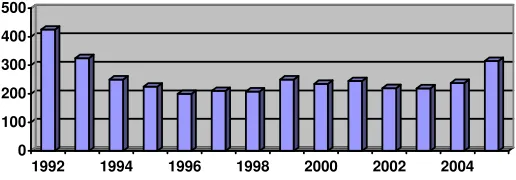
Kenya hosted 420,000 refugees at the height of the Somalia crisis in 1992. This figure fell fairly steadily to about 220,000 by the end of 2003, but new violence in the region, notably in Ethiopia and Somalia, led to a new rise, to an estimated total of 315,000 by the end of 2005 (see Figure 9.1).
With no programmes for their permanent resettlement and integration within Kenya, a majority of refugees in the country are confined to camps in geo-graphically remote areas such as Dadaab in north-eastern Kenya, and Kakuma in the north-west. The UNHCR’s figures of October 2006 indicate that Dadaab had nearly 137,000 refugees and Kakuma well over 92,000.3 In addition there
2
Chapter 172 of the Laws of Kenya, Number 25 of 1967 and Number 6 of 1972 (revised).
3 The main areas of Kenyan settlement in the US include Washington, DC (where 50 per cent
are some 2100 convention refugees4 and an unknown number of urban refugees, estimated to be between 50,000 and 100,000.
Figure 9.1 Number of refugees and asylum seekers (‘000), Kenya, 1992-2005
0 100 200 300 400 500
1992 1994 1996 1998 2000 2002 2004
Source: World Refugee Survey, US Committee on Refugees, 1992 to 2005
Although forced migration has been a recurrent concern for both colonial and postcolonial governments in Kenya, according to the Ministry of Immigra-tion, ‘there is no coordinated approach to the issue of immigration’.5 It is note-worthy that the government and UNHCR have played different roles since 1992. The government, claiming a lack of resources, has been providing land and physical security in the camps, and has also been registering all the refugees in Kenya, while the UNHCR – which is better resourced – and its partners have been providing all the other services. As of now, refugees in Kenya either have full status (pre-1992 cases, recognised by the government), or they possess a UNHCR Mandate Letter (post-1992 cases, recognised by UNHCR).
Kenyan officials interviewed indicated that the Kenyan attitude towards refugees from neighbouring countries has always been positive: ‘They are our brothers and sisters, how can we refuse them?’, and ‘We in Kenya accommo-date foreigners. It is African to be hospitable.’6 However, when asked if immigration (in general) was a problem to Kenya, negative aspects were also mentioned, in particular the fact that Kenya was not able to control the influx of foreigners because of its porous borders.
4
A ‘convention refugee’ is a person who is outside of their own country and is unable or unwilling to return to that country because of a well-founded fear of persecution.
5
Interview with Mr E.Kisome, permanent secretary Ministry of Immigration and Registration of Persons, 4 August 2006.
Issues of disease, crime, and cultural erosion were mentioned as drawbacks of immigration. In Nairobi, Somalis have gone into businesses such as taxis, housing and supermarkets, thus not only presenting real competition but in some cases pushing (mainly Asian) Kenyans out of business. If the pre-1992 refugee regime in Kenya can be characterised as generous and hospitable, with emphasis on local integration, the post-1992 regime has been inhospitable, characterised by growing levels of xenophobia, denial of basic refugee rights and few opportunities for local integration. The attitude seems to be most negative towards Somali refugees. The Ministry of Planning indicated that ‘the threat of international terrorism has also recently impacted on Kenyan attitudes and policies towards refugees’ (MPND, 2006: 7).
It cannot be ruled out that part of the apparent change towards refugees within Kenyan government circles has been triggered from outside, notably foreign pressure to deal with terrorists. Kenya has been the scene of several terrorist attacks in the last decade, notably the 7 August 1998 bomb attack on the US embassy in Nairobi, which killed 291 and wounded over 5000, and the 28 November 2002 bombing of an Israeli-owned hotel near Mombasa and the (failed) attempt to shoot down an Israeli plane that same day. Twelve Kenyans and three Israelis were murdered by two suicide bombers in the hotel attack. All of these attacks were claimed by Al-Qaeda (Rutten, 2004). These threats resulted in the drafting of a highly contested Suppression of Terrorism Bill (2003), increased security measures in Kenya’s airports and the rounding up of Somalis in Nairobi. In May 2002 hundreds of people, including children, were arrested in the Nairobi estate of Eastleigh, in a police crackdown on illegal foreigners. Police arrested over 843 aliens, mostly from Somalia and Ethiopia, and recovered powerful sophisticated communications equipment used to communicate with relatives in their respective countries (IRIN, 2002a).
Kenyan Muslims have also felt harassed by their own authorities. In their view the Anti-Terrorism Police Unit is operating illegally and should be dis-banded (ABC News Online, 2006). Although Kenya redrafted the Suppression of Terrorism Bill, it has not yet been tabled in Parliament. Immigration officials, however, indicated that terrorist issues will be put into the Migration Act, so that even without the Terrorism Bill legal tools will be available to address this matter.
status, that is, ‘Class H’ permits. (These permits cost Ksh60 000 – about €650. Licenses would weed out illegal aliens involved in business and provide revenue. Those holding this type of permit are also required to pay taxes.) The last objective was to determine for security purposes the number of refugees residing in the country.
The UNHCR aims to return to the position prior to 1991 through capacity-building of the Department of Refugees within the Ministry of Immigration and Registration of Persons. The Ministry has three departments: the Registrar of Persons; Immigration; and Refugees. Once there is a commissioner in charge of refugees, there should be a budget line from the Ministry of Finance to support the department fully. At present this is UNHCR budget, aided by international organisations such as the World Food Programme and various NGOs. Donors support the capacity-building of the Refugee Department. Its staff is currently sixteen, with five administrative officers, and in July 2006 the UNHCR, through assistance from the Danish government, trained them for the first time. Lack of funds and of ICT (Information and Communication Technology) within the Ministry have, however, created a major bottleneck. Systems are too manual (e.g. at airports and borders). Better equipment and more personnel are needed.
Transit migration: Pointing fingers in the human trafficking debate
According to immigration officials, Kenya is a transit country for Ethiopians, Rwandans, Somalis, Eritreans and Asians. Harbouring foreigners is a big problem leading to trafficking, but it was also indicated that ‘transit [human trafficking] is a peripheral issue for us’.7 This statement was linked to the fact that the effective tackling of this problem is an impossible job, given Kenya’s geographical and financial position which simply does not allow for an illegal-entrance-proof border control.
Our borders are porous and that makes it easy to sneak in and out of the country. One should realise that most people do not move through Jomo Kenyatta airport, although it is the hub for East Africa and beyond. They simply pass overland towards the border and leave by public or private transport some five kilometres before the border town. With the help of agents they cross the border, and in this way they can go as far as South Africa. Somalis in particular follow this route. Our
7
legal framework also does not cater for human trafficking. The fines are not prohibitive enough.8
The Labour Ministry pointed at Kenya being a transit for labour migrants, mainly from Somalia, who enter Kenya as refugees and leave as ‘Kenyan’ migrant workers. Labour officials called for awareness campaigns on labour migration and human trafficking which are considered critical for both the migrant and their families, and those remaining at the home place.
Migration officials interviewed by the authors stated that lately many illegal transit migrants have been of Asian origin. The rate of success in detecting illegal entrants went up after the Netherlands Embassy facilitated equipment and training to detect forged passports. IOM also provides training on detecting trafficking. In spite of this support, Kenyan migration officials blamed foreign embassies for handing out visas for family reunion. This triggers human trafficking into Kenya, and people cannot be prosecuted since this is too costly, as people would have to stay longer in Kenya – at the expense of aid organisa-tions – and in addition would not be not able to use tickets home that would have already been arranged by these international agencies.9
Labour migration: Golden opportunity or a threat?
Current discussion about migration is pointing more towards the apparent positive aspects of international labour mobility. It was reported by the UN (2006: 12, 54) that in 2005 some 191 million people were living outside their home countries, remitting an estimated US$232 billion back home. This is more than double the estimate of a decade earlier.
In Kenyan government circles the debate on remittances is also gaining momentum, although the issue of migrant labour is not new. Kenya, Tanzania and Uganda used to exchange migrant labour during the heyday of the first thirty-year East African economic union (1948–1977). The open borders stimulated both documented and unauthorised migration. For nearly two decades of the first East African economic union, all the East African Commu-nity (EAC) countries allowed their citizens to move freely from one country to another.
When Uganda came under military rule, Kenya and Tanzania adopted a ‘help-the-neighbour’ attitude, allowing an inflow of Ugandan refugees as well as job-seekers. This resulted in strained relations between Uganda and its two neighbours. Between 1984 and 1987 the Kenyan authorities, grappling with
8
Interview with Ministry of Labour officials.
negative economic factors, expelled Ugandans irrespective of their residence status in Kenya. These events brought the longstanding free movement of East Africans to a halt until the second EAC Federation was established in 1999, which should result in the adoption of a common passport, a relaxing of emigration/immigration formalities for their citizens, as well as a political federation (Oucho, 2006; Sander, 2003).
In the past, Kenyans who migrated outside Africa mostly did so for reasons of education and further training, mainly at British institutions. Many later returned to Kenya and emerged as the elite in the struggle for independence, and as leaders in crucial government and private sector management positions immediately after the British handed over power in 1963. In subsequent years many Kenyans, backed by government-financed scholarships and guaranteed jobs on return, left for higher education both in the West (mainly the UK and USA) and the East (the Soviet Union, and India). Among African countries, Kenya led in terms of numbers of students going to the USA, with 7097 in 2001/02, ahead of Nigeria (3820), Ghana (2672), Egypt (2409), and South Africa (2232).
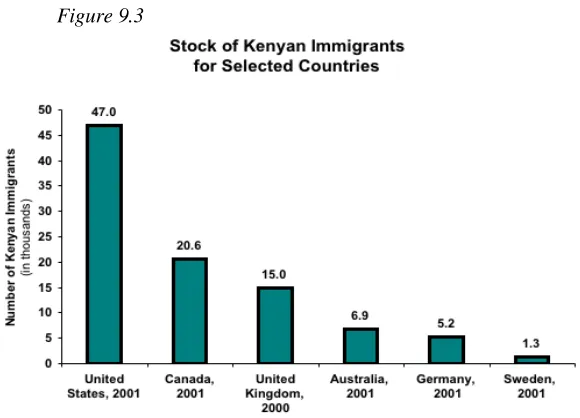
In the year 2001, about 47,000 Kenyan immigrants were living in the USA, 15,000 in the United Kingdom, and 1300 were in Sweden (Okoth, 2003). Figure 9.2 indicates the trend of Kenyan immigrants to the two major destinations (USA and UK), from 1991 to 2001, and Figure 9.3 shows the number of Kenyan immigrants in six Western countries in 2001. Kenyan schoolteachers were recruited throughout the 1990s in the Seychelles, Rwanda, Burundi and the Congo. The Kenyan government has not yet established standards to ensure the adequate training and protection of these workers before their departure and during their stints abroad. Many Kenyans also began pursuing opportunities in low-skilled positions such as bus drivers, domestic servants, cruise ship atten-dants, and security guards in Saudi Arabia, Qatar, United Arab Emirates and Bahrain. The wave of African migrants to Spain has hit world headlines, and estimates are that some 20,000 Somalis made similarly perilous journeys across the Gulf of Aden to the Middle East – about 1000 people are thought to have died in this attempt. It might well be that (Muslim) Kenyans, from the coast and the north-eastern region, have joined this route.10
The total figure of Kenyan external migrants will be hard to establish for several reasons, such as unwillingness or inability to register with a Kenyan mission. According to one migration official, Kenyan authorities do not have reliable and up-to-date figures. He said that this was because, for example,
Figure 9.2
Source: Migration Information Source, Global Data Center (cited in MPND, 2006; Okoth, 2003)
Figure 9.3
someone might ‘go to a brother for a visit and subsequently “disappear” for ten years, working abroad.’ However, a total of some 200,000 to 300,000 Kenyan migrants might be a conservative estimate, so that the neighbouring countries as well as countries in southern Africa and the Middle East will account for most of those Kenyans who did not move to the industrialised North. Besides looking for educational and training opportunities, a whole range of push and pull factors were identified by the Ministry of Planning and National Development explaining out-migration by Kenyans.
Push and pull factors
As well as the ‘push’ factors affecting migrant choices for leaving their place of residence – low and eroding wages and salaries; unsatisfactory living condi-tions, lack of transport, housing, etc.; under-utilisation of qualified personnel; lack of freedom; discrimination in appointments and promotions; lack of research and other facilities, including support staff; declining quality of educa-tional systems and perceived prestige of ‘foreign training’; social unrest, politi-cal conflicts and wars – there are a myriad of ‘pull’ factors characterising the new location of settlement – better working conditions; job opportunities and professional development; higher wages and income; higher standard of living; substantial funds for research, advanced technology, modern facilities, support staff; political stability; meritocracy, transparency; and intellectual freedom.
investment entity.’11 Discussions were also held between the KCA and the Ministry of Planning with the Kenya Commercial Bank (with Western Union), Postbank and City Bank.
The financial benefit of remittances seems for many observers to over-shadow the negative aspects of migration. In particular the Kenyan govern-ment’s promise to create half a million new jobs annually seems to have triggered new initiatives to proactively support Kenyans in finding jobs abroad. The Kenyan Cabinet (Minute 126/03, 18/12/2003) authorised the setting up of an International Jobs Office (IJO) under the Cabinet Office to carry out interna-tional market research, in close liaison with the Kenyan embassies and UN agencies, to identify suitable job opportunities for Kenyan professionals within international agencies, to identify new employment opportunities in the interna-tional market, and to re-advertise such jobs in the local media.
The description of the IJO functions suggests that finding jobs in the free international labour market was the IJO’s key target. However, the IJO’s director himself indicated that initial efforts were directed mainly towards supporting Kenyans in acquiring high-ranking positions in the offices of the United Nations, especially at senior levels – where Kenya is outnumbered by other African countries such as Ghana, Senegal, Nigeria and South Africa. The IJO is compiling a database of Kenyans working in international organisations, to monitor when their contracts expire, and it lobbies for a similar or larger number of Kenyans to be employed in those organisations. Between April 2005 and April 2006, Kenyan staff at the UNHCR increased from 19 to 33. An average of 120 vacancies in various UN organisations are advertised weekly on notice boards placed in strategic government buildings in Nairobi. At a later stage IJO did broaden its activities and put more effort into streamlining hunting for international jobs for Kenyan professionals in the private sector, because Kenyan society cannot absorb the human resources available. To fulfil this objective, the IJO acts as a facilitator for foreign governments or recruitment officers who come to interview professionals, and also conducts visits to countries in Europe, southern Africa and the Middle East.12 Other Kenyan government offices claim that the IJO has gone beyond its mandate by looking for private jobs in the international market. It was concluded that in particular
11 Interview Hon. Peter Anyang’ Nyong’o, MP for Kisumu Town West and former Minister for
Planning and National Development (2003–November 2005), 31 July 2006.
12
southern Africa and the Middle East are the key destinations and best opportu-nities for ‘quick wins’.13 A local newspaper reported that 20,000 Kenyans had secured jobs in Saudi Arabia and the United Arab Emirates through the IJO (The Standard, 28 July 2006). Another 10,000 were reported to be working in southern Africa.
Most governments in the Middle East have a very sophisticated network of recruitment agencies. In 1991 Parliament was presented with a bill allowing foreign employment agencies to operate in Kenya. This bill, however, never became law. Recently a survey was conducted among the foreign agencies and 68 of these organisations were counted. The Ministry of Labour developed a code of conduct for foreign agents. It also stated the need for pre-departure orientation schemes for migrant workers regarding the culture, and social and political conditions of the host countries. Awareness campaigns on labour migration and trafficking in persons are also critical. Whether these efforts will be sufficient and able to prevent bad practices remains to be seen. In this respect lessons should also be learned from, for example, the experiences of Asian migrants. The government of Kenya countersigns the contracts signed by Kenyan migrant workers. But having countersigned contracts might be useless in cases where on arrival these are replaced with new ones with less favourable conditions.14 Likewise the idea that Kenyans are very welcome should be ques-tioned. Recent reports for the Gulf region indicate that the growing presence of foreign labour worries these countries, especially concerning some workers’ rights (for example wages, education and health rights) demanded in negotia-tions during the free trade agreements.15 This might mean opportunities for Kenyans, but only if they agree to certain unfavourable conditions. Unfavour-able stories have appeared in the press concerning Kenyan teachers in the Seychelles. Former Minister Anyang’ Nyong’o referred to the situation of
13 The IJO has been instrumental in finding job opportunities for engineers and architects in
Namibia. In Saudi Arabia 23 doctors, nurses and medical technicians were offered jobs through ALMACO a recruitment agency in Riyadh (IJO, 2006). Fifty positions for Kenyans as veterinary doctors and lab technicians were secured with ALAMARAI, a dairy products company in Saudi Arabia. In trying to promote Kenyan professionals, the IJO mission also spoke to an umbrella organisation, Waleed Al-Swaidan, which manages 382 recruitment offices in Saudi Arabia. Most of these recruitment agencies had limited information on Kenya and tended to focus on South-East Asian countries when recruiting. In the United Arab Emirates, 208 jobs (contractors, welders, etc.) were offered in construction companies (Grand Hayat, DANADA), and 200 jobs with Emirates Airlines.
14 See http://www.smc.org.ph/amnews/amn060815/middleast/bahrain060815.htm on high rates
of suicide among Indian migrants in the Gulf region, mostly because of financial problems, or from loneliness.
Kenyan nurses in the UK, which he called appalling: ‘Long hours for little pay; it is slavery.’
Remittances from Kenyans in the diaspora
Remittances have been associated with significant declines in poverty. In addition, they help households maintain consumption levels through economic shocks. Remittances are put to use by means of investment, education, health and increased entrepreneurship. The 2006 World Bank report estimated that remittances reduced the number of people living in absolute poverty (below US$1 per day) in Kenya by some 2 per cent (World Bank 2006: 128–9). In recent years there has been a great deal of interest in remittances as an instru-ment for reducing poverty and promoting growth. The IJO and the Ministry of Planning and National Development also refer to remittances as a major source of Kenya’s foreign exchange (together with direct investment and donor funds). The September 2005 IJO report of the mission on placement of Kenyans in international jobs said ‘It is not surprising, therefore, that the Kenyan economy has continued to survive despite the freezing of Donor Funding over the last decade.’
It has been difficult to measure the impact of remittances by Kenyans in the diaspora because of a lack of reliable data. However, there are four channels through which remittances are likely to enter the country. These are:
• transfers through Western Union and MoneyGram
• remittances to bank accounts in Kenya by Kenyans working abroad • remittances brought in by returning Kenyans and sold for Kenyan
shillings at forex bureaus
• remittances brought in by returning Kenyans and sold for shillings at commercial banks.
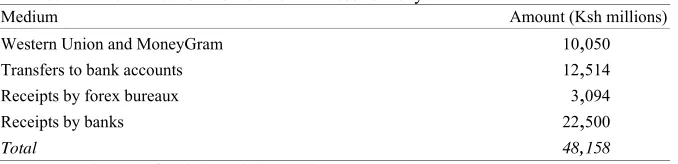
A study by the Central Bureau of Statistics in Nairobi has estimated that total inward remittances through Western Union rose from around Ksh5 billion in 2000 to about Ksh10 billion in 2005. In the case of MoneyGram, the amounts for inward remittances are much smaller, being in the order of Ksh50 million in 2005. The study also estimates that, given some assumptions, remittances received by forex bureaux are to the amount of Ksh3 billion, while remittances through other media are estimated at Ksh22 billion, making a total of Ksh48 billion in 2005, as shown in Table 9.1.
Table 9.1 Estimates for workers remittances to Kenya in 2005
Medium Amount (Ksh millions)
Western Union and MoneyGram 10,050
Transfers to bank accounts 12,514
Receipts by forex bureaux 3,094
Receipts by banks 22,500
Total 48,158
Source: Central Bureau of Statistics, Nairobi, cited in MPND, 2006)
refugees and green card lottery winners, and that 43.7 per cent of them sent money home regularly. Of that group, 40 per cent sent over US$2000 a year. Money is mainly used for daily consumption (72.5% of receivers), school fees (64.9%), investment (59%), and debt payment (17.5%). From her observations, Nyamwange concludes that villages in Kenya with foreign connections are better off than those without international remittances. This last statement is corroborated by Black (2004), for a village in Makueni district, where half of the households surveyed had access to migrant income, which was larger and more secure than local labour income.
Figures reported for remittances received in Kenya from migrants abroad vary from Ksh4 billion from all Kenyan migrant workers, to Ksh58 billion sent by Kenyans in the US through Western Union alone (The Standard, 28 July 2006).16 Planning Minister Henry Obwocha illustrated the importance of remit-tances by pointing to the initial public offer (IPO) for KenGen (Kenya Electric-ity Generating Company Ltd): out of the US$366 million invested, some US$100 million was believed to have come from the Kenyan community abroad.17 The Minister also pointed to another phenomenon, namely Kenyans abroad grouping together in a company and investing directly in Kenya. Mr Frank Mwaniki, former president of the Kenyan Community Abroad (KCA), indicated that the KCA has been collaborating with the Kenya Investment
16
The Ministry of Labour gave an annual figure for remittances of US$56 million (about Ksh4 billion). But the World Bank mentions a 2004 figure of about US$464 million (about Ksh34.8 billion). Kenyans in the diaspora are said to contribute 3.8 per cent of national income through remittances. This overshadows the FDI (US$50.4 million), and the net ODA of about US$200 million. Remittances through unofficial channels could add at least 50 per cent to official figures. In 2005, the conservative estimate of Frank Mwaniki, former president of the influential Kenyan Community Abroad, stood at about US$600 million annually. The Central Bank of Kenya indicated it likely to be between US$1.2 billion and US$1.3 billion, leaving aside informal channels of remittance.
17
Authority in trying to identify areas in which pooled resources can be invested. The Ministry of Planning and National Development is coordinating an infor-mal committee looking into the issue of remittances. Its mandate is based on a Cabinet Memo on diaspora issues. The newly-inaugurated Kenya Diaspora Remittance Facilitation Working Committee is attended by representatives from the CBK, the Ministry of Finance, the Ministry of Planning and National Development, the Ministry of Labour and Human Resource Development, Africa’s Brain Gain, the Kenya Institute for Public Policy Research and Analy-sis (KIPPRA), the Postal Corporation of Kenya, and the Investment Promotion Council (IPC). Consultations were held between the Committee and financial institutions.18
The KCA, through Mr Frank Mwaniki, reported that there would be two kinds of remittance: regular investment remittances, and transaction remit-tances. By pooling regular remittances in a huge fund for investment, transfer fees would be eliminated and a flat transfer fee for ad hoc transactions can be negotiated, regardless of amount. The so-called Kenyans Abroad Investment Fund (KAIF) should allow groups of Kenyans to band together to carry out projects that they normally would not be able to participate in individually (Muraguri, 2005). Secondly, it would be easier to predict the level of foreign exchange coming into the country, since currently most remittances of large sums enter via the informal route. If a premium could be guaranteed over the going buying/selling rates, people would be convinced that this was the best way to remit money to Kenya. The amalgamated fund gives the government of Kenya, and the CBK specifically, leverage in controlling not only foreign exchange flows but also the value of the Kenyan shilling on the international market.
The fund allows groups of Kenyans to band together to carry out projects that they normally would not be able to participate in individually. Secondly it will be easier to predict the level of foreign exchange coming into the country as currently, most remittances of large sums occur via the informal route. If a premium can be guaranteed over the going buying/selling rates, people will be convinced this to be the best way to remit money to Kenya, the amalgamated fund gives the government of Kenya, and CBK specifically, leverage in con-trolling not only foreign exchange flows but also the value of the Kenyan shilling on the international market.
18
Brain drain: Different opinions
Whereas remittances are seen as a positive aspect of international migration, the loss of skilled labour in specific fields such as health, education and engineering is considered a serious setback. According to the Ministry of Planning and National Development, Kenya has had to replace these professionals with expatriates from developed countries – at a very high cost (MPND, 2006). Kenya continues to fund the education of its nationals, only to see them end up contributing to the growth of rich countries, with little or no return on their investment. To show the magnitude of the problem, it costs about US$40,000 to US$50,000 to train a doctor, and around US$25,000 to train a nurse. Gideon Konchella (NDN, 2004), Assistant Minister for Health, estimates the loss to society of an emigrant doctor to be almost US$518,000 per doctor and about US$340,000 for a nurse (Kirigia et al, 2006). Ann Veneman of UNICEF said that the brain drain of medical professionals is threatening the very existence of sub-Saharan Africa’s health services, with the ‘push factor’ being the underly-ing cause of the malaise (IRIN, 2006). The Ministry estimates that the country loses on average twenty medical doctors each month.
In sum, the following are the positive and negative effects of brain drain on Kenya’s economy: on the negative side, brain drain reduces the already low numbers of skilled people available and needed for development; it reduces the number of innovative people, whether entrepreneurs or academics; it increases dependence on foreign technical assistance; it slows the transfer of technology and widens the gap between Kenya and the industrialised countries of the north; it negatively affects the country’s scientific output, and results in a loss of income tax revenue and potential contributions to the GDP. The positive aspects relate to contribution of new skills when migrants return; and remittances from skilled migrants boosting household welfare and supporting the balance of payments.
The Ministry of Planning intends to put in place policies to structure migra-tion – not just to tap remittances but also to address the issue of brain drain, especially with regard to the ‘2030 vision’ and the need for manpower. ‘But of now we do not have a specific policy on migration. This ministry should be the coordinating force but it is not. A department of foreign employment looking into human trafficking and agencies would be a good idea.’19 The Ministry of Labour officials also claim that their department should take the lead in coordi-nating issues of labour migration. In their view the current situation is one primarily of brain drain and wastage. Kenya lacks a policy for labour migration.
The Ministry of Labour is supposed to vet the terms of employment of Kenyan migrant workers or those in any foreign employment. According to Ministry of Labour officials, this is now being done by the IJO – without reference to the ministry.
The Ministry of Labour is concerned about the negative aspects of out-migration and indicated that they would like to manage this process, to turn it into a ‘brain gain’. In particular, the even temporary return of Kenyan migrants as consultants (‘brain circulation’) was seen to be a promising option. But officials said that it would first be necessary to establish in more detail which sectors in Kenya’s labour force are in deficit. Manpower surveys were last conducted over twenty years ago. The Ministry of Foreign Affairs is also of the opinion that there is a need for an audit of skilled and unskilled labour in Kenya, to address the gaps and surpluses.
The Ministries of Migration, Planning and Labour all claimed that Kenya does not have any bilateral arrangements with receiving countries, nor any co-development programme that includes Kenyan returnees. The IJO, by contrast, explained that it is trying to secure agreements with Namibia and Sudan.
The Ministry of Foreign Affairs blames the lack of a coordinated policy partly on the cross-cutting character of migration. There is need for a mecha-nism which brings in stakeholders from the government of Kenya, civil society, the private sector and international organisations to deal with the issue.20 There was also a clear understanding of the limited ability – and, perhaps, the limited will – of the Kenyan authorities to act in this respect. In fact, as mentioned by the Ministry for Immigration officials, ‘the brain drain is not a major govern-ment concern, if you get opportunities abroad then just head for these greener pastures, no need to involve the government of Kenya.’ A similar opinion – albeit in a more extreme degree – was aired by the director of the IJO. ‘The word “brain drain” is not in our vocabulary. We do not want to hear about it. We have to create 500,000 jobs per year but these are simply not here. The solution is to go beyond our own borders, especially to the Middle East and southern Africa.’ The IJO claims that brain drain will continue because of better working conditions and pay.
Another advantage of the brain drain, according to IJO, is that employers will be forced to improve working conditions in Kenya. At present Kenya retires its civil servants at 55 years. There are countries that want such civil servants – which reduces the problem of retirees who have no retirement benefits. Expertise that Kenya does not want to lose is contained through the condition put to the applicants to bring along a letter from their Kenyan
employer. This acts as an assurance that the person is of good character, and also allows IJO to deliberately discriminate in the selection if certain qualified persons should not leave the country (see advertisement for jobs in Saudi Arabia for Kenyan medical personnel and quality inspectors, The Standard July 31, 2006: 25). Labour officials stated:
IJO does not address labour deficits and only has a focus on exporting surplus labour. There is no integrated approach or coordination of identifying surplus labour, and balancing this with the concern of brain drain. The private sector needs to come together and look for an integrated approach and coordination of labour migration. International organisations also push their own interests and bring their agenda to the table. We also have no policy framework to facilitate compensation for taking away skilled labour from developing countries.
In view of the current state of the Kenyan economy and the high rate of unemployment, the Ministry of Planning does not expect an immediate return of Kenyans abroad.
It may actually be that many more talented, qualified and unemployed Kenyans willing to migrate will continue to seek opportunities abroad, and contribute to nation-building through direct financial remittances or other forms of brain gain. Hopefully, a robust private-public framework that can facilitate productive linkages between Kenyan academics, researchers, artists and investors at home and in the diaspora will emerge to consolidate the political and economic changes taking place in Kenya, as has been the case elsewhere’ (MPND, 2006).
From brain drain to brain gain (the diaspora option)
According to the ECA, strategies attempting to reverse the brain drain include the retention and return of skilled migrants to their countries of origin. How-ever, many African countries have acknowledged that these efforts are not always well organised or effective. For example, the IOM programme to bring back Kenyans was a top-down programme brought to the East African Commu-nity when Ugandans (though not many Kenyans and Tanzanians) wanted to return home. ‘IOM brings the agenda; we dance their tune’.21 The diaspora option (as the ECA calls it), which encourages highly-skilled expatriates to contribute their experience to the development of their country without neces-sarily physically relocating, emerged in the early 1990s as a more realistic strategy to alleviate the consequences of brain drain. There are some forty-one formal expatriate knowledge networks in the world, six of them African, including the Association of Kenyans Abroad.
In February 2003, the African Union called for the diaspora to be considered the sixth region of Africa, after North, South, East, West and Central Africa, while NEPAD wants the establishment of a database to determine the magni-tude of brain drain and promote collaboration between Africans abroad and at home. NEPAD has an arrangement to top up salaries of doctors and engineers (Mutume, 2003).
The Ministry of Planning and the Jomo Kenyatta University for Agriculture and Technology organised a conference in 2005 on the topic of brain gain. Among the recommendations put forward was the promotion of circular migra-tion, that is encouraging those living abroad to come back to work for a short period to conduct research and/or support their community. Another way to link with the diaspora is to provide them with the right to vote in their country of origin. Calls have recently again been made to the Kenyan Parliament for this purpose and a positive response is expected. However, according to Ministry of Migration officials, ‘If you want to facilitate the return of migrants, build the capacity of countries of origin or transit, to stem movement: facilitate economic empowerment and democracy, democratic institutions and peace.’ Ministry of Labour personnel aired similar views: ‘The EU holds open arms towards skilled labour from abroad. But unless the root cause is addressed [poverty], you will not stop out-migration. People go to Europe because there are jobs available; otherwise they would not go.’
Conclusion
Until quite recently, Kenyan government policy documents hardly addressed the issue of migration. At best a few remarks were made regarding the refugee situation of some 250 000 forced migrants who have settled in two main camps in the country. This encampment policy, implemented by UNHCR, was recently relaxed by recognising the status of urban refugees. New legislation concerning refugees in the country, which has been under consideration since the early 1990s, finally seems to be in the making. The growing importance of the migration debate in the country is also illustrated in the recent establishment of a Ministry for Immigration and a new Refugee Department.
engineering are needed but are being lost to foreign countries. Kenya will need to deal with this issue as a top priority and harmonise its migration policies, both at home and in collaboration with other countries in the region and beyond.
Interviews
Mr Furio De Angelis, UNHCR, August 2, 2006.
Mr Ekuru Aukot, Exec. Director Kituo Cha Sheria, August 3, 2006.
Mr Thuita Mwangi, Permanent Secretary Ministry of Foreign Affairs, August 2, 2006. Mr Frank Mwaniki, former chairman Kenya Community Abroad, interview by e-mail,
August 9, 2006.
Hon. Minister Henry Obwocha, Minister for Planning and National Development, July 31, 2006.
Mrs Grace Otieno, Director Employment, Ministry of Labour and 5 team members, August 2, 2006.
Mrs Judy Wakahiu, Exec. Director, Refugee Consortium of Kenya, August 3, 2006.
References
ABCNEWS ONLINE (2006), Kenya muslims protest, allege police discrimination.
September 30, 2006. http://www.abc.net.au/news/newsitems/200609/s1752530.htm.
BLACK,R.,L.MCLEAN HILKER &C.POOLEY (2004), Migration and pro-poor policy in
East Africa. Working Paper C7. Sussex Centre for Migration Research. Brighton, UK: University of Sussex.
GJLOS (Governance, Justice, Law and Order Sector) (2005), Medium term strategy 2005/06 to 2008/09 Final draft (version 5). 15 June 2005. Nairobi: Government of Kenya, GJLOS Reform Programme.
IRIN (Integrated Regional Information Networks ) (2002a), KENYA: Hundreds of foreigners arrested in Eastleigh. Nairobi, May 31, 2002.
http://www.irinnews.org/Report.aspx?ReportId=32214.
IRIN (2002b), KENYA-TANZANIA: Rights groups urge tougher refugee protection laws. Nairobi, April 23, 2002.
http://www.irinnews.org/Report.aspx?ReportId=31496.
IRIN (2005), AFRICA: Making room under the umbrella: The legal framework of forced migration. Nairobi, February 1, 2005.
IRIN (2006), SOUTHERN AFRICA: Band aid for medical brain drain. Nairobi, August 16, 2006. http://www.irinnews.org/report.aspx?reportid=60374.
KIRIGIA,J.,A.GBARY,L.MUTHURI,J.NYONI &A.SEDDOH (2006), The cost of health
professionals’ brain drain in Kenya. BioMed Central (BMC) Health Services Research Article 6:89.
MPND (Ministry of Planning and National Development) (2003), The economic recovery strategy for wealth and employment creation 2003-2007. June 2003. Nairobi: Government of Kenya, Ministry of Planning and National Development. MPND (2006), Kenyans in the Diaspora: Effects of emigration and brain drain on the
MURAGURI, G. (2005), Kenyans abroad investment fund (KAIF): An initiative of Kenyan Community Abroad (KCA) to address the issue of Kenyans in the diaspora participation in economic development. Paper presented at the Second Annual Africa’s Brain Gain Conference, Nairobi, December 7-9, 2005.
MUTUME, G. (2003), Reversing Africa’s ‘brain drain’: New initiatives tap skills of
African expatriates. Africa Recovery 17(2): 1.
NDN (Nairobi Daily Nation) (2004), Brain drain compensation. Tradequity 3(2). NEPAD (New Partnership for Africa’s Development) (2006), African peer review
mechanism. Country Review Report: Republic of Kenya, May 2006. Nairobi: APRM–NEPAD.
NYAMWANGE,M. (2005), International migration and the brain drain of students and
workers. National Social Science Journal 24(1): 97-103.
OKOTH, K. (2003), Kenya: What Role for Diaspora in Development? Migration Information Source, August 2003.
OUCHO, J. (2006), Migration and refugees in Eastern Africa: A challenge for the East African Community. In: C. Cross, D. Gelderblom, N. Roux & J. Mafukidze, eds, Views on Migration in Africa. Proceedings of an African Migration Alliance Workshop, Pretoria, South Africa, March 10-11, 2005.
RUTTEN, M. (2004), Kenya. In: Bogdan Szajkowski, ed., Revolutionary and dissident
movements of the world. London: John Harper Publishing.
SANDER, C. (2003), Migrant remittances to developing countries — A scoping study:
Overview and introduction to issues for pro-poor financial services. London: Bannock Consulting (now DAI Europe Ltd).
THUKU, H. (with assistance from K. King) (1970), Harry Thuku an autobiography. Nairobi: Oxford University Press.
UN (United Nations) (2006), International migration and development. Report A/60/871 of the UN Secretary-General.
US(UNITED STATES)DEPARTMENT OF STATE (2004), Trafficking in persons report.US
Office of the under secretary for democracy and global affairs. Washington, DC: US Department of State.
WORLD BANK (2006), Global economic prospects 2006: Economic implications of