SUPERVISOR DECLARATION
“I hereby declare that I have read this thesis and in my opinion this thesis is sufficient in terms of scope and quality for the award of the degree of Bachelor of
Mechanical Engineering (Structure and Materials).”
Signature : ...
REED GRASS AS SUSTAINABLE SOUND ABSORBER
MUHAMMAD FAHMI BIN NOORDIN
This report is submitted in fulfillment of the requirements for the award Bachelor of Mechanical Engineering (Structure and Materials)
Faculty of Mechanical Engineering Universiti Teknikal Malaysia Melaka
ii
DECLARATION
“I hereby declare that the work in this thesis is my own except for summaries and quotations which have been duly acknowledged.”
Signature : ...
iii
DEDICATION
iv
ACKNOWLEDGEMENT
Alhamdulillah, praise be only to Allah S.W.T. for giving me the strength and health to making this Final Year Project (FYP) to its completion. By his grant, I am able to finish up this report. I like to convey my sincere gratitude neither to all UTeM lecturers and staffs for the guidance, advice and the constructive comment throughout this final year project.
My special thanks to the individuals that assisted me to complete my final year project report, especially to my supervisor Madam Noryani Binti Muhammad that provided guidance and encouragement to me. Not forgotten, expression of gratitude to my seminar panel and my co-supervisor, Dr Azma Putra, for all the building advices and suggestions. In addition, thanks also to Fazlin (Master student) for her valuable guidance and “foot the bill” of the expenses that helps in completing this report.
v
ABSTRACT
vi
ABSTRAK
vii
TABLE OF CONTENT
CHAPTER TITLE PAGES
DECLARATION ii
DEDICATION iii ACKNOWLEDGEMENT iv
ABSTRACT v
ABSTRAK vi TABLE OF CONTENT vii
LIST OF TABLES x
LIST OF FIGURES xi
LIST OF SYMBOLS xiv
LIST OF APPENDICES xv
CHAPTER 1 INTRODUCTION 1
1.1 Research Background 1
1.2 Problem Statement 2
1.3 Objectives 2
1.4 Research Scopes 2
CHAPTER 2 LITERATURE REVIEW 3
2.1 Introduction 3
2.2 Reed Grass (Imperata Cylindrica) 3
2.3 Sound 5
2.4 Noise Control 6
2.5 Impedance Tube (using Two-Microphone Method) 7
2.6Sound Absorption (using natural fabrics) 8
viii
2.7.1 Specimens of chopped reeds 10
2.7.2 Absorption coefficient of Reeds 13 2.7.3 Acoustic applications 14
CHAPTER 3 METHODOLOGY 17
3.1 Introduction 17 3.2 Flowchart 18
3.3 Sample Preparation 19
3.4 Sound Absorption Coefficient Testing 21
3.4.1 Equipment of Test 22
3.4.2 Procedure of Sound Coefficient Testing 23 3.5 Air gap 24
3.6 Arrangement of samples in Impedance Tube 25 CHAPTER 4 RESULT AND DISCUSSION 27 4.1 Introduction 27
4.2 Sound Absorption Coefficient Results 27
4.3 Equation of Wavelength 28
4.4 Results on Axial Arrangement of Reeds 29
4.5 Results on Transverse Arrangement of Reeds 31
4.6 Results on Axial Arrangement of Reeds (with two fabrics) 33
4.7 Results on Cross Transverse Arrangement of Reeds 35
4.8 Sound Absorption Coefficient on Other Materials 37
4.9 Design and Fabrication of Panel 39
4.10 Discussion 40
4.10.1 Effect of Length 40
4.10.2 Effect of Sample Arrangement 41
ix
CHAPTER 5 CONCLUSION AND RECOMMENDATION 43
5.1 Conclusion 43
5.2 Recommendation 44
REFERENCES 45
APPENDIX A 47
x
LIST OF TABLES
NO. TITLE PAGE
2.1 Acoustical properties (absorption) of some
conventional and sustainable material (Asdrubali and Francesco, 2007) 9
3.1 The equipment in the experiment 22
4.1 Wavelength for 2 cm and 6 cm length of the reeds
in axial arrangement 30
4.2 Wavelength for 2 cm and 3 cm thickness of the
reeds in transverse arrangement 32 4.3 Wavelength for 2 cm and 6 cm length of the reeds
with two fabrics 34
4.4 Wavelength for 2 cm and 6 cm thickness of the
reeds in cross transverse arrangement 36 4.5 Wavelength for 2 cm and 3 cm length of the
reeds and lollipop sticks 38
xi
LIST OF FIGURES
NO. TITLE PAGE
2.1 Reed Grass (Imperata Cylindrica)
(Source: Troya M. T. 2009) 4
2.2 Two-Microphone Method
(Source: Andrew 1989) 7
2.3 The specimens of whole reeds are presented by four types of thickness
(Source: Mažuolis et al. 2012) 10 2.4 The process of preparing the specimens of
chopped reeds (200 mm thickness)
(Source: Mažuolis et al. 2012) 11 2.5 The process of preparing the specimens of
chopped reeds (150 mm thickness)
(Source: Mažuolis et al. 2012) 11 2.6 Chopped reeds as the specimens of a random mix
(50 mm thickness)
(Source: Mažuolis et al. 2012) 12
2.7 Suspended ceiling measurement
(Source: Koizumi 2002) 13
2.8 Vertical reed panel
(Source: Koizumi 2002) 13
2.9 Configuration of reed grass tested
xii
2.10 Loose material with the average thickness is 4cm is inserted in jute sacks to obtain a layer
of sound absorbing porous material 15
(Source: Mohanty A. R. 2010) 2.11 Classroom plan with dimensions (Source: Trematerra A 2013) 15
2.12 Classroom section, with height dimensions (Source: Trematerra A 2013) 15
2.13 Sound absorbent panels installed in the classroom during the test (Source: L.V. Redman 2003) 16
2.14 Sound source in the classroom with the measurement microphone (Source: L.V. Redman 2003) 16
3.1 Flowchart of the research 18
3.2 Samples collected 19
3.3 Tools preparation 19
3.4 Samples were cut 20
3.5 Samples 20
3.6 Impedance tube (Putra 2014) 21
3.7 Measurement setup (Putra 2014) 21
3.8 (a) Sample holder (b) Calibrator 22
3.9 (a) Rigid backing (b) 1 cm air gap (c) 2 cm air gap (d) 3 cm air gap 24
xiii
3.11 (a) Gaps between reeds on axial arrangement (b) Gaps between aligned reeds on transverse arrangement
(c) Gaps between reeds on cross transverse
arrangement 26
4.1 Measured absorption coefficient of 2 cm length of
reeds in axial arrangement 29 4.2 Measured absorption coefficient of 6 cm length of
reeds in axial arrangement 29 4.3 Measured absorption coefficient of 2 cm thickness
of reeds in transverse arrangement 31 4.4 Measured absorption coefficient of 3 cm thickness
of reeds in transverse arrangement 31
4.5 Measured absorption coefficient of 2 cm length of
reeds with two fabrics in axial arrangement 33 4.6 Measured absorption coefficient of 6 cm length of
reeds with two fabrics in axial arrangement 33 4.7 Measured absorption coefficient of 2 cm thickness
of reeds in cross transverse arrangement 35 4.8 Measured absorption coefficient of 6 cm thickness of
reeds in cross transverse arrangement 35 4.9 Comparison of measured absorption coefficient of
reeds and lollipop sticks 37
4.10 Absorber panel 39
4.11 Measured absorption coefficient of 2 cm and 6 cm
length of reeds in axial arrangement 40 4.12 Comparison of the measured value of absorption
coefficient of rigid backing samples with different 41 arrangement
4.13 Examples of sound insulated panels
xiv
LIST OF SYMBOL
°F = Fahrenheit
= Absorption Coefficient
60
T = Reverberation Time
V = Volume
c = Speed of Wave
% = Percentage
f = Frequency of Sound Wave
xv
LIST OF APPENDICES
NO. TITLE PAGE
A Gantt chart of PSM I and PSM II 47
B Results of Absorption Coefficient for Different
1
CHAPTER 1
INTRODUCTION
1.1 RESEARCH BACKGROUND
Until todays, the used of synthetic materials as acoustic absorbers are still practiced extensively in building industry. This is because the increasing of noise level affects people not only in the industry, but also in the living environment. A sustainable material is produced usually from natural or recycled materials and its production requires a small amount of energy. It makes special use of non-renewable resources and delivers a low environmental impact (Ersoy S. 2008). Therefore, researchers have now driven their attentions to find sustainable and eco-friendly materials to be an alternative sound absorbing. The need for new applications by addressing acoustic problems has been constantly growing.
Thus, the sound absorption properties of reed grass have been investigated. One of the reason is the reed grass are able to provide up to 80% absorption in a relatively broad frequency range (Asdrubali F. 2007). By increasing the layer thickness, this range can be expanded to the lower frequency regime. It has been found that the higher absorption properties of the tested samples are obtained sealing the reeds.
2
1.2 PROBLEM STATEMENT
In the final age, noise control was one of the major requirements to improve the living environment. For example, in the construction sector. The high cost involved in the building and renovation of noise barriers makes the growth of sustainable barriers necessary. One of the methods to execute that is provided by sound absorber. This survey was directed to look into the potency of using reed grass (Imperata Cylindrica) as sound absorbing. Different with the experiments before, this experiment using 3cm length of the reed grass that arranged in vertical arrangement.
1.3 OBJECTIVES
The objectives of this research are:
1. To design and fabricate reed grass as sustainable sound absorber.
2. To measure the sound absorption coefficient of the panel using the impedance tube.
1.4 RESEARCH SCOPES
The scope of project are:
1. Material preparation, design and fabrication.
3
CHAPTER 2
LITERATURE REVIEW
2.1 INTRODUCTION
This chapter will discuss the literature review in order to gain enough information that can be used to complete the research. It will includes the introduction of reed grass, usage of reed grass, overview of research in noise control in industry and also the analysis method used in previous research works. There are many advantages from the reed grass such as low density, cheap in cost, the availability, and biodegradable. Hence, the usage of reed grass has increased because of these advantages. The data’s include in this chapter are taken from thesis, books, journals, and any academic articles that are related to the research topic and will be clearly cited.
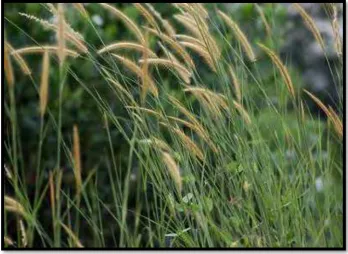
2.2 REED GRASS (Imperata Cylindrica)
4
Reed grass can find in the vicinity of Southeast Asia, Africa, India, Australia and tropical climes, such as North America, Central America and South America. In fact, the grasses are growing in some temperate areas, such as New Zealand and Japan. They thrive in countries that received rainfall in excess of 1,000 mm per year. Reed grass also lives in countries prone to flooding and fire resistant (Chee 2012). Consequently, the reed grass are easily spread into sandy areas, such as coastal, desert and watery habitats, such as swamps and river valleys. High growth rates have the reed grass quickly spread throughout the new country as a new pilot that threaten agriculture and plantation sectors.
[image:21.595.143.492.421.675.2]The scientific name is selected from the remembrance services grass pharmacist Italy, namely Ferrante Imperato (1550-1631). He is actively involved in the field of natural resources and the author Dell'Historia Naturale. Another name for them is the weeds in Indonesia, kunai in Papua New Guinea, co tranh (Vietnam), Eye and gogon (Philippines), yet-mei (Myanmar) and O - kha (Thailand). They are also known as congress and satin tail in English (Chee 2012).
5
2.3 SOUND
Sound is the sensation of hearing. It is any pressure variation (in air, water, or other medium) that the human ear can detect. Sound is developed when a source defines the air closest to it in motion. For instance, when a tuning fork is taken, it vibrates, causing the air around it to move back and forth creating a variation in normal atmospheric pressure. Then it will create alternate layers of expansion and contraction to move off from the vibrating source. These compression waves can we say as sound. The pressure fluctuation (amplitude) determines the loudness and the number of fluctuations its frequency.
Sound waves move around in the air at a speed which is temperature dependent. The velocity of sound is about 1130 feet per second at 70°F. The frequency of sound is measured in cycles per second, and is called Hertz (Hz). The human hearing range is about 20 to 20,000 Hz (Mueller 2001).
6
2.4 NOISE CONTROL
Noise is can be defined as any unwanted sound. Noise may be continuous or erratic depending upon the source. It annoys, distracts and generally upsets the environment. Noise affects people in a bit of ways. If sufficiently intense, noise may damage hearing or health, interfere with work tasks, interfere with speech communication, interrupt sleep, or cause irritation.
Noise can be controlled by addressing their origin, track or recipient. Noise control at the source. A noise source is created by the motility of a solid, liquid, or gas. A solid source may be quoted if its manner of performance is shifted so that it moves less. Liquid and gaseous sources may be piped down by reducing flow velocity, smoothing flow, and attenuating pressure pulsations (Zulkifli R. 2010).
Control at the source by planning while the merchandise is in the design stage is often the most cost effective and least expensive control measure. Most corrective measures for an existing noise control problem utilizes changes in the path. Solutions for path noise control include barriers, enclosures, silencers, and dampers, vibration dampening, and vibration isolation.
7
2.5 IMPEDANCE TUBE (using Two-Microphone Method)
The methods to use an impedance tube with two microphones is to obtain the acoustic features of materials samples. This setup can also be utilized to assess the absorption coefficient in-situ on road surfaces, as a non-destructive alternative to fit drilled out road samples into the tube. Besides that, impedance tubes can also be applied to receive the non-acoustic parameters of a porous material using multiple microphones and transfer function computations.
This setup also can be used to measure the absorption coefficient in-situ on road surfaces, as a non-destructive alternative to fit drilled out road samples into the tube (Andrew 1989). Moreover, impedance tubes can also be used to obtain the non-acoustic parameters of a porous material using multiple microphones and transfer function calculations.
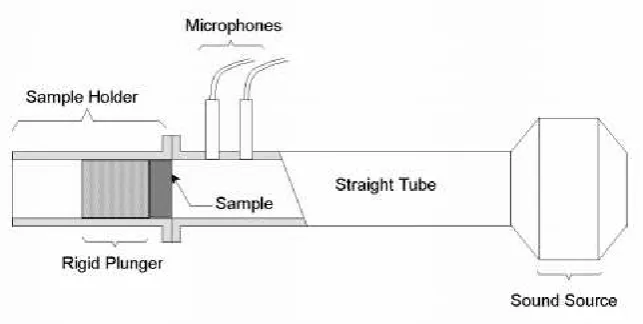
[image:24.595.158.480.527.689.2]The two-microphone method is shown schematically in Figure 2.2 below. A sample of the material to be tested is placed in a sample holder and mounted to one end of a straight tube. A rigid plunger with an adjustable depth is placed behind the sample to provide a reflecting surface. A sound source, typically a high-output acoustic driver, is connected at the opposite end of the tube. A pair of microphones is mounted flush with the inner wall of the tube near the sample end of the tube.