International Journal of Electroactive Materials
www.electroactmater.com
Short Communication
Electrochemical Analyses of Carbon Nanotube Based Supercapacitor in 1M
LiPF6 Organic Electrolyte
M.A. Azam1*, M.F. Rosle2
1Faculty of Manufacturing Engineering, Universiti Teknikal Malaysia Melaka (UTeM), Durian Tunggal, 76100 Melaka,
Malaysia
2Advanced Materials Research Centre (AMREC) SIRIM Berhad, Kulim Hi-Tech Park, 09000 Kulim, Kedah, Malaysia
*E-mail address: [email protected]
ABSTRACT: Excellent electrical conductivity, high mesoporosity, and high electrolyte accessibility of carbon nanotube
(CNT) ensure a high charge transport capability and hence a high power density for the capacitor. However, performance of the supercapacitors should be improved to satisfy the increasing demands for various applications. In this article, commercial CNT was used as active material and a non-aqueous solution, LiPF6 was used as electrolyte to fabricate
electrodes for EDLC-type supercapacitor. Electrochemical measurements such as BET analysis and cyclic voltammetry were performed to determine the capacitance behavior of the device. As results, specific surface area of the CNTs was found to be 609 m2 g-1, and specific capacitance was calculated to be 42 F g-1.
Keywords: CNT; Supercapacitor; LiPF6 electrolyte; BET; Electrode fabrication; Specific gravimetric capacitance
1. Introduction
Supercapacitors are usually known as ultracapacitor and double layer capacitor. In previous, conventional electrostatic capacitors have been used as energy storage device, but low capacitance performance have limited them to low power applications. As an improvement, scientists have been struggling on the understanding of the charge transfer processes that occur in the double layer system to make high-power capacitors possible and this so-called electrochemical or electrical double layer capacitors (EDLCs) are also able to deliver more power than batteries. From this point of view, supercapacitors combine the properties of high power density and higher energy density, and also have long life cycles due to the absence of chemical reactions.
Supercapacitors have two electrodes immersed in an electrolyte solution, with one dielectric separator between them, and two current collectors. The electrode is a metallic current collecting material in contact with an active material. EDLC results from strong interactions between the ions/molecules in the electrolyte and the electrode surface. The physical separation of the electronic and ionic charges is the source of the energy storage in an EDLC [1]. Active materials are in contact with a metal electrode, and also become charged. Solvated ions of opposite charge are attracted to the active material, and are accumulated at the interface between the active material and the electrolytic solution. The separator is necessary in order to prevent electrical contact between the anode and cathode, but still allows for solvated electrolyte ion migration. In the vicinity of the electrode surface, there is an opposite charge in solution due to an excess of either cations or anions. Thus, the double layer is made up of the
whole array of charged species and oriented dipoles existing at the metal-solution interface [2].
Carbon materials especially carbon nanotube (CNT) is the most common material for supercapacitor electrodes and has been intensively studied by many researchers [3 – 8]. Carbon materials originally have high surface area, 1,000 ~ 2,000 m2g-1 and importantly, better surface area and porosities can be achieved by additional treatments or activation [9 – 11]. Physical and chemical activations were used as the additional treatment of CNT electrodes to improve the surface area by introducing micropores. Besides pore structures and surface area, the wetting capability (wettability) of the electrode materials is also an important property that affects the capacitance behavior. Theoretically, the specific capacitance of carbon materials should increase with surface area. Porous texture of the carbon determines the ionic conductivity, which is related to the mobility of ions inside the pores [12].
of the alcohol can remove the unwanted impurities during CNT growth [13].
In the meantime, the reported specific gravimetric capacitance (Csp) values of the CNTs ranging from 20 to
more than 300 F g-1. The supercapacitor electrodes prepared from multi-walled CNT (MWCNT) in H2SO4
aqueous electrolyte was first reported with Csp of 113 F g -1, and followed by another MWCNT supercapacitor
electrodes, which have relatively low Csp values of 15-25
F g-1 [14, 15]. The single-walled CNT (SWCNT) electrodes in KOH aqueous electrolyte give a Csps of up to
180 F g-1, and 20-40 F g-1 in NaCl aqueous electrolyte [8, 16, 17]. Almost similar results were also reported in 1M LiClO4/propylene carbonate electrolytes [7]. The
capacitance of SWCNTs in acetonitrile electrolyte containing tetra-n-butylammonium hexafluorophosphate is around 280 F g-1 for 0.1 M [18].
In this article, basic experimental set up on electrode fabrication of CNT based supercapacitor was studied and the fabricated supercapacitor was tested by using cyclic voltammetry (CV) analysis. The commercial CNTs were also characterized using surface area analysis in order to understand the relationship to the device performance. In CV analysis, supercapacitor electrode responses to a constantly changing voltage, and can be used to calculate specific capacitance performance.
2. Experimental
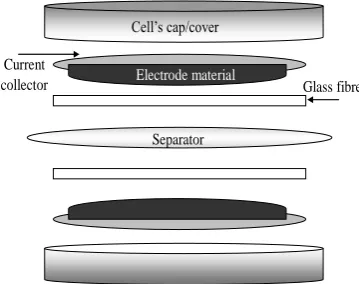
As shown in Figure 1, supercapacitor used in this study consists of two electrodes impregnated with an electrolyte solution with a semi-permeable membrane serving as a separator. The electrode is a metallic current collecting material in contact with an active material. In this study, 15 mm diameter stainless steel (SS) mesh was used as current collector and the commercially available CNT powders made of Carbon Nanotechnologies Inc. as active material at both electrodes. In this paper, this CNT powders is labeled as CNiCNT. Two-electrode Teflon cell jig was used as cell to fabricate the device. For the characterization CNiCNT powders, nitrogen (N2)
adsorption and desorption isotherms at –196 oC (77 K) were measured using Quantachrome Instruments by means of Brunauer-Emmett-Teller (BET) surface area and Barrett-Joyner-Halenda (BJH) pore analyses. Typically, 7
– 10mg of sample was used for the measurement.
The weight of CNiCNT electrode is fixed to the electrodes were dried up in vacuum oven for almost 12 hours at 110 oC. Listed in Table 1 below are the other important items needed to fabricate the electrodes.
Non-aqueous organic electrolyte, 1M lithium hexafluorophosphate (LiPF6) which was used as
electrolyte is well-known to the usage in Li ion batteries and is hazardous for human health, thus the cell assembly was performed in a glove box. Besides, it is important that soaking the electrode with electrolyte has to be done a closed environment to avoid the effect of air and water moistures. During cell assembly process, PP separator and the glass fibres were used to construct the supercapacitor. The separator is necessary in order to prevent electrical contact between the anode and cathode, but still allows for solvated electrolyte ion migration.
Table 1: Important elements in supercapacitor cell
fabrication
Current collector 15 mm diameter stainless steel mesh
Binder material Acetylene black (AB) 50% +polytetrafluoroethylene (PTFE) 50%
Active material Commercial CNT (Carbon Nanotechnologies Inc.)
Electrolyte Organic electrolyte, LiPFin EC: DMC 1:1 (Mitsubishi 6 1M Chemical)
Separator Polypropylene (PP)
*Glass fibres were used to avoid direct contact between electrodes
Furthermore, appropriate amount of electrolyte is required to avoid electrical failures (short circuit, electrolyte decomposition etc.) during the electrochemical measurement. The supercapacitor was tested using a Battery Cycler System, WonATech (WBCS3000). The applied voltage was set in the range of 0.0 – 3.0 V due to the organic electrolyte`s thermodynamic window which can be up to 5.0 V.
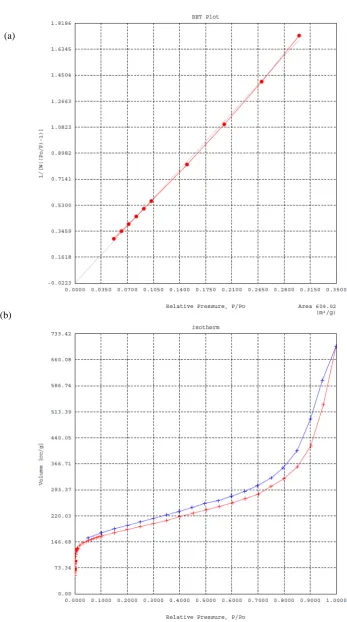
adsorption and desorption isotherms. From BET plot depicted in Figure 2(a) and the results summarized in
Table 2, the specific surface area (SSA) was calculated to
be 609 m2 g-1, almost one-half-fold lower than the theoretical maximum SSA of one side of graphene sheet
Current
collector Electrode material Glass fibre
Separator Cell’s cap/cover
Figure 2: (a) BET plot and (b) N2 adsorption and desorption isotherms at 77 K for CNiCNT sample
(a)
CNTs (multi walled CNTs) and/or the incorporation impurities (e.g. metal catalyst nanoparticles) in the sample. However, this is still a reasonable SSA compared to that
Pore size (micropore) from DR method 1.41 nm
Average pore size 1.55 nm
In addition, although maximum theoretical SSA value of single-walled CNTs can achieve of up to more than 2,000 m2 g-1, this results demonstrate that CNiCNT sample shown a relatively good surface area and pore size; only small effect of impurities. In principle, most of the surfaces of the CNTs are accessible to the surrounding environment, and this could be good for the access of electrolyte ion during charging-discharging process in electrochemical device including supercapacitor. In a supercapacitor consists of symmetric electrodes, there will be two double-layers present, one at each electrode/electrolyte interface. In ideal case, the electrodes are made of high effective surface-area materials such as porous carbon preferably CNTs in order to maximize the surface area of the double-layer. Good electrochemical performance is therefore achievable in this supercapacitor due to the relatively good SSA value and good average pore size of approximately 1.55 nm.
3.2 CV analysis of CNiCNT based supercapacitor
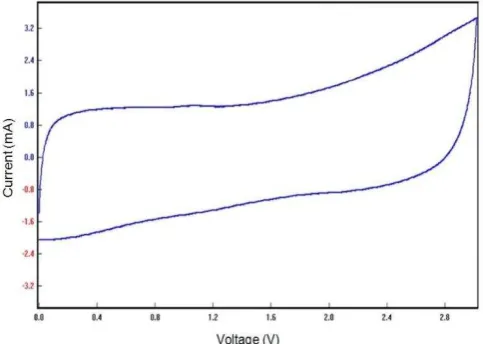
The results of the CV measurement were plotted and known as the CV profile, which gives insight into the charge and discharge behavior of the EDLC type supercapacitor. Ideal carbon material based supercapacitor shows a butterfly or a solid rectangular shape CV profile. Importantly, CNiCNT based supercapacitor was fabricated using Teflon cell jig to avoid difficulties/problems for example short circuit failure and electrolyte decomposition that may occur when using coin cell. Several considerations were taken during the EDLC cell fabrication. For example, the weight of active material and also the weight of binder material which might increase the resistance level in the cell. Figure 3 depicts the second cycle of the CV measurement of CNiCNT electrode in 1M LiPF6 electrolyte. At 2 mV s-1 of CV scan rate, the specific
gravimetric capacitance (Csp) was calculated to be 42 F g-1
(0.0 – 3.0 V potential). The capacitance was calculated from the following simple equation [19]:
C = I / mv (1)
where I is the average current value of anodic-cathodic currents generated by the supercapacitor, m is the working (positive) electrode weight, and v is the corresponding scan rate. The CV showed a rectangular shape profile, confirming the ideal charge-discharge behavior of carbon-based material. The absence of redox peak in the CV explains the consistent current density values at all scan rates. In a redox based electrochemical capacitor, chemical processes dominate and a sharp decrease can be observed for faradaic processes [20]. During the CV measurement, the effect of impurities in electrolyte and/or metal particles in the CNTs was eliminated, thus the degradation of the CNT and electrolyte was prevented.
The successful measurement of CV can be possibly attributed to the not-so-high level of impurities agglomerated with the CNTs, in other word good quality of CNTs, and also good CNT pore structures that allow good accessibilities of electrolyte ions onto CNT surfaces. And this is in good agreement with the BET measurement results. The results of mesopore type of CNT consisting little hysteresis loops from N2 isotherm adsorption
desorption in Figure 2 is suggested could possibly affect the accessibility or the mobility of the LiPF6 organic
electrolyte as well as electrochemical measurements giving low value of specific capacitance.
Figure 3: CV profile of CNiCNT electrode in 1M LiPF6
electrolyte
From current work, for the development of high-performance supercapacitors, it is desirable to directly grow CNTs (entangled or aligned CNTs) onto conducting foils to prepare the electrodes. The supercapacitor electrode might have large internal resistance because it includes binder or adhesive materials which are less conductive, which may become barriers in the access paths for electrons and electrolyte ions [21]. If high-quality CNT could be directly-grown on the conducting foil, capacitance performance would be enhanced greatly and this will also reduce the electrode fabrication complexity. Most importantly, due to the direct connection between the CNTs and current collector, higher electrical charge storage can be achieved.
4.0 Conclusion
A double layer type supercapacitor was successfully fabricated using commercially available CNT active material in both (positive and negative) electrodes and 1M LiPF6 as electrolyte. Device fabrication using Teflon cell
type jig promises minimum risk in the fabrication process, and also gives physical stability during CV measurement. From surface area and pore analyses, it was found that the CNT has a relatively good specific surface area of 609 m2 g-1 and 1.55 nm pore size. Although the surface area analysis might be affected by the impurities incorporated in the sample, it is however did not interfere the CV measurement at all, with a 42 F g-1 specific capacitance value, relatively reasonable value for electrode that consists of 20 % binder material. This study will enhance significant advancement to practically develop high performance CNT based supercapacitor.
Acknowledgment
The work presented in this article was carried out at Advanced Research Materials Centre (AMREC), SIRIM Berhad, Kulim, Kedah, Malaysia. The authors are thankful to Japan Advanced Institute of Science and Technology
(JAIST) for the financial support under “Research Project carried out at another institute”, and also to Dr S. Buniran (SIRIM) for sharing his knowledge in energy storage devices.
References
1. B. E. Conway, Electrochemical Supercapacitors: Scientific Fundamentals and Technological Applications (Kluwer, New York, 1999).
2. A. J. Bard, L. R. Faulkner, Electrochemical Methods, Fundamentals and Applications (2nd), John Wiley & Sons, Inc. (2001).
3. A. C. Dillon, Chem. Rev. 110 (2010) 6856.
4. M. A. Azam, N. S. A. Manaf, E. Talib, M. S. A. Bistamam, Ionics (2013) DOI: 10.1007/s11581-013-0979-x, in press.
5. H. Pan, J. Li, Y. P. Feng, Nanoscale Res. Lett. 5 (2010) 654.
6. M. A. Azam, A. Fujiwara, T. Shimoda, Int. J. Electrochem. Sci. 8 (2013) 3902.
7. S. Shiraishi, H. Kurihara, K. Okabe, D. Hulicova, A. Oya, Electrochem. Commun. 4 (2002) 593.
8. M. A. Azam, A. Fujiwara, T. Shimoda, J. New Mat. Elect. Syst. 14 (2011) 173.
9. K. Jurewicz, K. Babeł, R. Pietrzak, S. Delpeux, H. Wachowska, Carbon 44 (2006) 2368.
10. K. Kierzek, E. Frackowiak, G. Lota, G. Gryglewicz, J. Machnikowski, Electrochim. Acta 49 (2004) 515. 11. T. Hiraoka, A. I-Najafabadi, T. Yamada, D. N.
Futaba, S. Yasuda, O. Tanaike, H. Hatori, M. Yumura, S. Iijima, K. Hata, Adv. Funct. Mater. 20(2010) 422.
12. E. Frackowiak, F. Beguin, Carbon 39 (6) (2001) 937. 13. M. A. Azam, M. A. Mohamed, E. Shikoh, A.
Fujiwara, Jpn. J. Appl. Phys. 49 (2010) 02BA04. 14. C. Niu, E. K. Sichel, R. Hoch, D. Moy, H. Tennent,
Appl. Phys. Lett. 70 (1997) 1480.
15. R. Z. Ma, J. Liang, B. Q. Wei, B. Zhang, C. L. Xu, D. H. Wu, J. Power Sources 84 (1999) 126.
16. J. N. Barisci, G. G. Wallace, R. H. Baughman, Electrochim. Acta 46 (2000) 509.
17. K. H. An, W. S. Kim, Y. S. Park, J-M. Moon, D. J. Bae, S. C. Lim, Y. S. Lee, Y. H. Lee, Adv. Funct. Mater. 11 (2001) 387.
18. C-Y. Liu, A. J. Bard, F. Wudl, I. Weitz, J. R. Heath, Electrochem. Solid State Lett. 2 (1999) 577.
19. R. Chandrasekaran, M. Koh, A. Yamauchi, M.Ishikawa, J. Power Sources 195 (2010) 662. 20. M. A. Azam, K. Isomura, A. Fujiwara, T. Shimoda,
Phys. Status Solidi A 209 (2012) 2260.
21. M. Inagaki, H. Konno, O. Tanaike, J. Power Sources 195 (2010) 7880.
Received: August 21, 2013 / Accepted: September 9, 2013 © 2013 by Azam and Rosle; Licensee Electroactive Materials Society