CAR COUNTING USING CAMERA
MUHAMMAD HAZIQ BIN MOHAMMAD SABRI
This report is submitted in partial fulfilment of the requirements for Bachelor of Electronic Engineering (Telecommunication Electronics) With Honours
Faculty of Electronic and Computer Engineering Universiti Teknikal Malaysia Melaka
ii
CAR COUNTING USING CAMERA
UNIVERSTI TEKNIKAL MALAYSIA MELAKA
FAKULTI KEJURUTERAAN ELEKTRONIK DAN KEJURUTERAAN KOMPUTER
BORANG PENGESAHAN STATUS LAPORAN
mengaku membenarkan Laporan Projek Sarjana Muda ini disimpan di Perpustakaan dengan syarat-syarat kegunaan seperti berikut:
1. Laporan adalah hakmilik Universiti Teknikal Malaysia Melaka.
2. Perpustakaan dibenarkan membuat salinan untuk tujuan pengajian sahaja.
3. Perpustakaan dibenarkan membuat salinan laporan ini sebagai bahan pertukaran antara institusi pengajian tinggi.
4. Sila tandakan ( √ ) :
SULIT* *(Mengandungi maklumat yang berdarjah keselamatan atau kepentingan Malaysia seperti yang termaktub di dalam AKTA RAHSIA RASMI 1972)
TERHAD** **(Mengandungi maklumat terhad yang telah ditentukan oleh organisasi/badan di mana penyelidikan dijalankan)
TIDAK TERHAD
Disahkan oleh:
_ ________________________ ___________________________________ (TANDATANGAN PENULIS) (COP DAN TANDATANGAN PENYELIA)
Tarikh: ……….. Tarikh: ……….. MUHAMMAD HAZIQ BIN MOHAMMAD SABRI
iii
“I hereby declare that the work in this project is my own except for summaries and
quotations which have been duly acknowledge.”
iv
EN. ZULKARNAIN BIN ZAINUDIN
“I acknowledge that I have read this report and in my opinion this report is sufficient
in term of scope and quality for the award of Bachelor of Electronic Engineering (Electronic Telecommunication) with Honours.”
Signature : ...
Supervisor’s Name : ...
v
Specially dedicated to my beloved parents.
Mohammad Sabri Bin Mahamud and Haniza Binti Sariman
To my respecter supervisor:
Mr. Zulkarnain Bin Zainudin
Also to all my fellow friends who have encouraged and
Inspire me thanks for all support and guidance
vi
ACKNOWLEDGEMENT
Alhamdulillah, firstly I am grateful to almighty Allah S.W.T because at last I had finished my Final Year Project Report and my thesis successfully. I would like to express my sincere gratitude to my supervisor Mr. Zulkarnain Bin Zainudin for his invaluable guidance, continuous encouragement and constant support in making this research possible. I really appreciate his guidance from the initial to the final level that enabled me to develop an understanding of this research thoroughly. Without his advice and assistance it would be a lot tougher to completion.
I acknowledge my sincere indebtedness and gratitude to my parents for their love, dream and sacrifice throughout my life. I am really thankful for their sacrifice, patience, and understanding that were inevitable to make this work possible. Their sacrifice had inspired me from the day I learned how to read and write until what I have become now. I cannot find the appropriate words that could properly describe my appreciation for their devotion, support and faith in my ability to achieve my dreams.
vii
ABSTRACT
viii
TABLE OF CONTENTS
CHAPTER TITLE PAGE
PROJECT TITLE i
REPORT STATUS VERIFICATION FORM ii
ix
II LITERATURE REVIEW
2.1 Chapter Overview 5
2.2 Previous Project 6
2.2.1 Vehicle counting using Video Image Processing 6 2.2.2 Real-Time Canny Edge Detection Parallel
Implementation for FPGAs 6 2.2.3 Video-Based Distance Traffic Analysis :
Application to Vehicle Tracking and Counting 7
3.5 Process to Apply Canny Edge Technique 13
3.5.1 Read Input RGB Image 13
3.5.2 Convert RGB image into Grayscale 14 3.5.3 Canny Edge Detection Technique 15 3.5.4 Gaussian Mixture Models 18
3.6 Architecture Design 20
3.6.1 Background Registration 22
3.6.2 Background Subtraction 22
3.6.3 Foreground Detection 22
3.6.4 Image Segmentation 23
x
IV RESULT AND ANALYSIS
4.1 Introduction 24
4.2 Results 25
V CONCLUSION AND RECOMMENDATION
5.1 Introduction 31
5.2 Conclusion 32
5.3 Future Work 32
xi
10 Before completely canny edge process 17
11 After canny edge process 18
12 Gaussian Densities equation 19
13 D-variate Gaussian function 19
14 The overview of moving car detection and counting system 20 15 Flow of the algorithm for background elimination 21
16 Car counting using camera 25
xii
LIST OF ABBREVIATIONS
RGB - Red, Green, Blue
1
CHAPTER I
INTRODUCTION
1.1Introduction
Car detection and counting is important in computing traffic congestion on any road or street. The main goal of car counting using a camera is to develop methodology for automatic vehicle detection and its counting on the streets or road based on video recording or in real time situation. A system has been developed to detect and count the number of cars that passing through. Intelligent visual surveillance for road vehicles is a key component for developing autonomous intelligent transportation systems. Besides, by detecting and tracking cars in video recording will have some noise or unrelated image due to the background situation in that particular area. So, edges detection are be counting which shows how many areas are of particular size then particular to car areas is locate the points and counting the vehicles in the domain of traffic monitoring over the streets. That is why we are using canny edge detection for this project because of its accuracy and it is the best techniques for this project.
2
automates the process and to optimize the use of automatic system, we need to process the image (car) that enter the area in order to count the number of cars that passing through.
1.2Problem statements
Based on previous studies, a lot of journals have been published according to vehicle detection, vehicle counting system, and the best edge detection techniques for detecting cars. The process of car counting system is not very easy to develop because it requires time and energy of the researcher to complete the project. Most of the city or place in the world already has an intelligent transport system. Basically the system is using electronics devices that can be used to transmit data in real time situation to the based station where the place for users to monitor the vehicle transport system.
Besides, there are several disadvantage can get from the existing system such as the detectors cannot be detected multiple cars that passing through and sometimes at that place does not have a specific place to monitor the transportation system at several areas. Furthermore, we also want to find, “What is the best edge detection technique can be used
for this project?” Actually, there are many types and techniques for this edge detection.
So by doing some research, we can find that the best techniques among others method is a canny edge detector.
1.3Objective
3
1.4Scope of Work
In this project, we are using Matlab software as a tool and camera is an interface for data or image recognition. Second review and compare the most suitable edge detection techniques. The reason for using Matlab software because most algorithms that have been used for tracking and counting car is compatible with this software.
In order to achieve the objective of this project, there are several scopes and limitation that needed to be considered:
The system can be run and functioning to recognize and counting car from video recording
The video is recorded by using web camera
The data should be processed by detecting cars using canny edge detection and apply a Gaussian mixture model
The input of the video is recorded in order to replace the real-time of cars detection
The location of the video recorded is at any road or street
1.5Thesis Outline
Chapter 1 is about the introduction of the project. The introduction chapter consists of the project background, problem statement, objectives, scope of projects and thesis outline.
Chapter 2 is about the literature review that explained about the best techniques for edge detection of this project. It is mostly explained about the background subtraction study and application in detecting, tracking and counting system.
4
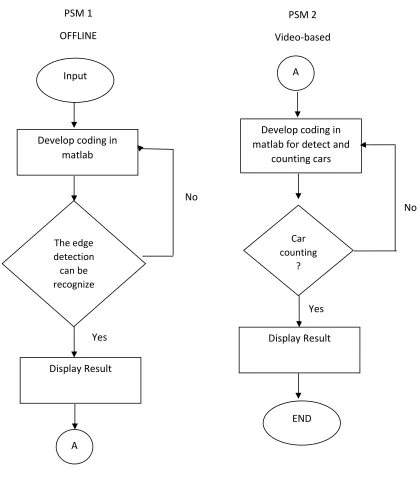
counting system. It also explained the detailed about the specification involved in this project. Flowchart is used to illustrate the steps and how the system will work.
5
CHAPTER II
LITERATURE REVIEW
2.1 Chapter Overview
6
2.2 Previous Project
2.2.1 Vehicle counting using Video Image Processing [1]
The main objective of this project is vehicle classification and counting. Based on the researcher, vehicle classification and counting is a very challenging task when wants to perform the system due to the problems like motion blur, the quality of picture or video taken and verifying the image resolution. A lot of algorithm has been developed for this vehicle and counting system. Besides that, the way to solve this problem is by doing the Scale Invariant Feature Transform (SIFT). This method is used for vehicle classification and counting that can be done according to class of vehicle described. With the SIFT algorithm, extraction invariant image features that are very stable over image translation, rotation, scaling, camera viewpoint and somewhat invariant to changes in the illumination will be possible.
2.2.2 Real-Time Canny Edge Detection Parallel Implementation for FPGAs [2]
The journal is about what is the best edge detection for use in digital image processing. There are many types of edge detection can be used for image processing, but the best technique for this project is a canny edge detector. Based on the researcher, canny edge is the most implemented edge detection algorithm because of its ability to detect the edge even the images taken that are very blur due to the lots of noise. According to
Christos Gentos and friend, “Canny algorithm has the ability to achieve a low error-rate
7
2.2.3 Video-Based Distance Traffic Analysis: Application to Vehicle Tracking and Counting [3]
According to the Angel Sanchez and Pedro D. Suarez, “Imaging hardware and video processing techniques give benefits for traffic monitoring and surveillance”. Based on this journal, the writer using appropriate road, vehicle modelling, strong vehicle detection and tracking algorithm will give us good results. For example, we will get the correct dynamic vehicle identification and a real-time frame rate.
2.3 Software
2.3.1 Matlab
Figure 2.1 : Matlab
MATLAB is a high-performance language for technical computing. It integrates computation, visualization, and programming in an easy-to-use environment where problems and solutions are expressed in familiar mathematical notation. Typical uses include:
Math and computation
Algorithm development
Modelling, simulation, and prototyping
Data analysis, exploration, and visualization
8
Application development, including Graphical User Interface building
MATLAB is an interactive system whose basic data element is an array that does not require dimensioning. This allows you to solve many technical computing problems, especially those with matrix and vector formulations, in a fraction of the time it would take to write a program in a scalar noninteractive language such as C or Fortran.
Besides that, matlab also can perform image processing, analysis, and algorithm development. The Image Processing Toolbox™ provides a comprehensive set of reference-standard algorithms, functions, and apps for image processing, analysis, visualization, and algorithm development. You can perform image analysis, image segmentation, image enhancement, noise reduction, geometric transformations, and image registration. Many toolbox functions support multicore processors, GPUs, and C-code generation.
9
CHAPTER III
METHODOLOGY
3.1 Introduction
This chapter presents a general framework and methodology developed for this project in order to design and develop system for car counting system using camera. The process for the whole project has to be sketch properly in earlier stage so that the project is guaranteed to be on the right path towards the objectives set. The methodology has to be systematically plotted and well oriented in order to avoid ambiguity of work progression.
10
3.2 Project Planning
Project planning is very important in ensuring a successful project. A proper and organized planning was made to ensure the completion of each task within the planned period of time. Project planning was implemented in the initial stages of this project. A Gantt chart was developed and used to plan the tasks on each stages to complete this project. The Gantt chart presents the tasks to be completed throughout the completion of this project. The Gantt chart basically represents the planned time and the actual time taken to complete this project.
3.3 Project Flowchart
11
3.4 Project Chart
Figure 3.1 : Flow Chart
12