Vol 4, No 4, October - Decenber 1995 Treailnent of
Malaria
235Clinical Comparison of Artemether
and Quinine
Treatment
of
Severe and
Complicated
Falciparum
Malaria
Patients
in fndonesia
A Preliminary Report*
!.
Tjitral,
s. oemijati2,
S.Sulaksonot,
ry.
Pribadi2,P.R, Arbani3, T.S. oey4,
p.N.
Harianto5,
s.
so"mohardjo6,
H.A.
Marwotol, N. Syahrudjil,
Sudiarsol,
and S.Gunawanl
I
Nnrionnl Institure of Heulrh Reseorch andDevelopnrcrt, Mirtistrl'of H e alt lt, J nkarta, I ndonesia.
2 Departnrcn! of Parruitology,
Faculty ol Medicitrc, lluivrsitl' of
It
Indouesia.t
D
I of Cotnntunicable Disease Conlrolarul Etrt'irott-.mcntul Health, MittistrS' ol Heahh, Jukurrn, lndoncsin.
" Bulikpnpan Gcneru! Hospital, Balikpuputl Ettçr Kolitnonrott, Indotre-sia.
5
Bcthestlo Hospitul, Tontohotr, Norrh Sulatesi, Ituloncsin. o
Mutrrrnu, Genero! Hospito!, Matûrûm, lhesr NusaTetrygttrq Itrdonesin.
*
Thi, pnlru had been prescnted at Britislt Soc'iet1.ltr pornritnlogl. 7rh Maloria Meeting, London, l9-21 Scptember 1995.
Abstrak
Dalan
rangka nenpersiapkan obat antittrularia alternatif wttuk pengobaranualaria
berat dan tnalaria falsiparutn dengan kontplikasi, telah dilakukan penelitian ntultisenter uji perbandingan acak antara pengobatan arte,trcter dan kina di RS Bethesda, RSIJ Balikltapan dan RSU Matarau, Indonesia seiak tahun 1994. Tujuan peneliticn ini adalah untuk nengetahui tnanifestasi klinis, tnenilai dan netnbandingkan efikasi dan keanrunan artenrcter i,ttranuskular dan kina dihidroklorida intravena pada penderita dev,asa tnalaria berat dannnlariafalsiltarun
dengan kotnplikasi.Linn
puluh dua orang dari 180 penderita tnalaria berat dan nalariafalsiparutn dengan kontplikasi yatrg direncanakan, dipilih secara acak untuk diobati dengan arteilrcter i,'ttratnuskular 1,6 tttg/kg BB/dosis setiap l2 jatn pada hari 0 dan dilaniutkan dengan dosis tunggal pada hari 1-4, atau diobati dengan kina dihidroklorida iltravena 20 tttggarailkg
BB dalatnI0 nl/kg
BB Dertrosa 5% dalattt 4 jant, dilanjutkan dengan 1O ng garanrftg BB/dosis setiop 8jatil
dan secepatnS.a diganti dengan kina peroral altabila penderila dapat ntenelan obat. Pengobatan diteruskan satnpai total tnencapai2l
dosis. Mereka tlirawat ninitnaL selanta l4 hari atau s(uilPai setnbuh secara klinis dan parasitologis. Dari 52 kasus tnalaria berat tlitenrukan 30 (57,7%) kasus denganI
konplikasi. Kotttplikasi yang sering ditenukan adalah hiperbilirubinetnia (50%),ualaria
serebral (26,9%) dan hiper-parasitenùa (25%). l|/alaupun denikian angka kenarian tertinggi berhubungan dengan edena paru (l00Vo), s1,ok seprik (IOO%), perdarahan (I0O7o) dan hiperkreatinetnia (83,3Vo). Angka kenatian penderita ualaria berat datt tnalariafalsiparutn 4engan kotinplikasi odalah 19,2% (10/52), pada kelontpok artetneter dan kina adatah 14,3% (4p8) dan 25Vo (6/24). Perbedaan tersebut secara statistik tidak benttalota. Kecenderuttgan kettrctian tneningkat denganjunlah
kouplikasi dan ketnatian 100% bila terdapat >3 kotttplikasi. Sanpai dengan hari ke 14, tidak ada perbedaan bertnakna diatûara ke dua kelotnpok tersebut pada angka kesenbuhan ( lO0% vs 100%), angka rata-ratawaktu bebas panas (34!33iau
vsj3!17
iatn) dan bebcts parasit (35!14 jatn vs 46!26 jatn); sedangkatr angka rata-rata v'akru kesadaran baik dari kelonpok artetileter adalah lebih cepat dibandingkan kelotttpok kina (29,6t8,4jatn
ts
105,3!66,6 jattr). Artetileter nenpunyai kelebihan dalatn tnenqtercepat rraklu kesadrtran (3,5 kali), kecenderwrgan tttenurunkan angka ketnaîian, se4ikit dan ringan efek samping, dan lebih nudah penberiannl'a.Abstract
236
Tjitra etal
Med J Indonesresolution
tine
was fa-ster in the artetnether group than in the quinine group (29.6!8.4 hts
105.3!66.6 h). This 3.S-fold reducriott itt cotna duration, suggestive reduced fatality, few andnild
side effects and convenience of intratnusculat treat,nent i,ldicated advantages of intranuscular arte,ilether the rap),.Keywords : severe ualaria, treatttrcnt, artenrcther, quinine.
Currently,
there arechloroquine
ormultidrug
resistantP.falciparunl
malaria cases in Indonesia.However,
theproportion
of
resistant
cases
is
still
low
except in
certain parts of
Indonesial-2
(Annex
l). This
plieno-mena is a seriouspublic
healthproblem.
The new drugswith
benerefficacy
needto
be studied.Severe
and complicated
falciparum
malaria
has beenreported
in
more than
lOToout
of
patients
with
fal-ciparum malaria,
with
amortality
ratebetween
18.8 -SO.OVI.3aAn
alternative drug to
reduce thecomplica-tions
andmortality
is
needed.Artemether
is anoil-based methyl
etherof
artemisinin
and
can be given by
intranruscular
injection.
It
is
arapidly acting schizonrocidal drug. Clinical trials
of
artemether have shown
to
have
high efficacy
againstuncomplicated, severe and complicated falciparum
malaria,
vivax
malaria, chloroquine and multidrug
resistant
P.falciparunl
respectively.
No
resistance toartemether
hasyet
been demonstrated.S-7 Becauseof
its
easeof
administration
andlow toxicity,
artemetherhas
replaced
guinine
for the
first-line
treatment
of
severe and
complicated falciparum malaria
in some
countries. However, this drug
is not yetavailable
com-mercially in
Indonesia. Therefore,
aclinical
study
of
artemether andquinine
treatment was beingperfornred
in
Indonesia
to
reveal the clinical
manifestations
of
severeand complicated
falciparum
malaria,
to
assess andcompare
theefficacy
andsafety of intramuscular
artemether andintravenous quinine dihydrochloride
in
the
treatment
of
severe and
complicated
falciparum
malaria
in
adults.METIIODS
This clinical
study
was acollaborative study
betweenthe
Ministry
of Health, Jakarta, the
University
of
In-donesia, Jakarta,
andseveral
referral
hospitals
in
en-demic malaria
areas
in Tomohon, Balikpapan
andMataram, Indonesia.
Study site and
tinte of
study
The
study
was beingcarried out
at thefollowing
refer-ral
hospitals:
the BethesdaHospital,
Tomohon,
North
Sulawesi,
the Balikpapan General Hospital,
Balik-papan,
East Kalimantan, and the Mataram
GeneralHospital,
Mataram,
West
Nusa Tenggara,
Indonesia. Thestudy
beganin
1994.Study design
The study
was an open,randomized
andcomparative
study
of
intramuscular artemether
versusintravenous
quinine dihydrochloride
in severe and
complicated
falciparum
malaria
patients.Patients
To
date
52
patients
out of a
target
of
180have
beenrecruited. The patients
fulfill
the
WHO criteria for
in
vivo antimalarial
sensitivity
testing8. Thesewere
:1.
Over
12 yearsofage.
2.
Non-pregnant or non-lactating
females.3.
Presence of asexualforms
ofP./a lciparum in blood
smears.4.
No ingestion
ofantimalarialdrug
intheprevious
l2
hours.5.
No history
of hypersensitivity
to antimalarials.
6.
The
absenceofany
other serious illness.
7.
Informed
consent wasobtained from
the patientsor
their relatives.
The presence
of
oneor
moreof
thefollowing
manifes-tations
wassufficient for
the diagnosis of
severe andcomplicated
falciparum
malariag-f 2 :l.Cerebral
malaria
Glasgow
Coma Scale (GCS) wasused
to assess thedepth
of
coma. A
total
score of GCS
lessthan
lO andpersisting
for
more than
30minutes after
con-vulsion
was consideredunrousable
coma.2.
Impaired
consciousness236 Tjitra et
al
Med J Indonesresolution
tine was
faster in the artenether group than in the quinine group (29.6a8.4 h vs 105.i!66.6 h). This j.S-fold reduction in cona duration, suggestive reduced fatality, few and nûld sidefficts
and convenience of iilra,truscular treatil,ent indicated advantages of i nt r an us cula r arteu et he r the rapy.Keywords : severe nalaria, treat,nent, artetnether, quinine.
Currently,
there arechloroquine or multidrug resistant
P.falciparurn
malaria cases in Indonesia.However,
theproportion
of
resistant cases
is still low
except in
certain parts
of
Indonesial-2
(Annex
1).This
pheno-mena is a serious
public
healthproblem.
The new drugswith better
efficacy
need to be studied.Severe
and complicated
falciparum
malaria
has beenreported
in
more
lhan
LOToout
of
patients
with
fal-ciparum malaria,
with
amortality
ratebetween
18.8 -SO.OVI,1aAn alternative drug to
reduce thecomplica-tions
andmortality
is
needed.Artemether
is anoil-based methyl
etherof artemisinin
and can be given
by
intramuscular injection.
It
is
arapidly acting schizontocidal drug. Clinical trials
of
artemether have shown
to have high efficacy
againstuncomplicated,
severe
and complicated falciparum
malaria,
vivax
malaria, chloroquine and multidrug
resistant
P.falciparunr
respectively.
No_resistanceto
artemether has yet
beendemonstrated.)-/
Becauseof
its
easeof administration
andlow toxicity,
artemetherhas replaced quinine
for
the
first-line
treatment
of
severe and complicated falciparum malaria
in
somecountries. However,
thisdrug
is not yetavailable
com-mercially
in Indonesia. Therefore,
aclinical study
of
artemether and
quinine
treatment was beingperfornred
in
Indonesia
to
reveal the clinical
manifestations
of
severe andcomplicated
falciparum
malaria,
to
assessand
compare the efficacy
andsafety of intramuscular
artemether andintravenous quinine
dihydrochloride in
the
treatment
of
severe
and complicated falciparum
malaria in
adults.METIIODS
This clinical study
was acollaborative study
betweenthe Ministry
of
Health, Jakarta, the University of
In-donesia, Jakarta, and several
referral hospitals
in
en-demic malaria areas
in
Tonrohon, Balikpapan
andMataram, Indonesia.
Study
siteand tinte of study
The
study
was beingcarried out
at thefollowing
refer-ral hospitals:
the BethesdaHospital, Tomohon,
North
Sulawesi, the Balikpapan General Hospital,
Balik-papan,
East Kalimantan, and the Mataram
GeneralHospital, Mataram,
West Nusa Tenggara,
Indonesia. Thestudy
beganin
1994.Study design
The study
was anopen, randomized
andcomparative
study
of
intramuscular artemether versus intravenous
quinine dihydrochloride
in
severe and complicated
falciparum malaria
patients.Pstients
To date 52 patients
out
of
a target
of
180have
beenrecruited. The patients
fulfill
theWHO criteria
for
irrvivo
antimalarial
sensitivity
testing8. Thesewere
:l'
Over
12 yearsof
age.2.
Non-pregnant or non-lactating
females.3.
Presence of asexualforms
ofP./a lciparum
inblood
smears.4.
Noingestionofantimalarial
drugin theprevious
l2
hours.
5.
No history
of hypersensitivity to antimalarials.
6.
The
absenceofany other serious illness.
7.
Informed
consent was obtainedfrom
the patientsor
their
relatives,The presence
of
oneor
moreof
thefollowing
manifes-tations was sufficient
for
thediasnosis
of
severe andcomplicated
falciparum
malaria9-12 :l.Cerebral
malaria
Glasgow
Coma Scale (GCS) wasused
to assess thedepth of coma.
A
total score
of
GCS
lessthan
l0
andpersisting
for more than
30minutes after
con-vulsion
was consideredunrousable
coma.2.
Impaired
consciousnessVol 4, No 4, October - Decenber 1995
3. Repeated
generalized convulsions
Malaria
with
more than two
generalized
convul-sions within 24
hours although
cooling
had
been done.4.
Prostration, extreme
weaknessThe malaria patient could nor sit
or
walk
with
unexpl
ainable neuropathology.
5.
Fluid,
electrolyte
and acid-base disturbancesMalaria
with
dehydration and or acidosis
with
arterial blood
pH
< 7 .25 and plasmabicarbonate
<l5 mmol/I.
6.
Circulatory
collapse
(algid
malaria)
Malaria with
hypotension (systolic BP
less than 70mm
Hg in
supine
position)
and signsof
peripheral
circulatory failure
such
ascold,
clammy, cyanotic
skin
andconstriction
ofperipheral
vessels.T.Spontaneous
bleeding and
clotting
disorders
or
Disseminated Intravascular Coagulation (DIC).
Malaria
with
retinal
or subconjunctival
haemor-rhages, bleedingfrom
the gums, epistaxis, metaena, haematemesisand
/
or signs of
DIC
such as
in-creased
plasma
fibrinogen
and decreased
an-tithrombin
III.
8.Pulmonary
edemaMalaria
with
cough,
afeeling of
oppression
in
the chest anddifficulty
in
breathing, dyspnoea,crepita-tions,
cyanosis,
convulsions and deterioration
of
consciousness.9.
Gastro-intestinal symptoms
Malaria with
consistentvomiting
and/or
diarrhoea.l0.Hyperpyrexia
Malaria
with body
temperature
(axillary)
above40.5"C
or
lO5oF.l l.
Severe anaemiaMalaria
with a
normocytic
anaenria
and
haema-tocrit
less than I57o orhaemoglobin
less than5 g%. 12. JaundiceMalaria
with jaundice, palpable
liver
andbilirubin
more
than50
pmol/l or
more than 3 mg7o.13,
Hypoglycaemia
Malaria with
blood
sugar less than 40mg%
or
less than2.2
mmol/l,
symptoms
of
anxiety, confusion,
breathlessness,
sweating and neurological
symp-tonrs. 14. Renal
failure
Malaria with urine output
lessthan 400
ml in 24
hours afterrehydration
and a serunrcreatinine
more than265
pmol/l or
more
than3
mg%o.15.
Haemoglobinuria
andblackwater fever
Malaria with black
urine rather than
redor
brown
as
in
other
casesof
massive haenrolysis andCom-bor
testpositive.
Treannent of
Malaria
23716.
Hyperparasitaemia
Malaria
with the density
of
asexual
forms of
P.falciparum in
theperipheral blood
smearsexceed-ing
57o
of
the erythrocytes (more than
250,000 parasiteper
pl
atnormal
redcell counts).
Setting
All patients were
hospitalized
and observedfor
at leastl4 days
or
until
thepatient
was cured.Investigation
A
thorough
history
was taken
andphysical
examina-tions performed
onstudy
subjectsfrom
time of
admis-sion onwards. During hospitalization,
daily
axillary
temperatures
were taken 4 hourly
at
2oo,6oo,
l0*,
l4oo, 18m
and22oountil
thepatient
becameafebrile
at<
37.5oC
for 24
hours. Thereafter temperatures
were takendaily.
Thick
and
thin
blood
smearswere taken
12hourly
at8-
and 20oofor
parasite countsuntil
the asexualforms
were cleared
for
3
consecutive examinations.
There-after,
smears were donedaily until
discharged.Routine haematology (haematocrit, haemoglobin,
redcell
count,
white
cell
count, platelet count and
reticulocyte count)
and
biochenristry (SGOT,
SGpT,
alkaline
phosphatase,
bilirubin,
protein,
BUN,
creatinine
andglucose) were
done onadmission
(pre-treatnrent),
on discharge(post-treatntent)
and atother
times
dependingon
theclinical
stateof
the patient.Other investigations were done
if
clinically
indicated
e.g. lumbar puncture, ECG, chest
X-ray
andelectrolyte
analysis,
Patients were
reviewed
at least once a day.Treatntent
Twenty-eight
patients were treatedwith
intramuscular
artemether
at
1.6nrg/kg
b.w,
12hourly on
day 0
anddaily
on dayI-4. Another
24 patients were treatedwith
intravenous
quinine dihydrochloride
20 mgsalt/kg b.w
or
16.7 mg base/kgb.w
in l0
ml/kg b.w of
5% dextroseinfused
in 4
hours
followed
by
lO
mg
salt or
8.3
mgbase/kg
b.w, 8 hourly. As soon
as
the
patient could
swallow the
medication, intravenous quinine
was replacedby oral quinine sulphare
lO mgsalt/kg b.w,
8238
Tjita
etal
In
addition all
patients were also treated
with
prima-quine
30
mg, single dose when the patients
could
swallow
thedrug or
onthe
lastday
of
treatment.Patients
who
had persistent
positive blood
smearsor
negative
smearsfollowed
by positive
smears on day 7 orday
14, were treatedwith
quinine
sulphateorally
10mg salt/kg
b.w, 8 hourly for 7
days and tetracycline
500
mg,
8hourly
for
7 dayÈ.They
followed
up
for
14 daysafter
treatment.Statistical
analysis
Chi-square (X2)
andFisher's exact
testswere
usedto
compare
the
characteristics,
clinical
events and
curerate
of
artemether
and
quinine
groups. Unpaired
Student's
t-test
was used
to
compare the
charac-teristics, haematology
andbiochemistry values, fever
and
parasite
clearancetime
andcoma resolution
time
of
those groups.RESULTS
During
thestudy,
of
thetotal
180 targetted severe andcomplicated falciparum malaria
patients,
52
patients
Med J Indones
have been
recruited.
Among
them, 36, I I
and 5 cases werefrom Balikpapan, Tomohon
andMataram
Hospi-tal
respectively.
Of
the 52
severe
and
complicated
falciparum malaria, 28
caseswere
in
the
artemether group and the other 24 cases werein
thequinine group.
There were 40 males and
12females; ranging
in
age andweight
betweenl3
and 70 years, and 39 and 65 kg. Less than 50% werc indigenous peoples andonly
afew
(7.7%)
had
previously
experienced malaria
with
fre-quency
in the
last
6 month ranging
between
I and 2
times. Duration
of
illness, axillary
temperatures
and parasite counls onadmission
rangedbetween
I
and 14days,
36 and40.6"C, and 313
and384,?80/pl
respec-tively.
Contparalive
charecteristics between treatntent
grouPs
Comparison of
thecharacteristics
(age, sex, race,dura-tion
of
illness, previous history
of
malaria,
malaria
frequency
in
the last
6
month, weight, axillary
temperature and parasite count) revealed nosignificant
differences
between thetwo
groups
(Table
l).
Table
l.
Comparison of characteristics of severe and cornplicated falciparum malaria patients between the treatment gtoups on admission at Bethesda Hospital, Balikpapan and Mataram General Hospital, Indonesia, 1994-1995.Characteristic Artemether
group* Quininegroup**
Student's
t
or X- test
Age =(x + SD)year Sex =male:female Race =native:others Duration of illness
=(x + SD)dav Malaria previously
=yes:no Malaria frequency in last 6mo=(x + SD)time Weight =(x + SD)kg Axillary temperature
=(x + SD)oC Parasite count
=(x + SD)
/pl
27+t2
2l:
712:
168+
52:26
1+
05l +
638.5 + 1.1
4j,223 + 60,050
33+16
19:
59:15
'l+
52:22
2+ I
5l
+
338.4 + 1.3
78,3181. 105,013
NS NS NS
NS
NS
NS NS
NS
NS
*
N=28
**11=!{
Vol 4, No 4, October - Decenber 1995
C o ntp at'ativ e c
lini
cal
e v e n t s b e tw e en
treahil
ent
groups
The
most frequent
(>5O7o)clinical symptoms
andsigns
in
both
groups were fever, pallor, jaundice,
nausea, hepatomegaly
and
splenomegaly. However,
there were
statistically no significant
differences
be-tween
thetwo
groups
(Figure
l),
Treamtent of
Malaria
239Contparalive
laboratory
testresulls
betweentreql-ntent
groups
Most
resultsof
routine haematology
andbiochemistry
examinations were abnormal
onadmission
(pre-treat-ment), except thewhite cell
andplatelet
counts, serumprotein
and glucose,which
werewithin
normal
values.There were
statistically
no
significant
differences
be-tween
thetwo
groups (Table
2).P
e
I
c
e
n
t
ffi
Artemeter
n=28
[image:6.595.55.549.81.421.2]I
Quinine
n=24
Figure
I.
Conparisott of clinical evenls oT severe and conplicated falciparutn tnalaria patietrts bet,*,een lhe treattttenl groups 01adnissiott at Bethesda Hospital, Balikpapan and Mataratn Ceneral Hospital, It'tdonesia lgg4-Igg5.
Table
2.
Comparison of laboratory tests of severe and complicated falciparurn malaria patients between the treatment groups onadmission (pre-treahent) at Bethesda Hospital, Balikpapan and Mataram General Hospital, Indonesia,
lgg4]31gi.
Laboratory test
90
80
70
60
50
40
30
20-t0
0
Ë ËË
*S
e q
d
=
-c_
o.c o o
o
OOCC.Dc'Ê'=-d-)
E
2 8O
3E
+ô5
8
itro
"sEuÈg
e
ààe
-eo oo)(J
o
*
F;ofi
^
IO
I
Artemether group*
(x+SD)
Quinine group**
(x+SD)
Student's
t-test
Haematocrit (%) Haemoglobin (g%)
Red cell count
(pl)
White cell count(nl)
Platelet(nl)
sGoT/ASAT (rU) SGPT/ALAT (rU) Alkaline phosphatase (IU)
Total bilirubin (mg%) Protein (mg%) BUN (mg%) Creatinine (mg%) Glucose (mg%)
3l+
89.5
+
3.0 3.4+
L.28.3
+
3.5 207.t + 97.O52+50
4l+41
234 + 3I25.9
+
7.6 6.1+
1.095 + 114
2.L
+
2.2 109+
8l
28+
98.6
+
3.13.1
+
0.97.5
+
3.7 177.5 + 45.85l+39
37 +26
t@
+73 4.O+
3.76.2
+
O.365+54
1.5 + 1.5 l0g + 29NS NS NS NS NS NS NS NS NS NS NS NS NS
*
N
=28**N=24
[image:6.595.54.547.487.691.2]24O
Tjitra et alThe
results
of all
laboratory
tests
from both
groupsimproved
and becamenormal
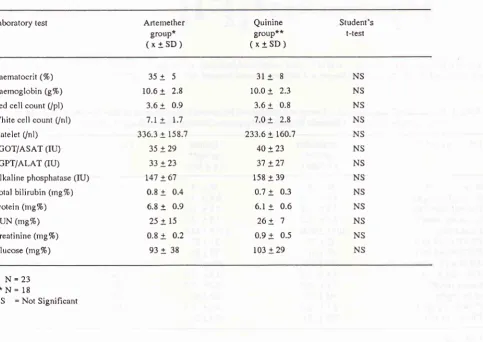
on discharge(post-treat-ment).
There
were
also
no significant difference
be-tween
thetwo
groups (Table
3).Clinical
manifustatiotts und outcomes
of
the
h'eat-mentgroups
Among
52 severe andcomplicated falciparum malaria
patients,
only
30
(57.77o)
were
caseswith
a
single
complication.
The common
clinical
manifestations
were
malaria with hyperbilirubinaemia,
malaria
with
impaired
consciousness,and malaria
with
hyperbilir-ubinaemia and
hyperparasitaemia
in
the
artemethergroup; and also malaria
with
hyperbilirubinaemia,
cerebral
malaria,
andmalaria
with
hyperpyrexia in
thequinine group (Table
4).Med J Indones
The most common complications
of
severe andcom-plicated
falciparum malaria patients were
hyper-bilirubinaemia (50%),
cerebral
malaria
(26.97o)
andhyperparasitaemia (257o).
However, the
highest
fatality
rates were
associatedwith pulmonary
edema (lOO7o),bleeding
(1007o),
septic shock
(1007o)
andhypercreatinaemia
(83.3V0).No fatal
cases werefound
in
patients
with
severe anemia and hyperpyrexia
(Table
5).The
overall
mortality
rate
of
severeand complicated
falciparum
malaria patients was
79.27o(10/52),
in
theartemether
andquinine
group
14.37o(4128)
and 25% (6124)respectively.
The risk
of
death increased
with
the number
of
complications
and
was
100%
if
there weremore
than 3conrplications (Table
4).Table
3.
Comparison of laboratory tests of severe and cornplicated falciparurn malaria patients between the treatment groups ondischarge (post-treâtment) at Bethesda Hospital, Balikpapan and Mataram General Hospital, Indonesia, I994-1995.
Laboratory test Arternether group*
(x+SD)
Quinine group**
(x+SD)
Student's t-test
Haematocrit (%) Haemoglobin (g%)
Red cell count
(pl)
White cell count(nl)
Platelet(nl)
SGOT/ASAT (IU) SGPT/ALAT (IU) Alkaline phosphatase (IU) Total bilirubin (mg%) Protein (rng%) BUN (rng7o)Creatinine (mg%) Glucose (mg%)
35+
510.6
+
2.83.6
+
0.97.I
+
1.7336.3 + 158.7
35+29
33+23
147 + 6'l 0.8
+
0.46.8
+
0.925+15
0.8
+
0.293+
383l+
810.0
+
2.33.6
+
0.87.0
+
2.8233.6 + 760.7
40+23 3'l + 27 158 + 39
0.?
+
0.36.1
+
0.626+
7 0.9+
0.5 103 + 29NS NS NS NS NS NS NS NS NS NS NS NS NS
*
N=23
**N=19
[image:7.595.76.560.359.701.2]Vol 4, No 4, October - Decenber 1995 Treatntent of
Malaria
24I
Table
4'
Clinical manifestations and outcomes of the treatment groups of severe and complicated falciparum malaria patientsat Bethesda Hospital, Balikpapan and Mataram General Hospital, Indonesia, 1994-1995,
Clinical manifestation Artemether
#
dead#
QuininedeadTotal
#
dead (%)Single contplication : Hyperbilirubinaemia
Impaired consciousness
Hyperpyrexia
Severe anaemia Cerebral malaria Hyperparasitaemia
5
4 2 2
I
I
5 2
3
2
3
0
0 0
0 0
I
0
10
6
5
4
4
I
0
0 0 0
I
0
0
0 0 0 0 0
Subtotal
Tv'o cotttltlications :
Hyperbilirubinaemia nnd hyperparasitaemia
Cerebral malaria and hyperbilirubinaenria Cerebral malaria and hyperparasi taernia
Hyperbilirubinaemia and hypercreatinaemia
Cerebral malaria and severe anaemia
Hyperbilirubinaemia and severe anaemia
Hyperbilirubinaemia and pulmonary ederna
30
l5
l5
l(
3.3)0
I
I
I
0 0
I
4
I
2
2
I
I
0
0
2
I
0 00
I
0 0
I
0
0 0
I
4
3 3 2
I
I
I
0
I
0
I
0 0 0
Subtotal
Three conplicatiotts:
Cerebral malaria, hyperparasitaemia and
septic shock
Hyperbilirubinaemia, hypercreatinaemia and
puhnonary edema
Hyperbilirubinaemia, severe anaenria and
hyperparasitaemia
Hyperbilirubinaemia, hyperparasitaemia and
impai red consciousness
Hyperparasitaemia, hypercreatinaemia and
impaired consciousness
ll
l5
4(26.7)Subtotal
More than three complicatiotts :
Cerebral malaria, hyperbilirubinaernia,
hyperparasitaemia and hypercreatinaelnia
Cerebral malaria, hyperbilirubinaernia,
hypercreati naemia, pulmonary ederna and
bleeding
3(60.0)
Subtotal Total
%
*p>0.05
2
28
100
0
6
25*
20
424
14.3*
1002
2(tOO) [image:8.595.64.555.102.730.2]242
Tjitraetal
Comparalive
efficacy
betweenh'eahnent groups
Of
the 52 severe andcomplicated falciparum
malaria
patients,
only
23 casesin
the artemethergroup and
18 casesin
thequinine
groupsurvived
and hadcompleted
the study
until
day
14
(Table 5, 6).
One
casein
the artemether group had not completed the studyuntil
day14,
but survived.
By
day
14, the cure ratesin both
treatmentgroup were
lO0%
(23123and l8/18). The fever
clearance times
ranged
from
0to
I
18 hoursin
the artemether group andfrom
6 to 60 hours in thequinine
group. The meanfever
clearance
times
(34t33
hours
vs
33+17
hours)
were
not significantly different
between
the two
treatment
groups. The parasite clearance times ranged
from
17to
57
hours
in
the artemether group
andfrom
12to
I37
hours
in
the quinine
group.
The
mean parasite
clearance
times
between these groups(35+14
hours vsMed J Indones
46!26
hours)
were
not
significantly different.
The
coma resolution times
of
those
with
cerebral malaria
ranged
from
18 to 36 hoursin
the artemether group andfrom
48
to
195hours
in
thequinine
group. The
meancoma
resolution times between these groups
were
26.6+8.4 hours in the artemether group and 105.5166.6
hours
in
the quinine group. There
was
a significant
difference
statistically with p
<0.05 (Table
6).Contparative
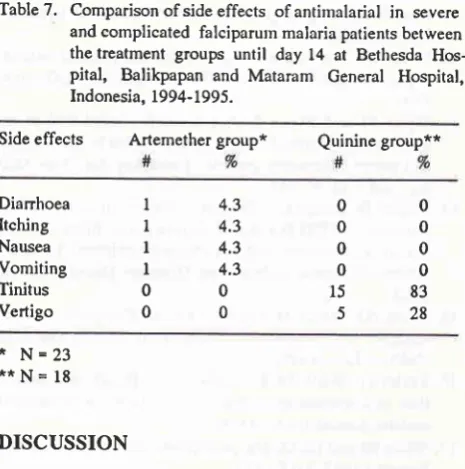
sideeffects
betweentreatment groups
A
sideeffect
wasdefined as a symptom
or signappear-ing only after drug administration. There were mild
and
self-limiting
symptoms
reportedin
both groups.In
the
artemether
group,
these
were
diarrhoea, itching,
nausea and
vomiting. While
in thequinine
group, thesewere
tinitus
andvertigo
(Table 7).
Table
5.
Complications and outcomes of the treatment groups of severe and complicated falciparum malaria patients atBethesda Hospital, Balikpapan and Mataram General Hospital, Indonesia, 1994-1995.
Complication Artemether
#
dead (%)#
Quininedead (Vo)Total
#
dead (Vo)Hyperbilirubinaemia Cerebral malaria llyperparasitaemia Impaired consciousness Severe anaemia
Hypercreatinaemia Hyperpyrexia Pulmonary edema
Septic shock Bleeding
l5
7
8
4
4 4
,'
I
0I
4 Q6.7) 3 (42.e)
l
(12.s) 0 0 3 (75.0) 0l
(r00) 0l
(100)2 (t8.2)
3 (42.9) 3 (60.0)
l
(2s.0) 0 2 (100) 0l
(100)l
(100) 0 t17 5
4
3 2
3
I
I
0
26
6 (23.1)t4
6 (42.9)13
4 (30.8)8
I
(12.5)70
6
5 (83.3)50
2
2(LOO)I
l
(100)l
I
(100)Table
6.
Comparison of antimalarial efficacy in severe and complicated falciparum malaria patients between the treatment groups until day 14 at Bethesda Hospital, Balikpapan and Mataram General Hospital, Indonesia, 1994-1995.Efficacy Artemether
group Quininegroup Student's t-testChi-square or
Cure Rate
(%)
Fever Clearance Time (x + SD) hour
Parasite Clearance Time (x 1 SD) hour
Corna resolution Time (x a SD) hour
23123 100
34+33
35+14
29.6 + 8.4*
l8/
l8
100
33+t7
46+26
105.3 1.66.6**
NS
NS
NS
*
N
=4
**Ns4
NS
s
7
Diarrhoea Itching
Nausea
Vomiting Tinitus Vertigo
Vol 4, No 4, October - Decenber 1995
Table
7.
Comparison of side effects of antimalarialin
severe and complicated falciparutn malaria patients between the treatment groupsuntil
day 14 at BethesdaHos-pital,
Balikpapan and Mataram General Hospital, Indonesia, 1994-1995.Side
effects
Artemethergroup*
Quinine group**Treament of
Malaria
243causing organ damage. l7
Artenrether
is able to preventparasite development
to
the
stage
at
which
cytoad-herence
will
limit
thepathophysiological
processesin
severe
and complicated fatciparum malaiia.t8
Ho*-ever, the
case
fatality rate
between
the two
groups (14.37ovs
257o) wasnot significantly different.
The
death cases
in
this study were
mainly with
more
than2 complications
and associated
with
fatal
complica-tions such as
pulmonary
edema, septic shock,bleeding
and
hypercreatinaemia.
In
aprevious study
with
intravenous quinine,
the death caseswere also
mainly
of
patients
with
more than
2complications and
associatedwith
tachypnoe,
hyper-creatinaemia,
hyperbilirubinaemia,
hypoglycaemia,
leucocytosis and
hypotension. The
casefatality
rate washigher (39%)
than the presenr study (19.2%).4Due
to limited
budget
and operational
reason,
thepatients were
followed up
for only
14 days.
Ideally,
this should be 28 days to
look for
recrudescence asthis
most occurred
within
4
weeks
of
treatment.l$20
Hence, no recrudescence case was
found
uptill
day
14.There
were various
signs and symptoms
of
drug
in-tolerance
in this trial.
Other studies also showed
thatartemether
hadsimilar
or
no sideeffects,
andquinine
had side effects
which
were mi ld andself
limi tiig.2622
CONCLUSION
Artemether is
awell
tolerated
andefficacious drug
in
the treatment
of
severe andcomplicated malaria. The
3.5-fold
reduction
in
coma duration, trend
toward
reduced
fatality, few
and
mild
side effects, and
con-venience
of
intramuscular treatment indicate
ad-vantages
of
artemether therapy
over
intravenous
quinine
therapy.ACKNOWLEDGl\{ENTS
The authors
would like
to thank thefollowing
for
their
invaluable
assistance
:
the Head
of
Communicable
Diseases Research Center,
National Institute of Health
Research and
Development,
Ministry
of Health,
Jakar-ta,
Republic
of
Indonesia;
the Head andstaff
of
Direc-torate
of
Vector
Borne
Diseases,Directorate
Generalof
Communicable
DiseasesControl
andEnvironmen-tal Health,
Jakarta,Indonesia;
theDirector
andstaff
of
Balikpapan
General
Hospital,
Balikpapan,
East
Kalimantan, Indonesia;
the Director
and
staff of
Mataram General
Hospital,
Mataram, West
Nusa
Tenggara,
Indonesia;
theDirector
andstaff
of
Bethes-da Hospital, Tomohon,
North
Sulawesi,
Indonesia;
I
I
I
I
0 0
00
00
00
00
15
83528
4.3 4.3 4.3 4.3
0
0
*
N=23
**N=
lg
DISCUSSION
The continuing
prominence
of
malaria
asa
causeof
illness
and death, and the spreadof
resistant parasitesto antimalarial
drugs has become a serious problem,
justifying a major effort
to
obtain
an
alternative
an-timalaria drug
for
the treatmentof
severe andcompli-cated
malaria.
Previous study showed that despite
treatrnent
with
intravenous
quinine,
severe
and complicated
fal-ciparum malaria,
had afatality
rateof 50%.4In
clinical
trials,
artemether
usually
produced
a
more rapid
therapeutic
response
than chloroquine,
sulfadoxine-pyrimethamine and
quinine.
l3-16Therefore,
arte-mether
is now
considered as one
of
the
antimalarial
drugs
of choice for
severely
ill
patients.This
preliminary
data was notsufficient
toconfirm
theefficacy
of
artemether against severe falciparum
rneasured
by fever
and pamsite clearance
times. 13-15The cure rate
on day
14, mean fever and
parasite clearance tinres between thetwo
groups (lOO7o,34+33h
and35+14
hvs
1007o, 33+17 h, and46tZA h)
were notsignificantly different. May
be the sample was notlarge
enough
to
show
a statistically significant
dif-ference
of
thesetherapeutic
responses.However,
the meancoma resolution
time
wasshorter
in
artemether group than inquinine group
(29.6r8.4
hvs
105.3a66.6h).
Faster recovery
of
consciousness
in
cerebral
malaria associated
with
artenrether had also
beenreported
in Matawi.l6
In
severemalaria,
the
pathological
effects
aredue
to sequestrationof
erythrocytes containing
nraturefornrs
[image:10.595.53.286.82.317.2]244
Tjitra etal
Kunming
Pharmaceutical
Factory, Kunming,
China;
Rhone Poulenc
Rorer Doma,
Jakarta, Indonesia; PT
Bhineka Usada Raya, Jakarta, Indonesia; and DR
Graham
White,
PTZeneca,ICI
Pestisida,London,
UK.
REFERENCES
1. Tjitra E, Marwoto HA, Sulaksono S et al. Antimalarial drug study. Bull Hlth Studies 1992; 19 (4): 15-23.
2. Pribadi
W.
Drug resistanceof
Phsnodiutn falciparwn inseveral parts
of
Indonesia. Syrnposium and workshop ondyug resistance of Plasnodiwn
falciparun,
FKUI, Iakarta,May 29-30, 1993.
3. Tjitm E. Clinical manifestatiôns and malaria treatment.
Cer-min Dunia Kedokteran 1994; 94: 5-L3.
4. Tjitra E and Richie TL. Preliminary report of Immunology
study on cerebral malaria patients in Manado and Tornohon
Hospitals, 1993- 1994. Communicable Disease Research
Center, National Institute of Health Research and
Develop-ment, Minïstry of Health, Jakaila, 1994.
5. Bunnag D, Viravan C, Looareesuwan S et al. Clinical trial
of
artesunate and artemether on multidrug resistancefal-ciparum malaria
in
Thailand, A
preliminary
report.Southeast Asian
I
Trop Med Publ Hlthl99I;22:380-5.
6. Hien TT and Amold K. Artemisinin and its derivates in the
treatment of falciparum malaria in Vietnarn. XIIIth Interna-tional Congress for Tropical Medicine and Malaria, forntien,
Pattaya, Thailand, 29 November - 4 December 1992,
7.
Li
GQ. Clinical trials on artemisinin and its derivates in treatment of malaria in China. XIIIth International Congressfor
Tropical
Medicine andMalaria, Iomtien,
Pattaya,Thailand, 29 November - 4 December 1992.
8. World Health Organization. Chemotherapy of malaria and
resistance to antimalaria. Report of a WHO Scientific Group. WHO Tech Rep Ser 1973i 529.
9. WHO Malaria Action Programme. Severe and complicated
malaria. Trans Roy Soc Trop Med Hyg 1990; 84 (Suppl 2):
l-65.
10. WHO Regional Office
for
South-East Asia. The clinicalmanagement of acute malaria. WHO Regional Publications,
South-East Asia Ser no 9, 3rd ed, 1990.
11. Departemen Kesehatan. Penatalaksanaan tnalaria berat di
Rumah Sakit dan Puskesnras. Sub Direktorat Malaria,
Direk-torat
Jenderal
PemberantasanPenyakit Menular &
Med J Indones
Penyehatan Lingkungan, Departemen Kesehatan Republik Indonesia, 1990.
12. Gilles HM. Management of severe and complicated malaria.
A practical handbook. World Health Organization, Geneva,
1991.
13.
Myint
PT and ShweeT.
A
controlled clinicaltrial of
ar-temether (qinghaosu derivate) versus quinine in complicated
and severe falciparum malaria. Trans Roy Soc Trop Med
Hyg 1987; 81:559-61.
14. Walker O, Salako
LA,
RisquatA.
Comparative trial of imartemether (ARTM) and sulfadoxine-pyrimethamine (S-P)
in severe falciparum malaria in Nigerian children, 5th
Inter-national Congress
of
Infectious Diseases, Nairobi, Kenya,t992.
15. White
NI,
WallerD,
CrawleyI
et al. Comparisonof
ar-temether and chloroquine
for
severe malariain
Gambianchildren. L:ncet 1992; 339: 317 -2L.
16. Taylor TE, Wills BA, Kazembe P et al. Rapid coma
resolu-tion with
artemetherin
Malawian childrenwith
cerebral malaria. Lancet 1993; 341:661-2.17. Wlrite
NI
and Ho M. The pathophysiology of malaria. AdvParasitol 1992 3L: 84-175.
18. Udomsangpetch
A,
Kyle
DE, WebsterHK.
Antimalarialdrugs affect cytoadherence and rosetting
of
Plasmodiwnfalciparwn
in
vitro: biological and theoritical irnplication.The 4lth Annual Meeting of The American Society of
Tropi-cal Medicine and Hygiene, Seattle, Washington, 15
-
19November 1992.
19. Tjitra E, Oemijati S, Arbani PR and Pribadi W. Clinical trials
of artesunate and artemetheron falciparum malaria in chloro-quine resistant areas (
A
prelirninary report),I
Indon Med Assoc 1995; 45:223-30.20. Tjitra E, Pribadi W, Raharjo K et al. Treatment of
uncompli-cated
in vitro
chloroquine resistant falciparum malaria inIrian Jaya.
Will
be presented at 44th Annual Meetingof
American Society
of
Tropical
Medicine and Hygiene,November 17-2L, 1995, San Antonio, Texas, USA.
21. Shwee T, Myint PT, Htut Y et al. The effect of
mefloquine-artemether cornpared with quinine on patients with
compli-cated falciparum malaria. Trans Roy Soc Trop Med Hyg
1988; 82: 665-6.
22. Kalbwang
I,
Na-BangchangK,
ThanavibulA
et al.Treattttent of
Malaria
2457
Vol 4, No 4, October - Decetnber 1995
EI
=l È19
oJ,=
'613
et
I
o-l -9
-'E à(t
'= -e
ÈË
s .lg
96
gE
È o !ç = o o
G
'6
Ê
'5
o
o-è
N !
c
-o É o c .9 d E
z.
I I I ôt
zl
ul
ol
I
s
J\r
n
o
o
E
rgËËËËËËË;sr
Édd<i;..ii+; aiÉ ?-FNNNNFNdd
II
I
'\p \5\t
gO
=6
=ii
v4
à0é)t
Ë'àt
q
"iFl?ER
ËEl
5.=3
F< q:l
=
ct
Ë
%"t
..,.r
i
o
-Y
I A-':1.Ës
Et-n E
5E -!-=s'
tËï;;HËË
oi9=:=::= !
E
t
I
E.
a -
Fg
fr
rà€- i-!
i is
Ë;=::
-.id-ddÉi
-
r+!=
-&,";
Med J Indones
246
Tjitra et alo
.9
(It
()
-o
E
=
o
@
r
*^
êg
L/
uj.t:
F
D
G
(
U
n
v
ç't
N
à
b
s
1
=
É
cË!
ttt
v)
UJ
c)
o
o
![Table 2. Comparison of laboratory tests of severe and complicated falciparurn malaria patients between the treatment groups onadmission (pre-treahent) at Bethesda Hospital, Balikpapan Mataram General Hospital, lgg4]31gi.](https://thumb-ap.123doks.com/thumbv2/123dok/270001.506772/6.595.55.549.81.421/comparison-laboratory-complicated-falciparurn-onadmission-hospital-balikpapan-hospital.webp)