Abstract—The authors present a mixed method for reducing the order of the large-scale dynamic systems. In this method, the denominator polynomial of the reduced order model is obtained by using the modified pole clustering technique while the coefficients of the numerator are obtained by Pade approximations. This method is conceptually simple and always generates stable reduced models if the original high-order system is stable. The proposed method is illustrated with the help of the numerical examples taken from the literature.
Keywords—Modified pole clustering, Order reduction, Pade approximation, Stability, Transfer function
I. INTRODUCTION
HE approximation of linear systems plays an important role in many engineering applications, especially in control system design, where the engineer is faced with controlling a physical system for which an analytic model is represented as a high order linear system. In many practical situations a fairly complex and high order system is not only tedious but also not cost effective for on-line implementation. It is therefore desirable that a high system be replaced by a low order system such that it retains the main qualitative properties of the original system.
Several order reduction techniques for linear dynamic systems in the frequency domain are available the literature [1-4]. Further, some methods have also been suggested by combining the features of two different methods [5-7].
In the clustering technique suggested by Sinha and Pal [8], the poles and zeroes are separately grouped to form clusters and then these clusters are replaced by their cluster centres by using an inverse distance measure (IDM) criterion. In the literature [9], only poles are grouped together to generate cluster centres and then denominator polynomial of the reduced model is synthesized from these cluster centres. In the proposed method, a modified pole clustering technique is suggested, which generates the more effective cluster centres than cluster centres obtained by authors [8, 9]. If a cluster contains r number of poles, then IDM criterion is repeated r times with the most dominant pole available in that cluster. The Pade approximation method was originally introduced by Pade [10]. This method is computationally simple and fits initial time moments and matches the steady state values. The disadvantage of this
Dr. C.B. Vishwakarma is a Associate Professor in the Department of Electrical Engineering, Galgotias College of Engineering & Technology, Greater Noida, India. (E-mail: [email protected].)
method is that the reduced model may be unstable even though the original system is stable. To overcome this problem, Shamash [11-12] introduced a method of reduction based on retention of poles of the high order system in the reduced model and Pade approximation about more than one point.In the proposed method, the denominator polynomial of the reduced order model is determined by using modified pole clustering technique while the coefficients of the numerator are obtained by Pade approximations. The proposed method is compared with the other well-known order reduction techniques available in the literature.
II. STATEMENTOFTHEPROBLEM
Let the transfer function of high order original system of the order ‘n’be
Let the transfer function of the reduced model of the order ‘k’ be
The objective of this paper is to realize the k -order reducedth model in the form of (2) from the original system (1) such that it retains the important features of the original high -order system.
III. REDUCTIONMETHOD
The reduction procedure for getting the kth -order reduced models consist of the following two steps:
Step-1: Determination of the denominator polynomial for the
th
k -order reduced model using modified pole clustering: The following rules are used for clustering the poles of the original system given in frequency domain:
Separate clusters should be made for real and complex poles.
Clusters of the poles in the left half s-plane should not contain any pole of the right halfs -plane and vice-versa.
C.B. Vishwakarma
Order Reduction using Modified Pole Clustering
and Pade Approximations
T
Poles on the jw-axis have to be retained in the reduced
order model.
Poles at the origin have to be retained in the reduced order model.
The brief algorithm for realizing the denominator polynomial by using the modified pole clustering is as follows:
Let there be r real poles in ith cluster are
1, 2,... r
p p p ,
where p1 p2 ... pr , and then modified cluster centre
ei
p can be obtained by using the algorithm of modified pole
clustering suggested in this paper.
Let m pair of complex conjugate poles in the th
j cluster be
1 1 2 2
[( j), ( j ),...(mjm)] where
1 2... m
.
Now using the same algorithm separately for real and imaginary
parts of the complex conjugate poles, the modified cluster
centre is obtained, which is written as ej Aej jBej,
An interactive computer oriented algorithm [13] has been developed, which automatically finds the modified cluster centre and is give as follows:
Step-1 Let r real poles in a cluster be
1 2... r
p p p .
Step-2 Set j1.
Step-3 Find pole cluster centre
1
Step-5 Now find a modified cluster centre from
1 go to step-7.
Step-7 Take a modified cluster centre of the th
k -cluster as pek cj.
For synthesizing the th
k -order denominator polynomial, one of the following cases may occur.
Case-1: If all modified cluster centres are real, then denominator polynomial of the kth -order reduced model can be obtained as
1 2
Case-2: If all modified cluster centers are complex conjugate
then the kth -order denominator polynomial is taken as
1 1 / 2 / 2
Case-3: If some cluster centers are real and some are complex
conjugate. For example, (k2) cluster centers are real and
one pair of cluster centre is complex conjugate, then th
k - order
denominator can be obtained as
1 1
hence, the denominator polynomial D s is obtained ask( )
0 1
( ) ... k
k k
D s b b s b s (6)
Step-2: Determination of the numerator of the reduced model by Pade approximations:
The original th
n -order system can be expanded in power series
about s0 as
The coefficients of the power series expansion can also be
calculated as follows:
0
The k - order reduced model is taken asth
1
For R s of eqn (9) to be Pade approximants ofk( ) G s ofn( )
equation (8), we have
0 0 0
solving the above k linear equations.
hence, the numerator N s is obtained ask( )
IV. NUMERICALEXAMPLES
Two numerical examples are taken from the literature to illustrate the algorithm of the proposed method. The first example is solved in details to get second order reduced model while only the results are given in the second example. An integral square error (ISE) [1] in between the transient parts of the original and reduced model is calculated using Matlab to measure the goodness of the reduced order model i.e. lower the ISE, closer the R s tok( ) G s , which is given byn( )
and reduced system respectively.
Example-1: Consider an eight-order system from the literature
[5].
( ) 40320 185760 222088 122664 36380
5982 514 18
N s s s s s
( ) 40320 109584 118124 67284
22449 4536 546 36
D s s s s
s s s s s
The poles are: -1, -2, -3, -4, -5, -6,-7, -8.
Let the 2nd-order reduced model is required to be realized, for
this purpose only two real clusters are required.
Let the first and second cluster consists the poles (-1, -2, -3, -4)
and (-5, -6, -7, -8 ) respectively. The modified cluster centres
are computed as
1
Using eqn (3), the denominator polynomial D s is obtained as2( )
2 2( ) 5.45971 6.19642
D s ss
using the eqns (8) and (10), the following coefficients are
calculated
Therefore, finally 2nd–order reduced model is obtained as
2 2
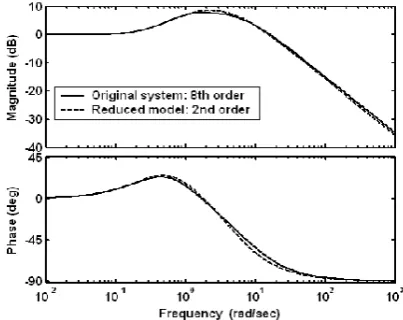
The step responses of the reduced order model and the original system are compared in the Fig.1 and the bode plot comparison is shown in the Fig. 2.
The proposed method is compared with the well-known reduction methods and shown in the Table-1, from which it is concluded that this method is comparable in quality.
Fig.1 Comparison of the step responses for example 1
Fig. 2 Comparison of the bode plots for example 1
TABLEI
COMPARISON OF THE REDUCTION METHODS
Reduction methods
Reduced model ISE
Proposed method
Mittal et al. [14]
2 2
Mukherjee et al.
[15] 2 2
Prasad and Pal
[6] 2 2
Example-2: Consider a 7th –order system taken from the
literature [16].
7 7 6 5 4 3 2
375000 31248.75 ( )
83.64 4097 70342 853703 2814271 3310875 281250
s 7.6744 j13.4462
and 32.0753 j38.8493.
The minimum 3rd-order reduced model is possible in this case.
The following two cluster centres are computed as
1
Finally, the 3rd–order reduced model is obtained as
2
3 2 3
0.06992 0.82487 0.16997 ( )
0.62933 7.28037 4.7967
s s
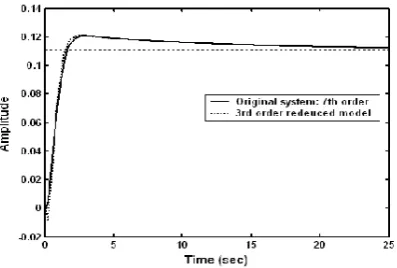
The step response comparison with the original system
7( )
G s is shown in the Fig.3 and the qualitative properties comparison is shown in the Table-2, from which it may be concluded that the proposed method is better in quality and provides good approximation in the transient as well as steady-state region.
Fig.3 Comparison of the step responses for example 2
TABLEII
QUALITATIVE COMPARISON WITH THE ORIGINAL SYSTEM
System Rise Time
r
3rdOrder 0.847 8.90 17.9
V. CONCLUSIONS
The authors presented a mixed method for reducing the order of the large-scale single-input-single-output systems. In this method, the denominator polynomial is determined by using the modified pole clustering while the coefficients of the numerator are obtained by Pade approximations. This method has been tested on the two numerical examples chosen from the literature and time and frequency responses of the original and reduced system are compared graphically and shown in the Fig.1, 2 and 3 and error (ISE) and qualitative properties comparison are shown in the Table-1 and Table-2 respectively. From these comparisons, it has been concluded that the proposed method is simple, computer oriented and comparable in quality. This method guarantees stability of the reduced model if the original high-order system is stable and exactly matches the steady-state value of the original system. The proposed method is equally applicable to linear multivariable systems and is reported elsewhere.
REFERENCES
[1] V. Singh, D. Chandra and H. Kar, “Improved Routh Pade approximants: A Computer aided approach”, IEEE Trans. Autom. Control, 49(2), pp.292-296, 2004.
[2] S.Mukherjee and R.N. Mishra, “Reduced order modeling of linear multivariable systems using an error minimization technique”, Journal of Franklin Inst., 325 (2), pp.235-245, 1988.
[3] Sastry G.V.K.R Raja Rao G. and Mallikarjuna Rao P., “Large scale interval system modeling using Routh approximants”, Electronic Letters, 36(8), pp.768-769, 2000.
[4] R. Prasad, “Pade type model order reduction for multivariable systems using Routh approximation”, Computers and Electrical Engineering, 26, pp.445-459, 2000.
[5] G.Parmar, S. Mukherjee and R. Prasad, “System reduction using factor division algorithm and eigen spectrum analysis”, Applied Mathematical Modelling, Elsevier, 31, pp.2542-2552, 2007.
[6] R. Prasad and J. Pal, “Stable reduction of linear systems by continued fractions”, Journal of Institution of Engineers IE(I) Journal-EL, 72, pp.113-116, 1991.
[7] R. Prasad, S.P. Sharma and A.K. Mittal, “Improved Pade approximation for multivariable systems using stability equation method”, Journal of Institution of Engineers IE (I) Journal-EL, 84, pp.161-165, 2003. [8] A.K. Sinha, J. Pal, Simulation based reduced order modeling using a
clustering technique, Computer and Electrical Engg., 16(3), 1990, 159-169.
[9] J. Pal, A.K. Sinha and N.K. Sinha, Reduced-order modelling using pole clustering and time-moments matching, Journal of The Institution of Engineers (India), Pt El, 76,1995, 1-6.
[10] Pade H, “Sur La representation approaches dune function pardes fraction vationnellers”, 9, pp.1-32, 1892.
[11] Shamash Y, “Stable reduced order models using Pade type approximants”, IEEE Trans. Autom. Control, Vol.AC-19, No.5, pp.615-616, October 1974.
[12] Shamash Y, “Linear system reduction using Pade approximation to allow retention of dominant modes”, Int. J. Control, Vol.21, No. 2, pp.257-272,
[13] C.B. Vishwakarma & R. Prasad, “MIMO system reduction using modified pole clustering and Genetic algorithm”, Modelling and Simulation in Engineering, Hindawi Pub. Corp., USA, Volume 2009, pp. 1-6, 2009.
[14] A.K Mittal, R. Prasad, S.P Sharma, “Reduction of linear dynamic systems using an error minimization technique”, Journal of Institution of Engineers IE(I) Journal-EL, Vol.84, pp.201-206, March 2004. [15] S. Mukherjee, Satakshi, R.C Mittal, “Model order reduction using
response matching”, Journal of Franklin Inst., Vol.342, pp.503-519, 2005.
[16] Bistritz Y. and Langholz G., “Model reduction by Chebyshev polynomial techniques”, IEEE Trans. Automatic Control, Vol-AC-25, No.5, pp. 741-747.