PREPARATION OF RECYCLING CHIP ALUMINIUM (Al 6061)
THROUGH POWDER METALLURGY ROUTE
This report submitted in accordance with requirement of the Universiti Teknikal Malaysia Melaka (UTeM) for the Bachelor Degree of Manufacturing Engineering
Engineering Materials (Hons.)
By
NOR SUHAILA BINTI MUHAMMAD B050910178
900530-11-5010
UNIVERSITI TEKNIKAL MALAYSIA MELAKA
BORANG PENGESAHAN STATUS LAPORAN PROJEK SARJANA MUDA
TAJUK: Preparation of Recycling Chip Aluminium (Al 6061) Through Powder Metallurgy Route
SESI PENGAJIAN: 2012/13 Semester 2
Saya NOR SUHAILA BINTI MUHAMMAD
mengaku membenarkan Laporan PSM ini disimpan di Perpustakaan Universiti Teknikal Malaysia Melaka (UTeM) dengan syarat-syarat kegunaan seperti berikut: 1. Laporan PSM adalah hak milik Universiti Teknikal Malaysia Melaka dan penulis. 2. Perpustakaan Universiti Teknikal Malaysia Melaka dibenarkan membuat salinan
untuk tujuan pengajian sahaja dengan izin penulis.
3. Perpustakaan dibenarkan membuat salinan laporan PSM ini sebagai bahan pertukaran antara institusi pengajian tinggi.
DECLARATION
I hereby, declared that this report entitled “Preparation of Recycling Chip Aluminium
(Al 6061) Through Powder Metallurgy Route” is the results of my own research except
as cited in references.
Signature :………..
Author’s Name : Nor Suhaila Binti Muhammad
APPROVAL
This report is submitted to the Faculty of Manufacturing Engineering of UTeM
as a partial fulfillment of the requirements for the Degree in Bachelor of
Manufacturing Engineering (Engineering materials) (Hons.). The member of the
supervisory is as follow:
...
ABSTRAK
Laporan ini membentangkan penyediaan kitar semula cip aluminum melalui kaedah
metalurgi serbuk. Bahan mentah yang telah digunakan ialah aluminum 6061. Salah satu
keperluan utama dalam melaksanakan projek ini ialah untuk menilai prestasi cip
aluminum dengan kelajuan ‘planetary ball mill’ yang berbeza. Sampel telah dikisar
dengan tiga kadar kelajuan putaran yang berbeza iaitu 100, 150, dan 200 rpm selama
satu jam. Satu lagi keperluan utama ialah untuk menganalisa kesan perbezaan suhu
kepada kekerasan cip aluminum. Sejak kekerasan sampel meningkat selepas ia dirawat
dengan haba, tiga suhu yang berbeza akan dikenakan dimulakan dengan 500, 550, dan
600 oC selama 40 minit. Dalam mendapatkan sampel yang mempunyai ciri-ciri yang
baik, setiap sampel akan diuji secara mekanikal untuk menyiasat ketumpatan, dan
kekuatan kekerasan setiap sampel. Pada masa yang sama, kesemua tiga sampel di
analisis untuk mendapatkan taburan saiz dan mikrostruktur selepas disinter dengan
ABSTRACT
This report presents the preparation of recycling chip aluminium through the powder
metallurgy route. The raw materials that have been used are aluminium 6061. One of the
key requirements in doing this project is to evaluate the performance of aluminium chips
with different speed of planetary ball mill. Samples were grind with three different rate
of rotation speed which is 100, 150, and 200 rpm for an hour. Another key requirement
is to analyze the effect of different temperature towards the hardness of recycling chips.
Since sample increase it hardness after been treated to the heat, three different sintering
temperatures will be introduced starting with 500, 550, and 600 oC for 40 minutes. In
order to get which sample has better properties, each sample will be testing
mechanically to investigate its density, and hardness strength properties of each sample.
At the same time, all these samples are being analyzed to obtain its size distribution and
microstructure after being sintered by using Particle Size Analyzer (PSA) and Optical
DEDICATION
To my parents and friends for their help and understandings,
To my supervisor, PM Dr. Mohd Warikh Bin Abdul Rashid for his support and guidance
is enlightenment to me.
Thank you for everyone for every support, help, and cooperation until I manage to finish
ACKNOWLEDGEMENT
Alhamdulillah, praise to Allah S.W.T. for giving me the chance to complete my Projek
Sarjana Muda (PSM) 1. Without involvement of many people, this project would not
finish on time. Special thanks to my supervisor, PM Dr. Mohd Warikh bin Abdul Rashid
who had offered his precious time, attention, experience and guidance throughout the
completion of this project.
I also would like to thanks to my friend for supporting and helping me when I faced a
problem while doing my PSM report. I appreciate all of their kind, and support in
completing these report. Last but not least, I would like to thank to my parents and
family members for their love, care, understanding, and support that they give for me to
TABLE OF CONTENTS
Abstrak i
Abstract ii
Dedication iii
Acknowledgement iv
Table of Contents v
List of Tables viii
List of Figures ix
List of Abbreviations, Symbols and Nomenclatures xi
CHAPTER 1: INTRODUCTION 1
1.1 Background 1
1.2 Problem Statement 2
1.3 Objectives 3
1.4 Scope 3
CHAPTER 2: LITERATURE REVIEW 4
2.1 Introduction 4
2.2.1 Wrought Alloy 5
2.2.2 Casting Alloy 12
2.2.3 Limitation of Wrought and Casting Alloys 16
2.3 Aluminium Alloy 6061 17
2.4 Recycling of Aluminium 19
2.5 Powder Metallurgy 20
2.5.1 Powder Production 21
2.5.2 Compaction 23
2.5.3 Sintering 23
2.5.4 Finishing Operation 23
CHAPTER 3: METHODOLOGY 25
3.1 Introduction 25
3.2 Experimental Process 25
3.2.1 Raw Material 26
3.2.2 Powder Production 26
3.2.3 Compaction 28
3.2.4 Sintering 29
3.2.5 Testing and Analysis 31
3.2.5.1 Density Measurement 32
3.2.5.3 Microstructure Observation 33
3.2.5.4 Particle Size Analyzer (PSA) 34
3.3 Flow Chart for Experimental Procedure 35
CHAPTER 4: RESULTS AND DISCUSSION 36
4.1 The sample 36
4.2 Density Test 37
4.3 Microhardness 38
4.4 Microstructure 40
4.5 Particle Size Analyzer 45
CHAPTER 5: CONCLUSION & RECOMMENDATION 48
5.1 Conclusion 48
5.2 Recommendation 49
REFERENCES 50
LIST OF TABLES
2.1 Wrought designation system 6
2.2 Cast alloy designation system 13
2.3 Chemical Composition of aluminium alloy 6061 18
2.4 Common powder preparation method 21
3.1 Parameter of sintering 30
4.1 Dimension of the sample 36
4.2 Microstructure of sintered samples 41
LIST OF FIGURES
2.1 Flow chart for powder metallurgy component production 24
3.1 a Ultrasonic bath cleaner 26
3.1 b Sample with acetone solution in the ultrasonic bath cleaner 26
3.2 Planetary ball mill 27
3.3 Shape of sample 28
3.4 Hydraulic cold press 29
3.5 Sintering graph 31
3.6 Tube Furnace 31
3.7 Electronic densimeter 32
3.8 Micro Vickers hardness tester 33
3.9 Optical Microscope (OM) 33
3.10 Particle Size Analyzer (PSA) 34
3.11 Process flow of entire experiment 35
4.1 Sample of compacted Al 6061 powder 37
4.2 Graph of density 38
4.4 Indention site 39
4.5 Graph of hardness 39
4.6 Thickness of sample 40
4.7 Formation of powder after sintering 44
4.8 PSA graph for Al 6061 powder with speed of 100, 150 and 200 rpm 46
LIST OF ABBREVIATIONS, SYMBOLS AND NOMENCLATURE
Al Aluminium
CO2 Carbon dioxide
Al2O3 Alumina
AA Aluminium Association
ANSI American National Standard Institute
PSA Particle Size Analyzer
ASTM American Society for Testing and Materials
SAE Society of Automotive Engineers
Mg2Si Magnesium silicide
PM Powder Metallurgy
Cu Copper
Si Silicon
Mg Magnesium
Zn Zinc
rpm revolution per minutes
CHAPTER 1
INTRODUCTION
1.1 Background
Aluminium produced from bauxite ore where commonly used in industry after iron since
its good recyclability as well as low density, good mechanical properties and corrosion
resistance. Nowadays, the recycling of this waste material becomes a major issue. The
waste of this material usually in the form of chips comes from the machining of
semi-finished product. Usually, conventional method been used in recycling this type of scrap.
According to, Gronostajski et al., (2000), the waste and scrap then returned to melting,
whereby some of the metal is recovered and reutilized in the production process. A lot of
metal is lost as a result of oxidation and the cost of labour and energy as well as the
expenditures on environmental protection increases the general cost of the process
during the recycling of the waste been carried out.
Sherafat et al., (2009), states that in conventional method, it is difficult to recycle the
chips due to their elongated spiral shape and small size in comparison with other scraps.
Chips surface area is also relatively large and covered with oxides and oil emulsion, so
that their recycling through re-melting process is not applicable. Under these conditions,
process. Besides, conventional recycling is characterized by high energy consumption,
high operating costs, and a large number of operations. This means that the conventional
process manage to recycle less of the aluminium scrap and lead to very significant
problem because the amount of recycled aluminium has been growing from days to
days.
In recent years, powder metallurgy (PM) method been suggested as an alternative way in
recycling the aluminium chips followed by the hot extrusion. This method results in
lower hardness properties of the recycled materials than metallurgically produced
material due to hot extrusion process where it causes residual porosity and imperfect
bonding. Now, recycling of aluminium scrap without melting phase are tried to be
fabricate so that the properties of the recycled aluminium can be improved.
1.2 Problem Statement
Recycling aluminium chips to the structural component becomes important for the
reduction in CO2 emission. Therefore, recycling of these light metals is an important
issue nowadays. The recycling of aluminium alloy scraps is mostly carried out by the
melting process and it require enormous heating energy in order to melt the scraps.
According to, Samuel (2003), by using conventional method, only 75-81% of
conventional recovery obtained with high energy consumption required for re-melting
scrap which is 6000 kcal/kg. It required high operation cost due to the large number of
operations and lead to high pollution that mainly due to the fumes and dross generated
during re-melting of the scrap.
Gronostajski et al., (2000) states that about 10% on average of the metal burnt and about
10% of it lost in the melting process of aluminium and aluminium alloy. The losses are
irreversible and can reach about 35% if melting takes place in gas or oil-fired furnaces
aluminium scraps during these conventional recycling is its low density which causes it
to stay for a long time on the surface of the molten metal and oxidize intensively.
In this research, powder metallurgy method is used in order to recycle the aluminium
chips. This reduces the emission of CO2 into the air that lead to air pollution by
eliminating the melting phase during the processing.
1.3 Objectives
a) To analyze the effect of different particle size towards the hardness of aluminium
6061.
b) To investigate the performance of aluminium 6061 after been sintered at
different range of temperature.
1.4 Scope
The scope of this research is to study the effect of different particle size of powder
obtain from different speed rotation of planetary milling towards the hardness of
aluminium 6061. Microstructure change after sintering process with temperature of
(500, 550, 600) oC are observed using optical microscope. Lastly, the distribution of the
CHAPTER 2
LITERATURE REVIEW
2.1 Introduction
This chapter will discuss on the fundamental of this project, mainly about the basic of
aluminium 6061. Next, the production of the chips through the powder metallurgy also
will be discussed since it is the important part in this project.
2.2 Aluminium and Aluminium Alloy
Aluminium and aluminium alloys have many outstanding attributes that lead to a wide
range of applications. Aluminium is light, ductile, has good electrical and thermal
conductivity, and can be made strong by alloying. An advantageous chemical property
of aluminium is its reactivity with oxygen, which leads to the formation of a dense layer
of Al2O3 on the surface that shields the base metal from further environmental
interaction (Starke, 2001).
All aluminium products belong to one of eight alloy series. They are available as
wrought and casting alloy. Wrought alloys are used as basic material for mechanical
forming such as extrusion, rolling, deep drawing and forging. These alloys have a
wrought alloys in quantities ranging from 1 to 7%, and in higher quantities, up to 20%
silicon to casting alloys. These elements are copper, magnesium, manganese, silicon,
and zinc.
Good cast-ability, particularly with regard to modern die-casting machines and
considering the very complex structure of casting for the automotive industry, low
shrinkage during solidification of the cast and good thermal stability are essential for
casting alloys.
Alloying element is actually one of the common industrial alloys. Other two things are
additive and impurities. Additive are added in smaller quantities usually less than 1%
which purpose to improve certain properties. The traditional additions are chromium,
manganese, nickel, titanium, beryllium, zirconium, lead, etc. Alloy can contain more
than one additive, and their concentration may exceed 1% in certain cases.
As for impurities, the main impurities of unalloyed aluminium in the 1000 series; their
total concentration determines the purity of the metal, are iron and silicon. The
concentration of impurities can vary depending on the alloy. Aluminium and its alloy
appear to have increasing applications and to be competitive to ferrous alloys due to
their important advantages such as, low density, high specific strength, high corrosion
resistance, good formability and weld-ability.
2.2.1 Wrought Alloy
Wrought alloys consist of two types: non-heat treatable of the 1XXX, 3XXX, 4XXX,
and 5XXX series, and heat treatable of the 2XXX, 6XXX, and 7XXX series.
Strengthening is produced by strain hardening which can be increased by solid solution
and dispersion hardening for the non-heat treatable alloys.
This aluminium classification numbering system has been established by American
National Standard Institute (ANSI) and the Aluminium Association (AA). This
heat treating condition of the material. The primary alloy groups are designated by a four
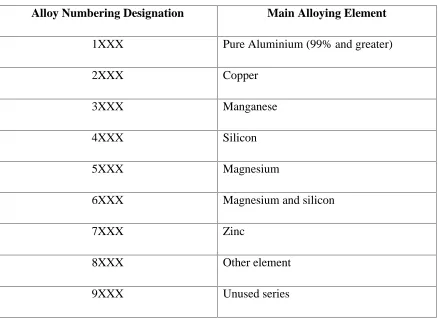
digit code as shown in Table 2.1.
Table 2.1: Wrought designation system
Alloy Numbering Designation Main Alloying Element
1XXX Pure Aluminium (99% and greater)
2XXX Copper
3XXX Manganese
4XXX Silicon
5XXX Magnesium
6XXX Magnesium and silicon
7XXX Zinc
8XXX Other element
9XXX Unused series
1000 Series –Aluminium of 99% or higher purity has many applications, especially in the electrical and chemical fields. These alloys are characterised by excellent corrosion
resistance, high thermal and electrical conductivity, low mechanical properties, and
excellent workability. Moderate increase in strength may be obtained by strain
2000 Series – Copper is the principal alloying element in this group. These alloys require solution heat treatment to obtain optimum properties: in the heat-treated
condition mechanical properties are similar to and sometimes exceed those of mild steel.
In some instances artificial ageing is employed to further increase the mechanical
properties. This treatment materially increases yield strength, with attendant loss in
elongation; its effect on ultimate tensile strength is not as great. The alloys in the 2000
series do not have as good corrosion resistance as most other aluminium alloys and
under certain conditions they may be subject to the inter-granular corrosion.
3000 Series – Manganese is the major alloying element of alloys in this group, which are generally non-heat treatable. Because only a limited percentage of manganese, up to
about 1.5% can be effectively added to aluminium, it is used as a major element in only
a few instances. These, however, are popular and are widely used general-purpose alloys
for moderate strength applications requiring good workability.
4000 Series–The major alloying element of this group is silicon which can be added in sufficient quantities to cause substantial lowering of the melting point without producing
brittleness in the resulting alloys. For these reasons aluminium-silicon alloys are used in
welding wire and as brazing alloys where a lower melting point than that of the parent
metal is required. Most alloys in this series are non-heat treatable, but when used in
welding heat-treatable alloys they will pick up some of the alloying constituents of the
latter and so respond to heat treatment to a limited extent. The alloys containing
appreciable amount of silicon become dark grey when anodic oxide finishes are applied.
5000 Series – Magnesium is one of the most effective and widely used alloying elements for aluminium. When it is used as the major alloying element, or with
manganese, the result is a moderate to high-strength non-heat treatable alloy.
series possess good welding characteristic and good resistance to corrosion in marine
atmospheres.
6000 Series – Alloys in this group contain silicon and magnesium in approximate proportions to form magnesium silicide, thus making them capable of being heat-treated.
Though less strong than most of the 2000 or 7000 alloys, the magnesium-silicon (or
magnesium-silicide) alloys possess good formability and corrosion resistance, with
medium strength.
7000 Series – Zinc is the major alloying element in this group. When coupled with a smaller percentage of the magnesium, it results in heat-treatable alloys of very high
strength. Usually other elements such as coppers and chromium are also added in small
quantities.
8000 Series–Used for alloys not covered by the above series.
9000 Series–Unused series.
The material designation for wrought aluminium alloy is:
‘7’ refer to themajor alloy element.
‘0’ refer to themodification of the original alloy.
Advantages of wrought aluminium alloys are:
a) Corrosion resistance: Alloys that which favorable in this respect is 1xxx, 3xxx,
5xxx, and 6xxx.
b) Thermal conductivity: Aluminium and its alloy are good conductors of heat.
c) Electrical conductivity: Pure aluminium and some of its alloy have exceptionally
high electric conductivity, second only to copper among common metals as
conductors.
d) Strength/weight ratio: This characteristic combined with the excellent corrosion
resistance and recyclability has led to aluminium’s broad use in containers,
aircraft, and automotive applications.
e) Fracture toughness and energy absorption capacity: Many aluminium alloys are
exceptionally tough and excellent choices for critical applications where
resistance to brittle fracture unstable crack growth are imperatives.
f) Workability: Aluminium alloys are readily workable by a great variety of
metal-working technologies and especially amenable to extrusion. This enables
aluminium to be produced in a remarkable variety of shapes and forms in which
the metal can be placed in locations where it can most efficiently carry the
applied loads.
g) Ease of joining: Aluminium alloys may be joined by a very broad variety of
commercial methods including welding, brazing, soldering, riveting, and bolting.
h) Recyclability: Aluminium and its alloys are among the easiest to recycle of any
structural materials. It may be recycled directly back into the same high quality