UNIVERSITI TEKNIKAL MALAYSIA MELAKA
STUDY ON THE IMPROVEMENT OF EFFICIENCY OF
THERMAL ENERGY HARVESTER
This report submitted in accordance with requirement of the Universiti Teknikal Malaysia Melaka (UTeM) for the Bachelor Degree of Engineering Technology
(Mechanical)(Air Conditioning & Refrigeration System Hons.)
by
ALWANA BINTI AZMIL B071110284
910813-05-5344
UNIVERSITI TEKNIKAL MALAYSIA MELAKA
BORANG PENGESAHAN STATUS LAPORAN PROJEK SARJANA MUDA
TAJUK: Study on the Improvement of Efficiency of Thermal Energy Harvester
SESI PENGAJIAN: 2014/15 Semester 2
Saya ALWANA BINTI AZMIL
mengaku membenarkan Laporan PSM ini disimpan di Perpustakaan Universiti Teknikal Malaysia Melaka (UTeM) dengan syarat-syarat kegunaan seperti berikut:
1. Laporan PSM adalah hak milik Universiti Teknikal Malaysia Melaka dan penulis. 2. Perpustakaan Universiti Teknikal Malaysia Melaka dibenarkan membuat salinan
untuk tujuan pengajian sahaja dengan izin penulis.
3. Perpustakaan dibenarkan membuat salinan laporan PSM ini sebagai bahan pertukaran antara institusi pengajian tinggi.
4. **Sila tandakan ( )
SULIT
TERHAD
TIDAK TERHAD
(Mengandungi maklumat yang berdarjah keselamatan atau kepentingan Malaysia sebagaimana yang termaktub dalam AKTA RAHSIA RASMI 1972)
(Mengandungi maklumat TERHAD yang telah ditentukan oleh organisasi/badan di mana penyelidikan dijalankan)
Alamat Tetap:
FAKULTI TEKNOLOGI KEJURUTERAAN
PENGKELASAN LAPORAN PSM SEBAGAI SULIT/TERHAD LAPORAN PROJEK SARJANA MUDA TEKNOLOGI KEJURUTERAAN MEKANIKAL (AIR CONDITIONING & REFRIGERATION SYSTEM): ALWANA BINTI AZMIL
Sukacita dimaklumkan bahawa Laporan PSM yang tersebut di atas bertajuk
“Study On The Improvement Of Efficiency Of Thermal Energy Harvester” mohon dikelaskan sebagai *SULIT / TERHAD untuk tempoh LIMA(5) tahun dari tarikh surat ini.
2. Hal ini adalah kerana IANYA MERUPAKAN PROJEK YANG DITAJA OLEH SYARIKAT LUAR DAN HASIL KAJIANNYA ADALAH SULIT.
Sekian dimaklumkan. Terima kasih.
Yang benar,
iv
DECLARATION
I hereby, declared this report entitled “Study on the Improvement of Efficiency of Thermal Energy Harvester” is the results of my own research except as cited in
references.
Signature : ……….
Author’s Name : ………
v
APPROVAL
This report is submitted to the Faculty of Engineering Technology of UTeM as a partial fulfillment of the requirements for the degree of Bachelor of Engineering Technology (Mechanical) (Air Conditioning & Refrigeration System Hons.). The member of the supervisory is as follow:
vi
ABSTRAK
vii
ABSTRACT
viii
DEDICATION
ix
ACKNOWLEDGEMENT
xii
3.6 Summary 26
CHAPTER 4: RESULTS & DISCUSSION 27
4.1 Introduction 27
4.2 Experimental Data 27
4.3 Temperature Difference of Peltier 31
4.3.1 Sample of Calculation 33 4.3.2 Analysis 34 4.4 Efficiency of the prototype TEH 39 4.4.1 Sample of Calculation 41 4.4.2 Analysis 42 4.5 Summary 46 CHAPTER 5: CONCLUSION & FUTURE WORK 47
5.1 Introduction 47
5.2 Conclusion of TEH project 47
5.3 Recommendation 48
5.4 Summary 50
xiii
LIST OF TABLES
3.1 Components used in prototype 18
3.2 Steam iron specification 20
4.1 Data for minimum range of temperature of the iron 28 4.2 Data for medium range of temperature of the iron 29 4.3 Data for maximum range of temperature of the iron 30 4.4 Temperature difference at minimum range temperature of iron 31 4.5 Temperature difference at medium range temperature of iron 32 4.6
4.7 4.8 4.9
Temperature difference at maximum range temperature of iron Efficiency of the peltier at minimum range temperature of iron Efficiency of the peltier at medium range temperature of iron Efficiency of the peltier at maximum range temperature of iron
xiv
LIST OF FIGURES
1.1 Thermoelectric / Peltier module 3
2.1 Principal of thermoelectric module 10
2.2 Schematic of thermocouple (left) and of a thermopile 13
3.1 Methodology for prototype (external components) 16 3.2 Methodology for prototype (internal components) 16
3.3 The actual prototype (outside) 17
3.4 Flow chart of the prototype TEH
Graph of temperature gradient versus time at minimum range of temperature of iron
Graph of temperature gradient versus time at medium range temperature of iron
Graph of temperature gradient versus time at maximum range temperature of iron
Graph of voltage generated versus time at minimum range temperature of iron
Graph of voltage generated versus time at medium range temperature of iron
Graph of voltage generated versus time at maximum range temperature of iron
Graph of efficiency of TEH at minimum range temperature of iron
Graph of efficiency of TEH at medium range temperature of iron Graph of efficiency of TEH at maximum range temperature of iron
Graph of hot & cold surface temperature of peltier at minimum
xv 4.11
4.12
5.1
range temperature of iron
Graph of hot & cold surface temperature of peltier at medium range temperature of iron
Graph of hot & cold surface temperature of peltier at maximum range temperature of iron
Recommended configuration of peltier
45
45
xvi
LIST OF ABBREVIATIONS, SYMBOLS AND
NOMENCLATURE
TEH - Thermal Energy Harvester
EH - Energy Harvesting
1
1.1 Project Background
Nowadays, natural sources such as fossil fuels as a sustainable supply of energy are decreasing while the demands in a sustainable energy are increasing. Hence, in order to deal with this problem many research have been conducted to find renewable energy in replacing the natural sources as a stable energy. This energy is very high demanding as it is act as a source of power generation. As implying the problem mention before, the idea of harvesting energy is generated within research.
Energy harvesting is the development in harvesting energy from the surrounding system or environment and converts it to available electricity. There are many sources in energy harvesting such as solar, thermal, mechanical and electromagnetic but in this project the focus is on thermal energy source. Usually, device that used thermal energy as a source is thermoelectric. Thermoelectric device employ the Seebeck effect, Peltier effect and Thompson effect. But, the Thompson effect generally will be neglected because of minimal effect on the thermoelectric module. The functions of thermoelectric module are used for both heating and cooling and
2 therefore it is applicable for precise temperature control application as well as for power generation.
Seebeck effect is found and invented by Thomas Seebeck in 1820. The theory can be best described as the current that is produced when two dissimilar metals undergoes temperature difference. Seebeck effect also may be defined as an electric potential will be develop in a thermocouple (closed circuit of two junctions of dissimilar metals) if these junctions are at different temperatures.
Few years later, a scientist discovered the opposite of Seebeck effect that works under a principal that if voltage is applies in a two thermocouple, one junction shall be heated and the other shall be cooled. The scientist’s named Peltier and the effect called Peltier effect. In simple words, when there are temperature gradient is applied into the peltier, current electric is generated and can be stored in a purpose to power supply electronic circuits.
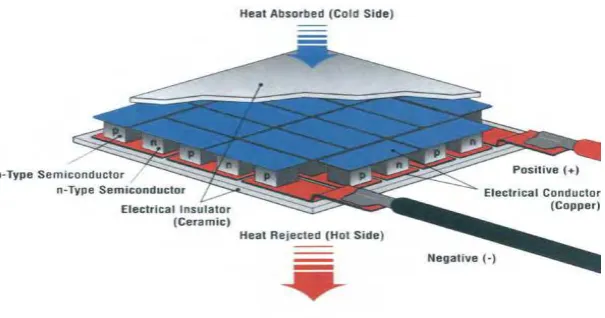
3 Figure 1.1: Thermoelectric/ Peltier module.
The source to gain this temperature gradient is from a thermal energy - an energy that is generated within a system or an object. As the thermal energy is captures, it applies into the peltier module. Peltier module is made of two semiconductor pellets and connects to electrodes. One of the pellets will act as a hot surface while the other one is as a cold surface. Surface that absorbs heat becomes cold and a surface that release heat becomes hot. Hence, temperature gradient can be calculated by the temperature difference of the both pellets.
4 In order to improve efficiency of the thermal energy harvester (TEH), temperature gradient plays an important role. Temperature gradient must be achieved at the maximum point to generate a large amount of current. A way to increase the temperature gradient, variation of the composition of both pellets from hot to cold side was claimed in 1949 by A. F. Loffe. It was called “distributed Peltier effect”. Energy harvesting gives numerous benefits and therefore it getting known widely. One of the advantages is eliminating the necessity of battery power. Harvesting energy may be reduce the needs in using battery as the device can be powered by only the harvester and depends on the energy storage. Besides, by energy harvesting the installation costs can be reduced. This is because it is easier to install even the self-powered device also need wires and conduits.
In addition, energy harvesting helps in reducing maintenance costs as it eliminates the possibility in servicing the batteries. Therefore, maintenance costs can be cut down and at the same time reducing the budget. Moreover, energy harvesting enables the possibility to continue provides sensing even under hazardous environment. This is beneficial to the owner as the device works in any under circumstances. The other advantage of energy harvesting is it provides long-term solutions. The energy harvesting device can functions without any problem as long as the ambient energy is available. One of the benefits from the energy harvesting is due to its environmental friendly characteristics, energy harvesting reduce the needs of using batteries as the device may only be powered from the ambient energy.
5 requirement. Energy harvesting device also provides benefit of heating and cooling process can be reversed. This is beneficial as only one device have the ability in heating and cooling. Thus, energy harvesting device helps in reducing space as well as reducing in costs because it ability in reversing heating and cooling process.
1.2 Problem Statement
Based on previous research, studies on thermal energy harvester are available. However, the efficiency of this thermal energy harvester is still at low rates. This is because thermoelectric energy conversion is still in a low efficiency. Hence, in this research it will be focus on investigation of the effect of temperature gradient of thermoelectric and the efficiency thermal energy harvester.
1.3 Objectives
i. To calculate efficiency of thermal energy harvester.
ii. To analyze the effect of temperature gradient of the hot and cold side of the peltier module.
1.4 Scope
6 running and after every minute. The temperature of the iron is neglected as the main purpose is only to capture amount of energy produce by the iron.
1.5 Summary
7
2.1 Introduction
There are so much wasted energy generates by systems such as air conditioning system, electronic circuit and car system. Hence, in order to re-use the wasted energy, the idea of energy harvesting is created. In addition, in introducing energy harvesting there is theories need to be understood and studied as well as the application of the energy harvesting itself. Therefore, in this chapter there are a few key points will be reviewed and discussed. The key points are thermal energy harvesting, Peltier and effect of temperature gradient.
2.2 Thermal Energy Harvester
The main idea of this research is on the thermal energy harvesting and therefore understanding on the main idea is crucial. According U. Alvarado et. al (2012) energy harvesting is a process of harvesting energy that is generates from the environment or surrounding and converts it to power supply. In agreement, S. K. T. Ravindran et. al (2011) said energy harvester converts ambient energy that is in the