UNIVERSITI TEKNIKAL MALAYSIA MELAKA
WEARABLE BRACELET FOR CHILD MONITORING SYSTEM
This report submitted in accordance with requirement of the Universiti Teknikal Malaysia Melaka (UTeM) for the Bachelor Degree of Engineering Technology (Bachelor's Degree in Electrical Engineering Technology Industrial Automation &
Robotics) (Hons.)
by
MARSYITAH BINTI MOHAMED ZIN
B071110153
910211-05-5064
UNIVERSITI TEKNIKAL MALAYSIA MELAKA
BORANG PENGESAHAN STATUS LAPORAN PROJEK SARJANA MUDA
TAJUK: Bachelor's Degree in Electrical Engineering Technology (Industrial Automation & Robotics)
SESI PENGAJIAN: 2014/15 Semester 1
Saya MARSYITAH BINTI MOHAMED ZIN
mengaku membenarkan Laporan PSM ini disimpan di Perpustakaan Universiti Teknikal Malaysia Melaka (UTeM) dengan syarat-syarat kegunaan seperti berikut: 1. Laporan PSM adalah hak milik Universiti Teknikal Malaysia Melaka dan penulis. 2. Perpustakaan Universiti Teknikal Malaysia Melaka dibenarkan membuat salinan
untuk tujuan pengajian sahaja dengan izin penulis.
3. Perpustakaan dibenarkan membuat salinan laporan PSM ini sebagai bahan pertukaran antara institusi pengajian tinggi. atau kepentingan Malaysia sebagaimana yang termaktub dalam AKTA RAHSIA RASMI 1972)
(Mengandungi maklumat TERHAD yang telah ditentukan oleh organisasi/badan di mana penyelidikan dijalankan)
iii
DECLARATION
I hereby, declared this report entitled
WEARABLE BRACELET FOR CHILD MONITORING SYSTEM
is the results of my own research except as cited in references.
Signature : ……….
Author’s Name : MARSYITAH BINTI MOHAMED ZIN
iv
APPROVAL
This report is submitted to the Faculty of Engineering Technology of UTeM as a partial fulfillment of the requirements for the degree of Bachelor of Engineering Technology (Bachelor's Degree in Electrical Engineering Technology Industrial Automation & Robotics) (Hons.). The member of the supervisory is as follow:
v
ABSTRAK
vi
ABSTRACT
vii
DEDICATION
viii
ACKNOWLEDGEMENT
ix
List of Abbreviations, Symbols and Nomenclature xiii
CHAPTER 1 INTRODUCTION 1
1.1 Background 1
1.2 Problem Statement 2
1.3 Project Objective 3
1.4 Scope 3
CHAPTER 2 LITERATURE REVIEW 4
2.1 Smartphone 4
2.1.1 Mobile Operating System 5
2.1.1.1 Android 7
2.1.1.2 iOS 8
2.2 Mobile Technology 8
2.2.1 Bluetooth 8
2.2.2 Wi-Fi 9
x
CHAPTER 3 METHODOLOGY 15
3.1 Project Methodology 15
3.1.1 Research 16
CHAPTER 4 RESULT & DISCUSSION 23
4.1 Result and Analysis of Connection Test 23
4.1.1 Bluetooth Test By Serial Connection 23
4.1.2 Bluetooth Connection Test Via Bluetooth Chatting 26 4.2 Result and Analysis of Wearable Child Bracelet Real Application 27
4.3 Discussion 33
4.4 Troubleshoot 33
CHAPTER 5 CONCLUSION, RECOMMENDATION and PROJECT
xi
LIST OF TABLES
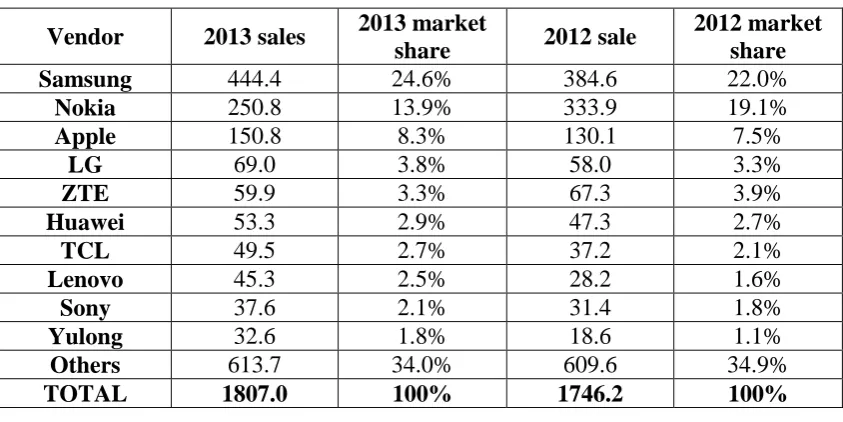
2.1 The top 10 mobile phone manufacturers in 2013 (millions of units) according to Gartner
5
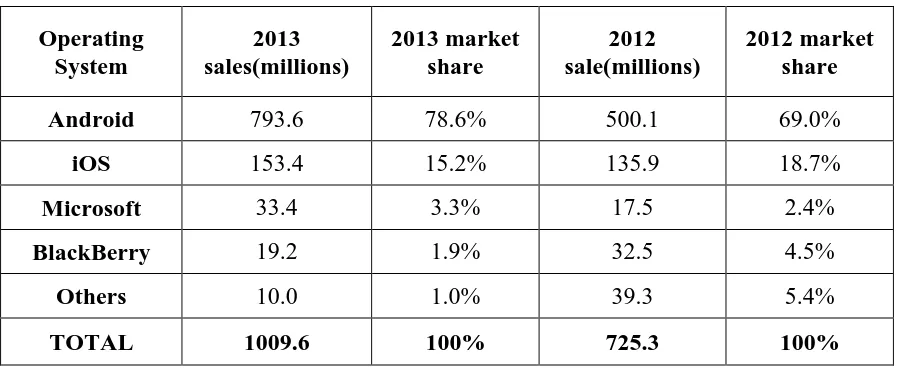
2.2 Global Smartphone operating system share in 2012 and 2013 according to IDC
7
xii
LIST OF FIGURES
2.1 Global Smartphone sale to end users from 1st quarter 2009 to 4th quarter 2013 by operating system.
6
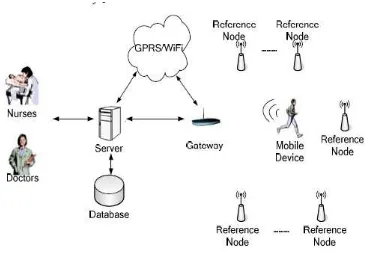
2.2 Outdoor Wireless Healthcare Monitoring System Architecture 10
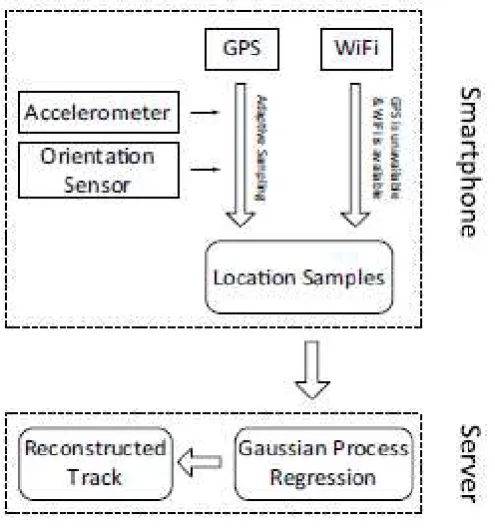
2.3 The System Architecture 11
4.1 Circuit Connection of Bluetooth and Microcontroller 24
4.2 Output Screen On Android Smartphone 25
4.3 HyperTerminal Connection Window 25
4.4 HyperTerminal Input Window 26
4.5 Bluetooth Connection Test Via Chatting 27
4.6 Wearable Bracelet 28
4.7 Android Smartphone Application Screen 29
4.8 Monitoring screen Before Start Activity 29
4.9 Bluetooth Device Selection Screen 30
4.10 Monitoring Screen After Connected 30
4.11 Monitoring System Failed to connect 31
xiii
LIST OF ABBREVIATIONS, SYMBOLS AND
NOMENCLATURE
OS - Operating System
iOS - iPhone Operating System GUI - Graphical User Interface PDA - Personal Digital Assistant SIG - Special Interest Group
IEEE - Institute of Electrical and Electronics Engineers BLE - Bluetooth Low Energy
1
CHAPTER 1
INTRODUCTION
In this chapter the purpose of the project is described generally including problem statement, objective and scope. The problem statement is related to the current issues while the objective is the target for this project in solving the problem arise. However, there will be limitation in completing this project which is discussed in the scope.
1.1 Background
Child went missing without trace is the most upsetting moment for the parent's child and it is worsen when that child is found death in horrible condition. Thus, a solution to a security problem is provided the child with safety device which can be monitored by parent themselves. This project proposed a device known as Wearable Bracelet for Child Monitoring System. This device aims to help parent in monitoring their children base on Bluetooth coverage area.
2
1.2 Problem Statement
It is a worst case scenario for a parent when their child is missing as there are no trace of where they are and if they are alive. Many cases of child missing are due to abduction. The facts that may relate to child abduction include taken by a family member and strangers. Abduction might be another option in gaining money as child is selling for their organ for a very high price and it is still worrisome for parent these days. If considering the factor lead to abduction is causes by family problem which makes the child feeling stress and always isolating themselves from others thus, create an environment for an abductor to abduct without witness. It is fine when the missing child can be found even for days but it is restless when they cannot be traced plus there is no clue on where they were abducted.
Statistic provided by Deputy Internal Security Minister of Malaysia show that in 2004 about 6270 teenagers have been reported missing in Malaysia and out of these number, 4620 of this missing children are teenage girls. From January 2004 to May 2005, 4237 of the 6270 missing children who are mostly teenagers, were found and returned to their home However, at the same time, a total of 149 girls age under nine years old were also reported missing. The police statistics have recorded that in 2005 the 71 girls who ran away from their homes and another 71 missing girls in 2006 were found death. While in 2007 it was recorded that there were about 3246 reports lodged with the police for missing girls and about 303 children and teenagers below the age of 18 have been reported missing in 2008 between January 1 and April 13 in Malaysia.
The statistics of missing children in Malaysia since 2004 recorded about 5,996 cases involving children below 18 years old. Excluding 1904 children, the rest of the child reported missing subsequently were found and returned home by the police safely. Out of the 1904 children that still missing are girls aged around 14 years to 17 years old.
3 Therefore, this child safety device is proposed to encounter the problem faced nowadays for a better child safety.
1.3 Project Objective
The project aims to meet the following objectives: (i) To design GUI for monitoring system.
(ii) To develop wearable bracelet for children that can communicate with android smartphone by using Bluetooth.
(iii) To built a monitoring system that can receive data from multiple Bluetooth bracelet at a time.
1.4 Scope
The project scope will cover aspect such as follows:
(i) Using MIT Apps Inventor 2 to develop a graphic user interface (GUI) for an android smartphone.
(ii) Bluetooth master-slave configuration for communication between Smartphone and bracelet.
4
CHAPTER 2
LITERATURE REVIEW
Throughout this chapter, literature review is made to discuss on the previous researches which are related to this project. The sources of the previous research is gather from journal, conference papers and website to study the concepts, theory and the method of the related aspect. Comparison from the referred sources are based on aspect as follow: conversation nowadays. Usually Smartphone brand, Operating System (OS), OS version and application are the topic often being discuss when having the conversation. Smartphone is a solution to information management, email, mobile, internet access and social networking. It is like having personal computer feature together in a mobile phone and it is portable. However, Smartphone is slightly bigger in size if compare to the standard mobile phone.
5 Table 2.1: The top 10 mobile phone manufacturers in 2013 (millions of units)
according to Gartner
Vendor 2013 sales 2013 market
share 2012 sale
A mobile operating system always referred as mobile OS is an operating system that able a Smartphone, PDA, tablet or any other device to operate. The features of a personal computer operating system which combined with other features such as Bluetooth, touchscreen, Wi-Fi, video camera, cellular and many more are the combination of nowadays modern mobile operating system.
There are several mobile operating systems use in Smartphone but not all of the operating system are used nowadays as Android, iOS, Windows Phone and Blackberry are the most common and famous among Smartphone users today. However, Android and iOS are in the fiercest competition. Android has become world's most commonly used Smartphone platform as it is widely used by many different phone manufacturer while for iOS, it is only used on Apple device that is iPhone. Even though, iOS is only used by iPhone but the royalty show by their customers make iOS a tough competitor to Android.
6 Android Smartphone which has many different choices and large price range. It is proven base on 2013 Smartphone sales in Table 2.2 which show Android OS rank first. The Statistic Portal has done the analysis on Smartphone sale base on operating system and it show that Smartphone with Android OS's sale is increasing uniformly from the first quarter of 2010 until the fourth quarter of 2013. Figure 2.1 shows the sale statistic of Smartphone by operating system shared by The Statistic Portal.
8
2.1.1.2iOS
Previously known as iPhone OS is an operating system exclusively distributed for Apple hardware. The user interface is base on the concept of direct manipulation that is using multi touch gestures. There are three element in the interface control, they are sliders, switches and buttons while the OS interaction are swipe, pinch, reverse pinch and tap which have specific definition within the context of iOS multi touch interface and operating system. iOS consist of four abstraction layers which are core OS layer, Core Service layer, Media layer and Cocoa Touch layer.
2.2 Mobile Wireless Technology
As there are rapid growth in phone technology, nowadays mobile phone; Smartphone is implement with wireless technology such as Bluetooth and Wi-Fi. Bluetooth and Wi-Fi is the medium for transferring data from one phone to another. Bluetooth is usually use for sending between two phone which connected when it is paired. As for Wi-Fi it commonly used and connected for more than two devices at a time.
2.2.1 Bluetooth
9 connection is refer to slaves which connected to a master. J.Mander and D. Picopoulos (2009) state that the connection is either Point to Point or Point to Multipoint. Point to Point is when there is a master and a slave while for Point to multipoint is when there are many slaves and it is connected to a Master.
Bluetooth has its own range which has been classified into class 1, class 2 and class 3. These 3 classes of Bluetooth is refer as classic Bluetooth for the version below 3.0 while version 4.0 and above is classed as Bluetooth Low Energy (BLE) and it is referred as Smart Bluetooth. Refer to Bluetooth Page it is state that class 1 range about 1 meter or 3 feet, class 2 range about 10 meters or 33 feet and class 3 range up to 100 meters or 300 feet while for BLE it range is estimate about over 100 meters.
2.2.2 Wi-Fi
Wi-Fi also written as Wi-Fi is the most successful wireless local area network. Chaoli Zhou and Jianhua Zien (2011) state in their paper that rapid growth of Wi-Fi improve the infrastructure facilities and advances of Smartphone technologies nowadays make most of the shelf Smartphone today support Wi-Fi.
Adnan Alam Khan and Noor Zaman (2009) says that Wi-Fi is very successful at delivering data over range of 150 meters with Wi-Fi installation can accommodate at 54 Mbit/s of bandwidth in 100 meter of radius for 32 users. Wi-Fi also require less power to transmit signal as Wi-Fi cards and equipment can communicate over short distance.
2.3 Tracking and Monitoring System
10 continuously monitor the patient remotely and to track the patients location as patient health is the priority when they are admit to a hospital. It says in this paper that the reasons outdoor monitoring system is design base on ZigBee is due to the longer communication range and less power consumption although it has less transmission rate. By using ZigBee the percentage of data lose is high due to ambient radio interference that will affect the communication between ZigBee node. Thus, through this paper they also proposing a reliable data transmission method to prevent data losing in their healthcare monitoring system by using time response mechanism, the original code and their compliment code check.
Meanwhile, in tracking the patient it mix the location engine which is embedded onto TI CC2431 chipset with localization algorithm base on Manhattan distance. Manhattan distance is the distance between two points in a grid where it is the sum of the horizontal and vertical component. Figure 2.2 show the architecture of this device on how it will monitoring the patient health. For the diagonal distance it is calculate base on Pythagorean theorem. The device is include with backup power to ensure continuous monitoring of patient.
11 Lei Zhang and Jiangchuan Liu (2013) introduce Energy-Efficient Location Tracking with Smartphone Sensor or kwon as SensTrack. This project is mainly targeting to tracking location with the minimum use of Global Positioning System (GPS) yet still achieve high accuracy. Besides that it also aim to improve energy consume by a tracking device as GPS consume a lot of energy and battery will completely drain in just a few hours. In addition, as GPS usage is reduce this project also targeting to expand the coverage area by using Wi-Fi. The SensTrack actually executes a GPS sampling gain from the acceleration and orientation sensor and later switch to the alternate location sensing method when user move indoor by Wi-Fi. Figure 2.3 is the system architecture which summarize this device overall operation.
Figure 2.3: The system architecture