AN ANALYSIS OF POLITENESS STRATEGY BETWEEN
ELLEN DEGENERES AND BARRACK OBAMA IN
THE
ELLEN SHOW
A Thesis
Submitted to Faculty of Adab and Humanities
In partial Fulfillment of the Requirements for
The Degree of Strata One (S1)
GADING AYU KUSUMA LISTY
1112026000003
ENGLISH LANGUAGE AND LITERATURE DEPARTMENT
FACULTY OF ADAB AND HUMANITIES
STATE ISLAMIC UNIVERSITY SYARIF HIDAYATULLAH
JAKARTA
ABSTRACT
Gading Ayu Kusuma Listy, An Analysis of Politeness Strategy between Ellen DeGeneres and Barrack Obama in The Ellen Show. Thesis. Jakarta: English Letters Department, Letters and Humanities Faculty, State Islamic University (UIN) Syarif Hidayatullah, August 2016.
This research is on pragmatics politeness of an interview between Ellen DeGeneres and the United States President, Barrack Obama in Ellen DeGeneres show episode 12 February 2016. It is a qualitative research that used Brown and Levinson‟s politeness strategy (1978), supported by J.L. Austin‟s speech act theory (1962). By applying the theories, the writer found that Both Ellen and Obama were observed politeness strategy. In Ellen‟s utterance, the writer found two Brown and Levinson‟s strategies which are positive and negative politeness. Meanwhile, in Obama‟s utterance, the writer found one Brown and Levinson‟s strategy which is positive politeness. The choices of strategy from the participants are influenced by varied payoffs and sociological factors. The payoffs factors are „save and satisfy‟ guest‟s face, „save and satisfy‟ host‟s face, and „save and satisfy‟ viewers‟ face. Meanwhile, the sociological factors are the social distance between speaker and hearer and the relative power of speaker and hearer.
Keywords: Pragmatics, Politeness, Positive strategy, and Negative strategy.
iv
DECLARATION
I hereby declare that this submission is my own work and that, to the best of my knowledge and belief, it contains no material previously published or written by another person nor material which to a substantial extent has been accepted for the award of any other degree or diploma of the university or other institutes of higher learning, except where due acknowledgment has been made in the text.
Jakarta, August 28th 2016
v
ACKNOWLEDGMENT
In The Name of Allah, Most Gracious, Most Merciful
All praises be to Allah SWT. The real writer‟s guide, who amazingly and
mysteriously guides and helps her in the process of making this thesis. Peace and salutation be upon the greatest prophet Muhammad SAW, his family, companions, and adherents.
The writer wants to say many thanks to her family: her mother (Mrs. Lilis Mawati) and father (Mr. Erlangga Wijaya Kusuma) who have taken care the writer and always support her much morally and materially, their merits and sacrifice will never be paid, and her beloved sisters (Anindita and Sajida) who have given her supports and kindness. The writer also wants to give her gratitude to Mrs. Alfi Syahriyani, M.Hum as the thesis advisor for her time, guidance, and contribution in correcting and helping the writer in finishing this thesis, so, the writer can complete the research. She thanks for all of her advices that have been delivered to her; and may Allah SWT bless her and her family.
In writing this thesis, the writer would like to express her deepest gratitude to the following persons:
1. Prof. Dr. Syukran Kamil, M.Ag. as the Dean of Faculty of Letters and Humanities.
2. Drs. Saefudin, M.Pd as the Head of English Letters Department.
vi
4. All lectures of English Letters Department, who have taught and educated the writer very well during her study at State Islamic University Syarif Hidatullah Jakarta.
5. Finally, the writer would like to thank everybody, all friends who are important to the successful realization of the thesis, as well as expressing her apology that the writer could not mention personally one by one. Thanks for being good friends. The writer also thanks to Abrar Alifian Epsa, her beloved who always support, strengthen, help, and motivate the writer.
May Allah, the all-Hearer, and all-Knower gives his blesses to us and gives them more that what they have been given to the writer. Ameen.
Jakarta, August 28th, 2016
vii
TABLE OF CONTENTS
ABSTRACT ... i
APPROVEMENT ... ii
LEGALIZATION ... iii
DECLARATION ... iv
ACKNOWLEDGEMENT ... v
TABLE OF CONTENS ... vii
LIST OF TABLES ... ix
LIST OF DIAGRAM ... x
LIST OF ABBREVIATION ... xi
CHAPTER I INTRODUCTION 1. Background of the Study ... 1
2. Focus of the Study ... 5
3. Research Question ... 6
4. Objectives of the Study ... 6
5. Significances of the Study ... 7
6. Research Methodology ... 8
6.1. Method of Research ... 8
6.2. Unit of Analysis ... 9
6.3. Technique of Data Collecting & Processing ... 9
6.4. Technique of Data Analysis ... 10
viii
CHAPTER II THEORETICAL FRAMEWORK ... 12
1. Previous research ... 12
2. Pragmatics ... 14
3. Speech Act ... 17
4. Politeness Strategy ... 21
CHAPTER III RESEARCH FINDING ... 31
1. Data Description ... 31
2. Data Analysis ... 32
CHAPTER IV CONCLUSIONS AND SUGGESTION ... 60
1. Conclusions ... 60
2. Suggestions ... 62
WORKS CITED ... 63
ix
LIST OF TABLES
Table 2.1 The five general function of speech act ... 19
Table 3.1. Politeness strategies in corpus data ... 31
Table 3.2. The analysis of politeness strategy in dialogue 1 ... 34
Table 3.3 The analysis of politeness strategy in dialogue 2 ... 37
Table 3.4 The analysis of politeness strategy in dialogue 3 ... 39
Table 3.5 The analysis of politeness strategy in dialogue 4 ... 40
Table 3.6 The analysis of politeness strategy in dialogue 5 ... 42
Table 3.7 The analysis of politeness strategy in dialogue 6 ... 44
Table 3.8 The analysis of politeness strategy in dialogue 7 ... 46
Table 3.9 The analysis of politeness strategy in dialogue 8 ... 47
Table 3.10 The analysis of politeness strategy in dialogue 9 ... 50
Table 3.11 The analysis of politeness strategy in dialogue 10 ... 52
Table 3.12 The analysis of politeness strategy in dialogue 11 ... 54
Table 3.13 The analysis of politeness strategy in dialogue 12 ... 57
Table 3.14. Politeness strategies used by Ellen ... 58
x
LIST OF DIAGRAM
xi
LIST OF ABBREVIATIONS
Abbreviation Explanation
S Speaker
H Hearer
CHAPTER 1
INTRODUCTION
1. Background of Study
One of the best human‟s treasures which cannot be found in animals or other creatures is their languages skill (Dardjowodjojo 189). Human‟s languages skill can help them communicate and exchange information with others, verbally or not. Communication is a process where somebody or some people, group, organization, and society created and use information in order to be connected with the environment and others (Stewart 4). The aim of communication is to share knowledge or experience through spoken language, written, movement, and broadcasting.
The greatest benefit from communication according to Stewart and Brent is to build the social network and nothing more important than the relationship with the others, family ties, friendship, and colleague. (Stewart 5) The process can be done through interpersonal communication. Interpersonal communication is the communication between one person and another or others. It is often referred to as face-to-face communication between two or more people. Both verbal and nonverbal communication and body language, play a part in how one person understands another. In verbal interpersonal communication, there are two types of messages being sent: a content message and a relational message. (Trenholm and Jensen 360)
Content messages are messages about the topic at hand and relational messages are messages about the relationship itself. This means that relational messages come across in how one says something and it demonstrates a person‟s feelings, whether positive or negative, towards the individual they are talking to, indicating not only how they feel about the topic at hand, but also how they feel about their relationship with the other individual (Trenholm and Jensen 360)
Sometimes when people do a communication, they can be possibly uttering words that can hurt their interlocutor‟s feeling, so it is very important to
keep the interlocutor‟s feeling while having a conversation in order to avoid a
possible gap in the relationship with the others. Communication process can be done privately or watched by the public, for example, is the communication process in the talk show. The talk show is a television programming or radio programming genre in which one person or group of people discusses various topics put forth by a talk show host. (Niven, Lichter and Amundson 118) Usually, guests consist of a group of people who are learned or who have great experience in relation to whatever issue is being discussed on the show for that episode.
non-celebrities have been featured in an attempt by DeGeneres to give them 15 minutes of fame. Guests in this role have included intelligent children, small business owners, etc. The program often features audience participation games where prizes are awarded. In Indonesia, Ellen DeGeneres Show is available in Life Time Asia Channel.
The show has won 38 Daytime Emmy Awards, including four for Outstanding Talk Show (2004, 2005, 2006, 2007) and three for Outstanding Talk Show Entertainment (2010, 2011, 2013). DeGeneres herself has won the Daytime Emmy Award for Outstanding Talk Show Host four times (2005, 2006, 2007, 2008). The show has also won Emmys for numerous writing and technical categories. It won the Genesis Award for "Best Talk Show" in 2010 and 2012. DeGeneres has won the People's Choice Award for "Favorite Daytime TV Host" 14 times. The show averages around 3.9 million viewers per episode, according to daytime television ratings, making it a highly viewed daytime show. (Seidman)
Ellen DeGeneres, as the successful talk show host who has won many awards and got millions viewers for her talk show has a responsibility to take care of her talk show‟s value. Ellen has to maintain her utterance in order to save
communication was watched by millions of people. Beside Ellen, Mr. Obama also needs to maintain his utterance in order to save his dignity as President.
It is attracted writer to do a research on this talk show, because writer identifies the application of politeness strategy in the dialogue of the talk show which the speaker must rationally assess the possible face-threatening nature or utterances that can hurt hearer‟s feeling which speaker is about to make and then
decide either to avoid it entirely, or at least to soften or minimize it by choosing an appropriate linguistic strategies.
Politeness Strategy is a theory by Brown and Levinson. In the spirit of Grice, Brown and Levinson posit a Model Person (MP) with the ability to rationalize from communicative goals to the optimal means of achieving those goals. In doing so, the MP has to assess the dangers of threatening other participants‟ (and hence her/his own) face and to choose the appropriate
strategies in order to minimize any face threats that might be involved in carrying out the goal-directed activity. In contrast to Leech‟s model, therefore, Brown and Levinson‟s model can be seen as an attempt to formulate a theory of
how individuals produce linguistic politeness, i.e. it is a production model. (Watts 85)
Face in Brown and Levinson‟s model is a theoretical construct which The
MP, with the ability to rationalize from communicative goals to the optimal means of achieving those goals, seems to fit well with their redefinition of face,
work of Erving Goffman. (Gunarwan 261) The MP in Brown and Levinson‟s model refers to the „speaker‟, and the only reason the addressee is brought into
the picture is in order that the MP can assess which the most appropriate politeness strategy to use in the circumstances. No mention is made of the ways in which the addressee may react to the politeness strategy produced. Focus in Brown and Levinson‟s model is thus on the speaker, whereas in Leech‟s model
it is on the hearer. (Watts 85)
Based on that background, the writer is attracted to do a research to find out the politeness strategy that is implied in the dialogue of the talk show. Research is a series of activities that are arranged in a systematic and procedural to find the truth, to prove theories or assumptions that have been discovered, or solve a problem (Farkhan 2). To analyze and assess the strategies used on Ellen DeGeneres talk show, the writer uses Politeness Strategy Theory by Brown and Levinson.
2. Focus of the Study
3. Research Questions
Based on the main problem of this research that has been outlined earlier, the writer has formulated the questions as follow:
3.1. What kinds of politeness strategies used by Ellen as the host of Ellen DeGeneres Show when communicate with the guest of the talk show which implied to save the speaker‟s and interlocutor‟s face from Face
Threatening Act (FTA) caused by her speech?
3.2. What kinds of politeness strategies used by the guest of the show, Mr. Barrack Obama when communicate with Ellen DeGeneres which implied to save the speaker‟s and interlocutor‟s face from Face
Threatening Act (FTA) caused by his speech?
3.3. What are the factors influencing speaker to choose kinds of politeness strategies in the dialogue?
4. Objectives of Study
In general, this research aims to describe the application of politeness strategy in Ellen DeGeneres talk show episode 12 February 2016 which is viewed from Brown and Levinson‟s politeness strategy theory. In particular, this
4.1. Describe kinds of politeness strategies used by Ellen as the host of Ellen DeGeneres Show when communicate with the guest of the talk show which implied to save the speaker‟s and interlocutor‟s face from Face
Threatening Act (FTA) caused by her speech.
4.2. Describe kinds of politeness strategies used by the guest of the show, Mr. Barrack Obama when communicate with Ellen DeGeneres which implied to save the speaker‟s and interlocutor‟s face from Face
Threatening Act (FTA) caused by his speech.
4.3. Know the factors influencing speaker to choose kinds of politeness strategies in the dialogue.
5. Significances of the Study
6. Research Methodology
“Research methodology is a set of principles which is essential for the
research process.” (Farkhan 52) In this research, the research methodology is
divided into some parts as follow:
6.1. Method of Research
This research is in the pragmatics field and conducted by using qualitative research method. The qualitative data refers to types of information that are non-countable or not expressed numerically. This information includes elements that are termed intangible or immeasurable because they express qualities, values, the state of mind, and ideas. (Franklin 17). According to the analysis, this research applies descriptive analysis that “involves gathering data that describe events and then organizes, tabulates, depicts, and describes the data collection” (The Association for Educational Communications and Technology)
The reason of using qualitative research is because this research uses a transcript data from a talk show‟s dialogue which is a verbal
6.2. Unit of Analysis
The unit of analysis in this research is the politeness strategies in
Ellen DeGeneres talk show episode February 12, 2016. The data is a transcription from the dialogue in the talk show which contains politeness strategy. The source of the data is from YouTube
https://www.youtube.com/watch?v=PLHo6uyICVk
6.3. Technique of Data Collecting & Processing
According to Ed. Subroto, key element for the qualitative research method is the writer (Subroto 4). The writer does some steps to collect and process the data as follow:
1. Identifying the problem by watching Ellen DeGeneres talk show video, listens carefully to the dialogue, makes a transcription of the dialogue, reads the whole dialogue transcription.
2. Justifying the main problem of the research by picking the dialogue of the host and guest of the talk show which assumed contain politeness strategy.
3. Reducing the dialogue that is not accordance with the research problem.
6.4. Technique of Data Analysis
In this research, the writer does some steps in analyzing data, such as:
6.4.1. Classifying politeness strategy that implied Face Saving Act (FSA) of the speaker and interlocutor based on the context, illocutionary act, and kind of politeness strategy. 6.4.2. Analyzing speech act sentences using Brown and
Levinson‟s politeness strategy theory and J.L.
Austin‟s speech act theory which are used as the
main theories in this research.
6.4.3. Explaining politeness strategy that implied Face Saving Act (FSA) of the speaker and interlocutor to avoid Face Threatening Act (FTA).
7. Conceptual Framework
The data of the research is from dialogue in Ellen DeGeneres Show
episode February 12, 2016, which contain politeness strategy. Next, the data processed by classifying politeness strategy that implied Face Saving Act (FSA) of the speaker and interlocutor and analyzes speech act sentences using Brown and Levinson‟s politeness strategy theory and J.L. Austin‟s speech act theory.
The output of this research is to explain the application of politeness strategy on it and the Factors influencing the choice of strategy
CHAPTER II
THEORICAL FRAMEWORK
1. Previous Research
The writer has observed some previous researches which correspond with this research in some aspects. The aim of reviewing previous research is to know other researches in the same subject area which applied similar theory or corpus. The previous research can be one of the important references in making a research; it can help the writer to enrich the theories that used in the research. Here are some previous researches in the form of journals that related to this research:
The first previous research was titled “Redressive Strategies for FTA in Oprah Winfrey‟s Talk Show”. This research analyzed the application of PP
(Politeness Principle) from the pragmatics perspective. It employed two theories, the PP and its redressive strategies (especially redressive strategies). The analytical data for the present study are collected from Oprah Winfrey‟s Talk Show. This
paper analyzed and investigated Oprah Winfrey‟s Talk Show from different
perspectives by means of qualitative approach. The purpose of this study is the application of these two theories in the daily talk, and the analysis of how they do FTAs (Face-Threatening Acts). (Xiao-yan 7)
Overall, the first previous research was blameless, it analyzed the dialogue very well; described the dialogue‟s context, the speaker‟s reason for using politeness strategy, and how speaker‟s utterance counted as politeness strategy.
This research also mentioned what kinds of the strategy used by the speaker, it explained the kinds of politeness, negative or positive and the strategies which implied to save speaker‟s and hearer‟s face. The correlation with this first previous
research is it applied politeness strategy theory in some episodes of Oprah Winfey talk show, differently here the writer analyzes Ellen DeGeneres the talk show in only one episode, the writer also analyzes it based on the illocutionary act of the utterances. Another difference is the writer‟s research not only focus on the politeness strategies used by the host of the show but it also put attention to the politeness strategy used by the guess of the show.
The second previous research was titled “Politeness in E-mails of Arab Students in Malaysia”. This study analyzed the politeness strategies found in Arab postgraduate students‟ e-mails to their supervisors during their period of study at
Malaysian universities. This research used quantitative and qualitative approaches to analyze eighteen e-mails that were sent by six Arab postgraduate students to their supervisors. The politeness strategies were analyzed according to Brown and Levinson‟s (1987) politeness theory, and the degrees of directness were
categorized according to Cross-Cultural Speech Act Realization Pattern (CCSARP) Blum-Kulka and Olshtain (1984) coding scheme. (Zena Moayad Najeeb 21)
focused on the directness which categorized according to Cross-Cultural Speech Act Realization Pattern (CCSARP). While writer‟s research here analyze spoken
communication in the form of a dialogue transcription and only focus on the strategy used by speakers.
2. Pragmatics
Modern use and current practice of pragmatics are credited to the influence of the American philosophical doctrine of pragmatism. The pragmatic interpretation of semiotics and verbal communication studies in Foundations of the Theory of Signs by Charles Morris in 1938, for instance, helped neatly develop the differences of mainstream enterprises in semiotics and linguistics. (Levinson 3)
According to Yule, “pragmatics is the study of the relationship between
linguistic form and the users of those forms.” (4) There are four areas that
pragmatics is concern with, as follow:
1. “Pragmatics is study of speaker meaning.” Pragmatics concern with the study of meaning uttered by the speaker or written by writer and interpreted by listener or reader.
2. “Pragmatics is the study of contextual meaning.” It includes the relationship of what people mean in a specific context and how the context effect what is said.
how a great deal of what is unsaid is predictable as part of what is communicated.
4. “Pragmatics is the study of the expression of relative distance.” The choice between said and unsaid was determined by the notion of distance. Closeness, whether it is physical, social, or conceptual, implies shared experience. On the supposition of how close or distance the listener is, speaker decide how much needs to be said. (3)
“The central topics of linguistic pragmatics are those aspects of meaning which are dependent on context.” (Cruse 3) Context can be interpreted as the
immediately preceding discourse and the situation of the participants. (Black 3) There are some clues which can help listener in a communication to determine the meaning of an utterance; the first one is tone of voice or intonation which is an important contextualize of meaning. On occasions, it may even enable hearer to reverse the apparent sense of something. (Finch 154)
The second clue is the thematic force. This kind of force is concerned with the way the speaker to announce to the audience what it is that the speaker is principally concerned about; it is often reflected in the syntactic organization of the communication. Putting an item first in a sentence, for example, is a good way of drawing attention to it and let listener or reader know what it is that speaker or writer wishes to focus on. (Finch 155)
intends to convey but does not explicitly express. The second type of context-dependent meaning concerns expressions which designate different things, places, or times in the world, in different contexts: this table, over there, last night. (3)
2.1. Implicature
The word „implicature‟ is derived from the verb „to imply‟, as it cognate „implication‟. Originally, to imply mean to fold something into something else;
hence that which is implied is folded in, and has to be unfolded to be understood. A conversational implicature is, therefore, something which is implied in conversation, that is, something which is left implicit in actual language use. (Mey 45)
To get the meaning of what someone said, interlocutors have to interpret what they say. But interpretation is a tricky affair; misunderstandings are always possible, and sometimes seem to be a rule rather than an exception. (Mey 47) As Leech remarks, “interpreting an utterance is ultimately a matter of guesswork, or (to use the more dignified term) hypothesis formation” (Leech 30)
2.2. Context
Context is action. Context is about understanding what things are for; it is also what provides speaker‟s utterances their true pragmatics meaning and let
them be counted as true pragmatic acts. It is absolutely important not only in conveying the proper values to reference and implicature but also in dealing with other pragmatics issues. (Mey 41)
An important part of the language in use, and therefore of pragmatics, is what people are essentially doing with language when they state; whether they are informing, criticizing, blaming, warning, congratulating, christening a baby, and so on. This is the topic of speech acts. Other topics covered by pragmatics are politeness as expressed linguistically and conversational analysis, which deals with the way conversations are structured. (Cruse 4)
3. Speech Act
Speech act theory originated from the works of the Oxford philosopher of ordinary language John Langshaw Austin (1911–1960). Austin first presented the main tenets of his theory in the lectures he gave at Oxford in the years 1952– 1954 under the title “Words and deeds”, and subsequently in the William James Lectures he delivered at Harvard University in 1955. In 1969 one of Austin‟s
pupils, the American philosopher John R. Searle, published his own version of the theory. Searle‟s systematization and development of Austin‟s ideas has been
Definition of speech acts based on A Glossary of Semantics and Pragmatics by Cruse, “are the acts which crucially involve the production of language. It is usual to recognize three basic types: locutionary acts, illocutionary acts and perlocutionary acts.” (167) While according to Yule speech acts are utterance
actions which commonly given more spesific labels, such as apology, complaint, compliment, invitation, promise, or request. (47) The central tenet of speech act theory is that the uttering of a sentence is, or is part of, an action within the framework of social institutions and conventions. (Huang 93)
Austin said that “to utter the sentence (in, of course, the appropriate
circumstances) is not to describe my doing of what I should be said in so uttering to be doing or to state that I am doing it: it is to do it.”(6) According to Austin,
saying something amounts to simultaneously performing three types of acts: i) A Locutionary act, which is the stating of a sentence with sense and
reference. The locutionary act can be separated into a phonetic act (the act of uttering certain noises), a phatic act (the act of uttering sounds that have sense and reference), and a rhetic act (the act of uttering noises that belong to a certain language vocabulary and grammar). i) An Illocutionary act, which is the action performed by virtue of the
ii) A Perlocutionary act, which is the production of a consequence by the utterance. Contrary to what occurs at the illocutionary level, perlocutions are not directly achieved by the conventional force of an utterance. Also, perlocutions occur at a further level, as the interlocutor‟s actual reaction to the speech act. (101)
3.1. Classification of Illocutionary Acts
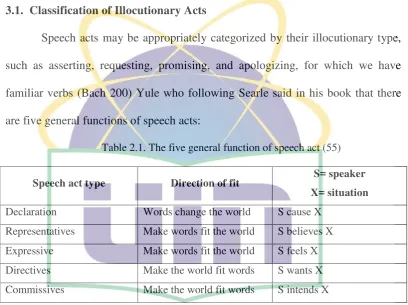
Speech acts may be appropriately categorized by their illocutionary type, such as asserting, requesting, promising, and apologizing, for which we have familiar verbs (Bach 200) Yule who following Searle said in his book that there are five general functions of speech acts:
Table 2.1. The five general function of speech act (55)
Speech act type Direction of fit S= speaker X= situation
Declaration Words change the world S cause X Representatives Make words fit the world S believes X Expressive Make words fit the world S feels X Directives Make the world fit words S wants X Commissives Make the world fit words S intends X
According to Leech, Searle‟s illocutionary acts‟ classification is based on diverse
criteria, wich are defined as follow:
1. Assertives
2. Directives
Directives intended to produce some effect through action by the hearer, for examples are ordering, commanding, requesting, advising, and recommending. They frequently belong to the competitive category, and therefore comprise a category of illocutions in which negative politeness is important.
3. Commissive
Commissives commit the speaker to some future action to a greater or lesser degree, promising, vowing, and offering are the examples. These tend to be convivial, being performed in the interests of someone other than the speaker.
4. Expressives
Expressives have an expressing function or making known, the speaker‟s psychological attitude towards a state of affairs which the illocution presupposes, such as thanking, congratulating, pardoning, blaming, praising, condoling, etc. They tend to be convivial, and therefore intrinsically polite. The reverse is true, however, of such expressives as blaming and accusing. (106)
5. Declaration
4. Politeness Theory
This theory was presented by Goffman (1963) and from the English folk term, which ties face up with notions of being embarrassed or “losing face”.
(Brown & Levinson 61) In this theory, two main types of face that are universally recognized in human cultures are the positive and negative faces. Negative face is the want of every competent adult member that his actions be unimpeded by others. Positive face is the want of every member that his wants be desirable to at least some other. (Brown & Levinson 62) Politeness theory was formulated by Brown and Levinson. It addresses the affront to face posed by face-threatening acts to addresses.
Ferguson defines politeness as formulas in terms of “interpersonal rituals”
(138). Politeness “helps us to achieve effective social living” (Watts, T. J, & Ehlich, K. 2). Politeness is a pervasive phenomenon in all communities. It became the major component of a “dominant ideological discourse in Britain in
the eighteenth century” (Watts 40). Fraser sees politeness as “a property
associated with an utterance in which, according to the hearer, the speaker has neither exceeded any rights nor failed to fulfill any obligations” (13). The social
4.1. Face Threatening Acts
Face-Threatening Acts (FTA) can be defined as acts that inherently damage the face of the addressee or the speaker by acting in opposition to the wants and desires of the other (Brown & Levinson 26). For negative Face Threatening Acts, Brown and Levinson (1978) state that negative face is threatened when an individual does not avoid or intends to avoid the obstructions of his interlocutor's freedom of action. Because of the negative face, the speaker or hearer will have trouble in communication which results in the submission of will to the other and the construction of communication. When a negative face is threatened on the hearer and the speaker, as explained in the section that follows, freedom of choice and action is obstructed.
a) Damage to the Hearer: Through the form of orders, requests, suggestions, advice, threats.
b) Damage to the Speaker: An act or communication that shows the speaker is under the power of the hearer; expressing compliments and thanks, accepting thanks or saying „excuse me‟.
In the case of positive Face Threatening Acts, the speaker or hearer does not care about the other person‟s needs or feelings. Damage to the hearer or
a) Damage to the Hearer: An act that shows the speakers‟ expressions toward the
hearer‟s positive face. The speaker expresses his willingness to disregard the
emotion of well-being to the hearer.
b) Damage to the Speaker: An act that shows the speaker is unable to control himself and that would call for the need of apology and regret for doing an act. (Zena Moayad Najeeb 130)
4.2. Politeness Strategy
According to Brown and Levinson, politeness strategies are used to save the hearer‟s face when face-threatening acts are desired or necessary (68). These
strategies are:
A. Bald On-record: doing act baldly, involves doing it in the most direct, clear, unambiguous and concise way possible. It is mostly used where the danger to H‟s face is very small, as in offers, requests, and suggestions (e.g. come in or
do sit down). Another example can be seen in instances of urgency: „Watch out!‟ or „Be careful!‟ In instances of efficiency: „come in‟.(69)
B. Positive Politeness: oriented to reduce a threat to the hearer‟s positive face and to ensure that the hearer is comfortable, such as: prevent disagreement and jokes, be optimistic, use of solidarity, make a promise, listen and attend to the hearers‟ needs andwants. (70)
Strategy 1: Notice, attend to H (her/his interests, wants, needs, goods, etc.
Strategy 2: Exaggerate (interest, approval, sympathy with H). Example: Good old Jim. Just the man I wanted to see. I knew I‟d find you here.
Strategy 3: Intensify interest to the hearer in the speaker’s contribution.
Example: You m never guess what Fred told me last night. This is right up your street. →(FTA) [begins a narrative]
Strategy 4: Use in-group identity markers in speech. Example: Here‟s my
old mate Fred. How are you doing today, mate?
Strategy 5:Seek agreement in safe topics. Example: I agree. Right.
Manchester United played really badly last night, didn‟t they?
Strategy 6: Avoid disagreement. Example: Well, in a way, I suppose you‟re
sort of right. But look at it like this…
Strategy 7: Presuppose, raise, and assert common ground. Example: People like me and you, Bill, don‟t like being pushed around like that, do we?
Strategy 8: Joke to put the hearer at ease. Example: Great summer we‟re
having. It‟s only rained five times a week on average.
Strategy 9: Assert or presuppose knowledge of and concern for hearer’s
wants. Example: I know you like marshmallows, so I‟ve brought you home a
whole box of them.
Strategy 10: Offer, promise. Example: I‟ll take you out to dinner on
Strategy 11:Be optimistic that the hearer wants what the speaker wants,
i.e. that the FTA is slight: I know you‟re always glad to get a tip or two on
gardening, Fred.
Strategy 12 Include both S and H in the activity. Example: I‟m feeling
really hungry. Let‟s stop for a bite.
Strategy 13 Give or ask for reasons: I think you‟ve had a bit too much to
drink, Jim.
Strategy 14 Assert reciprocal exchange. For example: I‟ll mow the lawn
after school tomorrow. → (FTA) if you help me with my math homework.
Strategy 15 Give gifts to H (goods, sympathy, understanding, and
cooperation). Example:
A: Have a glass of malt whiskey, Dick. B: Terrific! Thanks.
A: Not at all. (Watts 89-90)
C. Negative Politeness:This is usually oriented from the hearer‟s negative face.
Negative face is the desire to remain autonomous so the speaker is more appropriate to include an out for the listener, through distancing styles like apologize (Mills, 2003).
Strategy 2: Do not assume willingness to comply. Question, hedge. Example: I wonder whether I could just sort of ask you a little question.
Strategy 3: Be pessimistic about ability or willingness to comply. Use the
subjunctive. Example: If you had a little time to spare for me this afternoon, I‟d like to talk about my paper.
Strategy 4: Minimise the imposition. Example: Could I talk to you for just a minute?
Strategy 5: Give deference. Example: (to a police constable) Excuse me, officer. I think I might have parked in the wrong place.
Strategy 6: Apologise. Example:Sorry to bother you,but...
Strategy 7: Impersonalise the speaker and the hearer. Example:
A: That car‟s parked in a no-parking area. B: It‟s mine, officer.
A: Well, it‟ll have to have a parking ticket.
Strategy 8: State the FTA as an instance of a general rule. Example: Parking on the double yellow lines is illegal → (FTA) I‟m going to have to
give you a fine.
Strategy 10: Go on record as incurring a debt, or as not indebting H. Example: I‟ll buy you a beer at lunchtime. → (FTA) If you could just sort out
a problem I‟ve got with my formatting. (Watts 90-91)
D. Off record: This strategy includes metaphor and irony rhetorical questions, understatement, tautologies, and uses connotations instead of direct requests. For example, a speaker might say „my home is too far from here‟, which
would imply to the listener to take an action, such as drive the speaker home or let the speaker stay in hearer‟s place, without directly asking him/her to do
so. (Brown & Levinson 69)
Strategy 1:give hints. Example: it‟s cold here (shut the window)
Strategy 2: give association clues. The act of implied something associated with S-H‟s mutual knowledge irrespective of their interactional experience.
Strategy 3: presuppose. An utterance of this strategy can be almost wholly relevant in context.
Strategy 4: understate. Example:
A: what a beautiful house B: oh I don‟t know it‟s a house
Strategy 5: overstate. Example: I have seen it thousand times, but she‟s not there.
Strategy 7: use contradictions. Example: so happy that my teacher doesn‟t
care about be.
Strategy 8: be ironic. Example: Abrar‟s a real genius (after he just done
stupid things)
Strategy 9: use metaphor. Example: Abrar‟s real fish (He drinks/ swims
like a fish)
Strategy 10: use rhetorical questions. Example: how many times do I have to tell you about that?
Strategy 11:be ambiguous.Example: Frank‟s a pretty smooth cookie.
Strategy 12:bevague. Example: I‟m going to you-know-where.
Strategy 13: over-generalize. Example: people who live in glass houses shouldn‟t throw stones
Strategy 14: displace H. Example: he never comes here for a long time.
Strategy 15:be incomplete, use ellipsis. Example: well, I didn‟t see you in
class this morning. (Brown & Levinson)
4.3. Factors Influencing the Choice of Strategies:
1. The payoffs: a priori considerations. Here is the list of the payoff associated with each of the strategies, derived on a priori grounds.
a) Bald on record payoffs: Efficiency, Clarity, perspicuous, Demonstrable non manipulativenes. Example: yes you may enter the room. By uttering that, the speaker can get the advantage of getting the acclaim of honesty, for indicating that he trusts the addressee. (Brown & Levinson 71)
b) Positive politeness payoffs: To satisfy H‟s positive face, in some respect. Example: what a beautiful house, it just like a princess’ castle. The speaker can reduce FTA by declaring the hearer that he considers himself to be „of the same kind‟.(71)
c) Negative politeness payoffs: To satisfy H‟s negative face, in some degree. Example: “Can you possibly help me with this?” (189) the speaker can thereby avoid incurring a future debt.(72)
d) Off record payoffs: speaker can satisfy negative face to a degree greater than that afforded by the negative politeness strategy. The speaker can avoid the inescapable accountability, the responsibility for his action, that on record strategies entail. Example: I can’t open this jar. The speaker can avoid the potential threat of ordering the hearer to help him open the jar.(72)
2. The Circumsance: Sociological factor. Brown and Levinson argue that the assessment of the seriousness involves the following factors in many and perhaps all culture:
a) The social distance (D) of S and H (a symmetric relation). Example: 1. “Excuse me, would you by any chance have the time?”
2. “Got the time, mate?” (80)
Where speaker and hearer are strangers, speaker could use (1) and where speaker and hearer are close, speaker could use (2). The distance of the speaker and hearer is the variable that changes (1) to (2) and vice versa. b) The relative power (P) of S and H (an asymmetric relation). Example:
1. Excuse me sir, would it be all right if I take it? 2. Mind if I take it?
In the same situation, (1) might be said by an employee to his boss, while (2) might be said by the boss to the employee. Power of the hearer which greater than speaker is the only variable that changes (2) to (1) and vice versa
c) The absolute ranking (Rx) of imposition in particular culture. Example: 1. Look, I‟m terribly sorry to bother but would there be any chance of
your borrowing me your phone? I must have lost my phone and I can‟t go home without calling my husband.
2. Hey, can I use your phone?
Both might be said in the airport by a traveler to a stranger. The only variable is R, and it must because the value of R is lower in (6) that the language applicable to a low FTA value is employed there. (80-81)
CHAPTER III
RESEARCH FINDINGS
1. Data Description
The data for this research was collected from an interview between Ellen DeGeneres and Barrack Obama. The interview held on February 12, 2016 has duration 21 minutes 49 seconds and broadcasted for Ellen DeGeneres Talk Show.
The data is from Ellen‟s and Obama‟s utterance which contain politeness strategy
and transcript into a script form. Below are the corpus data the writer has obtained:
Table 3.1. politeness strategies in corpus data
No. Politeness Strategies Observance of Politeness Strategies
1 Bald on record -
2 Positive politeness 17
3 Negative politeness 4
4 Off record -
5 Do not do the FTA -
Total 21
Ellen as the host of talk show and Obama as the guest made utterances in the form of question and statement. Through their words the writer analyzed strategies employed by them. The analysis is divided into three parts the first one is Ellen‟s politeness strategy, the second is Obama‟s politeness strategy, and the
last is the speaker‟s factors of for using some kinds of strategies. The theories
used for analyzed for the data are politeness strategy by Brown and Levinson, and speech act by Austin.
2. Data Analysis
In this part, the analysis has been divided into 12 dialogues which contain politeness strategy. Every dialogue has been analyzed based on the context of utterance, illocution act, FTA, and the factors influencing the choice of strategy.
Dialogue 1
(1) 0:12
Ellen: When I was a little girl growing up in New Orleans I never dreamed that have my own show and I certainly never thought I'd be able to say these words. Please welcome the President of the United States Barack Obama (audiences clapping)
(2) 0:51
Obama: Can I just say I was watching some of the dance moves on that stage. You guys don’t forget? I like it
(3) 1:00
Ellen: Yap the gentlemen they were on the floor touch falling very well
a. Politeness Strategy in Dialogue 1
In datum (1) Ellen used negative politeness in strategy 2 which is hedge by mentioning word “Please” before she uttered a direction. Here Ellen asked her
negative face of her audiences because it predicted some future act of hearer and in so doing put some pressure on hearer to do the act.
In the meantime, Obama used positive politeness in strategy 9 in datum (2) which is assert or presuppose speaker’s knowledge of and concern for hearer’s
wants. This is the first utterances Obama uttered after he entered the talk show stage. Obama ever saw the dance on talk show stage several times ago in his previous interview with Ellen. The illocution used by Obama was assertive because he was reporting something.
b. Factors Influencing the Choice of Strategy in Dialogue 1
1. Payoff to Use Politeness Strategies
Ellen‟s payoff in datum (1) for using negative politeness in strategy 2 is to
save the audience‟s negative face. By using this strategy, Ellen could give a
direction to her interlocutors without threatening their negative face. This strategy could redress audiences‟ negative face by carefully avoiding presuming or assuming that anything involved in the FTA is desired by them.
Meanwhile, Obama‟s payoff in datum (2) for using positive politeness in
strategy 9 is to satisfy his interlocutor‟s face. It derives from the want to convey
2. Sociological value
The social distance factor in datum (1) has a great value for the FTA weightiness. The social distance between Ellen and her audience was great based on an assessment of the frequency of the interaction.
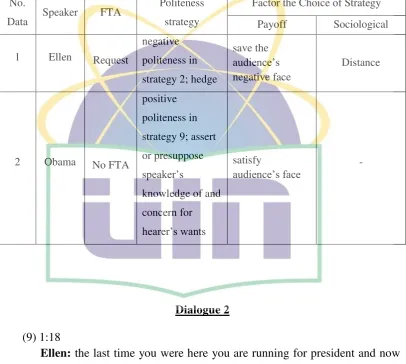
Table 3.2. The analysis of politeness strategy in dialogue 1 No.
Ellen: the last time you were here you are running for president and now you're leaving I feel like I have something to do with this both. An obvious question but what how do you feel now compared to when you were here before?
(10) 1:32
Obama: older (11) 1:35
(12) 1:37
Obama: you know over the interesting thing is actually I feel really energetic. The first time I came, there was a lot of possibilities out there but also uncertain and you know. You're young you're eager to get started but you don't know what you don't know and now after having served for seven years, and having got a lot done seen the progress that we've made. Seeing the incredible resilience the American people in fighting back from recession and more in some ways. The fear drops away you feel confident but America's going to do well you know the job better or more relaxed than and just as enthusiastic as I was the first NASCAR
a. Politeness Strategy in Dialogue 2
As seen in (9), Ellen used negative politeness in strategy 6; apologize. Here Ellen was asked to Obama what it was felt like become someone who‟s
going to leave his tenure. Now Obama is in the end of his period as a President of U.S. and will be an ex-President. That‟s mean Obama is going to become someone who‟s not powerful as he used to be. The illocution used in Ellen‟s
utterance is directive where the S want X or speaker wanted situation. Here Ellen as speaker wanted to get information from her interlocutor, but the information which Ellen needed to know could threat Obama‟s negative face and her positive face for impinging.
In this case, Obama believed what he uttered because that was his own experience.
The second strategy is positive politeness in strategy 3 which is intensify interest to H. This talk show was produced and broadcasted in America (and other countries). The hearer in this utterance is not just Ellen, but also American people who watched this talk show. Obama praised America people for being struggle with their country‟s condition.
b. Factors Influencing the Choice of Strategy in Dialogue 2 1. Payoff
Ellen‟s payoff for using negative politeness is to save Obama‟s negative face.
She was using hedge before uttering her question. She described Obama‟s current
condition implied in her utterance when she said that Obama ever come to her show before. Then Ellen used negative politeness in strategy 6 to communicate she wanted to not impinge on Obama. Ellen could indicate her reluctance to impinge on her interlocutor‟s negative face and thereby partially redress that impingement. She admitted that she was impinging on Obama‟s face by using
hedge “an obvious question but...” before uttering the question. This strategy is
implied that Ellen as speaker was indirectly apologizing for doing FTA.
Positive politeness in strategy 7 is approach-based in datum (12), Obama taking the role of Ellen in order to reduce the distance between his and Ellen‟s
word you instead of I. He told about his experience to Ellen but he talked like Ellen did that experience.
The payoff of using the second strategy which is positive politeness in strategy 3 is to satisfy hearers who are viewers of the show, whether in the home or studio. Obama intensified his interest to the hearers who are America people. He making a good story that seeing America people are struggling from country collapse was pleased him a lot.
2. Sociological value
The power P factor in (9) was more considerable in this utterance, where hearer has greater power over the speaker and this again lessens of FTA weightiness which provided Ellen with the reason for her choice of strategy.
Table 3.3. The analysis of politeness strategy in dialogue 2 No.
Data Speaker FTA Politeness strategy
Factor the Choice of Strategy
12 Obama No FTA positive politeness in strategy 3
Satisfy
viewer‟s
positive face
Dialogue 3
(20) 4:22
Ellen: ... I think we have people that we all have one thing in common which we just want a good quality of life and then we have these people that feel one way and if someone feels another way we tend to hate them and it's just you know
(21) 4:48
Obama: it's not helpful (22) 4:50
Ellen:no. it's not helpful
a. Politeness Strategy in Dialogue 3
From this dialogue, it (22) can be seen that Ellen used positive politeness strategy in strategy 5 which is seek agreement. They were talking about the civil who hates other who have different choice for the later U.S. election. Ellen said that it was not helpful to hate other since they all live in the same country and Obama agree with her by repeating Obama‟s utterance. The illocution used here is
assertive where Ellen as speaker stated her agreement with her interlocutor. b. Factors Influencing the Choice of Strategy in Dialogue 3
1. Payoff
2. Sociological value
Obama as addressee has greater power over the speaker and this again lessens of FTA weightiness which provided speaker with the reason for her choice of strategy.
Table 3.4. The analysis of politeness strategy in dialogue 3 No.
Obama: I mean those include you have good form (32) 6:47
Ellen: I have better form than her (33) 6:50
a. Politeness Strategy in Dialogue 4
It seen in (33) that Obama used positive politeness in strategy 6 which is
avoid disagreement. Obama uttered it after they saw Michelle and Ellen's push up battle video. Ellen said that she has a better form than Michelle. Obama indirectly disagreed with her. Illocution used here was assertive when speaker commits to the truth.
b. Factors Influencing the Choice of Strategy in Dialogue 4
1. Payoff to Use Politeness Strategies
Obama‟s payoff for using positive politeness in strategy 6 is to save Ellen‟s
positive face. He could threat Ellen‟s face if he showed his disagreement. The
sub-strategy used by speaker is token agreement where Obama pretend to agree with Ellen in order to hide his disagreement.
2. Sociological value
Speaker considered the FTA‟s weightiness was measured by his interlocutor‟s
power. Ellen as host of the talk show has greater power over Obama in the talk show stage.
Table 3.5. The analysis of politeness strategy in dialogue 4
strategy 5 which is seek agreement.
Dialogue 5
(34) 6:54
Ellen: We do have to break but before we‟re gonna break we have had a
little bit of fun with you over the years and I wanna... (35) 7:00
Obama:noticeI heard about this I will be watching every day
a. Politeness Strategy in Dialogue 5
It could be detected in this part of dialogue (35) that Obama used positive politeness in strategy 9 which is assert or presuppose speaker’s knowledge of and
concern for hearer’s wants. Obama was implying his knowledge of Ellen‟s
wants. Obama said that he was familiar already with her show because he always watched Ellen‟s show. The illocution used here is assertive which commit the
speaker to the truth of the expressed proposition.
b. Factors Influencing the Choice of Strategy in Dialogue 5
1. The payoffs
The payoff in using positive politeness in strategy 9 is to satisfy his interlocutor‟s
Table 3.6. The analysis of politeness strategy in dialogue 5
No.
Data Speaker FTA Politeness strategy
Factor the Choice of Strategy
Obama: you know when I'm in the Situation Room and we’re talking about counter-terrorism strategy, then I say you know what? we got a break for Ellen
(38) 7:20
Ellen: that‟s why I like you come here
a. Politeness Strategy in Dialogue 6
In this utterance (36) Ellen used negative politeness in strategy 3 which is
be pessimistic. She uttered this utterance in replying to Obama‟s statement that he
watched Ellen‟s talk show every day. Ellen as the host of the show must be very
show every day. She could threat her interlocutor‟s face if she said directly if she did not believe him and asked for future fact.
In (37) Obama used positive politeness in strategy 1 which is notice, attend to hearer. After Obama said that he been watched Ellen talk show every day, he strength his statement by mentioned that he even watched it in his meeting time. Ellen as the host of talk show must be feel honored her show was got more attention from The President. The illocution used here is assertive, because Obama as speaker reported something.
b. Factors Influencing the Choice of Strategy in Dialogue 6
1. The payoffs
Ellen‟s payoff for using negative politeness in strategy 3 is to save
Obama‟s negative face. Ellen was indirectly arguing Obama that he watched it
every day since Ellen knew that Obama as President must be has a limit time. By being pessimistic Ellen not directly ask Obama if his statement was true or not. This strategy gives redress to Obama‟s negative face by explicitly expressing
doubt that the conditions for the appropriateness of speaker‟s speech act obtain. Obama‟s payoff of using positive politeness in strategy 1 is to satisfy Ellen‟s
2. Sociological value
The reason for choosing strategy 3 is because Ellen as speaker asserted that hearer is relatively more powerful than her, she indicated that the weight of FTA was assessed crucially on values of power.
Table 3.7. The analysis of politeness strategy in dialogue 6
No.
Obama: I don‟t miss plane commercial. Take your shoes off (56) 10:09
Ellen: ouch. It’s stinky (57) 10:10
Ellen: not yours. Not yours (58) 10:14
Obama: I wear clean stuff I don‟t know about you (59) 10:21
a. Politeness Strategy in Dialogue 7
In (56, 57, 59) Ellen used positive politeness in strategy 8 which is joke. In this dialogue Ellen uttered something ambiguity. She said that it’s stinky and make Obama though that it was for him but what Ellen means was not Obama‟s
shoes are stinky but other people‟s shoes are stinky. She aimed to be hilarious and
having a fun conversation. The illocution used here is assertive which has a function of collaborative where the illocution goal is indifferent with the social goal.
b. Factors Influencing the Choice of Strategy in Dialogue 7
1. Payoff
Ellen‟s payoff for using positive politeness in strategy 8 is to warm the situation
and invite hearer to laugh. Ellen as speaker saved Obama‟s positive face by
uttered with people take their shoes off which implicated that Obama‟s shoes are
clean and he was not threatened. When speaker and hearer were laughing together they could warm the atmosphere which aimed to make closer the relationship of them. The social goal Ellen achieved here she considered for being funny and succeed entertain her interlocutor.
2. Sociological value
Table 3.8. The analysis of politeness strategy in dialogue 7
Ellen: wehave to take another break. We‟ll be back (75) 12:46
Ellen: We‟re back with Mr. President Barrack Obama and I mention in the monolog but I can‟t tell you and thank you enough for what you’ve done for the gay communities.
a. Politeness Strategy in Dialogue 8
b. Factors Influencing the Choice of Strategy in Dialogue 8
1. Payoff
The speaker's payoff in datum (75) for using positive politeness in strategy 2 is to save her interlocutor's positive face. Ellen indicated that she and Obama both belong to some set of person who shared specific wants, including goals and values. Since Ellen is a lesbian and part of LGBT it must be assured that she support every good thing that happened to gay community. She saved Obama's positive face by showing her approval and interest for what he was done and thanked him.
Table 3.9. The analysis of politeness strategy in dialogue 8 No.
than you are that I really think. you’re courage and you're just really likable and so to claim who you were then suddenly empowers other people and then something it's your brother is here on call let's hear your best friend it's your co-workers and and and then attitudes shift and the loss followed but it started with folks like you
(77) 14:26
Ellen: a lot of that. Well, thank you (78) 14:36
Ellen: I’m not really gay
a. Politeness Strategy in Dialogue 9
In (76) Obama observed positive politeness in strategy 15 which is give gift to hearer.Obama told Ellen that she has an amazing personality; she was given great influence for the other LGBT to be fearless. Since people who love their own gender were bullied by other but Ellen who claimed herself as lesbian could live happily and feel free. She could reach success instead of being sad of her condition. Illocution used here is assertive where Obama as speaker give a compliment to his interlocutor.
It (77) could be detected that Ellen used negative politeness in strategy 4
which is minimize the imposition. She uttered this utterance after Obama compliment her. The illocution used here is expressive where S feels X or speaker feels situation. In this situation Ellen felt that Obama could threat his negative face for over complimenting her, which means Obama as speaker is under power of the hearer. Ellen wanted to stop Obama for complimenting her and thanked for his compliment.
said that she was not a gay and made audiences in the studio were falling into laughter because they knew that Ellen is a lesbian. She used assertive illocution which commits speaker to the truth of the expressed proposition.
b. Factors Influencing the Choice of Strategy in Dialogue 9
1. Payoff
In datum (76) Obama used positive politeness strategy in strategy 15 in order to satisfy Ellen's positive face wants. He did a gift-giving action, he gave a compliment to Ellen and make Ellen felt admired, Obama said that he proud of Ellen with her role, Ellen as a Lesbian could empower other people and become so influential and Obama really appreciated it. That could fulfill Ellen's human-relations wants to be accepted, liked, and understood.
The payoff in datum (77) of using negative politeness in strategy 4 for this case is to save Obama's negative face and Ellen's positive face. Ellen may feel constrained when Obama give a compliment because it could threaten to the Obama himself, for being under power of the interlocutor. Ellen wanted to stop Obama being under her power using negative politeness in strategy 4. By minimizing the imposition to prevent Obama from giving compliment to her, Ellen could save Obama's negative face.
jokes and falling into laughter can greatly save one‟s face because everyone likes
to be considered humorous. 2. Sociological value
In datum (77) Ellen considered the Power of Obama when Obama complimenting her, she felt constrained to denigrate the object of Obama's prior compliment, thus damaging his own face. Obama's power value also measured when she stop Obama for complimenting her.
Dialogue 10 (82) 15:04
Obama:it‟s hard. As Michelle reminds me our job is to prepare them not to meet us and both my daughters are wonderful people... they really are just solid kids they don't have an attitude there courteous and kind to everybody and they work hard they don't feel like they're entitled anything
(83) 16:00
Ellen: they have great parents and I both you and Michelle are really really amazing Michelle is such a strong and wonderful role model for all women and I you know she's been a great first lady
(84) 16:23
Obama: I agree. That‟s I agree
a. Politeness Strategy in Dialogue 10
In (82) the speaker used positive politeness in strategy 15 which is give gift. In this dialogue Obama was talking about his daughter, he so glad about their attitude. Since the show aired in America and won great popularity, there's a big possibility that his daughters watched the show. The illocution used here is assertive where speaker believes situation.
As seen in (83), Ellen used positive politeness in strategy 1 that is notice, attend to hearer. Ellen is praising Obama‟s family when they are talking about his
daughters. Illocution used here is expressive which have the function of expressing, or making known, the speaker‟s psychological attitude towards a state
b. Factors Influencing the Choice of Strategy in Dialogue 10
1. Payoff
The payoff in datum (82) for using positive politeness in strategy 15 is to satisfy hearer's face. The hearer who satisfied by Obama is this dialogue is his daughters. A gift that Obama gave is human-relation wants which is to be cared about. He wanted to show to them that he really thankful for having daughters like them.
To satisfy Obama's positive face for being admirable and interesting is the purpose of using positive politeness in strategy 1 in datum (83). As a family-man who loves to show off his family, Obama must be happy if somebody noticed the good things about them. By praising his daughter's and wife, Ellen could satisfy Obama's wants, for having a perfect family.
Dialogue 11
(85) 16:31
Ellen: and you’ve been a great president and just like what you said people can say things over and over and over again about unemployment or the economy or anything else I can but if if you really if you listen to that you're gonna believe it if you look at and in looking into it and see what the facts are it's just not the truth
(86) 16:47
Obama: we're better off now than we were when I came (87) 16:49
Ellen: you’ve done amazing job
a. Politeness Strategy in Dialogue 11
In (85&87) Ellen used positive politeness in strategy 15 which is give gift to hearer. In this dialogue Ellen praised Obama for what he had done for the country, he had done amazing job and gave his best dedication for U.S. She praised him for stay on his own principle in leading the country. Again the speaker used expressive illocution where Ellen as the speaker an also the civil felt the impact of Obama‟s dedication. She also felt the need of her interlocutor to get praise for what he had done after having served for seven years.
b. Factors Influencing the Choice of Strategy in Dialogue 11
1. Payoff
had chance to lead U.S. for two eras and now he is at the end of it. He must be so proud if his civil was happy and satisfied with his dedication all this time.
Table 3.12. The analysis of politeness strategy in dialogue 11 No.
Ellen: I have something to give you then. (95) 18:11
Obama: you do? Ok. Let‟s see (96) 18:14
Ellen: so it‟s a charm and it's my picture and your picture (97) 18:20
Obama: oh yeah look at that. This is so sweet. Thank you (98) 18:29