Knowledge and
critical thinking
skills
increase
clinical
reasoning
ability
in
urogenital disorders: a Universitas
Sriwijaya
Medical Faculty experience
Irfannuddin
Education Development and Evaluation Unit, Sriwijaya University, Medical Faculty
Abstrak
Tujuan Kemampuan penalaran
kliiik
odotoh salah salu kompetensi utama yang harus dimiliki oleh lulusan doher sehingga perlu dilatih sejak mahasiswa. Akan tetapi, pembuktian kuantitatif tentangfaktor-faktor yang mempengaruhi kemampuan penalaran klinik mahasiswa masih sangat sedikit. Penelitian ini bertujuan untuk menenlukan pengaruh pengetahuan danfaktor
lainnya terhadap kemampuan penalaranklinik
mahasiswa sebagai bahan acuan dalammenentukan metode pembelajaran penalaran klinik.
Melode Penetritian potong linlang dilakukan terhadap mahasiswa Fakuhas Kedokteran Universitas Sriwijaya program KBK semester
IV
Data yang diambil adalah tentang kemampuan penalaran klinik dengan faktor risikonya pada kasus sistem urogenital karena saat data diambil pada April 2008, mahasiswa baru menyelesaikan pembelajaran blok urogenilal. Kemampuan penalaran klinik dinilai dengan /es script concordance danfaktor risiko dinilai berdasarkan hasil evaluasiformatif, sumatif blok dan karakterisitk mahasiswa. Analisis data dilakukan dengan metode regresi Cox. Hasil Hasil penelitian terhadap 132 mahasiswa menunjukkan persentase kemampuan penalaran klinik yang rendah sebesar 38,694. Mahasiswa yang mempunyai pengetahuan yang rendah dibandingkan dengan yang tinggi mempunyai 63% lebih tinggi risiko mengalami penalaran klinik yang rendah (kR suaian:
1,63; 9594 interval kepercoyaan(C[):
I,l0-2,42). Dibanding dengan kelompok mahasiswa yang lerampil berpikir kritis, mahasiswa yang tidak terampil berpikir ltritis lebih berisiko dua kali lebih mempunyai penalaran klinikyang rendah(M
suaian:
2,30; 95% interval kepercayaan(CD:
1,55-
3,41).Kesimpulan Dari penelitian ini dapat disimpulkan bahwa mahasiswa yang tidak terampil berpikir kritis atau memiliki pengetahuan yang rendah memiliki kemampuan penalaran klinik yang rendah. (Med J Indones 2009;
l8:
53-9) Kata kunci penalaran klinik, pengetahuan dasari berpikir kritis, kurikulum berbasis kompetensiAbstract
Aim
Clinical reasoning is one of the essential competencies for medical practitioners, so thatit
must be exercised by medical students. Studies on quantitative evidence of factors influencing clinical reasoning abilicy of students are limited. The aim of this study was to determine the influence of knowledge and other factors on the clinical reasoning abiliry ofthe students, which can serve as reference to establish methods for learning ctinical reasoning.Methods This is a cross-sectional study on fourth semester students enrolled in the Competency-based Curriculum of the Medical Faculty, University of Sriwijaya. Data on clinical reasoning abilily and risk factors during urogenital blockwere collected
inApril
2008, when the students have just completed the btock. Clinical reasoning abiliry was tested using the Script Concordance test and the risk factors were evaluated based on formative tests, block summative assessments, and student characteristics. Data were analyzed by Cox regression.Results The prevalence of low clinical reasoning ability of the 132 students was 38.6%. The group with low basic knowledge was found to have 63% risk
ol
low clinical reasoning abiliry when compared to those with high basic knowledge (adjusted RR = 1.63; 95% conidence intewal(Ct):
1.10-2.42).
When compared to students with high critical thinking skitls, those with lory critical thinking skills had 2.3 time to be low clinical reasoning abitity (adjusted RR:
2.30; 9s%CI:
1.55-
3.41).Conclusion Students with low critical thinking skills or with inadequate knowledge had a higher risk of low clinical reasoning ability. (Med J Indones 2009; 18: 53-9)
54
lrfannuddinThe medical practitioners
is
expectedto
provide high
quality health
services.
There are 44,000
to
98,000American
that died
each
year
due
to
preventablemedical
errors.rStudies
on
malpractice
casesin
theUnited
States showed the most frequent source of thesefailures
to
diagnose
are the
physicians
themselves.The failures
stemfrom
the
limited
competencyof
theclinicians.
Theseinclude
faulty
decisions,insensitivity
to
patient data, and
inadequateknowledge
of
patient
problems.2Sibert
el
al
statedthat
clinical
competencies should include clinical and inteqpersonal skills in interactingwith
the patient, having sound basic knowledge, in addition toproblem-solving
andclinical
reasoningabilities' Of
all
these,clinical
reasoning is the most important componentof clinical
competency.rClinical
reasoning is acognitive
process through which clinical cases are synthesized and integratedwith
knowledge and experience
to
diagnose and manage the patient's problem.aClinical
reasoning
is a skill
that can
be
developedthrough a leaming
process.5Proficiency can also
be assessed and oneof
the instruments used is the Script
Concordance(SC) test. This test
has been shown to beable
to
demonstratethe
reasoning process.
It
is
also easyto
construct and organize, furthermore
it
cân
bestandardized
and directly
evaluated
objectively
and quantitatively.6As
an institution
responsible
for
producing
medical
doctors,
the
medical
faculty
is
obligated
to
build
clinical
reasoning
ability
in
the
students
though
various learning methods.
In
order
to
choose
theappropriate
learning
methods,
factors that
influence
clinical
reasoning
must first be
determined.
Prior
tothis,
factors have
only
been approachedqualitatively.
The
aim
of
this study was
to
determine
the
factors
that influence
clinical
reasoningability
of the students
in
a
Competency-based
Curriculum
(CBC)
of
theUniversity
of
Sriwijaya (UnSri) Faculty
of
Medicine
through
amore quantitative
approach.METHODS
A
comparative cross-sectional
study was
undertakenon
135
medical students
in a
Competency-basedCurriculum
(CBC)
of
the
University
of
Sriwijaya
(UnSri)
inApril
2008. Subject was excluded
from
this
study
if
heor
shedid
not comple'te the entire
process.Relevant
clinical
reasoning
ability
associated
with
urogenital
cases was selected. Studentsof
semesterIV
Med J Indones
of
the
CBC
program
entered the urogenital andbody
fluids
block (Block
XI)
from
the endof
Februaryuntil
midApril2008.
Clinical
reasoning ability was assessed by script concor-dance test. Other infl uenc ing factors such as basicmedical
knowledge,
clinical
skills, communication
skills, critical thinking skills, gradepoint
average, gender andmode
of
entrance were assessedby
someformative
assessments, summative assessments and questionnaires.Constructing and Scoring the Script
Concordance
(SC) Test
The
Script Concordance
(SC) test is
awritten
test. Theteaching staff
of
the
Division of Kidney
Diseases andHypertension
of
the Internal Medicine Department
of
UnSri Medical Faculty was invited
to
participate in
constructing
the
test.
This
group determined
clinical
casesto
be
tested
by
referring
to
the
competencyobjectives
of
the block. The
casesinclude
nephritic
syndrome, nephrotic syndrome,
renal failure,
andurinary tract infection.
Thesefour
cases were presentedas
vignettes.
After
caseswere
constructed,
lists of
questions were prepared based on diagnostic hypothesis,investigative actions,
and patient managementoptions.
The complete SC test comprisedof
60 items(Table
1). The subject was asked to take the SC test. Each student carried out the testindividually
for 60 minutes.
The
scoring
processwas
derived
from the
aggregate scoring method. There were nowrong or right
answers. The subject's answers were compared to answersgiven
by the experts/specialists
in
the respective field.7After
the
format
was
constructed,nine consultant internists
were asked
to
be the panelof
experts. Answers givenby
this panel
became
the
reference
for
scoring
thesubject's answers. For
example,if
an item was chosen by 6 out of 9 panel members, and the subject also chosethe
sameitem
asthe 6 members, then
the subject
will
receive
a
scoreof
0.61, and so
on for
the rest
of
the questrons.When the test was
tried out
on the panel of experts, they chose diverse answers to the 60 test questions.Howeveq
even though the answers were diverse,they showed
a tendencyto
agreeon certain answers.
If a
subject
wasable
to
choosethe
same answetson
all
60
questions on theLikert
scale consistent to the answers chosen by themajority
ofthe
reference panel, the subject received amaximal
scoreof
31.89.This
scoreis
designated asTabte
l.
Script Concordance Test sample questionnaireScenario: Mr. Su'eb 24years, complained ofreddish urine since 2 days ago Diagnostic Hypothesis Ruled out
or
Less probablealmost ruled out
Neither less nor more probable
More probable
Certain or almost
certaln
If
you find Mr. Su'eb suffered from nephritic syndrome, proteinuria, then you thinkIf
you find Mr. Su'eb with urinary bladder calculi, edema of the eyelids in themorning, then your assumption
will
beIf
you fi.nd Mr. Su'eb suffered from tumor of the urinary bladder, raised plasmaconcentration of urea and creatinine, then
your assumption becomes
then his percentage is 62.72%
of
themaximal
score, orjust written down
as 62.7. Students' score weredivided
into
2
categories
low
and high
ability
of
clinical
reasoning
with cut-offpoint
55%. The percentage waschosen based
on holistic
standard
causethere is
no standard reference.8Assessment
of
Other Influencing Factors
The level
of
basic knowledge
was
assessedfrom
Multiple
Choice Question(MCQ)
summative test in theurogenital
and bodyfluids block.
Basic knowledge wasdivided into
2 categorieslow
andhigh
basicknowledge
with
cut
off point
45,
basedon
agreementby
experts.The experts determined pass
or fail
border
usingAngoff's
standardsetting
reference.8Data
on clinical
skills
were the
gradesreceived
by
the subject during
Objective
StructuredClinical
Examination (OSCE)
of
theurogential
and bodyfluids block,
and the categoriesto
determined
low
and
high skill were 65,
based onholistic
standardgiven by
experts.Data on communication skills and
critical thinking
skills
were basedon
average scoreof tutor
evaluation
sheets
on the subject's
ability to
communicate during
8
sessions
of
tutorial
discussion.
The
componentsevaluated
in
communication
skills
were the
abiliry
toask
questions,put forth
argumentations,or
formulate
ideas
clearly and concisely.
Whereas,
componentsof critical thinking skills include the ability
to
posequestions
and give
explanatory
statements,to
arguelogically and supply information
based
referencesusing
their own
words.e The scorefor
both components were:
I :ne v er,2:r
ar ely, 3:occ
asionally,
4:frequently,
5:always.
Communication
andcritical thinking skills
were
divided in
to 2 categorieshigh
andlow
skills
with
score 3 asholistic
approachcut
offpoint.8
Data
on
Grade Point Average (GPA)
were
secondary data takenfrom
grades achievedin prior
blocks
(I-X).
Subject with
GPA
lower 3.0 would
be
categorizedlow
GPA
while other higher GPA. Data
on
studentcharacteristics
were
taken
from
questionnaires given
to
the students.The
questionswere on
gender and the modeof
entrance to theuniversily.
Assuring
of
Data Quality
Steps
were taken
to
insure the quality
of
the
data obtained.After
construction, the
SC testwas given
to2
internists, consultant specialists
in Kidney
Diseasesand Hypertension,
who were
asked
to
analyze
eachtest
item. Be[ore given to the subject, the SC
test wasfirst
given
to
apanel
of
experts.The results
from
the
reflerencepanel were aîalyzed
psychometrically
with
Cronbach's alpha
coefficient through the
SPSSprogram. Questions
with low validity
and
reliability
were
discarded
or rewritten.
A
hundred and
twenfy
questions were created and given to the reference panel to be answered.
From
120 questions, 60 questionswith
the highest reliability
were selected. Theminimum
alphareliability
coefiûcientfor
the test was 0.7.'0After
being
reviewed
by the nine
experts
of
the
reference
panel,From this,
60
questions
with
the highest reliability
were
aga.inselected Reliabiliry
coefficient
for
the
60 questions was 0.911.To ensure the degree
of
validity,
the 2 internistsspecia-lizing
in
Kidney
Diseases
and Hypertension
were onceagain
askedto review
the
selected60
questions.The
SC test wasalso given
to
36
residentsin
intemal
medicine.
Clinical
reasoning
increasedproportionate
to
increasedknowledge
and experience.rrThe
averagetest results
for
the
residents was higher than
the subjects(65.14
+
5.9 vs.
56.08
+
6.93).
IndependentT
test showed asignificant difference
between thetwo
groups (p<0,000).
Attempts were made
to
clariff
any
uncertainties in
the various factors
that
influenced
clinical
reasoning.For
example,
the MCQ
and
OSCE
examinationswere
comparedto
the
block's
learning objectives. For
critical thinking
and communication
skills, the
tutorswere given guidelines
on
evaluation.
If
there are
any doubts, thetutors were
askedto clarifu
the evaluation
immediately after
atutorial
session.Data
Analysis
and Ethics
Approval
The
dependentvariable
in
this
study
is
the clinical
reasoning
ability in
diseasesof
the urogenital
sysiem.Independent variables
include
knowledge, clinical
skills, communication skills,
GPS, gender, and modeof
entrance to the university.All
of
the data were adjusted to ordinal scale. Data were processed by computer usingSTATA
Release10.0. Relative
risk
was calculated
toidenti$r
risk
factors
for low clinical
reasoningability,
and
analyzed
by
Cox
regression.
The
analysis
waschosen because
of low
prevalence
of
low
clinical
reasoning ab
ility
(3 8.6%).1,This
observational study was approved by the ResearchEthical Committee
of the
Universlty
of
IndonesiaFacully
ofMedicine. Written
aswelI
as oralinformation
on the
study
were given
to all
subjectsprior
to
data co[lection. The subject then signed aninformed
consentform.
RESULTS
One
hundred and
thirry
five
shrdentsparticipated in
this
study.Three
studentswere excluded
from
further
analysis because
of
absence.
Clinical
reasoningwas
evaluated
using
the
Script,Concordance
Test.The
results showed
38.6%
students had
low
clinical
reasoning
ability.
From table
2
it
can be seenthat the
clinical
reasoningwas equally
distributed
in
terms
of risk
factors
suchas GPA,
gendeq
and mode
of
entrance,
as
well
ascommunication skills.
Table
2.
Some characteristics of students and the risk of low clinical reasoning ability in urogenital disordersClinical Crude 95% reasoning ability relative confrdence P High Low risk interyal
(n:8 t) (n:5 t)
Grade point
averâge
High
Low
Gender
Male
Female
Mode ofentrance
SPMB*
Special pâth
Basic Knowledge
High
Low
Clinical skills
High
Low
Critical thinking
skills
High
Low
Communication skills
High
Low
42
2439
27I 00 Reference
1.13 0.65-1 95 0 675
23 19 I 00 Relèrence
58 32 0?9 0 4s-l.39 0 406
52 36 1.00 Reference 29 r s 0 83 0.46-t 52 0.553
64
29t1
22I 00 Reference t.8t 104-3.1s 0036
66
15
3l
t1
*SPMB: [ndonesia acronym for national selection ofnew studen[ revenue
Out
of
seveninfluencing factors
for clinical
reasoningability,
Cox
regression analysis resulted
only
3variables showed
signitcant crude relative
risk,
i.e.basic knowledge,
critical thinking skills
and
clinical
skills.
Allof
them werethen analyzedin final model.
In
the
final
model (table
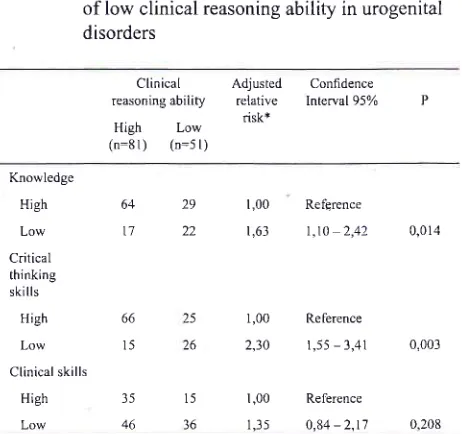
3),
basicknowledge
andcritical
thinking skills were the dominant factors
associatedwith clinical
reasoning. Studentsthat were
not skilled
in critical thinking
had a
2.3-fold risk
of
low clinical
reasoning compared to those
skilled in critical thinking.
When observed
from
the aspectof
knowledge, studentswith low
basic knowledge had
a
630Ârisk
of
low
clinical
reasoningability
comparedwith
studentswith
high
basic knowledge.35 15 l-00 Reference
46 36 r.46 0 80-2.67 0.21s
25 I 00 Reference 26 2.31 1.33-4.00 0 003
I 00 Reference
0 16 0 4r- 1.36 0 3s7 44
[image:4.612.318.548.168.515.2]Table 3. The relationship between knowledge,
critical
thinking
skills,
andclinical skills
on therisk
of
low clinical
reasoningability
in urogenital disordersThe level
of
intelligence was not
evaluated
in
this
study because the students accepted
to UnSri
Medical
Faculty
are students
that
have underwent
a
rigorous
selection process.
Clinical and learning
experienceswere also
not
assessed becausethe
students have hadonly minimal
exposure
to clinical
experience
in the
subject
of
urogenital
system.The
results
of
this study
showed
that
if
55 was
the passing gradefor
goodclinical
reasoning,then
38.6%of
the students hadlow clinical
reasoningability. This
condition
is
probably due
to
the student's
leaming
processes
and other factors
that
did not
optimally
enhanced
clinical
reasoningskills.
The
studentstaking
the SC
test
were
studentsat
thebeginning
of
their medical
education (semester
IV)
where knowledge and clinical
experience
were just
forming.
The learning experience integrated all branches of medical science on theurogenital
systemfor
6 weekswith tutorial
discussionsfor only 4
cases. These cases were not the exact matchof
the casesin
the SC test.The study was focused on lower rate of
clinical
reasoningability. Clinical
reasoning is the mostimportant
compe-tency for doctors, that must be systematically developed earlier.rLower ability of clinical
reasoning
will
affect
performance
of medical
competencies.The failure
rate
of
these studentswas lower
than
the resultsof
thefinal
semestermedical
studentsin
France taking the web-based SC testin
urology.It
was reportedthat failure
in
the French
students
was
80o%.3But
simple
comparisons
cannot
be made since
learning
experiences, level
of difficulty of
the
SC test, and the passing grades between the 2 groups wereprobably
not the sarne.Gender was
not
found
to
influence
clinical
reasoning.Literature actually
mention that female students tendedto
show better
academic
and
clinical
performances comparedto
male
students.This
wasprobably
due to female students being more sensitivewith
moreattention
to
detall when evaluating the patient.
This
difference
may be
significant
if
the sample was greater.r6Grade
Point Average (GPA)
did not
influence
clinical
reasoning
ability.
Ferguson, James,
and
Madeley
reported
that the
student academic performance
hadonly
asmall
influence on the student's competence as a doctor. They found that many factors, such ascognitive
factors
(prior
academic
abilify,
entrance mode),
non-cognitive factors (personaliry, method
of
studying, Clinical Adjustedreasoningability relative risk+ High Low
(n:8 l) (n=5 t)
Confidence Interval 95% P
Krowledge High Low Critical thinking skills
High Low Clinical skills
High Low
64
29t7
2235
46
1,00 Refçrence
t,63 l,to 2,42 0,014
1,00 Relerence 2,30 r,55 - 3,41
1,00 Reference
1,35 0,84-2,t7
0,003
0.208 + Relative risk is adjusted between the variables in this table
DISCUSSIONS
This
study
has severallimitations.
One
limitation
was the number of sample analyzed for risk factors inclinical
reasoning
ability. It
consisted ofonly
132 CBC sfudents outof
morethan
1000medical
students atUnSri.
Each class willof
course havedifferent
characteristics.A few
instruments
for
evaluating
therisk
factors,
such ascommunication skills
andcritical thinking skills
were basedon tutor
evaluation that can
be
subjective.
The tutors must also evaluatel0-12
students simultaneously,and
may
be unable
to
obtain
a
complete
or
accurate assessment.To minimize information
bias,
the
tutorswere thoroughly provided
with
strict guidelines for
assessing
the
students.At
the end
of
every
tutorial
session, the
tutors were
askedto clarify
any
uncertain data on evaluation.This
shrdy
did not
analyzeother
risk
factors that
mayinfluence
clinical
reasoning
ability,
such
asthe
levelof
intelligence,
clinical
experience, andprior
learning
experiences.
Clinical
reasoning is an intellectuaI processthat
needs
cognitive skills.'r Therefore, the level of
intelligence
will
influencethis
reasoning process.After
analyzing clinical
reasoning
using SC test,
Charlin
et
al
concluded
that clinical
experience significantly
influence
clinical
reasoning.laKomputsa
et
al
alsoshowed that
experienced
clinicians exhibited
betterclinical
reasoning thannewly
graduated clinicians.ts66
l5
25
26
15
[image:5.612.54.285.100.317.2]and
the
student's
facilities),
the learning
process, andde mograph ic fàctors, infl uenced academi c perfbrmance
more. These factors
may
be belter associatedwith
GPAthan
with
clinical reasoning.16 Besides,
GPA
is
theresult of summative evaluation that could be influenced
other factors such
asvalidity
andreliability of
the testquestions.s
Mode
of
entrance
also
did not influence
clinical
reasoningability.
All
of
students were selectedin
some strict criteria.
In
alI
direction
of
mode
of
entrance, they were best candidateCommunication
skills
were
not
found
to
influenceclinical
reasoning ability in
the
students.
This
studyassessed communi cation skil I s through tutor observation
during group discussions. The observed communication
skills were oral communication skills,
which is
theabitity
to express
infbrmation
or ideas
concisely
andclearly.
Communication
skills
are
actually
one of
theimportant components of medicaI competence. However,
in
association
to
clinical reasoning,
communicationskills
arebetter suited
to
probe information/data from
the
patient, educate
the
patient,
and
interdisciplinary
interactionwith
other professionals.On the other
hand,clinical
reasoning is acognitive
process that needs theability
to organize
data and knowledgecritically
basedon former experience.5 rT
The results
of this study showed that
clinical
reasoningis influenced by knowledge
andcritical thinking
sliills.
Clinical
reasoning is acognitive
process where variousinformation
from
the
clinical
caseis
synthesized andintegrated
with knowledge and experience, and
thenapplied
to
clinical
decisions
such
as
lormulating
a
diagnosis
and
choosing
the
correct
patientmanagement.5,rT
Clinical
reasoning
is build
up
by
collecting
a
rangeof
basic
knowledge and
the
development
of
critical
thinking
skills.r8 Every doctor and medical student needcritical
analytical skills, which
are logical and based on strongknowledge
as partof their
clinical
competence.sThe first step
olclinical
reasoning process iscollecting,
organ
izing
andinterpretalion of
data. For the reason, thedoctor must
identily
the problem andcritically
analyzesit
to make some
priorities. On
the next step,
studentsmust generate
the
hypothesisand
critically
analyzeit
to make the diagnosis. The hypothesis
willbe
critically
evaluated
and
compared
with
some
alternatives diagnosis. On the last step, doctor must determine somealternative
investigations and management
strategies.He
also has
to
think critically
to
choose
the most
apropiate investigation
and management strategiesfbr
each patient.rr
Clinical skills
assessedby
OSCE tend to moderately
influence
clinical reasoning
ability
ol
the
students.The OSCE
is
atool for
assessingthe performance
of
clinical skills that is
also
associatedwith knowledge
and reasoning,but in
OSCE, the skill
itself is
a moredominant
aspect
than cognitive
aspect. Smee
statedthat
skill
assessmentis
not
interchangeablewith test
that
assessknowledge and reasoning.re
Boursicott
andRobert have also stated that OSCE cannot assess
every
component
of
competency,since some
clinical
skills
are not based on knowledge and reasoning.20
Clinical
reasoning can be strengthenedby
developing
knowledge
and
critical
thinking
skills
through
asuitable leaming concept. Experts
suggested applyingconstructivism
leaming
concept
to
build
all
3components. Constructivism
is focused
on
preparing the students to solveproblems in uncertain/ambiguous
siluations. Through
the conceptof
constructivism,
thestudents can
construct
reality
basedon
the perceptionof their
experience.2lThe
essence
of
constructivism
is
reflection
andfeedback
in all
aspects
of
the
learning
process.Experience obtained
through that learning
process hasto be discussed
reflectively
(reflective discourse) and
through
this reflective
discourse
a
critical
reflective
processwill
occur.z2This reflection
makesit
possiblefor the
student to rebuild and rearrange concepts, skills,knowledge,
as well as valuesinto the fabric
of
their
existing
knowledge.2lThe constructive leaming
concept, emphasizing
theconcept of
reflective
discourse and feedback, can
beachieved through severaI methods. The concept can be
accomplished
though reflective
discourses
where
all
the participants
will
stand equally.23Other methods
of
learning include
peertutoring,
co[laborative
learning, and sell directed learning. r(''22ln
conclusion,
this
study showed
that a
low
level
of
knowledge
and
low
level
of
critical thinking ability
influenced
clinicaI
reasoning
abitity.
Therelore,
moreeFlective and
elficient
learning
ef-tortsare
needed toimprove poor clinical skills,
such as by improving basicknowledge and
critical thinking skills
by the
stLLdents.The process of learning and
building
basicknowledge
and
critical thinking skills can be
achieved
throughconstructivism learning
concepts
that
emphasize
thereflective process and fèedback.
Vol.18, No.l, January - March 2009
Acknowledgements
The author wishes to thank
all
the
year 2006 studentsof
the
CBC
program
of
University
of
Sriwijaya,
Medical Faculty for their
willing
participation in
this
study. The author also wishes
to
thank the faculty
executives,
education
unit,
and administrative staff
of
the
University
of
Sriwijaya
Medical Faculty
that
havegiven permission
aswell
as assistancein
the datacollecting,
and especially
to Prof.
Bastaman Basuki,
Dr.
Abdul Latief
SpA
(K),
and
Dr. Minarma
Siagianfor their
invaluable technical
assistance inthis
studv.REFERENCES
1.
Public Citizen's Conggress Watch. Medical misdiagnosis. Challenging the malpractice claims of the doctors' lobby.2003 [cited 2008 Des l0]. Available from: www.tradewatch.
org/documents |PDF %20 of2}Report.pdf
2.
Becker JF. Failure to diagnose. fcited 2008April
20].Available
from:
http//:pittburgh/misdiagnosis lawyerlbecker.htm.
3.
SibertL,
Darmoni SJ, Dahamna B, Weber J, Charlin B.On line
clinical
reasoning assessmentwith
the
script concordancetest:
a
feasibility
study.BMC
Medical Informatics and Decision Making [home page on internet]. 2005 [cited 2008 Mar 03];5:l-10. Available from: http:// wwwbiomedcentral.com/ I 472-69 47 I 5 I 18.4.
GrovesM,
Scott
I,
AlexanderH.
Assessing clinical reasoning: a method to monitor its development in a PBL cuniculum. Med Teach. 2002;24:507 -15.5.
The College Faculty; University of Washington, Schoolof
Medicine. The clinical reasoning guidelines for
"ICM II".
Washington DC: The Cotlege; 2005.
6.
SibertL,
Darmoni SJ, DahamnaB, Hetlot
F, Weber J,Charlin B. On line clinical reasoning assessment with script
concordance test in urology: result
ofa
French pilot study.BMC Med Educ fhomepage on intemer]. 2006 fcired 2008
Mar 06];6: l-12. Available from: http://www.biomedcentral.
corn/1472-692016145.
7.
Charlin B, RoyL,
BrailovskyC,
Goulet F. The script concordance test: a tool to assess the reflective clinician.Teaching and Leaming in Medicine. 2000;12:189-95.
8.
Searle J. Defining competency-the role ofstandard setting.Med Educ. 2000;3 4 :3 63 - 6
Learning skills lo increase clinical
reasoning
59Si-Mui S, Azila
NMA,
Lay-Hoong L, Tan CP, Nget-HongT.
A simpte instrument
for the
assessmentof
studentperformance in problem-based leaming tutorial. Ann Acad Med Singapor e. 2006;3 5 :634-41.
What
does Cronbach's alpha mean?UCLA
Academy Technology Services. fserial online].
2007. [cited 2008Mar I 4]. Available from : http ://www. ats. ucla. edu/stt/spss/
faqlalpha.html.
Norman G. Research in clinical reasoning: past history and
cunent trends. Med Educ. 2005;39:418-21 .
Barros AJD, Hirakata VN. Alternative for logistic regression
in
cross-sectional studies: an empirical comparison thatdirectly
estimatesthe
prevalenceratio.
BMC
MedicalResearch Methodolody Iserial online]. [cited 2006 Agustus
0 I I ; 3 (2 I ): [ 1 3p] Available from: http ://www.biomedcentral.
com/147 1-228813121 .
Jenicek
M.
A
physician's self-paced guideto
critical thinking. American Medical Association; 2006Charlin B, Gagnon
R,
PelletierJ, Coleti
M, Abi-Rizk
G, Nasr C, et al. Assessment of clinical reasoning
in
thecontext of uncertainty: the effect of variability within the reference panel. Med Educ. 2006;40:848-54.
Khonputsa P, Besinque
K,
FisherD,
Gong WC. Useof
script concordance test to assess pharmaceutical diabetic care:a
pilot
studyin
Thailand. (abstract). Med Teach.2006;28:570-3.
Ferguson
E,
JamesD,
MadeleyL. Factors
associatedwith success in medical school: systematic review of the
literature. BMI. 2002;324:952-7 .
Suebnukam
S,
HaddawyP. Clinical
reasoning skill acquisitionthrough intelligent group
turoring. Asian Institute of Technology Computer Science and InformationManagement Program fserial online]. 2005 lcited 2008 Mar
061 ; Available from: http://ait. ac.th.
Pithers RT, Soden
R. Critical thinking
in
education: areview Educational Research. 2000;42:327 -49.
Smee S. ABC of learning and teaching in medicine: skill
based assessment. BMJ. 2OO3 ;326 :7 03 -6.
Boursicot
K,
RobertsT.
Howto
setup
an OSCE. The Clinical Teacher. 2005 ;2: I 6-20.Mergel B. Instructional design and leaming theory. 1998
[cited2007 Sept I 4] ; Available from: fi Ie: ///G: lLeamingyo2} Theories%2Oofl%20 Instructi orral Yo20 Design.htm.
Merriam
SB. The role
of
cognitive development inMezirow's
transformationalleaming theory.
Adutt Education Quarterly. 2005;55 :60-8.Branch
Wl
ParanjapeA.
Feedbackand
reflection:Teaching methods for clinical settings. Academic Medicine. 2002:77:1185-6.
t0
9.
t'7.
1l
I2
l3
t4
l5
T6
l8
l9
20
2l
22