DEPARTEMEN BIOLOGI
FAKULTAS MATEMATIKA DAN ILMU PENGETAHUAN ALAM INSTITUT PERTANIAN BOGOR
2014
FREQUENCY OF LEFT-HANDED PEOPLE AND THEIR
CREATIVITY IN PADANG WEST SUMATERA
PERNYATAAN MENGENAI SKRIPSI DAN SUMBER
INFORMASI SERTA PELIMPAHAN HAK CIPTA
Dengan ini saya menyatakan bahwa skripsi saya berjudul Frequency of Left-handed People and Their Creativity in Padang West Sumatera adalah benar karya saya dengan arahan dari komisi pembimbing dan belum diajukan dalam bentuk apa pun kepada perguruan tinggi mana pun. Sumber informasi yang berasal atau dikutip dari karya yang diterbitkan maupun tidak diterbitkan dari penulis lain telah disebutkan dalam teks dan dicantumkan dalam Daftar Pustaka di bagian akhir skripsi ini.
Dengan ini saya melimpahkan hak cipta dari karya tulis saya kepada Institut Pertanian Bogor.
Bogor, Oktober 2014
Meidilla Dwi Sari
ABSTRACT
MEIDILLA DWI SARI. Frequency of Left-handed People and Their Creativity in Padang West Sumatera. Supervised by BAMBANG SURYOBROTO and ALEX HARTANA.
Handedness is the best-known and most studied human asymmetry. It can
be defined as the individual’s preference to use one hand predominately for unimanual tasks. Left-handed people are present in every human population but always comprise a small minority. Some suggest that the structure of the brain of left-handed and right-handed persons might differ, with a larger corpus callosum in those who are left-handed. This would be of particular advantage when the individual was engaged in divergent thinking. This study collect data on the frequency of left-handed preference and it’s covariation with creativity in Indonesia. The numbers of respondents in this research are 328 individuals consisted of 126 males and 202 females in Padang, West Sumatera. In determining left-handed preference, respondents were asked what hand they prefer to use of 10 tasks. Determination of creativity used the Adjective Check List. Frequency of left-handed males in Padang, West Sumatera was higher than of females. Percentage of creative right-handed males and females is not different, while for left-handed percentage of creative males is higher than of females. The results of study showed that only in males does handedness interact with mental ability lends some support to a possible testosterone link.
Keywords: creativity, handedness, left-handed, padang
ABSTRAK
MEIDILLA DWI SARI. Frekuensi Orang Kidal dan Kreativitasnya di Padang Sumatera Barat. Dibimbing oleh BAMBANG SURYOBROTO dan ALEX HARTANA.
ii
berbeda, sedangkan untuk persentase pria kidal yang kreatif lebih tinggi dari pada wanita. Hasil penelitian ini menunjukan bahwa hanya pada pria terjadi interaksi handedness dengan kemampuan mental yang kemungkinan disebabkan oleh hubungan testosteron.
ii
Skripsi
sebagai salah satu syarat untuk memperoleh gelar Sarjana Sains
pada
Departemen Biologi
DEPARTEMEN BIOLOGI
FAKULTAS MATEMATIKA DAN ILMU PENGETAHUAN ALAM INSTITUT PERTANIAN BOGOR
BOGOR 2014
FREQUENCY OF LEFT-HANDED PEOPLE AND THEIR
CREATIVITY IN PADANG WEST SUMATERA
Judul Skripsi : Frequency of Left-handed People and Their Creativity in Padang West Sumatera
Nama : Meidilla Dwi Sari
NIM : G34100106
Disetujui oleh
Dr Bambang Suryobroto Pembimbing I
Prof Dr Ir Alex Hartana Pembimbing II
Diketahui oleh
Dr Ir ImanRusmana, M.Si Ketua Departemen
PRAKATA
Puji dan syukur penulis panjatkan kepada Allah SWT atas segala rahmat dan karunia-Nya sehingga karya ilmiah ini berhasil diselesaikan. Karya ilmiah ini ini disusun berdasarkan hasil penelitian berjudul Frequency of Left-handed People and Their Creativity in Padang West Sumatera yang berlangsung dari Februari sampai April 2014.
Terima kasih kepada Dr Bambang Suryobroto dan Prof Dr Ir Alex Hartana selaku dosen pembimbing atas bimbingan dan saran yang diberikan. Terima kasih banyak kepada Papa, Ibu, Dai, Niva, dan Mas Adi cinta dan dukungannya. Terima kasih kepada SMP Negeri 23 Padang dan SMP Negeri 18 Padang yang telah mengizinkan pengambilan data. Terima kasih juga untuk Lisa dan Tante Is untuk bantuan dalam pengambilan data dan untuk semua teman-teman Biologi 47 dan Zoo Corner family untuk bantuan dan dukungan selama ini.
Semoga karya ilmiah ini bermanfaat.
Bogor, Oktober 2014
DAFTAR ISI
DAFTAR TABEL x
DAFTAR LAMPIRAN x
INTRODUCTION 1
Background 1
Aim 2
MATERIALS AND METHOD 2
Time and Place 2
Sample 2
Collecting Personal Data 2
Left-handed Preference 2
Determination of Creativity 2
RESULTS 3
Frequency of left-handed people 3
Creativity 4
DISCUSSION 5
CONCLUSION 6
REFERENCES 6
APPENDIX 7
x
DAFTAR TABEL
1 Percentage of hand prefer and frequency of handedness 3
2 Percentage of prefer the left hand based on age 4
3 Percentage of creativity in handedness 4
4 Percentage of the total scores of ACL 5
DAFTAR LAMPIRAN
1 Research questionnaire 8
2 Handedness questionnaire 9
1
INTRODUCTION
Background
Handedness is the best-known and most studied human asymmetry. It can
be defined as the individual’s preference to use one hand predominately for
unimanual tasks and the ability to perform these tasks more efficiently with one hand (Llaurens et al. 2009). Left-handed people are more skillful with their left hands when performing tasks. Left-handed people are present in every human population but always comprise a small minority compared to the large majority of the population that is right-handed. Left-handedness is found in approximately 10% of the population, but the frequency varies between various human populations. A study in four societies in Baka, Bobo-Diuolasso, Eipo, and Inuit had found this frequency ranges from 3.3% to 26.9% (Faurie et al. 2005) and reviewed 81 studies on handedness in 14 countries in America, Africa, Europe, Asia and Australia found a range from 5% to 27.5% (Raymond and Pointer 2004). Hand preference is influenced by genetics, development, and environment factors. Several genes could influence handedness. Such as LRRTM1 (Leucine-rich repeat transmembrane neuronal 1) and PCSK6 (proprotein convertase subtilisin / kexin type 6) (Scerri et al. 2011). LRRTM1 is expressed during the development of specific forebrain structures, and thus could influence neuronal differentiation and connectivity. This is the first potential genetic influence on human handedness to be identified, and the first putative genetic effect on variability in human brain asymmetry (Francks et al. 2007). PCSK6 is known to play a key role in regulating left-right axis specification, making it a highly attractive candidate gene for involvement in handedness (Scerri et al. 2011).
There are several developmental factors in the womb and birth, including brain damage resulting from stress during birth that can influence handedness. A surge of fetal testosterone level during pregnancy can also influence handedness (Tran
et al. 2014). Environmental factors could also exert selection forces on left-handers. Attitudes towards left-handedness vary from one culture to another. Cultural and environmental factors could change hand preference (Llaurens et al.
2009).
2
Aim
The aim of this study is to determine frequency of left-handed people and their creativity in Indonesia, particularly in Padang, West Sumatera.
MATERIALS AND METHOD
Time and Place
.
The research was held in February until April 2014 in Padang, West Sumatera. Sampling was conducted in two Junior High School level and door to door visits. Data was analyzed in Biosystematics and Ecology of Animals Division, Department of Biology, Bogor Agricultural University.
Sample
The numbers of respondents in this research are 328 individuals consisted of 126 males and 202 females in Padang, West Sumatera. The number of respondents from two Junior High School level are 217 individuals. The number of respondents from door to door visits are 111 individuals. Respondents are Minangkabau ethnic group.
Collecting Personal Data
Respondents were asked personal information such as name, address, gender, ethnic group, and recording of peigree of the respondents to determine family mambers who are left-handed (Appendix 1).
Left-handed Preference
In determining left-handed preference, respondents were asked what hand they prefer to use to throw a ball, use a spoon, saw, sew, shoot marbles, bowling, or playing tennis, cut with a knife, cut with scissors, hammer, and write (Appendix 2). If they routinely use the left hand or either hand for any number of these 10 tasks, they are designated left-handed preference (Rife 1940).
Determination of Creativity
3
theoretical range of scores is therefore -12 to +18. If respondents had a score ≤ 3 they are categorized as not creative, while a score of > 3 creative (Gough 1979).
RESULTS
Frequency of left-handed people
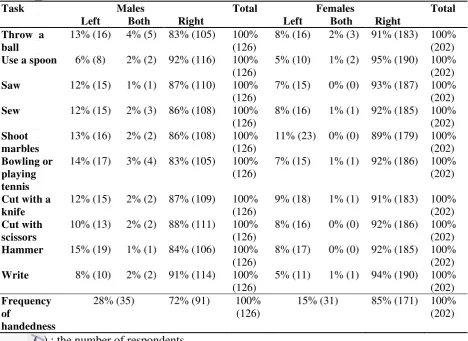
Percentage of hand prefer and frequency of handedness are shown in Table 1. Highest percentage of prefer the left hand in males was hammer, while in females was shoot marbles. Highest percentage prefer the both hands in males and females were throw a ball. Total frequency of left-handed was 20%. Frequency of left-handed males was 28% and frequency of left-handed females was 15%.
Table 1. Percentage of hand prefer and frequency of handedness
4
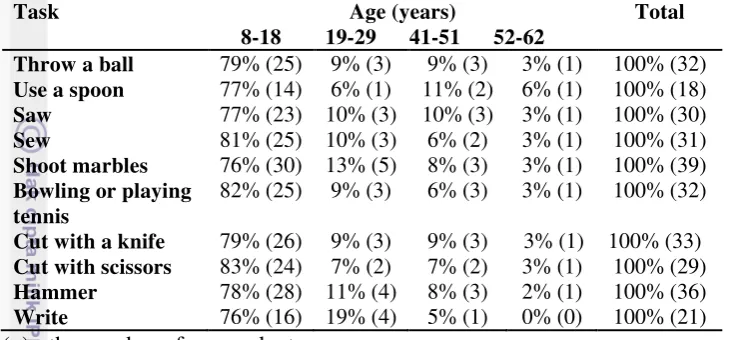
percentage of prefer the left hand were age range 8-18 in all tasks. The age range 30-40, 63-73, and 74-84 were no one left-handed people.
Table 2. Percentage of prefer the left hand based on age (ACL >3) was 36% and percentage of creative left-handed people was 50%. The creative right-handed males were 39% and creative right-handed females were 35%. The creative left-handed males were 66% and creative left-handed females were 32%. The result of this research show that percentage of creative males and females with right-handed preferences is not different , while for left-handed the proportion of creative males is higher than of females.
5 females. The cerebral lateralization theory of Geschwind-Galaburda (Tran et al.
2014) posits that high intrauterine levels of testosterone promote the development of left-handedness because of differential effects of testosterone on brain hemisphere maturation; specifically, left brain hemisphere maturation is delayed. Male brains are exposed to substantially higher testosterone levels than female brains during prenatal development; hence, a sex effect for handedness may be expected. Testosterone-induced effects on brain lateralization thus likely take place early during embryonic development (Tran et al. 2014).
Percentage of creative left-handed people were higher than of right-handed. The result of this research show that percentage of creative males and females with right-handed preference is not different, while for left-handed percentage of creative left-handed males is higher than of females. The results of study showed that only in males does handedness interact with mental ability lends some support to a possible testosterone link. Obviously, male fetuses are more likely to be exposed to the higher levels of testosterone than female fetuses.
Total Score
Left handed Right handed
Males Females Males Females
6
If a dose or effect relationship were involved, this would mean that males are apt to have the greatest growth in the planum temporale or any other affected areas of the brain. This means that any benefit derived from changes in the normal pattern of neurological development would be expected to be more visible in males than females (Coren 1995).
Coren S.1995. Differences in divergent thinking as a function of handedness and sex. The American Journal of Psychology. 108(3): 311-325
Faurie C, Schiefenhövel W, le Bomin S, Billiard S, Raymond M. 2005. Variation in the frequency of left‐handedness in traditional societies. Current Anthropology. 46: 142–147.
Francks C, Maegawa S, Lauren J, Abrahams Bs, Velayos-Baeza A, Medland SE, Colella S, Groszer M, McAuley EZ, Caffrey TM et al. 2007. LRRTM1 on
chromosome 2p12 is a maternally suppressed gene that is
associatedpaternally with handedness and schizophrenia. Molecular Psychiatry. 12:1129-1139.
Gough HG.1979. A creative personality scale for the Adjective Check List.
Journal of Personality and Social Psychology. 37(8):1398-1405.
Llaurens V, Raymond M, Faurie C.2009. Review Polymorphism of handedness in humans. Phil.Trans. R. Soc B. 364 : 881-894.
Raymond M, Pontier D.2004. Is there geographical variation in human handedness?. Laterality. 9(1):35–52.
Rife DC. 1940. Handedness, with special reference to twins. Genetics 25: 178-186.
Scerri TS, Brandler WM, Paracchini S, Morris AP, Ring SM, Richardson AJ, Talcott JB, Stein J, Monaco AP. 2011. PCSK6 is associated with handedness in individuals with dyslexia. Human Molecular Genetics. 20(3): 608-614.
7
9
Appendix 2 Handedness questionnaire
Ceklis ( √ ) tangan mana yang nyaman dan biasa anda gunakan dalam melakukan kegiatan berikut :
No Kegiatan Tangan yang digunakan
Kiri Kanan
1 Melempar
2 Bermain bowling / tenis /
bulutangkis
3 Bermain kelereng
4 Memotong dengan pisau
5 Makan dengan sendok
6 Memalu
7 Menggerggaji
8 Menjahit
9 Menulis
10 Menggunting
10
Appendix 3 Creativity determination
Ceklis ( √ ) semua sifat dibawah ini yang anda anggap mendeskripsikan diri anda.
___mampu ___jujur
___tak-bergantung ke orang lain ___banyak akal
___biasa, menurut adat ___percaya diri
___tidak resmi ___sexy
___tidak berpuas-diri ___patuh
___berwawasan ___tinggi hati
___curiga ___tidak biasa, diluar peraturan
Positive and negative items on ACL
Positive Negative
mampu mudah terpengaruh
pintar berhati-hati
yakin lumrah
egois tradisional
suka bercanda biasa, meurut adat
tak-bergantung ke orang lain tidak berpuas-diri
tidak resmi jujur
berwawasan ketertarikan sempit
11
RIWAYAT HIDUP
Penulis lahir di Padang pada tanggal 14 Mei 1992 dari pasangan Ir Sjafri.S dan Salwati sebagai anak ketiga dari tiga bersaudara. Penulis menyelesaikan pendidikan di SMA Negeri 2 Padang pada tahun 2010 dan melanjutkan studi pada Jurusan Biologi, Fakultas Matematika dan Ilmu Pengetahuan Alam, Institut Pertanian Bogor melalui jalur SNMPTN. Selama mengikuti perkuliahan, penulis aktif sebagai anggota di Divisi Pamabi (Paguyuban Mahasiswa Biologi) Himpunan Mahasiswa Biologi (Himabio) IPB pada periode 2011/2012 dan 2012/2013.
Penulis melakukan Studi Lapangan pada tahun 2012 dengan judul penelitian Keanekaragaman Gymnospermae di Kebun Raya Cibodas. Penulis melakukan Praktik Lapangan pada tahun 2013 dengan judul Identifikasi Jabon (Anthocephalus cadamba) dan Nyamplung (Calophyllum inophyllum) sebagai Sumber Daya Genetik di Unit Pelaksana Teknis Daerah Perbenihan Tanaman