Contents
1. Learning Outcome Statements (LOS) 2. Study Session 10—Corporate Finance (1)
1. Reading 33: Corporate Governance and ESG: An Introduction 1. Exam Focus
2. Module 33.1: Stakeholder Management
3. Module 33.2: Factors Affecting Corporate Governance 4. Key Concepts
5. Answer Key for Module Quizzes 2. Reading 34: Capital Budgeting
1. Exam Focus
2. Module 34.1: Capital Projects, NPV, and IRR 3. Module 34.2: Payback Period, Project Rankings 4. Key Concepts
5. Answer Key for Module Quizzes 3. Reading 35: Cost of Capital
1. Exam Focus
2. Module 35.1: Weighted Average Cost of Capital 3. Module 35.2: Project Cost of Capital
4. Key Concepts
5. Answer Key for Module Quizzes 3. Study Session 11—Corporate Finance (2)
1. Reading 36: Measures of Leverage 1. Exam Focus
2. Module 36.1: Measures of Leverage 3. Key Concepts
4. Answer Key for Module Quiz
2. Reading 37: Working Capital Management 1. Exam Focus
2. Module 37.1: Working Capital Management 3. Key Concepts
4. Answer Key for Module Quiz 4. Topic Assessment: Corporate Finance
5. Topic Assessment Answers: Corporate Finance 6. Study Session 12—Portfolio Management (1)
1. Reading 38: Portfolio Management: An Overview 1. Exam Focus
2. Module 38.1: Portfolio Management Process 3. Module 38.2: Pooled Investments
4. Key Concepts
5. Answer Key for Module Quizzes 2. Reading 39: Portfolio Risk and Return: Part I
2. Module 39.1: Returns Measures
3. Module 39.2: Covariance and Correlation 4. Module 39.3: The Efficient Frontier 5. Key Concepts
6. Answer Key for Module Quizzes
3. Reading 40: Portfolio Risk and Return: Part II 1. Exam Focus
2. Module 40.1: Systematic Risk and Beta 3. Module 40.2: The CAPM and the SML 4. Key Concepts
5. Answer Key for Module Quizzes 7. Study Session 13—Portfolio Management (2)
1. Reading 41: Basics of Portfolio Planning and Construction 1. Exam Focus
2. Module 41.1: Portfolio Planning and Construction 3. Key Concepts
4. Answer Key for Module Quiz
2. Reading 42: Risk Management: An Introduction 1. Exam Focus
2. Module 42.1: Risk Management Introduction 3. Key Concepts
4. Answer Key for Module Quiz
3. Reading 43: Fintech in Investment Management 1. Exam Focus
2. Module 43.1: Fintech in Investment Management 3. Key Concepts
4. Answer Key for Module Quiz 8. Topic Assessment: Portfolio Management
9. Topic Assessment Answers: Portfolio Management 10. Study Session 14—Equity Investments (1)
1. Reading 44: Market Organization and Structure 1. Exam Focus
2. Module 44.1: Markets, Assets, and Intermediaries 3. Module 44.2: Positions and Leverage
4. Module 44.3: Order Execution and Validity 5. Key Concepts
6. Answer Key for Module Quizzes 2. Reading 45: Security Market Indexes
1. Exam Focus
2. Module 45.1: Index Weighting Methods 3. Module 45.2: Uses and Types of Indexes 4. Key Concepts
5. Answer Key for Module Quizzes 3. Reading 46: Market Efficiency
1. Exam Focus
3. Key Concepts
4. Answer Key for Module Quiz 11. Study Session 15—Equity Investments (2)
1. Reading 47: Overview of Equity Securities 1. Exam Focus
2. Module 47.1: Types of Equity Investments 3. Module 47.2: Foreign Equities and Equity Risk 4. Key Concepts
5. Answer Key for Module Quizzes
2. Reading 48: Introduction to Industry and Company Analysis 1. Exam Focus
2. Module 48.1: Industry Analysis
3. Module 48.2: Pricing Power and Company Analysis 4. Key Concepts
5. Answer Key for Module Quizzes
3. Reading 49: Equity Valuation: Concepts and Basic Tools 1. Exam Focus
2. Module 49.1: Dividends, Splits, and Repurchases 3. Module 49.2: Dividend Discount Models
4. Module 49.3: Relative Valuation Measures 5. Key Concepts
6. Answer Key for Module Quizzes 12. Topic Assessment: Equity Investments
STUDY SESSION 10
The topical coverage corresponds with the following CFA Institute assigned reading:
33. Corporate Governance and ESG: An Introduction
The candidate should be able to:
a. describe corporate governance. (page 1)
b. describe a company’s stakeholder groups and compare interests of stakeholder groups. (page 2)
c. describe principal–agent and other relationships in corporate governance and the conflicts that may arise in these relationships. (page 3)
d. describe stakeholder management. (page 4)
e. describe mechanisms to manage stakeholder relationships and mitigate associated risks. (page 4)
f. describe functions and responsibilities of a company’s board of directors and its committees. (page 5)
g. describe market and non-market factors that can affect stakeholder relationships and corporate governance. (page 8)
h. identify potential risks of poor corporate governance and stakeholder management and identify benefits from effective corporate governance and stakeholder
management. (page 10)
i. describe factors relevant to the analysis of corporate governance and stakeholder management. (page 11)
j. describe environmental and social considerations in investment analysis. (page 13) k. describe how environmental, social, and governance factors may be used in
investment analysis. (page 13)
The topical coverage corresponds with the following CFA Institute assigned reading:
34. Capital Budgeting
The candidate should be able to:
a. describe the capital budgeting process and distinguish among the various categories of capital projects. (page 19)
b. describe the basic principles of capital budgeting. (page 21)
c. explain how the evaluation and selection of capital projects is affected by mutually exclusive projects, project sequencing, and capital rationing. (page 22)
d. calculate and interpret net present value (NPV), internal rate of return (IRR), payback period, discounted payback period, and profitability index (PI) of a single capital project. (page 23)
e. explain the NPV profile, compare the NPV and IRR methods when evaluating independent and mutually exclusive projects, and describe the problems associated with each of the evaluation methods. (page 29)
f. describe expected relations among an investment’s NPV, company value, and share price. (page 32)
The topical coverage corresponds with the following CFA Institute assigned reading:
35. Cost of Capital
a. calculate and interpret the weighted average cost of capital (WACC) of a company. (page 39)
b. describe how taxes affect the cost of capital from different capital sources. (page 39)
c. describe the use of target capital structure in estimating WACC and how target capital structure weights may be determined. (page 41)
d. explain how the marginal cost of capital and the investment opportunity schedule are used to determine the optimal capital budget. (page 42)
e. explain the marginal cost of capital’s role in determining the net present value of a project. (page 42)
f. calculate and interpret the cost of debt capital using the yield-to-maturity approach and the debt-rating approach. (page 43)
g. calculate and interpret the cost of noncallable, nonconvertible preferred stock. (page 44)
h. calculate and interpret the cost of equity capital using the capital asset pricing model approach, the dividend discount model approach, and the bond-yield-plus risk-premium approach. (page 44)
i. calculate and interpret the beta and cost of capital for a project. (page 48)
j. describe uses of country risk premiums in estimating the cost of equity. (page 49) k. describe the marginal cost of capital schedule, explain why it may be
upward-sloping with respect to additional capital, and calculate and interpret its break-points. (page 50)
STUDY SESSION 11
The topical coverage corresponds with the following CFA Institute assigned reading:
36. Measures of Leverage
The candidate should be able to:
a. define and explain leverage, business risk, sales risk, operating risk, and financial risk and classify a risk. (page 61)
b. calculate and interpret the degree of operating leverage, the degree of financial leverage, and the degree of total leverage. (page 62)
c. analyze the effect of financial leverage on a company’s net income and return on equity. (page 64)
d. calculate the breakeven quantity of sales and determine the company’s net income at various sales levels. (page 66)
e. calculate and interpret the operating breakeven quantity of sales. (page 66) The topical coverage corresponds with the following CFA Institute assigned reading:
37. Working Capital Management
The candidate should be able to:
a. describe primary and secondary sources of liquidity and factors that influence a company’s liquidity position. (page 73)
b. compare a company’s liquidity measures with those of peer companies. (page 74) c. evaluate working capital effectiveness of a company based on its operating and
cash conversion cycles and compare the company’s effectiveness with that of peer companies. (page 76)
d. describe how different types of cash flows affect a company’s net daily cash position. (page 77)
e. calculate and interpret comparable yields on various securities, compare portfolio returns against a standard benchmark, and evaluate a company’s short-term investment policy guidelines. (page 77)
f. evaluate a company’s management of accounts receivable, inventory, and accounts payable over time and compared to peer companies. (page 79)
STUDY SESSION 12
The topical coverage corresponds with the following CFA Institute assigned reading:
38. Portfolio Management: An Overview
The candidate should be able to:
a. describe the portfolio approach to investing. (page 95)
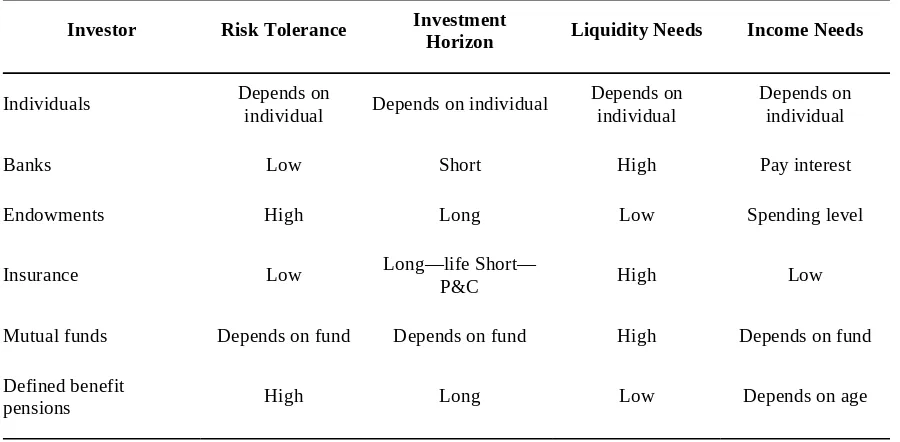
b. describe types of investors and distinctive characteristics and needs of each. (page 96)
c. describe defined contribution and defined benefit pension plans. (page 97) d. describe the steps in the portfolio management process. (page 98)
e. describe mutual funds and compare them with other pooled investment products. (page 100)
The topical coverage corresponds with the following CFA Institute assigned reading:
39. Portfolio Risk and Return: Part I
The candidate should be able to:
a. calculate and interpret major return measures and describe their appropriate uses. (page 107)
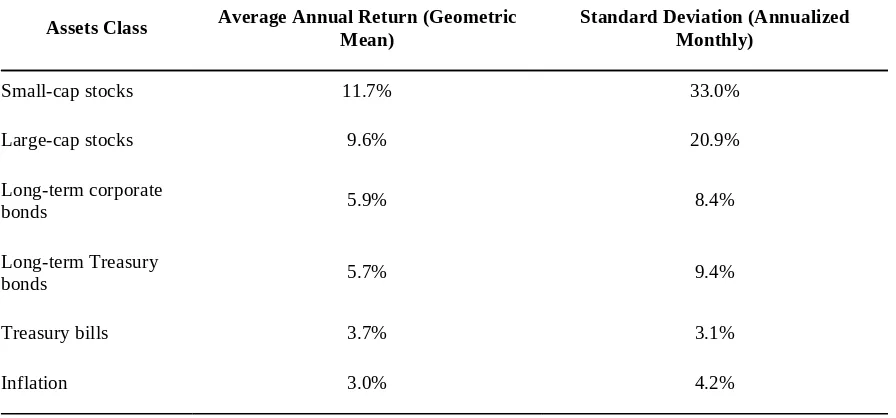
b. describe characteristics of the major asset classes that investors consider in forming portfolios. (page 110)
c. calculate and interpret the mean, variance, and covariance (or correlation) of asset returns based on historical data. (page 112)
d. explain risk aversion and its implications for portfolio selection. (page 114) e. calculate and interpret portfolio standard deviation. (page 116)
f. describe the effect on a portfolio’s risk of investing in assets that are less than perfectly correlated. (page 117)
g. describe and interpret the minimum-variance and efficient frontiers of risky assets and the global minimum-variance portfolio. (page 119)
h. explain the selection of an optimal portfolio, given an investor’s utility (or risk aversion) and the capital allocation line. (page 119)
The topical coverage corresponds with the following CFA Institute assigned reading:
40. Portfolio Risk and Return: Part II
The candidate should be able to:
a. describe the implications of combining a risk-free asset with a portfolio of risky assets. (page 129)
b. explain the capital allocation line (CAL) and the capital market line (CML). (page 130)
c. explain systematic and nonsystematic risk, including why an investor should not expect to receive additional return for bearing nonsystematic risk. (page 133) d. explain return generating models (including the market model) and their uses.
(page 135)
e. calculate and interpret beta. (page 137)
f. explain the capital asset pricing model (CAPM), including its assumptions, and the security market line (SML). (page 139)
h. describe and demonstrate applications of the CAPM and the SML. (page 143) i. calculate and interpret the Sharpe ratio, Treynor ratio, M2, and Jensen’s alpha.
STUDY SESSION 13
The topical coverage corresponds with the following CFA Institute assigned reading:
41. Basics of Portfolio Planning and Construction
The candidate should be able to:
a. describe the reasons for a written investment policy statement (IPS). (page 153) b. describe the major components of an IPS. (page 154)
c. describe risk and return objectives and how they may be developed for a client. (page 154)
d. distinguish between the willingness and the ability (capacity) to take risk in analyzing an investor’s financial risk tolerance. (page 155)
e. describe the investment constraints of liquidity, time horizon, tax concerns, legal and regulatory factors, and unique circumstances and their implications for the choice of portfolio assets. (page 156)
f. explain the specification of asset classes in relation to asset allocation. (page 157) g. describe the principles of portfolio construction and the role of asset allocation in
relation to the IPS. (page 159)
The topical coverage corresponds with the following CFA Institute assigned reading:
42. Risk Management: An Introduction
The candidate should be able to: a. define risk management. (page 165)
b. describe features of a risk management framework. (page 166)
c. define risk governance and describe elements of effective risk governance. (page 166)
d. explain how risk tolerance affects risk management. (page 167) e. describe risk budgeting and its role in risk governance. (page 167)
f. identify financial and non-financial sources of risk and describe how they may interact. (page 168)
g. describe methods for measuring and modifying risk exposures and factors to consider in choosing among the methods. (page 169)
The topical coverage corresponds with the following CFA Institute assigned reading:
43. Fintech in Investment Management
The candidate should be able to: a. describe “fintech.” (page 177)
b. describe Big Data, artificial intelligence, and machine learning. (page 178) c. describe fintech applications to investment management. (page 179)
STUDY SESSION 14
The topical coverage corresponds with the following CFA Institute assigned reading:
44. Market Organization and Structure
The candidate should be able to:
a. explain the main functions of the financial system. (page 189) b. describe classifications of assets and markets. (page 191)
c. describe the major types of securities, currencies, contracts, commodities, and real assets that trade in organized markets, including their distinguishing characteristics and major subtypes. (page 192)
d. describe types of financial intermediaries and services that they provide. (page 195)
e. compare positions an investor can take in an asset. (page 198)
f. calculate and interpret the leverage ratio, the rate of return on a margin transaction, and the security price at which the investor would receive a margin call.
(page 199)
g. compare execution, validity, and clearing instructions. (page 202) h. compare market orders with limit orders. (page 202)
i. define primary and secondary markets and explain how secondary markets support primary markets. (page 205)
j. describe how securities, contracts, and currencies are traded in quote-driven, order-driven, and brokered markets. (page 207)
k. describe characteristics of a well-functioning financial system. (page 208) l. describe objectives of market regulation. (page 209)
The topical coverage corresponds with the following CFA Institute assigned reading:
45. Security Market Indexes
The candidate should be able to:
a. describe a security market index. (page 219)
b. calculate and interpret the value, price return, and total return of an index. (page 219)
c. describe the choices and issues in index construction and management. (page 220) d. compare the different weighting methods used in index construction. (page 220) e. calculate and analyze the value and return of an index given its weighting method.
(page 223)
f. describe rebalancing and reconstitution of an index. (page 227) g. describe uses of security market indexes. (page 227)
h. describe types of equity indexes. (page 228) i. describe types of fixed-income indexes. (page 229)
j. describe indexes representing alternative investments. (page 229) k. compare types of security market indexes. (page 230)
The topical coverage corresponds with the following CFA Institute assigned reading:
46. Market Efficiency
a. describe market efficiency and related concepts, including their importance to investment practitioners. (page 239)
b. distinguish between market value and intrinsic value. (page 240) c. explain factors that affect a market’s efficiency. (page 240)
d. contrast weak-form, semi-strong-form, and strong-form market efficiency. (page 241)
e. explain the implications of each form of market efficiency for fundamental analysis, technical analysis, and the choice between active and passive portfolio management. (page 242)
f. describe market anomalies. (page 243)
STUDY SESSION 15
The topical coverage corresponds with the following CFA Institute assigned reading:
47. Overview of Equity Securities
The candidate should be able to:
a. describe characteristics of types of equity securities. (page 253)
b. describe differences in voting rights and other ownership characteristics among different equity classes. (page 255)
c. distinguish between public and private equity securities. (page 255)
d. describe methods for investing in non-domestic equity securities. (page 256) e. compare the risk and return characteristics of different types of equity securities.
(page 258)
f. explain the role of equity securities in the financing of a company’s assets. (page 259)
g. distinguish between the market value and book value of equity securities. (page 259)
h. compare a company’s cost of equity, its (accounting) return on equity, and investors’ required rates of return. (page 260)
The topical coverage corresponds with the following CFA Institute assigned reading:
48. Introduction to Industry and Company Analysis
The candidate should be able to:
a. explain uses of industry analysis and the relation of industry analysis to company analysis. (page 267)
b. compare methods by which companies can be grouped, current industry
classification systems, and classify a company, given a description of its activities and the classification system. (page 268)
c. explain the factors that affect the sensitivity of a company to the business cycle and the uses and limitations of industry and company descriptors such as “growth,” “defensive,” and “cyclical.” (page 271)
d. explain how a company’s industry classification can be used to identify a potential “peer group” for equity valuation. (page 272)
e. describe the elements that need to be covered in a thorough industry analysis. (page 272)
f. describe the principles of strategic analysis of an industry. (page 273)
g. explain the effects of barriers to entry, industry concentration, industry capacity, and market share stability on pricing power and price competition. (page 275) h. describe industry life cycle models, classify an industry as to life cycle stage, and
describe limitations of the life-cycle concept in forecasting industry performance. (page 277)
i. compare characteristics of representative industries from the various economic sectors. (page 279)
k. describe the elements that should be covered in a thorough company analysis. (page 281)
The topical coverage corresponds with the following CFA Institute assigned reading:
49. Equity Valuation: Concepts and Basic Tools
The candidate should be able to:
a. evaluate whether a security, given its current market price and a value estimate, is overvalued, fairly valued, or undervalued by the market. (page 289)
b. describe major categories of equity valuation models. (page 290)
c. describe regular cash dividends, extra dividends, stock dividends, stock splits, reverse stock splits, and share repurchases. (page 291)
d. describe dividend payment chronology. (page 292)
e. explain the rationale for using present value models to value equity and describe the dividend discount and free-cash-flow-to-equity models. (page 293)
f. calculate the intrinsic value of a non-callable, non-convertible preferred stock. (page 296)
g. calculate and interpret the intrinsic value of an equity security based on the Gordon (constant) growth dividend discount model or a two-stage dividend discount
model, as appropriate. (page 296)
h. identify characteristics of companies for which the constant growth or a multistage dividend discount model is appropriate. (page 301)
i. explain the rationale for using price multiples to value equity, how the price to earnings multiple relates to fundamentals, and the use of multiples based on comparables. (page 302)
j. calculate and interpret the following multiples: price to earnings, price to an
estimate of operating cash flow, price to sales, and price to book value. (page 303) k. describe enterprise value multiples and their use in estimating equity value.
(page 307)
l. describe asset-based valuation models and their use in estimating equity value. (page 308)
Video covering this content is available online.
The following is a review of the Corporate Finance (1) principles designed to address the learning outcome statements set forth by CFA Institute. Cross-Reference to CFA Institute Assigned Reading #33.
READING 33: CORPORATE GOVERNANCE
AND ESG: AN INTRODUCTION
Study Session 10
EXAM FOCUS
Candidates should understand the idea of a firm’s stakeholders, how conflicts can arise between stakeholders, and how effective corporate governance can mitigate problems arising from these conflicts. Other important points are the election of the board of directors, the board’s duties, and important factors in board composition. Finally, the rationale for incorporating environmental, social, and governance factors into the portfolio selection process is presented.
MODULE 33.1: STAKEHOLDER MANAGEMENT
LOS 33.a: Describe corporate governance.
CFA® Program Curriculum, Volume 4, page 6
In the CFA Institute publication, The Corporate Governance of Listed Companies: A Manual for Investors1, corporate governance is described as “the system of internal controls and procedures by which individual companies are managed. It provides a framework that defines the rights, roles and responsibilities of various groups … within an organization. At its core, corporate governance is the arrangement of checks,
balances, and incentives a company needs in order to minimize and manage the conflicting interests between insiders and external shareowners.”
Under shareholder theory, the primary focus of a system of corporate governance is the interests of the firm’s shareholders, which are taken to be the maximization of the market value of the firm’s common equity. Under this theory, corporate governance is primarily concerned with the conflict of interest between the firm’s managers and its owners (shareholders).
The focus of corporate governance under stakeholder theory is broader; it considers conflicts among the several groups that have an interest in the activities and
performance of the firm. These groups include shareholders, employees, suppliers, and customers, among others.
LOS 33.b: Describe a company’s stakeholder groups and compare interests of stakeholder groups.
The following have been identified as the primary stakeholders of a corporation.
Shareholders have a residual interest in the corporation in that they have claim to the net assets of the corporation after all liabilities have been settled. Shareholders have voting rights for the election of the board of directors and for other important corporate matters, which gives them effective control of the firm and its management. They have an interest in the ongoing profitability and growth of the firm, both of which can increase the value of their ownership shares.
The board of directors has a responsibility to protect the interests of shareholders; to hire, fire, and set the compensation of the firm’s senior managers; to set the strategic direction of the firm; and to monitor financial performance and other aspects of the firm’s ongoing activities.
Typically, the firm’s executives (most-senior managers) serve on the board of directors, along with directors who are not otherwise employed by the firm. In a one-tier board structure, both company executives and non-executive board members serve on a single board of directors. In some countries, boards have a two-tier structure in which the non-executive board members serve on a supervisory board that oversees a management board, made up of company executives.
Senior managers typically receive compensation (remuneration) that is made up of a salary, a bonus based on some measure of company performance, and perquisites (e.g., expense accounts, use of company planes, special retirement benefits, vacation time off). Their interests can be expected to include continued employment and
maximizing the total value of their compensation. Executive bonuses are typically tied to some measure of firm performance, giving senior managers a strong interest in the financial success of the firm.
Employees also have an interest in the sustainability and success of the firm. They have an interest in their rate of pay, opportunities for career advancement, training, and working conditions.
Creditors supply debt capital to the firm and are primarily owners of the firm’s
outstanding bonds and banks that have made loans to the firm. Providers of debt capital to the firm do not typically have a vote in firm management and do not participate in firm growth beyond receiving their promised interest and principal payments. The interests of creditors are protected to varying degrees by covenants in their debt agreements with the firm.
Suppliers of resources to the firm have an interest preserving an ongoing relationship with the firm, in the profitability of their trade with the firm, and in the growth and ongoing stability of the firm. As they are typically short-term creditors of the firm, they also have an interest in the firm’s solvency and on-going financial strength.
LOS 33.c: Describe principal–agent and other relationships in corporate governance and the conflicts that may arise in these relationships.
in the agent’s interest to write insurance policies on people or property that are not good risks, in order to maximize commission income. The principal (the owners of the
insurance company) does not want to issue policies that are bad risks as that is a money-losing proposition. Insurance companies mitigate this conflict by imposing underwriting standards for the policies they will issue and by continuing to work only with agents who consistently act in the company’s best interest.
Conflicts of interest between shareholders and managers
or directors
In the context of a corporation, shareholders are the principals (owners), and firm management and board members (directors) are their agents. Managers and directors may choose a lower level of business risk than shareholders would. This conflict can arise because the risk of company managers and directors is more dependent of firm performance compared to the risk of shareholders, who hold diversified portfolios of stocks and are not dependent on the firm for employment.
Conflicts may also arise when directors who are also managers favor management interests at the expense of shareholders or when directors favor one group of shareholders at the expense of another.
There is also an information asymmetry between shareholders and managers because managers have more and better information about the functioning of the firm and its strategic direction than shareholders do. This decreases the ability of shareholders or non-executive directors to monitor and evaluate whether managers are acting in the best interests of shareholders.
Conflicts between groups of shareholders
A single shareholder or group of shareholders may hold a majority of the votes and act against the interests of the minority shareholders. Some firms have different classes of common stock outstanding, some with more voting power than others. A group of shareholders may have effective control of the company although they have a claim to less than 50% of the earnings and assets of the company.
In the event of an acquisition of the company, controlling shareholders may be in a position to get better terms for themselves relative to the terms forced on minority shareholders. Majority shareholders may cause the company to enter into related party transactions, agreements or specific transactions that benefit entities in which they have a financial interest, to the detriment of minority shareholders.
Conflicts of interest between creditors and shareholders
Shareholders may prefer more business risk than creditors do because creditors have a limited upside from good results compared to shareholders. Equity owners could also act against the interests of creditors by issuing new debt that increases the default risk faced by existing debt holders, or by the company paying greater dividends to equity holders, thereby increasing creditors’ risk of default.
Conflicts of interest between shareholders and other
stakeholders
The company may decide to raise prices or reduce product quality in order to increase profits to the detriment of customers. The company may employ strategies that
significantly reduce the taxes they pay to the government. LOS 33.d: Describe stakeholder management.
LOS 33.e: Describe mechanisms to manage stakeholder relationships and mitigate associated risks.
CFA® Program Curriculum, Volume 4, page 14
Stakeholder management refers to the management of company relations with stakeholders and is based on having a good understanding of stakeholder interests and maintaining effective communication with stakeholders. The management of
stakeholder relationships is based on four types of infrastructures:
1. The legal infrastructure identifies the laws relevant to and the legal recourse of stakeholders when their rights are violated.
2. The contractual infrastructure refers to the contracts between the company and its stakeholders that spell out the rights and responsibilities of the company and the stakeholders.
3. The organizational infrastructure refers to a company’s corporate governance procedures, including its internal systems and practices that address how it manages its stakeholder relationships.
4. Governmental infrastructure comprises the regulations to which companies are subject.
With respect to the company’s relationship with shareholders, there are standard practices. These practices are required by corporate laws and similar in many jurisdictions, although there are some differences across countries.
Corporations typically hold an annual general meeting after the end of the firm’s fiscal year. At the general meeting, company management provides shareholders with the audited financial statements for the year, addresses the company’s performance and significant actions over the period, and answers shareholder questions.
Corporate laws dictate when the annual general meeting may occur and how the meeting must be communicated to shareholders. Typically, anyone owning shares is permitted to attend the annual general meeting, to speak or ask questions, and to vote their shares. A shareholder who does not attend the annual general meeting can vote her shares by proxy, meaning she assigns her right to vote to another who will attend the meeting, often a director, member of management, or the shareholder’s investment advisor. A proxy may specify the shareholder’s vote on specific issues or leave the vote to the discretion of the person to whom the proxy is assigned.
resolutions and may require a supermajority vote for passage, typically two-thirds or three-fourths of the votes cast. Such special resolutions can also be addressed at
extraordinary general meetings, which can be called anytime there is a resolution about a matter that requires a vote of the shareholders.
When there are multiple board member elections at one meeting, some companies use majority voting and some use cumulative voting. With majority voting, the candidate with the most votes for each single board position is elected. With cumulative voting, shareholders can cast all their votes (shares times number of board position elections) for a single board candidate or divide them among board candidates. Cumulative voting can result in greater minority shareholder representation on the board compared to majority voting.
Minority shareholders may have special rights by law when the company is acquired by another company.
LOS 33.f: Describe functions and responsibilities of a company’s board of directors and its committees.
CFA® Program Curriculum, Volume 4, page 21
Board structure
A company may have any number of directors on its board. Companies often have directors with expertise in specific areas of the firm’s business, such as risk
management, finance, or industry strategy. In a one-tier board, there is a single board of directors that includes both internal and external directors. Internal directors (also called executive directors) are typically senior managers employed by the firm. External board members (also called non-executive directors) are those who are not company management. Non-executive directors who have no other relationship with the company are termed independent directors. Employee board representatives may be a
significant portion of the non-executive directors.
In a two-tier board structure, there is a supervisory board that typically excludes executive directors. The supervisory board and the management board (made up of executive directors) operate independently. The management board is typically led by the company’s CEO.
With a one-tier board, the chairman of the board is sometimes the company CEO. While this was common practice in the United States historically, separation of the CEO and chairman of the board functions has become more common in recent years. When a
lead independent director is appointed, he has the ability to call meetings of the independent directors, separate from meetings of the full board.
Currently, the general practice is for all board member elections to be held at the same meeting and each election to be for multiple years. With a staggered board, elections for some board positions are held each year. This structure limits the ability of
shareholders to replace board members in any one year and is used less now than it has been historically.
The board of directors is elected by shareholders to act in their interest. Board members are typically mandated by corporate law to be fully informed and to use due diligence and their expertise in fulfilling their obligation to act in the interests of the company and its shareholders.
The board of directors is not involved in the day-to-day management of the company; that responsibility rests with senior management. The duties of the board include responsibility for:
Selecting senior management, setting their compensation and bonus structure, evaluating their performance, and replacing them as needed.
Setting the strategic direction for the company and making sure that management implements the strategy approved by the board.
Approving capital structure changes, significant acquisitions, and large investment expenditures.
Reviewing company performance and implementing any necessary corrective steps.
Planning for continuity of management and the succession of the CEO and other senior managers.
Establishing, monitoring, and overseeing the firm’s internal controls and risk management system.
Ensuring the quality of the firm’s financial reporting and internal audit, as well as oversight of the external auditors.
Board committees
A board of directors typically has committees made up of board members with particular expertise. These committees report to the board, which retains the overall responsibility for the various board functions. The following are examples of typical board committees.
An audit committee is responsible for:
Oversight of the financial reporting function and implementation of accounting policies.
Effectiveness of the company’s internal controls and the internal audit function. Recommending an external auditor and its compensation.
Proposing remedies based on their review of internal and external audits. A governance committee is responsible for:
Oversight of the company’s corporate governance code.
Implementing the company’s code of ethics and policies regarding conflicts of interest.
Monitoring changes in relevant laws and regulations.
A nominations committee proposes qualified candidates for election to the board, manages the search process, and attempts to align the board’s composition with the company’s corporate governance policies.
A compensation committee or remuneration committee recommends to the board the amounts and types of compensation to be paid to directors and senior managers. This committee may also be responsible for oversight of employee benefit plans and evaluation of senior managers.
A risk committee informs the board about appropriate risk policy and risk tolerance of the organization, and oversees the enterprise-wide risk management processes of the organization.
An investment committee reviews and reports to the board on management proposals for large acquisitions or projects, sale or other disposal of company assets or segments, and the performance of acquired assets and other large capital expenditures.
The number and size of board committees will depend on the size, complexity, and nature of the business. Regulations often require that firms have audit committees. Financial services firms are often required to have a risk committee as well. Some companies combine two functions into one committee. The composition of a board committee is often based on its function, with audit committees, compensation committees, and governance committees often made up of only non-executive or independent directors.
MODULE QUIZ 33.1
To best evaluate your performance, enter your quiz answers online.
1. The theory that deals with conflicts of interest between a company’s owners and its creditors is most appropriately called:
A. structure theory. B. stakeholder theory. C. shareholder theory.
2. For which two of a company’s stakeholders does information asymmetry most likely make monitoring more difficult?
A. Suppliers and employees. B. Employees and managers. C. Managers and shareholders.
3. The least likely item to be a requirement for good stakeholder management is: A. maintaining effective communication with other stakeholders.
B. an understanding of the interests of several stakeholder groups. C. the ability to put aside the interests of one’s stakeholder group.
4. An agreement between a company and a labor union that represents most of its employees would be most appropriately considered part of a company’s:
A. legal infrastructure. B. contractual infrastructure. C. organizational infrastructure.
5. The type of voting that is most likely to allow minority stockholders a greater representation on the board of directors is:
Video covering this content is available online.
C. cumulative voting.
6. The type of resolution most likely to require a supermajority of shareholder votes for passage is a resolution to:
A. acquire a company. B. choose a board member.
C. approve the choice of an auditor.
7. The board of directors committee most likely to be responsible for monitoring the performance of a project that requires a large capital expenditure is:
A. the risk committee. B. the audit committee. C. the investment committee.
MODULE 33.2: FACTORS AFFECTING
CORPORATE GOVERNANCE
LOS 33.g: Describe market and non-market factors that can affect stakeholder relationships and corporate governance.
CFA® Program Curriculum, Volume 4, page 25 Several capital market factors can affect corporate governance and stakeholder
relationships. Companies that work to have more communication and contact with shareholders, in addition to annual meetings and analyst meetings, have improved relations with shareholders who may be more likely to support management proposals and positions in the event of negative comments or pressure for change from dissident shareholder groups.
Activist shareholders pressure companies in which they hold a significant number of shares for changes, often changes they believe will increase shareholder value. They may bring pressure for change by initiating shareholder lawsuits or by seeking representation on the board of directors. Other activist tactics include proposing shareholder resolutions for a vote and raising their issues to all shareholders or the public to gain wider support. Hedge funds have, more and more, engaged in shareholder activism to increase the market values of firms in which they hold significant stakes. A group may initiate a proxy fight, in which they seek the proxies of shareholders to vote in favor of their alternative proposals and policies. An activist group may make a
tender offer for a specific number of shares of a company to gain enough votes to take over the company.
Both senior managers and boards of directors can be replaced by shareholders if they believe company performance is poor and would be improved by a change. The threat of a hostile takeover, one not supported by the company’s management, can act as an incentive to influence company managements and boards to pursue policies more in alignment with the interests of shareholders and oriented toward increasing shareholder value.
Issues of corporate governance and conflicts of interest arise when company
An important non-market factor that can affect stakeholder relationships is the legal environment within which the company operates. Shareholders’ and creditors’ interests are considered to be better protected in countries with a common-law system under which judges’ rulings become law in some instances. In a civil law system, judges are bound to rule based only on specifically enacted laws. In general, the rights of creditors are more clearly defined than those of shareholders and, therefore, are not as difficult to enforce through the courts.
In the past, corporate boards and managements have had an advantage in
communicating through the media to influence shareholders or to shape public opinion. Advances in communications, especially through internet outlets and social media sites, have levelled the playing fields to a significant degree. It has become much easier for dissident shareholders to bring issues to the attention of other shareholders and to influence public opinion about certain issues. Among senior managers and board members, concern about their professional reputations has increased as a result. Media exposure can act as an important incentive for management to pursue policies that are consistent with the interests of shareholders and avoid egregious related-party
transactions.
In 2003, the U.S. SEC mandated that U.S.-registered mutual funds institute policies and procedures to ensure that the proxies they hold for investors in their funds are voted in the best interests of fund investors. Prior to this, many funds that held shares for investors failed to devote resources to fulfill their responsibility to vote proxies. U.S. funds are also required to disclose their proxy voting records.
Overall, the increased focus on the importance of good corporate governance has given rise to a new industry focused on corporate governance, which includes firms that advise funds on proxy voting and corporate governance matters. Firms that provide ratings of companies’ corporate governance practices offer another avenue to influence managements to better address the interests of shareholders.
LOS 33.h: Identify potential risks of poor corporate governance and stakeholder management and identify benefits from effective corporate governance and stakeholder management.
CFA® Program Curriculum, Volume 4, page 28
Risks of poor governance and stakeholder management
When corporate governance is weak, the control functions of audits and board oversight may be weak as well. The risk is that some stakeholders can gain an advantage, to the disadvantage of other stakeholders. Accounting fraud, or simply poor recordkeeping, will have negative implications for company performance and value.
Poor compliance procedures with respect to regulation and reporting can easily lead to legal and reputational risks. Violating stakeholder rights can lead to stakeholder
lawsuits. A company’s reputation can be damaged by failure to comply with
governmental regulations. Failure to manage creditors’ rights can lead to debt default and bankruptcy.
Benefits of effective governance and stakeholder
management
Effective corporate governance can improve operational efficiency by ensuring that management and board member incentives align their interests well with those of shareholders. Effective governance implies effective control and monitoring. Just as weak control can lead to abuses, a strong system of controls and compliance with laws and regulations can avoid many legal and regulatory risks.
Formal policies regarding conflicts of interest and related party transactions can also lead to better operating results. Proper governance with respect to the interests of creditors can reduce the risk of debt default or bankruptcy, thereby reducing the cost of debt financing. Alignment of management interests with those of shareholders leads to better financial performance and greater company value.
LOS 33.i: Describe factors relevant to the analysis of corporate governance and stakeholder management.
CFA® Program Curriculum, Volume 4, page 31 In recent years, both analysts and markets have had an increased focus on effective corporate governance as an important factor in operational and financial performance. Elements of corporate governance that analysts have focused on include ownership and voting structures, board composition, management remuneration, the composition of shareholders, strength of shareholder rights, and management of long-term risks.
Company ownership and voting structure
Voting control of companies is typically proportional to share ownership because each share entitles its holder to one vote. In a dual class structure, one class of shares may be entitled to several votes per share, while another class of shares is entitled to one vote per share. This structure is often used to ensure that founding shareholders (and, later, their heirs) can maintain control of the board of directors even when their economic ownership is significantly less than 50%. Companies with a dual-class share structure have traded, on average, at a discount to comparable companies with a single class of shares.
Clearly, the interests of the owners of shares with multiple votes will take precedence over the interests of shareholders in general. Analysts will consider what the interests of the controlling shareholders are and how the ownership of the controlling shares is expected to change over time.
Analysts may want to consider carefully the make-up of a company’s board of directors. Important considerations are whether directors:
Are executive, non-executive, or independent directors. Are involved in related-party transactions with the company.
Have the diversity of expertise that suits the company’s current strategy and challenges.
Have served for many years and may have become too close to the company’s management.
Overall, an analyst must decide if the board is responsive to shareholder interests or has conflicts of interest, and if the board has the mix of expertise that is needed to deal with challenges and pursue the best strategy for the company.
Management incentives and remuneration
In addition to salary, senior corporate managers often receive cash bonuses based on short-term performance metrics and bonuses based on longer-term equity performance, such as company shares or options to be awarded at future dates. While such plans are typically described as being a mechanism to align the interests of management and shareholders more closely, in many cases they may not do that well. Analysts may be concerned if:
The remuneration plan seems to offer greater incentives, paid in cash, to achieve short-term performance goals at the expense of building long-term company value through equity-based incentives.
Performance-based incentive pay is fairly stable over time, indicating that the performance targets are possibly easy to achieve.
Management remuneration is very high relative to that of comparable companies in the industry.
Management incentives are not aligned with current company strategy and objectives.
Composition of shareholders
If a significant portion of a company’s outstanding shares are held by an affiliated company or institution, those shareholders may be able to exert enough influence to dictate the company’s policies and direction. In some countries, it is quite common for one company to hold a large minority stake in another company. Some claim that such cross-holdings between companies lead to greater stability, better cooperation between the two companies, and a longer-term perspective on company performance. However, when the shareholder company tends to vote with management and to support board members with long tenure, it can hinder change by protecting the company from potential hostile takeovers and activist shareholders.
Relative strength of shareholders’ rights
If the rights of shareholders are weak, perceived increases in shareholder returns from being acquired or from significant changes in corporate strategy may be difficult or impossible to realize. Examples of weak shareholders’ rights are the existence of anti-takeover provisions in the corporate charter or bylaws, staggered boards, and a class of super voting shares, which all restrict the rights of shareholders to effect change.
Management of long-term risks
Analysts should be concerned if a company does not manage the risks of stakeholder conflicts well over time. A failure to manage stakeholder issues well or a failure to manage other long-term risks to the company’s sustainability can have disastrous consequences for shareholders and others with interests tied to company results.
LOS 33.j: Describe environmental and social considerations in investment analysis. CFA® Program Curriculum, Volume 4, page 36 While the quality of corporate governance has long been a consideration in investment analysis, the consideration of environmental and social factors is a more recent
development. The use of environmental, social, and governance factors in making investment decisions is referred to as ESG investing. Many issues can be considered in this context, including harm or potential harm to the environment, risk of loss due to environmental accidents, the changing demographics of the workforce, and reputational risks from corrupt practices or human rights abuses.
ESG investing is also termed sustainable investing or responsible investing and sometimes socially responsible investing, although that term can be somewhat ambiguous because it previously referred to investing that integrated ethical or moral concerns into the portfolio selection process.
Conflict may occur when integrating ESG considerations into portfolio construction when the manager has a fiduciary responsibility to act in the best financial interests of the account owner or beneficiaries. Choosing to construct a portfolio based on an environmental, social, or governance concern at the expense of investor returns would violate the manager’s fiduciary duty. In the United States, the Employee Retirement Income Security Act (ERISA) describes the fiduciary duty of pension fund managers. Recently, the U.S. Department of Labor addressed this potential conflict, stating that using ESG factors in determining the risk and expected return of securities is not a violation of the manager’s fiduciary responsibilities. Additionally, it was determined that for two investments that have the same relevant financial characteristics, using ESG factors to choose one over the other is not a violation of the fiduciary duty imposed by ERISA.
LOS 33.k: Describe how environmental, social, and governance factors may be used in investment analysis.
There are several approaches to integrating ESG factors into the portfolio management process. The following are some important examples.
Negative screening (sometimes called exclusionary screening or norms-based
screening) refers to excluding companies in specific industries from consideration for the portfolio based on their practices regarding human rights, environmental concerns, or corruption. Examples of industries where ESG factors might lead to exclusion are mining, oil extraction and transport, and tobacco. Specific companies that might be excluded are those with poor records on corruption and human rights (labor) practices. Company scores based on a range of ESG concerns are often used in negative screening to identify companies that should be excluded.
Under the positive screening approach, investors attempt to identify companies that have positive ESG practices. For example, a portfolio manager may focus on
environmental sustainability, employee rights and safety, and overall governance practices. Often a scoring system across a set of ESG factors is used to identify
companies for inclusion in portfolios. A related approach, the best-in-class approach, seeks to identify companies within each industry group with the best ESG practices. By constructing portfolios of these companies, a manager can preserve the index sector weightings in the portfolio while still taking advantage of opportunities to profit from positive ESG practices.
The terms ESG integration and ESG incorporation refer broadly to integrating qualitative and quantitative characteristics associated with good ESG management practices.
Impact investing refers to investing to promote specific social or environmental goals while still making profitable investments. Investments made can be in specific
companies or projects, including venture capital investments in companies focused on increasing sustainability or providing environmental improvements. Another approach to impact investing is green finance. Green finance refers to producing economic growth achieved in a more sustainable way by reducing emissions and better managing natural resource use. An important part of green finance is the issuance of green bonds, bonds for which the funds raised are used for projects with a positive environmental impact.
Thematic investing refers to investing in an industry or sector based on a single goal, such as the development of sustainable energy sources, clean water resources, or climate change.
MODULE QUIZ 33.2
To best evaluate your performance, enter your quiz answers online.
1. Which of the following statements concerning corporate takeovers is most accurate?
A. Staggered board elections are considered an anti-takeover measure. B. A proxy fight refers to a move by management to take away voting rights
from an activist shareholder.
C. A takeover not supported by management is termed hostile, while a takeover supported by management is termed a tender offer.
2. Benefits of effective corporate governance and stakeholder management most likely include:
A. reduced risk of default.
B. more efficient related-party transactions.
C. greater control exercised by the most-interested stakeholders.
3. Executive compensation and bonuses are most likely consistent with the interests of shareholders if they are:
A. stable over time.
B. aligned with the company’s strategy.
C. sufficiently high relative to the company’s competitors.
4. The method of ESG integration that does not exclude any sectors but seeks to invest in the companies with the best practices regarding employee rights and environmental sustainability is:
KEY CONCEPTS
LOS 33.a
Corporate governance refers to the internal controls and procedures of a company that delineate the rights and responsibilities of various groups and how conflicts of interest among the various groups are to be resolved.
LOS 33.b
The primary stakeholders of a corporation include shareholders, the board of directors, senior management, employees, creditors, and suppliers.
LOS 33.c
The principal-agent relationship refers to owners employing agents to act in their interests. Conflicts can arise because the agent’s incentives may not align with those of the owner or, more generally, because the interests of one group within a corporation are not the same as those of other groups.
LOS 33.d
Stakeholder management refers to the management of the company relations with stakeholders and is based on having a good understanding of stakeholder interests and maintaining effective communication with stakeholders.
LOS 33.e
The management of stakeholder relationships is based on a company’s legal, contractual, organizational, and government infrastructures.
LOS 33.f
The duties of a board of directors include:
Selecting senior management, setting their compensation, and evaluating their performance.
Setting the strategic direction for the company.
Approving capital structure changes, significant acquisitions, and large investment expenditures.
Reviewing company performance and implementing any necessary corrective steps.
Planning for continuity of management and the succession of the CEO. Establishing, monitoring, and overseeing the firm’s internal controls and risk management.
Ensuring the quality of the firm’s financial reporting and internal audit.
Factors that can affect stakeholder relationships and corporate governance include: Communication and engagement with shareholders.
Shareholder activism.
Threat of hostile takeover and existence of anti-takeover provisions. Company’s legal environment.
Growth of firms that advise funds on proxy voting and rate companies’ corporate governance.
LOS 33.h
The risks of poor governance include weak control systems, poor decision making, legal risk, reputational risk, and default risk. Good corporate governance can improve
operational efficiency and performance, reduce default risk, reduce the cost of debt, improve financial performance, and increase firm value.
LOS 33.i
Elements of corporate governance that analysts have found to be relevant include ownership and voting structures, board composition, management remuneration, the composition of shareholders, strength of shareholder rights, and management of long-term risks.
LOS 33.j
The use of environmental, social, and governance (ESG) factors in making investment decisions is referred to as ESG investing. Many issues can be considered in this context, including harm or potential harm to the environment, risk of loss due to environmental accidents, the changing demographics of the workforce, and reputational risks from corrupt practices or human rights abuses.
LOS 33.k
ANSWER KEY FOR MODULE QUIZZES
Module Quiz 33.1
1. B Stakeholder theory focuses on the conflicts of interest among owners and several groups that have an interest in a company’s activities, including creditors. (LOS 33.a)
2. C Information asymmetry can exist between a company’s shareholders and its managers because the company’s managers may be much more knowledgeable about the company’s functioning and strategic direction. This makes it more difficult for shareholders to monitor the firm’s managers and determine whether they are acting in shareholders’ interests. (LOS 33.b)
3. C The ability to manage the conflicting interests of company relations with stakeholders requires good communication with stakeholders and a good understanding of their various interests. (LOS 33.c)
4. B A company’s contractual infrastructure refers to the contracts between the company and its stakeholders that specify the rights and responsibilities of each party. (LOS 33.d)
5. C With cumulative voting, shareholders get a vote for each share they own times the number of director elections each year and can give all their votes to a single candidate for the board. This helps minority stockholders to get more proportional representation on the board of directors. (LOS 33.e)
6. A Ordinary resolutions, such as those to appoint an auditor or elect a board member, require a simple majority. Acquisitions, mergers, takeovers, and amendments to the company bylaws often require a supermajority of more than 50% for passage. (LOS 33.e)
7. C The investment committee reviews proposals for large acquisitions or projects and also monitors the performance of acquired assets and of projects requiring large capital expenditures. (LOS 33.f)
Module Quiz 33.2
1. A Because staggered board elections make it more difficult for activist
shareholders to gain control of a board of directors, they are considered an anti-takeover measure. A proxy fight is an attempt to convince shareholders to vote a certain way. A tender offer can be made in the context of a takeover, whether hostile or otherwise. (LOS 33.g)
2. A Reduced risk of default is among the benefits of effective corporate governance. Risks from poor corporate governance include related-party transactions by
3. B Executive compensation should be designed to align management’s incentives with the interests and objectives of the shareholders. Executive compensation that is stable over time may indicate that executives’ performance targets are easy to achieve. High compensation relative to comparable companies may be a concern, especially if the company’s performance has not been better than its peers. (LOS 33.i)
4. B Positive screening does not exclude any sectors but seeks to invest in the companies with the best practices. Negative screening typically excludes some sectors. Impact investing refers to making an investment in a company or project in order to advance specific social or environmental goals. (LOS 33.j, 33.k)
1.
Video covering this content is available online.
The following is a review of the Corporate Finance (1) principles designed to address the learning outcome statements set forth by CFA Institute. Cross-Reference to CFA Institute Assigned Reading #34.
READING 34: CAPITAL BUDGETING
Study Session 10
EXAM FOCUS
If you recollect little from your basic financial management course in college (or if you didn’t take one), you will need to spend some time on this review and go through the examples quite carefully. To be prepared for the exam, you need to know how to calculate all of the measures used to evaluate capital projects and the decision rules associated with them. Be sure you can interpret an NPV profile; one could be given as part of a question. Finally, know the reasoning behind the facts that (1) IRR and NPV give the same accept/reject decision for a single project and (2) IRR and NPV can give conflicting rankings for mutually exclusive projects.
MODULE 34.1: CAPITAL PROJECTS, NPV, AND
IRR
LOS 34.a: Describe the capital budgeting process and distinguish among the various categories of capital projects.
CFA® Program Curriculum, Volume 4, page 48 The capital budgeting process is the process of identifying and evaluating capital projects, that is, projects where the cash flow to the firm will be received over a period longer than a year. Any corporate decisions with an impact on future earnings can be examined using this framework. Decisions about whether to buy a new machine, expand business in another geographic area, move the corporate headquarters to Cleveland, or replace a delivery truck, to name a few, can be examined using a capital budgeting analysis.
For a number of good reasons, capital budgeting may be the most important
responsibility that a financial manager has. First, because a capital budgeting decision often involves the purchase of costly long-term assets with lives of many years, the decisions made may determine the future success of the firm. Second, the principles underlying the capital budgeting process also apply to other corporate decisions, such as working capital management and making strategic mergers and acquisitions. Finally, making good capital budgeting decisions is consistent with management’s primary goal of maximizing shareholder value.
The capital budgeting process has four administrative steps:
senior management, functional divisions, employees, or sources outside the company. Step 2: Analyzing project proposals. Because the decision to accept or reject a capital project is based on the project’s expected future cash flows, a cash flow forecast must be made for each product to determine its expected profitability.
Step 3: Create the firm-wide capital budget. Firms must prioritize profitable projects according to the timing of the project’s cash flows, available company resources, and the company’s overall strategic plan. Many projects that are attractive individually may not make sense strategically.
Step 4: Monitoring decisions and conducting a post-audit. It is important to follow up on all capital budgeting decisions. An analyst should compare the actual results to the projected results, and project managers should explain why projections did or did not match actual performance. Because the capital budgeting process is only as good as the estimates of the inputs into the model used to forecast cash flows, a post-audit should be used to identify systematic errors in the forecasting process and improve company operations.
Categories of Capital Budgeting Projects
Capital budgeting projects may be divided into the following categories:
Replacement projects to maintain the business are normally made without detailed analysis. The only issues are whether the existing operations should continue and, if so, whether existing procedures or processes should be maintained.
Replacement projects for cost reduction determine whether equipment that is obsolete, but still usable, should be replaced. A fairly detailed analysis is necessary in this case.
Expansion projects are taken on to grow the business and involve a complex decision-making process because they require an explicit forecast of future demand. A very detailed analysis is required.
New product or market development also entails a complex decision-making process that will require a detailed analysis due to the large amount of uncertainty involved.
Mandatory projects may be required by a governmental agency or insurance company and typically involve safety-related or environmental concerns. These projects typically generate little to no revenue, but they accompany new revenue-producing projects undertaken by the company.
Other projects. Some projects are not easily analyzed through the capital
budgeting process. Such projects may include a pet project of senior management (e.g., corporate perks) or a high-risk endeavor that is difficult to analyze with typical capital budgeting assessment methods (e.g., research and development projects).
LOS 34.b: Describe the basic principles of capital budgeting.