ABSTRACT
Ambar, Angger Nooroel. 2016. Anna Fitzgerald’s Motive to Sue Her Parents as Seen in Jodi Picoult’s My Sister’s Keeper. Yogyakarta: Sanata Dharma University.
Anna Fitzgerald is a teenager who is prepared by program called “how is Anna Fitzgerald’s character described in My Sister’s Keeper?” and (2) “what are the motives that make Anna Fitzgerald sue her own parents?” In this study the writer used library study. The object of this paper was a novel entitled My Sister’s Keeper (2004) by Jodi Picoult. Meanwhile for the sources of this paper were books theory of character and characterization and books of psychology and data from internet.
After analyzing by using those theories, the writer drew two conclusions. The first is Anna’s character. Anna is thoughtful, smart, caring, pessimistic, and indecisive. Secondly, the writer concluded that Anna’s motives to sue her parents were because Anna wanted the right to control her own body, because the cares of her parents for Anna was not as much as Kate, and the last motive is to help her sister.
Finally, the writer suggested to the future researcher to analyze the other characters, especially Jesse and Sara by using psychological approach. The writer also suggested to the English teacher to use this novel for teaching and learning source.
ABSTRAK
Ambar, Angger Nooroel. 2016. Anna Fitzgerald’s Motive to Sue Her Parents as Seen in Jodi Picoult’s My Sister’s Keeper. Yogyakarta: Sanata Dharma University.
Anna Fitzgerald adalah remaja yang telah disiapkan oleh keluarganya melalui program bernama Preimplantation Genetic Diagnosis. Anna adalah donor yang tepat untuk Kate. Kakak perempuannya Kate menderita leukemia dan Anna telah melakukan ribuan operasi, tranfusi, dan suntikan untuk membantu Kate agar tetap hidup. Dia tidak pernah mempermasalahkan hal tersebut sampai suatu hari dia memutuskan untuk menyewa seorang pengacara untuk menuntut orang tuanya atas hak untuk mengontrol tubuhnya sendiri.
Ada dua rumusan masalah dalam penilitian ini yakni (1) “bagaimanakah karakter Anna sebagaimana dijelaskan dalam novel My Sister’s Keeper?” dan (2) “motif apa sajakah yang membuat Anna ingin menuntut kedua orang tuanya?” Dalam penilitian ini, penulis menggunakan studi pustaka untuk mengumpulkan informasi yang dibutuhkan. Objek dari penilitian ini adalah novel My Sister’s Keeper (2004) dari Jodi Picoult. Sedangkan, sumber dari makalah iniadalahbukuyang berisikanteorikarakterdankarakterisasidanbukutentangpsikologisertabeberapa data dari internet.
Penulis membuat dua kesimpulan setelah menganalisis karakter dari Anna. Anna adalah seorang gadis pemikir, pandai, penyayang, pesimis, dan mudah berubah pikiran. Kedua, penulis menyimpulkan bahwa motif Anna untuk menuntut orangtuanya adalah karena Anna menginginkan hak untuk mengontrol tubuhnya sendiri, karena orangtuanya tidak menyayangi dia sebagaimana mereka menyayangi Kate, dan yang terakhir karena dia ingin menolong Kate.
Akhirnya, penulis menyarankan kepada para peneliti selanjutnya untuk menganalisa karakter yang lain terutama karakter Jesse dan Sara menggunakan pendekatan psikologi. Direkomendasikan juga bahwa novel ini bisa dijadikan bahan pembelajaran.
ANNA
FITZGERALD’S
MOTIVE TO SUE HER PARENTS
AS SEEN IN JODI PICOULT
‘S MY SISTER’S KEEPER
A SARJANA PENDIDIKAN FINAL PAPER
Presented as Partial Fulfillment of the Requirements to Obtain the Sarjana Pendidikan Degree
in English Language Education
By
Angger Nooroel Ambar Student Number: 121214120
ENGLISH LANGUAGE EDUCATION STUDY PROGRAM DEPARTMENT OF LANGUAGE AND ARTS EDUCATION
FACULTY OF TEACHERS TRAINING AND EDUCATION SANATA DHARMA UNIVERSITY
i
ANNA FITZGERALD’S
MOTIVE TO SUE HER PARENTS
AS SEEN IN JODI PICOULT
‘S MY SISTER’S KEEPER
A SARJANA PENDIDIKAN FINAL PAPER
Presented as Partial Fulfillment of the Requirements to Obtain the Sarjana Pendidikan Degree
in English Language Education
By
Angger Nooroel Ambar Student Number: 121214120
ENGLISH LANGUAGE EDUCATION STUDY PROGRAM DEPARTMENT OF LANGUAGE AND ARTS EDUCATION
FACULTY OF TEACHERS TRAINING AND EDUCATION SANATA DHARMA UNIVERSITY
iv
DEDICATION PAGE
I DEDICATED THIS PAPER TO
MY FATHER, MY MOTHER
MY BROTHER, AND MY SISTER
FOR THEIR ENDLESS SUPPORT
v
If you can’t fly, then run
If you can’t run, then walk
If you can’t walk, then crawl
But whatever you do,
You have to keep moving forward.
viii ABSTRACT
Ambar, AnggerNooroel. 2016. Anna Fitzgerald’s Motive to Sue Her Parents as Seen
in Jodi Picoult’s My Sister’s Keeper. Yogyakarta: Sanata Dharma University.
Anna Fitzgerald is a teenager who is prepared by program called Keeper (2004) by Jodi Picoult. Meanwhile for the sources of this paper were books theory of character and characterization and books of psychology and data from internet.
After analyzing by using those theories, the writer drew two conclusions. The first is Anna‟s character. Anna is thoughtful, smart, caring, pessimistic, and indecisive. Secondly, the writer concluded that Anna‟s motives to sue her parents were because Anna wanted the right to control her own body, because the cares of her parents for Anna was not as much as Kate, and the last motive is to help her sister.
Finally, the writer suggested to the future researcher to analyze the other characters, especially Jesse and Sara by using psychological approach. The writer also suggested to the English teacher to use this novel for teaching and learning source.
ix ABSTRAK
Ambar, Angger Nooroel. 2016. Anna Fitzgerald’s Motive to Sue Her Parents as Seen
in Jodi Picoult’s My Sister’s Keeper. Yogyakarta: Sanata Dharma University.
Anna Fitzgerald adalah remaja yang telah disiapkan oleh keluarganya melalui program bernama Preimplantation Genetic Diagnosis. Anna adalah donor yang tepat untuk Kate. Kakak perempuannya Kate menderita leukemia dan Anna telah melakukan ribuan operasi, tranfusi, dan suntikan untuk membantu Kate agar tetap hidup. Dia tidak pernah mempermasalahkan hal tersebut sampai suatu hari dia memutuskan untuk menyewa seorang pengacara untuk menuntut orang tuanya atas hak untuk mengontrol tubuhnya sendiri.
Ada dua rumusan masalah dalam penilitian ini yakni (1) “bagaimanakah karakter Anna sebagaimana dijelaskan dalam novel My Sister’s Keeper?” dan (2)
“motif apa sajakah yang membuat Anna ingin menuntut kedua orang tuanya?” Dalam penilitian ini, penulis menggunakan studi pustaka untuk mengumpulkan informasi yang dibutuhkan. Objek dari penilitian ini adalah novel My Sister’s Keeper (2004) dari Jodi Picoult. Sedangkan, sumber dari makalah iniadalahbukuyang berisikanteorikarakterdankarakterisasidanbukutentangpsikologisertabeberapa data dari internet.
Penulis membuat dua kesimpulan setelah menganalisis karakter dari Anna. Anna adalah seorang gadis pemikir, pandai, penyayang, pesimis, dan mudah berubah pikiran. Kedua, penulis menyimpulkan bahwa motif Anna untuk menuntut orangtuanya adalah karena Anna menginginkan hak untuk mengontrol tubuhnya sendiri, karena orangtuanya tidak menyayangi dia sebagaimana mereka menyayangi Kate, dan yang terakhir karena dia ingin menolong Kate.
Akhirnya, penulis menyarankan kepada para peneliti selanjutnya untuk menganalisa karakter yang lain terutama karakter Jesse dan Sara menggunakan pendekatan psikologi. Direkomendasikan juga bahwa novel ini bisa dijadikan bahan pembelajaran.
x
ACKNOWLEDGEMENTS
First of all, I would like to thank Allah SWT, who becomes my guardian and a good listener. My sincere thanks are also dedicated to my family, my father Ambar Bayudi the man who I am waiting for when I am dreaming, my mother Noor Indriani who always gives me the best support and jokes to cheer me up, and my forever best friends and enemies, Adhie Soma Noor Ambar and Indria Aje ng Noor Ambar. Thanks for their countless prayer, endless love and support.
I would also thank my thesis advisor, Carla Sih Prabandari, S.Pd., M.Hum for her patience to check my paper, Agustinus Hardi Prasetyo, S.Pd., M.A. as my academic advisor, M r. Eric Hookom who helps me checking my grammar, and Drs. Bambang Hendarto Yuliwarsono, M.Hum., who kindly checks my grammar and gives me a lot of advices to finish this paper.
My next gratitude also goes to my bestfriend Alvian Pandhu for his support.I also give my special thanks to my wonder girls, Miwita Rosari, Agnes Listi, and Agatha Dwi for their endless supports and never endingjokes. I also thank D class or Penguin Kejam for the laughter in every semester. The last but not least, I also thank to my cute cats; Lizzie, Donkey, Ronald, Snowy, Milly, Tompel, Bobby, Noah, Shiro, and Raphael for being my best mood booster ever.
xiii
LIST OF FIGURE
xiv
LIST OF APPENDICES
1 CHAPTER I INTRODUCTION
This chapter contains some information related to the background of the study and the approach of the study. The background of the study explains the description of the study and the reason for choosing this topic. The approach of the study explains the approach, which is used in this study and the steps and the process in completing this study. This chapter also states the focus of the study.
A. Background
According to Sdorow and Rickabaugh (2002) motive is divided into four types namely: hunger related, the sexual, the arousal, and the achievement oriented. The hunger and sex motive are primary motives, because they concern people‟s biological needs. Meanwhile, the arousal and achievement motives are social motives, because they involve the motives that come from learning and social interaction.
Concerning these motives, there is a novel that relates to them. The title of this novel is My Sister’s Keeper by Jodi Picoult. The novel tells about Anna who is prepared by a program called Preimplantation Genetic Diagnosis. She lives to become the „keeper of her sister‟. She is only thirteen and likes the other teenagers,
but she has undergone numerous surgeries, transfusions, and shots to make her sister Kate able to fight with her illness, leukemia. Anna is healthy and strong and she will do anything for her dying sister, Kate. However, one day she starts to question who she truly is and the reasons why her family keeps her as a part of the family. She decides to hire a lawyer and sues her parents because they do not give her the right to control her own life.
Sometimes we always think a family that looks happy and harmonious is the perfect family. However, we never know what the truth is behind this perfect family. Do they really love each other, or is there someone who feels intimidated by others? This novel shows that every family has their own secrets.
The second reason, this novel tells about injustice inside a family and how a child feels unfairly treated because she is not able to obtain her own right to make decisions. For these reasons the writer was interested in analyzing this novel.
The purposes of this paper are to describe the character of Anna Fitzgerald as seen in the novel entitled My Sister’s Keeper and to explain the motives that make Anna Fitzgerald decide to sue her parents. Based on the main purpose of this paper, the research problems are formulated as follows.
1. How is Anna Fitzgerald‟s character described in My Sister’s Keeper? 2. What are the motives that make Anna Fitzgerald sue her own parents?
B. Approach of the Study
of literary criticism that uses some of the techniques of psychoanalysis in the interpretation of literature.
The writer used library study to collect the data. Library study is defined as the systematic study and investigation of some aspect of library and information science where conclusions are based on the analysis of data collected in accordance with pre-established research design and methodologies. The data were from various sources such as textbooks, essays, newspaper, novels, magazine articles, cookbooks, songs, political speeches, advertisements and pictures.
based on Huffman, Vernoy & Vernoy (2000), and Hierarchy of needs based on Maslow (1970) were used to analyze and answer the problems.
6 CHAPTER II DISCUSSION
This chapter is divided into two sections. The first section is the review of related theories and the second section is the discussion. The discussion section is divided into two sections; the first section is the analysis of Anna‟s character and the second
section is the analysis of Anna‟s motive to sue her parents.
A. Review of Related Theories 1. Character
According to Rohberger & Woods (1971), a character is a person who acts out in a particular time, place (setting), and some kind of conflict in a pattern of events. A character must be credible, that is readers must accept them as believable person (p. 20).Forster (1974) divides the characters into flat and round character. Flat characters were called “humorous” in the seventeenth century. A flat character builds a single
idea or quality and is presented without much individualizing detail, and therefore can be fairly adequately describes in a single phrase or sentence. One great advantage of a flat character is that he or she is easily recognized by the reader‟s eye. The second
circumstances; they move through circumstances, which give them in retrospect a comforting quality, and preserve them when the book that produced them may decay.
Whereas a round character is complex in temperament and motivation and is represented with subtle particularity such a character. Therefore it is difficult to describe with any adequacy as a person in real life. A round c haracter is also known as two-dimensional people.
2. Characterization
According to Murphy (1972), characterization is how the author conveys to the reader what sort of people the characters are, how the author makes the reader get to know and understand the people that he or she writes about. It can be shown from what the character wear, or how they walk, look, gesture and so on, how the character states their opinion, the manner which he or she expresses or the character voices or even their accent. Their character also can be seen from the opinion from the other characters; their manners, or their past life. There are nine ways to analyze character provided by Murphy (1972):
a. Personal description
This method is to describe the character through their visual appearance. The author describes what the character looks like, such as: what they wear, their height, or their weight. This method is done to create the readers‟ imagination about the
b. Character as seen by others
Character as seen by other is how the author describes the characters through the other character‟s eyes and opinion from another. How other characters tell the reader
their opinion that seen from their eyes about certain character.
c. Speech
A character can be seen from what character‟s say. Therefore, the author may describe the character through his or her speech. Speech can give us an insight into the character of one of the characters in the book through what the character says.
d. Past life
Author usually describes the character‟s past life in the book. It is to give the reader a clue to events that have helped to shape the character‟s character. This method can be done by direct comment by the author, the other‟s character, the character‟s thought, or their conversation with the other characters.
e. Conve rsation of others
f. Reaction
The reaction from the character also can give the reader a clue about the character by letting the reader know the way the character reacts to vario us situations and events. How the characters react or do toward such various situations in the story makes the readers guess the characters personalities through their reaction.
g. Direct comment
Direct comment is as simply as the author describes the characteristic of certain character. It makes the reader can easily guess the characteristic from the character on the novel.
h. Thoughts
The author can give the reader direct knowledge of what a person is thinking about. The author can tell the reader what different people are thinking. This method offers the possibility to reveal the deepest desire or wishes from the character.
i. Mannerism
How the author describes the character‟s mannerisms, habits, or idiosyncrasies
which may also tell the reader something about the characters. The reader can guess the character‟s characteristic toward their manner, how they behave toward someone
3. Motive and Motivation
Both of motivation and motive cannot be separated. Motive and motivation are connected to each other. Motivation itself is the study of the “whys” of behavior. According to Huffman, Vernoy & Vernoy (2000), motivation is the process of activating, maintaining, and directing behavior toward goal. In the other words, motivation is „something‟ that comes out from human mind to push them to do
something. Simply put, motivation is the reason why human do something. Hungers, sexual needs, desires, wishes and needs are some examples that come out from motive such as hunger and thirst must be filled before others.
a. The Differences between Motive and Motivation
we describe the forces acting on or within an organism to initiate and direct behavior. It means that motivation is the process or the act of someone to do something.
b. Hierarchy of Needs
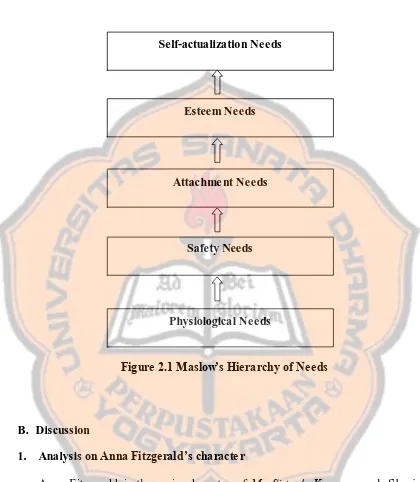
There is a hierarchy of needs, which can explain about motives. Abraham Maslow (1970) as cited by Gerric & Zimbardo, 2008formulated the theory hierarchy of needs, as illustrated in figure 2.1 there. The first concern is physiological needs, such as food, oxygen, and water. These physiological needs must be fulfilled before any other needs can begin to operate. The next level is called safety needs. Safety needs are needs for security, comfort, freedom for fear, from fire, from dangerous situation, and from financial disaster. On the third level is attachment or belonging needs, attachment needs are needs for affection, belonging with people, love and to be loved, and having a place in a group. Next is esteem needs, the requirement for a stable. Esteem needs embraces needs for achievement, power, and self- respect. At the top of hierarchy needs there is self actualization needs. A self-actualization need is a need that refers to what a person‟s full potential is and the realization of that
Figure 2.1 Maslow’s Hierarchy of Needs
B. Discussion
1. Analysis on Anna Fitzgerald’s character
Anna Fitzgerald is the main character of My Sister’s Keeper novel. She is a thirteen years old girl who has to be her „sister‟s keeper‟. She is prepared by a
program called Preimplantation Genetic Diagnosis. Her sister, Kate, has leukemia and Anna has to undergo countless surgeries, transfusion, and shots to make Kate able to
Physiological Needs Self-actualization Needs
Attachme nt Needs
fight her illness. The story begins when Anna decides to hire a lawyer to sue her parents because they do not give her right to control her own body.
Forster (1974) divides the character into two types namely; flat and round character. Anna is a round character. She is complex and difficult to understand as individual living people. She changes from an obedient girl into a stubborn girl. He used to be an obedient girl, she does whatever her parents ask her without asking her whether she agrees or not. Suddenly she hires a lawyer and sues her parents to show that what her parents ask her are too much. She becomes a stubborn girl and does not want to do what her parents ask her to do.
In analyzing Anna‟s character the writer use the theory based on Murphy (1972).
Murphy provides nine ways to analyze the character of novel or movie. Some of them are applied to analyze Anna‟s characteristic. The following are Anna Fitzgerald‟s not like. However, Anna has already thought about death and life. It can be seen from her speech:
anyone who‟d listen that she was named for the place where her parents were
vacationing when they made her (“Good thing they weren’t staying in Jersey City,”
my father used to say). (p.7)
When Anna thinks why some mothers only have one child not two or three it shows that she is a thoughtful person. No one cares about the reason behind why some people only want to have one child or two children.
While Julia says boldly to Campbell that Anna is a smart kid. She says that Anna is a smart kid; she can read people very well (p.338). The other proof is when Campbell meets Brian. Campbell wants to talk personally to Brian, so he asks her to take a walk with Judge, his service dog.
“Hey,” I say to Anna brainstorming. “Want to do me a favor? Judge could use a couple of quick runs up and down the stairs, or he‟s going to get restless in court”.
“Yesterday you told me I couldn‟t walk with him” “Well, today you can.”
Anna shakes her head. “I‟m not going anywhere. The minute I leave you‟re just going to talk about me.”(p. 343)
Anna is a smart girl, she can read the situation. She is not as innocence as other teenager. Based on the quotation she is described as a smart girl because she knows that the moment she leaves Campbell will talk about her to Brian. She prefers to stay with them so they cannot talk about her.
c. Caring
Anna has a big heart, eventhough she is in a point when she does not like her family she still thinks about them. It can be seen from the direct comment form Campbell, her lawyer: “Your brother stole a judge car and you want me to get him
out?” (p. 212). This happens when Jesse gets caught when he steals a judge car.
However, Anna asks Campbell to help Jesse. She believes that what her brother does is not a good thing, but she still thinks how to help her brother to make him out.
look for a dress for Kate to go to prom in hospital, it is very hard to look for the dress that can cover her Hickman catheter. Kate and Sara begin to quarrel because of the dress. Kate walks out through the other side while Anna follows her and drags her into a salon. Anna asks the receptionist what they can do for her sister‟s hair. After
making a fun with the worker on salon, they walk out together hand in hand while laughing (p.317-318). Anna shows that she really cares to her sister. She wants to show her that being sick is not a crime. Thus, she does not have to embarrass just only she is sick.
d. Pessimistic
As a human being Anna also has bad negative sides on her. Anna is a pessimistic person. She only thinks about the bad thing that is possible to happen. It can be seen from her speech:
I don‟t think anyone would come to my funeral. My Parents, I guess, and Aunt Zanne
and maybe Mr. Ollincott, the school studies teacher. At Kate‟s funeral, everyone will come. There will be nurses from the hospital who‟ve gotten to be our friends, and other
cancer patients still counting their lucky stars, and townspeople who helped raise money for her treatments. They will have to turn mourners away at cemetery gates. There will be so many lush funeral baskets that some will be donated to charity. The newspaper will run a story of her short and tragic life. (pp.85-86)
The other proof is when she asks her parents the reason why they have her, the answer makes her wonder. She says “what would have happened if Kate had been
healthy. Chances are, I‟d still be floating up in heaven or wherever, waiting to be attached to a body to spend some time in Earth” (p. 8). The sentences shows that she
doubts her existence if Kate is healthy. She believes that if Kate is healthy she will not be in her family.
e. An indecisive
Anna is a teenager. She is still unstable and easily changes her mind. The condition in her family makes her in the middle of dilemma that is helping her sister or suing her parents because she can not get the right to control her own body. It can be seen from her speech, when Julia asks her what if her mother leaves the house. She answers; “No!” to my utter embarrassment, my eyes get glassy with the tears. “I‟ve changed my mind. I don‟t want to do this anymore. None of it.” (p.183)
The other proof is when Julia talks to Campbell, Julia says that Anna changes her mind after she knows that if she continues this case there is a possibility that she will not live with her mom again. Thus, she says she does not want to do this anymore. (p.187)
Another proof can be seen from Campbell‟s direct comment:
Campbell‟s direct comment shows that Anna is an indecisive. She is still
confused with what she has to do. She still thinks about everyone else than herself. She is afraid if her decision can make everyone hurt.
2. Analysis of Anna Fitzgerald’s motives to sue her parents
In analyzing Anna Fitzgerald‟s motives, the writer employs theory of motives by Huffman, Vernoy & Vernoy (2000) and hierarchy needs by Maslow (1970). Anna Fitzgerald as the major character in the novel My Sister‟s Keeper has motives to sue her parents. Anna is prepared by a program called Preimplantation Genetic Diagnosis. She is the perfect match for her sister.
Since she was born she has been done countless surgeries and shot to help her sister fight her illness. Her parents never ask whether she agrees or not to do those treatments. She finally decides to sue her parents after her parents ask her to donate her kidney. She feels the unfair treatment that her parents do to her. She thinks that this is the time she gets the right control of her own body. Anna‟s motives to sue her
parents because of some of hierarchy needs on herself are not fully fulfilled. These are the following motives that make Anna want to sue her parents:
a. Wanting the right control of her body
Abraham Maslow (1970) already formulated hierarchy needs to analyze every need that people need. In Maslow‟s view, every need at each level of the hierarchy
this motive is included in safety needs. Safety needs are needs for security, comfort, tranquility, and freedom for fear as cited in (Gerric & Zimbardo, 2008). Anna does not have any right to control her own body, so she does not get any comfort, security and freedom from fear in her family. Anna is prepared by a program called Preimplantation Genetic Diagnosis, so she already has a special purpose to live in this world as her sister „keeper‟. She is afraid of losing her body while helping her sister
because her parents control her body. She can not say no because her parents never ask her if she agrees or not to help her sister. Anna does not have any choice because her parents never ask her.
The proof shows when Anna explains to Campbell the reason why she wants to hire a lawyer because she really wants to sue her parents.
“there is way too much to explain-my own blood seeping into my sister‟s veins; the nurse holding down to stick me for white cells Kate might borrow; the doctor saying they did not get enough the first time round. The bruises and the deep bone ache after I
gave up my marrow; the shot that sparked more stem cells in me, so there‟d be extra for my sister. The fact that I am not sick, but might as well be. The fact that the only reason I was born was a harvest crop for Kate. The fact that even now, a major decision about
me is being made, and no one‟s bothered to ask the one person who most deserves it to
speak her opinion. There‟s way too much to explain, and so I do the best I can. It is not God it is just my parents. I want to sue them for the rights to my own body”. (p.19).
The other proof is told by Jesse. He says that this event happens on Christmas Eve. Christmas Eve should be a big day and a wonderful day, however Kate gets infection and Anna follows her to hospital because Anna is always on their radar. She plays the grand plan for Kate. When Julia asks him about how their parents decide that Anna will help Kate, Jesse answers “You make it sound like there is some
Based on quotation above, it shows that Anna does not have any control of her own body. She does not have any choice because her parents never ask her. She knows that the one and only reason why she exists is because her parents need her to help her sister. She does not have any choice to control her body because her parents never ask her.
b. Because the cares of her parents for Anna not as much as Kate
The second motive is because Anna‟s parents do not care for her as much as they
care for Kate. If we see this motive in hierarchy of needs by Maslow, this motive is included in attachment needs. Attachment need is a need of belonging, need to affiliate with others, to love, and to be loved as cited in (Gerric & Zimbardo, 2008). As a child who is prepared by a program to help her sister, Anna always thinks that the one and only reason why her family keeps her is for her sister. It can be seen from her speech:
As we got older, I didn‟t seem to exist, except in relation to her.It made me wonder, though what would happened if Kate had been healthy. Chances are, I‟d still be floating up in Heaven or wherever, waiting to be attached to a body to spend some time on Earth. Certainly I would not be a part of this family. See, unlike the rest of the free world, I didn‟t get here by accident. And if your parents have you for a reason, then that reason better exist. Because once it‟s gone, so are you. (p. 8)
and decides to see Anna. When she sees Anna, Anna asks her to stay with her, but Sara says that Kate is sick. Anna pulls away and says “But I‟m in the hospital!”.
Despite staying with Anna, Sara decides to look for a nurse to give more shots so Anna cannot feel the pains after the surgery. (pp. 232-233).
Therefore, based on the quotation it states how her parents do not really care with Anna. It shows from the situation in hospital when Anna does the bone narrow surgery. It does not seem fair for Anna. Both Anna and Kate are in hospital, but her mom still chooses to be with Kate and says that she is little bit busy.
c. Wanting to help her sister
The third motive is Anna wants to help her sister. If we see this motive in hierarchy of needs by Maslow, this motive is included in attachment needs. Attachment need is a need of belonging, need to affiliate with others, to love and to be loved as cited in (Gerric & Zimbardo, 2008). The real reason why she wants to sue her parents is not only because she wants the right to control her own body. The other reason is to help her sister because her sister does not want to do other operation or transplantation. She wants her parents to let her go, Kate wants to die. Anna agrees to sue her parents not only because she wants the medical emancipation of her body, but also to help her sister. She shows her love to her sister. She will do anything to her even it can make her parents are sad.
her sister. Kate wants Anna stop helping her to do the transplantatio n. She asks her to stop doing that. Kate says that this is the time for her to go (pp.388-391).
Therefore based on the sentences above it shows that Anna is a caring perso n. She shows how much she loves her. She decides to sue her parents is not only for herself, but also for her sister. She knows that her sister already tired and she wants her parents to let her go.
The other proof shows when Anna reminds the time when her parents just came into their bedroom talked about donating a kidney. Anna says that she wants to do it but, Kate disallows Anna to do it and says “Don‟t do it” (p. 389). Kate answers show
23 CHAPTER III
CONCLUSIONS AND SUGGESTIONS
This chapter consist two parts; conclusions and the suggestions. In the conclusion part, the writer presents the answers of the problem formulated. The suggestions part is aimed for the future researcher, who conducts the same research and for the English teacher.
A. Conclusions
After doing analysis on the novel My Sister’s Keeper, the writer draws some conclusions. By applying the theories of character and characterization, to analyze Anna Fitzgerald‟s characters. Anna Fitzgerald is a girl who is prepared by program
Anna is a smart girl. It is not easy to lie to her. She will find out easily when someone lies to her. That the reasons why when Campbell tries to lie to her about his illness Anna easily finds out that Campbell actually lies to her. It happens also when Campbell wants Anna to leave him for a moment because he wants to talk with her father Brian. Anna prefers to stay with them because she knows after she leaves they will talk about her.
Anna is a caring person too. Eventhough she knows that the condit ion in her family makes her get unfair treatments, she still cares for them. She still helps Kate to look for a dress for a prom and show to other people that her illness is not something that she should embarrass with. She also still wants to help Jesse when he gets caught stole a judge‟s car. She knows that she should treat her family nicely even gets unfair
treatment.
As a human being, Anna also has bad characters. She is a pessimistic person. She never thinks that something good will happen to her. She only thinks about the bad things that may happen to her. Like she already thinks that no one will come to her funeral while everyone will come to her sister funeral.
Anna Fitzgeralds has own motives why she wants to sue her parents. Her motives to sue her parents are because some of her hierarchy of needs are not fully fulfilled. Anna needs to fulfill her need of security and attachment needs. Anna needs security and freedom for fear from her family because she does not have any right to control her own body in her family. Meanwhile, she needs to fulfill the attachment needs because she needs to be loved. She does not get proper love because her parents busy take care of Kate. The last one is because she wants to help her sister.
B. Suggestions
My Sister’s Keeper is a very interesting and touching novel. It has a shocking
twist ending in the story. This novel tells about family life. Each character in this novel can be analyzed by the future researchers. The future researchers also can find a lot of moral value in this novel.
27
REFERENCES
Barry, P. 2009. Beginning theory an introduction to literary and cultural theory. New York: Manchester University Pers.
Dockeray, C. F., & Lane, G. G. 1950. Psychology. New York: Prentice- hall, Inc.
Forster, M. E. 1974. Aspects of the novel. London: Edward Arnold Ltd.
Gerrig, J. R., & Zimbardo, G. P. Psychology and life. New York: Pearson Education, Inc.
Huffman, K.,; Vernoy, M.,; &Vernoy, J. 2000. Psychology in action. New York: John Willey & Sons, Inc.
Kenned, X. J., & Gioia, D. 2010. An introduction to fiction. New York: Longman.
Lahey, Benjamin B. 2009. Psychology: an introduction. New York:McGraw Hill.
Mcclelland, C. D.,; Atkinson, W. J.,; Clark, A. R.,; & Lowell, L. E. 1976. Achievement motive. New York: Irvington Publisher, Inc.
Murphy, M. J. 1972. UNDERSTANDING UNSEENS : An introduction to English poetry and the English novel for overseas students. Oxford: George Allen &Unwin Ltd.
Petri, L. H. 1981. Motivation: theory and research. Maryland: Wadsworth, Inc. Picoult, J. 2004. My sister’s keeper. New York: Washington Square Press.
Ryan, M. 2012. An introduction to criticism literature/film/culture. The Atrium, Southern Gate, Chicester, West Sussex: Wiley-Blackwell.
Roberts, V. E., & Jacobs, E. H. 1987. FICTION an introduction to reading and writing. Englewood Cliffs: Prentice-Hall, Inc.
Sdorow, L.M., & Rickabaough, C. A. 2002. Psychology. New York: McGraw Hill. Stagner, R., & Karwoski, F. T. 1952. Psychology. New York: McGraw-Hill Book
Company, Inc.
Worchel, S., & Shebilske, W. 1989. Psychology: principles and applications. Englewood Cliffs: Prentice-Hall, Inc.
ONLINE RESOURCE
Giustini, D. (2014, December 2) Research Method. Retrieved November 6, 2015, from http://hlwiki.slais.ubc.ca/index.php/Research_methods.
.
29 Appendix 1
Summary of My Sister’s Keeper
https://www.amazon.com/My-Sisters-Keeper-Novel Readers/dp/0743454537?ie=UTF8&ref_=asap_bc
Anna‟s parents get a shock when they know that Anna is trying to sue them for the right control of her body. Sara, Anna‟s mother who is a lawyer decides to
representative her husband and herself. Sara thinks that Anna is only doing this to get an attention from her parents and believe that this case will be easily resolved. However, Anna is really serious with her lawsuit. The judge ask Julia Romano to be her guardian, she is guardian ad litem for Anna. As time goes by, Anna feels dilemma because of her decision to sue her parents. She starts thinking ifis the right thing to do or not. She feels guilty with her decision, she almost changes her mind, but when she knows that her mother still hopes her to donate her kidney for her sister, Anna decides to continue her lawsuit. Anna lives temporary in Brian‟s firehouse because of
this problem.
already gave to her. She says as long as she has Anna‟s kidney with her, she will always remember Anna.
32 Appendix 2
Biography of Jodi Picoult
Jodi Picoult is the bestselling author of twenty-three novels: Songs of the Humpback Whale (1992), Harvesting the Heart (1994), Picture Perfect (1995), Mercy (1996), The Pact (1998), Keeping Faith (1999), Plain Truth (2000), Salem Falls ( 2001), Perfect Match (2002), Second Glance (2003), My Sister‟s Keeper (2004),
Vanishing Acts (2005), The Tenth Circle (2006), Nineteen Minutes ( 2007), Change of Heart (2008), Handle with Care (2009), House Rules (2010), Sing You Home (2011), Lone Wolf (2012), The Storyteller (2013), Leaving Time (2014), and the YAQ novels Between The Lines(2012) and Off The Page (2015), co-written with her daughter Samantha van Leer.
released this fall as follows: October 11, 2016 (US/Canada), October 12, 2016 (Australia), and November 22, 2016 (UK).
JENNIFER HAUCK FOR THE VALLEY NEWS
Picoult studied creative writing with Mary Morris at Princeton, and had two short stories published in Seventeen magazine while still a student. Realism - and a profound desire to be able to pay the rent - led Picoult to a series of different job s following her graduation: as a technical writer for a Wall Street brokerage firm, as a copywriter at an ad agency, as an editor at a textbook publisher, and as an 8th grade English teacher - before entering Harvard to pursue a master‟s in education. She married Tim Van Leer, whom she had known at Princeton, and it was while she was pregnant with her first child that she wrote her first novel, Songs of the Humpback Whale.
HONORS AND AWARDS
In 2003 she was awarded the New England Bookseller Award for Fiction. She has also been the recipient an Alex Award from the Young Adult Library Services Association, sponsored by the Margaret Alexander Edwards Trust and Booklist, one of ten books written for adults that have special appeal for young adults; the Book Browse Diamond Award for novel of the year; a lifetime achievement award for mainstream fiction from the Romance Writers of America; Cosmopolitan magazine‟s
„Fearless Fiction‟ Award 2007; Waterstone‟s Author of the Year in the UK, a
Reader‟s Choice Award, the Abraham Lincoln Illinois High School Book Award, and
a Maryland Black-Eyed Susan Award. She‟s the 2013-14 recipient of the New Hampshire Literary Award for Outstanding Literary Merit.