!"#$%&"'()$"*
!"#$%"&'()*+,$
-."#/0123
45667'489:8;86<'(=#>=
-?89:8;86@A67=8>=B?3
C%D*%)('#$E4"'."#"&)
The Method of Electric Images
Denny Darmawan
41121458
In the electrostatics, we can determine the electric field field E(!! r) and the potentialV(r) using the first Maxwell equation :
∇·E!=ρ/ε0 (1)
where in the Cartesian coordinates,∇= ˆi∂∂
x+ ˆj
∂ ∂y+ ˆk
∂
∂z, and the relation
!
E=−∇V (2)
whenρis zero. This procedure requires that we have already known the charge distributionρ. But how if we have not known the charge distribution? In this essay, I will describe one of the methods used in the electrostatics which is called
The Image Method and applied it to some examples. Let us first take a look on a conductor.
The Conductors
A conductor is defined as a material which can conduct electricity well. It means the electrons can move freely from one point to another inside the material under an applied electric field. If we isolate the conductor and apply a constant electric field, then the charges inside the conductor will rearrange their position to compensate the external field, so the electric field inside the conductor is zero. Then we have no charge density inside it, and only exist at the surface of the conductor called the surface charge density.
Now we know that there is a charge distribution at the surface of the conduc-tor, so we can determine the electric field produced by this charge distribution using eq. (1). With the help of the Gauss’ divergence theorem which states that
!
V
∇·E dV! = "
S
!
E·ˆn dS (3)
wheredSis the element of closed surface area. Then we get !
V
∇·E dV! = 1 ε0
!
V
ρdV =Qs ε0
then !
S
!
E·n dSˆ =Qs
ε0
(5)
where ˆnis the unit vector normal to the surface of the conductor, andQsis the
surface charge. We can consider the closed surface area to be a cylinder put at the surface, so the top side of the cylinder is at the outside of the surface and the bottom side is inside it. Since no electric field exist inside the conductor, the electric field is going outside the surface. From eq. (5) we get
!
E·nˆ=σ/ε0 (6)
whereσis the surface charge distribution defined asσ=Qs/AwhereAis the
surface area of the conductor.
The Boundary Value Problem
Enough with the conductor, now we are going back to our problem: If we do not know the value of the charge distribution, how can we find the electric field and the electric potential. Let us look as this case: Suppose we have a perfectly conducting plane which is grounded, so the electric potentialV is zero at the surface. Then we have a positive chargeQput above the surface of the conductor. Now we want to know the electric field and the potential near this charge.
The readers may argue that we have already know the value of the charge (which isQ), so this case is not fit into our problem: we do not know the value of the charge and we want to know the electric field and the potential near the charge. But look carefully to this case, when we put the positive chargeQ near the surface of the conductor, this will induce a negative charge distribution on it, since by putting the positive charge there will be an electric field going through the conductor and the charges on the conductor will rearrange their position to maintain the electric field inside it to be zero, and we do not know what the distribution is, so this case is still fit into our problem.
Now, the readers may argue again, why should the surface of the conductor is set to be zero (grounded). Actually, this case is belong to the general problem in the electrostatics called The Boundary Value Problem. This is the problem where we try to determine the electric field without knowing the charge dis-tribution and the potential disdis-tribution . What we have is the first Maxwell’s equation (eq. 1) and the relation between the electric field and the potential (eq. 2). By substituting eq. (2) to eq. (1) we have
∇2
V =−ρ
ε0
(7)
This equation is called thePoisson’s equation. If we setρ= 0 (for a charge free region), we have the special case
which is called theLaplace’s equation.
Now, there is a procedure to solve both equations. First, we try to solve the Laplace’s or Poisson’s equation using direct integration whenV is a function of one variable or using the separation of variable ifV is a function of more than one variable. Of course there would be some unknown integration constants. To determine these constants, we apply the boundary condition (that is why we setV = 0 at the surface of the conductor in our case). After obtaining the potentialV, we can get the electric field using eq. (2) and the induced charge distributionσusing eq. (6).
The Image Method
To do the first step, we have learnt the method of separation of variable and the solution to the spherical coordinates in the lecture. There is another method which is quite useful in tackling a specific problem like in our case. The method is called the image method, introduced for the first time in 1848 by the great physicist Lord Kelvin. This method states that a charge configuration put above an infinite grounded perfect conducting plane, can be replaced by the charge configuration, the image charge and an equipotential surface in the place of the conducting plane. When we use this method, we have to have the image charge put in the conducting region, so the eq. (7) is satisfied. Another condition is that the image charge should be located such that the potential of the conducting plane is zero or constant, so the boundary condition is satisfied. By using this method, we do not have to solve the Poisson’s or the Laplace’s equation. However, this method can only be applied to a specific problem like what we have in our case. Let us look at some examples:
Example 1: a point charge above a grounded conducting
plane
We look back to our case: we have a positive point chargeQput at a distance ofh
above a perfectly conducting plane which is grounded, so the electric potential at the surface is zero (see figure 1a). We can consider that the plane is lying on the
xy plane, and the point charge is above the centre of this plane sox= 0, y= 0 andz=h. Now, we replace the conducting plane with an equipotential surface, which is zero, and an image (fictious) point charge −Q(figure 1b) (we choose
that the value of the image point charge is the same with the real point charge, but with opposite charge, and the same distance from the surface, but with the opposite direction. This choices will make the potential at the surface is zero, as required). The electric field at the pointP(x, y, z) is given by:
"
E("r) = Q
4πε0r3 1 "
r1+ −Q
4πε3 2 "
r2
r1 is the distace of pointP from the real point charge, andr2 is the distance of
Q
Figure 1: (a) a point charge above a grounded conducting plane (b) the image configuration
We want to know the surface charge distribution at the surface of the con-ducting plane. By settingz= 0 for the eq. (9) and using eq. (6) we get
We can see that the charge distribution is maximum at the surface under the point charge and decrease rapidly if we move from this point (see figure 2).
This negative charge distribution will exert a force on the positive point charge toward the surface, which is simply:
!
F = −Q 2
Figure 2: The surface charge distribution of a perfectly conducting plane when a positive charge Qis located at a distance habove it. We use the value of
Q= 1 andh= 5.
Example 2 : a point charge near a conducting sphere
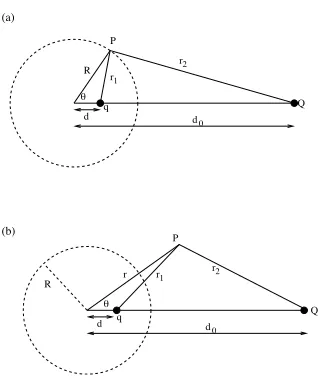
Suppose we have a grounded conducting sphere of radiusRand we put a positive point charge Qnear the sphere with a distance of d0 from the centre of the sphere. From symmetry, the image charge q should be located on the line joining the centre of the sphere and the positive point charge (assume that the unit vector along this line is ˆk). Now, what is the value of the image charge? We cannot set the value to be the same as the real point charge with the opposite sign as we did for the example 1 (we will see the reason below). By using the image method, it is required that the equipotential surface is zero. Suppose that the image charge has a distance of!r1=R!−d!to pointP at the surface of the sphere and!r2 =R!−d!0 for the real charge (see figure 3a). Since the potential at the surface should be zero, then
Vp= 1 4πε0
!
Q
|R!−d!0|
+ q
|R!−d!| "
= 0
So we have
Q
|R!−d!0|
= −q
|R!−d!| We can write the above equation as
Q/R
|ˆr−dR0ˆk|
= −q/d |ˆrR
d −kˆ|
(10)
so we can set both the denominators and the numerators are equal:
q= d
0
Figure 3: A point charge and a grounded conducting sphere
|rˆ−
In order to be the same, each term in eq. (12) should be the same, so we have
d0
Now, the reader might ask: why don’t we factorise outRin eq. (10) both sides? Well, if we did that, then we end up withq=−Qandd=d0. Since the image
method requires that the image charge should be located in the conducting region, this cannot be the solution.
Now we have the value of the image charge and its position from the centre of the sphere. We can determine the potential at pointP which is outside the sphere with a distance ofrfrom the centre of the sphere (figure 3b):
V = 1
and the electric field
To get the electric field at the surface of the sphere, we set!r=R!
We can write the above equation in term ofθusing the Cosinus Law:
|R!−d0!|=
rearrange the above equation, we will get
!
We can see that the electric field is normal to the surface of the sphere, using eq. (6) We get the surface charge distribution to be
σ=− Q
From figure 4, we can see that the charge density is maximum atθ = 0
and minimum atθ=π. The force exerted on the positive point charge by the
induced charge distribution is :
!
In summary, we can see that the image method is very useful in calculating
the induced charge distribution at a conducting surface due to the presence of a charge configuration and also the electric field and the potential near this system. However, this method can only be applied to this specific problem.
References
[1] D.K. Cheng, Field and Wave Electromagnetics, 2nd ed., Addison-Wesley :
Massachusetts (1989).
[2] M.H. Nayfeh and M.K. Brussel,Electricity and Magnetism, John Wiley &
Sons : New York (1985).
[3] M.N.O. Sadiku, Elements of Electromagnetics, 2nd ed., Saunders: Fort