THESIS
Submitted as Partial Fulfillment as the Requirements for the Sarjana Degree of English Department Faculty of Arts and Humanities UIN Sunan Ampel
Surabaya
By:
Tika Dzurriyatina Reg. Number A73213134
ENGLISH DEPARTMENT
FACULTY OF ARTS AND HUMANITIES
THE STATE ISLAMIC UNIVERSITY OF SUNAN AMPEL
SURABAYA
ABSTRACT
Dzurriyatina, Tika. 2017. English Pronunciation Errors of the Three Asean Presidents’ Speech: Brunei, Malaysia, and Philippine. English Department, Faculty of Arts and Humanities. The State Islamic University of Sunan Ampel Surabaya.
The advisor: Raudlotul Jannah, M. App. Ling.
Key words: pronunciation error, consonant, vowel, ambiguity sound
This research analyzes the three ASEAN presidents’ speech which focuses on the pronunciation errors either vowel and consonant sounds. Besides, it also examines the ambiguity sounds that are made by the three ASEAN spresidents’ speech. The method of this research is descriptive quantitative design which calculates and describes English pronunciation errors focused on vowel and consonant sounds and the ambiguity sounds. The research problem are what pronunciation errors on consonants and vowels and what the efffects of pronunciation errors on consonants and vowels related to ambiguity sound are made by the three ASEAN presidents’s speech who are as the second language. This research uses human as the instrument, because the researcher is the main instrument to collect data. The data are collected by looking for and downloading the video of the three ASEAN presidents’ speeches, listening, and transcribing utterances which contain consonants and vowels, and ambiguity sounds. Moreover, the data are analyzed through four steps: identifying, counting, classifying, and interpretating errors and drawing conclution.
INTISARI
Dzurriyatina, Tika. 2017. English Pronunciation Errors of the Three Asean Presidents’ Speech: Brunei, Malaysia, and Philippine. English Department, Faculty of Arts and Humanities. The State Islamic University of Sunan Ampel Surabaya.
Pembimbing : Raudlotul Jannah, M. App. Ling.
Kata kunci: Kesalahan pengucapan, konsonan, vokal, suara ambiguitas
Penelitian ini menganalisis tiga pidato presiden ASEAN yang berfokus pada kesalahan pengucapan suara vokal dan konsonan. Selain itu, juga memeriksa suara ambiguitas yang dibuat oleh tiga pidato para spiduser ASEAN. Metode penelitian ini adalah deskriptif kuantitatif dengan rancangan yang mengkalkulasikan dan menjelaskan kesalahan pengucapan bahasa Inggris yang difokuskan pada suara vokal dan konsonan dan suara ambiguitas. Masalah penelitian adalah kesalahan pengucapan pada konsonan dan vokal dan apa kesalahan pengucapan kesalahan pada konsonan dan vokal yang terkait dengan suara ambiguitas yang dibuat oleh tiga pidato presiden ASEAN yang merupakan bahasa kedua. Penelitian ini menggunakan manusia sebagai instrumen, karena peneliti merupakan instrumen utama untuk mengumpulkan data. Data dikumpulkan dengan mencari dan mendownload video dari tiga pidato presiden ASEAN, mendengarkan, dan menguraikan ucapan yang berisi konsonan dan vokal, dan suara ambiguitas. Selain itu, data dianalisis melalui empat tahap: mengidentifikasi, menghitung, mengklasifikasi, dan menafsirkan kesalahan dan menarik kesimpulan.
TABLE OF CONTENTS
Inside Cover Page………...i
Inside Title Page………..ii
Declaration Page……….iii
Motto………...………....iv
Dedication Page………...v
Thesis Advisor‟s Approval Page……….vi
Thesis Examiners‟ Approval Page……….vii
Acknowledgement………....viii
Table of Contents…………..………...…x
List of Appendices………...………….………....xiii
Abstract………..………...xiv
Intisari………...……….…xv
CHAPTER I INTRODUCTION 1.1Background of the Study………1
1.2Research Problems……….6
1.3Research Objectives………...6
1.4Significance of the Study………...7
1.5Scope and Limitations………7
CHAPTER II LITERATURE REVIEW
2.1Theoritical Framework...………...………...9
2.1.1 English as Global Language .……...………...………....9
2.1.2 Transfer...…………..………..………….11
2.1.3 Pronnunciation Error...……..……….…………13
2.1.4 Phonology...………...……….…………14
2.1.5 Pronunciation...…...……….………...15
2.1.6 Phonological Ambiguity………...……….…………..25
2.1.7 Phonological Features…...………..………...26
2.1.8 Short Biography of the Three ASEN Presidents………….…...…..29
2.2Review of the Related Studies…...……….………...31
CHAPTER III RESEARCH METHOD 3.1Research Design………...34
3.2Research Instrument.……...……….………35
3.3Subject of the Research………35
3.4Data and Data Source.…...………....35
3.5Data Collection…...………..36
3.6Data Analysis………...……….……....37
CHAPTER IV FINDINGS AND DISCUSSION 4.1 Findings………..……..42
4.1.2 Honorable Dato „Sri Mohd Najib, Malaysia‟s President……...…...49
4.1.3 Beniqno S.Aquino III, Philipine‟s President...54
4.2 Discussion………...………...59
CHAPTER V CONCLUSION AND SUGGESTION
5.1 Conclusion………62
5.2 Suggestion…….………...64
REFERENCES
CHAPTER 1
INTRODUCTION
An introduction contains of background of study, the research problems,
objective of the research, significance of the research, scope and limitation of the
research and definition of the key terms.
1.1 Background of study
Many people know that English becomes one of the most influential
languages in the world, dominating many spheres of everyday life including
business, politics, media, education computer sciences and many others. As the
importance of English language is raising every day, it is not surprising that the
number of English speakers has increased (Sopio, 2015). English is the best
language for studying and most sought after language in the world. It has become
a rule organized verbal behavior that has obtained global proportions. Therefore,
English becomes the important rule in various spheres or aspects.
In communication processes, English becomes effective among speakers, if
they maintain the morphology, syntax, semantics and phonological ideals of the
language (Jakobson, 1956). The commonplace of linguistics about spoken
language is more variable than written, and the variation in speech is caused by
region, social group, and situation. The speech form of regional and social groups
is also involved to the pronunciation of particular words in distinctive ways. It is
characterized by generalized sound features whose pattern is different of each
group (Mark&Queen, 2015). The different pattern of sound features is also
We know from many researches that L2 speech perception and production that the
sources of L2 pronunciation errors are often found in L1 characteristics. The term
L1 has the same meaning with a person‟s mother tongue, first language and native
language. While, a person‟s second language is called the L2 and it is not a person‟s mother tongue. It has some kinds of status and it is used to
communicative need (Crystal, 1995). A view of error made by second language
learner, L2 learners has changed over time.
For example, the phonological features of rhoticity among the three
countries which belong to each president become problematic in English
pronunciation. Malaysian English is also generally assumed to be non-rhotic such
the vowel in word and girl as/ɜː/ with no following /r/, which similarly suggests that the variety is non-rhotic. However, some researchers disagree. For example,
Hickey (2004) stated that “Malaysian English is also rhotic” and /r/ occurs in
words such as art, door, andworker. Others claim that rhoticity in Malaysian English is a new phenomenon, just as in Singapore. Ramasamy (2005) similarly
suggests that thepronunciation of non-prevocalic /r/ is a new phenomenon in the
speech of youngMalaysians. Although that study only considered the English of
Malaysian Tamils, it seems to confirm that Malaysian English is now not
exclusively non-rhotic.
Meanwhile, in Brunei English, the occurrence of rhoticity, so /r/ in
nonprevocalic positions such as in far and whatever is pronounced. In fact, the close ethnic, historical, economic and cultural ties between Singapore, Malaysia
Philippine, rhotic /r/ is pronounced in nearly all positions of a word (Phuong,
2012). In this study, the researcher examines the pronunciation error of three
ASEAN presidents thatuse ESL (English Second Language). Those presidents
come from three different countries in which each of the presidents has distinctive
ways of speaking because of the different mother tongues. When speaking a
foreign language, some speakers may consciously retain certain phonological
features of their mother tongue as markers of ethnic or group identity (Elina,
2013). Every non-native speaker or learners can pronounce the error in English
word that causes misunderstanding in communication.
There are some researchers who analyze pronunciation to the foreign
language in the various focuses around the world: pronunciation teaching
corresponds to recent recommendations in the pronunciation teaching literature
(communicative approach and suprasegmental orientation), and at the role of
phonetic training in English pronunciation teaching in Finland (Tergujeff, 2013),
pronunciation errors at the segmental level of consonants, vowels, epenthesis and
word stress in the speech of Brazilian learners of English which affect their
intelligibility to native speakers (Cesar, 2003), the problems in English
pronunciation experienced by learners whose first language is Sudanese Spoken
Arabic (Muhammad, 2014), the difficulties of Iranian EFL learners in phonology
and pronunciation (Hoshemian, 2012), consonantal phoneme pronunciation errors
in the English of EFL learners from three different first language groups in the
province of Aceh, northern Sumatra, Indonesia (Mathew, 1997), pronunciation
(Demirezen, 2009), the differences in the sound systems of two languages
(English and Hindi) and how these differences cause problem in acquisition of
second language sound system (Pal, 2013), the pronunciation of consonants /ð/ &
/θ/ by adult Vietnamese learners of English (Sao, 2016). Most of the researchers
did the research that focus on kinds of pronunciation, phonology, its factors and
some with the effects of non-native speakers‟ability to native speakers or in
communication.
There are also other researchers who analyze pronunciation error to the
second language in various subjects: Learners of Dutch (Neri, Catia, & Helmer,
2006), native Arabic learners (Mohamed, 2013), Nigerian ESL Students (Mark&
Queen, 2015), Swedish and Somali (Borjesson, 2013), Japanese English as a
Second Language (ESL) learners (Nogita, 2010), Algerian students (Hanafi,
2014), South Korean university students of English (John, 2009), Finnish and
Japanese Adult Learners of English (Paakki, 2013). Those researchers did
research that holistically focus on kinds of pronunciation and its factors.
Moreover, there has not been any researcher whostudied pronunciation in the
speech of ESL speaker. Therefore, this present study fills this gap by investigating
pronunciation error in speech and continuing the discussion of pronunciation
holistically. The speeches of each president take the international or inter-ASEAN
forum. It also takes the same the topic of each speech which is related to politic in
their country, such as cooperation or visiting among countries. Thus, this further
study does not only take different angle to address the same problem, but also
To enrich the previous studies, the researcher takes two other existing
researches that can be directed to this study to fulfill or follow those researches.
The first study is Azlina (2016) analyzes President Joko Widodo‟s speech by focusing consonant and vowels. It describes pronunciation errors in English
focused on consonants and vowels. For fulfilling and continuing that research, this
study takes the same focuses but different in subject. This focuses on English
pronunciation error of consonants and vowels and it uses the three presidents‟ speech of ASEAN which use ESL in different country. Those are the Honorable
Dato „Sri Mohd najib as Malaysia‟spresident, the Sultan of Hassanal Bolkiah Mu‟izzaddin Waddaulah as Brunei‟s president, and Benigno S. Aquino III is from
Philippine.This research hopefully can know second language acquisition through
their English speech in video that was held in different conference of
inter-ASEAN or international. Furthermore, it can give sufficient subject to prove of
ESL speakers among different presidents in different country as pronunciation
study.
The other researcher is Reinisch and L. Lori (2014). It focuses on how the
listener expects the same speaker or different speakers on video that they watch
and show articulating unambiguous versus ambiguous sounds. Listeners use
lexical knowledge to return phoneme categories. When hearing an ambiguous
sound between /s/ and /t/ in lexical unambiguous contexts. While in this study, the
researcher herself analyzes ambiguous phonetic sound that is found from the
effect of pronunciation error on consonant and vowels. It mostly emerges from the
Furthermore, the researcher has two reasons of doing research at the three
ASEAN presidents. First, the researcher wants to know what the pronunciation
errors which are made by the three ASEAN presidents and compare among them
as L2 speakers of different mother tongues. Secondly, the researcher wants to
know whether the pronunciation errors which are made by the three ASEAN
presidents can emerge the ambiguity sound. From those reasons, the researcher
intends to conduct a research entitled “ENGLISH PRONUNCIATION ERRORS
OF THE THREE ASEAN PRESIDENTS‟ SPEECH: MALAYSIA, BRUNEI
AND PHILIPPHINE”
1.2 Research Problems
This study is conducted to answer the problems formulated in the following
questions:
1. As the second language, what are pronunciation errors on consonants
and vowels made by the three ASEAN presidentsin their speech?
2. What are the effects of pronunciation errors on consonants and vowels
related to ambiguity sound which mostly emerge from each of the three
ASEAN Presidents?
1.3 Research Objectives
From identifying problem above, the objectives of the study are aimed:
1. To explain the English pronunciation errors on consonants and vowels
which are made by three ASEAN presidents in their speech as ESL
2. To know ambiguous sound mostly emerge from each of three ASEAN
President Speech.
1.4 Significances of the Research
Carey (2002) stated that there are many pronunciation errors to English
second language pronunciation which are caused by transfer. “When a language
learner attempts to produce L2 sounds, their relative success at approaching the
target is depend on their ability to separate their L2 utterance from their repertoire
of L1 phonemes and allophones” (Carey, 2009). The significant of the research is
theoretical and practical. Theoretically, this further research gives information to
the linguistic students who are interested in the pronunciation. Besides, it can be
the reference for everyone who wants to investigate the pronunciation error.
Practically, the result of this study is expected to give a broad overview of contribution of the fields to L2 production research.
1.5 Scope and limitation
The scope of the research is focusing on analyzing English pronunciation
errors eather in consonants and vowels sound. It also studies about ambiguity
sound. The object of pronunciation is taken from the three ASEAN presidents‟
speech. The data of the three ASEAN presidents‟ speech are about politic in their
country, such as cooperation or visiting among countries.
The three ASEAN presidents are the Honorable Dato „Sri Mohd najib,
Malaysia‟s president is in the speech of the Global Social Business Summit
(GSBS) 2013, the Sultan of Hassanal Bolkiah Mu‟izzaddin Waddaulah as
relations between the two countries, Philippine and Brunei, and Benigno S.
Aquino III from Philippine is in the speech of the sixty-fifth General Assembly of
the United Nations. The video of the three speeches are downloaded from
youtube. The countries of three ASEAN presidents use English as second
language. Therefore, the researcher compares English pronunciation errors of the
three ASEAN presidents.
1.6 Definition of the key terms
a. Pronunciation is the manner of producing a certain sound or a chain of
sounds, but it can also refer to a standard way of producing a certain
sound in a certain language (Muller, 2013).
b. Speech is one of the ways for communication among human (Sinha,
2015). It is a kind of formal talk given to audience or the act or way of
speaking to interlace a communication with society (Oxford Dictionary,
2008).
c. English Second Language (ESL) is the study of the English language by
non-native speakers in an English-speaking environment. (Nordquist,
2015).
d. Error is when you have done anything which is considered to be
CHAPTER II
LITERATURE REVIEW
This framework consists of some required theories. Because the writer
investigated pronunciation error and ambiguity sound of the three ASEAN
presidents, this present study combines those two theories in order to draw a great
inference of the analysis. Those theories are English as Global language, transfer,
pronunciation error, phonology, pronunciation, phonological ambiguity, and
phonological features. They can eventually lead the analysis to English pronunciation error of the three ASEAN presidents’ speech.
1.1 Theoretical Framework
1.1.1 English as global language
Many kinds of statement say that English is a global language. It can be
heared on television spoken by politicians from all over the world. It also can be
looked in travel and advertisements or in hotel, news and restaurant. They will
understand English and there will be an English menu (crystal, 2003). Therefore,
English becomes the main language for various business or relation between
countries from all over the world.
Although English becomes a global language, English also have problems
for some countries. It mostly finds in some countries which do not use English in
daily communication or it becomes foreign language. In facts, mother tongue
usually becomes the main problematic that it must be attention for English learner.
tongue, the English learner may still have mixed feelings about it. It is be strongly
motivated to learn it, because it will put them in touch with more people than any
other language (crystal, 2003).
There is not more than few countries speak other language in majority of
their mother tongue, so the use of mother tongue cannot give a language global
status. To achieve such a status, a language has to be taken up by other countries
around the world. They must decide to give it a special place within their
communities, even though they may have few (or no) mother tongue speakers
(crystal, 2003).
There are two main ways to make a global language become a second
language in a country. Firstly, a language can be made as the official language in a
country, to be used as a medium of communication in such domains of
government, the law courts, the media, and the educational system. To get on in
these societies, it needs to master the official language as early as possible in life. Such a language is often described as a ‘second language’, because it is used to
complete a person’s mother tongue, or ‘first language’. The role of an official
language is today best illustrated by English, which now has some kind of special
status in over seventy countries.
Secondly, a language can be made a priority in a country’s foreign language
teaching, even though this language has no official status. It becomes the language
which children are most likely to be taught when they arrive in school and the one
most available to adults who for whatever reason never learned it, or learned it
2.1.2 Transfer
Beginning in the post-war years and carrying on into the 1960s, there was a
strong assumption that most of the difficulties facing the L2 learner were used by
his or her first language. It was assumed that there were differences between the L1 and L2. The learner’s L1 knowledge would interfere with the L2, and the L1
and L2 were similar. The L1 would actively help L2 learning. The proccess that
was held responsible for this was called language transfer (Ellis, 1985).
Transfer occurs at the following levels of language: phonology, syntax,
lexis, pragmatics, and morphology (Mathias, 2013). Many pronunciation errors
are made by second language learners, L2 learners has altered over time. In the
1950s, transfer was the dominating explanation of why errors occur. Transfer
could result in either positive or negative transfer which implied that a learner’s
L1 has an influence in the learning of a foreign language. It could be noticed that
negative transfer is mostly referred to as interference (Mathias, 2013). Moreover,
the errors that occurred were thought to be linked to the dissimilarities between
the L1and the L2, an assumption based on Behaviorism. However, this came to
change in the 1970s when transfer was displaced by the view on that an L2 is
taught and learned as an L1. Therefore, the errors came to be explained in reference to the learners’ development and not as much in terms of transfer
(Odlin, 1989).
A few important factors related to the occurrence and extent of transfer will
now be presented. The first factor is linked to the learning setting. For instance,
practice outside the classroom. Secondly, the proficiency level of the learner has
an impact considering that errors tend to decline with a higher skill level. Thirdly,
the style refers to the material being analyzed. For instance, greater difficulties
may arise when the material is not suitable to analyze, such as informal speech. Finally, the learner type or profile is related to students’ attitude towards the target
language. This couldeither have a positive or a negative impact on the learning
process (Benson, 2002).
Benson explains that transfer either occurs consciously or unconsciously.
That is consciously, due to inadequacy of knowledge or for unconsciously, as the
knowledge has not learned yet is made automatic. This is caused to the following
reasons: First, there is the influence of the interlanguage which is a mixture of a person’s L1 and L2. Another reason is that learning is seen as a cumulative
process or knowledge is stacked over time. It implies that previous knowledge has
an impact on learning a new language. The third reason is related to affective
factors such as prestige (Benson, 2002).
The SLA is focusing on positive and negative transfer as well as additional
explanations. The first explanation concerns positive transfer which occurs when
there are corresponding elements in the target language and the language one
already knows. Thereby, transfer does not cause the errors but improve the
learning. Another reason is that the learner avoids specific structures, which is
caused by the lack of corresponding structures in the L1 and the L2. The third explanation concerns the students’ different development rates, which are caused
can lead to more focus and placed on different structures or forms in the target
language which is same with avoidance. However, this indirectly causes the
avoidance but directly encourages the learning of another form or structure. The
fifth explanation is the overproduction of particular grammatical or lexical
elements. An example could be the overuse of formal words which are commonly
used in Romance languages (Benson, 2002).
2.1.3 Pronunciation Errors
Pronunciation errors have been long interested by linguists and nonlinguists.
Recently, the attention has been focused on the use of the data of speech errors as
an indication of the psychological reality of phonological description.A
commonly the type of speech error is spoonerism. It occurs when the initial
consonants of two words are interchanged, as when someone says tips of the slung instead of slips of the tongue.The theoretical interest of such speech errors is discussed in the works of Fromkin (1973).
Spoonerisms can involve interchanging the place of initial consonants, as in
the example, aconsonant is interchanged with zero, that is, itis transposed, as
when someonesays pick slimp [pik slimp] instead of pink slip [piŋk slɪp]. The nasal consonantof the word pink has been transferred to the resulting nonsense wordslimp. But notice that somehow in the transformation from the intended utterance to the speech error, [ŋ] has become [m]. If the velar nasal hadbeen
transferred as such, the resulting error would have been *[slɪŋp].
However, this sequence is ill-formed in English, since there is a
sameplace of articulation as a following consonant. Thus we have the words
ramp, rant, and rank with [mp, nt, ŋk], but not the words *ranp, *rangt, and *ramk. The modification of [ŋ] to [m] accompanies the speech error. Thus, it provides evidence for the reality of this sequential constraint. As pointedout by
Fromkin, forms of resulting which is from speech errors generally do not
violatethe phonological properties of the language.
Speech error phenomena motivate the necessity of a fundamental distinction
in the study of language. Speakers of English "know" that the word pink should be pronounced [pɪŋk] rather than [pɪk]. The error involved in pronouncing [pɪk] is
therefore one of language use rather than one in the knowledge. It is that the speaker has the way this word should be pronounced. In other words, the speaker
who uttered pick slimp did not think that the correct pronunciation of pink was [pɪk] (Fromkin, 1973).
2.1.4 Phonology
Phonology is the explanation of phones or speech sounds. There are two
studies of phonology, i.e. phonetics and phonemics (Ramelan, 1994). The
difference between phonology and phonetics is that phonology is the study of the
use of distinctive speech sounds (phonemes) in particular languages and phonetics
concern the study of human speech sounds; describes the wide range of sounds
humans can produce (Dalton & Seidlhofer, 1994). These fields consist of elements
such as stress and pronunciation of individual sounds. Phonetics concerns the
sounds of a language, which are classified and categorized into vowels and
phonetic symbol, a phoneme. According to Mobärg (2001), phonemes are “the
smallest unit of spoken language capable of distinguishing one meaning from
another. In set and sat, for instance, we see that by going from /e/ to /æ/, we acquire a new meaning”.
The difference between vowels and consonants is that the air is not
obstructed when articulating vowels, but obstructed when articulating consonants.
The articulation of vowels could be described using a vowel chart, which
illustrates the position of the tongue seen from the side of the mouth. In relation to
this, there are three important factors or vowel parameters, which are lip position (unrounded-rounded), vertical tongue position (high-low, or closed-open), and horizontal tongue position (front-back)” (Dalton & Seidlhofer, 1994). However, the articulation of consonants differs from the articulation of vowels. There are
three important aspects which are the place, manner, and force of articulation. The
first to concern where and how the airstream is obstructed, and the latter part refer
to the energy produced by the sound in terms how much (Dalton & Seidlhofer,
1994).
2.1.4 Pronunciation
Pronunciation is the way of speaker produces sounds, individual sounds or combination of sounds. It can refer to an individual’s exact manner of producing a
certain sound or a chain of sounds, but it can also refer to a standard way of
producing a certain sound in a certain language (Muller, 2013). There are two
includes phoneme that consist of vowel and consonant. In addition,
suprasegmental includes stressing and intonation.
A. Segmental
The segmental feature concerns with the phonemes which includes of vowel
and consonants of a language. Consonant, consonant sounds may be voiced or
unvoiced. While the consonant sounds are mostly articulated via closure and
obstruction in the vocal tract, vowel sounds are produced with a relatively free
flow of air. They are all typically voice. To describe vowel sounds, we consider the way in which the tongue influences the ‘shape’ through which the airflow
must pass. To talk about place of articulation, we think of the space inside the
mouth as having a front versus a back and high versus a low area. The place of
articulation include: bilabial, labiodental, interdental, alveolar, palatal, velar,
uvular, and glottal.
The phonetic symbols for English consonants and vowels are then presented
and classified according to the three criteria: voicing (whether the vocal cords
vibrate or not), place of articulation (where in the mouth the sound is produced),
and manner of articulation (how the airstream flows in the mouth during the
articulation).
a. Vowels
Vowels are sounds in which there is no obstruction to the flow of air as it
passes fron the larynx to the lips (Roach, 1998).The places of articulation of
vowels are made especially difficult because in vowels the tongue should not
between the tongue and the mouth in the vowels sounds (Vlack, 2005). That
statement can clarify that the place of articulation in vowels is differentiated
become two different planes: relative height and relative frontness. There three
categories of vowels, namely front, central and back.
1. Front Vowels
There are six phonemes in articulation of front vowels: /i/, /I/, /e/, /ɛ/,
/a/, and /æ/.The places of articulation of those vowels are same with
consonants that is voiced is based on the location of the tongue within the
mouth. For the front vowels, the tongue is obviously more forward in the
mouth (Vlack, 2005).
Sound Distinction
/i/This is the highest and the most forward front vowels
Examples: beat /bi:t/, feed /fi:d/, city /si:ti/, and sheep /ʃi:p/
/ɪ/ This is a bit lower and further back than /i/ Examples: bit /bɪt/, fit /fɪt/, slid /slɪd/, and ship /ʃɪp/
/e/ This is a mid-front vowel
Examples: bait /bet/, raid /red/, and made /med/
/ / This is a mid-front vowel that is beginning to get a little low. Examples: bet /bɛt/, red /rɛd/, lead /lɛd/, and bed /bɛd/.
/æ/ The tongue is getting quite low here, but it is still near the front of the
mouth.
Example: bat /bæt/, ladder /læd/, fad /fæd/
Examples: body /bɑdi/, pot /pɑt/, and hobby /hɑbi/
2. Central vowels
The articulations of central vowels consist of four /ə/, /ᴧ/, / /, and / /.
There is really only on central vowels in English, but we have different
signs for stressed and unstressed sounds.
Sound Distinction
/ə/ This is the unstressed central vowel. It is so important a sound it even has a name schwa.
Examples: amerika /ə’mer.I.kə/, and korea /kə’ri:.ə/
/ᴧ/ This is the stressed central vowel. No one cares what it is called. Examples: lucky /’lᴧk.i/, up /ᴧp/, and but /bᴧt/
/ / This is the r-colored unstressed central vowel. Examples: lover /’lᴧv. /, and sister /’sIs.t /
/ / This is the stressed central vowel.
Examples: dirt /d :t/, herb / :b/, and fur /f :/
Basically, /ə/ and /ᴧ/ are the same sound. The diferent in location
of the tongue when they are produced is tiny. They have been given
different symbols because, in English, it is very important that we
distinguish between stressed and unstressed sounds.
3. Back vowels
The articulations of back vowels consist of four /u/, /ʊ/, /o/, and /ɔ/.
Back vowels in English are rounded. The basic problem is not all rounded to
vowels, and consonants are based on the location of the tongue within the
mouth. Because the tongue does not touch anything, this makes finding the
location much harder.
Sound Distinction
/u/ This is the highest and most back of the English vowels. This is tense
sound in that the lips are taut when you are making the sound.
Examples: you /ju:/, dude /du:d/, and food /fu:d/
/ʊ/ This is a little bit further forward and lowers than /u/. This sound is lax.
Your lips are rounded but in a relaxed way.
Examples: book /bʊk/, could /kʊd/, and wood /wʊd/.
/o/ This is central back vowel. This sound also has a longer more rounded
version which is sometimes written /o/.
Examples: boat /boʊt/, over /’oʊ.v /, drove /droʊv/, and show /ʃoʊ/.
/ɔ/ This is the lowest and furthest forward of all the back vowels. Examples: call /kɔ:l/, awful /’ɔ:.fl/, horse /hɔ:rs/, and halt /hɔ:lt/
The categories of articulation above indicate that the vowels are
harder than consonant because vowels are including various part of tongue.
b. Consonants
In Oxford dictionary, consonants is speech sound created (partly) by
stopping the breath with the tongue, lip etc. According to Forel and Puskás
(2005) consonants are divided into two groups which base on the place of
1. Place of articulation
Bilabial [p], [b], [m]sounds are produced when the lips are brought
together. For example [p] which is voiceless, [b] and [m] are voiced.
Labiodental [f], [v] sounds are made when the lower lip is raised
towards the upper front teeth. For example, [f] which is voiceless and
[v] is voiced.
Interdental [θ], [ð] both [θ] and [ð] are represented orthographically
by the th in the words thin [θIn], ether [‘i: θ ], then [ðen] and either [‘i: ð ] (or, as some pronounce the last word [aj ðər]). To articulate
these “between the teeth” sound in English (interdentals), one inserts
the tip of the tongue between the upper and lower teeth. On the other hand, some speakers of English produce [θ] and [ð] by placing the
tongue against the back of the upper teeth, making a sound more
correctly called dental.
Dental sounds are produced by touching the upper front teeth with the
tip of the tongue such as [s] which is voiceless and [c] is voiced.
Alveolar [t], [d], [n], [s], [z], [l], [r] sounds are made by raising the tip of the tongue towards the ridge that is right behind the upper front
teeth, called alveolar ridge such as [t,s] too, sue, both voiceless, and
[d,z,n,l,r] do, zoo, nook, look, rook, all voiced.
Palatal [ʃ], [š], [ʒ], [č], [ž], [ǰ], [j] produce the sounds in the middle of
palatal sounds, along with [č] and [ǰ], the sound that begin and the end
words church and judge, are sometimes referred to as alveopalatals, or palatoalveolars. The first sound in yellow is the palatal glide [j].
Palatoalveolarsounds are made by raising the blade of the tongue
towards the part of the palate just behind the alveolar ridge. For
example, [ʃ, tʃ] are voiceless and [ʒ, dʒ] are voiced.
Velar [k], [g], [ŋ], [w]sounds are made by raising the back of the tongue towards the soft palate, called velum. For example [k] back,
voiceless, and [g,ŋ] both voiced bag, bang. [w] is a velar which is
accompanied with lip rounding.
Uvulars [R], [q], [G] Uvular sounds are produced by raising the back
of the tongue to the ovula. The r in French is often an uvular trilland in symbolized by [R]. Uvular sounds are also found in other
languages.Arabic, for example, has two uvular sounds symbolized as
[q] and [G]. Uvular sounds do not occur in English
Glottal [ʔ], [h] the [h] sounds that starts words such as hat, who, and hair is a glottal sound. Although classified as a consonant, there is no
airflow restriction in pronouncing [h]. Its sound is from the flow of air
through the open glottis. The tongue and lips are usually in the
position for the production of the following vowel as the airstream
2. Manner of articulation
Plosive are sounds in which is a complete closure in the mouth, so that
the air is blocked for fraction of a second and then released with a
small burst of sound called plosion (it sounds like a very small
explosion). The glottal stop, the word football can be pronounced without interruption in the middle as in [fʊtbɔːl] or with a complete closure of the glottis instead of [t]: [fʊbʔɔːl].
Fricatives have a closure which is not quite complete. This means that
the air is not blocked at any point, and therefore there is no plosion.
On the other hand the obstruction is big enough for the air to make a
noise when it passes through it, because of frication.
Affricatives are a combination of a plosive and a fricative (sometimes they are called ‘affricative plosives’). They begin like a plosive, with a
complete closure, but instead of a plosion, they have a very slow
release, moving backwards to a place where a friction can be heard
(palatoalveolar).
Nasals resemble plosives, except that there is a complete closure in the mouth, but as the velum is lowered the air can escape through the
nasal cavity.
Approximants are sounds where the tongue only approaches the roof
of the mouth, so that there is not enough obstruction to create any
friction.
B. Suprasegmentals
Suprasegmentals are aspects of speech that influence stretches of sound
larger than a single segment. Suprasegmentals aspects of speech include length,
tone, and intonation, syllable structure, and stress.
a. Length
Length is how long or short a phoneme should be pronounced.
b. Tone and intonation
The term tone and intonation refer to linguistic uses of pitch. Tone
refers to the use of pitch to convey meaning at the word level. Intonation
refers to the use of pitch to convey meaning at the sentence or discourse
level.
c. Syllable structure
Words can be cut up into units called syllables. Syllables have internal
structure: they can be divided into parts. The parts are onset and rhyme;
within the rhyme we find the nucleus and coda. Not all syllables have all
parts; the smallest possible syllable contains a nucleus only. A syllable may
or may not have an onset and a coda. The onset is the beginning sounds of
the syllable; the ones preceding the nucleus. These are always consonants in
[l], [m], [n], and the velar nasal (the 'ng' sound) can also be the nucleus of a
syllable.
In this example, the English word "plant" consists of a single CCVCC
syllable. This syllable has been broken up into its onset (any consonants
preceding the vowel) and its rhyme (all phonemes from the vowel to the end
of the syllable). The rhyme has been further divided into the nucleus, which
in the vast majority of syllables is a vowel (the exceptions are syllabic
consonants) and the coda, which are any consonants following the nucleus.
The rhyme is the vowel plus any following consonants. 'plant'.
Syllable is composed of an Onset = /pl/ and a Rhyme = /ænt/ (the rhyme is
obligatory = the head of the syllable)
d. Stress
Linguistic stress is a prominence relation between syllables: certain
syllables are longer, louder, higher-pitched, or more clearly articulated than
2.1.6 Phonological Ambiguity
Ambiguity is the property of being “ambiguous‟, where a word, term,
notation, sign symbol, phrase, sentence, or any other form are used for
communication, is called ambiguous if it can be interpreted in more than one way.
Ambiguity, however, depends on context, i.e .the same linguistic item, be it a
word, phrase, or sentence may be ambiguous in one context and unambiguous in
another. Ambiguity to Crystal (1988) is the reference to a word or sentence which
expresses more than one meaning and this reference has to do with linguistics. In
this regard, several types of ambiguity can be recognized; these include grammatical (or structural) ambiguity in a phrase like “new houses and shops”
which could be analyzed as either “new {houses and shops}”, i.e. both are new, or
“{new houses} and shops”, i.e. only the houses are new.
Another major type of ambiguity is the semantic (or lexical) ambiguity which might be viewed in a sentence like “Visiting speakers can be awful”, which
is interpreted in two different ways. The first interpretation is “It is awful to visit
speakers” whereas the second one is “Speakers who visit are awful”. Another
definition of ambiguity is forwarded by Hartmann and Stork (1976) who state that
ambiguity is a construction which admits more than one interpretation. An instance is “Patent medicines are sold by frightening people” the ambiguity arises
due to the fact that we cannot tell whether the sense intended is “Patent medicines
There are some types of ambiguity. Linguistics theories have identified two
main types of ambiguity, such as syntactic ambiguity and lexical ambiguity. The
other types are scope ambiguity, phonological ambiguity, punctuation ambiguity,
grouping ambiguity, cross-reference ambiguity, and structural ambiguity. For this
study, the researcher takes phonological ambiguity theory. Phonological
ambiguity is a subtype of lexical ambiguity. It occurs when two or more words
have the same sounds and have different meanings, such as see and sea, weight and wait, read and red, hear and here, and knows and nose (Hamidi, 2009).
2.1.7 Phonological Features
The three ASEAN Presidents have their own characteristics of
pronunciation which are caused by their first language in that country. The
researcher classifies into two categories which are vocal features and consonant
features. Phuong (2012) had found note of the following phonological features of
the three countries. They belong to each country of three ASEAN presidents:
a. Malaysia
Vocal
1. Merger of /i:/and /ɪ/: feel – fill, bead – bid all have /i/. 2. Merger of /u:/ and /ʊ/: pool –pull, Luke –look all have /u/. 3. Merger of / / and /ɔ:/: pot – port, cot – caught all have /ɔ/. Consonant
1. Reduction of word-final consonant clusters, usually dropping the
alveolar
b. Brunei
Vocal
1. Shortening of long vowels, so shirt is /ʃ t/ and cream is /krim/ Consonant
1. Reduction of final consonant clusters by means of plosive deletion, so
first is /f s/.
2. The occurrence of rhoticity, so /r/ in nonprevocalic positions such as in
far andwhatever is pronounced.
3. l-vocalisation, i.e. the lateral is realized with a back vowel quality such
as sell is/seo/ or /seɤ/
4. Omission of final stops /t, d/ and use of a glottal stop in place of final
/k/, so handis /hen/ c. Philippine
Vocal
1. Substitution of /a/ for /æ/, /ɔ/ for /o/, /I/ for /i/, /ε/ for /e/.
Consonant
1. Substitution of /s/ for /z/, /ʃ/ for /ʒ/, /t/ for /θ/, /d/ for / ð /, /p/ for /f/, /b/
for/v/.
2. Simplification of consonant clusters in final position.
3. Rhotic (/r/ is pronounced in nearly all positions of a word).
In Malaysia, Brunei and Phillipine use English as a second language. But,
Phuong (2012) stated English that is in Southeast Asia like those three country
Philippine English have been well-documented and have attracted many scholars
as they share interesting historical and linguistic characteristics.It is widely
accepted that there is always a relationship between a language and political
history, so it is better to know how English was spread to these countries. The
spread of English to Brunei, and Malaysia was caused by the British colonization,
its spread to the Philippines resulted from US colonization.
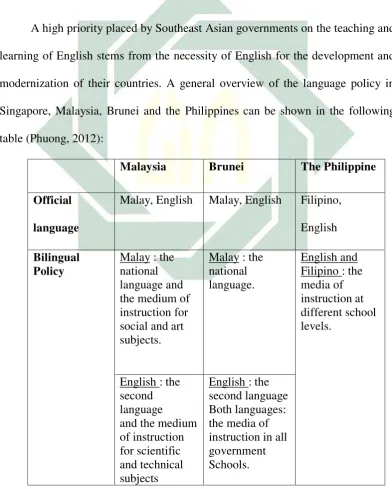
A high priority placed by Southeast Asian governments on the teaching and
learning of English stems from the necessity of English for the development and
modernization of their countries. A general overview of the language policy in
Singapore, Malaysia, Brunei and the Philippines can be shown in the following
table (Phuong, 2012):
Malaysia Brunei The Philippine
Official
language
Malay, English Malay, English Filipino,
2.1.8 Short Biography of the Three ASEAN Presidents
a. Honorable Dato ‘Sri Mohd najib, President of Malaysia
Dato' Sri Mohd Najib was appointed as Malaysia's sixth prime minister on 3 April 2009. He replaced Dato’ Seri Abdullah Ahmad Badawi who did not re
-elected as Umno President. Dato' Sri Najib, the eldest son of the second prime
minister, Tun Abdul Razak Hussein, was born in the district of Kuala Lipis in the
state of Pahang. He received his primary and secondary education at one of the
country's leading schools, St John's Institution. He continued his secondary education at the Malvern Boys’ College in Worcestershire, England.
Upon completion of his secondary education, Dato' Sri Najib enrolled at the
University of Nottingham and graduated in 1974 in industrial economics. On his
return to Malaysia in the same year, Dato' Sri Najib joined the national oil
company, Petronas, as an executive where he served for two years before entering
politics in 1976. Dato' Sri Najib was elected unopposed as Member of Parliament
at the age of 23. He has served in a series of government positions including as
minister of culture, youth and sports, minister of defence, minister of education,
minister of finance and deputy prime minister. In March 2009, Dato' Sri Najib
was elected unopposed as Umno president after Dato' Seri Abdullah decided not
to seek re-election.
b. Hassanal Bolkiah Mu’izzaddin Waddaulah, Sultan of Brunei Darussalam Hassanal Bolkiah Muʿizzaddin Waddaulah was born on July 15 1946 in
Brunei Town [now Bandar Seri Begawan], Brunei. He was 29th sultan of
Saifuddin. He was educated privately and later attended the Victoria Institution in
Kuala Lumpur, Malaysia, and the Royal Military Academy at Sandhurst, England.
In 1961 Sir Omar named him crown prince, and when Sir Omar abdicated six
years later, Hassanal Bolkiah became sultan on October 5, 1967, his coronation
taking place on August 1, 1968. For the next decade, however, his father remained
the power behind the throne. After the death of his mother in 1979, his father
withdrew from public affairs, and the sultan quickly took the dominant role in the
administration of Brunei. He made frequent trips throughout the country to listen
to his subjects as well as to promote himself as ruler. In anticipation of
independence from Britain, he began to create a native bureaucracy, replacing
British expatriates in the civil service with Bruneians, and he cracked down on
corruption.
After having held Brunei as a protectorate for 95 years, the British formally
withdrew on January 1, 1984. Although there were minor disagreements over matters such as the management of Brunei’s huge investment portfolio, relations
between the two countries continued to be friendly. Sir Omar died in 1986, and on
October 5, 1992, the sultan, who also acted as prime minister and as the minister
of defense and of finance, celebrated the 25th year of his reign. He continued to
rule under a state of emergency declared by his father in 1962. In the 1980s and 1990s the sultan regularly appeared at or near the top of lists of the world’s richest
c. Benigno S. Aquino III, President of the Philippines
Benigno Simeon Cojuangco Aquino III is the 15th and current President of
the Philippines. He is scion of a famous and influential political family of four
generations. Servillano "Mianong" Aquino, his great-grandfather was a delegate of the ‘Malolos Congress’. Benigno Aquino, Sr, his grandfather was the speaker
of the ‘House of Representatives’ of the Philippines while his father Benigno
"Ninoy" Aquino, Jr. was a Senator. His mother Corazon Aquino remained the
11th President of the country from 1986 to 1992.
He resided in the US for a while with his family when they took self-exile but after his father’s assassination he went back to Philippines and worked in
private organisations. His first political representation was from the 2nd district of Tarlac province in 1998 as an elected member of the ‘House of Representatives’.
He represented the House for the next two terms and was barred in 2007 because
of term restrictions. He served as a Senator of the 14th Congress. He remained the Secretary General and Vice President of the ‘Liberal Party’ for Luzon and at
present serves as Chairman of the party. He succeeded Gloria Macapagal-Arroyo
as the 15th President of the country.
2.2 Review of the Related Studies
Eva and Lori (2013) analyzedlisteners use lexical knowledge to retune
phoneme categories. When hearing an ambiguous sound between /s/ and /f/ in
Although such retuning could help listeners adapt to foreign accented speech,
research has focused on single phonetic contrasts artificially manipulated to create
ambiguous sounds. It is therefore unclear whether analogies to adaptation to
accented speech are warranted. In the present studies, to be adapted ambiguous
sound was embedded in a global foreign accent. Results showed that listeners
retune phoneme categories which aremanipulated within the context of a global
foreign accent, and they generalize this short time learning to the perception of
phonemes from the previous unheard speakers. However, generalization was observed only when opening and test speakers’ fricatives were attempted across a
similar perceptual space.
Azlina (2016) investigated the pronunciation errors of President Joko Widodo’s speech by focusing on consonants and vowels.The objective of this
research is to explain kind of pronunciation errors on consonants and vowels
made by President Joko Widodo in his speech. The research uses human as the
instrument. The researcher is the main instrument to collect data. The data are collected by looking for, downloding Joko Widodo’s speech video, listening and
transcribing utterance which contains consonants and vowels. The result of this
research shows that there are five types of consonants errors made by Presidents
Joko Widodo. The errors of labiodental are 56, 18%, such as: government /g’ᴧf.ən.mənt/, Alveolar is 23, 67%, such as: business/’bIs.nIs/, Interdental is 18,
President Joko Widodo. In central vowels, it finds 90 data of 144 or 78, 95%,
CHAPTHER III
RESEARCH METHOD
In this part, the researcher described the method that was used in this
research. The researcher explained the general process in collecting and analyzing
the data. It consisted of research design, subject of the research, research
instrument, data and data source, data collection and data analysis.
1.1 Research Design
This studyuses descriptive quantitative design in which it is included into
the part of content analysis. Krippendorff (2014) defines content analysis is the
techniques to analyze a set of texts to interpret the meaning and the content of the
texts through the context and its use. Texts can be gotten from books, book
chapters, essays, interviews, discussions, newspaper headlines and articles,
historical documents, speeches, conversations, advertising, theater, informal
conversation, or really any occurrence of communicative language.
For this study, it is designed to identify the pronunciation error of speeches
that is made by the three ASEAN Presidents. The researcher takes the subjects
that use English as a second language. To analyze the subjects, the researcher is
interested to take the speech of each president. The speeches are taken from the
videos and transcripts are taken from internet which is used as the data to be
analyzed. This study examines the pronunciation errors of the three ASEAN Presidents’ speech by describing and interpreting the data from the data collected.
internet. It is then analyzed further about are the pronunciation errors and
ambiguity sounds are that made by the three ASEAN presidents in their speech.
3.2 Research Instrument
The research instrument is the researcher herself. The researcher analyzes it
by using dictionary. The dictionary uses English IPA phonetic online. It is a tool
for analyzing the data. Collecting and analyzing the data of this study is done by
researcher. The researcher finds the whole transcripts of speech of each ASEAN
President. Afterward, it is analyzed pronunciation errors and found the ambiguous sound of the three ASEAN Presidents’ speech. Therefore, the major instrument of
this research is human.
1.3 Subject of the research
The subject of this study is the speech of the three ASEAN Presidents which
is English as a second language. It is taken from youtube and the event was held
in a conference of inter-ASEAN or international. This subject is chosen because
the researcher is interested to analyze the various ways of speaking in ASEAN
and there has not been any researcher who studied pronunciation in the speech of
ESL speaker.
1.4 Data and Data Source
The whole data are taken from the utterances of the three ASEAN presidents’ speech. Data sources are taken from video of ASEAN presidents’
speech in youtube in certain event such as summit or other conferences. There are three videos of the three ASEAN presidents’ speeches as the data source. The first
speech is the Global Social Business Summit (GSBS) 2013, which was held from
November 7-9 in Kuala Lumpur, Malaysia. Then, its duration spent 11.42 minutes. The second speech is when the Sultan of Hassanal Bolkiah Mu’izzaddin
Waddaulah as Brunei’s presidentbecomes the speaker ofthe “excellent” bilateral
and diplomatic relations between the two countries, Phillippine and Brunei, that is
to maintain the cooperation between two countries. The first speech is opened by the Sultan of Hassanal Bolkiah Mu’izzaddin Waddaulah for 6.39 minutes. Then, it
is continued by President Rodrigo Duterte until 10.11 minutes. The third speech is Benigno S. Aquino III as the Philippnine’s president. It is considered as his debut
in the international stage as the country's Chief Executive, the Fifteenth President
of the Republic of the Philippines, President Benigno Aquino III addresses the
sixty-fifth General Assembly of the United Nations (UN). It spent 8.05 minutes.
1.5 Data Collection
To complete the data, the researcher collected the data by the following steps:
1. The researcher searchedand downloaded the threeASEAN Presidents’
speech videos from youtube.
2. After finding the video, the researcher downloaded it from youtube.
There were three speeches of the three ASEAN presidents which were
downloaded from these links.
A. The Honorable Dato ‘Sri Mohd najib as Malaysia’s presidentis in
the speech of the Global Social Business Summit (GSBS) 2013
B. The Sultan of Hassanal Bolkiah Mu’izzaddin Waddaulah as Brunei’s president is in the speech of the “excellent” bilateral and
diplomatic relations between the two countries, Phillippine and
Brunei.
https://www.youtube.com/watch?v=n8JlbH7jNnI
C. Benigno S. Aquino III as the Philippnine’s president is in the
speech of the sixty-fifth General Assembly of the United Nations
(UN).
https://www.youtube.com/watch?v=8JWyScwuTeI
3. The researcher searched the transcripts of the threeASEAN Presidents’ speech in the internet.
4. The reseearcher made a phonetic transcription by using English IPA phonetic online for the three ASEAN presidents’ utterances.
1.6 Data Analysis
After listening, watching, and transcribing the video, the researcher
analyzed the data through several steps:
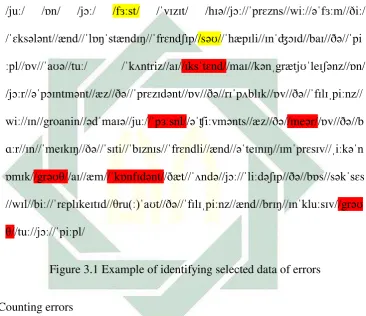
3.6.1 Identifying errors
The researcher rechecks the pronuncition error while listening and watching
the videos. The researcher identified the words which contain the consonant and vocal features of each president’s speech. To identify the pronunciation
errors, the researcher gives the highlighting of each ASEAN president
speech in the data. There are two marks to highlight the pronunciation error,
Example:
/jɔː//ˈɛksələnsi/ /ˈprɛzɪdənt/ /Rodrigo Roa Duterte/ /ˈɛksələnsiz/ /ˈleɪdɪz/
/ænd/ /ˈʤɛnt(ə)lmən/ /maɪ/ /ˈgʌvnmənt/ /ænd/ /ðə/ /ˈpiːpl/ / v/ /bruːˈnaɪ/
/darussalam/ /ʤɔɪn/ /miː/ /ɪn/ /ɪksˈtɛndɪŋ/ /ə/ /ˈvɛri//wɔːm/ /ˈwɛlkəm/ /tuː/ /juː/ / n/ /jɔː/ /f ːst/ /ˈvɪzɪt/ /hɪə//jɔː//ˈprɛzns//wiː//əˈf ːm//ðiː/
/ˈɛksələnt//ænd//ˈl ŋˈstændɪŋ//ˈfrɛndʃɪp//səʊ//ˈhæpɪli//ɪnˈʤɔɪd//baɪ//ðə//ˈpi
ːpl// v//ˈaʊə//tuː/ /ˈkʌntriz//aɪ//ɪksˈtɛnd//maɪ//kənˌgrætjʊˈleɪʃənz// n/
/jɔːr//əˈpɔɪntmənt//æz//ðə//ˈprɛzɪdənt// v//ðə//rɪˈpʌblɪk// v//ðə//ˈfɪlɪˌpiːnz// wiː//ɪn//groanin//ədˈmaɪə//juː//ˈp ːsnl//əˈʧiːvmənts//æz//ðə//meər// v//ðə//b
ɑːr//ɪn//ˈmeɪkɪŋ//ðə//ˈsɪti//ˈbɪznɪs//ˈfrɛndli//ænd//əˈteɪnɪŋ//ɪmˈprɛsɪv//ˌiːkəˈn
mɪk//grəʊθ//aɪ//æm//ˈk nfɪdənt//ðæt//ˈʌndə//jɔː//ˈliːdəʃɪp//ðə//b s//səkˈsɛs
//wɪl//biː//ˈrɛplɪkeɪtɪd//θru(ː)ˈaʊt//ðə//ˈfɪlɪˌpiːnz//ænd//brɪŋ//ɪnˈkluːsɪv//grəʊ
θ//tuː//jɔː//ˈpiːpl/
Figure 3.1 Example of identifying selected data of errors
3.6.2 Counting errors
This study used descritive quatitative design. The result of calculation was
presented either numeral or percentage. In discussion, it also has been
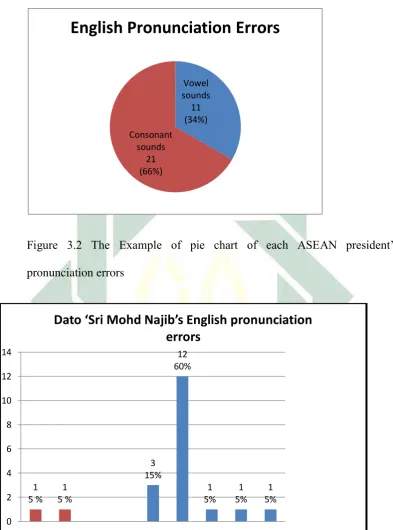
shown in the column and pie chart form. The researcher presented pie charts
in general frequncy of vowels and consonants sounds. Meanwhile, Column
charts are the frequency of each kind of vowel and consonant errors. The
Figure 3.2 The Example of pie chart of each ASEAN president’
/i/ front vowel/ɪ/ front o el [m] bilabial consonant sound[t] alveolar consonant sound[d] alveolar consonant sound[l] alveolar consonant sound[g] velar consonant sound
Dato Sri Mohd Najib s English pronun iation
3.6.3 Classifying Errors
After the process of data collection has been completed, the next step was
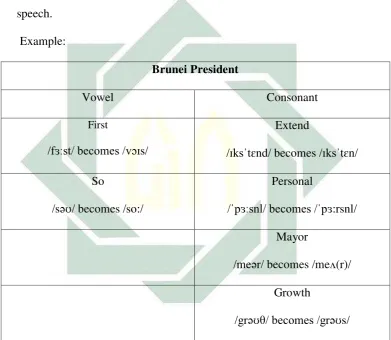
that the researcher classifyed the data into some columns which consist of
vowel and consonant based on each president. The researcher also added the correct pronunciation of the incorrect utterances of four ASEAN Presidents’
speech.
Example:
Brunei President
Vowel Consonant
First
/f ːst/ becomes /vɔɪs/
Extend
/ɪksˈtɛnd/ becomes /ɪksˈtɛn/
So
/səʊ/ becomes /so:/
Personal
/ˈp ːsnl/ becomes /ˈp :rsnl/
Mayor
/meər/ becomes /meᴧ(r)/
Growth
/grəʊθ/ becomes /grəʊs/
Figure 3.1 Example of classifying errors
3.6.4 Interpretating errors
3.6.5 Classifying phonological ambiguity
After the researcher described the pronuciation errors that have been
classified, the researcher classified the ambiguous sounds which mostly
emerge from each ASEAN President from the utterance based on the data
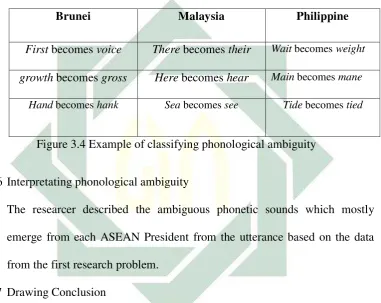
from the first research problem.
Brunei Malaysia Philippine
First becomes voice There becomes their Wait becomes weight
growth becomes gross Here becomes hear Main becomes mane Hand becomes hank Sea becomes see Tide becomes tied
Figure 3.4 Example of classifying phonological ambiguity
3.6.6 Interpretating phonological ambiguity
The researcer described the ambiguous phonetic sounds which mostly
emerge from each ASEAN President from the utterance based on the data
from the first research problem.
3.6.7 Drawing Conclusion
After analyzing the data, the researcher concluded the explanation as the
CHAPTER IV
FINDINGS AND DISCUSSION
This chapter portrays the results of the research analysis which is named as
Findings. Afterward, there is also the discussion of the research findings.
4.1 Findings
This present study eventually creates several results of the data analysis.
English pronunciation errors are the first finding. The researcher takes two
branches. They are vowels and consonants errors. In addition, to construct the English pronunciation errors of the three ASEAN presidents’ speech, there are
some umbiguity sounds that are made by the three ASEAN presidents. To summarize, the three ASEAN presidents’ ambiguity sounds are also presented.
1.1.1 Hassanal Bolkiah Mu‟izzaddin Waddaulah, Sultan of Brunei
Hassanal Bolkiah Mu’izzaddin Waddaulah’s English pronunciation errors
are the first data analyzed in this study. In order to produce the result, the
researcher collects all Hassanal Bolkiah Mu’izzaddin Waddaulah’s utterances.
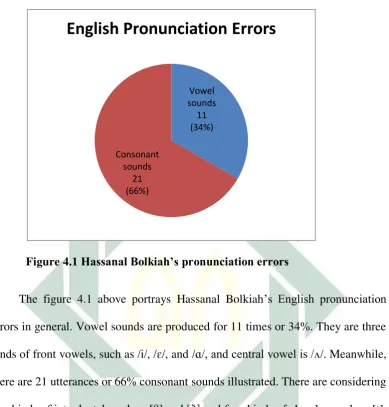
Eventually, there are 11 vowels and 21 consonant sounds which were found in Hassanal Bolkiah’s speech. The speech has 504 words which spent 6.39 minutes.
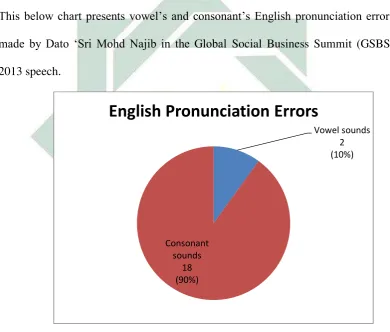
This below chart presents vowel’s and consonant’s English pronunciation errors
made by Hassanal Bolkiah Mu’izzaddin Waddaulah in the speech of the
“excellent’ bilateral and diplomatic relation between the two countries, Philippine
Figure 4.1 Hassanal Bolkiah‟s pronunciation errors
The figure 4.1 above portrays Hassanal Bolkiah’s English pronunciation
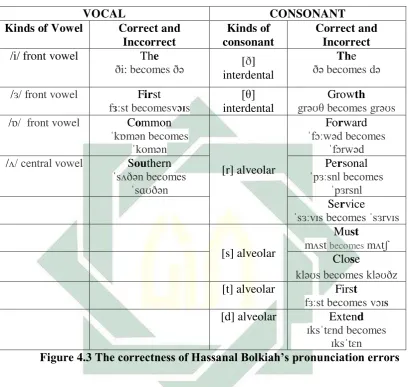
errors in general. Vowel sounds are produced for 11 times or 34%. They are three kinds of front vowels, such as /i/, /ɛ/, and /ɑ/, and central vowel is /ᴧ/. Meanwhile,
there are 21 utterances or 66% consonant sounds illustrated. There are considering two kinds of interdental, such as [θ] and [ð] and four kinds of alveolar, such as [t],
[d], [s], and [r]. The frequency and the percentage of each error are charted in
figure 4.2 below.
Vowel sounds
11 (34%)
Consonant sounds
21 (66%)
Figure 4.2 TheFrequency and Percentage of Hassanal Bolkiah‟s
pronunciation errors
In figure 4.2 above, each Hassanal Bolkiah’s pronunciation error is drawn.
The red bars depict vowel sounds while the blue bars signify consonant sounds. ‘[ð] Interdental consonant sound’ reaches the biggest frequency among all
pronunciation errors. It is portrayed for 11 times or 33%. On the contrary, ‘/ɛ/
front vowel’, ‘/ɑ/ front vowel’, and ‘/ᴧ/ central vowel, [t] alveolar consonant
sound and [d] alveolar consonant sound become the lowest items which are only