The Elements of
INTERNATIONAL
ENGLISH
M
.
E.Sharpe
Armonk, New York
London, England
The Elements of
INTERNATIONAL
ENGLISH
Style
A GUIDE TO WRITING
CORRESPONDENCE, REPORTS,
TECHNICAL DOCUMENTS,
and INTERNET PAGES
FOR A GLOBAL AUDIENCE
All rights reserved. No part of this book may be reproduced in any form without written permission from the publisher, M.E. Sharpe, Inc.,
80 Business Park Drive, Armonk, New York 10504.
All brand names and product names used in this book are trade names, services marks, trademarks, or registered trademarks of their respective owners,
and have been appropriately capitalized. M.E. Sharpe, Inc., is not associated with any product or vendor mentioned in this book.
Library of Congress Cataloging-in-Publication Data Weiss, Edmond H.
The elements of international English style : a guide to writing English correspon-dence, reports, technical documents, and internet pages for a global audience / by Edmond H. Weiss.
p. cm.
Includes bibliographical references and index. ISBN 0-7656-1571-1 (hardcover : alk. paper)
1. English language—Style—Handbooks, manuscripts, etc. 2. Communication, International—Handbooks, manuals, etc. 3. English language—Textbooks for foreign speakers. 4. Web sites—Design—Handbooks, manuals, etc. 5. Technical writing— Handbooks, manuals, etc. 6. Report writing—Handbooks, manuals, etc. 7. Letter writing—Handbooks, manuals, etc. I. Title.
PE1421.W39 2005
808’.042—dc22 2004021680
Printed in the United States of America
The paper used in this publication meets the minimum requirements of American National Standard for Information Sciences
Permanence of Paper for Printed Library Materials, ANSI Z 39.48-1984.
~
to the emotions of the hearers . . .
—Aristotle
Whether you are developing information for non-native speakers of English or information that
a vendor is going to translate, you must write in an international style that transcends culture.
vii
Contents
Preface xi
Acknowledgments xvii
1. The Language of Global Business Is International
English 3
A Riddle 3
What Is International English Style? 4
The Two Strategies: Culture-Free, Culture-Fair 11
Discussion Questions 13
Sources and Resources 14
2. Principles of Simplicity 15
Meaning and Risk 15
Ogden’s Basic English 17
Tactic 1: Adopt a Locally Invented, Controlled English 18
Tactic 2: Adopt a Reduced Dictionary 19
Tactic 3: Adopt an Industry-Sanctioned Controlled English 19
Tactic 4: Choose Words with One or Few Meanings 21
Tactic 5: Avoid Verbs with Two or Three Words in Them
(Phrasal Verbs) 24
Tactic 6: Use the Simplest Verb Forms 25
Tactic 7: Define Many Terms in a Glossary 26
Tactic 8: Choose Words that Are Pronounceable 28
Tactic 10: Avoid Redundant and Wordy Expressions
for Time and Place 30
Tactic 11: Avoid Unhelpful Redundancies 32
Tactic 12: Avoid Nominalizations 33
Discussion Questions 36
Sources and Resources 36
3. Principles of Clarity 38
The Problem: Clear Only If Known 38
Tactic 13: Be Careful of Loosely Connected Words and
Phrases 40
Tactic 14: Be Aware of Frequently Misplaced Descriptive
Words 42
Tactic 15: Do not Confuse Frequently Confused Terms 43
Tactic 16: Form Words in Standard Ways 45
Tactic 17: Use Standard Spellings 46
Tactic 18: Avoid Converting Nouns into Verbs 46
Tactic 19: Be Aware of the Several Englishes 47
Tactic 20: Be Careful with Money and Dates 48
Tactic 21: Avoid Illogical or Arbitrary Idioms 48
Tactic 22: Avoid Words that Can Have Opposite Meanings 50
Tactic 23: Avoid Abbreviations, Contractions, and Acronyms 51
Tactic 24: Avoid Figurative Language in General 51
Tactic 25: Avoid Literary and Cultural Allusions 52
Tactic 26: Avoid Military and Sports Vocabulary 53
Tactic 27: Avoid Technical Terms Used with Nontechnical
Meanings 55
Tactic 28: Avoid Business Jargon and Fashionable Business
Terms 56
Tactic 29: Avoid Regionalisms and Slang 57
Tactic 30: Avoid Sarcasm or Irony 58
Tactic 31: Avoid Humor and Wordplay 59
Tactic 32: Suit Your English Idiom to the Local Language 60
Discussion Questions 61
Sources and Resources 62
4. Reducing Burdens 63
Reading and Stress 63
Tactic 34: Prefer Simple Sentences to Compound Sentences 66
Tactic 35: Prefer Simple Sentences to Complex Sentences 67
Tactic 36: Retain Certain Optional Words 68
Punctuation and International English 69
Tactic 37: Use Commas Aggressively 72
Tactic 38: Use Hyphens Aggressively 73
Tactic 39: Avoid Quotation Marks 75
The Burdensome Page 77
Tactic 40: Do not Justify Text, but Do not Break Words
at the Ends of Lines 78
Tactic 41: Create a Readable, Accessible Page 80
Tactic 42: Reduce GOTOs 84
Tactic 43: Break Apart Long Paragraphs 85
Tactic 44: Convert Some Paragraphs into Lists 86
Tactic 45: Convert Some Paragraphs into Tables 87
Tactic 46: Convert Some Paragraphs into Playscripts 87
Tactic 47: Convert Some Paragraphs into Decision Tables 88
Tactic 48: Convert Some Paragraphs into Logic Diagrams 89 Reducing Burdens as an Ethical Objective 90
Discussion Questions 90
Sources and Resources 91
5. Writing for Translation 93
Limits on Translation 93
Translation Is a Business Expense 95
Preparing a Manuscript for Translation 97
Controlled Language and the Future of Translation 99
Discussion Questions 103
Sources and Resources 104
6. Principles of Correspondence 105
Business Letters: An Exercise in Style 105
Tactic 49: Eliminate Western Letter Lingo and Formats 107
Tactic 50: Adopt the Receiver’s Format 111
Tactic 51: Emulate the Receiver’s Opening Paragraph and
Customary Closing 115
Tactic 52: Emulate the Receiver’s Content Restrictions 116
What about E-mail? 118
Discussion Questions 122
Sources and Resources 123
7. Principles of Cultural Adaptation 124
Was der Bauer nicht kennt . . . 124
Tactic 53: Be Extremely Polite and Formal 127
Tactic 54: Assess Other Cultures without Stereotyping 129
Tactic 55: Localize Radically 131
Tactic 56: Define Your Graphics Strategy 133
Tactic 57: Consider Hall’s Context Continuum 133
Issues of Philosophy and “Hypernorms” 135
Discussion Questions 139
Sources and Resources 140
Appendixes
1. Projects for Students of International English 141
2. Sentences that Need Editing 143
3. Instructional/Technical Passages that Overburden
the Reader 145
4 A Portfolio of Bad News Letters 149
5. An Internationalized Website Checklist 153
xi
Preface
Several years ago, a client (one of the world’s largest corporations) ap-proached me with a problem. According to the firm’s market research, more than half the people visiting the company’s website were reading English as their second language—and the proportion was increasing daily. Given this trend, the client asked, should the company rethink its editorial policies, develop new standards for writers (whom they called “content providers”), perhaps even develop an alternative version of the website for persons with less than fluent English?
After several discussions, we realized that most of the conflicting alternatives involved a clash between two principles: globalization, pro-ducing a one-size-fits-all solution for a diverse world of English speak-ers, versus localization, adapting and modifying this universal model for particular readers, in particular locales. The first principle proposes, for example, the elimination of nearly all figurative language (no “ballpark estimates” or “advertising blitzes”); the second recommends the use of English figures and idioms that resemble those peculiar to the first language of the reader (“one may access the account by the Internet” for German speakers of English, for example).
in an especially clear, lean, “bullet” style, even though some cultures regard the use of bullets as a sign of poor education? In preparing an English report for a Chinese reader, should you put a hyphen in the word “mis-led,” knowing that such a hyphen, helpful as it might be to the reader, is incorrect punctuation?
English is the first language of about 400 million people (E1s). But there are more than another billion people who speak it either as a second language (E2s), usually in their business or profession, or as a foreign language (E3s), speaking or reading only rarely, as needed. As difficult as it is to communicate clear, unambiguous information to E1s, it is even more difficult to communicate with E2s, who read and evaluate an increasingly larger proportion of our business and techni-cal documents.
The labels E1, E2, and E3 used above are adaptations of David Crystal’s L1, L2, and L3 in English as a Global Language (Cambridge University Press, 1997) and refer generally to those who speak a par-ticular tongue as their first, second, or foreign language. In my adapta-tion, E2 speaks English as a second language; M2 speaks Mandarin Chinese as a second language. Although this system may sometimes appear insensitive and mechanistic, it is preferable to such long-winded expressions as “those who speak English as a second language” and to such culturally charged terms as native or mother-tongue.
All communication risks misunderstanding, and communication be-tween E1s and E2s simply increases those risks. As this book explains, sometimes the best way to contain the risk is to write in an unusually readable style—using short words, short sentences, and elementary verb forms, and eliminating idioms such as stone’s throw and expres-sions with many meanings, such as have been detained.
Sometimes, however, this first set of tactics—which are common to much good business and technical writing—needs to be modified to suit E2. Familiar, clear words, including make, set, fix, or hold, can have too many context-dependent meanings and might better be re-placed with longer words that have fewer meanings: construct, define, repair, or conclude, for example. Everyday phrasal verbs, notably check out, might be replaced with investigate or leave, depending on what is intended.
• Business students, graduate and undergraduate, especially those concerned with international business who find that their texts do not adequately address the problems of International English,
• Communication students, especially those preparing for careers in business and technical writing/editing,
• Trainers and seminar leaders, especially those who organize and facilitate workshops and short courses on international and inter-cultural communication,
• Business professionals, especially those who have become aware of the difficulties and frustrations of using English as a global lan-guage of commerce, and
• Writers and editors (business and technical) whose job is to revise E1’s drafts and prepare them for an international readership.
Although E2s who also write English as their second language will get many good ideas from this text, it is mainly intended for E1s. In many ways, the more facile and comfortable one is in writing English, the more prone one is to making the many errors explained here. For example, whether to start an International English sentence with although
is only an issue for writers who start sentences with although. (Not ev-eryone does.)
International business communication is filled with small tactical prob-lems and must resolve many serious ethical, economic, and philosophi-cal questions as well. For example: How much should the sender of a message be expected to adapt to the limitations of the receiver? Is it ever ethical for an honorable person to be ambiguous, even when that person is writing to people who prefer ambiguity? Will the Internet eventually familiarize all English speakers with American figures of speech? Is it necessary to be gender-sensitive in International English, when most of the first languages spoken by E2s have a nonpolitical view of gender in language? What should companies do if they plan to use machine trans-lation of their documents and web pages?
• Principles of Simplicity, that is, how to choose the right words and phrases for an E2 document.
• Principles of Clarity, that is, how to reduce the chances that pas-sages and sentences will mislead or befuddle the E2 reader. • Reducing Burdens, that is, decreasing the effort and stress
associ-ated with a passage or document, increasing the chances the E2 will understand it correctly.
• Writing for Translation, that is, focusing the advice so far in ways that support and simplify the work of translators—human or machine.
• Principles of Correspondence, that is, the special issues of style and manner associated with formal letters, on the one hand, and less formal e-mail, on the other.
• Principles of Cultural Adaptation, that is, broader, contextual con-cerns about the barriers between cultures and the ethical ambigu-ities in intercultural exchanges.
• Appendixes with projects for teachers, students, and workshop leaders.
Except for the Appendixes, each chapter concludes with discussion questions related to the topic of the chapter. Although the link between topic and question may not initially be apparent, all the questions are indeed germane and productive. In every case, the question is meant to stimulate a discussion that will lead either to the clear conclusions of the previous chapter or, in a few cases, to an important irresolvable contro-versy. So, the chapter on clarity asks: Have you ever lost time or money trying to follow unclear instructions? This query should underscore the economic value of editing and revising, which is the main reason for making business documents clearer. In contrast, a question at the end of the chapter on burdens asks students about the different levels of diffi-culty in the texts they use and their effect on them. This question should lead to a provocative argument about the responsibilities of authors and publishers to their readers, with some discussants noting that many suc-cessful and respected sources feel no obligation to reduce the burden on their readers at all.
is relatively easy and straightforward to use this style to present certain long documents such as service manuals or product specifications, it is quite another thing to write a hundred pages of concepts, anecdotes, and insights without some wordplay, figurative language, and more than an occasional complex sentence. When International English documents are well prepared, they are clear, efficient, reliable, readable, and trans-latable; for these reasons, they are also rather dull and colorless.
xvii
Acknowledgments
The Elements of
INTERNATIONAL
ENGLISH
3
1
The Language of Global Business
Is International English
Business and technical documents intended for those who read English as their second language must be unusually simple, unambiguous, and literal. Ideally, they should be edited for ease of translation. They must also be free of cultural irritants and distractions. Every native speaker of English (E1) must learn to edit and revise documents meant for international readers.
A Riddle
Here’s a riddle heard on a business trip to the Middle East:
Question: If a person who speaks many languages is called multilin-gual and a person who speaks two languages is called bilinmultilin-gual, what is a person called who speaks only one language?
Answer: An American.
Today, such travelers, even if they are not more enlightened, have an easier time of it. Nearly one-fourth of the people on Earth speak English well enough to perform everyday tasks and share the ideas that occur in normal conversation. But most of that group, more than a billion people, speak English as their second language, not their first. Although many people throughout the globe lament the rapid spread of English, com-plaining that it has displaced and obviated other languages, English has gained currency mainly as a second language, not a first. No demo-graphic projection in any study shows that English is becoming the first language of significantly more people. In fact, the British organization charged with estimating the future of the English language predicts the opposite: that the proportion of native speakers of English (referred to in this text as E1s) in the world will continue to decline in this century and may even be overtaken in its second position by Hindi/Urdu. In-deed, in the United States, English is already losing ground to Spanish (Gradol, 2000).
Those of us who are E1s and who study the international uses of English do not expect it to replace any major language, except, perhaps, for certain specific international uses such as scientific journals. On the contrary, the purpose of this text is to remind those with the best grasp of English, who acquired that ability without the ardors of learning a second language, that they have an added responsibility when they com-municate with those who read English as their second language (E2s). Nor does this text suggest that Americans—or anyone else—should be smug about knowing only English. Living well in the twenty-first cen-tury—being a good citizen and an effective professional—virtually re-quires us to learn at least one other language, at least well enough to make friends when we travel. Such knowledge will improve our ability to write and speak in an International English Style.
What Is International English Style?
main difference, however, is that about two-thirds of them speak Chinese as their first language (M1) and only a third as a second language (M2).
Furthermore, for various demographic reasons, the number of E1s is declining, if not absolutely then as a proportion of the world’s popula-tion, whereas the number of E2s is growing. That is, the typical writer/ reader of English is increasingly someone who has learned it as a sec-ond language. It is projected that by the middle of the twenty-first cen-tury, most of the countries that have an official second language will have selected English as that language. Thus, in those countries that publish official documents in two languages, the second will probably be English; in those countries that require children to learn a foreign language, that language will be English; and in those countries that de-mand second-language competence as a condition of employment in the government or civil service, English will usually be that language. (One Chinese leader has expressed the goal that all Chinese people should learn English.)
Currently, hundreds of thousands (perhaps millions) of school chil-dren are enrolled in compulsory or strongly recommended English courses throughout the world. These students know that not only their academic careers but their ultimate earning power will be shaped to some extent by how well they can conjugate the exasperating English verb to lay or pronounce correctly the illogically spelled says. One can also suspect that most of these students are pursuing the language reluc-tantly, especially in those countries where English is associated with colonialism or with controversial American foreign policy or trans-national corporations.
When David Crystal calls English a “global language,” he is talking about its widespread study and use by nonnative speakers: E2s. What makes English a global language is the way it is used: to support inter-national commerce, to unify communities with diverse languages, and to provide a lingua franca, a universal language, much as Latin became in the Middle Ages and French until the early twentieth century.
Aérospatial (AECMA), a Belgian organization, to make English the of-ficial language of the world aircraft industry. Rather, English emerged as a global language in the Twentieth Century through the combined effect of American economic and military power. (In contrast, British influence was in sharp decline in the last century.)
By International English Style, I mean an approach to English that reflects an appreciation of its global uses and sensitivity to the needs of the E2 reader. Of course, not all E2s require special treatment. People with an aptitude for languages can master two or three of them, writing and speaking not only competently but beautifully in all. Some of the finest prose in English is the work of E2s, including some by writers who did not begin the study of the language until they were adults.
For the most part, however, International English will be read not by the linguistically gifted but, rather, by those tens of millions of ordinary folks who were coerced by school systems or compelled by economic necessity to learn this quirky tongue with its exotic spelling, esoteric rules of word order, and huge, synonym-filled vocabulary. Most of them, moreover, will be using an alphabet different from their own— always an immensely difficult task—and perhaps even a separate key-board for their word processor. In addition, a good many may even resent the fact that America’s economic or military might has forced them to set aside their own language and to sacrifice their own com-fort and fluency.
Imagine, for instance, how the French feel about the use of English in European websites or how they regard Algeria’s decision to make En-glish, not French, its official second language. France is one of the few countries still policing its business communications to keep out incipi-ent English words. Or think of a billion Indians, and their tense history with Britain, who are obliged to use English to bridge the language gaps within their linguistically diverse country or as a way to secure those controversial “outsourced” American jobs. Empathize for a moment with those who see English as a linguistic juggernaut, driving minor lan-guages out of existence and devaluing fluency in any other tongue.
who read English as their second language, typically as part of their work or education.
Generally, the following pages contain lists of tactics and tips that will help the reader learn how to handle word choice, punctuation, or verb forms. These tactics follow from two broad communication pre-cepts of International English Style:
• First, reduce the burden on the E2 reader in every way possible, but without condescending or “writing down.”
• Second, write for translation, that is, for a reader who might con-sult a bilingual dictionary.
Nearly all good writers and editors of business prose try to reduce the burden on their readers in order to satisfy Henry Fowler’s objective: to make the sentences understandable on one reading (Fowler, 1926). Simi-larly, writing well for an E2 reader generally means using the same methods and editorial principles one uses in writing for an E1 reader— only more so. That is, one should write even simpler, clearer, easier-to-read material for the E2 easier-to-reader than one writes for E1s: short familiar words, short uncomplicated sentences, active and indicative verb forms. Most of the battle in communicating with E2 readers can be won by applying George Orwell’s most basic rules of style (see Orwell, 1946):
• Never use a long word where a short one will do.
• Never use a foreign phrase, a scientific word, or a jargon word if you can think of an everyday English equivalent.
• If it is possible to cut a word out, always cut it out.
1. Reading is hard; writing is harder.
2. Reading is difficult; writing is more difficult than reading.
By almost any standard of editing, the first version is better written than the second. It contains not only fewer words but fewer words with more than one syllable. (Most measures of readability are based on two vari-ables: words-per-sentence and syllables-per-word.) Version 1 is plain, direct, even slightly poetic. In contrast, the second is slow, pedestrian, and prosaic. What is more, according to the Flesch-Kincaid Readability Index, a metric used to enforce the readability standards of U.S. govern-ment docugovern-ments, the first sentence requires only a third grade education to understand, while the second requires a seventh grade education.
Probably everyone from George Orwell to Strunk and White would consider the first better than the second. Yet, people who read English as their second language would probably have more trouble with the first than the second. Why?
In the first, better-written version, the key word is hard, a word with several meanings; a person learning English would not learn the meta-phorical, “difficult” sense of hard first. Nor would the bilingual dictio-nary such a person consults list the “difficult” equivalent as the first meaning. Furthermore, the second part of the better sentence is elliptical— it leaves words out deliberately. People who speak idiomatic English know that “harder” means “harder than reading.” Would someone whose En-glish was less fluent, less idiomatic, know what was missing?
Writing in an International English Style also means removing meta-phors, vogue expressions, and the kind of breezy style that characterizes much business communication. Consider this professionally written copy from a brokerage’s website:
Before:
We set no boundaries on what we can accomplish with our cli-ents. Where others see insoluble problems, we see unexpected opportunities to create new products, to introduce new technol-ogy and to enter new markets. Above all, we constantly seek to provide our clients with the timely, informed and imaginative in-sights necessary for them to achieve their objectives. The possi-bilities of today’s international markets are boundless. And so is our commitment to working with our clients to seize them. You will find this spirit reflected throughout this Annual Review from the fundamentals of our firm’s culture to the array of successes we helped our clients attain during 2000.
It is difficult to simplify and clarify this text because, frankly, it con-sists of little more than hollow self-congratulation and untestable claims. If we revise it to make it friendlier to E2, however, it becomes:
After:
We can accomplish much with our clients. Where others see difficult problems, we see opportunities to invent new products, to introduce new technology, and to enter new markets. Most important, we always provide our clients with the timely, intelli-gent, and imaginative ideas they need to succeed. The potential in today’s international markets is huge. And so is our commit-ment to help our clients profit. This promise is in every part of this Annual Review: from our fundamental principles to the list of successes we helped our clients to attain in 2000.
(Grade 11 Reading Difficulty)
Even though most E1 readers might prefer the richer style of the Be-fore version, most E2 readers (and translators) would probably prefer the After. Granted, it is more prosaic and colorless. But it is clearer, easier to follow, and, ironically, easier to see for what it is: unsubstanti-ated self-praise. This explains why, generally, advertisements and cor-porate puffery translate poorly: they contain more sound than substance. Generally, English meant for international business or technical consumption needs to be stripped of its humor, poesy, figures, and allusions—much of what makes reading pleasurable. Most wordplay will do nothing more than confuse or distract E2. Richard Lanham, one of the best writers on writing, represents an interesting case. In the excellent Revising Business Prose and several predecessor text-books, he advocates the stripped-down, colorless approach. But in the less well-known—but far more stimulating—work, Style: An Anti-Textbook, written well before he saw the potential return in urging people to write colorlessly, he takes a nearly opposite view, urging business and professional writers to have as much fun with their lan-guage as they can.
electronic, to my seminars. Writers should consider what E2s will find when they consult that dictionary.
For example, American writers are fond of the word need to mean “wish” or “preference”: create a need, meet the needs of, satisfy client needs, or assess training needs, and so on. One might even argue that the use of need is a deliberate ploy by business writers meant to create the misimpression that there is no choice, only necessity. Unfortunately, Cassell’s French-English Dictionary defines need as:
1. besoin (close to the meaning above, but with a greater sense of urgency or discomfort)
2. nécessité (requirement, essential)
3. adversité (a condition of threat or frustration) 4. indigence (near-poverty)
Clearly, this overworked term needs to be replaced with a more pre-cise English synonym: create a demand, give the clients what they re-quest, assess skill deficiencies. Applying this principle often reverses the most basic rule of editing: to prefer the shortest, simplest, most fa-miliar word. Unfortunately, the short, commonplace words of English tend to have the largest number of meanings; the word set leads the Oxford English Dictionary in number of definitions. Thousands of basic English verbs will have a dozen or more definitions in a substantial bi-lingual dictionary: make, take, fix, reach. The problem is exacerbated when they are part of two- and three-word phrasal verbs such as take out
or make a fool of, or nominalizations like make a distinction, take a decision (Brit.), fix limits, reach a consensus.
Making matters more difficult is the fact that thousands of English words can be several parts of speech. For example, close is noun, verb, and adjective; closer is noun when pronounced one way and an adjec-tive when pronounced another.
And if that were not enough, we must also remember that when pub-lishers issue bilingual dictionaries they will want, if possible, to use uncopyrighted, public domain editions. This means that their English definitions may be based on a dictionary 50 to 100 years old, in which the oldest meanings probably will be listed first.
that it has a prefix. No English or bilingual dictionary will list the word
uncopyrighted. What then should the writer/editor do? Select “books that are no longer copyrighted,” or “un-copyrighted”? The latter choice, which solves the dictionary problem, will irritate most technical and business editors, who are forever removing unneeded hyphens from the writing of people who put “pre-test” into their drafts. Indeed, the rec-ommendation that International English documents be punctuated ag-gressively, with more hyphens and commas than modern English requires or permits, generates more resistance from professional editors than any other tactic proposed in this text.
In short, sometimes the best way to write for E2 is to write for E1 with more demanding thresholds of readability and stricter tolerances. This is the style Lanham calls CBS: Clear, Brief, and Sincere. At other times, however, E2 is better served by a longer word, a nonstandard punctuation mark, or a restored elliptical word or phrase.
The Two Strategies: Culture-Free, Culture-Fair
In general, then, adapting a draft for international readers of English requires two classes of changes:
• Stripping away linguistic and cultural distractions and irritants, making the document, insofar as possible, culture-free.
• Adding to the document items and styles designed specifically to please and attract the local communication culture, that is, making the document culture-fair.
Culture-freewriting is an aspect of a business and marketing strategy called globalization: modifying products, technologies, and the associ-ated documents, labels, and literature so that they will be acceptable anywhere in the world in a single form. Interestingly, the globalization of a product frequently is the effect mainly of changes in communica-tion: choices in packaging, color, illustration, branding, and language. The process is iterative, requiring feedback from readers whose sensi-bilities may be hard to predict, and it consists mainly in removing things that might confuse or offend—and then removing even more things.
itself—a book, report, proposal, stand-alone website, curriculum vi-tae, or R&D brochure. For example, a friend who writes articles for the gem and jewelry trade recently published a piece about heat-treated sapphires, which he called Blue Devils. According to his account, a significant number of Iranians in the New York precious stone com-munity “went ballistic.” Indeed, consider how often devils—a highly charged symbol in several cultures—appear innocently as logos, mas-cots, product names.
In any case, globalizing the text, at the very least, compels us to edit out this year’s vogue words (“actionable”) or, in more ambitious appli-cations, avoid constructions that start with until—an English construct missing from many modern languages. Globalizing also means replac-ing figurative expressions with literal ones and newly-coined words with traditional ones. It may even require the replacement of newly-coined terms and names hard to pronounce in half the world with others that are more easily pronounced. (People “subvocalize” to themselves while they read; a word that is hard to pronounce—notably one starting with r or
th—will slow down even a silent reader.) The most extreme form of globalization is to use a controlled form of English, a restricted vocabu-lary and syntax engineered specifically for clarity and simplicity. Con-trolled languages, as will be explained later, also facilitate machine translation.
Globalization is a modernistic strategy seeking one-size-fits-all solu-tions, which, to a modernist, are also the best practices. Viewed favor-ably, it is an attempt to be simple, clear, and inoffensive—all of which are always good goals for a communicator. Looked at unfavorably, how-ever, it is an attempt to reduce effort and save money by making one product or document for everyone, without expending the effort or money to adapt it to local needs or preferences.
In contrast, the postmodernistic process that leads to culture-fair com-munication is called localization: adapting a global product for local use, or modifying a product developed for one locality so that it better suits another, seeking a “goodness of fit” between the product/text and the local culture.
Even when the document remains in English, however, numerous opportunities for localization present themselves. Certain cultures, for example, look with distrust at the bullet-list memo that is so popular in the United States; to localize the English version, one might change the format. Although globalization usually means removing all pic-tures of people from business documents, localization can entail re-placing them with pictures of people who look, work, and dress like the readers.
Most of the websites concerned with localization emphasize the prob-lem of changing the characters used on computer keyboards; yet the concept is much broader. Localizing a text with great intensity—what Nancy Hoft (1995) calls “radical localization”—can involve adapting to the particular learning styles of different reader cultures or adjusting the granularity of the information to correspond to local teaching customs. Writing in an International English Style, then, requires a comple-mentary use of both strategies: replacing the vogue technical term granu-larity in the previous sentence with a simpler alternative such as level of detail (globalization strategy), while adding a bilingual glossary of tech-nical terms for a particular edition (localization strategy). Above all, it requires a constant awareness—and an extra iteration of editing—to ensure that E2 gets the message.
In sum, a first-draft document by an E1 writer, no matter how facile or articulate, will almost never be appropriate for an E2 reader. It will take more time to edit than most business writers are inclined to allo-cate. This text urges E1 writers to make the time and to appraise this use of resources as a sound investment.
Discussion Questions
• Should American business students be required to study a foreign language?
• Is it responsible for a company to send someone who speaks only English to conduct sensitive business interactions among people who do not speak English well?
• Does it matter how many languages there are in the world? Why or why not?
• In most social situations, who should adapt to whom: the host or the guest?
Sources and Resources
Chaney, Lillian, and Jeanette Martin. Intercultural Business Communication.
Englewood Cliffs, NJ: Prentice-Hall, 1995.
Crystal, David. English as a Global Language. Cambridge: Cambridge University Press, 1997.
Gradol, David. The Future of English? The British Council, 2000. (www.britishcouncil.org/learning-elt-future.pdf).
Guy, Vincent, and John Mattock. The International Business Book. Lincolnwood, IL: NTC Business Books, 1995.
Hoft, Nancy. International Technical Communication. New York: John Wiley & Sons, 1995.
Kachru, Braj B. (ed.). The Other Tongue: English across Cultures. 2nd ed. Chicago: University of Illinois Press, 1992.
Kirkman, John. “How Friendly Is Your Writing for Readers around the World?” In
Text, Context, and Hypertext: Writing with and for the Computer, Edward Barrett (ed.). Cambridge, MA: MIT Press, 1988.
Lanham, Richard. Style: An Anti-Textbook. New Haven, CT: Yale University Press, 1974.
Lanham, Richard. Revising Business Prose. New York: Macmillan, 1999.
Leninger, Carol, and Rue Yuan. “Aligning International Editing Efforts with Global Business Strategies.” IEEE Transactions on Professional Communication 41, no. 1 (March 1998): 16–23.
Orwell, George. “Politics and the English Language” (http://eserver.org/langs/ politics-english-language.txt).
Strunk, William, and E.B. White. The Elements of Style. 4th ed. New York: Macmillan, 1995.
Thrush, Emily A. “Bridging the Gaps: Technical Communication in an International and Multicultural Society.” Technical Communication Quarterly (Summer 1993): 271–283.
15
2
Principles of Simplicity
Selecting or coining the right words can increase the chances that E2 will understand E1’s writing. English has an immense vocabulary with several synonyms for most terms. Generally, writing in an International English Style
requires us to restrict our vocabulary and discipline other language choices. The objective of this chapter, therefore, is to suggest the most effective ways to replace potentially unclear vocabulary and to trim away unnecessary words.
Meaning and Risk
People who study the techniques and troubles of verbal communication are sometimes amazed that anyone ever understands anyone else. Indi-vidual words can have a dozen meanings, only a few of them eliminated by context. Adjacent to other words, they can modify and be modified in ways the author never expected. There are even some students of lan-guage, influenced by the later philosophical investigations of Wittgenstein, who insist that no individual speaker or writer means precisely the same thing by the same word in any two utterances.
From the practical perspective of business and technical communi-cation, however, much of this discourse analysis is unhelpful—except to remind us that the reader is an active participant in the writing/ reading transaction, not a passive receptacle for information. Com-merce, government, and science demand that writers be understood. Even if writers cannot entirely manage and control what the readers will do with and to the text, they can at least limit the choices and reduce the opportunities for misunderstanding. In effect, making a text easy to understand usually means making it harder to misunder-stand. Editing for E2s, moreover, means making it especially hard to misunderstand.
Both globalization and localization are ways of minimizing the chance that E2 will bring an interpretation to the text that is too far from the writer’s intention. Obviously, because E2 has more ways to misread any string of words than E1, the need for simplicity and con-taining risk is even greater. The most common approach is to reduce radically the number of words and other verbal forms that may be used in the documents. So, for example, it is unwise to use the verb to table, which has opposite meanings in British and American English. Similarly, we should avoid depend from, an idiomatically correct form that is hardly ever used, and probably not use absent as an elliptical form of in the absence of (“absent any problems”).
Usually, the best vocabulary choices are words E2s learn in the first few years of English study: house, not domicile or residence;teacher,
not instructor or facilitator or even lecturer;start, not initiate, initial-ize, or implement: long, not extended or protracted. Similarly, it is usually better to use the simple, fundamental forms of the present and past tense rather than such English verb forms as the past emphatic (he did run), which lack equivalents in many other languages.
Ogden’s Basic English
The inspiration for many simplified and limited forms of English is C.K. Ogden’s Basic English, developed in the 1930s (Ogden, 1932). Ogden proposed that English should be learned and used globally. He observed that English has far fewer arcane word endings to learn than almost any other major language and that its conjugations and declensions are among the simplest. German, for example, has a gender and case inflection for every definite article, with both regular and irregular forms; English has the.
The main drawbacks to English as a global language, as he saw it, were its wild spelling practices and its immense vocabulary. (The Shorter Oxford English Dictionary has 25,000 entries.) To solve the former prob-lem, Ogden, like many language radicals of the period, including George Bernard Shaw, proposed a new set of phonetic spelling rules, so that, for example, cough and cuff would evidently end with the same sound. Not surprisingly, Ogden’s spelling crusade—like everyone else’s—failed. But his attack on vocabulary was far more successful.
Ogden proposed that the rich mess of English vocabulary could be reduced to 850 words, and that this tiny list, capable of being learned in a few days or weeks, could, with the application of a few consistent prefixes and suffixes, be adequate to sustain an adult level of conversa-tion on a wide variety of personal and professional topics. Ogden’s gram-mar recommendations and word list are widely available in books and on websites (for example, http://www.fact-index.com/b/ba/ basic_english.html), but to get a sense of the vocabulary, consider the following lists, all the permitted words beginning with u or y:
• U-words—umbrella under unit up use
• Y-words—year yellow yes yesterday you young
The writer of Basic English has no until, unless, upset, or usual, as well as no yet, yonder, or yoghurt. Ogden’s argument is that, somewhere in the list of 850, there is a close enough equivalent word or phrase to stand for the forbidden word—“dog doctor” for “veterinarian,” for example.
controlled languages, what has been most retained is the word list—still used as the basic vocabulary in beginner’s courses on English, espe-cially in Asia.
Tactic 1: Adopt a Locally Invented, Controlled English
Many firms that write for an international audience elect to control the vocabulary and grammar in their documents, not just as a vague edito-rial goal but as a matter of enforced policy. Taking inspiration from Ogden’s work, they develop a restricted vocabulary (1000 to 3000 words, plus unlimited product-specific terms, is typical) and limit the number of permissible sentence patterns. As inconvenient, even chafing, as this may be for the communicator, it radically reduces the burden on E2 and E3 readers, and especially on translators.
Beyond Ogden’s foundation, these languages also learn from the higher level computing languages—like COBOL and FORTRAN—developed in the 1950s and 1960s. Instead of writing in a natural, uninhibited form of English, they use what the computer professional calls a “pseudocode,” a language somewhere between ordinary English and computer code. Such artificial languages contain the following components:
• A list of approved verbs with their single definitions
• A list of approved logical operators, such as “if,” “more than,” and “of”
• A list of approved basic nouns
• An expandable list of new technical and product terms (mostly nouns) that may be added to accommodate the discussion of new topics, provided they can be defined with terms already in the offi-cial dictionary
The keys to implementing such a project are, first, a self-contained dictionary that uses only the terms in the controlled language, a re-quirement nearly impossible to meet with Ogden’s 850-word list; and second, a software product that flags every deviation in the text and, like an ordinary spell checker, suggests replacements that are within the system.
for its Ogden-influenced “Caterpillar English,” an especially poetic phrase. And Kodak long ago attacked the problem of translating its film and camera product literature by creating parallel simplified versions of English and the translation languages. IBM has “Easy English,” Gen-eral Motors has “CASL,” and Sun and Avaya (among others) have their own versions of Controlled English.
As will be explained later in this chapter, there are numerous sophis-ticated software products available that not only contain existing sim-plified and controlled versions of English, but, more important, provide the platform and tools with which to construct one’s own, using the available versions as a starting point. The potential benefits for E2 read-ers and translators are immense. The only ones who sometimes resent controlled languages are skilled and professional communicators, who find their rules and structures nearly demeaning. Indeed, it would prob-ably be a mistake to assign an experienced professional writer to work in such an environment—except, perhaps, as the overall supervisor and editor.
Note also that, in practice, nearly any word can be used in a con-trolled document, as long as it is defined or explained in a glossary. Although it would defeat the purpose of the method to have too many such exceptions, it also solves the problem associated with all standard methods: how to deal with the unanticipated special case.
Tactic 2: Adopt a Reduced Dictionary
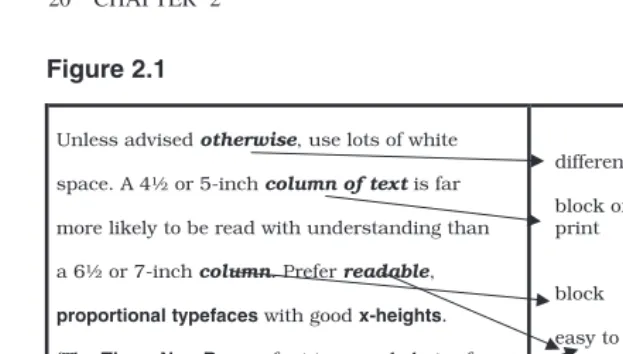
Short of this extreme, one may merely adopt a limited dictionary, such as the Beginner’s Dictionary of American English Usage, and use only words that appear in it. In Figure 2.1, for example, all the words that do not appear in the Beginner’s Dictionary are italicized and point to syn-onyms that do appear in the dictionary. Those terms that do not appear in the dictionary, but are appropriate technical terminology, are bold-faced and will appear in the glossary.
Tactic 3: Adopt an Industry-Sanctioned Controlled English
instructions in English. I have worked with E2 writers, writing in En-glish, in an aircraft manufacturing company and have seen the impres-sive results they achieved in documents as sensitive as maintenance and service instructions for jet airplanes. Furthermore, those wishing to use SE, or another controlled form of English, can choose from several tools to aid the writing and editing. The following list, necessarily incomplete because of the rapid growth in this industry, is offered as introduction to the technology, without recommendation or evaluation:
• The Boeing Simplified English Checker (Boeing Corporation) is part of a comprehensive suite of tools, including the BSEC Vocabu-lary Management System and the BSEC VocabuVocabu-lary Profiler. • Asset (Piper Group PLC) is a tool for looking up dictionary entries
and writing rules of Simplified English, as well as for updating the lexicon.
• Cap Gemini ATS (in the Netherlands) offers tools and services for managing a variety of controlled languages.
• ClearCheck (The Carnegie Group) calls itself “Controlled English Authoring and Checking Software.”
• CoAuthor (Oracle) is an advanced terminology-management sys-tem, which includes a Simplified-English (AECMA) option. • Lantmaster (LANT) is an authoring and checking product that can
be combined with the same company’s machine-translation sys-tem, LANTMARK.
Unless advisedotherwise, use lots of white space. A 4½ or 5-inchcolumn of textis far more likely to be read with understanding than a 6½ or 7-inchcolumn. Preferreadable,
proportional typefaceswith goodx-heights. (TheTimes New Romanfont is a good choice for
• SGML Language Manager (Information Strategies Inc.) promises to help authors work within any controlled vocabulary, in AECMA Simplified English, or locally devised grammar specification.
These applications are proprietary, commercial products, used mainly by persons in the aerospace and other high-technology industries. Search-ing the Internet with the product names will lead to company websites and further information. Visiting www.aecma.org/publications.htm will lead you to the official (and somewhat expensive) SE papers.
Simplified English, a proprietary product, should not be confused with the Security and Exchange Commission’s Plain English, a similar system meant to ensure the understandability of financial disclosure documents for all English readers. Although it has fewer rules and re-strictions, it offers similar advice on style. The SEC Plain English Hand-book can be found at www.sec.gov/pdf/handbook.pdf.
Tactic 4: Choose Words with One or Few Meanings
My relatively small German-English dictionary offers six German equiva-lents for the English fix and eleven for mind. Similarly, during my first European seminar, I was asked repeatedly about my unconscious and habitual use of the word address: as in address a problem, address an issue, to be addressed later. Apparently, this term mystified many mem-bers of my audience.
Ordinary English words acquire many meanings, some of them meta-phorical, some of them the residue of longer expressions. In the expres-sion bated breath, for example, the bated is a derivative of abated. NOTE:
Baited is the wrong word. Not only does nearly every noun, verb, and modifier have at least two or three close synonyms, but each has a hand-ful of meanings of its own. The word address, as a verb, can mean to talk about or approach; as a noun it can be a street number or a lecture. Moreover, a lecture can be a scholarly speech, which is synonymous with address, or a scolding, which is not.
Head (n)–the top of something.
In contrast, The American Heritage Dictionary (4th ed.) offers 32 definitions of head as a noun, including an obscene one. Fortunately, the
American Heritage lists the most recent definitions first; its first defini-tion, however, contains the word forwardmost, a term that will appear in almost no dictionary and registers as a spelling error for my word pro-cessor. There are also four definitions of head as an adjective, including a slang reference to users of illegal drugs, six as a transitive verb, and three as an intransitive verb.
Although few bilingual dictionaries are so extensive in their defini-tions, it is still extremely useful for E1 writers to acquire bilingual dic-tionaries for the main languages of their E2 readers and to check a sample of their nouns and verbs. When several meanings of the English word are given, writers should either choose a word whose definition is first or second, or, alternately, choose another word. To illustrate, the Cassell’s French-English dictionary does not offer a definition of address close to my meaning in address a problem; the closest it comes is entreprendre,
to address oneself to. The Oxford Hebrew-English Dictionary offers seven Hebrew synonyms for the transitive verb address, none of them as close as the French.
If, however, the writer replaces address the problem with explain the problem, the result is much better. Here Cassell’s offers one French synonym for explain—expliquer—which is quite close to the mean-ing; the Oxford Hebrew gives three synonyms for explain, but the first, reading from the right, is l’havhir, which is the closest to the intended meaning. As a recurring editorial tactic, then, writers should replace a word with many meanings with one that has fewer meanings, or only one, in rare cases.
But what if there is no such alternative? Obviously, the solution is to select a word whose first or second meaning comes closest to your intention. This rule can be difficult to follow, however. Unfortunately, many of the world’s dictionaries still honor the policy of listing the
oldest meanings of a word first, not mentioning the current meanings until the end of the entry. So, the first three or four definitions may be rare or archaic!
public domain edition, hopelessly out of date. That assumption is for those countries that honor American copyrights; in other countries, a more recent dictionary might have been plagiarized. The public domain version of Webster’s Unabridged (1913)—the basis of many no-royalty English dictionaries—illustrates the problem. If you look up transpar-ent, you will find
(Trans*par”ent) a. [F., from LL. transparens, -entis, p. pr. of trans-parere to be transparent; L. trans across, through + trans-parere to appear.)
1. Having the property of transmitting rays of light, so that bodies can be distinctly seen through; pervious to light; diaphanous; pellucid; as, transparent glass; a transparent diamond;— opposed to opaque. “Transparent elemental air.” Milton. 2. Admitting the passage of light; open; porous; as, a
transpar-ent veil. Dryden.
For template, this dictionary says “Same as Templet,” and for templet
the dictionary says
(Tem’plet) n. [LL. templatus vaulted, from L. templum a small timber.] [Spelt also template.]
1. A gauge, pattern, or mold, commonly a thin plate or board, used as a guide to the form of the work to be executed; as, a mason’s or a wheelwright’s templet.
2. (Arch.) A short piece of timber, iron, or stone, placed in a wall under a girder or other beam, to distribute the weight or pressure.
In other words, any bilingual dictionary based on this lexicon (or its derivatives) will probably be no help to an E2 reader confronting the modern uses of transparent or template. That is all the more reason to replace words that are current and fashionable, where possible, with more traditional, stable vocabulary (invisible, open, or obvious for trans-parent;pattern, format, or design for template).
Tactic 5: Avoid Verbs with Two or Three Words in Them (Phrasal Verbs)
When possible, we should replace two-word verbs like look at or carry on with examine or continue. We probably should not replace carry on
with the verb resume, however, since it has several meanings and would lead the reader to an unnecessarily complicated dictionary entry.
Although most advice on international communication recommends short familiar words, often such basic verbs as make, take, have, set, and others can have scores of context-dependent meanings. International readers will have trouble with make a difference versus make progress
versus make sense. Consider the following: • take charge
• take issue • take offense • take one’s turn
• take a turn for the worse • take out (go on a date)
• take out (destroy or neutralize)
Of course, if we are using a simplified or controlled vocabulary, words like tolerate might not appear in the controlled vocabulary, forcing us to use the two-word form.
Instead of . . . Try
Open up Expand, enlarge Shut out Prevent, prohibit Carry on Continue Speak to Discuss Make clear Clarify, explain Follow up Pursue, track
Also avoid three-word verbs like put up with or make a fool of; prefer
tolerate or embarrass.
Instead of . . . Try
Take offense at Resent Keep abreast of Monitor, assess Beat up on Abuse, overwhelm Take advantage of Exploit
By replacing two- and three-word verbs with prepositional tails, we solve another editorial problem as well: to-which,of-which, and with-which. The misguided attempt to impose Latin grammar on English (which is a Germanic language) has led to the notion that sentences may not end with prepositions and therefore coerced otherwise good writers to offer such clumsy sentences as: The report outlines three problems to which we should attend. This prissy sentence structure overlooks the fact that the verb is attend to; more important, it generates a sentence with a noticeably un-English word pattern and increases the difficulty for E2. Replacing the two-word verb attend to with a one word substi-tute like discuss eliminates the problem.
Tactic 6: Use the Simplest Verb Forms
Many of the tactics in this chapter have the common objective of in-creasing the chance that the English we write for E2 will use the vo-cabulary and grammar learned in the early years of English instruction. And, as everyone who has studied a foreign language remembers, it often takes many years to learn the more advanced and complicated forms of the verbs: difficult tenses, voices, and moods.
For that reason, we can simplify the task of E2 if we avoid, wherever possible, the emphatic and progressive English tenses. Instead of we will be arriving, use we will arrive. Instead of Do you have, use Have you.
(Some forms of controlled English severely restrict the use of words end-ing in ing because of the several problems associated with this suffix.)
Before:
• The first screen asks whether you will be using the same password.
• ROI corporation was managing our overseas distribution. • The system has been extensively improved since Release 1.
After:
• The first screen asks: Will you use the same password? • ROI corporation managed our overseas distribution. • Release 2 is considerably better than Release 1.
Before:
• Vacation dates are usually decided by the Human Resources administrator.
• If access to the building is denied, the security officer must be contacted.
• With the online banking option, overdrafts are covered auto-matically.
After:
• The Human Resources administrator usually decides vaca-tion dates.
• If you cannot enter the building, contact the security officer. • The online banking option covers overdrafts automatically.
For similar reasons, it is better to use the indicative mood than the subjunctive. Granted, except for flight attendant speeches (Should your future travel plans) the subjunctive is nearly missing from most Ameri-can business writing. Now and then, however, it bursts through in such expressions as should it prove to be the case that (if) or should you decide to (if you decide to).
Before:
Should access to your files be denied, the system administra-tor must be notified.
After:
If the network denies you access to your files, notify the sys-tem administrator.
Tactic 7: Define Many Terms in a Glossary
The traditional way of presenting glossaries is as an attachment or appendix at the end of the document. Unfortunately, asking readers to branch and loop through a document lowers the general attractiveness and usefulness of the publication. Indeed, when one leaves the main text to pursue a definition in the glossary, it is often difficult to work one’s way back to the original point of departure. The more the in-tended reader of a document is asked to read anything other than the next word, the greater the burden, the less reliable the communication, the less attractive the publication, and the more likely that the reader will abandon the process.
The best way to define unfamiliar or difficult text is immediately, within the line in which the novel term appears. This minimizes branch-ing and searchbranch-ing. Most organizations that publish legal and technical publications aspire to spell out and explain new terms this way the first timethey appear, especially if they are acronyms or abbreviations. There-after, the reader is expected to rely on the glossary. But there are two problems with this method:
• When a publication is long and complicated, readers rarely read it straight through, so that the first time they see a new term may not be the first time it appears in the text.
• Any page in any document is likely to be cut and pasted into any other document from the same organization, with no attempt to spell out, within the body of the text, the meanings of terms defined elsewhere in the original.
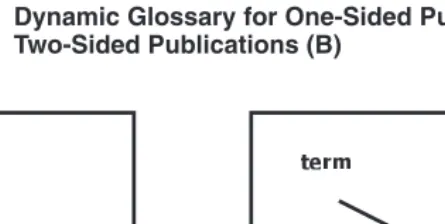
Therefore, I recommend as the best approach a dynamic glossary that defines the new and difficult terms in a footnote area at the bottom of each page (or at the end of each two-page spread). (See Figure 2.2.)
Although asking readers to branch to the bottom of the page and back can be somewhat distracting, it is far more comfortable a method than sending readers to the end of the publication or the back of the book. Moreover, if the definitions are stored with the file as footnotes, they will travel with the passage in which they appear and be retained in the next document that uses that material.
can be accessed by “mousing over” the text in question. In fact, Interna-tional English in hypertext can be even more effective by linking itself to online dictionaries in several languages, so that any word in the text can activate an entry from a dictionary in the first language of the reader. Although this technology will solve few of the substantive dictionary or meaning problems discussed in this chapter and elsewhere, it will at least make life easier for E2s and encourage them to read documents that would otherwise be too burdensome.
These are, of course, expensive and time-consuming adaptations. But they may be justifiable in circumstances where the costs of misunder-standing are extremely high, or the potential for profit exceeds the cost.
Tactic 8: Choose Words that Are Pronounceable
When people read silently to themselves, they speak the words they are reading in their minds and typically hear them in their own voice. The phenomenon is called subvocalization. This link between silent reading and speech can be problematical. For example, most people cannot read any faster than they can speak; those who wish to break through this speed barrier must force themselves to quit the subvocalization habit, even to the point of no longer reading words in sequence.
For writers of International English, the persistence of subvocalization means that hard-to-pronounce words will be hard to read, to the point of slowing the reader and interrupting the flow of ideas. This observation is particularly germane when naming products, systems, or companies,
Figure 2.2 Dynamic Glossary for One-Sided Publications (A) and Two-Sided Publications (B)
the situation in which writers may have their greatest freedom in choos-ing or inventchoos-ing words. For example, nearly every E2 has trouble with the th sound (especially unvoiced, as in with), and many E2s from Asian countries struggle with 1 and r. When General Instrument Corporation of Horsham, Pennsylvania, changed its image in 1996, it also adopted the more high-tech-sounding name of NextLevel. In 1998, it restored the original name, mainly because most of its Asian customers for cable-TV converter boxes had trouble with saying the 1 in NextLevel. Simi-larly, the spokesclown for McDonald’s restaurants in Japan is called
Donald McDonald not Ronald, out of consideration for Japanese cus-tomers who have difficulty with r.
When creating names, especially names based on product or system acronyms, it is also useful to make sure that the newly created word does not have some unpleasant or unintended meaning in the first lan-guage of some segment of your E2 readers. Newly coined product names should be checked by persons who speak Spanish, Mandarin, Hindi/ Urdu, and other major languages spoken among the audience. It would be unfortunate if the new name, though easily pronounceable, embar-rassed your company or organization by being bizarre or off-color in one of these languages.
Tactic 9: Do not Coin Words that Are not Needed
Coining words and inventing new technical terms is one of the more enjoyable parts of writing. But only those with a keen knowledge of English and an especially good ear for its nuances should try it. Nothing is to be gained, especially if the audience is E2, by coining a word for a situation in which a perfectly good English word already exists. And only someone with more than a casual knowledge of the language can be sure, before coining or inventing a new word, that there is not already a suitable English word in the dictionary. For example, many years ago someone without such awareness introduced prioritize into our dis-course—an ugly, pretentious, and unnecessary substitute for the verb
rank. Similarly, English has no need for the verb mentored (taught or
have never heard in school, never read in books, never seen anywhere before. How can anyone expect E2 to deduce that the silly mentee is a back formation from the vogue word mentor?
Another reason that coining words requires an unusually deep knowl-edge of English is that one must be sure that the so-called new word does not in fact already exist with an established meaning of its own. Over the past twenty years, more and more speakers in business and government have decided that the word actionable means practical, fea-sible, and susceptible to action or intervention. In this use, an actionable recommendation is one that can be followed. “Actionable intelligence,” to use the latest popular variation on this word, is information reliable enough that you can take dangerous actions based on it.
Unfortunately, the word actionable already has a well-established dictionary meaning: “just cause for a lawsuit.” Any attorney will tell you that a person who does something actionable will be sued and will probably lose the lawsuit. Obviously, the language never needed this variant meaning of actionable. Actionable recommendations are just feasible or practicable recommendations. Actionable intelligence is trust-worthy intelligence (as opposed to the regular kind). And, most impor-tant for this discussion, now actionable cannot be used reliably in any business communication, especially one aimed at E2.
This is not to suggest that words cannot change their meanings. In fact, words add and change meanings perpetually. Rather, the point is that not all language change adds clarity or precision to communication and, moreover, that words in a transition of meaning usually do not be-long in International English documents. To illustrate, an E2 reader con-sulting a bilingual dictionary will read that enormity is a synonym for
atrocity (not immensity) and that fortuitous means accidental (not lucky). It avails little that the E1 who used those words meant something else by them and that most Americans would have understood them with mean-ings not in that dictionary.
Tactic 10: Avoid Redundant and Wordy Expressions for Time and Place
Business and technical documents are never more long-winded and wordy than in expressing simple matters of time, space, distance, or sequence. At this point in time is one of fifty long-winded ways to say
and many are incorporated into the style-checking programs of word processors. See, for example, Steven Wilbers’s webpage, http:// www.wilbers.com/Keys1Exercises.htm, or my own book, 100 Writing Remedies (1990).
This sort of verbosity is understandable and acceptable in impromptu speaking, and even in hastily composed first drafts. But it should not survive the first draft. A productive way to reduce the burden on E2 is to trim these expressions to their leanest forms, especially the redundant ones like 3 square meters of area.
Time Wasters
Instead of . . . Use
two weeks’ duration two weeks period of time time, period interval of time interval twenty-minute period twenty minutes three hours long three hours during periods of time during three hours of time three hours
The expressions “calendar month” and “calendar year” are necessary only to distinguish your meaning from “person-month” or “staff- year”; also avoid the expression “time frame”—a phrase with such various simple meanings as due date, deadline, or interval.
Before:
Adding new security points to the terminal, which will require a period of three months’ construction, cannot be done under your time frame.
After:
Adding new security points to the terminal, which will re-quire three months’ construction, cannot be completed by your deadline.
Place Wasters
Instead of . . . Use