THE EFFECT OF FECL3 AND LENGTH OF INCUBATION ON THE DEGRADATION OF
LIGNOCELLULOSE FROM SENGON AND PINE WOODS USING SERPULA LACRYMANS Irnia Nurika1, Nur Hidayat1, Nur Lailatul Rahma1, Sakunda Anggarini1
Department of Agricultural Industry, Faculty of Agricultural Technology, University of Brawijaya Email: 1[email protected], 1[email protected], 1[email protected], 1[email protected]
ABSTRACT
The aim of this research is to determine the effect of FeCl3 affected to lignocelullosic degradation of Sengon and Pine wood residue by Serpula lacrymans during incubation. which was showed by the changing value of Total Soluble Phenols (TSP), Total Reducing Sugar (TRS), weight loss and pH extract. The experimental design used is a Factorial Block Randomized Design with three factors: the type of wood (K) (Sengon and Pinewoods), the concentration of FeCl3 (M) selected are 10, 30 and 50 µM and length of incubation (T): 0, 7, 14, 21, 28 and 35 days. The results revealed that the addition of FeCl3 on both types of woods during incubation did not give a significant impact on the value of TSP, TRS, weight loss and pH. The best treatment in TSP production is Sengon wood was incubated for 28 days (0.064 mg/g). While the greatest amount of total reducing sugars is Pinewood, incubated for 28 days in the amount of 36.58 mg/g. The best in percentage of weight loss is Pinewood, incubated for 28 days contains 33,98% with pH extract 4.14
Keywords: biodegradation, lignocelullose, total soluble phenols, total reducing sugar.
1. INTRODUCTION
Wood waste is an organic compound, which composed from carbon materials such cellulose, hemicellulose, lignin and other carbohydrates. The use of wood waste is very limited for example it is used for firewood, organic fertilizer and bricket. However it contains high of lignocellulose which is potential used as bioenergy material or value added chemical biobased (Wit et al., 2013). The biodegradation of lignocellulose waste released some sugars derived from both cellulose and hemicellulose which has normally been used as biofuel (Howard et al., 2003), mean while lignin consists of mono-
aromatic hydrocarbon which resulted derivative of aromatic compounds that can be used as natural binder, sub-bituminous-coal and sulfhur-free solid fuel which needed further analysis and exploration (Kamm and Kamm, 2004). The use of Sengon and Pinewoods have been investigated to release high amount of lignocellulose. Sengon wood contains 36,73% of cellulose, 25,67% hemicelulosa. 32,93% lignin and 4,67 % other compounds (Luciasih dan Efiyani, 2015). While pine wood consist of 44,7% cellulosa, 17,4% hemicelulosa, 28,42% lignin and 5,95% other compounds (Shi, 2010).
The biological pretreatment using microorganism or biodegradation is the most environmentally friendly method that is commonly used to break down lignocellulose compared to chemical or physically treatment (Okano et al., 2005). It has been known that Basidiomycetes is one of the greatest fungus on the degradation of lignocellulose (Sun and Cheng, 2002). Three types of Basidiomycetes which have quite aggressive to breakdown lignocellulose are brown-rot, white-rot and soft-rot.
The brown rot fungus is very potential on lignocellulose degradation through the depolimerization and assimilation from the polisacharide component without the overall breakdown of lignin (Watkinson and Eastwood, 2012) therefore it could safe the energy and maximize the sugar extraction from wood (Hibbett and Donoghue, 2001). The brown rot fungus Serpula lacrymans causes one of the most destructive types of decay in wooden structures, dry rot. Serpula lacrymans is one of most destructive of brown rot due to the breakdown of lignocellulose (Watkinson and Eastwood, 2012).
involves a Fenton-type catalytic system producing hydroxyl radicals that attack lignocellulose. The initial stages of brown rot fungus are believed to involved Fenton chemistry (Fe2+ + H2O2). Among the brown rot fungi, Gloeophyllum trabeum has been studied the most (Hattaka, 2001). It has been thought that the form of hydroxyl radical was initiated from the reacyion between Fe2+ and H2O2, where the biomass it self contains which can be reduced by iron-reduction compound to Fe2+ (Arantes et al., 2012).
In the brown rot, the low molecular weight compound (LMWC) such as phenol derivative and peptide are also able to reduce the ferric iron. The phenolic compound is one of the secondary metabolite released through the process of lignin demethylation by the brown rot (Arantes, 2009). It has been approved that oxalic acid chelates the Fe3+ into soluble complexes, whereas the iron can be derived from this Fe3+ complexes back to Fe2+ promoting the continuation of Fenton reaction (Xu and Goodel, 2001; Jensen et al., 2001). It has also been hypotesised that S. lacrymans involved on enzymatic reaction, which showed the evidence of iron reductase enzyme and cellulose-binding domain. Oxidoreductase are able to access the Fe2+-dependent to molecule of cellulose so it is therefore the Fenton reaction occurs and generate the hidroksil radical which then degrade the structure amorf of cellulose. Meanwhile the Fenton reaction will produce Fe3+ which will be reduced by the variegatic acid (VA) (Eastwood et al., 2011).
The hyfa of brown rot will attack the lumen area and therefore the production of oxalic acid, iron-reduction compound (RC) and hydrogen peroksida (H2O2) has increased. The oxalic acid will bind the Fe3+ from biomass, and difuse into the cell wall. H2O2 and RC will also difuse into the cell wall and finally generate hydroxyl radical through the Fenton reaction (Arantes, 2012), in which this lignocellulose degradation by the brown-rot (Jellison et al., 1997). FeCl3 is one of most
oligomeric sugars which also reduce the ester and eter compounds from lignin or carbohydrate via pretreatment process (Liu et al., 2009). Therefore, in this experiment the present of FeCl3 become the main factor that can maximize the releasing of hydroxyl radical via Fenton reaction and it is therefore affect on lignocelluose degradation both Sengon and Pine woods. The length incubation will also affect on the results. Based on Nurika (2013) the incubation for 25 days showed on both total reducing sugars and soluble phenols
The formulation of addition FeCl3 are about 10, 30 dan 50 µM which was incubated for 35 days on both Sengon and Pine woods. In which the activity of Serpula lacrymans degrade lignocelluloses can be optimised. The results of the project can hopefully be applied on the production of value added chemicals such vanillin and phenols as a result of lignin degradation the production of while bioethanol aceton and butanol are the product generated from cellulose and hemycellulose degradation.
2. MATERIAL AND METHODSS 2.1. Materials
Agricultural waste of Sengon and Pine woods, Malt extract, Agar, Barley seeds, Serpula lacrymans, FeCl3, CaCO3, CaSO4, aquades, and alcohol 70%. NaOH, Potassium Tartat, Dynitrosalisilic acid, glucosa, Sodium Carbonate, galic acid, Follin Ciocalteu, and aquades.
Facilities and tools are glassware, Laminar Air Flow, Autoclaf, thermometer, waterbath, spektrofotometri, vortex, oven, pH meter, desicator and balancel.
2.2. Material and Culture Preparations
Sengon and Pine woods was chopped into small pieces ± 2 cm. Serpula lacrymans were grown into media Malt Extract Agar (MEA) and is followed by culturing on Barley media.
Preparation of Malt Extract Agar (MEA) media
steril petridish under La minar Air Flow. The isolate Serpula lacrymans was then inoculated on MEA media and incubated at 22°C±2° for 2-3 weeks until is used.
Preparation of Grain spawn
media then left overnight before it’s setrilised
for second time the day after. Five plugs of S.lacrymans was cultured into grain spawn and incubated for 2-3 weeks at 22°C±2° (Nurika, 2013).
Preparation of Sengon and Pine woods
Woods was chopped into ±2 cm and 20 gram of wood was placed into 250 gram honey jar. 10 ml of FeCl3 was added with different concentrations 10, 30 dan 50µM and homogenized by hand shaking. Afterward it was sterilized at temperature 121oC for 15-20 minutes. After the material was chilled for 24 hours and sterilized for second time. S.lacrymans was then cultured by the addition of 2±0,2 gram inoculated grain spawnand incubated at 22±2°C for 35 days.
Aquoeus Extraction
The cultured was incubated for -0, 7, 14, 21, 28 and 35 days and extracted using aquades. The extract was then used for analysis: total reducing sugars, total soluble phenols, and pH. (1) 150 ml of purified water was measured into each beaker and boiled to a temperature of 80°C, (2) Each of the sample emptied separately into fine muslin netting held in 250 ml beakers. This allowed for the large biomass to be separated from the aqueous extract sample, (6) the biomass was squeezed by hand within the muslin netting trapping the
liquid produced in a separate beaker. The cake was then used for theweighed loss analysis Experimental Design Third factor: Length of incubation (T) : 0 days (control); 7, 14, 21, 28 and 35 days.
Chemical analysis Total reducing sugars
Reducing sugars were determined colour-imetrically by the DNS (dinitrosalicylic acid) method using glucose as the standard (Miller, 1959) and the absorbance was read at 540 nm using a spectrophotometer. In order to minimize sugar variation, each samples contained 3 replications, and the sugar standard has been aplied on every running the samples.
Total soluble phenols
Phenols were measured colourimetrically using the Folin-Ciocalteau method with gallic acid as the standard and the absorbance was read at 760 nm using spectrophotometer. The Folin–Ciocalteau method has been used for the analysis of total soluble phenols (Singleton and Rosi, 1965). This colorimetry method is based on a chemical reduction of the reagent, a mixture of tungsten and molybdenum oxides which result a blue color on the maximum measurement at 765nm (Singleton and Rossi, 1965). The intensity of light absorption at that wavelength is proportional to the concentration of phenols.
pH
pH was measured using the protocol standard from SNI 06-6989.11-2004.
Weight loss
Weight loss was measured based on the Pitt Method (Pitt and Hocking, 2008).
Data Analysis
3. RESULTS AND DISCUSSIONS
Total Soluble Phenols (TSP)
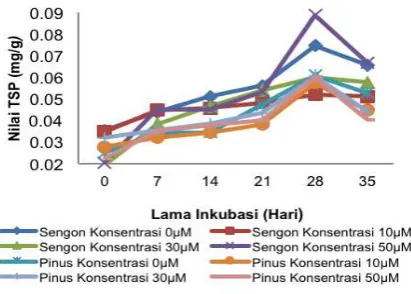
Total soluble phenols indicated the amount of phenol released from the degradation of lignin by Serpula lacrymans. Based on MANOVA analysis revealed that foctors type of woods and length of incubations resulted significant effect on TSP. The highest total phenol concentration 0,09 mg/gram straw dry weight was observed using S. lacrymans, reached a peak 28 days after incubation and slightly decreased afterward which was achieved by Sengon wood with 10uM of addition FeCl3
.
During the incubations, the TSP results from each treatment showed similar trends, which increased significantly until 28 days and decreased afterward (Figure 1). The process of lignin degradation by brown rot has been conducted by breaking down the chains of aromatic compounds, which has been known as part compound of lignin. (Yelle et al., 2008), Another evidence of reducing of lignin by S.lacrymans is the decreasing of pH during incubations indicated that substrat release some oxalic acid contributed on Fenton reaction as one of strongest Fe3+-chelator (Gamauf et al., 2007).
Figure 1.Graph the effect of additionGrafik FeCl3 toward the value of Total soluble phenols released from extraxt Sengon and Pine
woods during the incubations.
Total soluble phenols released from the biomass extraction showed an increased from 7 days of incubation and reached the peak at 28 days. (Figure 1). Compare to control (0 days) there was an increased of TSP after 7 days 49,15% and 153,17% after 28 days incubation and decreased thereafter. The significant increased until 28 days showed evidence that the lignin degradation could occure from the generation of hydroxyl radical that are able to broken down lignin through Fenton reaction. This is also supported by Irbe et al (2011) mentioned that the production of hydroxyl radical was started significantly after 10 days incubations and achieved the peak at week 4 or 5. Nurika (2013), has also supported that Serpula lacrymans produces some organic acid including oxalic acid and another low molecular weight (quinone) in which the oxalic acid reached highest concentration after 35 days incubations, while quinone peaked at 21 days. This evidence showed that the longest time incubations, could also release the highest amount of total soluble phenols.
Total Reducing Sugars (TRS)
The colorimetric assay based on 3,5 dinitrosalisylic acid (DNS) was used for estimating total reducing sugars on lignocellulose degradation in wheat straw SSF. Total reducing sugar released during incubation of the fungus growing on straw was used to identify the effectiveness of the selected fungi to decompose cellulose and hemicellulose in wheat straw.
Figure 2. Graph the effect of additionFeCl3 toward
the value of Total reducting sugars (TRS) released from extract Sengon and Pine woods during the
incubations.
The increasing value of TRS extracted from Sengon and Pine woods revealed that the lignocellulose of biomass has been broken down by the fungus activity resulted amount of sugars (Figure 2). Most of the highest percentage TRS reached peak on 28 days incubation (61.86%), obtained by Sengon wood while Pinewoods 201.94% (36.58 mg/g), both were added with addition 10uM FeCl3. The increasing value of TRS was hypothesised by the caused of lignocellulose degradation by the brown rot through the break down of hemicellulose (xylose and mannosa) first to penetrate the sellulose side (Highley, 1997). The highest percentage of TRS reached at days 28 which were identified by the releasing of hydroxyl radical affected to the amount of TRS.
It has been identified that the value of TRS has a significant effect between Sengon and Pinewoods in which the amount of sugar released by the Sengon wood higher Sengon wood, which caused by the diversity of chemicals compounds between Sengon and Pinewoods. The pinewoods contains higher both sellulose and hemisellulose compared to Sengon wood. Pinewoods consists of 44,7% sellulose and 17,4% hemiselulosa (Shi et al., 2010) while Sengon wood contains 36,73% sellulose and 25,67% hemisellulosa (Agustini dan Efiyanti, 2015).
Table 1. Average value of TRS (mg/g) from extract resulted from treatments with addition
FeCl3
Consentration
FeCl3 (µM) TRS (extract) (mg/g)
0 20,71a
10 21,98ab
30 20,40a
50 22,89b
*Numbers are followed by the alphabet showed
un-significant using Tukey test 5%.
The addition of FeCl3 50µM revealed a significant effect on releasing of TRS compared to 0,10 dan 30µM. FeCl3 which has been added on woods will be reduced to Fe2+ by the existence of oxalic acids produced by brown rot (Gamauf et al , 2007). The addition of 50µl Fe3+ will produce highest amount Fe2+ which will supply the Fe2+ to the brown rot and therefore produce hydroxyl radical via Fenton reaction.
Weight loss
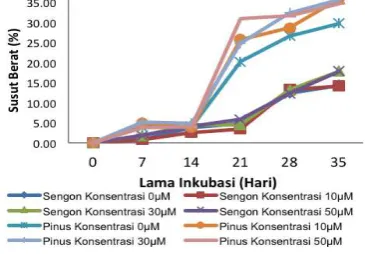
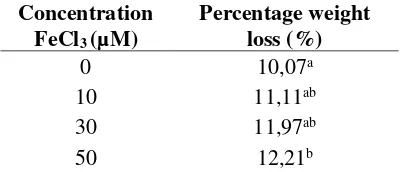
Based on gravimetric assay, the weight of the woods was determined. After incubation for 35 days of culture (Figure 3) this decreased significantly by 12-17%. This assay indicated the lignocellulose degradation, which is showed by the decreasing of wood weight after incubated, compared to the initial weight (day 0). Based on MANOVA assay revealed the significant interaction between length of incubation and type of woods. The single effect of FeCl3, type of woods and length of incubations resulted significant on weight loss (Table 2). In general, the percentage of weight loss increased until end of incubation (Figure 3).
Figure 3.Graph the effect of additionFeCl3 toward
The percentage of weight loss showed similar trends both Sengon and Pinewoods in which significantly increased after 14 days incubations. However, the highest percentage of weight loss was obtained from Pine wood, resulted 12.77% after 28 days incubations and the highest percentage of weight loss was achieved at 35 days (16.05%). While on Pinewood the highest percentage was obtained at 35 days incubations 33.98%.
Biodegradation of softwood by the brown rot showed that the longest incubation times resulted on increasing the polimerisation degree of cellulose followed by rising up of wood weight loss (Suzuki et al., 2006), it has been supported by Howell et al (2009), that the percentage of weight loss from Pinewood incubated by Serpula lacrymans has increased significantly during four weeks and after week six the percentage obtained 33.1%. It means that the changing percentage of weight loss in this experiment is quiet similar.
Table 2. The average percentage of weight loss based on treatment the addition of FeCl3
Concentration FeCl3 (µM)
Percentage weight loss(%)
0 10,07a
10 11,11ab
30 11,97ab
50 12,21b
*Numbers are followed by the alphabet showed
un-significant using Tukey test 5%.
From Table 2 revealed that the addition of 50uM FeCl3 on woods resulted weight loss percentage so much higher thean the one without addition of FeCl3 (control). This caused by the lignocellulose degradation by the brown rot through Fenton reaction in which the supply of . Fe3+ has been reduce to Fe2+ and with the presence of H202 will egenerate hydroxyl radical, that caused the break down of lignocellulose in wood (Eastwood, 2011). The adding of Fe3+ and Gt-chelator as iron reduction will reduce the degree polimerisation of sellulose. The addition of Fe3+ and Gt-chelator as iron reduction will reduce the degree polimerisation of sellulose so that it will degrade easily by G. trabeum.
The percentage of weight loss revealed that
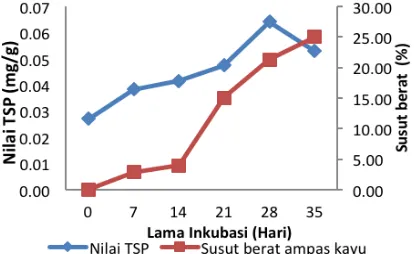
the breakdown of lignocellulose by S.lacrymans. The results of TSP, TRS and weight loss showed such a correlation between all those parameters. Total reducing sugars as one indicator the degradation of sellulose and hemisellulose on woods, while the total soluble phenols as an indicator of phenolic compounds released from lignin by the fungus S.lacrymans. The pattern of correlation all parameters can be seen in Figure 4 and 5.
Figure 4. Graph Relationship the value of TRS (mg/g) and weight loss during incubation
(days)
Most treatments has simikar pattern of on the graph relationship between the value of TRS (mg/g) with the percentage of weight loss (%) (Figure 4), showed the increasing of TRS was followed by an increased the percentage of weight loss peaked at 21 days and reached the maximum value at 28 days. It has been stated by Curling et al (2001), that the percentage of weight loss equal with the degradation of both sellulose and hemisellulose in which the longest incubation time, the more product released by the degradation of lignosellulose such as xylan, mannan, and glucan so therefore the percentage of weight loss has increased.
The value of TRS (mg/g) has decreased after it’s incubated for 35 days on both woods extract (Sengon and Pinewoods). It has been hypothesized that during the incubations, the metanolised system has occurred with the present of sugars is needed for the energy during the fungal growth (Surthikanthi et al., 2005). It is therefore that fungus has consumed
number of TRS (mg/g) released on the degradation of lignocellulose, and this caused on decreasing amount of sugars released after 28 days. Similar to the percentage weight loss results, showed on the increasing of Sengon and Pinewoods degradation even after 35 days (Figure 4).
Figure 5. Graph Relationship between the value of TSP (mg/g) with percentage of weight
loss (%).
The rate of TSP (mg/g) has increased during the incubations indicated the presence of lignin degradation by the fungus Serpula lacrymans. Figure 5 showed that the increasing TSP (mg/g) reached peak at 28 days followed by the increased of weight loss. The weight loss of wood extract has rise up from beginning of cultivation until 35 days incubations. This means that the degradation of lignocellulose in samples were present (Figure 5). This evidence was also supported by Schilling et al., (2012), that the percentage of weight loss on wood has risen up following the decrease amount of lignin in wood biomass, which means that most of the lignin content has already been converted to aromatic or phenolic compounds.
pH
pH was measured on both extract Sengon and Pinewoods incubated by Serpula lacrymans. The changing of pH on during the lignocellulose incubations depicted that some of organic acid compounds such as oxalic acid was released (Nurika, 2013). Based on MANOVA analysis, the results showed there is such significantly interaction between the length of incubation and type of woods. The length of incubations significantly affected on
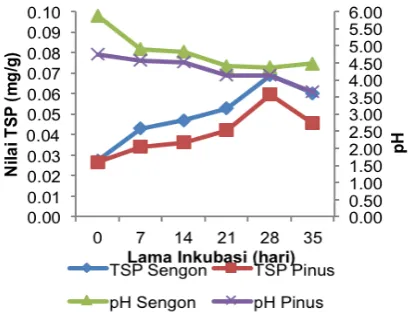
the pH of woods extract, which was depicted on Figure 6. The decreasing of pH occurred on all of treatments started from day 0 until day 35.
Figure 6. Graph the effect of additionFeCl3 toward the value of pH from extract Sengon
and Pine woods during the incubations
The value of pH on Sengon wood extract ranged from 5.8 to 4.3, while the pH on Pinewood was about 4.7 to 3.6. Most of the pH changing on every treatment was not significantly affected by the addition of FeCl3. The production of oxalic acid has accumulated during the incubation of brown rot significantly affected to decreasing of pH (Green et al., 1991). The lowest of pH on wood extract showed that the oxalic acid production and some low molecular weight hydroquinone which are the reduction agent of Fe3+_ to Fe2+
, The presence of Fe2+ will automatically react with H2O2 resulted from metabolism of brown rot, which then generated the hydroxyl radical through Fenton reaction and this free radical caused the lignocellulose degradation (Varela and Tien, 2003). Furthermore, pH has also such a factor influenced the lignocellulose degradation by the brown rot. In which the optimum pH needs for the maximum polimerisation degree of lignocellulose was about 4 (Xu and Goodell, 2001). While the pH on this experiment ranged from 3.5 until 4.3 after the samples was incubated for 35 days, which supported that the lignocellulose degradation has occurred due to the optimum conditions (pH).
2011). This hydroxyl radical has caused the lignin degradation on substrate and therefore the releasing of some phenolic compounds as derivative of lignin has come up, which then also supported the presence of relathionship between the increasing value of total soluble phenol (mg/g) released during the incubation (Figure 7).
Figure 7. Graph Relationship the value of TSP (mg/g) and pH during incubation (days)
The value of TSP (mg/g) released between both substrates (Sengon and Pinewoods) has exactly the same pattern showed the increasing of TSP during incubation and reached a peak on 28 days. The same as to the value of pH betwoon both substrates which continuously decreased during incubation (Figure 7) which depicted the production of organic acid especially oxalic acid during the substrates incubated by S.lacrymans. The increasing of oxalic acid as an agent to reduce Fe3+ to Fe2+, therefore the degradation of lignocellulose via Fenton reaction was also supported this experiment as it has already investigated that most of the lignocellulose degradation by brown rot were caused generating of hydroxyl radical produce via Fenton reaction, or it has also said by Gamauf et al (2007), that the oxalic acid produced by S. lacrymans have a role as Fe3+
-chelator which helped on lignocellulose degradation.
4. CONCLUSIONS
1. The addition of FeCl3 both on substrates
Sengon and Pinewoods doesn’t give
total soluble phenols, total reducing sugars, pH and the percentage of weight loss
2.
The highest amount of total soluble phenols released was achieved by the Sengon wood extract incubated for 38 days (0.064mg/g), while the greatest amount of total reducing sugars released (36.58mg/g), the highest percentage of weight loss (33.98%) with pH 4.14 were resulted from Pinewood extract incubated for 28 days5. REFERENCES
ARANTES, V., J. JELLISON, and B. GOODELL. 2012. Peculiarities of Brown-rot Fungi and Biochemical Fenton Reaction with Regard to Their
Potential as a Model for
Bioprocessing Biomass. Appl.
Microbiol. Biotechnol. 94: 323-338.
AGUSTINI, L and EFIYANTI, L. 2015. Pengaruh Perlakuan Delignifikasi terhadap Hidrolisis Selulosa dan
Produksi Etanol dari Limbah
Berlignoselulosa. Jurnal Penelitian Hasil Hutan 33: 69-80.
CURLING, S., CLAUSEN, C., WINANDY, J. 2001. The Effect of Hemicellulose Degradation on the Mechanical Properties of Wood During Brown-rot Decay. International Research Group on Wood Protection 01-20219. Stockholm.
EASTWOOD, D.C., FLOUDAS, D.,
BINDER, M., Majcherczyk, A., Schneider, P., Aerts, A., Asiegbu, F.O., Baker, S.E., Barry, K., Bendiksby, M., Blumentritt, M., Coutinho, P.M. 2011. The Plant Cell
Wall- Decomposing Machinery
Underlies the Functional Diversity of Forest Fungi. Science 333: 762-765.
FORTIN, Y and POLIQUIN, J. 1976. Natural Durability and Preservation of One Hundred Tropical African Woods. International Development Research Centre.
GREEN, F., LARSEN, M. J., WINANDY, J. Analysis of Character Correlation among Wood Decay Mechanism, Mating Systems, and Substrate Ranges in Homobasidiomycetes. Syst. Biol. 50: 215-242.
HIGHLEY, T. L and GREEN, F.
1997.Mechanism of Brown-Rot Decay : Paradigm or Paradox. Int. Biodeter. Biodegr. 39: 113-124.
HOWARD, R.L., ABOTSI, E.L. RENSBURG,
J and HOWARD, S. 2003.
Lignocellulose Biotechnology: Issues
of Bioconversion and Enzyme
Production. Afr. J. Biotech. 2:
602-Characteristisation of the Initial Degradation Stage of Scot Pine Sapwood After Attack by Brown-rot
Fungus Caniophora puteana.
Biodegradation 22: 719-728.
JELLISON, J., CHANDHOKE, V.,
GOODELL, B., and FEKETE, F. A.
1997. The Isolation and
Immunolocalization in Iron-binding
Compound. Appl. Microbiol.
Biotechnol. 35: 805-809.
KAMM, B AND KAMM, M. 2004. Principles of Biorefineries. App. Microbio. Biotechnol. 64: 137-145.
LIU, L., SUN, J.S., LI, M., WANG, S.H., PEI, H.S., ZHANG, J.S., 2009. Enhanced Enzymatic Hydrolysis and Structural Features of Corn Stover by FeCl3
Pretreatment. Biores.Technol. 100: 5853–5858.
Lignocellulosic Conversion by The Brown-rot Fungus Serpula lacrymans. Thesis. University of Warwick, Conventry.
Basidiomycetes. Animal Feed Sci. Technol 120: 235–243.
PITT, J and HOCKING, D. A. 2009. Fungi
and Food Spoilage. Springer
Dordercht Heidelberg. London.
RITSCHKOFF, A.C. 1996. Decay Mechanism of Brown-rot Fungi. VTT Publication 268. Espoo, Findland.
SCHILLING, J.S., AI, J., BLANCHETTE, R.A., DUNCAN, S.M., FILLEY, T.R
and TSCHIMER, U.W. 2012.
Lignocellulose Modification by Brown-rot Fungi and Their Effect as Pretreatment on Cellulolysis. J. Biores. Technol. 116: 147-154.
SHI, W. 2010, Pretreatment and Enzymatic Hydrolysis of Peat and Pine Sawdust for Bioethanol Production. Thesis. Lakehead University. Ontario, Canada.
SINGLETON, V. L and ROSSI, J.A.J. 1965. Colorimetry of Total Phenolic with Phosphomolybdic-phosphotungtic acid Reagent. Am. J. Enol. Viticult. : 144-158.
SNI 06-6989.11-2004. 2004. Air dan Air Limbah-Bagian 11: Cara Uji Derajat Keasaman (pH) dengan Menggunakan alat pH meter. Badan Standarisasi Nasional. 1-2.
Ethanol Production: A Review. Biores. Technol. 83: 1-11.
SURTHIKANTHI, D., SURANTO, dan
SUSILOWATI, A. 2005. Biokonversi
Kompleks Lignoselulosa Eceng
Gondok (Eichorrnia crassipes (Martz) Solms) Menjadi Gula Pereduksi oleh
Phanerochaete chrysosporium.
BioSMART 7: 17-22.
SUZUKI, M. R., HUNT, C. G., HOUTMAN, C. J., DALEBROUX, Z. D and
HAMMEL, K. E. 2006. Fungal
Hydroquinones Contribute to Brown rot of Wood. Environ. Microbiol. 8: 2214 – 2223.
VARELA, E. and TIEN, M. 2003. Effect of pH and oxalate on hydroquinone-derived hydroxyl radical formation during brown rot wood degradation. App. Environ. Microbiol. 69: 6025-6031.
WATKINSON, S.C and D.C. EASTWOOD. 2012. Serpula lacrymans, Wood and Building. Adv. App. Microbiol. 78: 121-149.
WIT, D. M., JUNGINGER, M., and FAAIJ, A. 2013. Learning in Dedicated Wood
Production System: Past and
Implication for Bioenergy. Renew. Sustain. En. Rev. 19: 417-423.
XU, G. and GOODELL, B. 2001. Mechanisms of wood degradation by brown-rot fungi: chelator-mediated cellulose degradation and binding of iron by cellulose. J. Biotech. 87:43-57.
YELLE, D. J., J. RAPLH, F. LU, and K.E.
HAMMEL. 2008. Evidence of