674
INFINITE SEQUENCES
AND SERIES
11
Infinite sequences and series were introduced briefly in A Preview of Calculusin connection with Zeno’s paradoxes and the decimal representation of numbers. Their importance in calculus stems from Newton’s idea of representing functions as sums of infinite series. For instance, in finding areas he often integrated a function by first expressing it as a series and then integrating each term of the series. We will pursue his idea in Section 11.10 in order to integrate such functions as . (Recall that we have previously been unable to do this.) Many of the functions that arise in mathematical physics and chemistry, such as Bessel functions, are defined as sums of series, so it is important to be familiar with the basic concepts of convergence of infinite sequences and series.
Physicists also use series in another way, as we will see in Section 11.11. In studying fields as diverse as optics, special relativity, and electromagnetism, they analyze phe-nomena by replacing a function with the first few terms in the series that represents it.
e⫺x2
x y
T∞
y=sin x
T¡
T¶ T£
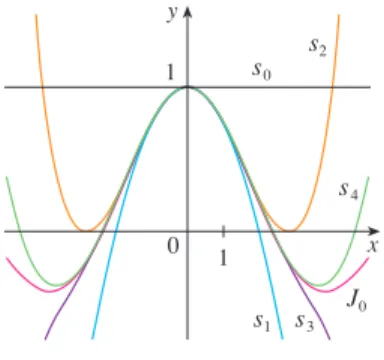
The partial sums of a Taylor series provide better and better approximations to a function as increases.n
SEQUENCES
A sequencecan be thought of as a list of numbers written in a definite order:
The number is called the first term, is the second term,and in general is the nth term. We will deal exclusively with infinite sequences and so each term will have a successor .
Notice that for every positive integer there is a corresponding number and so a sequence can be defined as a function whose domain is the set of positive integers. But we usually write instead of the function notation for the value of the function at the number .
The sequence { , , , . . .} is also denoted by
EXAMPLE 1 Some sequences can be defined by giving a formula for the nth term. In the following examples we give three descriptions of the sequence: one by using the preced-ing notation, another by uspreced-ing the definpreced-ing formula, and a third by writpreced-ing out the terms of the sequence. Notice that doesn’t have to start at 1.
(a)
(b)
(c)
(d) M
EXAMPLE 2 Find a formula for the general term of the sequence
assuming that the pattern of the first few terms continues. SOLUTION We are given that
Notice that the numerators of these fractions start with 3 and increase by 1 whenever we go to the next term. The second term has numerator 4, the third term has numerator 5; in general, the th term will have numerator . The denominators are the powers of 5, so a has denominator . The signs of the terms are alternately positive and negative, so5n
n
n⫹2 n
a5苷 7 3125 a4苷⫺
6 625 a3苷
5 125 a2苷⫺
4 25 a1苷
3 5
3 5, ⫺4 25,
5 125, ⫺
6 625,
7 3125, . . .
anV
1, s3 2 ,1
2, 0, . . . , cos n
6 , . . .
an苷cosn
6 , n艌0
cos n6
n苷0⬁
{
0, 1, s2, s3, . . . , sn⫺3, . . .}
an苷sn⫺3, n艌3{
sn⫺3}
n苷3 ⬁
⫺23, 3 9, ⫺
4 27,
5 81, . . . ,
⫺1n n⫹1
3n , . . .
an苷⫺1n n⫹1
3n
⫺1nn⫹1
3n
1 2,2 3,
3 4,
4 5, . . . ,
n
n⫹1, . . .
an苷n n⫹1
nn⫹1
n苷1
⬁
n
ann苷1
⬁
or an
a3 a2 a1 NOTATION
n
fn an
an n
an⫹1
an an a2
a1
a1, a2, a3, a4, . . . , an, . . .
11.1
we need to multiply by a power of . In Example 1(b) the factor meant we started with a negative term. Here we want to start with a positive term and so we use
or . Therefore
M
EXAMPLE 3 Here are some sequences that don’t have a simple defining equation. (a) The sequence , where is the population of the world as of January 1 in the year .
(b) If we let be the digit in the th decimal place of the number , then is a well-defined sequence whose first few terms are
(c) The Fibonacci sequence is defined recursively by the conditions
Each term is the sum of the two preceding terms. The first few terms are
This sequence arose when the 13th-century Italian mathematician known as Fibonacci solved a problem concerning the breeding of rabbits (see Exercise 71). M
A sequence such as the one in Example 1(a), , can be pictured either by plotting its terms on a number line as in Figure 1 or by plotting its graph as in Figure 2. Note that, since a sequence is a function whose domain is the set of positive integers, its graph consists of isolated points with coordinates
. . . .
From Figure 1 or 2 it appears that the terms of the sequence are approaching 1 as becomes large. In fact, the difference
can be made as small as we like by taking sufficiently large. We indicate this by writing
In general, the notation
means that the terms of the sequence approach as becomes large. Notice that the following definition of the limit of a sequence is very similar to the definition of a limit of a function at infinity given in Section 2.6.
n L an
lim nl⬁an
苷L lim
nl⬁ n n⫹1 苷1
n 1⫺ n
n⫹1 苷
1 n⫹1 n
an苷nn⫹1 n, an
3, a3 2, a2
1, a1
an苷nn⫹1 1, 1, 2, 3, 5, 8, 13, 21, . . .
n艌3 fn苷fn⫺1⫹fn⫺2
f2苷1 f1苷1
fn
7, 1, 8, 2, 8, 1, 8, 2, 8, 4, 5, . . .
an e
n an
n
pn pn
an苷⫺1n
⫺1n⫹2
5n ⫺1n⫹1
⫺1n⫺1
⫺1n
⫺1
0 1 1
2
a¡ a™ a£a¢
F I G U R E 1
F I G U R E 2
0 n
an
1 1
2 3 4 5 6 7
7 8
DEFINITION A sequence has the limit and we write
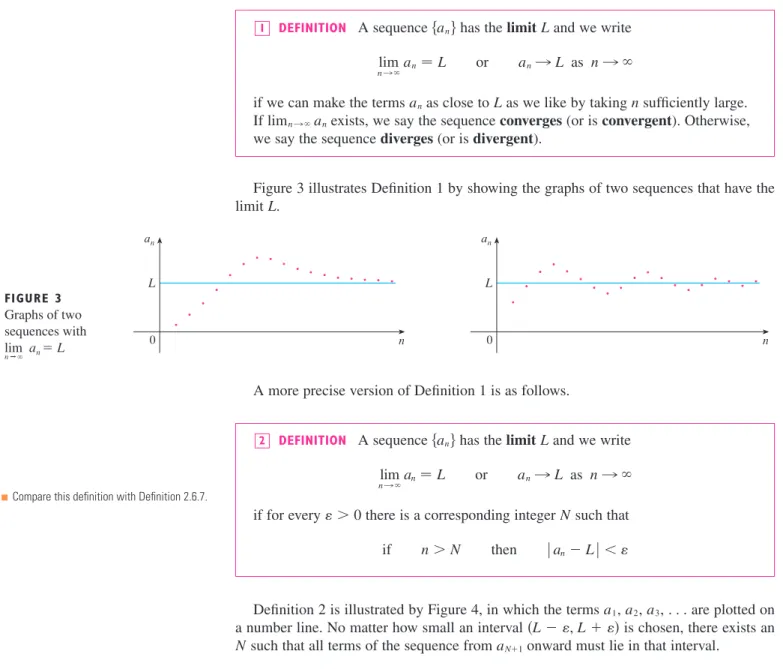
if we can make the terms as close to as we like by taking sufficiently large. If exists, we say the sequence converges(or is convergent). Otherwise, we say the sequence diverges(or is divergent).
Figure 3 illustrates Definition 1 by showing the graphs of two sequences that have the limit .
A more precise version of Definition 1 is as follows.
DEFINITION A sequence has the limit and we write
if for every there is a corresponding integer such that
if then
Definition 2 is illustrated by Figure 4, in which the terms , , , . . . are plotted on a number line. No matter how small an interval is chosen, there exists an
such that all terms of the sequence from onward must lie in that interval.
Another illustration of Definition 2 is given in Figure 5. The points on the graph of must lie between the horizontal lines and if . This picture must be valid no matter how small is chosen, but usually a smaller requires a larger .
F I G U R E 5 2
0 n
y
1 3 4
L
y=L+∑
N
y=L-∑
N
n⬎N y苷L⫺
y苷L⫹
an
F I G U R E 4 0 L-∑ L L+∑
a¡ a£ a™ aˆ aN+1 aN+2 a˜ aß a∞ a¢ a
aN⫹1 N
L⫺ , L⫹ a3 a2 a1 an⫺L ⬍ n⬎N
N ⬎0
anlL as nl⬁ or
lim nl⬁an
苷L
L an
2
0 n
an
L
0 n
an
L
F I G U R E 3
Graphs of two sequences with
lim an= L
n `
L
limnl⬁an
n L
an
anlL as nl⬁ or
lim nl⬁an
苷L
L an
1
SECTION 11.1 SEQUENCES |||| 677
If you compare Definition 2 with Definition 2.6.7, you will see that the only difference between and is that is required to be an integer. Thus we have the following theorem, which is illustrated by Figure 6.
THEOREM If and when is an integer, then
.
In particular, since we know that when (Theorem 2.6.5), we have
if
If becomes large as nbecomes large, we use the notation . The fol-lowing precise definition is similar to Definition 2.6.9.
DEFINITION means that for every positive number there is
an integer such that
if then
If , then the sequence is divergent but in a special way. We say that diverges to .
The Limit Laws given in Section 2.3 also hold for the limits of sequences and their proofs are similar.
If and are convergent sequences and is a constant, then
lim nl⬁an
p苷
[
lim nl⬁an]
p
if p⬎0 and an⬎0 lim
nl⬁ an bn
苷 lim nl⬁an
lim nl⬁bn
if lim nl⬁bn
苷0 lim
nl⬁anbn
苷 lim
nl⬁anⴢnliml⬁bn
lim nl⬁c
苷c lim
nl⬁can
苷c lim
nl⬁an
lim nl⬁an
⫺bn苷 lim nl⬁an
⫺ lim
nl⬁bn
lim nl⬁an
⫹bn苷 lim nl⬁an
⫹ lim
nl⬁bn c bn
an
⬁
an
an limnl⬁an苷⬁
an⬎M n⬎N
N
M limnl⬁an苷⬁
5
limnl⬁an苷⬁ an
r⬎0
lim nl⬁
1 nr 苷0
4
r⬎0
limxl⬁ 1xr苷0
F I G U R E 6 0 2 x
y
1 3 4
L
y=ƒ
limnl⬁an苷L
n fn苷an limxl⬁fx苷L
3
n limxl⬁fx苷L
limnl⬁an苷L
The Squeeze Theorem can also be adapted for sequences as follows (see Figure 7).
If for and , then .
Another useful fact about limits of sequences is given by the following theorem, whose proof is left as Exercise 75.
THEOREM If , then .
EXAMPLE 4 Find .
SOLUTION The method is similar to the one we used in Section 2.6: Divide numerator and denominator by the highest power of and then use the Limit Laws.
Here we used Equation 4 with . M
EXAMPLE 5 Calculate .
SOLUTION Notice that both numerator and denominator approach infinity as . We can’t apply l’Hospital’s Rule directly because it applies not to sequences but to func-tions of a real variable. However, we can apply l’Hospital’s Rule to the related function
and obtain
Therefore, by Theorem 3, we have
M
EXAMPLE 6 Determine whether the sequence is convergent or divergent. SOLUTION If we write out the terms of the sequence, we obtain
The graph of this sequence is shown in Figure 8. Since the terms oscillate between 1 and infinitely often, does not approach any number. Thus does not exist;
that is, the sequence ⫺1n is divergent. M
limnl⬁⫺1n an
⫺1
⫺1, 1, ⫺1, 1, ⫺1, 1, ⫺1, . . . an苷⫺1n lim
nl⬁
ln n n 苷0 lim
xl⬁
ln x x 苷xliml⬁
1x 1 苷0 fx苷ln xx
nl⬁
lim nl⬁
ln n n
r苷1 苷 1
1⫹0 苷1
lim nl⬁
n
n⫹1 苷nliml⬁
1 1⫹ 1
n 苷
lim nl⬁ 1
lim nl⬁ 1
⫹ lim
nl⬁
1 n n
lim nl⬁
n n⫹1
lim nl⬁an
苷0 lim
nl⬁ an
苷0
6
lim nl⬁bn
苷L lim
nl⬁an
苷 lim nl⬁cn
苷L n艌n0
an艋bn艋cn
SECTION 11.1 SEQUENCES |||| 679
NThis shows that the guess we made earlier from Figures 1 and 2 was correct.
F I G U R E 7
The sequence bn is squeezed
between the sequences an
and cn.
0 n
cn
an
bn
n n n
SQUEEZE THEOREM FOR SEQUENCES
0 n
an
1 1
2 3 4
_1
EXAMPLE 7 Evaluate if it exists.
SOLUTION
Therefore, by Theorem 6,
M
The following theorem says that if we apply a continuous function to the terms of a con-vergent sequence, the result is also concon-vergent. The proof is left as Exercise 76.
THEOREM If and the function is continuous at , then
EXAMPLE 8 Find .
SOLUTION Because the sine function is continuous at , Theorem 7 enables us to write
M
EXAMPLE 9 Discuss the convergence of the sequence , where .
SOLUTION Both numerator and denominator approach infinity as , but here we have no corresponding function for use with l’Hospital’s Rule ( is not defined when is not an integer). Let’s write out a few terms to get a feeling for what happens to as gets large:
It appears from these expressions and the graph in Figure 10 that the terms are decreas-ing and perhaps approach 0. To confirm this, observe from Equation 8 that
Notice that the expression in parentheses is at most 1 because the numerator is less than (or equal to) the denominator. So
We know that as . Therefore as by the Squeeze
Theorem. M
nl⬁ anl0
nl⬁
1nl0
0⬍an艋 1 n an苷
1 n
2ⴢ3ⴢ ⭈ ⭈ ⭈ ⴢn nⴢnⴢ ⭈ ⭈ ⭈ ⴢn
an苷1ⴢ2ⴢ3ⴢ ⭈ ⭈ ⭈ ⴢn nⴢnⴢnⴢ ⭈ ⭈ ⭈ ⴢn
8
a3苷 1ⴢ2ⴢ3 3ⴢ3ⴢ3 a2苷 1ⴢ2
2ⴢ2 a1苷1
n an
x x!
nl⬁ n!苷1ⴢ2ⴢ3ⴢ ⭈ ⭈ ⭈ ⴢn
an苷n!nn
V
lim nl⬁ sin
n苷sin
lim nl⬁n
苷sin 0苷0 0lim nl⬁ sin
n
lim nl⬁ fan
苷fL
L f
lim nl⬁an
苷L
7
lim nl⬁
⫺1n
n 苷0
lim nl⬁
⫺1n
n
苷nliml⬁1 n 苷0 lim
nl⬁
⫺1n n
N CREATING GRAPHS OF SEQUENCES
Some computer algebra systems have special commands that enable us to create sequences and graph them directly. With most graphing calculators, however, sequences can be graphed by using parametric equations. For instance, the sequence in Example 9 can be graphed by enter-ing the parametric equations
and graphing in dot mode, starting with and setting the -step equal to . The result is shown in Figure 10.
1
t
t苷1
x苷t y苷t!tt N The graph of the sequence in Example 7 is shown in Figure 9 and supports our answer.
F I G U R E 1 0
1
0 10
F I G U R E 9
0 n
an
1 1
EXAMPLE 10 For what values of is the sequence convergent?
SOLUTION We know from Section 2.6 and the graphs of the exponential functions in
Section 1.5 that for and for . Therefore,
putting and using Theorem 3, we have
It is obvious that
and
If , then , so
and therefore by Theorem 6. If , then diverges as in Example 6. Figure 11 shows the graphs for various values of . (The case is shown in Figure 8.)
M The results of Example 10 are summarized for future use as follows.
The sequence is convergent if and divergent for all other values of .
DEFINITION A sequence is called increasingif for all ,
that is, It is called decreasingif for all . It is called monotonicif it is either increasing or decreasing.
EXAMPLE 11 The sequence is decreasing because
and so an⬎an⫹1for all n艌1. M
3 n⫹5 ⬎
3
n⫹1⫹5 苷 3 n⫹6
3n⫹5
n艌1 an⬎an⫹1
a1⬍a2⬍a3⬍ ⭈ ⭈ ⭈.
n艌1 an⬍an⫹1
an
10
lim nl⬁r
n苷
0 1if ⫺1⬍r⬍1 if r苷1 r
⫺1⬍r艋1
rn
9
r>1
r=1
0<r<1
0
r<_1
_1<r<0
0 n
an
1 1
n an
1 1
F I G U R E 1 1
The sequence an=rn
r苷⫺1 r
rn r艋 ⫺1
limnl⬁rn苷0
lim nl⬁ r
n 苷 lim nl⬁ r
n苷0 0⬍ r ⬍1
⫺1⬍r⬍0
lim nl⬁ 0
n苷0 lim
nl⬁ 1
n苷1 lim nl⬁r
n苷
⬁ 0if r⬎1 if 0⬍r⬍1 a苷r
0⬍a⬍1
limxl⬁ax苷0 a⬎1
limxl⬁ax苷⬁
rn r
V
SECTION 11.1 SEQUENCES |||| 681
EXAMPLE 12 Show that the sequence is decreasing.
SOLUTION 1 We must show that , that is,
This inequality is equivalent to the one we get by cross-multiplication:
Since , we know that the inequality is true. Therefore and so is decreasing.
SOLUTION 2 Consider the function :
Thus is decreasing on and so . Therefore is decreasing. M
DEFINITION A sequence is bounded aboveif there is a number such
that
It is bounded belowif there is a number such that
If it is bounded above and below, then is a bounded sequence.
For instance, the sequence is bounded below but not above. The sequence is bounded because for all .
We know that not every bounded sequence is convergent [for instance, the sequence satisfies but is divergent from Example 6] and not every mono-tonic sequence is convergent . But if a sequence is both bounded and monotonic, then it must be convergent. This fact is proved as Theorem 12, but intuitively you can understand why it is true by looking at Figure 12. If is increasing and for all , then the terms are forced to crowd together and approach some number .
The proof of Theorem 12 is based on the Completeness Axiomfor the set of real numbers, which says that if is a nonempty set of real numbers that has an upper bound ( for all in ), then has a least upper bound . (This means that is an upper bound for , but if is any other upper bound, then .) The Completeness Axiom is an expression of the fact that there is no gap or hole in the real number line.
b艋M M
S
b b
S S x x艋M
M
S
⺢
L n
an艋M an
an苷nl⬁
⫺1艋an艋1 an苷⫺1n
n 0⬍an⬍1
an苷nn⫹1
an⬎0 an苷n
an
for all n艌1 m艋an
m
for all n艌1 an艋M
M an
11
an fn⬎fn⫹1
1, ⬁ f
whenever x2⬎1 f⬘x苷 x
2⫹1⫺2x2 x2⫹12 苷
1⫺x2 x2⫹12 ⬍0 fx苷 x
x2⫹1 an
an⫹1⬍an n2⫹n⬎1
n艌1
1⬍n2⫹n &?
n3⫹n2⫹n⫹1⬍n3⫹2n2⫹2n &?
n⫹1n2⫹1⬍nn⫹12⫹1 &?
n⫹1
n⫹12⫹1 ⬍ n n2⫹1
n⫹1
n⫹12⫹1 ⬍ n n2⫹1 an⫹1⬍an
an苷 n n2⫹1
2
0 n
an
1 3 L M
MONOTONIC SEQUENCE THEOREM Every bounded, monotonic sequence is convergent.
PROOF Suppose is an increasing sequence. Since is bounded, the set
has an upper bound. By the Completeness Axiom it has a least upper bound . Given , is notan upper bound for (since is the leastupper bound). Therefore
But the sequence is increasing so for every . Thus if , we have
so
since . Thus
so .
A similar proof (using the greatest lower bound) works if is decreasing. M
The proof of Theorem 12 shows that a sequence that is increasing and bounded above is convergent. (Likewise, a decreasing sequence that is bounded below is convergent.) This fact is used many times in dealing with infinite series.
EXAMPLE 13 Investigate the sequence defined by the recurrence relation
SOLUTION We begin by computing the first several terms:
These initial terms suggest that the sequence is increasing and the terms are approaching 6. To confirm that the sequence is increasing, we use mathematical induction to show that for all . This is true for because . If we assume that it is true for , then we have
so
and
Thus ak⫹2⬎ak⫹1
1
2ak⫹1⫹6⬎12ak⫹6 ak⫹1⫹6⬎ak⫹6
ak⫹1⬎ak n苷k
a2苷4⬎a1 n苷1
n艌1 an⫹1⬎an
a9苷5.984375 a8苷5.96875
a7苷5.9375
a6苷5.875 a5苷5.75
a4苷125⫹6苷5.5
a3苷124⫹6苷5 a2苷122⫹6苷4
a1苷2
for n苷1, 2, 3, . . . an⫹1苷12an⫹6
a1苷2
an
an limnl⬁an苷L
n⬎N whenever L⫺an ⬍
an艋L
0艋L⫺an⬍ an⬎L⫺
n⬎N n⬎N
an艌aN
for some integer N aN⬎L⫺
L S
L⫺ ⬎0 L
S苷an n艌1
an an
12
SECTION 11.1 SEQUENCES |||| 683
We have deduced that is true for . Therefore the inequality is true for all by induction.
Next we verify that is bounded by showing that for all . (Since the sequence is increasing, we already know that it has a lower bound: for all .) We know that , so the assertion is true for . Suppose it is true for
. Then
so
Thus
This shows, by mathematical induction, that for all .
Since the sequence is increasing and bounded, Theorem 12 guarantees that it has a limit. The theorem doesn’t tell us what the value of the limit is. But now that we know
exists, we can use the recurrence relation to write
Since , it follows that , too (as , too). So we have
Solving this equation for , we get L L苷6, as predicted. M L苷12共L⫹6兲
n⫹1l⬁
nl⬁
an⫹1lL
anlL lim nl⬁an
⫹1苷 lim
nl⬁
1
2共an⫹6兲苷12
(
lim nl⬁an⫹6
)
苷12共L⫹6兲L苷limnl⬁an
兵an其
n an⬍6
ak⫹1⬍6
1
2共ak⫹6兲⬍ 1
2共12兲苷6 ak⫹6⬍12
ak⬍6 n苷k
n苷1 a1⬍6
n
an艌a1苷2 n
an⬍6 兵an其
n
n苷k⫹1
an⫹1⬎an
E X E R C I S E S
11.1
1. (a) What is a sequence?
(b) What does it mean to say that ?
(c) What does it mean to say that ?
2. (a) What is a convergent sequence? Give two examples.
(b) What is a divergent sequence? Give two examples.
3– 8 List the first five terms of the sequence.
3. 4.
5. 6.
7. , 8. ,
9 –14 Find a formula for the general term of the sequence, assuming that the pattern of the first few terms continues.
9. 10.
{
1, 13,1 9,
1 27,
1
81, . . .
}
{
1, 13, 1 5,1 7,
1
9, . . .
}
an
an⫹1苷 an
an⫺1
a1苷4 an⫹1苷2an⫺1
a1苷3
兵2ⴢ4ⴢ6ⴢ ⭈ ⭈ ⭈ ⴢ共2n兲其
an苷
3共⫺1兲n
n!
an苷
n⫹1
3n⫺1
an苷1⫺共0.2兲n
limnl⬁an苷⬁
limnl⬁an苷8
11. 12.
14.
List the first six terms of the sequence defined by
Does the sequence appear to have a limit? If so, find it.
16. List the first nine terms of the sequence . Does this
sequence appear to have a limit? If so, find it. If not, explain why.
17– 46 Determine whether the sequence converges or diverges. If it converges, find the limit.
17. 18. an苷
n3 n3⫹1 an苷1⫺共0.2兲n
兵cos共n兾3兲其
an苷
n
2n⫹1
15.
兵5, 1, 5, 1, 5, 1, . . .其
{
1, ⫺23, 4 9, ⫺
8
27, . . .
}
13.
{
⫺14, 2 9, ⫺
3 16,
4
25, . . .
}
兵2, 7, 12, 17, . . .其
SECTION 11.1 SEQUENCES |||| 685
(a) Determine whether the sequence defined as follows is convergent or divergent:
(b) What happens if the first term is ?
55. If $1000 is invested at 6% interest, compounded annually,
then after years the investment is worth dollars.
(a) Find the first five terms of the sequence .
(b) Is the sequence convergent or divergent? Explain.
56. Find the first 40 terms of the sequence defined by
and . Do the same if . Make a conjecture
about this type of sequence.
57. For what values of is the sequence convergent?
58. (a) If is convergent, show that
(b) A sequence is defined by and
for . Assuming that is
convergent, find its limit.
Suppose you know that is a decreasing sequence and
all its terms lie between the numbers 5 and 8. Explain why the sequence has a limit. What can you say about the value of the limit?
60 –66 Determine whether the sequence is increasing, decreasing, or not monotonic. Is the sequence bounded?
60.
62.
63. 64.
65. 66.
67. Find the limit of the sequence
68. A sequence is given by , .
(a) By induction or otherwise, show that is increasing
and bounded above by 3. Apply the Monotonic Sequence
Theorem to show that exists.
(b) Find .limnl⬁an
(e) Use parts (c) and (d) to show that for all .
(f) Use Theorem 12 to show that exists.
(The limit is . See Equation 3.6.6.)
79. Let and be positive numbers with . Let be their
arithmetic mean and their geometric mean:
Repeat this process so that, in general,
(a) Use mathematical induction to show that
(b) Deduce that both and are convergent.
(c) Show that . Gauss called the
common value of these limits the arithmetic-geometric
meanof the numbers and .
80. (a) Show that if and ,
then is convergent and .
(b) If and
find the first eight terms of the sequence . Then use
part (a) to show that . This gives the
continued fraction expansion
81. The size of an undisturbed fish population has been modeled
by the formula
where is the fish population after years and and are
positive constants that depend on the species and its
environ-ment. Suppose that the population in year 0 is .
(a) Show that if is convergent, then the only possible
values for its limit are 0 and .
(b) Show that .
(c) Use part (b) to show that if , then ;
in other words, the population dies out.
(d) Now assume that . Show that if , then
is increasing and . Show also that
if , then is decreasing and .
Show that the sequence defined by
is increasing and for all . Deduce that is
conver-gent and find its limit.
70. Show that the sequence defined by
satisfies and is decreasing. Deduce that the
sequence is convergent and find its limit.
71. (a) Fibonacci posed the following problem: Suppose that
rabbits live forever and that every month each pair produces a new pair which becomes productive at age 2 months. If we start with one newborn pair, how many
pairs of rabbits will we have in the month? Show that
the answer is , where is the Fibonacci sequence
defined in Example 3(c).
(b) Let and show that .
Assuming that is convergent, find its limit.
72. (a) Let , , , . . . ,
, where is a continuous function. If
, show that .
(b) Illustrate part (a) by taking , , and
estimating the value of to five decimal places.
;73. (a) Use a graph to guess the value of the limit
(b) Use a graph of the sequence in part (a) to find the
smallest values of that correspond to and
in Definition 2.
74. Use Definition 2 directly to prove that
when .
75. Prove Theorem 6.
[Hint:Use either Definition 2 or the Squeeze Theorem.]
76. Prove Theorem 7.
77. Prove that if and is bounded, then
show that is increasing.
A sequence that arises in ecology as a model for population growth is defined by the logistic difference equation
where measures the size of the population of the generation of a single species. To keep the
numbers manageable, is a fraction of the maximal size of the population, so . Notice
that the form of this equation is similar to the logistic differential equation in Section 9.4. The discrete model—with sequences instead of continuous functions—is preferable for modeling insect populations, where mating and death occur in a periodic fashion.
An ecologist is interested in predicting the size of the population as time goes on, and asks these questions: Will it stabilize at a limiting value? Will it change in a cyclical fashion? Or will it exhibit random behavior?
Write a program to compute the first terms of this sequence starting with an initial population . Use this program to do the following.
1. Calculate 20 or 30 terms of the sequence for and for two values of such that
. Graph the sequences. Do they appear to converge? Repeat for a different value of between 0 and 1. Does the limit depend on the choice of ? Does it depend on the choice of ?
2. Calculate terms of the sequence for a value of between 3 and 3.4 and plot them. What do
you notice about the behavior of the terms?
3. Experiment with values of between 3.4 and 3.5. What happens to the terms?
4. For values of between 3.6 and 4, compute and plot at least 100 terms and comment on the
behavior of the sequence. What happens if you change by 0.001? This type of behavior is
called chaoticand is exhibited by insect populations under certain conditions.
p0 k
k
k k
p0 p0
1⬍k⬍3
k p0苷12
p0, where 0⬍p0⬍1
n
0艋pn艋1
pn
nth
pn
pn⫹1苷kpn共1⫺pn兲 LOGISTIC SEQUENCES
CAS L A B O R A T O R Y
P R O J E C T
SERIES
If we try to add the terms of an infinite sequence we get an expression of the form
which is called an infinite series(or just a series) and is denoted, for short, by the symbol
But does it make sense to talk about the sum of infinitely many terms? It would be impossible to find a finite sum for the series
because if we start adding the terms we get the cumulative sums 1, 3, 6, 10, 15, 21, . . . and, after the term, we get , which becomes very large as increases.
However, if we start to add the terms of the series 1
2 ⫹ 1 4 ⫹
1 8 ⫹
1 16 ⫹
1 32 ⫹
1
64 ⫹ ⭈ ⭈ ⭈ ⫹ 1 2n ⫹ ⭈ ⭈ ⭈
n n共n⫹1兲兾2
nth
1⫹2⫹3⫹4⫹5⫹ ⭈ ⭈ ⭈ ⫹n⫹ ⭈ ⭈ ⭈
兺
an or兺
⬁
n苷1 an
a1⫹a2⫹a3⫹ ⭈ ⭈ ⭈ ⫹an⫹ ⭈ ⭈ ⭈ 1
兵an其n苷1 ⬁
11.2
we get , , , , , , . . . , , . . . . The table shows that as we add more and more terms, these partial sumsbecome closer and closer to 1. (See also Figure 11 in A Preview of Calculus,page 7.) In fact, by adding sufficiently many terms of the series we can make the partial sums as close as we like to 1. So it seems reasonable to say that the sum of this infinite series is 1 and to write
We use a similar idea to determine whether or not a general series (1) has a sum. We consider the partial sums
and, in general,
These partial sums form a new sequence , which may or may not have a limit. If exists (as a finite number), then, as in the preceding example, we call it the sum of the infinite series .
DEFINITION Given a series , let denote its
partial sum:
If the sequence is convergent and exists as a real number, then the series is called convergentand we write
The number is called the sumof the series. Otherwise, the series is called divergent.
Thus the sum of a series is the limit of the sequence of partial sums. So when we write , we mean that by adding sufficiently many terms of the series we can get as close as we like to the number . Notice that
EXAMPLE 1 An important example of an infinite series is the geometric series
a苷0 a⫹ar⫹ar2⫹ar3⫹ ⭈ ⭈ ⭈ ⫹arn⫺1
⫹ ⭈ ⭈ ⭈苷
⬁
n苷1
arn⫺1
⬁
n苷1
an苷 lim nl⬁
n
i苷1 ai s
⬁n苷1an苷s s
⬁n苷1
an苷s or
a1⫹a2⫹ ⭈ ⭈ ⭈ ⫹an⫹ ⭈ ⭈ ⭈苷s
anlimnl⬁sn苷s 兵sn其
sn苷
兺
ni苷1
ai苷a1⫹a2⫹ ⭈ ⭈ ⭈ ⫹an nth
sn
冘
⬁n苷1an苷a1⫹a2⫹a3⫹ ⭈ ⭈ ⭈
2
冘
an limnl⬁sn苷s兵sn其
sn苷a1⫹a2⫹a3⫹ ⭈ ⭈ ⭈ ⫹an苷
兺
ni苷1 ai s4苷a1⫹a2⫹a3⫹a4 s3苷a1⫹a2⫹a3
s2苷a1⫹a2 s1苷a1
兺
⬁
n苷1
1 2n 苷
1 2 ⫹
1 4 ⫹
1 8 ⫹
1
16 ⫹ ⭈ ⭈ ⭈ ⫹ 1
2n ⫹ ⭈ ⭈ ⭈苷1 1⫺1兾2n
63 64 31 32 15 16 7 8 3 4 1 2 n Sum of first nterms
1 0.50000000 2 0.75000000 3 0.87500000 4 0.93750000 5 0.96875000 6 0.98437500 7 0.99218750 10 0.99902344 15 0.99996948 20 0.99999905 25 0.99999997
N Compare with the improper integral
To find this integral, we integrate from 1 to and then let . For a series, we sum from 1 to and then let nl⬁.
n tl⬁
t
y
⬁1 f共x兲dx
苷lim tl⬁
y
t
Each term is obtained from the preceding one by multiplying it by the common ratio .
(
We have already considered the special case where and on page 687.)
If , then . Since doesn’t exist, the
geometric series diverges in this case. If , we have
and
Subtracting these equations, we get
If , we know from (11.1.9) that as , so
Thus when the geometric series is convergent and its sum is . If or , the sequence is divergent by (11.1.9) and so, by Equation 3,
does not exist. Therefore the geometric series diverges in those cases. M
We summarize the results of Example 1 as follows.
The geometric series
is convergent if and its sum is
If , the geometric series is divergent.
EXAMPLE 2 Find the sum of the geometric series
SOLUTION The first term is and the common ratio is . Since , the
series is convergent by (4) and its sum is
M 5⫺ 10
3 ⫹ 20
9 ⫺ 40
27 ⫹ ⭈ ⭈ ⭈苷 5 1⫺
(
⫺23
)
苷 553 苷3
ⱍ
rⱍ
苷23⬍1r苷⫺2
3 a苷5
5⫺103 ⫹209 ⫺4027⫹ ⭈ ⭈ ⭈
V
ⱍ
rⱍ
艌1ⱍ
rⱍ
⬍1兺
⬁
n苷1 arn⫺1
苷 a 1⫺r
ⱍ
rⱍ
⬍1兺
⬁
n苷1 arn⫺1
苷a⫹ar⫹ar2⫹ ⭈ ⭈ ⭈
4
limnl⬁sn
兵rn其 r⬎1
r艋 ⫺1
a兾共1⫺r兲
ⱍ
rⱍ
⬍1lim nl⬁sn
苷 lim nl⬁
a共1⫺rn兲 1⫺r 苷
a 1⫺r ⫺
a
1⫺r limnl⬁r
n苷 a 1⫺r
nl⬁
rnl 0
⫺1⬍r⬍1
sn苷
a共1⫺rn兲 1⫺r 3
sn⫺rsn苷a⫺arn rsn苷 ar⫹ar2⫹ ⭈ ⭈ ⭈ ⫹arn
⫺1
⫹arn sn苷a⫹ar⫹ar2⫹ ⭈ ⭈ ⭈ ⫹arn
⫺1
r苷1
limnl⬁sn sn苷a⫹a⫹ ⭈ ⭈ ⭈ ⫹a苷nal⫾⬁
r苷1
r苷12 a苷12
r SECTION 11.2 SERIES |||| 689
NFigure 1 provides a geometric demonstration of the result in Example 1. If the triangles are constructed as shown and is the sum of the series, then, by similar triangles,
s a
苷 a
a⫺ar so s
苷 a
1⫺r
s
F I G U R E 1
a a
a ar a-ar
ar ar@ ar#
ar@
s
NIn words: The sum of a convergent geometric series is
EXAMPLE 3 Is the series convergent or divergent?
SOLUTION Let’s rewrite the term of the series in the form :
We recognize this series as a geometric series with and . Since , the
series diverges by (4). M
EXAMPLE 4 Write the number . . . as a ratio of integers. SOLUTION
After the first term we have a geometric series with and . Therefore
M
EXAMPLE 5 Find the sum of the series , where .
SOLUTION Notice that this series starts with and so the first term is . (With series, we adopt the convention that even when .) Thus
This is a geometric series with and . Since , it converges and (4) gives
M
⬁n苷0
xn苷 1 1⫺x 5
ⱍ
rⱍ
苷ⱍ
xⱍ
⬍1r苷x a苷1
兺
⬁
n苷0 xn苷
1⫹x⫹x2⫹x3⫹x4⫹ ⭈ ⭈ ⭈ x苷0 x0苷1
x0苷1 n苷0
ⱍ
xⱍ
⬍1兺
⬁
n苷0 xn 苷 23
10 ⫹ 17 990 苷
1147 495 2.317苷2.3⫹
17 103 1⫺ 1
102
苷2.3⫹
17 1000
99 100
r苷1兾102 a苷17兾103
2.3171717. . .苷2.3⫹ 17
103 ⫹ 17 105 ⫹
17 107 ⫹ ⭈ ⭈ ⭈ 2.317苷2.3171717
V
r⬎1
r苷43 a苷4
兺
⬁
n苷1
22n31⫺n苷
兺
⬁
n苷1
共22兲n 3⫺共n⫺1兲苷
兺
⬁
n苷1
4n 3n⫺1 苷
兺
⬁
n苷1
4
(
43)
n⫺1 arn⫺1nth
兺
⬁
n苷1
22n31⫺n
F I G U R E 2
0 n
sn
20 3
N What do we really mean when we say that the sum of the series in Example 2 is 3? Of course, we can’t literally add an infinite number of terms, one by one. But, according to Definition 2, the total sum is the limit of the sequence of partial sums. So, by taking the sum of sufficiently many terms, we can get as close as we like to the number 3. The table shows the first ten par-tial sums and the graph in Figure 2 shows how the sequence of partial sums approaches 3.
sn
N Another way to identify and is to write out the first few terms:
4⫹16
3 ⫹ 64
9⫹ ⭈ ⭈ ⭈
r a
Module 11.2 explores a series that depends on an angle in a triangle and enables you to see how rapidly the series converges when varies.
TEC
n
1 5.000000 2 1.666667 3 3.888889 4 2.407407 5 3.395062 6 2.736626 7 3.175583 8 2.882945 9 3.078037 10 2.947975
EXAMPLE 6 Show that the series is convergent, and find its sum.
SOLUTION This is not a geometric series, so we go back to the definition of a convergent series and compute the partial sums.
We can simplify this expression if we use the partial fraction decomposition
(see Section 7.4). Thus we have
and so
Therefore the given series is convergent and
M
EXAMPLE 7 Show that the harmonic series
is divergent.
SOLUTION For this particular series it’s convenient to consider the partial sums , , , and show that they become large.
苷1⫹12⫹12⫹12⫹12苷1⫹42
SECTION 11.2 SERIES |||| 691
NNotice that the terms cancel in pairs. This is an example of a telescoping sum: Because of all the cancellations, the sum collapses (like a pirate’s collapsing telescope) into just two terms.
NFigure 3 illustrates Example 6 by show-ing the graphs of the sequence of terms
and the sequence of partial sums. Notice that and . See Exercises 62 and 63 for two geometric inter-pretations of Example 6.
Similarly, , , and in general
This shows that as and so is divergent. Therefore the harmonic
series diverges. M
THEOREM If the series is convergent, then .
PROOF Let . Then . Since is convergent, the
sequence is convergent. Let . Since as , we also
have . Therefore
M
With any series we associate two sequences:the sequence of its par-tial sums and the sequence of its terms. If is convergent, then the limit of the sequence is (the sum of the series) and, as Theorem 6 asserts, the limit of the sequence is 0.
| The converse of Theorem 6 is not true in general. If , we cannot conclude that is convergent. Observe that for the harmonic series we have
as , but we showed in Example 7 that is divergent.
THE TEST FOR DIVERGENCE If does not exist or if , then the
series is divergent.
The Test for Divergence follows from Theorem 6 because, if the series is not divergent, then it is convergent, and so .
EXAMPLE 8 Show that the series diverges.
SOLUTION
So the series diverges by the Test for Divergence. M
If we find that , we know that is divergent. If we find that , we know nothingabout the convergence or divergence of . Remem-ber the warning in Note 2: If , the series might converge or it might diverge.
anlimnl⬁an苷0
anlimnl⬁an苷0
anlimnl⬁an苷0 NOTE 3
lim nl⬁an
苷 lim nl⬁
n2
5n2⫹4 苷nliml⬁
1 5⫹4兾n2 苷
1 5 苷0
兺
⬁
n苷1
n2 5n2⫹4 limnl⬁an苷0
兺
⬁
n苷1
an
lim nl⬁
an苷0 lim
nl⬁
an
7
冘
1兾n nl⬁an苷1兾nl0
冘
1兾n冘
anlimnl⬁ an苷0
NOTE 2 兵an其
s 兵sn其
冘
an 兵an其兵sn其
冘
an NOTE 1苷s⫺s苷0 lim
nl⬁an
苷 lim nl⬁共sn
⫺sn⫺1兲苷 lim
nl⬁sn ⫺ lim
nl⬁sn
⫺1
limnl⬁sn⫺1苷s
nl⬁
n⫺1l⬁
limnl⬁sn苷s 兵sn其
冘
an an苷sn⫺sn⫺1sn苷a1⫹a2⫹ ⭈ ⭈ ⭈ ⫹an
lim nl⬁
an苷0
兺
⬁
n苷1 an
6
兵sn其 nl⬁
s2nl⬁
s2n⬎1⫹ n 2 s64⬎1⫹6
2 s32⬎1⫹5
2
THEOREM If and are convergent series, then so are the series (where is a constant), , and , and
(i) (ii)
(iii)
These properties of convergent series follow from the corresponding Limit Laws for Sequences in Section 11.1. For instance, here is how part (ii) of Theorem 8 is proved:
Let
The nth partial sum for the series is
and, using Equation 5.2.10, we have
Therefore is convergent and its sum is
M
EXAMPLE 9 Find the sum of the series .
SOLUTION The series is a geometric series with and , so
In Example 6 we found that
So, by Theorem 8, the given series is convergent and
M
A finite number of terms doesn’t affect the convergence or divergence of a series. For instance, suppose that we were able to show that the series
is convergent. Since
it follows that the entire series is convergent. Similarly, if it is known that the series converges, then the full series
is also convergent.
兺
21–34 Determine whether the series is convergent or divergent. If it is convergent, find its sum.
21. 22.
35– 40 Determine whether the series is convergent or divergent
by expressing as a telescoping sum (as in Example 6). If it is
convergent, find its sum.
36.
1. (a) What is the difference between a sequence and a series?
(b) What is a convergent series? What is a divergent series?
2. Explain what it means to say that .
;3– 8 Find at least 10 partial sums of the series. Graph both the
sequence of terms and the sequence of partial sums on the same screen. Does it appear that the series is convergent or divergent? If it is convergent, find the sum. If it is divergent, explain why.
4.
5. 6.
7. 8.
Let .
(a) Determine whether is convergent.
(b) Determine whether is convergent.
10. (a) Explain the difference between
(b) Explain the difference between
11–20 Determine whether the geometric series is convergent or divergent. If it is convergent, find its sum.
SECTION 11.2 SERIES |||| 695
56. If the partial sum of a series is ,
find and .
57. When money is spent on goods and services, those who
receive the money also spend some of it. The people receiv-ing some of the twice-spent money will spend some of that,
and so on. Economists call this chain reaction the multiplier
effect.In a hypothetical isolated community, the local
govern-ment begins the process by spending dollars. Suppose that
each recipient of spent money spends and saves
of the money that he or she receives. The values and
sare called the marginal propensity to consumeand the
mar-ginal propensity to saveand, of course, .
(a) Let be the total spending that has been generated after
transactions. Find an equation for .
(b) Show that , where . The number
is called the multiplier. What is the multiplier if the
marginal propensity to consume is ?
Note:The federal government uses this principle to justify deficit spending. Banks use this principle to justify lending a large percentage of the money that they receive in deposits.
58. A certain ball has the property that each time it falls from a
height onto a hard, level surface, it rebounds to a height ,
where . Suppose that the ball is dropped from an
initial height of meters.
(a) Assuming that the ball continues to bounce indefinitely, find the total distance that it travels. (Use the fact that the
ball falls in .)
(b) Calculate the total time that the ball travels. (c) Suppose that each time the ball strikes the surface
with velocity it rebounds with velocity , where
. How long will it take for the ball to come to rest?
Find the value of if
60. Find the value of such that
61. In Example 7 we showed that the harmonic series is
diver-gent. Here we outline another method, making use of the
fact that for any . (See Exercise 4.3.76.)
If is the partial sum of the harmonic series, show
that . Why does this imply that the harmonic
series is divergent?
;62. Graph the curves , , for
on a common screen. By finding the areas between successive curves, give a geometric demonstration of the fact, shown in Example 6, that
兺
41– 46 Express the number as a ratio of integers.
42.
43.
44.
45. 46.
47–51 Find the values of for which the series converges. Find the sum of the series for those values of .
48.
49. 50.
51.
52.We have seen that the harmonic series is a divergent series
whose terms approach 0. Show that
is another series with this property.
53–54 Use the partial fraction command on your CAS to find a convenient expression for the partial sum, and then use this expression to find the sum of the series. Check your answer by using the CAS to sum the series directly.
69. If is convergent and is divergent, show that
the series is divergent. [Hint:Argue by
contradiction.]
70. If and are both divergent, is
neces-sarily divergent?
Suppose that a series has positive terms and its partial
sums satisfy the inequality for all . Explain
why must be convergent.
72. The Fibonacci sequence was defined in Section 11.1 by the
equations
Show that each of the following statements is true.
(a)
(b)
(c)
The Cantor set, named after the German mathematician Georg Cantor (1845–1918), is constructed as follows. We
start with the closed interval and remove the open
inter-val . That leaves the two intervals and and
we remove the open middle third of each. Four intervals remain and again we remove the open middle third of each of them. We continue this procedure indefinitely, at each step removing the open middle third of every interval that remains from the preceding step. The Cantor set consists of the
num-bers that remain in after all those intervals have been
removed.
(a) Show that the total length of all the intervals that are removed is 1. Despite that, the Cantor set contains infi-nitely many numbers. Give examples of some numbers in the Cantor set.
(b) The Sierpinski carpetis a two-dimensional counterpart
of the Cantor set. It is constructed by removing the center one-ninth of a square of side 1, then removing the centers of the eight smaller remaining squares, and so on. (The figure shows the first three steps of the construction.) Show that the sum of the areas of the removed squares is 1. This implies that the Sierpinski carpet has area 0.
[0, 1]
63. The figure shows two circles and of radius 1 that touch
at . is a common tangent line; is the circle that touches
, , and ; is the circle that touches , , and ; is
the circle that touches , , and . This procedure can be
continued indefinitely and produces an infinite sequence of
circles . Find an expression for the diameter of and
thus provide another geometric demonstration of Example 6.
64. A right triangle is given with and .
is drawn perpendicular to , is drawn
perpen-dicular to , , and this process is continued
indefinitely, as shown in the figure. Find the total length of all the perpendiculars
in terms of and .
What is wrong with the following calculation?
(Guido Ubaldus thought that this proved the existence of God because “something has been created out of nothing.”)
66. Suppose that is known to be a convergent
series. Prove that is a divergent series.
67. Prove part (i) of Theorem 8.
THE INTEGRAL TEST AND ESTIMATES OF SUMS
In general, it is difficult to find the exact sum of a series. We were able to accomplish this for geometric series and the series because in each of those cases we could find a simple formula for the partial sum . But usually it isn’t easy to compute . Therefore, in the next few sections, we develop several tests that enable us to determine whether a series is convergent or divergent without explicitly finding its sum. (In some cases, however, our methods will enable us to find good estimates of the sum.) Our first test involves improper integrals.
We begin by investigating the series whose terms are the reciprocals of the squares of the positive integers:
There’s no simple formula for the sum of the first nterms, but the computer-generated table of values given in the margin suggests that the partial sums are approaching a num-ber near 1.64 as and so it looks as if the series is convergent.
We can confirm this impression with a geometric argument. Figure 1 shows the curve and rectangles that lie below the curve. The base of each rectangle is an interval of length 1; the height is equal to the value of the function at the right endpoint of the interval. So the sum of the areas of the rectangles is
F I G U R E 1
x y
0 1 2 3 4 5
y= 1 ≈
area= 1 1@
area= 1
2@ area= 13@ area= 14@ area= 15@
1 12 ⫹
1 22 ⫹
1 32 ⫹
1 42 ⫹
1
52 ⫹ ⭈ ⭈ ⭈苷
兺
⬁
n苷1 1 n2 y苷1兾x2 y苷1兾x2
nl⬁
sn
兺
⬁n苷1 1 n2 苷
1 12 ⫹
1 22 ⫹
1 32 ⫹
1 42 ⫹
1 52 ⫹ ⭈ ⭈ ⭈ limnl⬁sn
sn nth
冘
1兾关n共n⫹1兲兴11.3
SECTION 11.3 THE INTEGRAL TEST AND ESTIMATES OF SUMS |||| 697
circles and sides of the triangle. If the triangle has sides of length 1, find the total area occupied by the circles.
74. (a) A sequence is defined recursively by the equation
for , where and can be any
real numbers. Experiment with various values of and
and use your calculator to guess the limit of the sequence.
(b) Find in terms of and by expressing
in terms of and summing a series.
75. Consider the series
(a) Find the partial sums and . Do you recognize the
denominators? Use the pattern to guess a formula for . (b) Use mathematical induction to prove your guess. (c) Show that the given infinite series is convergent, and find
its sum.
76. In the figure there are infinitely many circles approaching the
vertices of an equilateral triangle, each circle touching other
sn
s4 s1, s2, s3,
兺
⬁
n苷1
n
共n⫹1兲!
a2⫺a1 an⫹1⫺an
a2 a1
limnl⬁an
a2 a1 a2 a1 n艌3
an苷
1
2共an⫺1⫹an⫺2兲
兵an其
n
5 1.4636 10 1.5498 50 1.6251 100 1.6350 500 1.6429 1000 1.6439 5000 1.6447
sn苷
兺
ni苷1
1
If we exclude the first rectangle, the total area of the remaining rectangles is smaller than the area under the curve for , which is the value of the integral . In Section 7.8 we discovered that this improper integral is convergent and has value 1. So the picture shows that all the partial sums are less than
Thus the partial sums are bounded. We also know that the partial sums are increasing (because all the terms are positive). Therefore the partial sums converge (by the Monotonic Sequence Theorem) and so the series is convergent. The sum of the series (the limit of the partial sums) is also less than 2:
[The exact sum of this series was found by the Swiss mathematician Leonhard Euler (1707–1783) to be , but the proof of this fact is quite difficult. (See Problem 6 in the Problems Plus following Chapter 15.)]
Now let’s look at the series
The table of values of suggests that the partial sums aren’t approaching a finite number, so we suspect that the given series may be divergent. Again we use a picture for confirma-tion. Figure 2 shows the curve , but this time we use rectangles whose tops lie abovethe curve.
The base of each rectangle is an interval of length 1. The height is equal to the value of the function at the leftendpoint of the interval. So the sum of the areas of all the rectangles is
This total area is greater than the area under the curve for , which is equal to the integral . But we know from Section 7.8 that this improper integral is divergent. In other words, the area under the curve is infinite. So the sum of the series must be infinite; that is, the series is divergent.
The same sort of geometric reasoning that we used for these two series can be used to prove the following test. (The proof is given at the end of this section.)
x
⬁1
(
1兾sx)
dxx艌1
y苷1兾sx 1
s1 ⫹
1
s2 ⫹
1
s3 ⫹
1
s4 ⫹
1
s5 ⫹ ⭈ ⭈ ⭈苷
兺
⬁
n苷1
1 sn y苷1兾sx
F I G U R E 2
x y
0 1 2 3 4 5
area= 1
œ„
1 œ„
1 œ„
1 œ„ 1
y= 1 œ„x
area=
2 area= 3 area= 4
y苷1兾sx sn
兺
⬁n苷1 1
sn 苷
1
s1 ⫹
1
s2 ⫹
1
s3 ⫹
1
s4 ⫹
1
s5 ⫹ ⭈ ⭈ ⭈
2兾6
兺
⬁n苷1 1 n2 苷
1 12 ⫹
1 22 ⫹
1 32 ⫹
1
42 ⫹ ⭈ ⭈ ⭈ ⬍2 1
12 ⫹
y
⬁
1 1
x2 dx苷2
x
⬁1 共1兾x 2兲dx
x艌1
y苷1兾x2
n
5 3.2317 10 5.0210 50 12.7524 100 18.5896 500 43.2834 1000 61.8010 5000 139.9681
sn苷
兺
n
i苷1
1
THE INTEGRAL TEST Suppose is a continuous, positive, decreasing function on and let . Then the series is convergent if and only if the improper integral is convergent. In other words:
(i) If is convergent, then is convergent.
(ii) If is divergent, then is divergent.
When we use the Integral Test, it is not necessary to start the series or the inte-gral at . For instance, in testing the series
Also, it is not necessary that be always decreasing. What is important is that be ulti-matelydecreasing, that is, decreasing for larger than some number . Then is convergent, so is convergent by Note 4 of Section 11.2.
EXAMPLE 1 Test the series for convergence or divergence.
SOLUTION The function is continuous, positive, and decreasing on so we use the Integral Test:
Thus is a convergent integral and so, by the Integral Test, the series
is convergent. M
EXAMPLE 2 For what values of is the series convergent?
SOLUTION If , then . If , then . In either
case, , so the given series diverges by the Test for Divergence (11.2.7). If , then the function is clearly continuous, positive, and decreasing on . We found in Chapter 7 [see (7.8.2)] that
It follows from the Integral Test that the series converges if and diverges if . (For , this series is the harmonic series discussed in Example 7 in
Section 11.2.) M
The series in Example 2 is called the p-series. It is important in the rest of this chapter, so we summarize the results of Example 2 for future reference as follows.
p苷1 0⬍p艋1
p⬎1
冘
1兾npy
⬁1 1
xpdxconverges if p⬎1 and diverges if p艋1
关1, ⬁兲
f共x兲苷1兾xp p⬎0
limnl⬁共1兾np兲苷0
limnl⬁共1兾np兲苷1
p苷0 limnl⬁共1兾np兲苷⬁
p⬍0
兺
⬁n苷1
1 np p
V
冘
1兾共n2⫹1兲x
⬁1 1兾共x
2⫹1兲dx
苷lim tl⬁
冉
tan⫺1t⫺ 4
冊
苷
2 ⫺
4 苷
4
y
⬁1 1
x2⫹1 dx苷limtl⬁
y
t
1 1
x2⫹1 dx苷limtl⬁ tan ⫺1x
]1
t 关1, ⬁兲f共x兲苷1兾共x2⫹1兲
兺
⬁n苷1
1 n2⫹1
冘
⬁n苷1an
冘
⬁n苷N an N
x
f f
y
⬁4 1
共x⫺3兲2dx we use
兺
⬁n苷4
1
共n⫺3兲2 n苷1
NOTE
兺
⬁n苷1 an
y
⬁1 f共x兲dx
兺
⬁n苷1
an
y
⬁1 f共x兲dx
x
⬁1 f共x兲dx
冘
⬁n苷1an an苷f共n兲
关1, ⬁兲
f
SECTION 11.3 THE INTEGRAL TEST AND ESTIMATES OF SUMS |||| 699
NIn order to use the Integral Test we need to be able to evaluate and therefore we have to be able to find an antiderivative of . Frequently this is difficult or impossible, so we need other tests for convergence too.
f x⬁