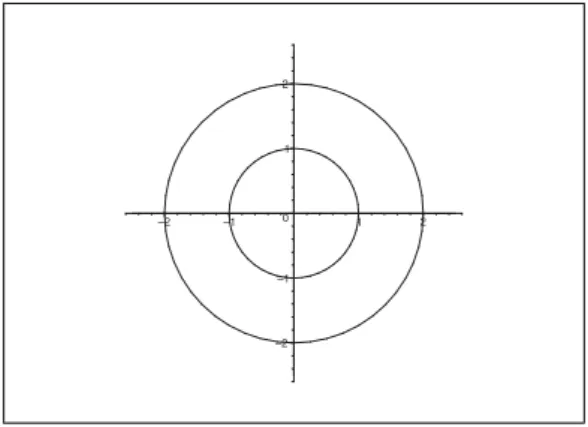
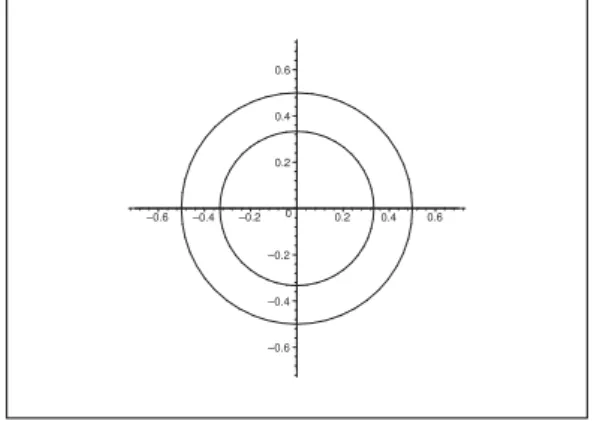
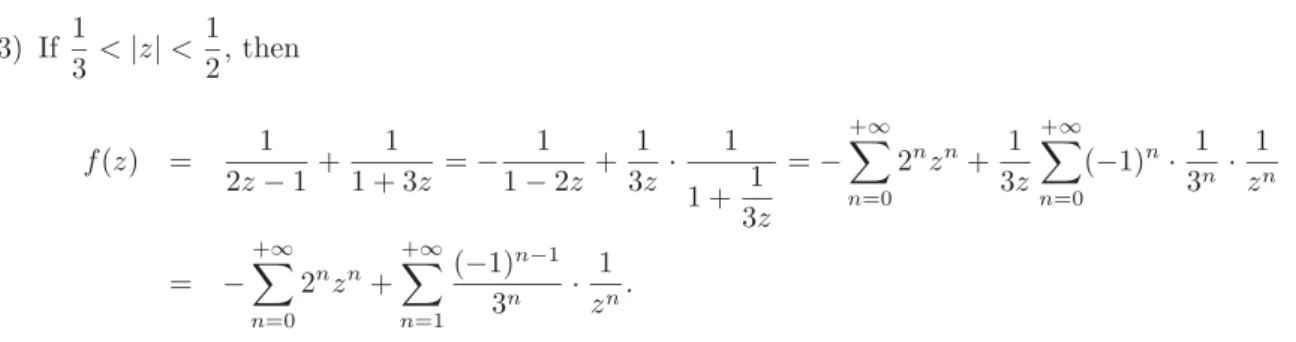
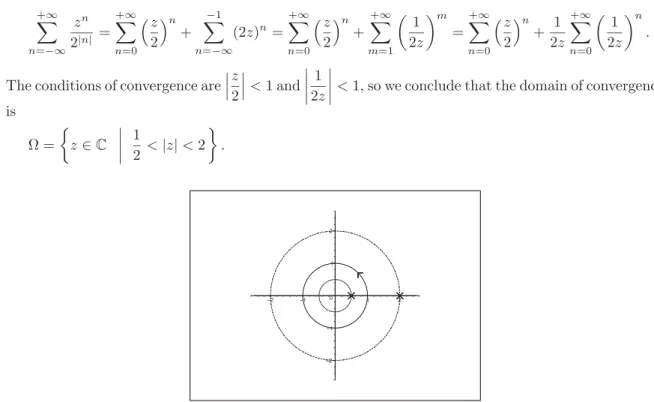
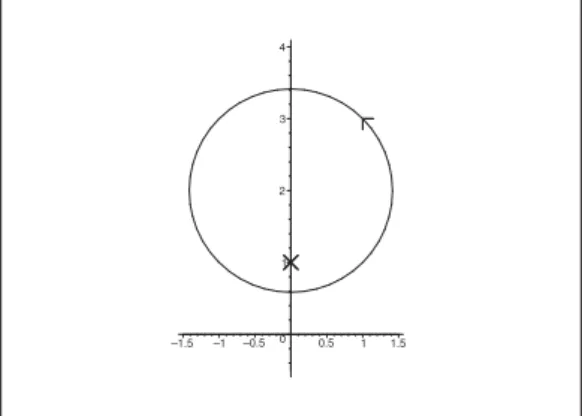
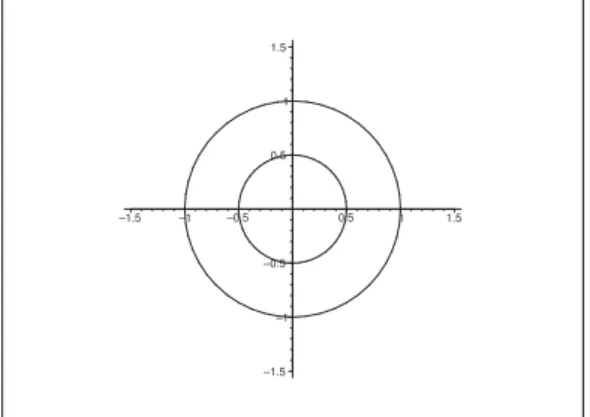
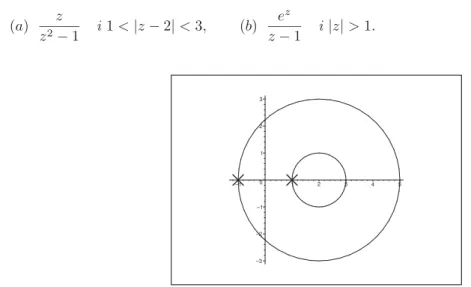
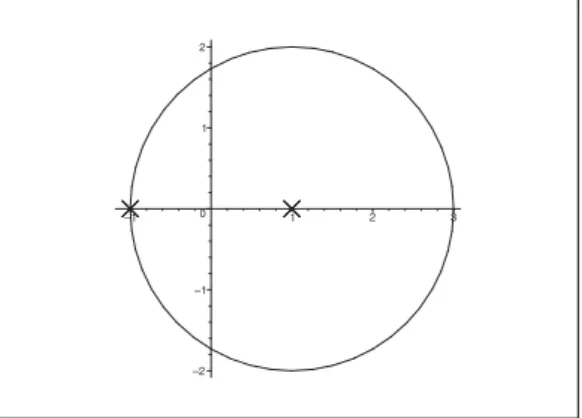
The domain of convergence of the Laurent series is defined as the intersection of the domains of convergence of the series on the right-hand side of the above equation. The Laurent series expansion of an analytic functionf(z) is always convergent in a ring of centrumz0, where this ring does not contain any singularity of f(z), i.e. f(z) is analytic in the entire ring.
STUDY AT A TOP RANKED
Click on the ad to read more Click on the ad to read more Click on the ad to read more Click on the ad to read more Click on the ad to read more Click on the ad to read more.
INTERNATIONAL BUSINESS SCHOOL
Click on the ad to read more Click on the ad to read more Click on the ad to read more Click on the ad to read more Click on the ad to read more Click on the ad to read more Click the ad to read more. Click on the ad to read more Click on the ad to read more Click on the ad to read more Click on the ad to read more Click on the ad to read more Click on the ad to read more Click the advertisement to read more Click on the advertisement to read more.
CLICK HERE
When we find the Laurent series of f in C\ {−1}, it is tacitly understood that z0 =−1 is a point of extension. Explain why f6 has a primitive in the domain C\ {0} and find the Laurent type of any primitive off6. Also find the radius of convergence R. 2) Find the Laurent series of the function f from the point z0 = 0 in the domain |z| > R, and determine its cofficients.
Also find the Laurent series of g in the same ring and the coefficients of this series. Then, by term integration of the Laurent series expansion, it follows that all primitives are given by .
3 Fourier series
4 Laurent series solution of differential equations
Click on the ad to read more. Click on the ad to read more. Click on the ad to read more. Click on the ad to read more. Click on the ad to read more. Click on the ad to read more. Click on the ad to read more. per ad to read more. Click on the ad to read more. Click on the ad to read more. Click on the ad to read more. Click on the ad to read more. Click on the ad to read more. Click on the ad to read more. Click on the ad to read more. Click on the ad to read more. Click on the ad to read more. Click on the ad to read more. Click on the ad to read more. Click on the ad to read more. per ad to read more. Click on the ad to read more. Click on the ad to read more. Click on the ad to read more. Click on the ad to read more. Click on the ad to read more. Click on the ad to read more. Click on the ad to read more. Click on the ad to read more. Click on the ad to read more. Click on the ad to read more. Click on the ad to read more. Click on the ad to read more. Click on the ad to read more. per ad to read more. Click on the ad to read more. Click on the ad to read more. Click on the ad to read more. Click on the ad to read more. Click on the ad to read more. Click on the ad to read more. Click on the ad to read more.
Click on the ad to read more Click on the ad to read more Click on the ad to read more Click on the ad to read more Click on the ad to read more Click on the ad to read more Click the ad to read more Click on the ad to read more Click on the ad to read more Click on the ad to read more Click on the ad to read more Click on the ad to read more Click on the ad to read more Click on the ad to read more Click on the ad to read more Click on the ad to read more Get help now. Click on the ad to read more Click on the ad to read more Click on the ad to read more Click on the ad to read more Click on the ad to read more Click on the ad to read more Click the ad to read more Click on the ad to read more Click on the ad to read more Click on the ad to read more Click on the ad to read more Click on the ad to read more Click on the ad to read more Click on the ad to read more Click on the ad to read more Click on the ad to read more Click on the ad to read more. Click on the ad to read more Click on the ad to read more Click on the ad to read more Click on the ad to read more Click on the ad to read more Click on the ad to read more Click the ad to read more Click on the ad to read more Click on the ad to read more Click on the ad to read more Click on the ad to read more Click on the ad to read more Click on the ad to read more Click on the ad to read more Click on the ad to read more Click on the ad to read more Click on the ad to read more Click on the ad to read more.
However, in complex theory, we cannot completely rely on the correct solution formula, because the main logarithm appears latently in the calculations.
EXPERIENCE THE POWER OF FULL ENGAGEMENT…
Click on the ad to read more Click on the ad to read more Click on the ad to read more Click on the ad to read more Click on the ad to read more Click on the ad to read more Click the ad to read more Click on the ad to read more Click on the ad to read more Click on the ad to read more Click on the ad to read more Click on the ad to read more Click on the ad to read more Click on the ad to read more Click on the ad to read more Click on the ad to read more Click on the ad to read more Click on the ad to read more Click on the ad to read more to read.
RUN FASTER
Clearly, the domain of convergence is C\ {0} and only the zero solution can be extended to all C. Here we will do this by inspection without using auxiliary questions in the formulation. The coefficient z2−z=z(z−1) of the term of the highest order of differentiationf(z) is zero at the singular points 0 and 1.
Comparing these results, it follows that a0 and a−2 cannot both be different from zero, so if we want convergent series solutions, then we must have a0·a−2= 0.
SETASIGNThis e-book
From an analytical extension of f(z), or simply by checking the differential equation, it follows that this function f(z) is a solution of (21) everywhere in its domain. In general, for the corresponding Laurent series, whose derivation is postponed for the next variant, we conclude that since the singularities are 0 and −1 and 1, their domain of convergence is 0<|z|<1. If botha−1= 0 and a0= 0, then the Laurent series is convergent on the open unit disk{z∈C| 0<|z|<1}with the center removed, which we expected because the differential equation has singular points -1, 0, and 1.
By reading the text of the example, we see that g(z) = z f(z) appears somewhere as an auxiliary function.
5 Isolated boundary points
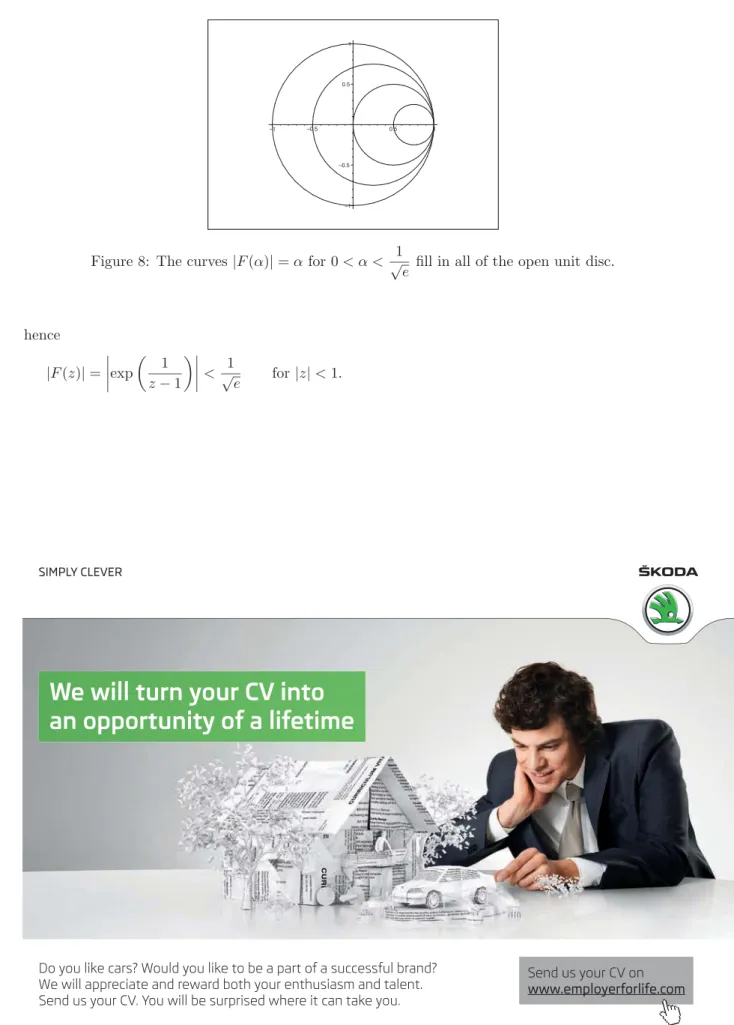
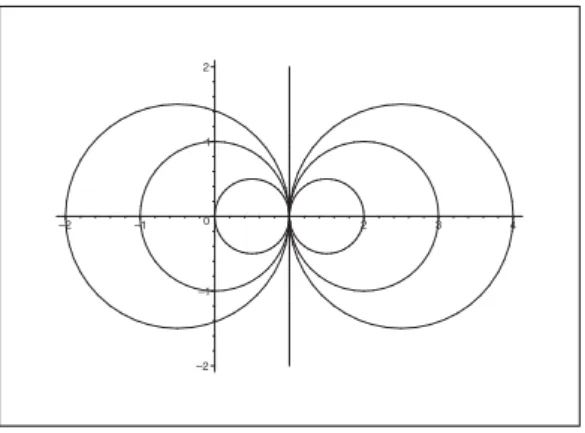
Therefore, the family of curves can also be described as all circles in the plane through the point (1,0) and centered on the x-axis, fitted with the vertical line = 1, where we remove the common point (1,0 ) form all the turns. It follows that everyz,|z|<1 in the open unit disk lies on exactly one of the curves. However, it is seen that the function is bounded at every point in a neighborhood ofz0= 1, which also lies on the open unit disk.
The value of the line integral is obtained by Laurent's theorem, since the coefficient z−1 is 12 and since we integrate along a closed simple curve in Ω that separates the two limit circles. This implies that z= 0 is a simple pole of g(z) and that z= 2 is a removable singularity of g(z). 2) In the ring 0<|z|<2 we get the expansion of the Laurent series.
6 The conditions around the point at ∞
Finally, ∞ is a significant singularity. and furthermore∞ is a significant singularity. has a removable singularity atz= 0, a simple pole atz= 1 and an essential singularity atz=∞. one). It can be seen immediately. has a removable singularity atz= 0, simple poles atz=±i and a double pole at∞. b). It immediately follows that atz=±i are simple poles and atz=∞ is a significant singularity. zn has a significant singularity at ∞. It has no other singularity. one).
Click on the ad to read more Click on the ad to read more Click on the ad to read more Click on the ad to read more Click on the ad to read more Click on the ad to read more Click on ad to read more Click on ad to read more Click on ad to read more Click on ad to read more Click on ad to read more Click on ad to read more Click on ad to read more Click on ad to read more Click on ad to read more Click on ad to read more Click on ad to read more Click on ad to read more Click on ad to read more Click the ad to read more Click the ad to read more Click the ad to read more Click the ad to read more Click the ad to read more Click the ad to read more Click on the ad to read more. The singularity at∞ is not isolated, although the limit of a sequence of poles, therefore∞ is an essential (not isolated) singularity.