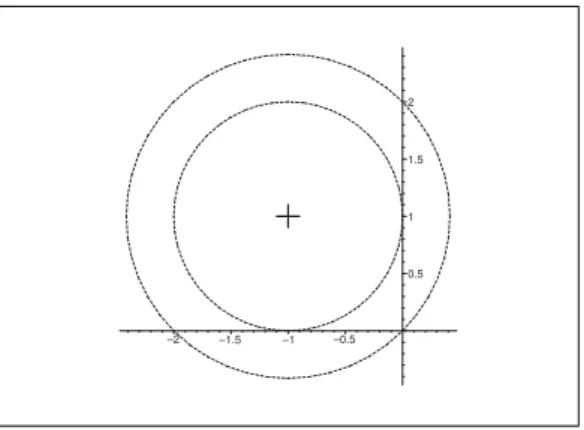
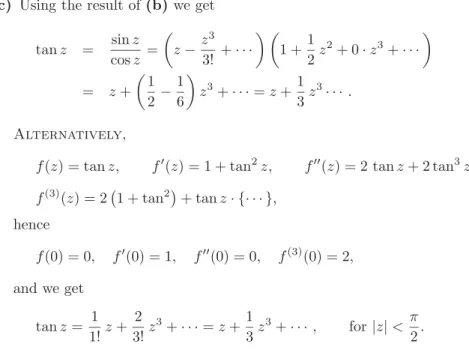
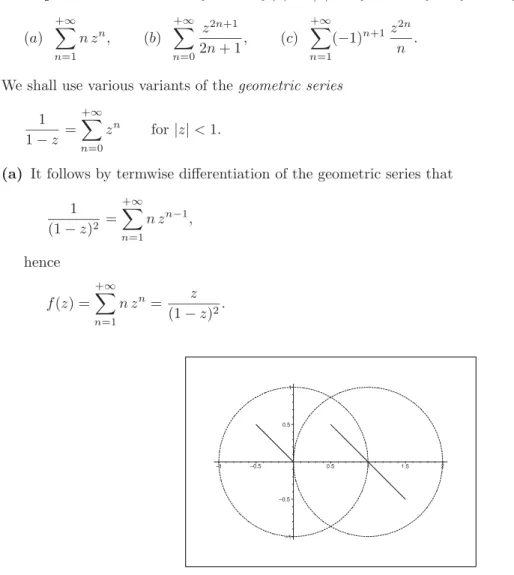
In a sense, all power series of finite positive radius of convergence are a variant of the geometric series. Then f(z)±g(z) and f(z)·g(z) also have convergent power series expansions, which are (at least) convergent in the same disk |z|< r.
2 Simple Fourier series in the Theory of Complex Functions
If we use polar coordinates here, z=r eiθ, then we get for each xedr∈]0, [ a Fourier series of the function φ(θ) given by. When f(z) = 1/(1−z),|z| < 1, is treated in the same way, we obtain after some calculations the following important formula.
3 Power series
It follows that the radius of convergence is 1. withn2 in the exponent, it would not be a good idea to use the criterion of quotients. Example 3.6 Find the radius of convergence for each of the series. a) Sincecn=nn, we get by the measure of roots that 1.
STUDY AT A TOP RANKED
Click on the ad to read more. Click on the ad to read more. Click on the ad to read more. Click on the ad to read more. Click on the ad to read more. Click on the ad to read more.
INTERNATIONAL BUSINESS SCHOOL
Ifa∈]0,1], then it follows from the first equality sign that the radius of convergence r= 1. Calculate the radius of convergence for the series +∞. It follows that the radius of convergence is w = lim.
CLICK HERE
Click on the ad to read more Click on the ad to read more Click on the ad to read more Click on the ad to read more Click on the ad to read more Click on the ad to read more Click on the ad to read more Click on the ad to read more Click on the ad to read more. The right-hand side is finite and independent of |z| ≤1, therefore the convergence is absolute and uniform in the closed disc.
4 Analytic functions described as power series
Click on the ad to read more. Click on the ad to read more. Click on the ad to read more. Click on the ad to read more. Click on the ad to read more. Click on the ad to read more. Click on the ad to read more. on the ad to read more Click on the ad to read more Click on the ad to read more Click on the ad to read more. Click on the ad to read more. Click on the ad to read more. Click on the ad to read more. Click on the ad to read more. Click on the ad to read more. Click on the ad to read more. per ad for more Click on ad for more Click on ad for more Click on ad for more.
5 Linear differential equations and the power series method
Click on the ad to read more Click on the ad to read more Click on the ad to read more Click on the ad to read more Click on the ad to read more Click on the ad to read more Click on the ad to read more Click on the ad to read more Click on the ad to read more Click on the ad to read more Click on the ad to read more Click on the ad to read more Click on the ad to read more Click on the ad to read more Click on the ad to read more Click on the ad to read more Click on the ad to read more Click on the ad to read more. On the other hand, if f(z) is given by (4), then f(z) is clearly analytic in C, and it follows by differentiation that (4) satisfies.
EXPERIENCE THE POWER OF FULL ENGAGEMENT…
Click on the ad to read more. Click on the ad to read more. Click on the ad to read more. Click on the ad to read more. Click on the ad to read more. Click on the ad to read more. Click on the ad to read more. per ad to read more. Click on the ad to read more. Click on the ad to read more. Click on the ad to read more. Click on the ad to read more. Click on the ad to read more. Click on the ad to read more. Click on the ad to read more Click on the ad for more Click on the ad for more Click on the ad for more Click on the ad for more.
RUN FASTER
Click on the ad to read more Click on the ad to read more Click on the ad to read more Click on the ad to read more Click on the ad to read more Click on the ad to read more Click on the ad to read more Click on the ad to read more Click on the ad to read more Click on the ad to read more Click on the ad to read more Click on the ad to read more Click on the ad to read more Click on the ad to read more Click on the ad to read more Click on the ad to read more Click on the ad to read more Click on the ad to read more Click on the ad to read more Click on the ad to read more.
SETASIGNThis e-book
Click on the ad to read more Click on the ad to read more Click on the ad to read more Click on the ad to read more Click on the ad to read more Click on the ad to read more Click the ad to read more Click on the ad to read more Click on the ad to read more Click on the ad to read more Click on the ad to read more Click on the ad to read more Click on the ad to read more Click on the ad to read more Click on the ad to read more Click on the ad to read more Click on the ad to read more Click on the ad to read more Click on the ad to read more to read Click on the ad to read more Click on the ad to read more. Click on the ad to read more Click on the ad to read more Click on the ad to read more Click on the ad to read more Click on the ad to read more Click on the ad to read more Click the ad to read more Click on the ad to read more Click on the ad to read more Click on the ad to read more Click on the ad to read more Click on the ad to read more Click on the ad to read more Click on the ad to read more Click on the ad to read more Click on the ad to read more Click on the ad to read more Click on the ad to read more Click on the ad to read more to read Click on the ad to read more Click on the ad to read more Click on the ad to read more.
6 The classical differential equations
If the power series solution is not a polynomial, (14) means that the radius of convergence is 1. Since (n+ 2)(n+ 1)= 0 in the summation domain N0, we get the following recursion formula by the identity theorem ,.
7 Some more difficult differential equations
Becausen+ 1= 0 in the summation domainN0 we get the following recursion formula from the identity theorem. Reach your full potential at the Stockholm School of Economics, in one of the most innovative cities in the world.
8 Zeros of analytic functions
Here it is difficult – although not completely impossible – to insert the power series expansions, so we prefer the differentiation method here. Click on the ad to read more Click on the ad to read more Click on the ad to read more Click on the ad to read more Click on the ad to read more Click on the ad to read more Click on the ad to read more Click on the ad to read more Click on the ad to read more Click on the ad to read more Click on the ad to read more Click on the ad to read more Click on the ad to read more Click on the ad to read more Click on the ad to read more Click on the ad to read more Click on the ad to read more Click on the ad to read more Click on the ad to read more Click on the ad to read more Click on the ad to read more Click on ad to read more Click on the ad to read more Click on the ad to read more Click on the ad to read more Click on the ad to read more Click on the ad to read more Click on the ad to read more Click on the ad to read more Click on the ad to read more Click on the ad to read more Click on the ad to read more.
9 Fourier series
Click on the ad to read more Click on the ad to read more Click on the ad to read more Click on the ad to read more Click on the ad to read more Click on the ad to read more Click on ad to read more Click on ad to read more Click on ad to read more Click on ad to read more Click on ad to read more Click on ad to read more Click on ad to read more Click on ad to read more Click on ad to read more Click on ad to read more Click on ad to read more Click on ad to read more Click on ad to read more Click on the ad to read more Click on the ad to read more Click on the ad to read more Click on the ad to read more Click on the ad to read more Click on the ad to read more Click on the ad to read more Click on the ad to read more Click on the ad to read more Click on the ad to read more Click on the ad to read more Click on the ad to read more Click on ad to read more Click on ad to read more.
10 The maximum principle